Okay, that’s good to know, but what details in the sexy charts did everyone ignore while they were busy repeating everyone’s Twitter-sized talking points?
First, take a look at all of the beautiful data charts:

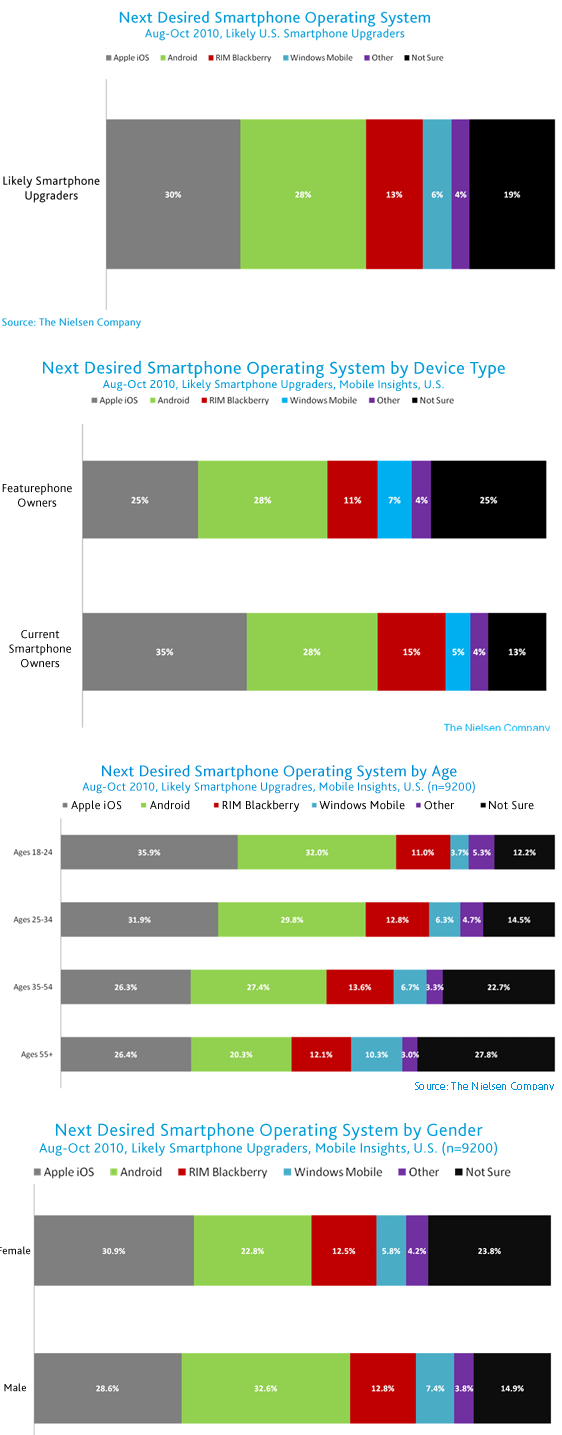
The first point that everyone missed is that only 30% of the current market uses smart phones. If you’ve spent more than five minutes reading blogs or logging on to Twitter, you’d think that one hundred and thirty percent used smart phones. If you have an iPhone and you’re chillin’ in your front yard with two of your neighbors, they’re probably sporting flip phones.
The second point most overlooked is that of that 30% of smart phone users, shockingly, a little over 1% use the Palm OS. Now, because you’re in the real estate industry, you know that Palm has been dominant because of the infrared technology that opened up lockboxes and seems to be everywhere, but with a shift in vendors like Supra becoming compliant to non-Palm operating systems, and an acquisition of Palm by HP, this 1% could go up or down given the market.
The third point that was very overlooked is how undecided “Featurephone” (or dumb phone) owners are compared to Smartphone owners. 25% of featurephone owners are undecided as to their likely smartphone upgrade whereas only 13% of current smartphone owners are undecided. The world of mobile phones is rapidly changing and even my grandma knows what an “app” is, so consumers are more educated on the topic although the amount of information available is overwhelming to many, especially those who do not currently own smartphones.
The fourth point that everyone missed is that of featurephone owners, 25% indicated they plan on upgrading to an Apple while 28% plan to upgrade to an Android. The reason this is noteworthy is that iPhones have been around for several years now and Androids are comparably new to the market, so a nearly 30% indication of consumers firmly stating they want an Android is impressive- that’s a lot of progress in a short time.
The fifth point that was wildly overlooked is the age preferences. The older the respondent, the less likely the were to have decided on their next phone and as the age of the respondent goes down, so does their preference toward a Windows Mobile OS. The undecided nature of older respondents is predictable, but Microsoft clearly has a choice to make as to take the challenge to appeal to a younger demographic or to embrace the older demographic and try to chip away at the rising preference for Apple and Android.
The sixth point I want to address is OS preference by gender. There were nearly 40% more women that were undecided than men. Women traditionally research more and mull over their decisions longer than men, so it’s no surprise, but the media’s insistence on focusing on a third of women leaning toward an iPhone missed the obvious fact that nearly 33% of men indicated an Android OS preference- the poor guys were left out of coverage altogether!
There’s a lot more to the data above, but these are just six things that immediately jumped out to me. Now that you’ve read between the lines of the reports, what do you think? Have you recently upgraded or have plans on upgrading? Tell us in the comments!