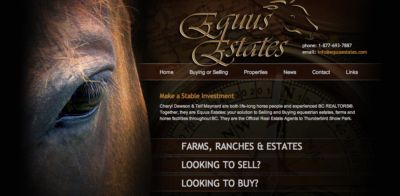
 When consumers arrive on your website, they should immediately know why the site’s what they were looking for, why its special, what it offers, and how much better it is than your peers. In fact it should so the same for consumer’s perception of you.
But does it? There is something special about you and your site, right?
If not, it’s time to figure out what can make your site worth visiting, returning to, or even how it can compel visitors to make you their Realtor.
Too often, websites try to be everything to everyone, then appeal to no one in particular.
Pick Something And Do It Well
How does one change that? Welcome to the “Unique Sales Proposition,” or the USP.
It’s fancy jargon for something that’s pretty simple. The “USP” behind your site comes down to what it aggressively projects — content, online tools, who it’s aimed at, homes and/or neighbourhoods featured, or even the style and language used. These are all possible factors that create target-rich niches for you. Or not.
With your experience in sales, you’ve probably learned that you can’t please everyone. Why make a website that tries to do that?
You shouldn’t. In fact, I suggest you purposely try not to appeal to some folks. With limited time on your hands, you can’t serve everyone, so why aspire to working with people other than ideal clients?
If you think anyone-who-brings-a-paycheque is your “ideal” client, you’re doing yourself a disservice and limiting what you offer online and even in real life.
Why Appealing To Everyone On Your Site Is Unproductive
Let’s try a hypothetical. Say 3,000 consumers search the phrase “Sunny Town real estate” monthly and you capture 500 of them. Upon arriving, they find a dozen listings, some generic spiel about “buying/selling Sunny Town properties”, a schwack of boring real estate clichés, and, oh, look, a mortgage calculator.
On the upside, everyone feels welcomed and kind of learns life’s peachy when you live in Sunny Town but from there they aren’t able to figure out what it is your site does for them after this visit. Or more importantly what you do well.
You’ve provided nothing original, said nothing important, and did nothing to stand out from the crowd, making you of no consequence — just another Realtor with another real estate site, like 99% of the sites serving average Sunny Town folks.
Sure that’s 500 visitors who came knocking on your site’s door, but likely few conversions or sales.
Why Not Appealing To Everyone On Your Site Makes Sense
Now pretend that, of those 3,000 curious consumers, there are a savvy 100 looking for a helpful site when decoding buying or selling local condos. They want a listing of all available condos — not just one company’s listings or one neighbourhood’s.. They also really want informative, abundant information on making decisions about buying and selling condos in Sunny Town.
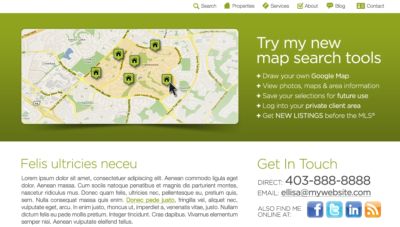 Let’s say your site offers a powerful real estate search tool and useful Sunny Town real estate information, including data and research with informative basics about the local market, and even future development plans that show what neighbourhoods will be, not just what they are.
Now the potential of engaging 100 or more consumers is greater. They’re not just paging through your site, but digging for real information. The more they feel they’re learning from you, the more they will feel you know your way around a condo transaction better then your peers. All possibly compelling them to return, or even invite you to be their Realtor.
Even if you only convert, say, 2 out those 100 potential clients each month, that means 24 ends a year. The larger that niche crowd becomes, the more chance of creating clients.
Double it to 200 visitors excited by real-time local, relevant real estate content from a field-tested professional, and that’s a conservative less-than-1% of the 3,000 visits, and now you’re looking at converting, say, 48 new clients by year’s end.
I’d bet a blog with current condo market stats, honest opinions, and brazen posts about the realities of buying/selling condos in Sunny Town would develop more viable clients from that high-potential group who are scouring your site then the 500 visitors from a generic search passing through a general site. A site who’s content barely skims a broad variety of real estate related topics in Sunny Town, but offer no depth. Nothing that makes the consumer better for having spent time on the site.
So What Is The USP of The Site?
“No website services Sunny Town condo-shoppers better, nor does another Realtor better serve those buyers. No site better explains Sunny Town’s market without the fluff or spin delivered by others.”
And this is just one example of an effective USP.
You Can’t Fake It
That should give you an idea of the thinking behind a good USP, but the USP itself isn’t a claim, mission statement, or even a tag-line. It’s what your site is — it’s a tangible, measurable, visible quality. Saying what your USP is means nothing, your site has to have it and be it. It can’t be faked — it’s there to be experienced by anyone landing on your site.
Don’t Wait For Your Own ‘Great’ Idea
Sure, others may be nurturing a similar USP — that happens. Heck, it’d be nice to have a never-before-seen USP that blows other real estate marketing out of the water, but that’s unlikely. Instead, worry about executing that USP better than your competition.
Don’t kid yourself, the web’s brand of real estate marketing isn’t a finished story — the web, and its marketing, is ever-changing, always improving. You very well may come up with a brilliant new idea. But if not you can be that person who is just doing it better.
Look at cell phones. When Blackberry came on the scene and reinvented the technology, the competition didn’t give up. The innovators to come didn’t just look at what Blackberry was doing and walk away — they saw what Blackberry wasn’t doing. Thinking outside the box, they further refined this technology and drew a large share of samrt phone consumers.
The same tactics are now working against Apple’s iPhone for the makers of Android phones.
These companies are brilliant because they aren’t reinventing the wheel nor do they want to win over the whole world — just folks who dislike The Other Guy’s product or want something very specific.
With real estate sites, the same strategy works. Don’t appeal to everyone, just those whose language you speak. Don’t underestimate the value of having strong appeal with a smaller demographic.
Identify both your appeal and your ideal demographic, and successfully converting visitors will be easier than you imagine.