The science behind email organization
We’re all looking for ways to improve productivity, and business professionals today spend a great deal of time in email which makes it an obvious choice for spotting potential inefficiencies. A new study by IBM researchers applies the science behind email organization and asserts there are only two types of email personalities – those who meticulously file emails into folders, and those who use search for “refinding” content.
IBM studied 354 long term users’ behavior by creating a modern email client that supports search, folders, tagging and threading so that users could choose their own organization (or lack thereof) method and conducted over 85,000 refinding actions.
The study says that creating complex folder structures is a preparatory effort that promotes effective refinding, as opposed to opportunistic methods for access, such as search and threading that promotes reducing the need to manually prepare.
Folders vs. no folders
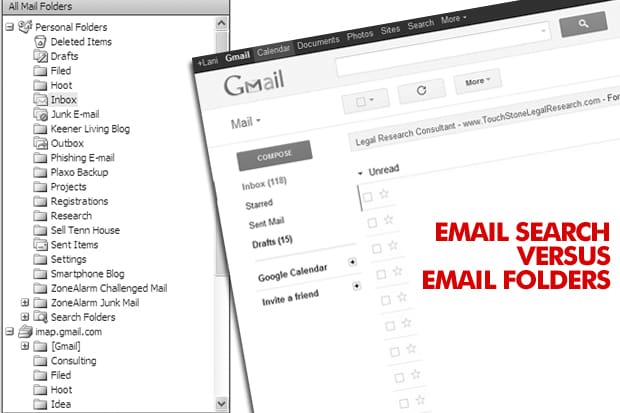
“Prior work has argued that folders may be poorly organized and sometimes ill-suited for retrieval,” the report notes. “Our data support opportunistic access,” the report concludes, asserting that users who create obsessive folder structures do not improve retrieval success, while search and threading actually promoted effective retrieval. Research reveals that although a less effective use of time, complex folder structures are being used less for information retrieval and more as a to-do list that is categorized.
Harvard Business Review’s Michael Schrage writes, “The essential takeaway is that the new economics of personal productivity mean that the better organized we try to become, the more wasteful and inefficient we become. We’ll likely get more done better if we give less time and thought to organization and greater reflection and care to desired outcomes. Our job today and tomorrow isn’t to organize ourselves better; it’s to get the right technologies that respond to our personal productivity needs. It’s not that we’re becoming too dependent on our technologies to organize us; it’s that we haven’t become dependent enough.”