Please welcome AG’s newest contributor Mike Simonsen, CEO and Co-Founder of Altos Research, which offers live real-time real estate research. Mike is the reason you see live data graph widgets on the nation’s top real estate website and he’s the reason financial firms and traditional news sources have reliable information. Mike is a frequent public speaker (at Inman and elsewhere), is very active in social media and you can even find him on Twitter. Please welcome Mike in the comments.
On Wednesday, NAR announced that home prices fell again in January to a national median price of $170,000, sales rates fell again to their lowest level in years, and nearly half of all transactions are on distressed loans.
“Everyone knows the real estate market sucks, right? Why would I ever want to publish the bad news to my clients?”
I get this question from real estate agents all the time. Also common is it’s omnipotence-begging cousin, “Can’t you make the chart go UP for a while?”
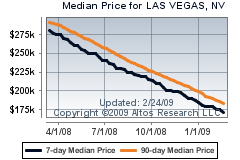
The underlying fear is, “if I talk about the market, no one will buy or sell anything.”
Newsflash: This is precisely why market data matters. In general the market sucks and everyone knows it. But I’m not in general. I have a home to buy (or sell) in a particular price range, in a particular part of town. I have a timeframe. I have investment goals. Market data helps me understand my unique situation, sets my expectations, and compels me to take action.
We tell people there are only three questions in real estate:
- What’s for sale?
- How much is this home worth?
- How’s the market?
Our industry is well tuned to answering the first two. You have your MLS, your IDX search on your site, open homes etc. You have CMAs, appraisers, and your professional opinion on property valuation. Heck you can even see the big real estate 2.0 web players focused on these two questions.
But all the other questions stem from #3. And with all the craziness out there, these are now the most important questions you can address: “How long is this going to take?”, “We like this place, do we have to make an offer today?”, “I’m thinking of buying, shouldn’t I just wait and see?”, “Why should I listen to you about where to price my home (I want to try higher)?”
Remember that real estate data is not about communicating the “good news.” It’s about illustrating why your recommendation makes sense. It’s about helping your clients see the path to their goal. In fact, the most important phrase that real estate statistics provide is: “Let me show you what I mean.”
So let me show you what I mean.
Last week the inimitable Russell Shaw posted a letter from John, an agent looking for advice about his business. Russell distilled John’s problems to:
1. Most listings currently being taken are not selling
2. Zero buyer deals in escrow
3. Overall market has changed enough that “comps” are now meaningless
4. Not enough time left over to work on organizing for the future
Russell describes these conditions as fundamentally pricing issues – and the business challenge to get the seller to accept price reductions 2,3,4 or 5 times. I’ll add the corollary that detailed market data is the way to illustrate the strategy, the urgency to the client – to compel the client to take the right action. In this case I would illustrate to the client these statistics:
- The days-on-market trend for properties in this price range. (“Look, it’s taking 7 months for anything to sell, because the only buyers are bargain shopping.”)
- Percent of properties on the market with price reductions (“This is what your competition is doing. We can be ahead of this curve or behind it.”)
- The magnitude of those price reductions (“Let’s look at how aggressive we need to be. Really.”)
The great news is that you already know the story your clients need to hear, the strategy they need to take. (Or you can visit the sage Mr. Shaw for inspiration.) Statistics and data are not the source of this strategy. They are merely the map, the illustration, the evidence of your expertise. After all, in these unprecedented times, wouldn’t a map come in handy?