 We all can identify those in our industry who are in real estate with great intention and determination but seems to lack the behavioral make-up or intestinal fortitude to become successful. Equally, we see those who ‘got it’ and immediately see why they’re doing well in this demanding field. So, why is there such a difference between these folks? If every agent is given equal opportunity and is exposed to the exact same training and education, why such a huge schism between the haves and the have nots? I’ve read several articles here on AG about the lack of business training for real estate agents and I couldn’t agree more! However, if we look a bit deeper to the actual propensity of individuals to behave according to their predictive behavior, we may see all the training and education in the World likely will not help. Case in point, I was interviewing a new agent. She was extremely well read and attractive. On the surface, she appeared to be perfect for the job. However, within the first 15 minutes, I knew she was in the wrong business. When I began our conversation with her lead generation schedule and how she’d need to time block a certain number of hours each day to contact folks about buying and selling, I thought she was going to pass out right there. The fear at the prospect of doing something that is at the core of our industry like calling on people for business turned her face as red as a Tomato and I think she actually broke out in Hives! It was clear after that initial interview, I didn’t need to help this person in real estate…I needed to help them out of real estate.
There are several well known models available such as the DISC or the Myers-Briggs Type Indicator that can give you a very good sense of the behavioral patterns that make up certain individuals and how these individuals will ultimately behave in such an environment like commission sales. I’m not hard and fast set on either the DISC or Myers-Briggs Type Indicator but I lean towards the DISC when I’m coaching a new agent simply because it’s what I’m more familiar with. I’d also say I’m not at all convinced either of these profiling models is 100% accurate nor do they always represent an individual with an adaptive personality…a mandatory skill set to have if you are required to work with Buyers and Sellers who exemplify multiple personalities…sometimes on a regular basis! (Insert laughter here). That said, a profile test is still a good barometer in ascertaining a dominant behavioral pattern. So when administering such a test, you must understand observable behavior can be grouped into four major personality styles, Assertiveness, Sociability, Tranquility, and Dependence. These four styles tend to exhibit specific characteristics common to that particular style. And since all individuals possess all four, what differs is the level to which each individual possess’.
Understanding and Determining your Profile
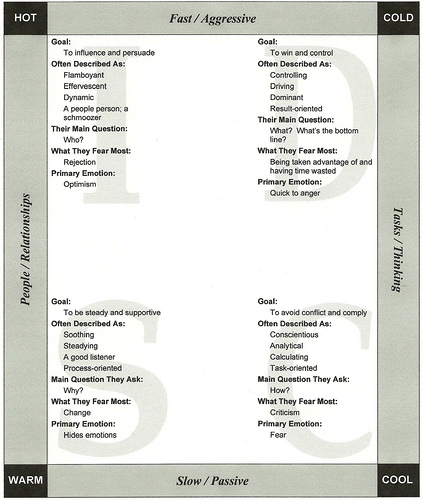
I mentioned I use the DISC to understand and determine those I coach as does many companies, HR professionals, consultants and trainers. I’ve highlighted the main behavioral markers for each letter in the DISC and listed them below. Can you see which aspect fits you best? The assessments classify the four aspects of behavior by testing a person’s preferences in word associations…DISC is an acronym for:
- Dominance – relating to control, power and assertiveness
- Influence – relating to social situations and communication
- Steadiness – relating to patience, persistence, and thoughtfulness
- Conscientiousness – relating to structure and organization
These four dimensions can be grouped in a grid with D and I sharing the top row and representing extroverted aspects of the personality, and C and S below representing introverted aspects. D and C then share the left column and represent task-focused aspects, and I and S share the right column and represent social aspects. In this matrix, the vertical dimension represents a factor of “Assertive” or “Passive”, while the horizontal represents “Open” vs. “Guarded”.
- Dominance: People who score high in the intensity of the “D” styles factor are very active in dealing with problems and challenges, while low “D” scores are people who want to do more research before committing to a decision. High “D” people are described as demanding, forceful, egocentric, strong willed, driving, determined, ambitious, aggressive, and pioneering. Low D scores describe those who are conservative, low keyed, cooperative, calculating, undemanding, cautious, mild, agreeable, modest and peaceful.
- Influence: People with high “I” scores influence others through talking and activity and tend to be emotional. They are described as convincing, magnetic, political, enthusiastic, persuasive, warm, demonstrative, trusting, and optimistic. Those with low “I” scores influence more by data and facts, and not with feelings. They are described as reflective, factual, calculating, skeptical, logical, suspicious, matter of fact, pessimistic, and critical.
- Steadiness: People with high “S” styles scores want a steady pace, security, and do not like sudden change. High “S” individuals are calm, relaxed, patient, possessive, predictable, deliberate, stable, consistent, and tend to be unemotional and poker faced. Low “S” intensity scores are those who like change and variety. People with low “S” scores are described as restless, demonstrative, impatient, eager, or even impulsive.
- Conscientious: People with high “C” styles adhere to rules, regulations, and structure. They like to do quality work and do it right the first time. High “C” people are careful, cautious, exacting, neat, systematic, diplomatic, accurate, and tactful. Those with low “C” scores challenge the rules and want independence and are described as self-willed, stubborn, opinionated, unsystematic, arbitrary, and unconcerned with details.
As you might have determined, “D” and “I” personalities tend to do very well in this business…both of which were clearly missing in the person I mentioned interviewing earlier in this post. Now, an “S” may have a tendency to make a great assistant due to their steady work ethic and desire for little change and a “C” would be a good fit for Designated Broker because of their demand for adherence to rules, regulations and structure. It should also be known your core behavioral style never changes but your adaptive style allows you to adopt and adapt to your environment to suit the situation. As you can imagine, a High “D” person may have a very hard time with adapting to a style to fit any environment other than one they control due to their demanding, forceful, egocentric, strong willed, driving, determined, ambitious, aggressive, and pioneering behavior…These are also the folks who tend to be the most successful, not only in real estate, but in whatever they do!
So, if you’ve never had a profile test done, give it a try and see what kind of behavioral style you have…you might be surprised!?