Welcome to the existential crisis you didn’t ask for
You’re hearing some phrases repeated as you scroll through LinkedIn – “Gen Z hates work,” and “nobody wants to hustle or grind anymore.” While there’s some truth to both, these words are bubbling up and it isn’t just about Gen Z, and it isn’t about a dying work ethic. Some say the 40-hour workweek is dead, others push for reverting back to 12-hour days.
Before rolling your eyes, let’s unpack what’s actually happening, how you can prepare for it, and put together a framework for keeping your operations moving ahead smoothly in case this sentiment leaks into your company.
How we got here (it took a century or two)
The 40-hour workweek was born in an era where labor movements were rising, legal mandates were making their way through America’s legislative bodies, and companies like Ford Motor Company popularized the 8-hour workday in the 90s, just before the Fair Labor Standards Act of 1938 became the law of the land.
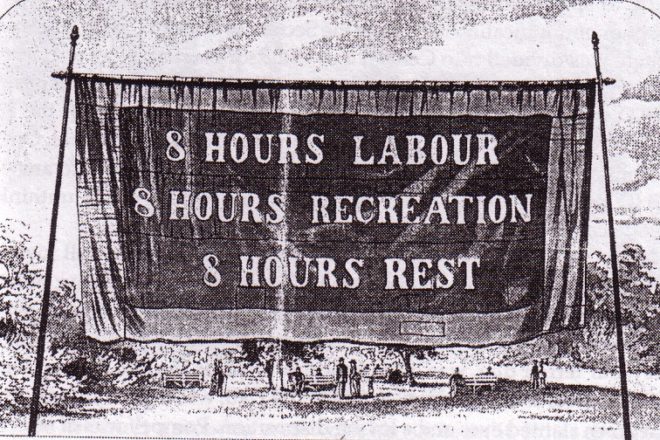
Originally, the idea was to move from a 12-hour work day to an 8-hour workday, a pipe dream during the Industrial Revolution when the above rally cry was introduced. The shift was historic, and came after protests, riots, and deaths. But the 40-hour week was born on a factory floor, not in a Slack channel.
Gen X burned out quietly, Millennials loudly, and Gen Z? They just left the chat entirely.
So how did we get here? The perfect mix of a pandemic trauma, economic whiplash, mass layoffs, wage stagnation, and the death of employee loyalty.
efore judging whether or not Gen Z’s rejection of the hustle lifestyle is right or wrong, first you must truly understand where they are coming from.
During the pandemic, the entire planet re-evaluated their priorities. Many people lost loved ones, even more lost their jobs. Talk about deflating – it’s hard to get pumped up to work 20 extra hours in a week through that lens of exhaustion. During this era, more and more frustrated employers flippantly adopted the “no one wants to work anymore” moniker, even further diminishing an exhausted population (who is tired of hearing that you paid 16% interest on your house in 1981, failing to mention that the house was only $40k, not $470k for the exact same house today).
Pair that with the undulating economy – seeing (or hearing about) their grandparents crash the economy with the dot com bust, and their parents crash the economy with the housing bust, not to mention whatever *this* (looks around) is. Of course neither generation “did” a crash, but Gen Z has been alive and witness to some of the most dramatic economic undulations in our history and it shows.
This generation has also seen more rounds of layoffs than Twitter has rebrands. But not only have they seen them, they’ve been victim to them first hand.
Wages have stagnated in their adulthood, and this has all become the perfect storm to create deep cynicism and a truly meaningful rejection to employers that say “we’re family.”
As the struggle rippled throughout the economy, social media made alternatives VISIBLE. Doomscrolling also involved lots of Gen Z folks talking about how they went independent, became creators, freelancers, OnlyFans girlies, freelancers, etc.
Employee loyalty is no longer automatic, it has to be earned. Gen Z is willing to give their time and talent, but it’s for money, not for passion. They’ve watched the world burn too many times for any other outcome. “Hustle” began as empowerment but has evolved into exploitation.
Talk about a perfect storm.
Gut check before someone makes this your problem
Listen,you don’t have to agree with Gen Z, but you do need to understand, and figure out where YOU stand.
There are a few questions you can ask yourself to determine your position:
- Are your team’s hours a matter of business survival? OR tradition?
- Would you rather have a butt in a chair from 9-5? OR measurable outcomes?
- Have you set expectations that reward presence? OR outcome?
- Be honest – are you confusing structure with control?
Think through your own biases, and be truthful with yourself, because resentment isn’t a strategy.
In some cases, hours DO matter (hospitality), but in others (software development) outcomes are what matters. In some cases, getting the most hours out of people is survival (medical professionals), while in others (financial analysts) it’s merely tradition.
Let’s say you’ve read this far and you still think Gen Z is lazy. Whatever, that’s fine. You can reject a trend without being a jerk or losing an employee, so let’s talk next about a framework for how you’ll handle this if/when it comes up in your company.
When it comes up, don’t panic
Here’s your script so you don’t accidentally say “back in my day…” or “no one wants to work anymore,” even if you’re only 27 years old:
Step 1: Don’t get defensive. Get curious!
Ask why they’re asking. It might not be about hours, it might be about flexibility, autonomy, or trust.
Step 2: Frame your values. Show you’ve put thought into this, that you’re not just rejecting their input.
“Here’s what we expect and WHY it matters to the business.”
Step 3: Offer transparency where possible.
“This is what’s negotiable, this is what isn’t, and here’s the reason.”
Step 4: Choose your own adventure:
Option A: Flexible by default? Share your system.
Option B: Hybrid but structured? Share the boundaries.
Option C: Traditional hours? Own it – without shaming the ask.
Bonus: Document your stance internally before it becomes a Slack fight.
What if you want to outright reject any employee inquiring about something like a 4-day workweek? Because you’ve read this far, I know you’re trying to do the right thing and not just knee-jerk react, so here’s an example of how that might go down:
Employee: “I wanted to ask – have you considered offering a 4-day workweek or something more flexible?”
You (the boss):
“I hear you, and I appreciate you bringing it up. Right now, a 5-day structure is core to how we operate and hit our goals, so a 4-day week isn’t something we’re entertaining.
That said, I am open to talking through ways we can make your current schedule work better for you. If there’s room for flexibility within our setup, let’s explore that. Tell me more about what inspired your question.”
The hard truth? This may not be generational
The frustrating part of this friction today is that it may appear to be just generations clashing. But that isn’t it, we’re seeing extremely young business owners and operators have similar frustrations. This friction is being dismissed as a generational shift, but we see a class and power dynamic at play here underneath it all.
Many of the people pushing back against a traditional 40-hour workweek can afford to. The rejection is sometimes from a place of privilege because there’s some form of financial safety net they can rely on if they lose a role. Others are trying to survive three jobs.
Further, your salaried team might have different needs than your hourly staff. Perhaps it’s time to consider how those two populations within your own company differ.
You may see a lazy generation, but perhaps it’s simply resistance to being minimized, chewed up, and spit out? Perhaps without the not-so-gentle reminder of piles of body bags during COVID, we wouldn’t be at this inflection point, who knows?
What we do know is that for most people asking the question, they’re not asking to be coddled, they’re in the midst of a labor market shift in real time.
Some are even offering to still work 40 hour weeks, just in fewer days. Others are simply burnt out, despite a younger age. For the sake of your business’ longevity, it’s your job to suss out which is which.
You don’t have to change everything – but you do have to pay attention
Folks, this isn’t a trendy movement, it’s a pressure test you’re in the middle of – how you react determines how you’ll survive.
Being thoughtful about expectations doesn’t make you soft, it makes you smart.
And even if you’re not in a position to wave a magic wand and grant all wishes, you ARE in a position to be curious, kind, and thoughtful, even as you say no.
Know your stance, communicate it clearly, and most importantly, try to remember that we’re all human and just survived a global pandemic. We’re changed.