Friday, April 3, 2026
Home Blog

The 6-step decision-making framework every operator should know

Why you need a framework in the first place

Whether you’re an operator (the glue between strategy and execution) turning chaos into clarity, or you’re the entire org chart, this decision-making framework helps you to avoid overthinking, emotional reactions, and decision fatigue. It’s your internal system for being a data-driven thinker focused on your long-term goals.

You need to be able to move quickly without redoing work later or causing the very chaos you set out to quash. When you’re wearing 80 hats and juggling fires, having a repeatable framework will allow you to protect your time, trust your decisions, and scale more smartly.

Discord and disagreement WILL happen

There are common team conflicts that pop up, even when you’re running an asynchronous team of freelancers:

  • Product wants to ship a new feature by next quarter, but engineering pushes back because of stability risks.
  • Marketing wants to push a cheeky campaign that has the potential to go viral, but legal flags it for FTC compliance issues.
  • Design wants a beautiful custom UI interaction, but engineering says it’ll delay launch by three springs unless simplified.
  • Sales wants to promise a feature that will help close a massive deal, but product says it’s not even on their roadmap and they’d need at least 90 days to build it out safely.
  • Customer success wants to delay rollout due to known customer pain points, but growth is pushing hard for monthly adoption numbers.
  • Ops needs to onboard a new vendor quickly to keep momentum, but finance wants to negotiate pricing (or needs 30-day procurement clearance).
  • Leadership wants to pivot strategy mid-quarter, but teams argue it derails committed OKRs and sets up burnout.
  • Support flags a P2 bug affecting tons of users, but engineering is heads down on a P0 incident and won’t context switch.

When these disagreements pop up, it can be hard to move as quickly as you want to, especially when you see merit to both sides of the conflict.

This is the decision-making framework I’ve used for nearly two decades. When friction arises and you frame your own decisions this way, you’ll build trust across teams, improve your influence, and more importantly, resolve conflict more effectively than you ever could if you just had a knee-jerk reaction.

First step: Name it

It may seem natural or overly obvious to you, but this move isn’t what comes to all brains as a first step – name it. Say it out loud.

“Looks like we’re split on timeline versus risk,” or “Feels like we’re caught between short-term revenue and long-term roadmap integrity,” or even “Looks like we’re trading speed for stability here – shipping quickly versus shipping safely.”

Make this your norm, and practice it, even if you’re alone in a room, working remotely.

Reiterate the shared north star

Yes, this feels like corporate talk, but stick with me, even if you’re a solopreneur – you’ve named the problem, now identify the finish line that everyone shares. It’s especially helpful if you acknowledge both sides as you forge ahead.

Examples:

  • “Our job is getting players in-game safely and hitting revenue targets.”
  • “Our goal is to grow the brand in a way that builds trust and keeps us out of legal hot water.”
  • “We’re here to drive adoption and retention – growth only matters if it sticks.”
  • “Our job is to stay agile without burning out the teams who make it happen.”

It’s data time

You’ve named the challenge and pointed to the finish line. Now how will we all get there? It’s time to pull data.

Look to your historical conversion curves, campaign forecasts, SOC 2 control impact, and anything that helps you debate facts, not egos. Here are some examples of what to pull based on the aforementioned conflicts:

1. Product vs. Engineering

Conflict: Ship quickly vs. stability
Helpful data to pull:

  • Bug counts from previous rushed launches
  • Historical velocity or burn-down charts
  • User impact of past outages or rollbacks
  • Forecasted impact of feature (revenue, retention, engagement)

2. Marketing vs. Legal

Conflict: Viral campaign vs. FTC compliance
Helpful data to pull:

  • Examples of flagged campaigns or FTC fines (internal or industry)
  • Historical campaign performance vs. legal review timelines
  • Risk scoring from legal/compliance team
  • Brand sentiment tracking from prior edgy campaigns

3. Sales vs. Product

Conflict: Promise feature vs. roadmap misalignment
Helpful data to pull:

  • Forecasted deal size and timing
  • Weighted pipeline projections with vs. without the feature
  • Resource allocation required to deliver the feature
  • Impact of mid-cycle roadmap changes on other initiatives

4. Customer xuccess vs. Growth

Conflict: Delay rollout vs. monthly metrics
Helpful data to pull:

  • Number and severity of customer pain points
  • NPS or CSAT trends
  • Monthly active users vs. churn after similar rollouts
  • Revenue impact of early adopters vs. retention loss

5. Leadership vs. Team leads

Conflict: Mid-quarter pivot vs. OKRs
Helpful data to pull:

  • Forecasted impact of pivot on top-line or strategic priorities
  • Current OKR progress across teams
  • Burnout or PTO trends (qualitative or HR data)
  • Opportunity cost of pivot (e.g., paused projects, missed goals)

Write out the options

In a lightweight doc or a Slack thread, tag the directly responsible individuals (DRIs), and list all relevant tradeoffs.

This is where your EQ (emotional intelligence) is paired beautifully with the data you’ve already pulled.

Keep this portion concise – no one wants to read Beowulf when they’re in the distress of conflict.

Facilitate the decision

If the folks involved can’t break the tie (even after reviewing your beautifully brief, fact-based rundown of tradeoffs) it’s time to escalate.

That doesn’t mean panic. It means you’ve done the groundwork, and now it’s up to someone with more context or authority to make the call.

Escalation isn’t failure, it’s efficiency. Your job is to make that decision easy by serving it up clearly: here’s the problem, here are the options, here’s what we recommend, but we’re stuck. Once leadership weighs in, it might not go your way. That’s okay.

If the decision is sound but not your personal fave, it’s time for a little grown-up move called “disagree and commit.” It means you raise your concerns, you get heard, and when a decision’s made – you support it fully and help others do the same.

That’s how trust scales, politics stay minimal, and nobody’s left secretly undermining the outcome.

Document and retro

Once the decision’s made, don’t just move on, document it. Drop a quick summary in the project thread, Notion, Confluence, whatever your team uses. Include what the conflict was (without placing blame, obviously), which tradeoffs were considered, who made the final call, and what the decision was.

This isn’t a novella, it’s just enough context so that future-you (or future-hire-you) aren’t stuck in detective mode. Paper trails reduce second-guessing, and earns you major points if anyone ever audits the process.

Then retro it. What worked about the decision process? What slowed it down? Were the right people involved? A 15-minute debrief keeps the playbook evolving and sharpens team instincts for next time. Velocity isn’t just about moving quickly NOW, it’s about making next time even smoother. Plus, it signals that you’re not just making decisions, you’re building a system that scales.

This isn’t about making the right call…

This decision-making framework won’t make the friction go away – conflict is a feature of fast-moving teams, not a bug. But it will give you the muscle memory to navigate hard calls with clarity, speed, and grace. Use it often enough, and you’ll find decisions start happening faster, with less drama and more trust.

Because the goal isn’t just making the right call, it’s building a team (or solo practice) that can keep making them, over and over, without burning out or blowing up.


Negotiating extra salary for extra duties

You’ve heard of the Great Resignation, a time in American history that has seen the greatest increase in job resignations ever recorded by the Bureau of Labor Statistics since they started tracking over two decades ago.

Understanding the “Great Resignation”

Some people are quitting for health reasons, some have resigned for personal reasons, and others are leaving for higher pay and better opportunities elsewhere. No matter what is causing the surge of people leaving their jobs, this will have an effect on the companies and workers they leave behind. Apart from missing their former coworkers, employees are missing help with projects and meeting deadlines.

Along with the Great Resignation, the pandemic conditions of the last few years have brought with them difficulties for businesses, such as decreased sales, difficulties obtaining stock, rising costs due to inflation, and dwindling customer bases. Unfortunately, this has led many companies to have to close their doors permanently.

Resignations or not, the show must go on

Those who were fortunate enough to stay afloat during these trying times have had to cut staffing and let go of vital members of their teams. While they most assuredly would prefer to keep their staff together and business running as usual, this is not the reality of our times. Regardless of staffing issues, employers still need to get products out and meet deadlines.

How many times have you been asked to do the work of two people, or three, or a whole department? I can personally remember this starting as early as elementary school. You don’t get extra recognition or rewards most of the time either. You just do it so your boss doesn’t complain and so that the job gets done.

Well, that ends now.

Getting to know “Additional Duties Pay”

There is a concept that has been making the rounds recently called Additional Duties Pay. It is exactly what it sounds like. When an employee is asked to take on extra tasks outside of the scope of their regular job, they should be reimbursed for their time and effort.

With Additional Duties Pay, either the employee can ask for additional pay to meet the growing demand for their services, or better yet, the company can offer this benefit at the time of the proposed job changes.

The state of Wisconsin has provided a guide to how they handle Additional Duties Pay here. Not all companies, such as those that are very small will be able to offer this to their valued employees.

Those that can, and have the means to follow through, should consider implementing this policy.

The all-AI startup that failed: A cautionary case study

Letting AI run an actual company

Picture this: You’re sitting in a college lab with a bunch of researchers, nerding out about this cool idea. “What if we made an all-AI software startup with AI agents performing all of the tasks?” You start tossing ideas back and forth and realize it wouldn’t actually be all that hard – but would it work? Artificial intelligence (AI) can automate the hell out of a calendar, but can it run an entire business?

That’s exactly what happened at Carnegie Mellon University. The first step in their creating “TheAgentCompany” was adding artificial workers (bots) from OpenAI, Meta, Google, and Anthropic to be software engineers, financial analysts, and project managers to work with simulated coworkers like a fake Chief Technical Officer (CTO), and a fake HR department they could refer to for help. The autonomous agents could use the internet for information, refer to an employee handbook, internal websites, and a Slack-like chat program, as well as write code, organize info into spreadsheets, and even communicate with “coworkers.”

So what happened when they hit the “let’s do this” button? It failed. Almost comically. The AI agents excelled at having meetings (a LOT of meetings), and had a lot of internal conflicts, and ended up with no product. It was essentially a parody of a stereotype of a comedy show about startups, all gloriously powered by AI itself. It’s worth reading about if you want the full story before we dive into why it’s more than just hilarious.

So this is what happens when you put AI agents in charge of the whiteboard without giving anyone a damn dry erase marker.

This failure wasn’t just predictable – it was inevitable

Artificial intelligence, especially Large Language Models (LLMs) are mind-blowingly phenomenal at matching patterns, but they’re not inventors. They’re still limited by their programming, and as they say – garbage in, garbage out.

But we’re no longer strictly at the garbage in, garbage out phase, are we?

If we’re being honest with ourselves, that ended when we graduated from simple website chatbots where you’d load your FAQ documents and allow people to have “human” sounding conversations with a bot based on that limited data set you’d fed it.

Today, AI is incredible at mimicry, synthesis, and analysis. But it struggles with originality, creation, nuance, and even judgment. It also struggles with prioritization in ambiguous, high-stakes environments as the Carnegie Mellon researchers discovered first hand.

This isn’t the first time in recent memory that we’ve collectively hoped that a technology would solve countless problems and propel us into the future. Think back to the metaverse, NFTs, and even blockchain technologies – all incredible (and highly hyped) technological advents, but the public mistook these tools for strategies. Just as most of us are doing with AI in this historic moment.

Where AI actually shines (since it can’t run a business yet)

I’m not here to dog on AI, in fact I use it extensively in my daily life now, and I am enamored with much of what it can do. I love Midjourney for image creation and I use it a lot (too much). Sora is entertaining to create interesting videos with.

But the stakes are low and the consequences of failure don’t exist.

AI is an incredible research assistant, it can do market analysis, code review, content summaries, and customer sentiment breakdown like no one’s business. It’s a huge time saver. But it isn’t a co-founder. Yet.

What we must all understand is that AI isn’t replacing humans, it’s augmenting smarter human leadership. We’re in the middle of an evolution at a pace we’ve never experienced before and we’re feeling it out together.

But it’s all still novel, so we keep handing over our vision to algorithms that can’t see, we laugh at AI agents failing an experiment, and we lose the plot.

So why do we keep falling for the illusion of agency?

First and foremost, we do what humans always do – we anthropomorphize. We want AI to be a magical wizard genie and solve our problems. But we also want it to be a peer. We anthropomorphize our pets, why wouldn’t we do it with AI and tell it please and thank you (”just in case it becomes sentient,” but really because it feels unnatural not to assign human features when typing to something that seemingly types back to us).

Meanwhile, we continue to hear the drumbeat of “AI is going to take your job.” And while it will absolutely, without a doubt, nix some jobs, it will create others (but try telling that to someone who has already lost their job to a bot and is on month 9 of being unemployed). Growing pains are painful – this evolution is not without figurative fatalities. But AI itself doesn’t have sentience, it’s not “coming” for your job, it’s just a fugn algorithm.

The Carnegie Mellon experiment proves something extremely important to us – just because you label something a CTO, that doesn’t mean it knows how to ship product-market fit, and just because you call something HR, that doesn’t mean it can navigate the nuances of office politics while keeping multiple stakeholders in a pre-designed balance while building “culture.”

Let’s pause to address ethical grey zones of AI

What happens when people inevitably try to automate founders instead of workers? Carnegie Mellon was just the start – you’re tweakin’ if you think that was the end. Many more will read about it and think “but I can make it work better” and get to experimenting, mark my words. This is when we enter labor displacement theater.

We have to ask ourselves – are these experiments just trying to shortcut genuine effort? The answer is hell yes. If I can nix 10 of my least favorite tasks by tomorrow and pay a few cents, as a small business operator, I absolutely will, especially if there’s no learning curve and it’s a “set it and forget it” tool. Wouldn’t you? Don’t lie. In this moment, we have to consider value extraction versus value creation. And quickly.

A final ethical grey area I want to make sure we touch on is the ethics of using AI to simulate human labor under the guise of “experimentation.” At what point does academic voyeurism and research become exploration creep into inappropriate human labor replication?

The takeaway for decision makers and founders

AI is amazing, no doubt, but don’t get starry eyed quite yet – treat it like a tool, not a co-founder. Continue to think independently and critically. Ask yourself “what is this AI tool optimizing for?”

Look at your processes right now and think through who is responsible for AI oversight? What policies do you have in place already (if any) and what should you immediately roll out?

More importantly, what blind spots are we baking into our own workflows by tapping into AI in its current form?

AI is impressive at accelerating processes, not replacing people who understand context, strategy, or more importantly – consequences.

AI agents may have failed to build an actual startup because they don’t understand the human aspects of business – clarity, ambition, fiduciary responsibility, compromise, and navigating friction. We should continue to experiment, but thoughtfully. Leadership still requires actual human meat bags. For now.

This article was first published in Q3 of 2025.

Is keeping your social media circle small a bad thing?

I hear the term ‘Echo chamber’ tossed around when I mention that I keep my follows and friends in general alignment with my social views and personal ethics. But what exactly is the alternative? 

‘I have friends from all walks of life. Devonté thinks Jewish people aren’t people, Maryam thinks Black people aren’t people, and I genuinely enjoy the regular, heated arguments regarding the necessity of microlabels on pictures of my food and children!’

No thanks.

It’s cute that people look at their Twitter feed like it’s a place for polite and formalized debate, but not only is it not, many of the arguments had on it and other social media outlets are less about genuinely asking questions and more about letting out aggression to opposition, no matter what manner of verbiage is actually used. 

Combatting bigotry and misinformation is exactly the opposite of relaxing, and the mantle of ‘hero’ hangs heavy, even if you do manage to change minds. So why not ‘keep to your own’; or, more loftily, ‘curate your online experience’? 

Wired writer Ethan Zuckerman sees this segmentation as a potential double edged sword. 

“Small-room networks can be deeply important spaces for communities to find support and solidarity. When you seek support for living with diabetes or without alcohol (two struggles I’m personally engaged in), you’re not looking for confrontation, but for camaraderie, comfort, and constructive advice. 

But small rooms have a big downside: They’re as useful for Nazis as they are for knitters. These conversations, insulated from outside scrutiny, can normalize extreme points of view and lead people deeper into dark topics they expressed a passing interest in.”

Not wrong. So what do we do about people with different, even harmful views? Bash our heads in trying to change one person’s mind, then move on to the next once they do, if they do? Because otherwise, the country just becomes more fractured and the terrorists win? 

Come on. 

‘Rick And Morty’ said it in a great way: ‘maintenance sucks and large adventures are cool.’ Letting someone you vehemently disagree with on major issues hang around in an effort to change them is an adventure. The adrenaline of the chronically online argument is a great way to up your heart rate. Voting, demonstrating, volunteering, and practicing keeping yourself safe is boring. 

It’s okay to be boring. No matter what your particular political bent, your life isn’t a Chicken Soup For The Soul starfish story. Neither is mine. 

I’ll be in my bubble.

Do video games make you more intelligent or less?

Growing up I wasn’t a stranger to video games. We had everything from an N64 to the latest PC, Xbox, and PlayStation. To this day, I still play a ton and don’t have any shame in doing so.

What I was a stranger to, however, was people believing video games were bad for children. Or telling them that it’ll “rot your brain”. I remember the first time I heard phrases like that, I was shocked. As I got older I found it was actually a commonplace belief, that there was no benefit and only consequences.

Study after study has been done to prove this theory, though there hasn’t been any success.

What they have seen through time and time again is that children’s brains do function differently just not negatively.

Research shows that kids who play video games score higher on brain function tests and have better memory capability. The study that included over 2,000 children between the ages of nine and ten is where this data was formed.

The children were separated into two groups. Those that play video games and those that did not. The children that did play played at least 21 hours a week. The team heading the study then looked over all the children’s performances on tests.

They found that the kids who played did indeed do better than those that did not. This is leading researchers to believe that gamers do have a leg up in certain functions.

What the team also found was that there was no difference in mental health between the two groups, disproving that they destroy one’s mental health. Overall, there isn’t a negative consequence to allowing children to play video games, so a few hours here and there won’t hurt anyone. In fact, it seems to be more of a cognitive boost than anything.

The research done will lend a hand to a bigger project by Akili Interactive on creating video games to assist with cognitive dysfunction.

If it comes to fruition one day the doctor might be prescribing Call Of Duty instead of Adderall.

This story was first published here on October 25, 2022.

Did you know influencer marketing is actually centuries old?

Influencer marketing is now one of those buzzword phrases that you can’t go a few days without hearing. In fact, it’s become such a common and popular term that it was officially added to the English Dictionary in 2019.

The language is knew, the concept is not

While this is a more recent industry change, the concept of an influencer is nothing new.

For years, people have looked to friends and family (as well as high-profile people like celebrities) to be influenced (intentionally or unintentionally) about what to buy, what to do, and where to go.

Social Media Today notes that influencers date back centuries.

One of the first “influencer” collaborations dates back to 1760, when a potter by the name Wedgwood made a tea set for the Queen of England,” writes Brooks. “Since the monarchy were the influencers of their time, his forward-thinking decision to market his brand as Royal-approved afforded it the luxury status the brand still enjoys today”

Now, influencers are known as people blowing up your Instagram feed with recommendations of what to wear and which stomach flattening teas to buy. Influencers are basically anyone who has the ability to cultivate a following and, from there, give advice on how followers should spend their money.

From 1760 tea to 1980s Michael Jordan

After the 1760 tea set influencer, influencers were found in the forms of fashion icons (like Coco Chanel in the 1920s, and Audrey Hepburn in Breakfast at Tiffany’s), celebrity endorsements (for example, all of the money Nike made in the ‘80s after signing Michael Jordan to be their spokesperson – I wonder if Hanes is raking in the same bucks as Nike…), TV stars endorsing products (like Jennifer Aniston when she was at the height of “The Rachel” cut and became the face of L’Oreal Elvive; now she’s the face of Aveeno).

Then in the mid-2000s, blogs became a space where “everyday” people could use their voice with influence. This trend has continued and has shifted into social media, usually with a blog counterpart.

Now, blogging and influencing is an industry in and of itself with influencer marketing being a key form of comms. It has become a multi-billion dollar industry on its own.

Time to take a look at how you’re tapping into that market yourself as an influencer, or engaging that population to represent your brand – it’s only going up from here.

This story first appeared on AG in May, 2022.

3 considerations when marketing in an era of uncertainty

The past few years have been challenging for businesses, as operations of all sizes and types and around the country have had to modify their marketing practices in order to address the sales barriers created by the pandemic. That being said, things are beginning to look up again and cities are reopening to business as usual.

As a result, companies are looking ahead with the awareness they need to pivot their marketing practices yet again. The only question is, how?

The pandemic forever shifted how we market

When the pandemic disrupted global markets, companies looked for new ways to reach their clients where they were: At home, even in the case of B2B sales. This was the first major pivot, back when store shelves were empty care of panic shopping, and everyone still thought they would only be home for a few weeks.

How did this transition work? By building out more extensive websites, taking phone orders, and crafting targeted advertising, most companies actually survived the crisis. Some even came out ahead. With this second pivot, however, these companies will have to use what they knew before the pandemic, while making savvy predictions about how a year-long crisis may have changed customer behavior.

Think brick and mortar

As much as online businesses played a key role in the pandemic sales landscape, as the months wore on, people became increasingly loyal to local, brick and mortar businesses. As people return to their neighborhood for longer in-person adventures, brands should work on marketing strategies to further increase foot traffic.

That may mean continuing to promote in-store safety measures, building a welcoming online presence, and developing community partnerships to benefit from other stores’ customer engagement efforts.

Reach customers with PPC

Obviously brick and mortar marketing campaigns won’t go far for all-online businesses, but with people staying at home less, online shops may have a harder time driving sales. Luckily, they have other tools at their disposal. That includes PPC marketing, one of the most effective, trackable advertising strategies.

While almost every business already uses some degree of PPC marketing because of its overall value, but one reason it’s such a valuable tool for businesses trying to navigate the changing marketplace is how easy it is to modify.

In fact, best practice is to adjust your PPC campaign weekly based on various indicators, which is what made it a powerful tool during the pandemic as well. Now, instead of using a COVID dashboard to track the impact of regulations on ad-driven sales, however, companies can use PPC marketing to see how their advertising efforts are holding up to customers’ rapidly changing shopping habits.

It’s all about the platforms

When planning an ad campaign, what you say is often not as important as where you say it – a modern twist on “the medium is the message.” Right now, that means paying attention to the many newer platforms carrying innovative ad content, so experiment with placing ads on platforms like TikTok, Reddit, and NextDoor and see what happens.

One advantage of marketing via smaller platforms is that they tend to be less expensive than hubs like Facebook. That being said, they are all seeing substantial traffic, and most saw significant growth during the pandemic. If they don’t yield much in the way of results, losses will be minimal, but given the topical and local targeting various platforms allow for, above and beyond standard PPC targeting, they could be just what your brand needs as it navigates the next set of marketplace transitions.

The last year has been unpredictable for businesses, but coming years may be the most uncertain yet as everyone attempts to make sense of what normal means now. The phrase “new normal,” overused and awkward as it is, gets to the heart of it: we can pretend we’re returning to our pre-pandemic lives, but very little about the world before us is familiar, so marketing needs a “new normal,” too.

This story was first published in March, 2023.

The myth of the college dropout and ageism in startup culture

Perhaps the most pervasive myth in startup culture is the myth of the college dropout, the young, twenty-something kid who dropped out of college (usually ivy league) to pursue their dream of a successful startup company and then go on to be an ultra-successful billionaire. 

With some of the most famous names in tech (Mark Zuckerberg of Facebook, Steve Jobs of Apple and Bill Gates of Microsoft, respectively) all dropping out of college and founding their companies before the age of twenty-two, it’s easy to think these famous outliers are a part of the ‘norm’. 

But according to a study from the Harvard Business Review, only 4% of college dropouts become successful startup founders. Furthermore, the research found that 62% of Unicorn founders held post-graduate degrees. (Unicorn founders own companies valued at a billionaire dollars or more.) 

The research also found time being on your side. Finding that the probability of extreme startup success only increases with age, until your late fifties. The average age of the founders behind America’s largest growth startups is forty-five. Even Unicorn founders are most likely to be well over thirty before they start. (So don’t worry if you’re not primed to make Forbes Thirty under thirty.) 

The higher the age of a founder the more experience they have and the more likely they are to make mistakes and learn from those mistakes. The average ages for different industries vary widely, as well. The average age across all startups hovers somewhere between twenty-nine and thirty-one with the average age steadily increasing year after year.

The average age for tech startups is somewhere in the early forties, despite the image that the famous aforementioned wunderkinder of tech put out. The oil, gas, and biotechnical industries see an even higher average age of forty-seven. 

What about the most successful startups? Research discovered that the top 0.1% of startups based on growth in their first five years, we find that the founders started their companies, on average, when they were 45 years old. These highest-performing firms were identified based on employment growth. The age finding is similar using firms with the fastest sales growth instead, and founder age is similarly high for those startups that successfully exit through an IPO or acquisition. In other words, when you look at most successful firms, the average founder age goes up, not down. 

However, when you look at success rates conditional on actually starting a company, the evidence against youthful entrepreneurial success becomes even sharper. Among those who have started a firm, older entrepreneurs have a substantially higher success rate. Older entrepreneurs were found to take more risks than their younger counterparts, and in business, many times those risks pay off. Our evidence points to entrepreneurial performance rising sharply with age before cresting in the late fifties. 

Relative to founders with no relevant experience, those with at least three years of prior work experience in the same narrow industry as their startup were 85% more likely to launch a highly successful startup. And it makes sense, right? Just as you wouldn’t hire a freshly-minted college graduate with little on the resume as a senior vice president and expect them to be successful, it is unlikely that a young person with very little experience would be highly successful with a startup. 

However, venture capitalists still tend to favor the young and inexperienced in Silicon Valley. Age bias, though unfair and unfounded, is still very much alive in Silicon Valley. VCs are not simply looking to identify the firms with the highest growth potential. 

The bottom line? Don’t let the media warp your perception of what a successful entrepreneur looks like, it’s never too late to pursue your dreams. 

How blemishes can boost your company’s sales

Go deeper - join us!

Create your account, choose weekly or yearly billing, and ALL STORIES are instantly available.
Your email address is 100% safe from spam!

Leadership vs. management: What’s the difference?

“Leadership” isn’t a synonym for “management”

Some people use the terms “leadership” and “management” interchangeably, and while there is nothing inherently wrong with this, there is still a debate regarding their similarities or differences.

Is it merely a matter of preference, or are there cut and dry differences that define each term?

Ronald E. Riggio, professor of leadership and organizational psychology at Claremont McKenna College, described what he felt to be the difference between the terms, noting the commonality in the distinction of “leadership” versus “management” was that leaders tend to engage in the “higher” functions of running an organization, while managers handle the more mundane tasks.

Are we just playing semantics?

However, Riggio believes it is only a matter of semantics because successful and effective leaders and managers must do the same things.

They must set the standard for followers and the organization, be willing to motivate and encourage, develop good working relationships with followers, be a positive role model, and motivate their team to achieve goals.

He states that there is a history explaining the difference between the two terms: business schools and “management” departments adopted the term “manager” because the prevailing view was that managers were in charge.

They were still seen as “professional workers with critical roles and responsibilities to help the organization succeed, but leadership was mostly not in the everyday vocabulary of management scholars.”

Leadership on the other hand, derived from organizational psychologists and sociologists who were interested in the various roles across all types of groups.

“Manager” is a profession, not a role within a group

So, “leader” became the term to define someone who played a key role in “group decision making and setting direction and tone for the group. For psychologists, manager was a profession, not a key role in a group.”

When their research began to merge with business school settings, they brought the term “leadership” with them, but the terms continued to be used to mean different things.

The short answer, according to Riggio is no, not really; simply because leaders and managers need the same skills to be productive and respected. Roles may shift, and our lexicon adjusts accordingly – we’re getting to witness the change in real time. How fascinating!

This editorial was first published at AG in June of 2014.

Is the 40-hour workweek dead? Here’s what Gen Z (& your team) really want

Welcome to the existential crisis you didn’t ask for

You’re hearing some phrases repeated as you scroll through LinkedIn – “Gen Z hates work,” and “nobody wants to hustle or grind anymore.” While there’s some truth to both, these words are bubbling up and it isn’t just about Gen Z, and it isn’t about a dying work ethic. Some say the 40-hour workweek is dead, others push for reverting back to 12-hour days.

Before rolling your eyes, let’s unpack what’s actually happening, how you can prepare for it, and put together a framework for keeping your operations moving ahead smoothly in case this sentiment leaks into your company. 

How we got here (it took a century or two)

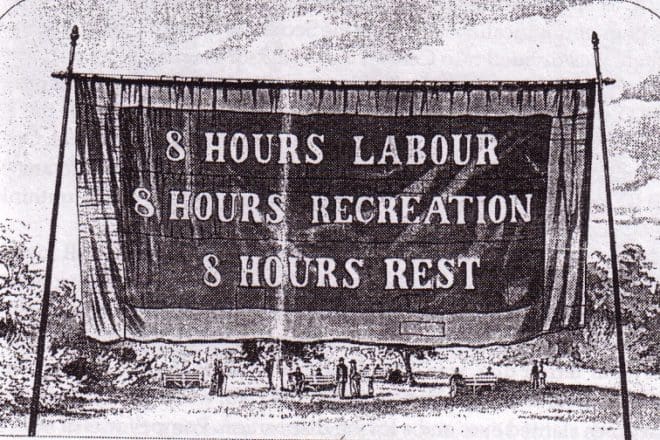
The 40-hour workweek was born in an era where labor movements were rising, legal mandates were making their way through America’s legislative bodies, and companies like Ford Motor Company popularized the 8-hour workday in the 90s, just before the Fair Labor Standards Act of 1938 became the law of the land. 

Originally, the idea was to move from a 12-hour work day to an 8-hour workday, a pipe dream during the Industrial Revolution when the above rally cry was introduced. The shift was historic, and came after protests, riots, and deaths. But the 40-hour week was born on a factory floor, not in a Slack channel.

Gen X burned out quietly, Millennials loudly, and Gen Z? They just left the chat entirely.

So how did we get here? The perfect mix of a pandemic trauma, economic whiplash, mass layoffs, wage stagnation, and the death of employee loyalty.

efore judging whether or not Gen Z’s rejection of the hustle lifestyle is right or wrong, first you must truly understand where they are coming from.

During the pandemic, the entire planet re-evaluated their priorities. Many people lost loved ones, even more lost their jobs. Talk about deflating – it’s hard to get pumped up to work 20 extra hours in a week through that lens of exhaustion. During this era, more and more frustrated employers flippantly adopted the “no one wants to work anymore” moniker, even further diminishing an exhausted population (who is tired of hearing that you paid 16% interest on your house in 1981, failing to mention that the house was only $40k, not $470k for the exact same house today).

Pair that with the undulating economy – seeing (or hearing about) their grandparents crash the economy with the dot com bust, and their parents crash the economy with the housing bust, not to mention whatever *this* (looks around) is. Of course neither generation “did” a crash, but Gen Z has been alive and witness to some of the most dramatic economic undulations in our history and it shows.

This generation has also seen more rounds of layoffs than Twitter has rebrands. But not only have they seen them, they’ve been victim to them first hand.

Wages have stagnated in their adulthood, and this has all become the perfect storm to create deep cynicism and a truly meaningful rejection to employers that say “we’re family.”

As the struggle rippled throughout the economy, social media made alternatives VISIBLE. Doomscrolling also involved lots of Gen Z folks talking about how they went independent, became creators, freelancers, OnlyFans girlies, freelancers, etc.

Employee loyalty is no longer automatic, it has to be earned. Gen Z is willing to give their time and talent, but it’s for money, not for passion. They’ve watched the world burn too many times for any other outcome. “Hustle” began as empowerment but has evolved into exploitation. 

Talk about a perfect storm. 

Gut check before someone makes this your problem

Listen,you don’t have to agree with Gen Z, but you do need to understand, and figure out where YOU stand.

There are a few questions you can ask yourself to determine your position:

  • Are your team’s hours a matter of business survival? OR tradition? 
  • Would you rather have a butt in a chair from 9-5? OR measurable outcomes?
  • Have you set expectations that reward presence? OR outcome? 
  • Be honest – are you confusing structure with control?

Think through your own biases, and be truthful with yourself, because resentment isn’t a strategy.

In some cases, hours DO matter (hospitality), but in others (software development) outcomes are what matters. In some cases, getting the most hours out of people is survival (medical professionals), while in others (financial analysts) it’s merely tradition. 

Let’s say you’ve read this far and you still think Gen Z is lazy. Whatever, that’s fine. You can reject a trend without being a jerk or losing an employee, so let’s talk next about a framework for how you’ll handle this if/when it comes up in your company. 

When it comes up, don’t panic

Here’s your script so you don’t accidentally say “back in my day…” or “no one wants to work anymore,” even if you’re only 27 years old:

Step 1: Don’t get defensive. Get curious!

Ask why they’re asking. It might not be about hours, it might be about flexibility, autonomy, or trust.

Step 2: Frame your values. Show you’ve put thought into this, that you’re not just rejecting their input.

“Here’s what we expect and WHY it matters to the business.”

Step 3: Offer transparency where possible.

“This is what’s negotiable, this is what isn’t, and here’s the reason.”

Step 4: Choose your own adventure:

Option A: Flexible by default? Share your system.

Option B: Hybrid but structured? Share the boundaries.

Option C: Traditional hours? Own it – without shaming the ask.

Bonus: Document your stance internally before it becomes a Slack fight.

What if you want to outright reject any employee inquiring about something like a 4-day workweek? Because you’ve read this far, I know you’re trying to do the right thing and not just knee-jerk react, so here’s an example of how that might go down:

Employee: “I wanted to ask – have you considered offering a 4-day workweek or something more flexible?”

You (the boss):
“I hear you, and I appreciate you bringing it up. Right now, a 5-day structure is core to how we operate and hit our goals, so a 4-day week isn’t something we’re entertaining.

That said, I am open to talking through ways we can make your current schedule work better for you. If there’s room for flexibility within our setup, let’s explore that. Tell me more about what inspired your question.”

The hard truth? This may not be generational

The frustrating part of this friction today is that it may appear to be just generations clashing. But that isn’t it, we’re seeing extremely young business owners and operators have similar frustrations. This friction is being dismissed as a generational shift, but we see a class and power dynamic at play here underneath it all.

Many of the people pushing back against a traditional 40-hour workweek can afford to. The rejection is sometimes from a place of privilege because there’s some form of financial safety net they can rely on if they lose a role. Others are trying to survive three jobs.

Further, your salaried team might have different needs than your hourly staff. Perhaps it’s time to consider how those two populations within your own company differ.

You may see a lazy generation, but perhaps it’s simply resistance to being minimized, chewed up, and spit out? Perhaps without the not-so-gentle reminder of piles of body bags during COVID, we wouldn’t be at this inflection point, who knows?

What we do know is that for most people asking the question, they’re not asking to be coddled, they’re in the midst of a labor market shift in real time.

Some are even offering to still work 40 hour weeks, just in fewer days. Others are simply burnt out, despite a younger age. For the sake of your business’ longevity, it’s your job to suss out which is which. 

You don’t have to change everything – but you do have to pay attention

Folks, this isn’t a trendy movement, it’s a pressure test you’re in the middle of – how you react determines how you’ll survive.

Being thoughtful about expectations doesn’t make you soft, it makes you smart.

And even if you’re not in a position to wave a magic wand and grant all wishes, you ARE in a position to be curious, kind, and thoughtful, even as you say no.

Know your stance, communicate it clearly, and most importantly, try to remember that we’re all human and just survived a global pandemic. We’re changed. 

This free tool helps you compare and establish your freelance rates

Go deeper - join us!

Create your account, choose weekly or yearly billing, and ALL STORIES are instantly available.
Your email address is 100% safe from spam!

How to keep momentum when your business is growing

When you first launched your business, you barely had time to breathe, things were moving so fast. You were too busy developing, designing, sourcing, and/or selling to think much about long-term strategy. All that hard work has paid off, and now you’ve got a few grand — or even a few million — in the bank. But it’s at this phase that many businesses tend to plateau, stalling out and losing that sense of forward motion.

To stay ahead of the game in an increasingly saturated market, this is the time you actually need to fight even harder. Too many other competitors on the playing field means even the most well-differentiated brand, product, or service barely stands out from the crowd. To win, and to break past barriers to further success, you’ll need the right game plan to level up. Here’s how you can use your current growth to fuel even more momentum.

Supercharge your marketing strategy

In the early days, you could rely on word of mouth, or perhaps a bit of press, to get your brand name out there. From there, maybe you started buying up Amazon or Google ads and running a modest social media campaign. But as you scale your business, you need a more aggressive, multi-pronged strategy to grow your sales and increase brand awareness. According to Hawke, a data-driven approach to marketing can mean huge returns for your business. 

The specific tools you use to grow your presence will look a bit different for every business. But the basic essentials include killer visual branding, authoritative content, and a user-friendly website that converts more prospects into customers. If you don’t have a CMO or the in-house staff to handle the job, you may need to contract with an outside expert. They can help you develop a plan that works, while highlighting the unique voice and vision of your brand.

Launch new products, services, channels, and revenue streams

Most brands break into the market with just one popular product or service: an iconic item or offering users forever associate with their brand identity. From there, they might add a few variations, like different colors, features, or add-ons. This is where many brands lose momentum, though, since a limited portfolio of offerings means a limited amount of growth. To break through and expand further, you need to offer customers even more options.

It’s not just about what you offer, but also where, when, how, and to whom you make it available. For instance, if you sell a product on your website, it could be time to start selling on Amazon or Walmart, too. If you sell snacks, beverages, pet products, cleaning supplies, or other consumer packaged goods, offering a subscription service could grow your revenue. If you’re in a B2B service, it could be time to move to B2C, or even B2G (business to government).

Invest in systems that grow with you

As your business takes on more layers of volume and complexity, you’ll need scalable tech solutions and other infrastructure. Simple tools — like spreadsheets and shared calendars — won’t be enough to manage all the new products, projects, and clients under your belt. If you sell physical products, you’ll need, at minimum, an dedicated inventory management platform. You may also need to subcontract tasks like logistics and fulfillment to a third-party provider.

For services-based businesses, you may need to implement tools like customer relationship management and project management software. You may also need tools like chatbots and automated scheduling software to manage increasing volumes of inbound customer communications. Advanced AI can automate many repetitive and administrative tasks, so you can stay focused on improving your offerings and delighting your customers.

Attract and develop top talent

If it’s in your budget, now’s the time to start thinking about adding more full-time talent to your team. The more you expand, the less feasible it is for a tiny core team to manage all aspects of the business. As it is, you’ve probably got too few employees, working too many hours, with their hands in too many pots. As your sales climb, you can start to think about hiring specialized associates and building distinct departments.

But it takes work to attract and keep skilled employees, especially in a world where employees tend to change jobs every few years. You’ll also need resources, like development and training opportunities, to keep them engaged and committed to your success. Invest early and often in resources employees can use to upskill, cross-skill, and grow personally and professionally. Your employees — new and old — will always be your most valuable company assets.

Think “scalable systems”

A key question to keep asking yourself as you scale is “Can this continue to grow with my business?” Every investment you make should be flexible, agile, and equipped to keep up with exponential expansion. New employees don’t just need to be highly skilled; they also need to be open-minded and coachable. Any new software or infrastructure you invest in should be able to accommodate a company ten times your current size. 

Remember: In this day and age, a company can go from unknown to viral sensation overnight. A bit of stagnation says nothing about where you’ll be just a month or two from now. You don’t want to overspend on bulky enterprise software, overhire employees, or purchase too much inventory.

But you do want to build a resilient business that keeps running smoothly as you reach your fullest potential.

‘Zero UX’ – ever heard of it?

1

Go deeper - join us!

Create your account, choose weekly or yearly billing, and ALL STORIES are instantly available.
Your email address is 100% safe from spam!

Build a data platform on a ramen budget (so every business decision is data-driven)

Creating an analytics platform for your organization doesn’t require a large budget. With careful planning and the right tools, you can build a functional data platform that delivers business value while keeping costs low.

The key is to understand your current needs and plan for growth as your business scales. This article provides a straightforward guide to building a cost-effective data platform, focusing on practical tools, processes, and team-building strategies.

Step 1: Centralize your data

The first step in building a data platform is to consolidate your data into a single location. This creates a reliable foundation for analytics. Snowflake is a strong choice for a data warehouse due to its performance and scalability, but alternatives like Google BigQuery, Amazon Redshift, or ClickHouse can also work, depending on your requirements.

A basic setup – including a data warehouse, an ETL (Extract, Transform, Load) tool, and a business intelligence (BI) platform – can start at approximately $50,000 per year. This covers:

  • Data Warehouse: Snowflake or BigQuery offers flexible, pay-as-you-go pricing suitable for small organizations.
  • ETL Tool: Tools like Fivetran or Stitch provide affordable data integration, often starting at a few hundred dollars per month.
  • Business Intelligence: Entry-level BI tools, discussed later, can fit within this budget.

Focus on integrating your most critical data sources, such as CRM, financial, or operational data, into the warehouse. Keep this step simple to avoid unnecessary complexity early on.

Step 2: Use low-code/no-code tools

Data transformation (preparing data for analysis) can be costly if you rely on custom code or enterprise tools. For organizations with limited budgets, low-code/no-code platforms like Make.com are an efficient solution.

Make.com enables you to automate data workflows, such as cleaning or merging datasets, without coding expertise. Its visual interface allows non-technical team members to manage basic transformations, reducing the need for specialized staff. A Make.com subscription typically costs $400–$600 annually, significantly less than the $50,000–$60,000 for enterprise-grade tools like dbt or advanced ETL platforms.

As your data needs grow, you can transition to more robust tools like dbt for complex transformations and better version control. Starting with a low-cost solution like Make.com helps you move quickly while keeping expenses manageable.

Step 3: Select flexible business intelligence tools

Business intelligence tools turn your data into actionable insights through dashboards and reports. Enterprise options like Looker and Omni are powerful but can be expensive. ThoughtSpot is a strong alternative, offering user-friendly features and AI-driven analytics at a more accessible price point.

When choosing a BI tool, prioritize flexibility to avoid being tied to a single vendor. Opt for platforms with standard data connectors (e.g., SQL or ODBC) to ensure compatibility with your warehouse and ease of switching tools later. For tighter budgets, open-source options like Metabase or Superset are viable, though they may require more setup.

BI tools typically cost $10,000–$20,000 per year, depending on features and user count. To control costs, limit licensed users and focus on dashboards that address critical business questions. Avoid deep customization early on to maintain flexibility.

Step 4: Plan for the next 6–12 months

A data platform should evolve with your business. To ensure success, plan your needs for the next 6–12 months with a structured approach:

  1. Evaluate Current Needs: Identify your key data sources and the business questions they address. For example, a retail company might focus on sales data, while a SaaS business might prioritize customer metrics.
  2. Set Short-Term Objectives: Target quick wins, such as a dashboard for revenue tracking, to demonstrate value and justify further investment.
  3. Ensure Scalability: Choose cloud-based tools like Snowflake or BigQuery that scale easily without major infrastructure changes.
  4. Manage Budget: Allocate funds to high-impact areas (data storage, basic transformations, and BI) while avoiding unnecessary features like real-time analytics.

Review your platform’s performance quarterly to align with changing business needs. This iterative approach ensures cost-efficiency and relevance.

Step 5: Hire a data engineer first

As your platform grows, you’ll need technical expertise to maintain and expand it. Your first hire should be a data engineer, who can manage data pipelines, transformations, and integrations. A data engineer’s skills are critical for building a reliable platform, unlike analysts (who interpret data) or data scientists (who focus on modeling).

A data engineer can:

  • Streamline ETL processes to ensure efficient data flow.
  • Establish data quality and governance standards.
  • Build scalable transformation pipelines using tools like dbt.
  • Translate business requirements into technical solutions.

Data engineer salaries typically range from $80,000 to $120,000 per year, depending on experience and location. To stay within budget, consider a junior engineer or a contractor for specific tasks. Platforms like Upwork or Toptal can provide temporary talent until a full-time hire is justified. Look for candidates familiar with your tools (e.g., Snowflake, Make.com, or ThoughtSpot) and a practical approach to building maintainable systems.

Just know that building a data platform on a limited budget is achievable with strategic choices. Centralize your data in an affordable warehouse, use low-code tools like Make.com for transformations, and select flexible BI platforms for insights. Plan iteratively for the next 6–12 months, focusing on scalability and quick wins. Hire a data engineer as your first team member to ensure a solid foundation. By starting small and prioritizing flexibility, you can create a data platform that delivers value now and grows with your organization.

Can this really bring all remote tools into one spot?

How long will remote work last?

Has the clock started to wind down yet? Will it ever? Probably not – most can agree that some form of remote work isn’t going away any time soon. And, one thing is for sure, we still need tools to help us collaborate, keep track of projects, and document our work.

Due to the COVID-19 pandemic, we saw a lot of companies develop new and improve existing tools to make things easier. One company believed that too many tools can create confusion, scattering resources and information across platforms. Moreover, having to switch back-and-forth between multiple tools is undoubtedly inefficient.

One startup brings tools together – with a twist

Allo says it’s the “first remote workspace” where you can “get everyone on the same page.” It is a cross-functional project management tool, team communication tool, and documentation tool that helps teams work across roles without dooming everyone to juggle too many software platforms.

Unlike heavy text-based tools, such as Notion, Slack, and Trello, Allo is a visual tool. It uses whiteboard canvas-style pages where you can connect all the tools you already use in one central place.

With a simple drag and drop motion, you can add documents, PDFs, images, videos, stickers, and website links to your canvas, similar to Microsoft PowerPoint or Google Sheet presentation.

On each canvas page, content can be separated into different sections so you can better organize your information so everyone can have an overall picture of the project.

While text-based tools are helpful for most, plenty of people are wired differently and tend to be slowed by non-visual tools. We think Allo has a real shot at making for a more inclusive workplace.

Communication tool and knowledge base

The tool also has a built-in chat bar so you can stay in constant communication with your team. If you need to jump on a video call, you don’t have to head over to Slack or Zoom to initiate a call. You can make the call straight through the platform.

Also, team members can tag each other on any page in a specific section of a canvas so everyone has a clear view of who’s working on what.

Allo also works as a “documentation repository.” Since you can collaborate and communicate all within the same tool, the documentation you’ve been working on has already been dragged and dropped into your canvas. And, those files can be previewed directly on Allo and some can even be modified.

Yes, there are even templates

So you don’t have to start from scratch, Allo has some pre-designed space templates for common uses, such as project planning, daily standups, design reviews, etc.

Overall, Allo is an easy-to-use visual and multi-functional tool. If an all-in-one tool sounds like something you’ve been waiting for, you can head over to their website to try the tool for free, which gives you limited access. To gain access to advanced features and support, you’ll need to sign up for a paid plan.

This story first appeared in AG on November, 2022.

Skip the weekly meeting – use AI to script your updates

Adulthood is just an endless stream of meetings

If you’re anything like me, you struggle to find the balance between completing your work for the week and updating your team on the status of projects. It’s estimated that 62% of the workday can be spent on basic administrative tasks, such as collecting data, emailing, and coordinating meetings.

Let’s be honest, putting together a weekly meeting and summary can feel like a part time job in itself, and most of us don’t have the luxury of having a personal assistant backing us up! This is where the new AI-driven tool, Broadcast, can help!

Focusing on getting sh*t done

According to their website, “Broadcast saves you time and helps you make better decisions as you scale your company by replacing ad-hoc update information workflows. All your updates on a single platform that’s easy to write on, distribute with, and search. Everyone can know what’s happening.”

You can keep your data to yourself or collaborate with team members and project managers, keeping everyone up to date. Then, when it’s time to send out an official update or newsletter, Broadcast will help you set that up and distribute organized information to the masses.

When it is time to hold a meeting, you’ll be able to compose a pre-written script, reducing the total time you’ll need to be pulled away from your work.

Implementing scripts + making data-informed decisions! Yes please

Broadcast can serve a central hub for new updates and current work status, possibly freeing up time otherwise spent in your email inbox or Zoom meetings. Collaborators and project managers alike can access your data to gain information without interrupting your workflow. Sounds like a dream, doesn’t it? 

Having the latest data at your fingertips will help you make informed decisions. Need to delegate a task to someone else in order to meet your deadline? Broadcast will help by providing digestible information to help you make that decision.

Maybe you need to coordinate a weekly meeting or status update to a supervisor or client. You have the opportunity to use Broadcast to allow access for review, or you can easily put together an update of your own while keeping confidential information under wraps. 

Does Broadcast seem like something you could utilize for your daily workflow? What other features would you like to see from this powerful AI tool?

Enhancing performance reviews with AI

Go deeper - join us!

Create your account, choose weekly or yearly billing, and ALL STORIES are instantly available.
Your email address is 100% safe from spam!

Toxic workplaces are literally bad for mental health

The government declares harm being done

Unhealthy work conditions have OFFICIALLY been declared harmful for mental and physical health. Of course, we all know this, and the amount of people that have had this realization has increased dramatically over the years. 

In a groundbreaking report in 2022, Surgeon General Vivek Murthy warned that “long hours and cutthroat work conditions” are hurting us. It was the first time the surgeon general’s office had spoken up about the potentially catastrophic effects of “toxic” workplaces.

It came just in time- as Americans reconsidered their positions in large numbers amid the resignation and quiet quitting phenomenon and return to office movement. 

5 factors hurting American workers

The report delves into several of the factors that go into the negative impact harsh work conditions have on the American people. 

  • Extensive Workloads 
  • Wavering Schedules 
  • Low Wages 
  • Really Long Commutes 
  • Limited Autonomy 

A multitude of workplace stressors were mentioned, including the above. Murthy stated that these factors have a strong impact on health and organizational performance, which is a point many have been trying to make for a generation. 

Also mentioned were the effects of discrimination, harassment, and hostile or dangerous working conditions, as well as “toxic,” disrespectful, and non-inclusive workplaces.

These pile on more pressure against workers and will lead to chronic stress, the report says. 

Chronic stress linked with declining health

Chronic stress has been linked to numerous short and long-term health issues like anxiety, depression, and potential substance abuse or misuse.

Stress also interferes with sleep, which can decrease the quality of life and increase the risk for other health conditions. Among those conditions may be heart disease, diabetes, immunosuppression, and even cancer. 

Murthy warned employers to promote healthy work environments, urging that stress won’t be easy, but it’s necessary and “worth it” for workers and organizations. 

The 5 components of a healthy workplace

Further, the report outlined five key components of a healthy workplace – nurturing workplace community, positive work-life balance, protection from harm, growth opportunities, and ensuring workers know that they matter. 

This is great news, but does it really take this for some employers to realize that their employees are essential and deserve a positive work environment? Our readers are business leaders that believe in investing in their teams, so much of this is preaching to the choir, but either way, it is now an official government declaration, and a new way to stand out as an employer.

How AI has made us easier to scam

Go deeper - join us!

Create your account, choose weekly or yearly billing, and ALL STORIES are instantly available.
Your email address is 100% safe from spam!

Bleisure: The new corporate buzzword that’ll make you mad

Go deeper - join us!

Create your account, choose weekly or yearly billing, and ALL STORIES are instantly available.
Your email address is 100% safe from spam!

Can you manage a digital PR strategy alone?

With a thriving digital PR strategy in place, potentially complemented by a search engine optimization (SEO) strategy, your brand should see much more visibility and enjoy a much better reputation. With the help of a digital PR services firm, it’s relatively easy to get started.

But is it possible to build and manage a digital PR strategy entirely on your own?

What Does a Digital PR Strategy Require?

First, we need to understand what a digital PR strategy requires. While there are many possible approaches to take, and you can technically claim to have a digital PR strategy with even the most minimal approach, the majority of successful digital PR strategies include the following:

  • High-level branding strategy. Nearly all digital PR strategies start with some kind of high-level branding strategy. You need to understand what your organization is, what it represents, how it’s different from other organizations, and how it appeals to its target audience.
  • Reputation management. Digital PR strategies also need to play offense and defense with reputation management. It’s important to circulate content and engagement opportunities to boost your reputation, while also guarding against reputational blows that might otherwise undermine your brand.
  • Press releases and publications. Regular production and distribution of press releases as well as other publications are a staple element of most digital PR strategies.
  • Search engine optimization (SEO). Search engine optimization (SEO) allows you to rank higher in search engine results pages (SERPs), ultimately boosting your visibility. However, this can be time-consuming and expensive.
  • Social media marketing. Social media is arguably the heart of most digital PR strategies, since it gives you the broadest possible reach for your posts.
  • Influencer marketing. Many modern brands now capitalize on influencer marketing as well, associating their brand with recognizable individuals.

How Does a Digital PR Agency Help?

Services like AgilePR exist to help individuals and businesses master the art of digital PR management. With the help of a digital PR agency or digital PR services from various organizations and freelancers, you can essentially take a hands-off approach. 

If you do your due diligence, you can find genuine experts in this field; those experts can help you analyze your current brand position, develop a strategy designed for the best possible results, and ultimately execute the legwork necessary to achieve those results. They can also answer all your questions and collaborate and brainstorm with you on any internal endeavors you pursue relevant to PR.

The only real downside is that you’ll have to pay for these services. But because you’ll typically see better results this way, and because it will save you so much time, it’s usually more than worth it.

Can You Manage a Digital PR Strategy on Your Own?

With this context in mind, is it possible to manage a digital PR strategy entirely on your own?

The short answer is yes. You can absolutely do this. But the reality is that you’ll probably overload yourself with work and see inferior results if you choose this route.

These are just some of the problems associated with independent digital PR strategy management:

  • Expertise. Do you feel confident that you understand the dynamics of SEO? Do you know the right way to approach an influencer about a collaborative opportunity? Are you familiar with the intricacies of writing and submitting press releases appropriately? Without expertise, you’re unfortunately likely to fail; if you don’t have a background in PR, doing the work independently might be extremely challenging to impossible.
  • Time commitments. Even if you do have that expertise, managing a digital PR campaign takes a lot of time, even for a small, emerging business. Doing research, developing content, practicing outreach, and other responsibilities can take dozens, if not hundreds of hours every week.
  • Lost opportunities. You might be able to manage a digital PR strategy and see decent results from it, but are you confident those are the best results you could have seen? Without the help of a digital PR agency, you’ll likely encounter lost opportunities.
  • Scalability. As your business grows and your digital PR needs expand, you’ll become less and less likely to retain control over your strategy. Working with an agency or a team of freelancers gives you the scalability you need.
  • Analysis. Data is a practical requirement for modern digital PR campaigns. Without the proper tools or analytic capabilities, you’ll essentially be trying to shoot a target in the dark. You’ll also find it very hard to troubleshoot anything that’s going wrong.

While it is possible to manage a digital PR strategy on your own, at least for a small or mid-size business, it’s usually better to work with a team of professionals. It might cost you more money up front, but you’ll generally see a much higher return on investment (ROI) over the long term.

You can’t track the Stripper Index, but these 10 weird indices might be even better

Does the “Stripper Index” actually exist?

It is said that the “Stripper Index” can be the first indicator of a looming recession because dancers rely on cash tips and are one of the first “luxuries” impacted when the American economy is struggling. This early indicator isn’t quite an official number floated on cable news channels, it’s not found on any terminal, and it turns out that no one is actually graphing the data.

Currently, the “Stripper Index” (which should be called the “Dancers’ Tip Index”) exists solely as anecdotes from club owners and dancers, and are featured in one-off media pieces when folks question the economy’s stability.

So if you’re interested in the Stripper Index, is there a documented data point you could track as an ultra-early economic indicator?

There are five dancer-related numbers we can track, and five alternative indicators that you can tap into for making forward-looking business and/or investment decisions. Or, you could befriend a dancer or club manager so you can just casually ask in passing – your call.

5 dancer-related data points to track

You’re still reading because you too can see the value in this specific data points, so let’s dive into ways we can come close to recreating our own personal metrics without having to go interview local clubs in person like a legit nerd:

Nasdaq: RICK
RCI Hospitality Holdings is the only gentlemen’s club conglomerate that is publicly traded. They operate roughly 60 clubs in America (both adult dancers and “Bombshells” bars).

The relevance of tracking this stock is to see how same-store traffic combined with check-size to indicate the discretionary spending pulse of customers. This data isn’t exactly a leading indicator, however, as you’d have to read through their 10Q reporting every 90 days.

Your state’s business fees
Texas is a fabulous example of how you could track dancer-related data, because they have a “pole-tax” (formally known as the Texas Sexually Oriented Business Fee) wherein every gentleman’s club that serves booze must pay a $10 per head fee which is reported and paid quarterly.

In our home state, there is a transparency portal that publishes the receipts and shows direct headcount of paid club entries, so there is no sampling error, and it’s completely public. Data drops on the Comptroller’s site about six weeks after a quarter ends.

Entertainers’ wages
Every year around May, the Bureau of Labor Statistics shows total employment and median hourly pay for dancers, but the rub here is that it includes backup dancers and ballet dancers.

That said, big swings typically coincide with club hiring waves more than anything, so it’s not the best data to track, but could be combined with other info to make your decisions.

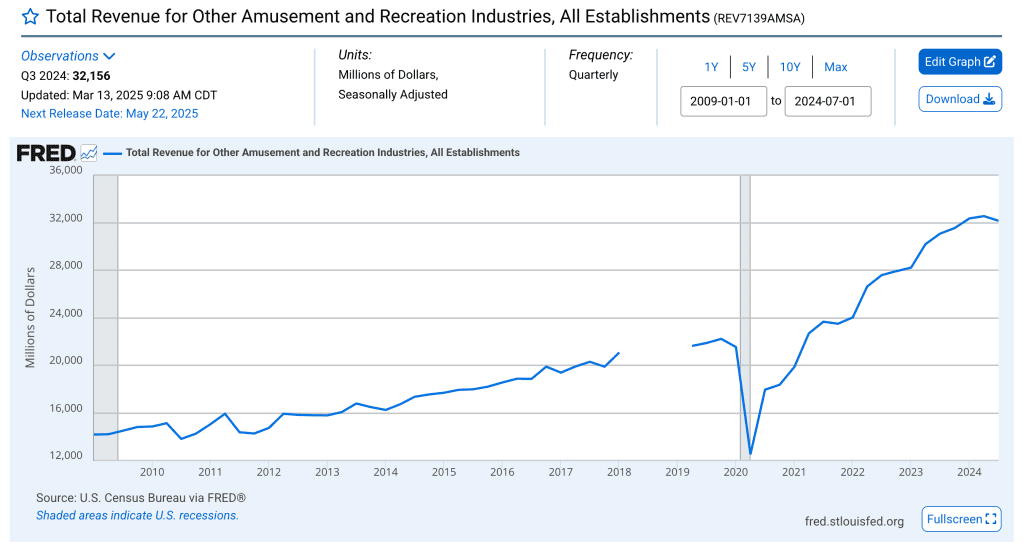
FRED revenue
The Federal Reserve Economic Data tracks local, state, and federal data across each industry – in this case, “Other Amusement & Recreation.” This category includes adult cabarets, gentlemen’s Club’s, strip clubs, pool halls, and everything else cool that your mom would be ashamed of you doing.

You can subscribe to FRED alerts, and new data hits roughly 10 weeks after each quarter concludes.

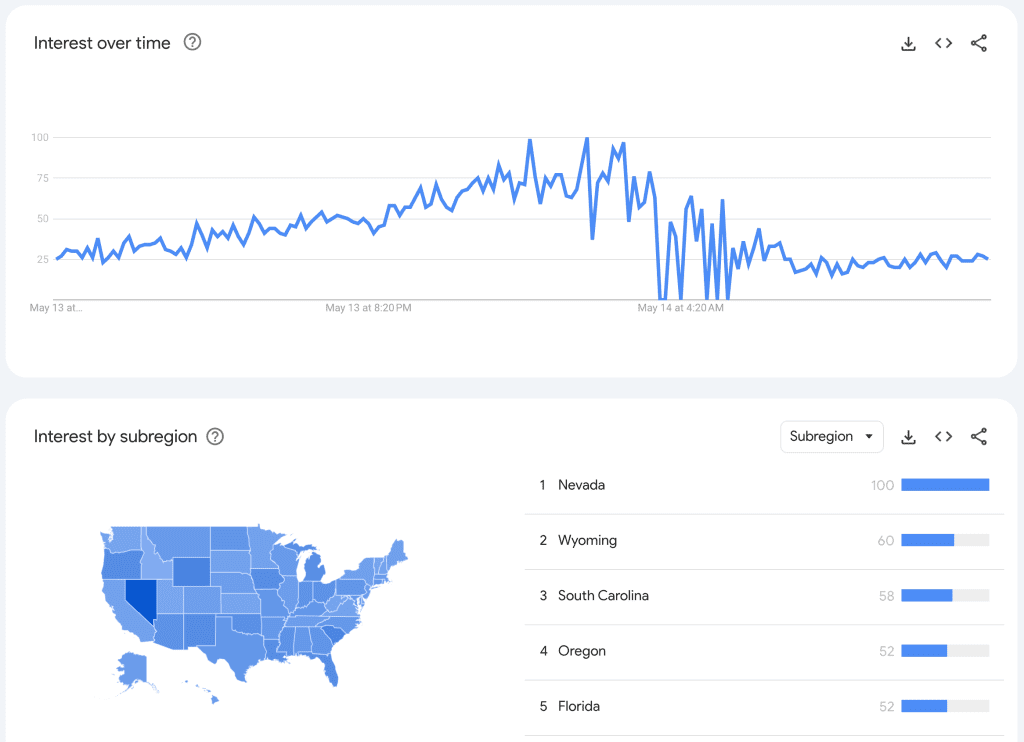
Google Trends
For a real-time sentiment gauge, get creative and use free global data to see what people are searching for. You can check customer demand by looking at “bachelor party ideas,” or “strip club near me,” and labor supply by “become a stripper,” or “exotic dance license.”

Get creative, and pull one-year and five-year charts so we how any of these terms spike during times of recession worries.

5 alternative indices to consider

If you’re more interested in the novelty of saying you track the “Stripper Index,” perhaps some other goofy indices are what you’re really after. These five alternatives can show up months before payroll data or GDP headlines, and are all updated for the public to review:

The Undie Index
A trend you’ll notice in most of this section is that we’ve made up our own names for the indices, but come along for the ride anyhow, won’t you? This one is actually called the “Men’s?Underwear Index” (HanesBrands “Innerwear” sales, found in the company’s quarterly earnings reports), and the theory is that when money is tight, fellas delay buying new boxers.

The Lipstick Index
When the economy struggles, smaller, more “affordable” luxuries are often the first line item on a budget to be nixed, so take another look at FRED’s MSRSUSA446 (monthly state retail sales for cosmetics/beauty), or perhaps Estée Lauder’s earnings reports.

The RV Index
Some analysts believe that RV orders dip significantly sooner than cars or houses, and since the RV Industry Association publishes a monthly shipment report, you can keep your eye on a pretty early indicator.

The Box Index
If there’s a cardboard box recession, we might have a full blown recession on our hands, so track corrugated box sales. Fewer boxes means fewer goods moving through our supply chain. Again, check the monthly FRED data on boxes for this potential indicator.

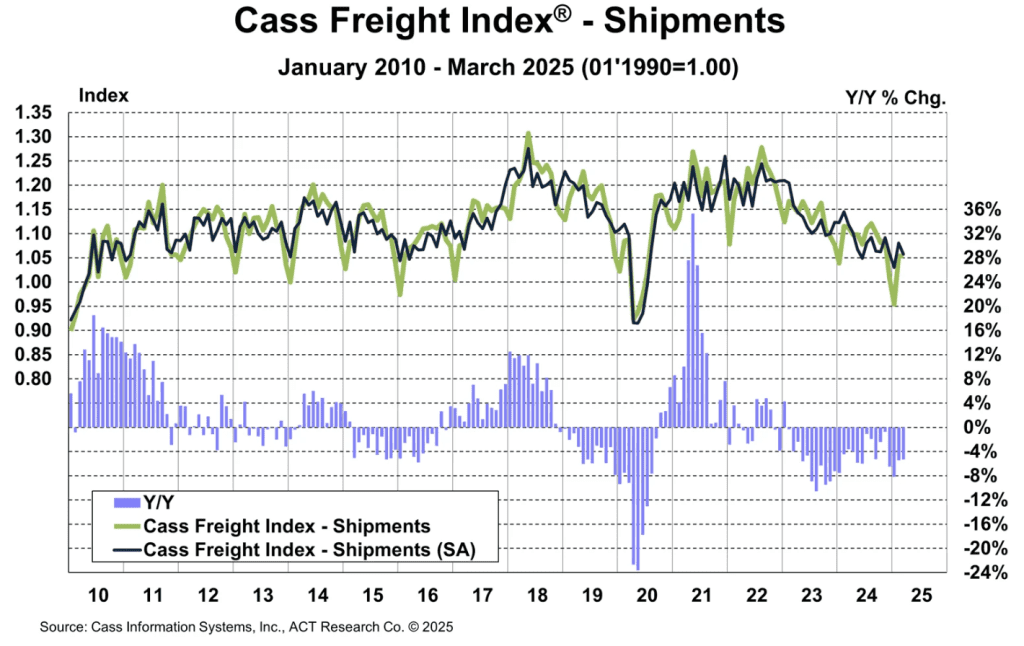
The Freight Index
Similarly, fewer freight orders means a pull back in consumerism – an early sign of economic troubles. Cass Transportation is a trusted source for this monthly data, and even if you’re not looking for signs of an economic collapse, this data can tell you the health of our current supply chain.

So which index will you begin to track, since we’re not lucky enough to have an actual Stripper Index? How will you know economic troubles are looming today or tomorrow, or if things are looking up? You have so many options!

Is doom spending the next big thing?

Do you have ‘F it’ money? 

Not ‘F you‘ money, but ‘F it‘? 

If you do, chances are you don’t have much of the regular kind. And that takes us to a new name for an old phenomenon:  Doom Spending

It sounds like a darker, slower, more depressing offshoot of Heavy Spending, and that’s not wholly inaccurate. If you can’t afford payments on a new car,  but CAN afford a one time cash drop nice pair of boots, feel better and buy the boots! 

You’ll never have enough money for surgery if you need it. But you DO have enough for a sweet watch to count down your diminished lifespan. Feel better! Buy the watch! 

Your credit and savings will never recover from the last several emergencies, that house you were eyeing is out of the question, and you have to make sure you pay rent right at 11:59 to try and get the withdrawal to come out in 48 hours rather than 3. But with the couple hundred left in your account, some out-of-print comics might be nice, right? And so on. 

Alaina Demopolous of The Guardian notes 

“All signs point to “doom spending” being a reckless and unwise decision, but it does feel fun to self-soothe via unnecessary purchases. And it’s a problem many Americans have. Despite inflation and high interest rates, the National Retail Federation reported that holiday shopping reached record highs last year, at a cool $964.4bn.”

One last wintery hurrah, perhaps. But I disagree on one point—if Zoomers, Millennials, and other generations are all equally circling the same drain, rather than doom spending despite high interest and raised prices, it’s because of it. 

Now of course someone living paycheck to paycheck who succumbs to the call of the effits, is probably someone with a place to stay, and at least a few of their base needs being met. 

However, the gap widening between workers and 1%ers can’t be put off with ‘That could be us someday’ any more. Similarly the illusion of being far removed from houseless folks who aren’t having their low end of the Hierarchy of Needs fulfilled is being dispelled. Is it any wonder that, while trudging along under greedflation, record layoffs, and a general social malaise, more of the lower born decided to wring out some semblance of high class enjoyment wherever they may? Why not trade the drab lie of the ‘Work hard, save, then prosper’ formula for the much more fun lie of ‘The Prada sunglasses will make it better’? 

The jig is up, the curtain has fallen, and I’ve already hit ‘Add to Cart’ five separate times. Let the End Times roll!

Optimizing your website accessibility as a small business

Ensuring digital accessibility on your website should be of utmost importance as a business owner. Beyond the disabilities we can see, there are also hidden or ‘invisible’ disabilities that can make it downright difficult or overly distracting to visit a website if it is not up to par.

The following is a comprehensive checklist that can be referenced throughout the entire process and applied to all digital channels:

Phase 1: Plan and Communicate

Following a strategic plan of action will be essential for your success through the development cycle. There needs to be full participation from all members to collaboratively share expectations and responsibilities.

  • Set clear KPIs for digital accessibility
  • Use Web Content Accessibility Guidelines (WCAG) 2.1 Level AA
  • Create both internal and public-facing policies that outline your efforts
  • Set appropriate timelines for all foreseeable goals
  • Encourage communication among all parties
  • Train all staff members involved to the best of their ability

Phase 2: Test and Audit

Audit all currently existing assets so that visual elements also adhere to WCAG 2.1 AA standard. This includes audio and video, as well as documents like PDFs and transcripts. Test these assets against standard using manual methods.

  • Perform testing across the board to current assets as-is
  • Rate them against WCAG 2.1 AA while conducting testing
  • Create lists of noted issues to improve on
  • Work with an external accessibility partner for full resolve

Phase 3: Fix and Verify

Finally, it’s time to get to the nitty gritty work! After testing digital properties, it’s time to make the fixes as necessary.

“Remember that accessibility is a journey, not a destination.”

Along with resolving the current state of affairs in your business, ensure all updates, features, and elements going forward adhere to standards. This helps to keep things up to date and in the best accessible condition consistently, instead of having to start this long process over again in a few years.

  • Remedy the most severe issues first – this not only gives a clear priority to the team but once completed, gives them a boost of confidence and energy
  • Train internal employees ongoing, as well as freelancers or contracted employees
  • Continue QA testing randomly, either internally or through a partner
  • Incorporate those with disabilities in user testing to rate satisfaction

Phase 4: Document, Train, and Maintain

Always track and document your process for both internal reference and your stakeholders.

  • Update your accessibility policy and statement to reflect your work
  • Ensure all new hires are trained and understand expectations
  • Communicate the accessibility policy to all vendors
  • Continually evaluate the digital channels moving forward
  • Set up reports to track ongoing progress
  • Document all outcomes, but especially positive user outcomes
  • Receive website certification if plausible

Creating a more inclusive world is one area your business can hold with pride if you make digital accessibility a priority. Get started today!