Home Blog Page 349

Veteran threatened with eviction for needing companion dog

Modernizing Fair Housing Laws

It’s possible that with each passing year, or decade, Fair Housing Laws have become more complex, more in-depth than that of their original intent.  The truth of it is, they are merely merging to be all encompassing so that no one will face discrimination in housing be they the buyer/seller or landlord/renter of a piece of  property. 

With The Federal Fair Housing Act in 1968, it became illegal to discriminate during the sale or rental of a dwelling based on a person’s national origin, sex, race, religion, or color. It wasn’t until 1988 that disability (codified by the ADA in 1990) and familial status were both included. Many states and local communities also have also included members of the Military as a protected class, and recently, the National Association of Realtors amended the Code of Ethics to include protections for all sexual orientations, and HUD, along with all HUD insured housing announced that they will not discriminate against actual or perceived sexually identity, or orientation.

Actually, Fair Housing Laws are not that complicated. We can’t screw over anyone in housing simply because they do not fit into whatever our own personal cookie-cutter appearance of normal may be. It’s illegal. 

Is Trump Village immune to Fair Housing Laws?

When this little piece appeared in the NY Times last week, I was totally appalled, and pretty freaking livid. A co-op is attempting to evict a Russian immigrant, a married man with two children, an Afghanistan War Veteran, having been on tour in Kosovo, Bagram, and Kandahar, some of the most violent places over there are in The BIG A. 

Upon returning from his latest nine-month tour,  Eugene Ovsishcher  was diagnosed with PTSD. Per the NY Times article, two doctors, his regular doctor, and a psychiatrist recommended that he get a companion dog to help alleviate some of the symptoms associated with PTSD, the flashbacks, the nightmares, and anxiety. While he submitted his regular doctor’s note to the co-op’s board for approval, to register Mickey with the co-op as a companion dog, the board says they need a note from an expert in PTSD.

The whole idea that a housing complex, anywhere, in this day age feels it is bigger than a family, a man who under the law is entitled to reasonable accommodations due to his disability, and a Soldier who served, is crap. A note from a doctor (yeah, you know, an Rx type thing) is all that is required. Trump Village needs a schooling in Fair Housing Laws. And service/companion animals. Immediately.

Note from the Editor in Chief: At AGBeat, it is our firm belief that housing is a human right, and any type of discrimination by any party will be exposed and will never be tolerated under any circumstances, no matter whose name is on the building.

Tweet a product name, get a tweet back with price tips

Be sure you’re paying the right price for electronics

It can be tough and expensive to own and run a small business, especially on a budget. Then, when it comes to purchasing worthwhile and useful gadgets or technology that can take your business to the next level—laptops, high-end cameras, smartphones, or printers or scanners—it can put added stress on your already thin budget.

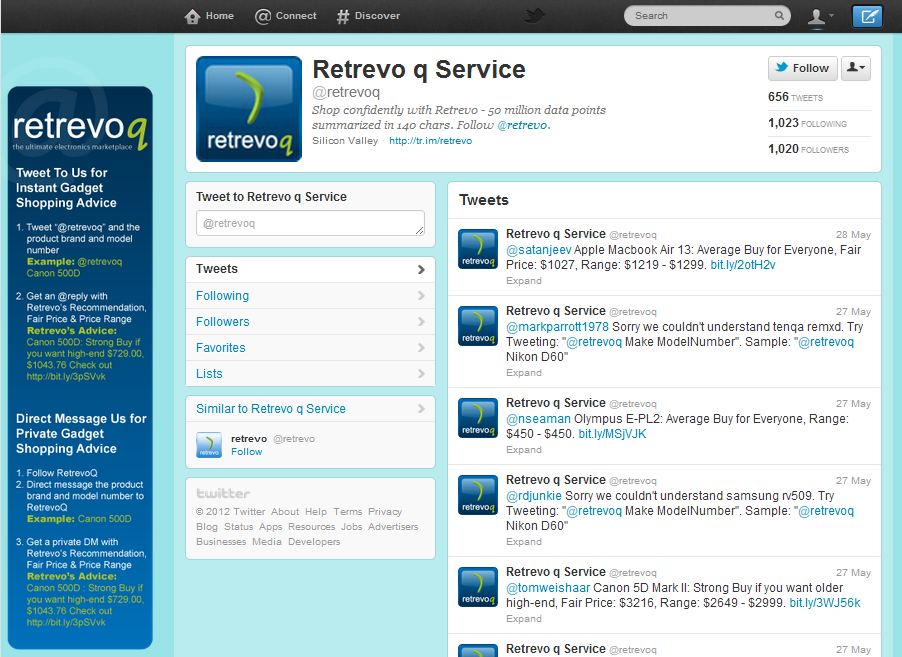
Without extensively researching each new gadget or piece of technology, it can be quite the gamble to make an expensive purchase. It is challenging to identify when you’ve paid too much for any one item and you may find yourself wondering if it was worth the price. But now you can ask the experts, Retrevo, what you should pay for any electronic item. And all it takes is a simple tweet.

Send a tweet, get a price recommendation immediately

Just send a tweet to @RetrevoQ indicating the brand name and model number and they’ll respond with a recommended price range and a fair price, so you can identify if you’re actually getting a good deal or if you need to take your business elsewhere. You also have the option to send a direct message to Retrevo with the same information and get a private DM back. Alternatively, you can visit the Retrevo website with more detailed information as depicted above.

This information will give you a great knowledge base when you are browsing, comparing, and preparing to purchase. It gives you a little more power when making a deal for electronics, as you’ll know the price range a product is worth.

As a small business pro, it’s important to cut back where you can so you can allocate that money to important parts of your business, like marketing efforts or hiring an employee or two. Using Retrevo’s service can ultimately save you money and give you the power and control you need while making important purchasing decisions. The best way to take control of your business is to be fully informed on all topics and areas that can and will affect your business. No longer do companies who markup prices on electronics have the upper hand. Retrevo has given the power back to the individual and the small business owner, and that only means more benefits for you.

IXACT Contact launches e-Newsletter feature

Newsletters for Realtors

While some support and some criticize e-newsletters, the majority of actively marketing real estate professionals use them in their marketing arsenal, which is the demand that customer relationship management (CRM) software company, IXACT Contact has responded to, launching a new e-Newsletter feature. The company says this new feature makes them the only real estate CRM on the market that gives subscribers the ability to send out pre-designed and written e-Newsletters to their contact.

Additionally, the company told AGBeat, “We’re now also the only real estate CRM to offer Email Campaign Reporting (this feature is normally reserved for dedicated email marketing systems like Constant Contact or MailChimp). It’s very exciting!”

Rich Gaasenbeek, Vice President, Sales and Marketing at IXACT Contact said, “When Realtors get busy, important relationship-building activities such as keeping in touch with past clients often fall by the wayside. With IXACT Contact’s monthly e-Newsletter, Realtors can keep in touch with everyone in their database easily and effectively. It’s effective because our e-Newsletter is designed and written by real estate marketing professionals. And because it’s complete and ready to send, it’s easy.”

With real estate professionals constantly seeking out ways to stay top of mind, a quick and easy e-Newsletter through a CRM is a simple way to do just that, without having to commit hours every day, as other marketing efforts tend to require. The company is confident in their new offering as a money saver as well, as their customers are no longer required to pay for extra third party services, and note that the major benefit is that Realtors can track the effectiveness of their email marketing and identify their best leads.

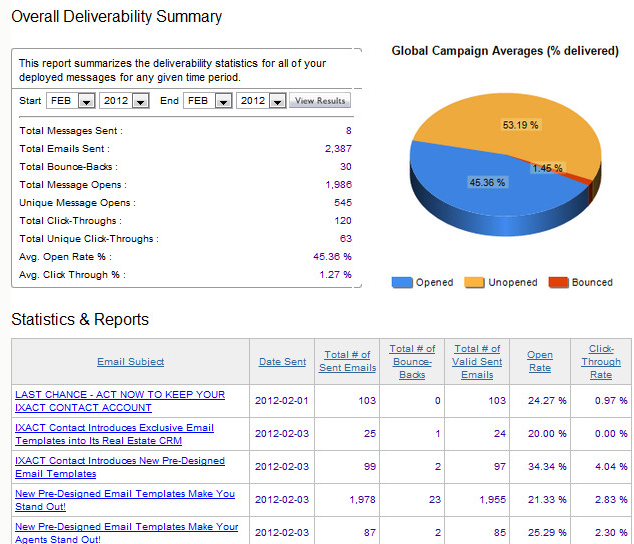
Below is a sample e-Newsletter through the IXACT Contact system (note that reduced image quality is on our end due to compression and does not represent the aesthetic quality of the e-Newsletters):

Construction spending up, now adding to the economy

Construction spending increases

According to the U.S. Commerce Department, construction spending rose for the second consecutive month, up 0.3 percent for the month, with government spending falling while new home construction and commercial construction continue increasing.

Residential construction jumped 2.8 percent in April to an annual rate of $256.1 billion, the highest level in six months. Some suggest this is another sign of stabilization in the housing market. Overall spending is up 7.6 percent above March 2011, when spending hit a 12 year low.

New home sales, commercial spending

New home sales rose 3.3 percent for the month, hitting its second highest level in two years, but sales remain at half of what economists consider to be healthy levels. Builder confidence has improved in 2012 after several years of borderline pessimism about the market, recently hitting its highest level in five years.

As builders find the bottom of the market, spending on commercial projects rose 1.0 percent for the month while office building spending rose 1.6 percent. Health care facilities saw a 2.6 percent increase in spending. These increases make up for the 1.4 percent drop in government building spending and a 5.0 percent dip in federal construction spending alongside a 1.0 percent drop in local and state construction spending.

The overall economy and housing

The Commerce Department notes that residential construction added to the economic growth in the first quarter of 2012, which grew at an annual rate of 1.9 percent, but unemployment remains at 8.2 percent, according to the Bureau of Labor and Statistics reporting Friday morning. It is projected that construction spending will continue adding to the economy for the first time in years, but gains are not expected to be dramatic.

Home sales had been basically flat from 2008 through 2011, but National Association of Realtors’ Chief Economist, Dr. Lawrence Yun recently projected that 4.6 to 4.7 million existing-home sales in 2012, up strongly from 4.26 million last year, and additional improvement in 2013 with sales rising to the range of 4.7 to 4.8 million.

Mortgage interest rates are projected to rise gradually and then average 4.9 percent in 2013 – still historically favorable. “The pressure of rising rents on consumer inflation could force the Federal Reserve to raise interest rates in 2014, which might be good for home sales. Refinancing would fall and bank staff would be able to focus more on mortgage origination for home purchases,” Dr. Yun said.

Jux adds major upgrade: infinite sites under one account

Jux adds new feature

In a move that comes from rising demand, beautiful blogging platform, Jux added a significant upgrade this morning by allowing people to manage an infinite number of Juxes from one single account. We’ve written about Jux extensively, and have showcased how businesses are using them, and this new feature falls in line exactly with what the largest need currently is.

The company says, “The idea is simple. People have lots going on. Especially Juxers. They take multiple adventures. They may be into food and timelapse videos. Photographers tackle more than one subject. Writers have more than one book idea. Real estate agents have more than one property for sale.”

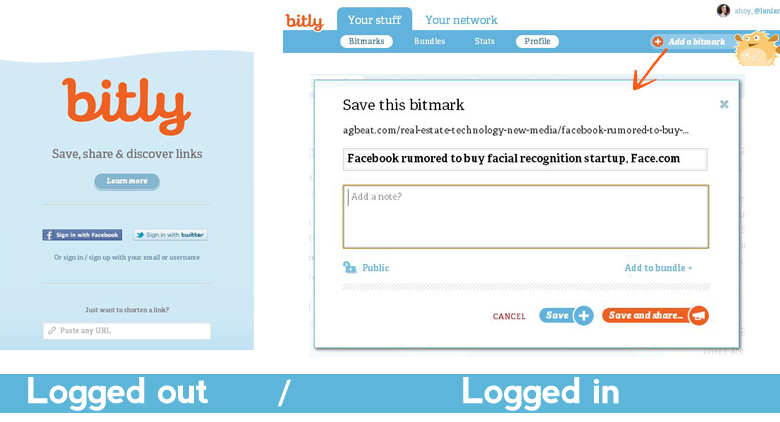
[ba-pullquote align=”right”]Jux points out that unlike multiple Tumblrs or WordPress blogs, all Juxes are in one place, and unlike tags, categories, or Pinterest boards, each Jux has its own identity.[/ba-pullquote]The way it works is that when users go in to add a photo, quote, or link (see image above) to their current Jux site, a “New Jux” is one of the simple options, and with a few clicks, a user can begin adding new content, title, and description and are off! The look defaults to the style of your last Jux as a smart default, but can be customized from that point on – this is a huge time saver for companies looking to keep their Jux sites consistent.

When you’ve added more than one Jux, your home page morphs into an overview of all of your Juxes, or you can hide the linkages and treat each Jux as an independent work. Jux points out that unlike multiple Tumblrs or WordPress blogs, all Juxes are in one place, and unlike tags, categories, or Pinterest boards, each Jux has its own identity.

Adding multiple Juxes is perfect for brands that need a separate site for talking about and displaying their team, their products, and their industry, but are looking to have all of those separated differently than tags, without having the hassle of setting up an entire website.


How to turn any bottle into an iPhone or camera tripod

Photographing on the go

With so many photo sharing apps and the excitement surrounding visual based sites like Pinterest, professionals are scrambling to find ways to simplify the process of taking and sharing photos so that it is not expensive or time consuming. While your competitors go out and buy thousands of dollars worth of equipment, here is a quick and inexpensive hack that will help you get better pictures from your smartphone while in the field, without having to carry around giant devices.

Tool one: the Glif

The Glif is a minimalist iPhone 4 stand that doubles as a tripod mount with a 1/4″-20 thread so that it works with any tripod you already have (saving you money), and as shown below, it fits on a key chain and in any pocket, and is said to be nearly weightless. The company has thought of all the details, even sending it in a box that acts as a tripod.

The photos below do the explaining best:


Tool two: Bottle Cap Tripod

Now, the Glif and/or the box it comes in might be enough for you, or at least a good place to start, but if you want to combine it with the Bottle Cap Tripod, you’re in for a treat. The Bottle Cap Tripod mounts on to any standard water or soda bottle and pivots up to 15 degrees in any direction.

The gadget is extremely light and portable, and has a universal tripod socket, and the company notes that it works best with the bottles are at least halfway full, especially if you’ve opted to use the Tripod with a point and shoot camera rather than your smartphone.

Again, the photos below do the explaining best:


iPhone or no iPhone

Whether you have an iPhone or a traditional camera, you can whip out your Bottle Cap Tripod and pivot that camera all about, and you’re saving time and money while you quickly snap great shots to share on your blog, Pinterest, Flickr, or even Facebook. Genius!

Resistance to Zillow’s new agent websites mounting

Zillow agent sites launch to mixed reviews

Just one day ago, Zillow announced “Premier Agent Websites,” a WordPress solution powered by Diverse Solution’s IDX, at $10 per month for non-Premier Realtors, and free for Zillow Premier Agent program subscribers.

The launch has seen mixed reviews, with some noting that it is a good place to start, while others question Zillow’s methods and motives. Zillow is not the first company to offer websites to agents, in fact, templated sites have been around for decades, but with the integration with Diverse Solution’s IDX and use of the WordPress platform, the offering is in most aspects more high quality, and setup is simple and streamlined, easy for any agent to understand.

[ba-pullquote align=”right”]”You see one template site, you’ve seen them all whether it’s Z-57, Advanced Access, Superlative or now Zillow.” -Jonathan Dalton, Realtor[/ba-pullquote]Jonathan Dalton, Realtor at Thompson’s Realty in Arizona weighed in, noting that “These websites can serve as useful tools at an affordable price for real estate agents looking for a rather quick and easy IDX and internet solution. It’s not one I believe more experienced online agents would prefer as most of us learned long ago that template sites tend to brand the template creator nearly equally as the agent. You see one template site, you’ve seen them all whether it’s Z-57, Advanced Access, Superlative or now Zillow.”

“Template-driven monotony aside,” he added, “I see two potential drawbacks. The IDX listings come with an inherent headache with the inclusion of Zestimates whose inaccuracy buyers’ agents have had to explain to unsuspecting buyers since they first created – that Zillow remains so married to its own flawed Zestimates to this degree even as it branches out beyond them is surprising given the known issues with the numbers.”

Dalton continued, “Secondly, if these IDX feeds also are being indexed the same as the more robust Diverse Solutions IDX products, I’m not certain why agents would be inclined to pay the much higher price for DS. More customization is possible, but if SEO is the end goal, I would question whether the means are justified at the significantly higher price.”

Issue one: exporting and importing content

The fine print is not obvious yet, but what was immediately obvious is that the company had turned off the default WordPress settings that allow agents to export all of their content from blog posts to comments, in the event they wish to move to their own hosting scenario, or to another platform.

[ba-pullquote align=”right”]”We didn’t launch Premier Agent Websites with export functionality for simplicity sake.” -Zillow[/ba-pullquote]Zillow told AGBeat, “We didn’t launch Premier Agent Websites with export functionality for simplicity sake. However, we received a lot of requests for this feature, so the beauty of an online service and a stellar, fast-paced team allowed us to make it happen very quickly. We’ll continue to add more functionality over time based on customer feedback. Now agents can chose to export posts, pages, community pages or all content, which includes posts, pages, comments, custom fields, terms, navigation menus and custom posts.”

The company will also soon add an import feature, but it is suspicious that the export function was turned off in the first place. One source told us that because of such a major oversight or choice to exclude the option to give agents an escape button, the fine print should be analyzed by all agents prior to giving any controls to a third party, particularly one that some see as competitive with the Realtor brand.

Issue two: Zestimates on all search results

Also receiving mixed reviews is the fact that each listing on an agent’s site is data presented through the IDX, thus directly from the original source, but on the same page as the current listing price is a Zestimate, a feature that does not appear to be optional. Professionals with Zillow agent sites will be subject to whatever their consumers think of Zestimates, positive or negative.
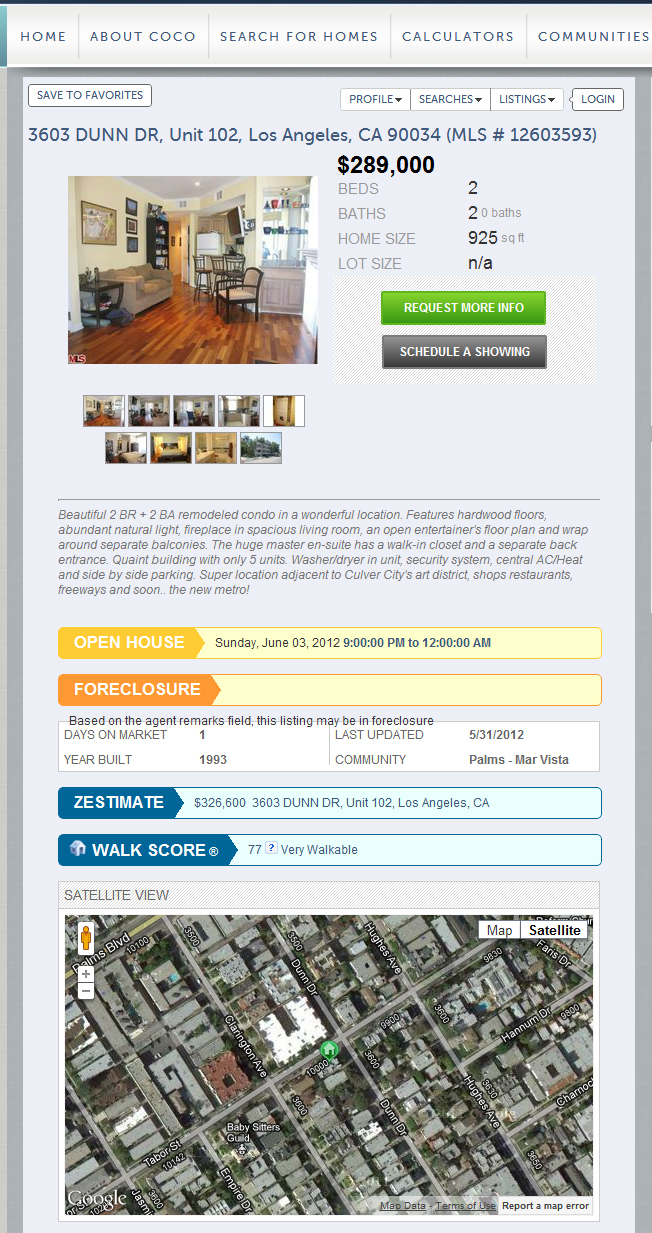

Listing details cut out of the image above for brevity, click to visit the original listing.

[ba-pullquote align=”right”]”We also include numbers from a few other automated valuation models, and our own recommendations for gauging the value of the home based on comparables that the user can evaluate for himself.” -Glenn Kelman, Redfin CEO[/ba-pullquote]Redfin CEO, Glenn Kelman told AGBeat, “Redfin has published IDX and VOW data alongside the listing’s Zestimate for five years, so I’m not sure what is new about this? We also include numbers from a few other automated valuation models, and our own recommendations for gauging the value of the home based on comparables that the user can evaluate for himself.”

The major difference between a brokerage like Redfin publishing Zestimates and agents is the awareness level of what the data is, means, and how it is being used and perceived. Grandma Realtor goes to a conference and hears that for $10 per month, she can have the sexiest Realtor website alive, and she is the least likely to understand the history and ramifications of Zestimates, in fact, may not even know what that is, or do more than click “buy” and let the site do its thing.

The level of understanding of risk differs between Redfin, or brokers who choose to implement the Zestimates alongside every single listing, and independent agents who can barely check email and are just looking to get a web presence because the gurus have told them they’re dead in the water without it.

Issue three: links to Zillow on all search results

What was immediately obvious to us was that every listing in search results on an agent’s new website not only has a Zestimate, but next to the Zestimate is a link to the listing on Zillow, also a feature that does not appear to be optional.

It is brilliant on Zillow’s part to do widespread link building a thousand times over, but unsuspecting agents may not be aware that every listing on their site points to Zillow and gives users a reason to leave, rather than keeping them on the site.

Austin Realtor and Co-Founder of Displet, Eric Bramlett said, “The new Zillow sites are completely decent. They’re obviously a loss leader for the company, so you have to ask yourself what the motive is. In this case, I think it’s increasing their Premier Agent subscriber numbers & increasing exposure of Zillow through badges, logos, and links. It looks like a good move for Zillow and a good, cheap product for agents, if they’re okay with entire value proposition.”

Do agent sites put Zillow one step closer to becoming a brokerage?

[ba-pullquote align=”right”]”The question the agents would surely tire of answering is why on earth do they prominently feature the obviously ludicrous Zestimate?” -Jeff Brown, Investment Broker[/ba-pullquote]Investment Broker, Jeff Brown shared his suspicions with AGBeat, noting that “This is a huge win, at least not a loss, for Zillow. The agent either wins new clients, or is made to look silly, which could indeed drive the customer to Zillow’s future real estate brokerage? The question the agents would surely tire of answering is why on earth do they prominently feature the obviously ludicrous Zestimate? Or, why are they listing the property so far under market value? If I was still on the house side of the business, I’d be disappointed in anyone whose thinking I’d previously respected, opting to participate. Somebody, anybody, please show me what I’m missing.”

Brown added, “Furthermore, if I ran Zillow, when I opened my brokerages around the country in the best markets, I’d never join any MLS. Almost immediately we’d be known as the company ‘with all the listings’. Contrary to the opinion of those born after the ice age, buyers don’t give a tinker’s damn about who has the inventory. They care only about finding THEIR new home. Zillow Real Estate will make it exceedingly easy for them to find. The ‘post ice agers’ will think this is something new under the sun, when instead it’ll be a real life, real time real estate sequel to Back to the Future. This can happen, and a whole lot easier than most may think.”

Zillow says they have no intention of acting as a broker to any real estate deal. Despite statements like this in the present and the past, some still believe the company could change their mind.

Update: Zillow said on May 4, 2012 to AGBeat, “We dropped all licenses in 2008, except for Washington and Texas. Since then we dropped Washington and retain Texas. We decided to keep the license in Texas because it is a non-disclosure state so having the brokerage license allows us to access certain data which helps us produce Zestimates.”

A fast moving company

As Zillow alluded to, they are a fast moving company, so they’ll pivot to address user concerns, and they have already addressed the first issue, but it remains unseen as to whether the remaining two dilemmas are features the company is willing (or able?) to alter, which could potentially hurt adoption rates of their website feature, despite that ridiculously great price tag, and some are asking who benefits the most when agents set up their sites – agents or Zillow?

Fascinating entrepreneur’s tale of bridging East and West

A quickly obvious contrast

When you first meet Monica Moffitt, you can’t miss her smile, it is brilliant and sincere, and it lights up any room, so when this tall, young, African American gal shakes your hand and hands you a business card, the contradiction that is Moffitt becomes immediately evident, as her Texan smile contrasts the Chinese characters all over her card. She’s used to the curiosity, and I could tell she almost enjoyed it when I looked up from her card to her face. I was immediately fascinated.

Moffitt is the founder of Tianfen Consulting, a cultural consultancy which separates itself from other consultancies by being more than just an HR branch for Western companies trying to branch out into the East and vice versa, no, the team handles general management, human resources, marketing and general business, emphasizing the nuance of the human to human business interactions.

Her company helps small to medium businesses into the Asian and American markets, and helps them to understand everything from how to hold a meetings, professional protocol, and entry routes. Moffitt is one of perhaps 100 people in America that works in an extremely tiny specialized niche, helping high net worth individuals in Asia to take advantage of the EB-5 visa for immigrant investors which is a method of obtaining a green card for investing at least $1,000,000 in America, creating at least 10 jobs.

What most Americans don’t know about the Chinese

Moffitt says that there are two primary traits of the Chinese people that most Americans are not aware of. First, she says that they really do understand American culture, and the majority will speak English to you on the street, and will often ask you your thoughts on current American politics.

She notes they are the “friendliest people on the planet,” which she says confidently, having traveled all around the globe, visiting nearly every continent. “It’s like southern hospitality times one thousand. If you are lost and ask someone on the street where to go, even if they’re late for work, they will physically walk you there themselves.”

When she lived in China for the first time and told people she was from Texas, she said with a chuckle that they always ask two things – “do you like Bush, and do you know Yao Ming?”

Moffitt confessed that like most Americans, when she first visited China, she had a preconceived notion that she would be a giant and would be the only black person, but she was surprised to find that she didn’t stand out the way she had feared, as there is quite a large African population in China, which is where people often assumed she was from.

From business analyst to entrepreneur

If you’re not already intrigued by Moffitt, there’s more – her background reads like an Aaron Sorkin movie about an Ivy Leaguer who followed her dreams. Her mother was fascinated with Japanese art, and gave Moffitt a Japanese middle name, so her affinity for Asian cultures started at an early age. Although she consults on all Eastern nations, she speaks most frequently about China, and she narrowed down her affinity when her best friend dared her in high school to dump Latin classes and take Chinese, to which she said, “I will if you will.” Her friend dropped it, but Moffit just kept going with her studies.

After graduating from a prestigious private school in Dallas, Moffitt sought to be a neurosurgeon and “save the world,” adding “that was always the plan.” She went off to Vanderbilt and began studying to become a neurosurgeon, but she continued pursuing her Eastern Asian studies. When she flirted with the idea of dropping neurosurgery, her father was conflicted, and her mother encouraged her to follow her heart.

So she finished Vanderbilt with a BA in East Asian Studies and Chinese, moved to China, and at age 21 began teaching at a University where the students were all a year or two older than her. Due to a family illness, Moffitt moved back to Texas and took what she intended to be a short term job before she left for China once again, but she spent six years excelling at an international IT firm as a business analyst for global software. Her mentor at the IT firm mentioned to her that the company offered tuition reimbursement, so Moffitt enthusiastically asked if she could get her PhD in Chinese Literature, but was met with a stern “no,” so she settled for pursuing her MBA from the University of Texas at Dallas.

Moffitt discovered that UTD had a very specific program, International Management, which differs from the standard International Business programs, in that it focused on the people side of the business, and human organization development. She finally found a way to combine her psychology and neurosurgery background (the human side) with her cultural and language studies (the cultural side) in the form of a MBA (the business side) to specialize in marketing and consumer behavior across international boundaries.

With her MBA in hand, Moffitt left the corporate world and launched her consulting firm, and as she handles Eastern nations, and one of her partners handles Latin America, the firm has an impressive global footprint, all because of a high school dare and an offer for tuition reimbursement.

Facebook Pages: schedule posts into the future

New Facebook Pages feature

One of the biggest frustrations of people managing one or multiple social media presences is when a major social networking platform like Facebook does not allow scheduling of messages, thus requiring live updates and reducing efficiency. Today, Facebook has announced that Page administrators may now schedule posts for the future, as well as add updates to the past, just as personal Timelines for users have offered since Facebook launched the Timelines.

Not only is this an effort to make consistent the features of Facebook offered across personal profiles, Pages, and Groups, it is one way that the company can cut out third party apps (like HootSuite, TweetDeck, etc.) as currently, the scheduling feature is limited to Facebook.com only.

Updates can now be scheduled up to six months in advance at 15 minute intervals each.

How to schedule posts into the future


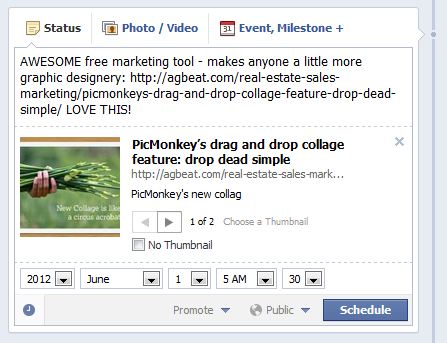
Although it seems like it would be extremely obvious how to schedule a post on a Facebook Page into the future, but it is less than intuitive. To schedule a post into the future:

  1. Go to your Facebook Page and type out your update.
  2. Then, at the bottom of the status update, click the tiny grey clock icon.
  3. That will then produce a small blue link that says “Add year,” which you should click.
  4. If you have not told your Page what year your company was founded, it will make you do that first. Note: for us, when we went through this process, it lost our update and we had to start again. 
  5. After you add the year (2012, of course), it will produce another small blue link, “Add month,” click and select.
  6. Then, another link will come up, “Add day,” “Add hour,” then “Add minute.”
  7. Schedule it into the future, and click the blue “Schedule” button when you are finished.

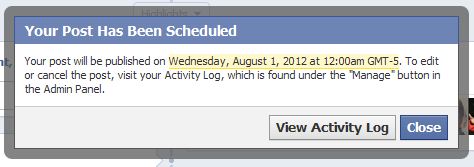
When you have completed a future status update, you will see a pop up similar to this:

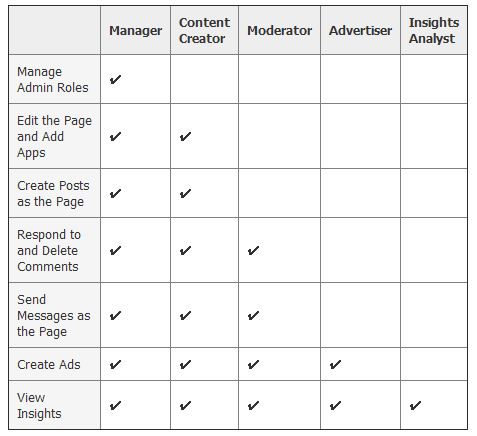
Additionally, Facebook outlines permissions that admins can now set for other team members:

FHA foreclosure starts spike an alarming 73% in April

Foreclosure starts fall in April

According to the April Mortgage Monitor report released by Lender Processing Services (LPS) Thursday, overall foreclosure starts fell 2.6 percent in April, with FHA foreclosure starts spiking an alarming 73 percent during the month, which LPS says “was driven primarily by defaults in 2008 and 2009 vintage loans, though all FHA vintages saw increases in foreclosure starts in April, despite that fact that the more recent vintages – from 2009 forward – have shown improved relative credit performance.”

“In 2008, when the loan origination market virtually dried up, the FHA stepped in to fill the void,” explained Herb Blecher, senior vice president for LPS Applied Analytics. “FHA originations tripled that year, and increased to five times historical averages in 2009. High volumes like that, even with low default rates, can produce larger numbers of foreclosure starts. That represents a lot of loans to work through – the 2008 vintage alone represents some $14 billion of unpaid balances in foreclosure, and the overall FHA foreclosure inventory continues to rise.”

The April data also showed that foreclosure sales continue to remain low nationally, decreasing 2.6 percent month-over-month, and with volume that remains about one-third that of foreclosure starts. Foreclosure sales in non-judicial states dropped 2.0 percent, and those in judicial states remained basically flat, down just 0.01 percent over the month. Even those states that saw increases in foreclosure sales saw only incremental increases in terms of real numbers, and all were still far below pre-moratoria levels.

Total loan delinquency rate at 7.12 percent

LPS reports that the total U.S. loan delinquency rate is 7.12 percent, up 0.4 percent for the month, as the total foreclosure pre-sale inventory rate hitting 4.14 percent, the same as the month prior.

Just as in months prior, Florida, Mississippi, Nevada, New Jersey and Illinois continue to have the highest percentage of non-current loans while Montana, Alaska, South Dakota, Wyoming and North Dakota continue to have the lowest percentage of non-current mortgages.

PicMonkey’s drag and drop collage feature: drop dead simple

PicMonkey’s new collage feature

As online photo editing tool Picnik said their final goodbyes, long-time users were forced to seek out alternatives, and PicMonkey has already emerged as a sexier, faster version of Picnik, grabbing Picnik defectors. Currently completely free, PicMonkey is a more intuitive version of an already intuitive photo editor, which makes perfect sense as some of the original Picnik developers launched PicMonkey.

The service has now launched a new “collage” feature which allows anyone to drag and drop uploaded images into an array of layouts, either pre-set or custom, and gives users complete control of spacing between images, whether or not image corners are rounded, and even control over what the background color is, including a color dropper (click the dropper icon and hover anywhere over an image in the collage and the background will change to that exact color as you hover around), and even a transparent background.

The controls are extremely simple and limited so you are never overwhelmed with options. It is advisable to use PicMonkey to edit each picture independently before uploading them to collage, so that you have the color right, or add words as you wish.

The collage feature is perfect for print flyers, blog post images, sidebar ads, and the like, and is perfect for any professional on a budget that can’t quite afford a talented graphic designer (yet).

Below are some screenshots so you can get a feel for how simple the collage feature is (click any image to enlarge):


And the final product:

The above images were from a 60 second session on PicMonkey, and in no time, we had a series of images pulled together that would work perfectly for an email header, flyer, or blog.

Bonus: make a Facebook cover photo

Let’s face it, designing a Facebook cover photo is not easy without Photoshop or one of those services that puts their URL all over your pictures. PicMonkey has a built in feature with the exact measurements for Facebook cover photos, and gives you several layout options so your photo doesn’t look like everyone else’s on the planet. Genius!

One in four homes sold in Q1 were distressed properties

Short sales and foreclosures

According to RealtyTrac, one in four homes sold in the first quarter of 2012 were distressed properties, reaching 26 percent of all sales, up from 22 percent the previous quarter. RealtyTrac data also reveals that foreclosure homes sold for an average of $161,214, a 27 percent discount compared to non-distressed homes sold. Short sale homes accounted for 12 percent of all homes sold in the first quarter, for an average price of $175,461, the lowest level since RealtyTrac began tracking foreclosures seven years ago.

“Foreclosure-related sales picked up in the first quarter, particularly pre-foreclosure sales where a distressed homeowner is selling to avoid foreclosure — typically via short sale,” said Brandon Moore, chief executive officer of RealtyTrac. “Those pre-foreclosure sales hit a three-year high in the first quarter even as the average pre-foreclosure sales price dropped to a record low for our report.”

Moore continued, “Meanwhile the average price of a bank-owned home is stabilizing and even increasing in some areas where a slowdown in REO activity over the past year has resulted in a restricted supply of REO homes available. Still, REO sales did increase on a quarterly basis in 21 states, indicating that lenders are still working through a bottleneck of unsold REO inventory in many areas.”

Processing times, regional performance

During the first quarter, it took an average of 306 days to complete a short sale, and 370 days to process a foreclosure. “Lenders are approving more aggressively priced short sales, which in turn is resulting in more successful short sale transactions,” Moore said.

As short sales and foreclosure sales rose in the first quarters, REOs fell 15 percent over the year, accounting for only 14 percent of all sales during the period.

Nevada, where housing bubbled during the boom and sank during the bust, had more distressed property sales than any other state, followed by California and Georgia, RealtyTrac said.

Among the nation’s 20 largest metropolitan statistical areas, those with the biggest annual increases in pre-foreclosure sales were Atlanta (78 percent), Detroit (75 percent), San Antonio (74 percent), Sacramento (70 percent), and Dallas (69 percent).

Metro areas with the biggest annual increases in REO sales were Minneapolis (33 percent), Boston (30 percent), Philadelphia (22 percent), Atlanta (15 percent), and Chicago (13 percent).

Zillow launches WordPress sites for real estate agents

New WordPress websites for agents

Zillow has announced the launch of “Premier Agent Websites1” which are customizable template websites for real estate professionals. The cost is $10 per month, or is free for Zillow Premier Agent program subscribers. The company touts ease of set up, alluding to agents not being required to be tech savvy.

Now making full use of their 2011 acquisition of IDX company, Diverse Solutions, agents can add an IDX feed from the MLS to offer site visitors real estate search, and while some MLSs charge a fee, Zillow says IDX comes standard with their sites and they do not take a cut. The company says the acquisition of Diverse Solutions “allowed Zillow to accelerate this important initiative to help real estate agents better market their business online.”

“It’s incredibly important for real estate agents to have a Web presence, but building and maintaining a custom website with local IDX feeds is often time consuming and complex,” said Jay Thompson, director of industry outreach and social media at Zillow. “We created this product for the tens of thousands of agents in our Premier Agent program, as well as any agent who wants an easy and affordable website for only $10 a month.”

Domain names, customization, and widgets

Zillow notes that the websites are designed for agents that do not have their own websites, and add that it could be an option for agents who wish to improve their current website. They also offer a personalized domain name at no additional cost, and the ability to add custom content through widgets, such as a blog, videos, mortgage widgets, school information and photo slideshows.

This announcement puts Zillow one step closer to being a complete marketing solution for real estate professionals which appears to be their goal, after announcing a free customer relationship management (CRM) platform that manages leads coming from the website, acquiring Postlets and Diverse Solutions, and now putting a pretty bow on the package by offering agent websites.

While this will not be a solution for all agents, and it is ideal for an agent to own and control their own web presence with no third party involvement, it is an inexpensive option for agents just starting out. It is unclear what kind of data Zillow will collect from these sites or what they could potentially do with it, but it is a smart long term plan for the company looking to compete more directly with Move, Inc., operator of Realtor.com and Top Producer.

[ba-youtubeflex videoid=”JcIvyVrjp0g”]

1 Zillow Agent Websites

Walmart stores and home prices: surprising new study

Revolting against Walmart

It is common for picket signs to come out when a Walmart is shopping for land in any city, as the mega corporation has a reputation for putting Mom and Pop local stores out of business, pushing wages down in an area, punishing the environment with a massive footprint, and destroying home values as it shifts an area’s demographic.

CNNMoney1 has outlined a new study by economists Devin Pope at the University of Chicago and Jaren Pope at Brigham Young University that reveals2 new Walmart stores may actually improve home prices near the store.

The report analyzed over 600,000 housing transactions nearby 159 new Walmart stores, which showed that homes within a half mile of a new store saw prices increase between 2.0 and 3.0 percent, an average of $7,000 in the two and a half years after a new Walmart store opened. Homes between a half mile and one mile away experienced price increases between 1.0 and 2.0 percent, an average of $4,000. The report notes that over one mile away, and the increases were “statistically insignificant.”

The report analyzed the pre-housing crash era, looking at transactions between 2001 and 2006, but did not include rural areas where housing data was unavailable, so further studies are definitely merited.

Conflicting data

Although the research done by the two economists show a positive correlation between home prices and Walmart store openings when compared to homes not close to a Walmart, the study disclaims that new stores may actually pull down prices, so while they released a conclusion, it still appears to be inconclusive.

“It was not until after the announcement and during the building process that we see homes close to the Walmart start to increase in value relative to homes that are slightly further away,” the authors said. “This suggests that it was the building of the Walmart itself that caused the change in housing values that we find, and that our results are not simply explained by Walmart building in areas that are experiencing housing price increases.”

According to CNNMoney, “Some studies show for example, that Walmart’s low prices often raise the household wealth of poor, and particularly, minority families considerably. Other studies show that new Walmart stores lower average wages and reduce the number of retail jobs in an area.”

1 CNNMoney report
2 Walmart and home prices

NerdWallet: business credit card comparisons, reviews

Choosing a credit card for your business

No matter how long you’ve owned and run your own business, you’ll eventually need to get a business credit card or two. It’s a natural step in the process, and an exciting one at that. But the sheer number of choices you have when it comes to credit cards can become instantly overwhelming and stressful, not to mention that looking up each card will be incredibly time-consuming. Instead of manually comparing hundreds of available cards, let NerdWallet do the work for you.

NerdWallet collects data on thousands of credit cards and creates relevant and useful comparisons for you. NerdWallet even compares multiple features at once, including card reward programs, interest rates, balance transfer and annual fees, and even how to earn the most airline miles for everyday business purchases.

It’s easy to get started; just fill out a simple, short questionnaire about what you need in a business credit card, and NerdWallet will provide you with pages and pages of applicable cards. For each card that is listed, you can choose which ones are worth your time to explore further by viewing the offer details, all without leaving your page of results.

Reviews and comments about credit cards

One feature that makes NerdWallet’s services unique is that other business professionals can leave reviews and comments about each credit card. Often, an involved conversation begins between NerdWallet users, so you’re sure to get real stories from real professionals. Sorting through the offer details and the user reviews can give you a clearer insight into what you’re looking for in a business credit card, and you don’t even have to do any of the legwork.

NerdWallet’s blog actually lists and details the four best corporate rewards cards for biz pros. The card currently ranked as number one is the Chase Ink Card. Here is an example of the type of researched reviews you’ll receive from NerdWallet:
[ba-quote]“The Ink by Chase has a lot to offer, from a crazy-high signup bonus to ongoing rewards to a full year of no interest. For starters, the signing bonus is worth $250. The ink charges no annual fee and earns rewards in 5% bonus categories….You will qualify for the $250 signing bonus when you spend $5k within the first 3 months. Additionally, they grant a 0% APR for 12 months, ideal if you need to make some purchases that will take a little time to pay down. If you don’t like fees, don’t like interest, but DO like rewards, the Chase Ink is an affordable and highly rewarding option for entrepreneurs.”[/ba-quote]

Finding the right business credit card for your professional life is easy, thanks to NerdWallet’s dedication to providing easy-to-understand and comprehensive overviews of each available card. Simply compare the cards that fit your specifications, apply right on the website, and get back to work. There’s no need to spend hours researching on your own because that work has already been done by NerdWallet.

When customers threaten to post negative Yelp reviews

The state of online reviews

It is a common behavior for brands to pay for positive online reviews or offer discounts and free goodies, and the same often goes for consumers removing negative comments. Many online review sites have taken extensive steps to attempt to secure valid, untainted reviews so consumers have unfiltered opinions about goods and services, but the system is not perfect, it is subject to offline behavior as well.

According to CBS Sacramento, a restaurant says a customer claimed he got food poisoning from the venue, sought a refund, learned there are no refunds, but was offered a refund in the form of a gift card that could be used at any local restaurant.

In response, the man allegedly threatened to post a horrible review of the restaurant on Yelp unless the restaurant coughed up a $100 gift card. “I’ll be doing a scathing review on you on Yelp… and I’ll report you to the health department. But if you give me a $100 gift card, then I won’t do it.”

The restaurant owner refers to the demand as “flat-out extortion,” and refused to budge. The customer has not received his demanded gift card, nor has he posted the negative review. “I hope this inspires other retail establishments and restaurants to push back on extortion,” he said.

How other small businesses can combat threats

Everyone now knows that they have a voice online and that it is relevant – after all, people trust strangers online as equally as they do their own family members now, and particularly trust online reviews over a brand’s voice. This is empowering and in rare events, the new empowerment has caused people to attempt to abuse their voice in exchange for a payoff.

Public relations expert, and founder of Silver Strategic Communications, Bob Silver said, “This sort of thing is inevitable for any business that engages consumers and encourages social interaction through peer reviews and user generated content. People are going to be people and pricks are going to be pricks.”

Silver added, “These guys handled exactly the right way. Proactively called the bluff of the unhappy customer, made the story public on their own terms and by doing so, set the public perception by being open and willing to engage in the discussion. Everyone’s going to be a critic these days and face it, you’re never going to make everyone happy. So do your best to participate in the public conversation openly, honestly and without being defensive. It may be painful at times, but you’ll benefit in the long run.”

An alternative response

Some will tell you that the customer is always right and that appeasement is the proper route, but Silver asserts that engaging in discussion is the most beneficial in the long run, even though it is difficult.

Christopher Barger, SVP of Global Social Media, Voce Communications/Porter Novelli, and author of The Social Media Strategist suggests three steps.

Barger said, “First, some preventative maintenance: have a presence on relevant networks. Interact with reviewers, both those who love you and those who are negative. Make sure the community gets to know you and trust you. You’ll have a hedge against manufactured negativity if you’ve earned the trust of the community.”

“Second,” he added, “also preventative maintenance: Develop your own “owned” presence online. Make it a blog or something outside of Facebook’s walled garden, something that will show up in search. You need a place to tell your story in your own words. But you can’t just start it up when you have a problem, you have to be out there before there is an issue.”

“Third: When faced with an extortion situation like this, I’d fight fire with fire,” Barger said. “Tell the story of what’s happening to you on your blog. You might well even name names to make sure that everyone who reads (including other small business owners in your field) knows who this person and what they’re about and what they tried to do. Make sure that you include a line in the post telling readers to feel free to share the link or the story. Tell the story or post the link within Yelp or whatever the network is. Be proactive and make the reviewer’s conduct the story, rather than letting them set the story arc and define the situation for you. This is especially something I would do if I had an email or IM or something in writing that could prove my side of the story.”

The risk and reward of being proactive

Barger notes, “Yes, you’ll risk people thinking that you’re picking on a customer or using a bully pulpit. But I’ve found that most bloggers and online reviewers have an innate sense of fairness, and this kind of a story will disappoint and anger them as much as it does you. Additionally, in my experience, bloggers and reviewers realize that brand bullying, when it happens, paints the entire online community by association, gives them all a bad name, and lessens the likelihood that businesses will be willing to work with anyone online or reach out to any of them in the future.”

“Many of them will quickly shun or disown the bad apple out of their own self-interest,” Barger added. “And whether the person ends up posting or not, you will have cast enough doubt on their story by going out first that the bite of their negative review might be lessened.”

Apartment design trends: urban areas, blending spaces

Emerging trends for apartment living

According to a panel of experts pulled together by the National Association of Home Builders (NAHB), while location of an apartment building remains the most important feature for renters when choosing where they live, key market trends in interior, exterior and outdoor living are emerging, alongside how generational differences are having an impact on apartment design.

Multifamily builders and developers are focusing more on urban projects that are near public transportation hubs as Millennials, the largest segment of the renting population, want to spend less time commuting and more time creating a balance between career and lifestyle.

“It’s all about the lifestyle for today’s renters. They want the urban experience of less commute time and immediate access to various activities,” said Jeff Kayce, vice president at Bozzuto Development Company and one of the webinar’s presenters. “Because of this, many developers are building near transit hubs and along transit lines.”

Trending design features in apartments

The NAHB panel noted that the design of common areas are shifting to meet demand, and areas are being designed to have one space bleed into another, creating a more open feel. “In the previous design cycle we saw separate, distinct rooms,” said Rohit Anand, AIA, and principal of the KTGY Group. “Now we have the computer room, media center and lounge all part of the same room, for example. This type of design helps foster interaction among residents.”

A focus on fitness also remains a top priority, but fitness center design has changed in recent years – it is no longer a dark room overlook the parking lot, say the panelists, rather the size has increased to closer to 1,500 square feet with emphasis on the view from the center. Fitness centers now have high quality equipment, and renters are looking for yoga and Pilates areas within the fitness center when apartment hunting.

Following the trend of bleeding spaces into one another, an emerging trend is blending outdoor and indoor spaces, as apartment designers add heating or cooling elements to outdoor areas to make them inhabitable in all seasons.

The NAHB says that in specific locations, niche amenities like dog runs, pet washing stations, garden plots and bike storage/workshops are becoming more popular. The panelists agreed, however, that it is important for builders and developers to know their clientele before incorporating niche amenities like these.

1 in 622 mortgages were foreclosed on in the past year

66,000 foreclosures completed in April

According to CoreLogic’s National Foreclosure Report for April, 66,000 foreclosures were completed in April, virtually unchanged from March levels, but down substantially from April 2011’s 78,000 completed foreclosures. CoreLogic reports that since the housing meltdown began in September 2008, roughly 3.6 million foreclosures have been completed.

Approximately 1.4 million homes, or 3.4 percent of all homes with a mortgage, were in the national foreclosure inventory as of April 2012 compared to 1.5 million, or 3.5 percent, in April 2011 and 1.4 million, or 3.4 percent, in March 2012.

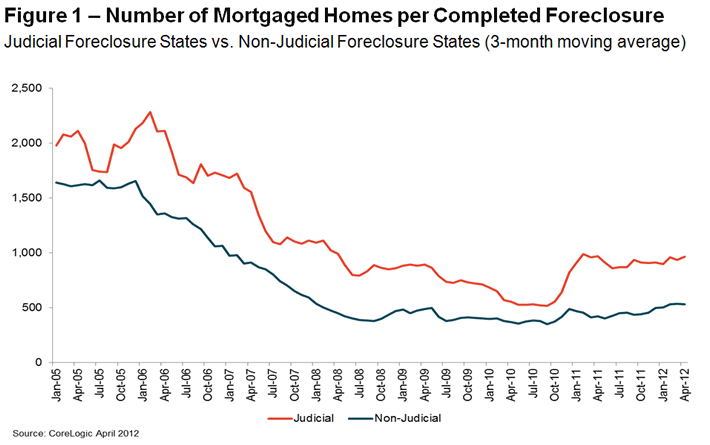
[ba-pullquote align=”right”]”There were more than 830,000 completed foreclosures over the past year or, in other words, one completed foreclosure for every 622 mortgaged homes.” -Mark Fleming, chief economist for CoreLogic.[/ba-pullquote]”There were more than 830,000 completed foreclosures over the past year or, in other words, one completed foreclosure for every 622 mortgaged homes,” said Mark Fleming, chief economist for CoreLogic. “Non-judicial foreclosure markets, like Nevada, Arizona and California, completed two and a half times as many foreclosures over the past year as judicial foreclosure states.”

“The inventory of homes in foreclosure in judicial foreclosure states is growing, but this increase is being more than offset by declining inventories in non-judicial states where the processing timelines to clear a foreclosure are shorter,” said Anand Nallathambi, chief executive officer of CoreLogic. “Nationally the inventory of homes in foreclosure decreased 0.1 percent from what it was a year ago at this time, and has leveled off over the first four months of 2012.”

Five states account for nearly half of the total

The five states with the highest number of completed foreclosures for the 12 months ending in April 2012 were California (142,000), Florida (92,000), Michigan (60,000), Texas (58,000), and Georgia (57,000). These five states account for 48.8 percent of all completed foreclosures nationally.

[ba-pullquote align=”right”]”Non-judicial foreclosure markets, like Nevada, Arizona and California, completed two and a half times as many foreclosures over the past year as judicial foreclosure states.”[/ba-pullquote]The five states with the lowest number of completed foreclosures for the 12 months ending in April 2012 were South Dakota (62), District of Columbia (162), North Dakota (541), West Virginia (598), and Hawaii (601).

The five states with the highest foreclosure inventory as a percentage of all mortgaged homes were Florida (12.0 percent), New Jersey (6.7 percent), Illinois (5.3 percent), Nevada (5.0 percent) and New York (5.0 percent).

The five states with the lowest foreclosure inventory were Wyoming (0.7 percent), Alaska (0.8 percent), North Dakota (0.9 percent), Nebraska (1.0 percent) and South Dakota (1.4 percent).


Mortgage application volume slips slightly

Mortgage applications fall for the week

According to the Mortgage Bankers Association’s (MBA) Weekly Mortgage Applications Survey for the week ending May 25, 2012, mortgage application volume is down 1.3 percent from the week prior. The results do not include an adjustment for early closings on Friday prior to the Memorial Day holiday.

The Refinance Index decreased 1.5 percent from the week prior, and the Purchase Index fell 0.6 percent during the same period. The refinance share of mortgage activity was unchanged at 76.6 percent of total applications.

The MBA reports that mortgage rates fell to a new survey low, and the adjustable-rate mortgage (ARM) share of activity decreased to 4.9 percent from 5.0 percent of total applications from the previous week.

Current interest rates

According to the MBA, the average contract interest rates hit new lows:

  • The average contract interest rate for 30-year fixed-rate mortgages with conforming loan balances ($417,500 or less) decreased to 3.91 percent, the lowest rate in the history of the survey, from 3.93 percent, with points increasing to 0.46 from 0.39 (including the origination fee) for 80 percent loan-to-value ratio (LTV) loans. The effective rate increased from last week.
  • The average contract interest rate for 30-year fixed-rate mortgages with jumbo loan balances (greater than $417,500) decreased to 4.23 percent from 4.25 percent, with points decreasing to 0.40 from 0.42 (including the origination fee) for 80 percent LTV loans. The effective rate decreased from last week.
  • The average contract interest rate for 30-year fixed-rate mortgages backed by the FHA decreased to 3.70 percent, the lowest rate in the history of the survey, from 3.73 percent, with points increasing to 0.59 from 0.57 (including the origination fee) for 80 percent LTV loans. The effective rate decreased from last week.
  • The average contract interest rate for 15-year fixed-rate mortgages decreased to 3.23 percent, the lowest rate in the history of the survey, from 3.26 percent, with points decreasing to 0.39 from 0.42 (including the origination fee) for 80 percent LTV loans. The effective rate decreased from last week.
  • The average contract interest rate for 5/1 ARMs decreased to 2.77 percent, the lowest rate in the history of the survey, from 2.83 percent, with points decreasing to 0.38 from 0.42 (including the origination fee) for 80 percent LTV loans. The effective rate decreased from last week.

Pending home sales drop in April, still up 14.4% for the year

Pending home sales (contracts) down

According to the National Association of Realtors’ (NAR’s) Pending Home Sales Index (PHSI), after three consecutive months of gains, pending home sales (contracts signed) fell 5.5 percent in April from March, but is 14.4 percent higher than April 2011.

Dr. Lawrence Yun, NAR chief economist, said a one-month setback in light of many months of gains does not change the fundamentally improving housing market conditions. “Home contract activity has been above year-ago levels now for 12 consecutive months. The housing recovery momentum continues,” he said.

Dr. Yun notes home sales are staying well above the levels seen from 2008 through 2011. “Housing market activity has clearly broken out at notably higher levels and is on track to see the best performance since 2007,” he said. “All of the major housing market indicators are expected to trend gradually up, but a new federal budget must be passed before the end of the year for the economy to continue to move forward.”

PHSI levels varied regionally

According to NAR:

  • In the Northeast, the PHSI rose 0.9 percent in April from March, and is up 19.9 percent higher than April 2011.
  • In the Midwest, the PHSI fell 0.3 percent for the month, but is 23.0 percent above April 2011.
  • In the South, the PHSI dropped 6.8 percent for the month, but is 13.3 percent higher over the year.
  • In the West, the PHSI fell 12.0 in April, and is 5.1 percent higher than April 2011.

NAR revises housing forecast

Despite April’s decline, NAR’s overall forecast for housing has been upgraded, with existing-home sales expected to reach 4.66 million this year, compared with 4.26 million in 2011. The outlook for 2013 is now 4.92 million, but could vary significantly depending on two scenarios.

The NAR says “if lending returns to normal, the 2013 outlook for existing-home sales would measurably improve to 5.3 million. However, a fiscal cliff scenario of higher taxes and sharp spending cuts beginning in early 2013, which is an unlikely event but still worth noting, would lower the sales projection to 4.5 million.”

Because of measurably lower inventory supplies, the forecast for home prices has been upwardly revised with the median existing-home price projected to rise 2 to 3 percent this year and 4 to 5 percent in 2013, with wide local market variations. Miami and Phoenix will easily achieve double-digit price growth by year end.

Yun said the price gains will measurably reduce the number of underwater homeowners. “For example, a 5 percent national price gain means the number of underwater homeowners would fall to about 9 million from current estimates of around 11 million. A 10 percent gain, say over the next two years, would reduce the underwater status to about 7 million households out of 75 million owner-occupied homes,” he said. Roughly 25 million homes are owned free and clear without a mortgage.

Though the proportion of distressed properties is still high, the numbers have been falling over the past two years. “The diminishing share of distressed properties is another reason for higher home prices in upcoming months,” Yun added.

Charring back patio: burning listings on the MLS?


A lot of listings went up in metaphorical flames this week, friends. Check out these bloopers and you’ll know why some listings are DOA. Thanks to Jane Peters of Los Angeles for being my ever-vigilant third eye.

I Smell Smoke

“Charring back patio” (Reason # 1 not to mix martinis and butane.)

“Open Sungay” – (Yay – another  West Hollywood open…good chance the agent will do my hair!)

“Lots oof stares” (Methinks they’re staring at the hole in your head.)

“Be careful – blond turn” (Well that explains the tire tracks and the mascara smears on the crossing guard…)

“Breezes and birds stinging” (Whimpered Magic Johnson when he lost his shorts to Larry Bird and the Celtics in the ’84 playoff games.)

I See Flames

“Sunset Blvd – orange house left” (No doubt it left after being cited for lack of taste.)

“$18000 deposit and last month rant” (With a deposit like that, I’d rant, too.)

“Spit rail fence” (Thank you for spoiling my lunch, Mucous Mary.)

“House turd  every Tues 11-2” (I divorced my house turd. I’m just sayin’…)

I Hear Fire Trucks

“Condo for leash”  (Isn’t it hard to walk it around the neighborhood?)

“English Tudor w/ high patched roof” (It’s your pitch that needs patching, pal…and p.s. – Are you high?)

“Newq lasting – red hot” (So is your head – I think it’s on fire.)

Last Words…

Fabulouse wrap around views…formal dinning room…Master Suit… salin pool  (I suggest you don your master suit, make your way through the din, drown yourself in the salin pool and enjoy the fabulouse views as you go into the light….)

Epitaph

“No balls after 8 pm” (Hollywood’s version of “Not tonight, honey – I have a headache.”)

That’s It for this week, folks. Remember:  Spell and Sell!

Convoluted copyright issues and real estate porn site profits

In part one and part two of AG’s series unveiling the broken chain of copyright ownership of real estate photos, awareness of the issue has caused a ripple effect with various entities arguing ownership of the copyright.

Here is how the chain of copyright ownership has become broken:

  • Some argue that a homeowner owns the copyright to all images created based on their property, but in no listing agreement that we are aware of does it say that photographs or likenesses of the listing remain the property of homeowners.
  • Others say the real estate photographer who took the images retains the copyright, but it depends on the contract (or terms included on a paid invoice) as to who owns the copyright, and if the Realtor who hired the photographer has a full license, limited license, or no license to the copyright (which would defeat the purpose of hiring a photographer). Many photographers give a limited license and spell out the specific allowed uses (entry into MLS, flyers, IDX, syndication, but not resold or repurposed).
  • Some say the listing agent owns the images because they paid for them, but as mentioned previously, that depends on the agreement between the agent and the photographer.
  • Other entities say the broker of the listing agent retains the copyright, as they are liable for all uses of the image, including misrepresentations.
  • This is where it gets complicated: some Multiple Listing Services (MLSs) outline in their Terms of Service that any images uploaded to the MLS transfers all copyrights to them, with the defense being that they must protect from scrapers and content thieves.
  • Some real estate syndication sites are even confused internally about whether or not they own the copyright.
  • Blogs that generate what is known as “real estate porn” by featuring sexy photos from the MLS, real estate listing site, IDX or elsewhere, often believe they have the right to use the content, but do not necessarily claim copyright ownership (rather seem to overlook its existence).

Each of these seven entities argues that they do or should own the copyright to all images of a specific listing, and each time a photo is uploaded then syndicated, it is questionable as to whether or not the uploader has the rights to transfer the copyright or not, depending upon their agreements.

Show me the money

While many of these entities are simply looking to protect the integrity of a real estate listing, other entities are less clear with their intentions. First Multiple Listing Service (FMLS), which was the catalyst for this series, uses the CoreLogic Fusion MLS product, which one source says is structured as FMLS sub-licensing (selling) to CoreLogic, which could be a reason for requiring a transfer (legitimate or not) of copyright ownership.

Another pain point for the industry is the “real estate porn” blog posts that take real estate photos and reuse them to increase traffic to the site and get more eyeballs on ads on the sidebars, none of which is likely shared with whoever the rightful copyright owner is.

Real estate porn – Trulia Luxe blog

First, take a look at Trulia Luxe, a blog devoted to high end listings with extremely high quality images by professional photographers. In this case, all images appear to be pulled from the Trulia website, as the listing has been syndicated to them. The blog post ends with a call to action to click to see the listing on Trulia and while the home’s designer and construction company were mentioned, there is no allusion as to who the broker or listing agent is.

“Once photos are on Trulia we have the rights to use them,” Trulia spokesperson Ken Shuman initially told us, “Per our terms of service, once photos are on Trulia we have the rights to use them,” but with further pressing, the legal department noted, “We get our pictures (and other content) from a variety of sources, including public domain sources, sources that license the content to us under our [sic] the Trulia feed agreement, and under licenses from real estate listings sources like brokers, listing aggregators, etc.”

The company’s Terms of Service says, “Trulia does not assert copyright or grant any rights to the underlying images or descriptions of real estate listings that may be contained in our search results and that we derive from the source Web site or information provided by the Web site owner. Trulia uses these images and excerpted descriptions solely as necessary to generate search results as a navigational tool to direct you to the originating Web site. Any use of the source images or descriptions is subject to the copyright owner’s permission and/or the requirements of applicable law. Trulia does assert copyright and reserves all right to the search results and associated compilations.”

There is clearly a conflict as to what the rights are, and we have not reviewed the “Trulia feed agreement” with MLSs, and other sources, but the Trulia Luxe blog policy appears to be to simply pull images from their website:

Real estate porn – Curbed, Inman

A well known source for real estate porn is the Curbed blog, which features celebrity listings, and listings that are unique and interesting, generating a great deal of traffic surrounding the listings. The sources vary, unlike Trulia’s blog, sometimes using images from the listing agent’s site, or real estate search sites. AGBeat reached out to Curbed who has not responded regarding the company’s policy regarding verification of copyright ownership.

For these listings, the photographer, Realtor, broker, MLS, or even real estate search site could claim ownership of the copyright. It is possible that the company receives permission in writing for each listing featured on the site, but like most real estate porn sources, a link to the original location of the listing is what many believe suffices as permission.

To make the real estate porn issue more convoluted, other sites get permission from Curbed to use their content featuring listings, so there are other locations that are generating other revenue from these listings.

Note that the site has paying advertisers, so the real estate porn that is generating traffic is also generating revenue, but it is unlikely that the listing agent, photographer, or information source sees any revenue from their works.

To make the real estate porn issue more convoluted, other sites get permission from Curbed to use their content featuring listings, so there are other locations that are generating other revenue from these listings, with policies (or a lack thereof) regarding how copyright permission is granted, and if the person giving permission even has the actual copyright ownership.

Real estate porn – AOL Real Estate

AOL Real Estate gives credit to the listing broker on images shared in their real estate porn blog posts, but has not responded to our request for comment regarding their policy in gaining permission or vetting the legitimacy of who owns the copyright. They go out of their way to mention the listing agent and link to the actual listing not only on the agent’s site, but the AOL Real Estate (powered by Move, Inc., the operator of Realtor.com) listing. But, like their counterparts, the real estate porn is designed to generate massive amounts of traffic to sell advertisements on the sidebars.

Real estate porn – Realtor.com

Although Realtor.com has an operating agreement through the National Association of Realtors (NAR), who retains partial ownership of the site, they too offer a Celebrity Real Estate feature designed to generate traffic in order to fetch higher ad rates. Realtor.com has not released a response yet as to what their policy is in vetting copyright ownership, nor have they responded regarding whether or not syndicating content from the MLS directly to Realtor.com gives the search site any ownership of copyrights.

Getting to the solution, clearing up the copyright issues

There are two problems that are running wild in the industry – first, everyone thinks they own the copyright, and it’s not possible for all parties to maintain ownership.

Second, real estate porn blogs appear to lack any vetting process, and even if they obtain permission from the broker to “promote” their listing, it remains unclear as to whether the broker has ownership of the copyright, or if they already assigned it to the MLS, or even their photographer.

As brokers are becoming hyper aware of where their listing data goes and what terms are associated with syndication, they must also know the terms of service when signing agreements with a photographer, uploading photos or tours to the MLS, opting in to listing syndication, or giving permission to a real estate porn blog to use their glossy photos to generate ad revenue.

“We [the NAR] do not believe any MLS should be insisting on owning a copyright as a condition of uploading a listing to the MLS,” said Laurie Janik, the General Counsel for the National Association of Realtors.

While FMLS (the catalyst of the copyright debate) is not associated with the NAR, the Association has a policy wherein brokers cannot give up their intellectual property as a condition of marketing a property.

Debra Boza-Valledor, the COO and Chief Marketing Officer for the Miami Association of Realtors (MAR) tells Miami Agent Magazine, “Before agents even consider uploading images, they must be absolutely sure that they are authorized to use the images. Once photos are posted, though, MAR’s policy is exactly that of FMLS, details of which are explicitly explained in the MLXchange contract. Photos are not limited to the MLS itself, but they can only be transmitted via approved methods, such as an IDX feed. Therefore, it will be the agents responsibility, Boza-Valledor said, to be aware of the policy, and how it may impact images and photographers.”

“I think the smarter agents know that,” Boza-Valledor added. While the MAR’s attitude may be viewed as cavalier, given that their terms are that of the FMLS, both NAR, MAR, and AG agree that all parties need to take some time to review their agreements and make sure copyright ownership is clear cut.

Tips for looking more photogenic in any picture

Looking more photogenic

[ba-pullquote align=”right”]The fastest way to boost the photogenic nature of any subject is to position the head properly to get the right jawline.[/ba-pullquote]Ultra famous photographer, Peter Hurley has released a new instructional video aimed not only at photographers, but their subjects, in an effort to help people to look more photogenic. By coaching his subject, Hurley shows how he accentuates the jawline of his clients with a few simple tips “for quick use whenever you have a human being in front of your camera,” or of course, if you are a human being in front of a camera.

Throughout his recent video, Hurley shows a step by step alteration of a man moving his head to create different looks, and it is quite dramatic. Afterwards, with several shouts of “shabang!” and the like, Hurley shows photos of models in natural poses, then in poses with adjusted jawlines, and the results (like those above) are stunning.

[pl_video type=”youtube” id=”Qe3oJnFtA_k”]

Other tips on being photogenic, why it matters

Of course we all want to look good in photos, but in a world where social media reigns, an accurate profile has become a critical tool for every professional’s arsenal. A recent study shows that a website’s conversion rate can be skyrocketed by using human faces, which is the ultimate case for using not only a profile picture (even if you’re scared), but for using photos of people more often than photos of things on your website.

[ba-pullquote align=”right”]If you fear putting up pictures of yourself online because you are insecure about your looks, so is everyone else. Learn these photogenic tips to help gain confidence.[/ba-pullquote]No one expects every person online to look like Cindy Crawford, but photos must be at least close to accurate (read: not ten years old, not Photoshopped to death), just like photos of food on packages must be accurately sized or disclaimed, so should images of yourself you present online as a depiction of you, because that image is trusted as fact.

Additionally, it is important to use a profile picture because Gravatars are often used on websites as the picture next to a comment you leave.

Lastly, we would add that there are 7 tips for what you should do or not do when getting your headshots done, and below is a brief video chock full of tips for looking good in a photo (but remember Hurley’s video about the importance of the jawline):
[ba-youtubeflex videoid=”9PSOSNqHgwA”]

How JCPenney’s new CEO successfully rehabbed an old brand

JCPenney has gone Fair and Square

[ba-pullquote align=”right”]JCPenney’s new CEO is the brains behind the Apple Genius bar, and JCP is getting that streamlined flavor Apple is so well known for.[/ba-pullquote]In February of this year, JCPenney took a different approach to their whole marketing program; they call it Fair and Square pricing. What is to be said for the whole marketing program and reprogramming that has been underway for JCPenney for the last quarter? The new Fair and Square Pricing program goes well beyond the rounded to whole dollars pricing system, there were cuts made to prices across the board and no more coupons. Yep. I said it. No more JCPenney coupons for the staff to track.

In the past, where the company’s marketing division would send out circulars and newspaper advertisements with over five-hundred coupon options in a year- SHAZAM! That is a ton of coupons for people to try to make sure were valid and usable… confusing even to the staff, let alone the customers. Fair and Square Pricing was going to be the end to the confusion, and a few other things…

Clearing out the clutter

With the end of coupon clipping at JCP also came the end of many managers’ jobs. The elimination of non-crucial jobs meant bringing on staff to properly train the remaining employees on the new outlook, promotions and mindset of the JCP vision. Clearing out the clutter so-to-speak, not only in the over staffing, but also in the look and presentation of the visual merchandising. To take a peek in the new store is to take a look at the company’s new dossier, likely penned by their new leader, former Senior Vice President of Retail Operations for Apple, Inc., Ron Johnson.

Getting back to their roots

[ba-pullquote align=”right”]”On every visit, customers will discover straightforward Fair and Square Pricing, month-long promotions that are in sync with the rhythm of their lives, exceptionally curated merchandise, artful presentation, and unmatched customer service.”[/ba-pullquote]”Over 110 years ago, James Cash Penney founded his company on the principle of treating customers the way he wanted to be treated himself: fair and square. Today, rooted in its rich heritage, J. C. Penney Company, Inc. (NYSE: JCP) is re-imagining every aspect of its business in order to reclaim its birthright and become America’s favorite store.

The Company is transforming the way it does business and remaking the customer experience across its 1,100 jcpenney stores and on jcp.com. On every visit, customers will discover straightforward Fair and Square Pricing, month-long promotions that are in sync with the rhythm of their lives, exceptionally curated merchandise, artful presentation, and unmatched customer service.”

Follow the leader

JCP may be on its way to something pretty interesting with the leadership if Johnson, the brilliant mind behind the Apple Genius bar. We can call him the Genius behind the Apple Store itself… we’ll call that a win for Apple. How about his amazing record sales profits when he captained the ship for The Gap? Impressive, yes… but with JCP, there was much to be done… Coupons, staffing, merchandising, marketing- just to name a few.

[ba-pullquote align=”right”]”with lowered stock shelves to clear the visual line throughout the store, the shelves have less merchandise cluttering them, making the store feel a lot less like it is going to fall in on you.”[/ba-pullquote]With the new streamlined look of the JCP stores, with lowered stock shelves to clear the visual line throughout the store, the shelves have less merchandise cluttering them, making the store feel a lot less like it is going to fall in on you. In December, during Christmas time, when many of the bustling seasonal staffers were there piling and piling merchandise onto the floor, armed with their ticketing guns and coupon guides, there was a totally different feel.

Did I mention there are no more pricing guns used? Just people and their dexterous little fingers. Eliminate the cost of the pricing guns and just show people how to stick stickers in a uniform way. Simple. Now, most stores have a perfectly centered Sephora chain (smooth move, JCP) to anchor the stores, and hip music and calming, more zen like visuals, JCP is certainly changing the direction of their store and at a fast pace.

Now that is fair and square

[ba-pullquote align=”right”]No more ninety-nine cents behind the decimal point.[/ba-pullquote]No more ninety-nine cents behind the decimal point, JCP has changed the way people are going to view their pricing system. They may have had to do some cut backs to get a staff that is more streamlined and more highly trained in their mission and product line, but if they are going in a direction that takes people away from fishing for coupons and having direct product pricing, a store that is efficient for the staff, and effective for theft deterrence due to the open, airy nature, the profitability will more than likely go up.

Taking notes from his Scion, the Apple Store and Target, Ron Johnson is likely to lead JCP back to their fair and square roots. People seem to like it.

Is outrage over Bit.ly’s new design merited?

URL shortener gets major makeover

Today, URL shortener, Bit.ly unveiled a completely overhauled design, adding bookmarks, profiles, and its first mobile (iOS) app. Commenters to bitly’s announcement1 were harsh, criticizing the new version, saying “You’ve made a simple, easy-to-use tool remarkably complicated.”

Bitly sees over 300 million link clicks every day, and has overhauled their service to be more robust and mobile, branding functions around their name, so rather than “bookmarks,” they offer “bitmarks,” and instead of “citizens,” they refer to users as “bitizens.”

“Bitmarks are the interesting links you collect across the web — a hard to find recipe, an article, an awesomely hysterical video,” bitly said in a statement. “It’s anything that you find and want to save and maybe even want to easily share. You can organize them into bundles based on a theme or share them with your friends via Facebook, Twitter and email. You decide whether each bitmark gets published to your public profile or saved privately, so that only you can see it.”

Immediately noticable features

Surpassing the quality of social reactions found through other services, bitly shows the number of shares of any URL shortened, not just through the bit.ly system, so try shortening a URL and go to the analytics (click “3 clicks” or the blue link offering analytics), and you’ll see a list of social shares even when using ow.ly, fb.me, and even the actual URL without a shortener (see example here).

Bitmarks are searchable, so when you’ve bitmarked a link, just like on Evernote or Microsoft’s One Note, you can search your saved content, which gives users a reason to spend more time with the tool, rather than simply shortening and tracking a URL.

The new (free) iPhone app allows users for the first time to shorten links easily via mobile and gives access to bitmarks as well as saved pages that can be viewed while offline.

Bitly bundles have also become collaborative, whereas the two year old feature has been limited to bundling lists of links into single shortened URL that could be shared and tracked.

Why all of the complaining?

In the past, you could go to bit.ly and in a big box at the top of the page, you would copy and paste a URL which would automatically be shortened. You could then share that URL to Twitter or Facebook. Easy peasy.

Now, you see the following options:

Adding features has led to an extra step in the form of a save button, which is the crux of the Twitter blowup over the new design. The site’s new features enrich the user experience, and while bitly devotees complain about how confused they are by a save button (which appears on almost every web service since the dawn of time, how “confusing”), we believe the company has added better functionality that give us cause to actually visit the site, rather than just opt to use bitly links through Tweetdeck.

It is understandable that early users were attracted to the service for the simplicity and it only having one true function (shorten a link to share and track), but adding profiles, bookmarking, and mobile options is an upgrade in service, not a downgrade, and while there is an extra click, it is worth the extra step to get a more robust user experience. They may lose a few early adopters confused and dismayed by an extra click, but the added features make for a better long term play for the company as they attract more new users.

1 bitly announcement