Home Blog Page 350

S&P: Home prices fall to ten year low

Home prices slide

According to the S&P Indices for its S&P/Case-Shiller Home Price Indices, prices for 20 individual cities, two composite indices (for 10 cities and 20 cities) and the National Index, all have fallen to post-crisis lows as the “pace of decline in home prices moderates” as the first quarter ends and data through March 2012 is released.

Average home prices fell 2.6 percent over the year, hitting its lowest point since the summer of 2002. In 65 percent of cities tracked by the S&P Indices, average home prices fell from the year prior, and the overall composite has fallen 35 percent from its 2006 peak, according to the S&P.

Atlanta performed the worst, seeing a 17.7 percent slide in prices in the last 12 months. Meanwhile, Phoenix experienced the largest improvement, with a 6.1 percent increase in home prices in the last year, with Dallas, Denver, and Miami also posting improved numbers.

Mixed signals across the nation

“While there has been improvement in some regions, housing prices have not turned,” says David M. Blitzer, Chairman of the Index Committee at S&P Indices. “This month’s report saw all three composites and five cities hit new lows. However, with last month’s report nine cities hit new lows. Further, about half as many cities, seven, experienced falling prices this month compared to 16 last time.”

Blitzer added, “There are some better numbers: Only three cities – Atlanta, Chicago and Detroit – saw annual rates of change worsen in March. The other 17 cities and both composites saw improvement in this statistic, even though most are still showing a negative trend. Moreover, there are now seven cities – Charlotte, Dallas, Denver, Detroit, Miami, Minneapolis and Phoenix – where the annual rates of change are positive.”

“This is what we need for a sustained recovery; monthly increases coupled with improving annual rates of change, said Blitzer. “Once we see this on a broader level we will be able to say the market has turned around.”

Seller motivation is key to short sale success

Short sale documentation

Recently, I listened to a local short sale agent who was ranting and raving because his short sale sellers were not giving him the documentation that he needed. Because he could not collect the required documentation in a timely manner, the short sale lender closed his file, and now he had to start all over again.

My ears perked up, just like the ears of a Labrador Retriever when he thinks he hears a rabbit or a bird. Collecting documentation is my specialty, and I can generally leave a short sale listing appointment knowing whether the short sale is going to be successful, primarily based on my assessment of the cooperation of the seller.

Is success in the cards?

A cooperative seller is one important key to short sale success. Here are four ways to assess whether your short sale is going to be successful—right from the get go:

  1. Assure that the short sale seller is willing to submit all the required documentation to the short sale lender. Many lenders will not move forward without all of the short sale documentation: paystubs, bank statements, tax returns. If a short sale seller is not willing to provide this information to the short sale lender, the short sale process will not be able to move forward (just like in the situation I mentioned above).
  2. Confirm that any third party liens can be released at closing. IRS liens, child support liens, HOA liens, and abstracts of judgment can reap havoc on your short sale. Look into all liens when you take the listing, and not when you are preparing to close.
  3. Is the seller interested in a loan modification? There are still a number of prospective short sale sellers that are deliberating a loan modification or underwater refinance. It is best to take a short sale listing only when the seller is certain that s/he will not be moving forward with a loan modification.
  4. Check foreclosure auction dates. It is extremely difficult to effectively process a short sale if there is already a foreclosure auction date scheduled. Research the title and learn about any foreclosure activity before taking the short sale listing.

We appear to be transitioning into a seller’s market in many parts of the United States, and listing calls are greatly appreciated. However,  no matter how awesome the home is, think twice before taking a short sale listing until after you have walked through these easy steps.

Top 5 time savers for high volume email users

Email overload is rampant

A recent study reveals that email obsession is not only unproductive, but actually has health implications, as the heart rate of a frequent email checker is in constant high alert mode, meaning it does not rest or increase like a normal heart should. According to SaneBox, the average employee receives 200 emails per day, with only about 20 of importance. The company also says that typical office worker spends 13 hours each week sending 110 emails per day.

Clearly, the inbox holds a lot of weight in terms of how productive an office is capable of being. As a full suite of email management tools, SaneBox says they save users an average of 2 hours per week from digging through their inboxes.

Dmitri Leonov of the SaneBox team tells AGBeat that is it not uncommon for people to struggle with a huge volume of email that exceeds their ability to manage. “Rather than being a convenient way to communicate, it’s become a source of stress. Sound familiar?”

Five ways to end email overload

Leonov offers a five-step solution:

1. Admit the problem – yes, really! You’re in denial. You aren’t able to handle your daily deluge of emails, and you need serious help. Recognize this and move on to step 2.

2. Understand that you have two options for dealing with your emails: find someone else to handle part of your email traffic, or just ignore whatever emails for which you don’t have the time.

3. Begin by finding someone who has the time to assume a portion of your email responsibilities. Forward them some of your less important emails so you have more time to focus on crucial messages.

4. If that unfortunate person in #3 doesn’t exist in your company, admit that not all email messages carry equal weight. Some are important, some can wait, and others are just taking up space in your email account – and this doesn’t include spam emails that are sent straight to your trash folder. Identify the hierarchy of your inbox, and always address the most important emails first.

This is where a tool like Sanebox comes in. It calculates the importance of your emails (with exceptional accuracy) based only on history of your communications, as well as social network connections – without ever looking at the content of the emails. It keeps important emails in your inbox, filters unimportant ones into a separate folder, and summarizes them in a daily digest. This way you don’t miss anything, but your inbox only contains the important messages!

5. Don’t open ANY emails until you’re prepared to take action; failure to follow this rule often results in opened emails that never get addressed and are eventually “lost in the sauce.” Every email needs to be either forwarded elsewhere, deleted, filed, tagged or responded to. Force yourself to see each of these through to completion.

The takeaway

There are two primary ways to solve email overload – changing your behavior patterns and adopting email management tools can go a long way toward reducing the stress levels associated with email. Doing so can improve productivity and have a positive impact on any company’s bottom line.

Real estate photos: widespread copyright concerns

In the real estate industry, brokers are growing acutely aware of what it means to syndicate listings and what it entails both technically and the positive and negative ramifications of sharing data, with some choosing to stop syndicating listings, primarily to Zillow, Trulia, and Realtor.com.

This awareness has real estate professionals and brokers considering what other contracts that they have entered into, with a new concern heating up concerning questions over who owns the copyright of real estate photographs. The catalyst was a recent email from the First Multiple Listing Service (FMLS) to members, notifying them that all photos would soon be watermarked, pointing to a recent escalation in copyright issues, noting that like many MLSs, they would watermark in an effort to protect content from “scammers, scrapers, etc.”

Also in the email to FMLS members was a notification that all uploaded content, photos and tours is, noting that uploading to the FMLS transferred copyright from the uploader to the MLS. Georgia Realtor, Lane Bailey noted that when transferring ownership, the wording reveals that FMLS will grant back a non-exclusive permission to use the images. Additionally, because this area (like many others across the nation) is served by more than one MLS, similar wording in other MLSs can put Realtors in violation of the Terms of Service when uploading the same photos to both MLSs. Bailey said, “After uploading them to one, we no longer own them, and therefore can’t transfer ownership to the other.”

The extent of the copyright dilemma

After our original story was featured on the Photography for Real Estate (PFRE) website, one reader said in comments that he has responded by submitting the issue to the Copyright and Government Affairs department of the Professional Photographers of America, an industry association and lobby.

PFRE Founder, Larry Lohrman said, “Here’s the situation: 1. Real estate photographers believe and behave like they own the copyright (which I believe they do if this was settled in a court case). 2. Listing agents for the most part don’t care about, pay attention to or understand copyright and photo licensing. They just do whatever’s necessary to get their listing online ASAP. 3. MLSs are concerned about the potential legal risk of having copyrighted photos that they don’t own the copyright to in their listing databases that they syndicate to large number of real estate sites, so they say in their terms of service that the act of uploading photos transfers the copyright to the MLS or specify that no copyrighted photos can be uploaded to their MLS.”

Florida real estate photographer Mike Yother takes it further and asks on the PFRE site, “if the photograph has had the power lines in the backyard or the athletic stadium cloned out and the MLS claims they own the photo, are they now the liable party when the seller sues them for misrepresentation?”

Additionally, copyrights of real estate photos extends not just to real estate syndication sites, but to other types of web properties. Is the “real estate porn” of high-end listings and sexy houses across America that are featured on blogs in violation of whoever argues they own the photo’s copyright, be it the MLS, broker, agent, homeowner or photographer? In that vein, when blogs and websites “feature” homes, are they also assuming liability for any potential misrepresentation as addressed by Yother?

Suzanne at PowerVision360.com said, “Did you know that with some upgrade photo companies – when you upload their terms of service are that they can do as they please with the photos – so the FMLS is not that far out of line. Most companies that offer a free album or gallery have this clause in their terms of service. It’s only when you pay for the PRO service that you retain the rights to your photo gallery.”

Several potential solutions

Currently, photographers often use a service called “Digimarc” which adds a digital watermark that cannot be seen with the human eye, but offers tracking of any use of the image on any website online, so that any use of a photo that has a copyright can be found and the copyright owner can reach out to the violator and request removal or pursue any damages.

Mark Miranda at Miranda Multimedia said that the Wichita Area Association of Realtors (WAAR) has enacted a policy wherein agents are required to either own the images they upload or have a written release to use them. This policy came about after an agent posted a Getty Image without permission and Getty directly contacted the broker and WAAR. Miranda notes that the resulting policy includes a $1,000 fine per image uploaded to the MLS without ownership or written permission for use. “In other words, if you steal all 24 listing photos from the listing of an agent who previously had a property listed, or that someone else commissioned to have taken, you can be fined $24,000!”

The solution this photographer uses is granting a limited, non-exclusive license to the agent to use the images for the purposes of marketing the home, and an unlimited non-exclusive license to WAAR for the purposes of syndication to IDX sites through the MLS. Miranda’s invoice to agents notes that payment of the invoice is an accepting of the licensing terms.

Miranda notes, “The terms printed on the invoice indicate their license to use the images, WAAR’s license to use the images, and an indemnification of WAAR should the agent violate the licensing terms. At first I was leery of providing WAAR with an unlimited license, but that’s far better than assigning all rights to them. In reality, they have no need or desire to use the images for anything other than syndication anyway.”

Lohrman said, “This can’t be rocket science! I cannot see why it isn’t possible to have a TOS agreement that works for all parties here,” proposing that it would say “the photographer or whoever created the photos owns the copyright (standard intelectual property law since they created the photos) and the creator of the photos grants a limited use license to the listing agent and the MLS that allows both the agent and the MLS to do whatever they need to do to take care of business. The listing agent would have the photographer sign this page and adds it to the 30 or so other pages of the listing agreement that they file with their broker and the MLS when they take the listing.”

With the attention this matter is receiving, it is possible that the National Association of Realtors (NAR) could get involved, but at a minimum, local real estate associations and MLSs will likely be reviewing the language of their Terms of Service.

Facebook rumored to buy facial recognition startup, Face.com

Facebook’s first acquisition since going public

Israeli business news site, Calcalist1 is reporting that Facebook is in talks with Face.com to purchase their facial recognition technology for what NewsGeek2 says could be for $80 to $100 million dollars. Although the acquisition is not confirmed by any officials in either company, most are considering it a strong possibility.

TheNextWeb3 said, “From what we heard, negotiations between the two companies have been held a number of times over the years, but Face.com has so far rebuffed offers because of the ‘low’ price Facebook was willing to pay. We’ll see if this deal ever gets inked.”

Face.com describes their company as “helping people find photos, using our home grown best-in-breed facial recognition technologies,” adding that the first deployment of their technology is their “Photo Finder” app for Facebook “which scans public photos in your social network and suggests tags for untagged faces.” They have also recently launched a mobile facial recognition app for iOS called “KLIK,” and has a public API.

The company was founded in 2007 by co-founders Eden Shochat, Gil Hirsch, and Yaniv Taigman, and has offices in New York City and Tel Aviv. In 2009, Face.com saw $1M in Series A funding, and another $4.3M in their 2010 Series B round, funded by Rhodium and Yandex.

In 2012, Facebook has acquired Sendoid (file transfer tool), Gazehawk (eye tracking tool for webcams), Instagram (photo app for $1B), Tagtile (loyalty purchas app), and Glancee (finds friends in common), which could potentially make Face.com the social network’s first acquisition since they went public.

Neither company has confirmed the potential acquisition, but after the holiday weekend, we suspect an announcement will be made in short order.

UPDATE: TechCrunch sources say the deal is not speculation, it is definitely real, and the two companies are currently in talks regarding acquisition.

UPDATE June 18, 2012: Face.com CEO confirms the acquisition.

1 Calcalist (story in Hebrew. Tip: open story in Google Chrome browser which will ask you if you want to translate.)
2 NewsGeek (also in Hebrew)
3 The Next Web

Top 5 email marketing mistakes you can correct right now


Email marketing can be a highly effective tool in nurturing leads, staying in touch with clients, and promoting your business. But it’s only effective if it’s done properly. In this article, we’ll discuss the top five “email marketing felonies” and what you can do to improve your email campaigns.

Me, me, me!

Don’t make your emails all about you and your business. Make sure that you’re not writing and sending out all of your emails simply to “sell.”  A great acronym to keep in mind when writing your marketing emails is WIFM, which stands for “what’s in it for me?”  Think about your emails in terms of the people receiving them and ask “What do my recipients have to gain by reading this email? What’s in it for them?”

Zzzzzzzzz

[ba-pullquote align=”right”]”You need to earn the attention of your recipients. This is done by providing them with emails that will help them in some way or that they’ll enjoy.”[/ba-pullquote]Don’t put your recipients to sleep. You don’t want them to read the first line of your email and hit the delete button, or worse, flag it as junk. Your email content should be interesting, useful, and compelling. You need to earn the attention of your recipients.

This is done by providing them with emails that will help them in some way or that they’ll enjoy. When you focus on providing compelling and useful email content, you’re staying top of mind with people and positioning yourself as an authority in your field. Don’t view yourself as a salesperson, but rather as an industry expert.

Unknown sender

Only email people you’ve had some sort of contact with and who have provided you with their email address. If you buy a list and email people who have no idea who you are, they’ll likely be taken back, probably see your email as junk, and delete it as soon as possible. When your recipients flag your emails as junk, your overall email deliverability rate can gradually decline because email providers like Gmail and Yahoo can quickly flag all emails sent from you. Essentially, you’re branding yourself as a “junk mail sender.” Tip: if you haven’t made contact with people for a long time, it’s a good idea to personally reach out to them before you put them on your email list so it’s not a shock when they all of a sudden receive an email from you.

Cold and impersonal

[ba-pullquote align=”right”]”You want recipients to think your email was written just for them and not potentially blasted to hundreds of people.”[/ba-pullquote]You should personalize emails as much as possible. This includes addressing your contacts by their name rather than taking the “dear valued client” approach. A good CRM will let you personalize your marketing emails in this way. You want recipients to think your email was written just for them and not potentially blasted to hundreds of people. You should also make sure the “From” field in your emails has your name and not the name of a company.

Spam words

Avoid using words that are commonly flagged by email providers as junk. Common words that trigger spam filters are “buy,” “cheap,” and “bargain.” For other common spam trigger words, take a look at HubSpot’s, The Ultimate List of Email SPAM Trigger Words. It doesn’t hurt to run your emails through a “spam checker” to minimize the chances of your emails being sent to spam.

Now that you know these common email mistakes, it’s up to you to take the tips you’ve learned in this article and put them to good use. Start now!

Realtor Association partners with Google for agent dashboard

San Diego Association’s new Google Dashboard

According to the San Diego Association of Realtors (SDAR), their new online dashboard filled with a full line of online tools for members is the first of its kind. Fully developed and powered by Google, Google Enterprise applications are integrated into the new “REALTOR® DASH,” which the association says could save users an estimated two hours of work per day.

[ba-pullquote align=”right”]“SDAR’s vision is to make our members’ jobs easier,” said SDAR CEO Mike Mercurio. “We’re doing that by making the tools REALTORS® use accessible, streamlined and powered by one of the world’s top digital innovators: Google.”[/ba-pullquote]The REALTOR® DASH product is being created by Google for SDAR, to streamline members’ business by offering a single location for “relevant information and tools” which the Association will unveil at their expo on Wednesday and begin testing in late June, with a full roll out expected in September.

“SDAR’s vision is to make our members’ jobs easier,” said SDAR CEO Mike Mercurio. “We’re doing that by making the tools REALTORS® use accessible, streamlined and powered by one of the world’s top digital innovators: Google.”

What the new dashboard entails

The new Google-powered dashboard will provide access to all commonly used tools, replacing as many as eight logins with one, such as the Multiple Listing Service (MLS), Department of Real Estate, zipForms, My SDAR (class registration, events, etc.), Local Area Disclosures forms and even social media platforms.

[ba-pullquote align=”right”]The new Google-powered dashboard will provide access to all commonly used tools, replacing as many as eight logins with one.[/ba-pullquote]What should catch the eye of the tech lovers is that Google’s Enterprise applications will be integrated, including Gmail, Hang Outs, Docs, sites, forms, Blogger, and SDAR says it also includes “content and interaction to facilitate collaboration only available to members of SDAR.”

SDAR members will have access to the dashboard and SDAR REALTOR® Plus members will receive the Google apps portion of the Google-powered dashboard for free while Non-REALTOR® Plus members can purchase the Google Apps portion for $19 before Sept 30 and $35 after Oct 1.

It will be interesting to see if Google partners with other associations to streamline sign-ins, or how other associations seek to improve productivity as SDAR has attempted to do.

NeedTo.com founder goes door to door introducing his startup

NeedTo.com founder obsessing over quality

Austinite Wade Floyd has always been an extremely hard worker, starting with his summer job at age 19 selling books door to door on commission, earning over $6k in his first summer, then began training college students for summer jobs and spent the next 15 years recruiting and teaching sales skills to college kids.

[ba-pullquote align=”right”]”The company’s slogan is ‘ending unemployment,’ and Floyd has separated himself from his startup site counterparts by actually leaving his desk and personally going door to door.”[/ba-pullquote]Taking that pavement pounding background to the tech world, Floyd founded NeedTo.com, and has been in beta in Austin, soon to launch to the public. The company acts as a matchmaker for everything from simple services to repetitive tasks with providers that are sometimes unemployed and freelancing or are part time at their service job. The company’s slogan is “ending unemployment,” and Floyd has separated himself from his startup site counterparts by actually leaving his desk and personally going door to door, introducing his company to people, and says he has seen great results already.

[ba-youtubeflex videoid=”H3iRz94Qun8″]

With over 1200 people already registered on the site and over 300 jobs posted, Floyd is still manually checking every single listing, and when a task does not have enough bids, he takes it upon himself to pop open the yellow pages and help make those connections. He is realistic and knows this will not always be possible, but during his beta phase, he is very obviously obsessing over every single interaction and transaction on the site.

Beta users keep coming back

So far, he has seen nearly one in three jobs repeat, with early adopters showing a high satisfaction level with the site and using it again. The company is currently undergoing an entire code re-write and will soon roll out to the public. Floyd tells AGBeat that there are new features on the way, like detailed profiles, badges for profiles (background check badges, veteran badges, college badges, etc.), a new payment system and in the next version, the company plans to innovate by adding an escrow option to secure both sides (which any Craigslist user can attest is a sadly absent element from any web transaction).

[ba-pullquote align=”left”]”Floyd places a great deal of emphasis on philanthropy, dedicating one out of every ten dollars made to charity.”[/ba-pullquote]Soon, the company will roll out pinpoint mapping to show nearby service providers, must like airbnb.com, and will offer a location-based check-in and check-out system, like Gowalla for service providers so that consumers can see what area people most often do jobs in, and theoretically when a provider has checked in or out of their location.

Philanthropy and pounding the pavement

Floyd places a great deal of emphasis on philanthropy, dedicating one out of every ten dollars made to charity. Floyd is an inspirational business leader who is never willing to settle for a consumer having a less than stellar experience, he leaves his desk to pound the pavement, and is fearless in his plans for growth which he is both realistic but enthusiastic about.

As he obsesses over every detail, he is keenly aware that in order to scale, the system will have to be to his standards to allow it to take over his part in the process, but prior to launch, he has touched every transaction in some way – an extremely rare claim of any tech startup.

How embedding tweets can increase social interactivity

Embedding tweets in your blog

While many have been using Twitter for over half of a decade, others are just joining in and seeking ways to do more than just broadcast into an empty room. A common understanding of business professionals is that the best method for doing business is to get people into your store or into your office, where you can interact with them, as it is much more effective than doing so on a street corner or in a room crowded with competitors.

Online, getting people into your store is getting people to spend time on your website, and there is this magical intersection between blogging and tweeting. Sure, you should have your company’s tweets featured on the sidebar of your website so people can see that you are engaged, but there are other ways to engage, specifically inside of your blog content.

In 2010, Twitter launched a method for embedding (copying and pasting code from Twitter into a website) tweets, and we criticized the social network for overcomplicating the process and not offering interactivity. Since then, they have updated the embed options to make all tweets embedded into a blog or website to not only allow users to reply, retweet, or favorite that tweet from within the website, without having to leave the site and go to Twitter.

Hence, Twitter helps you keep people in your store. Below is an example of an embedded tweet, so you can see what it looks like and how you can interact with it:

To embed a tweet

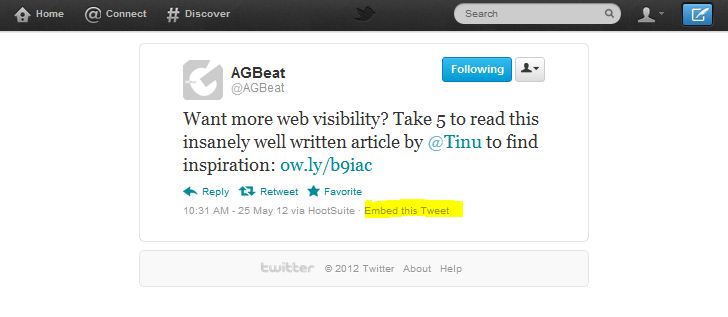
If you see a tweet or have tweeted something you want to highlight on your blog, start a new blog post, then go to the specific tweet and click “Expand” as seen below:

The expanded version will take you to this view, click “Details”:

This will take you to the specific tweet you are seeking to showcase. Click “Embed this Tweet”:

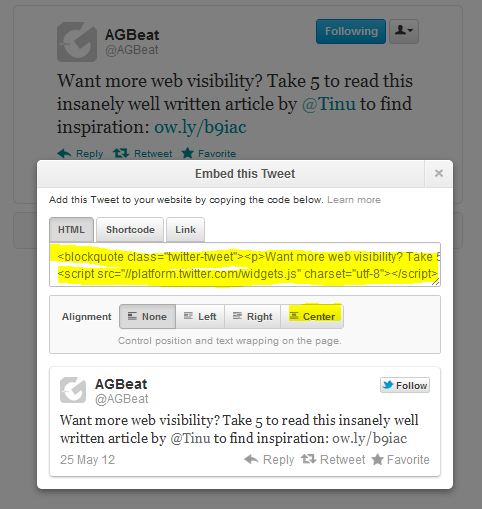
Put your cursor on the code, select the entire string of words and copy it. Select what alignment you want (we recommend “center”):

Paste this code into your blog post HTML editor, and below is the final product:

Play with the above embedded tweet – try following, replying, favoriting, or retweeting to see what it looks like on the user’s end. By offering ways to keep people in your figurative store, you are showcasing any variety of information without forcing them to leave, and that alone is an often overlooked ingredient to increasing social interactivity.

EventMethod: first look at an innovative event management app

Streamlining event management

One of the challenges of organizing and hosting events is that event management tools often have to be pieced together, with each missing a component of another – some have mobile options, others have embed options, some are customizable, others are not. Pulling the pieces together in a free, simplified mobile app is EventMethod which supports both iOS and Android devices, created by Austin-based RedMethod which has been innovating development for over eight years.

Handling everything from registration to tracks, schedules, and surveys, real time interaction is the key component solved by EventMethod, and through the app, event hosts can get live feedback on anything from keynote speakers, to the event venue. The feedback is a rare, often untapped version of lead generation most events never receive.

Additionally, event hosts can set up various QR codes tracked through the app that act as check-in spots at the event, or simply provide more information to attendees. Sponsors can be highlighted within the app, which is another overlooked feature of most event management, which usually leaves event hosts limited to print materials at the event. No more.

Untethered attendance, legitimate analytics

EventMethod offers remote participation from people unable to physically be at a conference, giving a third dimension to any event and capturing attendees that otherwise would have slipped through the cracks (think future attendees). The creators call this “untethered attendance,” a key feature that they say resulted from their inspiration for businesses to connect and interact with one another, particularly event attendees, often representing a variety of companies and organizations.

Analytics is a core feature of EventMethod that is the most commonly missing piece of event management tools, offering attendee data that is more than just a name and email address, rather includes a capture of which tracks an attendee went to, what their live feedback is, and what they clicked while inside of the app so that event organizers can improve their offering, often in real time.

User experience for event hosts and attendees

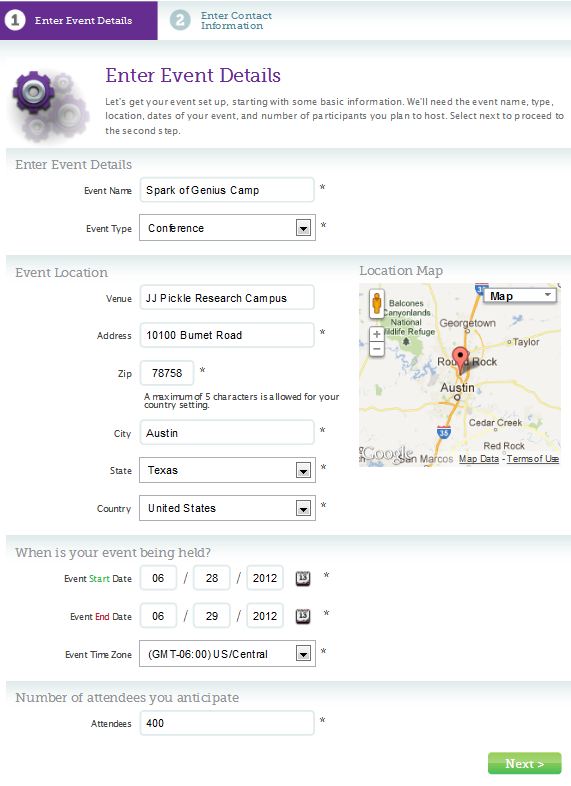
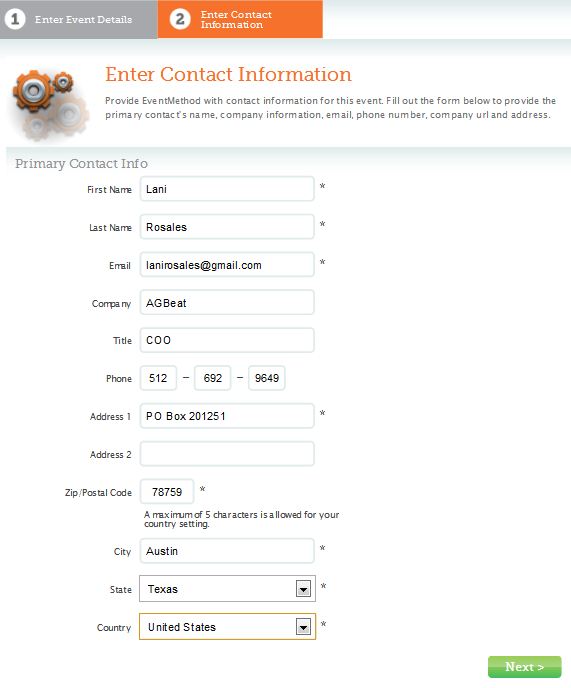
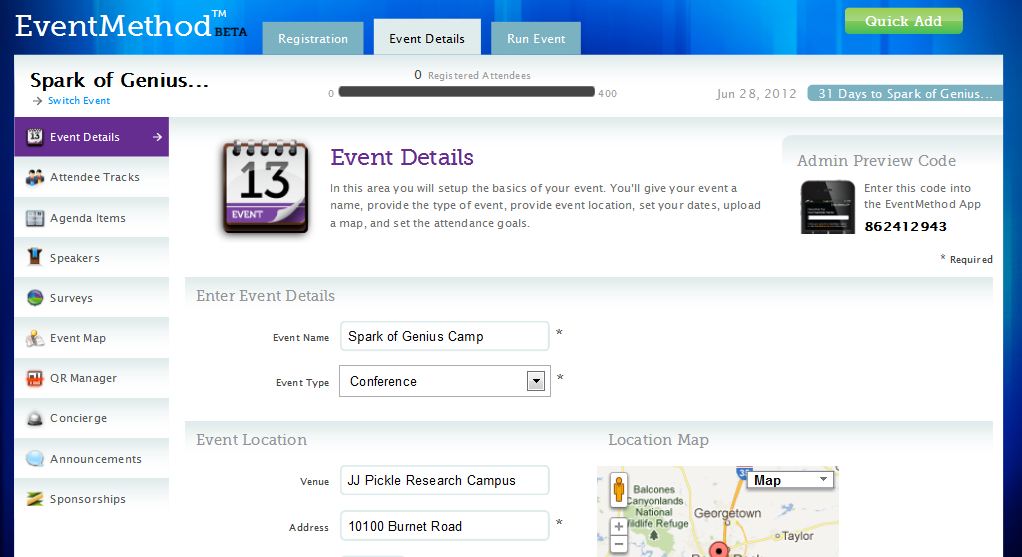
User experience is what is at the root of EventMethod’s creation, as they seek to deliver a new kind of user experience by improving engagement levels, and taking advantage of mobile tools in an increasingly mobile world. For event organizers, the user experience is extremely simple and leaves no one guessing about how to get set up (a common problem with event management tools). Below are the two steps it takes to get started:


Event host’s dashboard

After setting those up, event hosts are taken to their dashboard which couldn’t be any simpler:

In the above image (click to enlarge), you see in the top right a code to enter into the EventMethod app, which is what attendees will use in order to access that specific event, and because you can download multiple events to the same account, each event gets its own code to be used at each event, which is how the analytics are tracked.

Below is a compilation of screenshots that showcases EventMethod’s features what will enlighten any event host as to what gaps the app fills in:

Indiana Prudential office gunman pronounced dead

Seven hour standoff’s ending

Yesterday, a seven hour standoff at Prudential Executive Group Real Estate’s offices in Valparaiso, Indiana ended with gunman Roy L. Ferguson’s death pronounced at the hospital after two self-inflicted gunshot wounds to the head and another to the chest from what is being investigated as a potential police gunshot fired after Ferguson’s first two shots.

Early yesterday morning, with less than ten people in the office, Ferguson entered the building to confront an employee who he felt owed him money over what some are saying is over a real estate transaction. Ferguson held several hostages, and let them go throughout the day with only one injury, as one female employee was treated for a head injury and released from the hospital yesterday.

Office controller, Carolyn Biesen told the NWI Times1 that she was in her office, heard noises at the front desk, and saw a man standing over her injured coworker. Biesen yelled at him to leave, and tells the press, “That’s when he pulled his gun out — and pointed it in the air.” She retreated to her office, locked herself in, blocked the door with a file cabinet and called 911, hearing gunfire outside as Ferguson exchanged fire with police surrounding the building.

Gunman had “some history” with the brokerage

Biesen said the Texas man “had some history here,” but told reporters after the standoff concluded that she didn’t believe his intention was to hurt anyone. “If he wanted to, he could have come right into the office – maybe shooting through the door.” Of Ferguson’s death, Biesen said, “It’s very sad,” and that she felt sorry for the gunman who could have surrendered after the hostages were freed.

Due to the Memorial Day weekend, an autopsy is still pending and has not been scheduled, but Porter County Coroner Chuck Harris told the NWI Times that “the likelihood of all three gunshot wounds coming from the same weapon is not good,” and cannot be confirmed until autopsy.

Ferguson’s dispute is also under investigation and the reason for his taking hostages remains unclear.

AGBeat will report more as the story unfolds.

Related:

1 Northwest Indiana Times

ShortStack makes interactive Facebook Pages mobile

ShortStack for Facebook

In February, AGBeat introduced you to ShortStack, an inexpensive option for businesses to customize their Facebook experience for visitors. The Facebook app development company has now announced mobile timeline apps so that apps designed in ShortStack are viewable via mobile devices, an option that is critical as users’ time on Facebook increases via mobile exponentially. The use of third party apps is important as one of the many Facebook rules (that if violated can get any Page permanently deleted) is that Page owners cannot run giveaways or run contests natively, and must use an app.

The company tells AGBeat, “This is a big deal for ShortStack as well as business page owners because currently Facebook mobile does not support third party applications. When a user clicks on a custom app from within Facebook mobile they are taken to a blank page. By building your app with a platform such as ShortStack, users are able to have contests, giveaways, fan-gating, newsletter integration and anything else they can think of available for their fans who access Facebook using their mobile device.”

“We’re excited to be able to support mobile for our current and potential users,” said Jim Belosic, CEO of ShortStack. “Currently, custom mobile content is not a native feature of Facebook, so we thought that our users and those businesses looking to create custom Facebook apps could really benefit from this, especially with the statistics we’ve been seeing on how many people are using Facebook on their mobile device. We didn’t want custom apps to be left out of that conversation.”

Templates, themes, and Smart URLs

Now, when using ShortStack to build a custom app by using templates and themes, the app will automatically appear as if it was designed for mobile when smartphone and tablet users open the app, viewable through the “Smart URL” provided by ShortStack. Admins of business pages can share that URL within Facebook and through their additional social outreach methods. When a visitor clicks on the Smart URL, the system detects whether they are accessing the tab via a mobile device or a computer and they are shown to the appropriate content.

ShortStack’s mobile capabilities work for all ShortStack custom apps, including photo and video contests. Although the iPhone OS has file uploading disabled, a fan can still submit a photo to a photo contest from an existing Facebook album using their mobile device and submit and view videos into video contests. Smart URLs work with most smart phones, including the iPhone, Android and phones that have full mobile browsers.

UPDATE: ShortStack has launched “ShortStack University.” The company tells AGBeat, “ShortStack University is a free facebook-centered curriculum for beginner page admins hosted on a YouTube channel. The videos are completely free and available for anyone that wants to view them. They are also not based around ShortStack at all, the only thing ShortStack about them is that our team are the ones behind them providing the information, otherwise they are short 2-4 minute videos focusing on Facebook Pages and helping businesses become more efficient with them.”

SquareFoot: disruptive commercial real estate startup

Better serving small to medium business owners

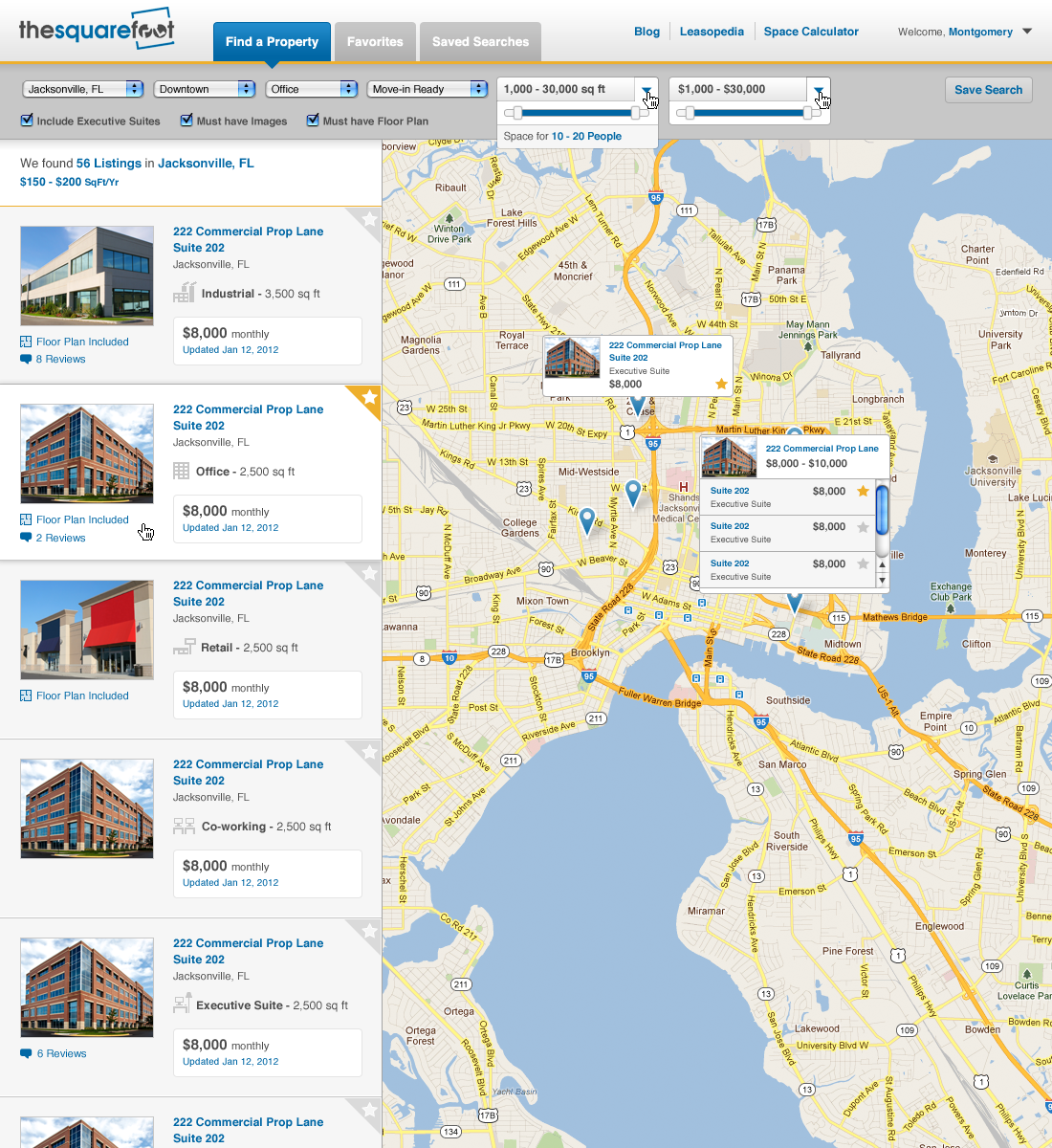
It is no secret that the commercial real estate industry has very few threats to the decades old way of doing business, but a soon-to-launch startup seeks to disrupt the industry to make it more consumer friendly, rather than forcing small businesses to waste time driving all over town in hopes they’ll be able to guess what NNN, GLA, Breakpoint, or CAM stand for or even mean.

There are budding commercial real estate lease sites that are shaking up the industry, but SquareFoot will launch to the public on June 13th as a fully web-based one-stop marketplace for commercial real estate leasing that connects prospective tenants with the full complement of providers they need for finding an office, giving relative pricing (that non-real estate professionals can actually understand), and setting up a new office, store, warehouse, or even restaurant. The company says “this begins with landlords and tenant brokers and continues with furniture vendors, IT providers, commercial movers, and a variety of other service and product providers.”

The company seeks to serve small and medium business (SMB) owners, entrepreneurs and the like for free to the user, as 75 percent of all commercial leases are less than 5,000 square feet, and AGBeat would add that this demographic is commonly neglected as most brokers focus on bigger fish. This is exactly why the need is prevalent and we predict SquareFoot will see massive revenue in their first year or get acquired quickly.

“Our approach to leasing transactions strengthens the tenant’s proposition in the leasing process while providing valuable pre-educated leads to the supply side, creating a situation where ALL parties benefit,” the company says. SquareFoot also provides additional value add to landlords to help them lease and market their available listings.

“The goal of our site is to make the process more digestible for the prospective tenant, and we have no vested interest in the leasing transaction,” the team adds.

Additional ways to help SMBs

Last fall, SquareFoot launched a prototype product and are now in private beta, set to launch first in Houston on June 13th at RealComm in Vegas, with aspirations to expand through Texas within the next 18 months.

The company already has ten of the top 15 office and retail landlords in Houston signed up, and offer commercial real estate info on their blog, and have launched Leasopedia.com to help educate prospective tenants with more than just a glossary which is the industry standard.

What is most impressive is that all three founders are in their twenties, two of whom are University of Texas at Austin graduates and one who is working on his MBA at Columbia. Justin Lee has a background in commercial real estate leasing development in Texas, Jonathan Wasserstrum spent four years in real estate finance for Jones Lang LaSalle before beginning his MBA at Columbia, and Aron Susman was a CPA at Deloitte and a VP, Head of Business Development for a healthcare technology company.

The team is energetic, enthusiastic, and knows personally the pain points small business owners go through to simply set up shop, so their passion for educating and helping shines through in all they do as they remove the commercial real estate iron curtain. Keep an eye on this company.

Click any image below to enlarge:

Company name and featured image updated in March of 2018.

Does the MLS own the copyright to real estate photos, tours?

Transferring copyrights to the MLS

First Multiple Listing Service (FMLS) is a 55 year old MLS serving over 30,000 real estate professionals in Georgia, and like any MLS, it has very specific Terms of Service (TOS) as to real estate photography. MLSs must outline what is and is not allowed when Realtors upload images, content, or virtual tours, in an effort to protect the integrity of the MLS content. Also serving the area covered by FMLS is the Georgia MLS (GMLS), and it is not uncommon for Realtors to be served by more than one MLS.

When closely reviewing the TOS of the FMLS, Georgia Realtor, Lane Bailey noticed that by uploading a photo, virtual tour, or any content, Realtors are transferring ownership of them to the FMLS:

“ASSIGNMENT OF CONTENT, INCLUDING PHOTOS AND VIRTUAL TOURS Any and all content, photographs, virtual tours or other materials that you hyperlink to the Site, upload onto the Site or provide to FMLS in any form or medium for inclusion on the Site or in the FMLS database are collectively referred to herein as the “Work”. You hereby irrevocably assign and transfer to FMLS all right, title and interest (including, without limitation, all copyrights and all other intellectual property rights) in and to the Work. You warrant that you have the full right, power and authority to assign the Work to FMLS. If you agree to these Terms of Use by clicking “I Accept” below, the Work you provide to FMLS, including all photos, virtual tours, and other materials and information, will be the sole property of FMLS. FMLS grants you a non-exclusive, royalty-free license to use the Work in your real estate brokerage business.”

Bailey noted that when transferring ownership, the wording reveals that FMLS will grant back a non-exclusive permission to use the images. Additionally, because this area (like many others across the nation) is served by more than one MLS, similar wording in other MLSs can put Realtors in violation of the Terms of Service when uploading the same photos to both MLSs. Bailey said, “After uploading them to one, we no longer own them, and therefore can’t transfer ownership to the other.”

Potential license suspension or fines

Violations of any MLS Terms of Service could result in potential license suspension or fines. While the language in the TOS is not likely directed at Realtors, rather a precautionary measure against scrapers, and third parties, but Bailey notes that despite being a potentially innocent policy, the MLS could be “wading in the pool of unintended consequences,” and adds that he believes Realtors legally maintain the rights to images they upload, the wording above says otherwise.

Bailey added, “What about those of us that might use pictures shot by a pro… that might also appear in magazines. It also means that you have to buy the copyrights from your photographer if you have the listing photographed by a professional.”

Copyright issues have been contentious regarding real estate photography, as it is common for third parties to use photos directly from the MLS or a Realtor’s website without attribution and other blatant acts of theft are rampant. Realtors are not new to guarding their copyright, but the MLS typically acts in concert with the professional, rather than against, which is what some may say this particular policy does.

The FMLS is not likely the only MLS in the nation using this wording, nor this policy, so it is important for real estate professionals to be aware of what rights they do or do not have, especially with their own content, virtual tours, and photography. The FMLS did not respond to our requests for comment.

Also read: “Real estate photos: widespread copyright concerns” to see some reactions and proposed solutions to this issue.

Mozilla project seeks to build a generation of webmakers

In modern times, web users have to do more than just exist

The internet. It’s a significant part of modern society, and in the professional realm, knowing how to use the web is as essential as anything else you could put on your résumé. One of the many great things about the internet is that it can create a true, worldwide community, connecting users with different backgrounds, skills, and beliefs across the globe. But in order for that to happen and to make the most of what the internet has to offer, users have to do more than just use the web; they have to actually make it.

Mozilla is bound and determined to make that happen through their upcoming launch of Mozilla Webmaker. According to Mozilla’s blog, “the goal [is to] help millions of people move from using the web to making the web. With new tools to use, projects to create, and events to join, we want to help the world increase their understanding of the web and take greater control of their online lives.”

Instead of being acted upon, web users need to act in order to make the web both a personalized and universal tool. The internet should be more than just a great place to cure boredom. It’s a tool that can enhance business, promote unity, and better every user.

Summer Code Party 2012

This summer, from June 23rd to September 23rd, a global invitation will be extended. Mozilla is putting together a learning campaign that will last the entire summer at locations across the world and online. Staying in line with their belief of users making the web, you can create your own event in your local community.

These summer get-togethers are all about teaching participants how to make the web what they want and need it to be, including learning code. It’s all about learning new skills so everyone has the opportunity to increase their web literacy and improve the state of the web. And the best part is that all the summer events are free and open to the public.

Mark Surman, the Executive Director at Mozilla says that they are dedicated to learning and creating an environment, online and physical, for others to learn. He goes on to say that “the web is becoming the world’s second language, and a vital 21st century skill—as important as reading, writing, and arithmetic. It’s crucial that we give people the skills they need to understand, shape and actively participate in that world, instead of just passively consuming it. That maker spirit and open ethos is vital to Mozilla, our partners, and the web.”

Before the Summer Code Party, Mozilla Webmaker’s new site will launch June 6. You’ll find ways to participate in Mozilla’s vision, how to make the web what you need it to be, and teach others your valuable skill set so everyone can be involved. If Mozilla is successful, the world really will be a connected community of projects, important information, and lifelong relationships.

Hostage situation at Prudential office in Indiana

Indiana real estate office’s hostage situation

According to Fox News and the NWI Times1, the FBI is in contact with a gunman inside of a Prudential Executive Group Real Estate’s offices in Valparaiso, Indiana. The police have not released the number of people being held hostage, and it is being reported that the area has been evacuated and police have the offices surrounded and are positioned with guns drawn behind cars and buildings outside of the offices.

The situation began at 10am on Friday, Valparaiso Police Sgt. Mike Grennes told NWI Times, and officers responded to reports of shots fired inside the building. Porter County SWAT team members arrived at roughly 11am, and FBI agents entered the building just after noon.

Police report that they believe they know who the gunman is but are not releasing his name, and Fox News sources say it is not an employee, but possibly a domestic situation.

Fox News has just reported that police are in contact with the gunman, and demands are unclear, but a good sign is that there are no reports of injuries and no ambulances are on the scene. Two men left the building around 11:30am unharmed, and one woman exited the building unharmed at 12:40pm. It remains unclear as to what the connection is of the five people to the situation.

NWI Times reports that by noon, representatives of the FBI, Indiana State Police, Porter County Sheriff’s Department, Valparaiso University police and Chesterton Police Department were at the scene assisting.

A representative for Valparaiso Community Schools confirmed with the NWI Times that Flint Lake Elementary School, Thomas Jefferson Elementary School and Thomas Jefferson Middle School are all on a modified lock down in response to the situation.

This story is ongoing and we will offer more as it breaks; keep reading AGBeat for more.

UPDATES

  • 3:33pm Sgt. Grennes now says the man is holding people hostage because he believes someone there owes him money.
  • Grennes also notes now that officers exchanged shots with the gunman when they arrived.
  • 3:53pm Sources close to the situation tell AGBeat that although unconfirmed, they believe only three people are left inside the building and that the gunman is an ex-customer who is disgruntled, but no one is clear as to with whom he is upset or why.
  • Sources tell us the dispute is personal, not real estate-related.
  • 4:42pm NWI Times reports that all of the hostages who were being held at a real estate office here have been released.
  • The gunman is still in the building and is communicating with the FBI.
  • Prudential Office controller Carolyn Biesen tells NWI that this morning, there was a woman injured, and our sources close to the situation say the woman that was released from the building this morning had sustained a head injury.
  • 5:27pm It is being reported that two large blasts were heard at the scene before a window was shattered. Police have entered the building, but it remains unclear as to the status of the gunman.
  • 5:42pm Police now say that the gunman has been taken to the hospital in critical condition after two self-inflicted gunshot wounds to the head.
  • 9:11pm Porter County Coroner Chuck Harris has confirmed the death of gunman Roy L. Ferguson, 48, of Texas. The dispute at the center of the hostage situation is still unknown.

1 Source: NWI Times

Related:

  1. Indiana remains shaken by the 2011 shooting of Ashley Okland which remains unsolved.
  2. 2011 Realtor Safety Report

Redfin sued by CoreLogic over their Home Price Tool

Redfin’s Home Price Tool

Launched just over two months ago, Redfin’s Home Price Tool was created to educate homeowners on the pricing process so they have an estimate before entering discussions with an agent, but CoreLogic has filed a lawsuit1 against Redfin claiming patent rights over the technology being used in the Home Price Tool, according to GeekWire2.

With Seattle-based Redfin’s Home Price Tool, users begin with a price range based on similar, recently sold homes in the neighborhood, then eliminates comparable homes that are dissimilar (new constructions, abandoned foreclosures, too big, too old, or unimproved, for example). Redfin says this results in a fair, competitive price range to guide users as to what their home is worth or how it should be priced.

At the time of its release, AGBeat columnist Tara Steele wrote, “While Redfin is not pioneering the CMA, nor the AVM (automated valuation model where a price is electronically generated), they are making strides toward what they call transparency by allowing consumers to interact with the data. This move will ruffle real estate professionals’ feathers, but could also be advantageous to Realtors whose listing clients refuse to budge on pricing, and for homeowners who feel the need to verify what their agent says. It’s not a revolutionary move, it’s an attempt to improve an existing technology and an existing concept in a transparent way.”

CoreLogic files against Redfin

In East Texas, CoreLogic has filed a patent suit alleging Redfin has infringed on their patent3 on “Real Estate Appraisal Using Predictive Modeling,” in other words, their Automated Valuation Model patent which was filed in 1992 and granted in 1994. Patents filed prior to 1995 expire 20 years after being granted, which means CoreLogic has just over two years remaining to defend their patent, although some commentary floating around alludes to patents expiring in 17 or 18 years which is only accurate if filed after 1995, so it is not likely that CoreLogic is filing in an effort to do so under the pressure of an expiring patent.

East Texas is, however, notorious for patent lawsuits as the majority filed in the district win. Neither CoreLogic or Redfin is headquartered in Tyler, Texas, but both do business in the district, so it is technically fair ground for filing suit.

This is not CoreLogic’s first lawsuit defending their patent, nor their first filed in the Eastern District of Texas, in 2010, the company sued4 Zillow, Inc., Lender Processing Services, Inc., Real Data, Inc., Realec Technologies, Inc., Fiserv, Inc., Intellireal, LLC, Interthinx, Inc., American Flood Research, Inc., Electronic Appraiser, Inc., and Espiel, Inc. CoreLogic settled5 with Intellireal in 2011, entering into a patent license agreement, and Precision Appraisal was dismissed from the lawsuit in December 2010.

We have reached out to CoreLogic and Redfin for comment and will update the story as statements are made.

Update: Friday May 25, both parties have declined to comment due to this being active litigation. AGBeat is still working to obtain some form of comment.

1 CoreLogic v. Redfin, full lawsuit
2 GeekWire story
3 U.S. Patent number 5,361,201
4 CoreLogic’s 2010 Lawsuit
5 Patent License Agreement

Clear IdeaPaint makes any wall a dry erase board

Genius idea for any home or home office

Your work space is an essential part of your professional success and productivity. It should be unique, reflect your professional goals and your creativity, and be functional for your needs. You could have a traditional office with full functionality, but what about embracing your creative side? Embracing your creative side can give you more freedom when brainstorming new ideas or ways to improve current ideas. One way to do that is to have a dry erase whiteboard surface covering an entire wall of your office or every wall in your office.

You may already know about IdeaPaint and their whiteboard paint for nearly every flat surface, including wood. But they’ve made some unique improvements that will fit every office. Unsurprisingly, the dry erase whiteboard paint used to only come in white, which can stifle your creative side and make your office seem boring—until you start writing on the wall, that is. Now, IdeaPaint comes in clear. That means you can paint your wall any color you want and then paint the clear dry erase whiteboard paint right over it. Think of the possibilities; you can paint over a patterned or solid wall. Either way, you’ll be able to write right on top of it and erase it just as easily.

As small business professional, you may not have a substantial amount of money to spend however you want. IdeaPaint’s dry erase whiteboard is an easy and affordable way to create an entire dry erase whiteboard anywhere you need it—in your conference room, individual offices, or in common areas so you and your employees can brainstorm together and write important notes and reminders to each other.

It’s a great way to stay organized and encourage creativity, and now you can make your office a unique space with any color paint you want and just cover it with one coat of IdeaPaint.

Your office should be as unique as your brand, and this is just one affordable way to accomplish that.  Make your office work for you so you can focus on securing that one important client, brainstorming your next big marketing campaign, or preparing for that upcoming professional conference. Make the most of your workspace and your time, all with one simple coat of paint.

All commercial real estate sectors making a comeback

New commercial data showing signs of life

According to the National Association of Realtors’ (NAR’s) quarterly commercial real estate forecast, fundamentals are gradually improving in all of the major commercial real estate sectors, which the trade group calls a “shaking off” of a prolonged impact from the recession. NAR reports that the apartment rental sector has fully recovered and is growing, while other sectors are beginning to regain some ground lost during the economic crisis.

NAR says jobs are responsible for the demand

Dr. Lawrence Yun, NAR chief economist, said new jobs are the key, projecting 2.0 to 2.5 million jobs will be added by 2013, assuming the new federal budget is passed before the end of the year. Dr. Yun says ongoing job creation is fueling the underlying demand for commercial real estate space, assisted by growing consumer spending.

“The pattern shows gradually declining commercial vacancy rates, with consequential but generally modest rent growth,” said Dr. Yun. “Although we need even stronger job growth, by far the greatest impact of job creation is in multifamily housing, where newly formed households striking out on their own have increased demand for apartment rentals – this is the sector with the lowest vacancy rates and strongest rent growth, which is attracting many investors.”

No capital available for small business

A large problem remains for purchases of commercial property priced under $2.5 million. Dr. Yun said, “Our recent commercial lending survey shows that there is very little capital available for small business, which is significantly impacting commercial real estate transactions, although funding is less restrictive for bigger properties.”

Performance of each market

Multifamily – the forecast notes vacancy rates will likely drop 0.2 percent over the next year to 4.3 percent, and with vacancy rates below 5 percent, NAR notes it becomes a landlord’s market with demand justifying higher rents. Increasing 2.2 percent last year, NAR projects rents will increase 4.0 percent in 2012 and another 4.1 percent in 2013. Net absorption is forecast at 215,900 units this year and 230,300 in 2013.

Office – the vacancy rates are projected to fall to 16.0 percent in the second quarter of 2013, down from 16.3 percent in the second quarter of 2012, while rents are projected to rise 2.0 percent in 2012 and 2.5 percent in 2013. NAR is forecasting net absorption of office space at 24.7 million square feet in 2012 and 48.0 million next year.

Industrial – vacancy rates are likely to decline from 11.0 percent in the current quarter to 10.7 percent in the second quarter of 2013 and rents are expected to rise 1.6 percent in 2012 and 2.4 percent next year. Net absorption of industrial space is seen at 44.1 million square feet this year and 62.4 million in 2013.

Retail – NAR projects vacancy rates will fall from 11.3 percent in the second quarter to 10.7 percent in the second quarter of 2013 and rent should rise 0.8 percent this year and 1.3 percent in 2013. Net absorption of retail space is projected at 8.0 million square feet this year and 21.9 million in 2013.

Commercial Real Estate Quarterly Market Survey

SBA: free business advice from Uncle Sam for small businesses

Running on the tightest of budgets

We recently covered the pros and cons of hiring a consultant versus a full-time employee. But, what if you can’t afford either option? What if you need help and advice but your budget is small or non-existent? There is a convenient, accessible solution, no matter in which area you live within the United States. Whether you currently have your own business and need business advice or your goal is to become an entrepreneur sometime in the near future, Uncle Sam can help.

All across the United States, Small Business Development Centers, also known as SBDCs, are physical resources for entrepreneurs in all industries. Located in all fifty states and several U.S. Territories, SBDCs provide educational and consultation services for free. All you have to do is go into your local center and attend a workshop and ask those tough questions that have been plaguing you—topics ranging from marketing, engineering, or even organization and product production.

Boosting your brand’s success

Although you may feel embarrassed seeking free assistance from the government, there is absolutely no need. Even so, all consulting and provided services are kept confidential. This is to protect you, your business, and your customers. These Small Business Development Centers are fully staffed and fully funded, consisting of full-time staff members and volunteers qualified to advise business professionals.

These days, valuable business advice is rarely free. However Uncle Sam understands the importance of small businesses for the vitality and livelihood of the current economy. These centers make professional goals easier to achieve and even more worthwhile and rewarding for everyone involved. Even if you are confident in your knowledge about how to run a business, getting pointers and advice from other professionals can only help to further your efforts.

Depending on your own professional success, consider volunteering in the future. You could be the saving grace for a professional just starting out, just like someone was for you. The small business community should be about supporting each other. The Small Business Development Centers are a great place to start.

Six rules for effectively arguing any opposing point

The rules for arguing

We’ve all created embarrassment for ourselves by parading our ignorance in public. Most of the time we’re convinced the problem resided in the other side’s inability to see the logic in our position. How many times have we realized the error in our logic after we’ve taken positions basically declaring gravity is a myth? This is me raising my hand in shame. Done it — many times. Merely recalling a few of ’em can make me blush a bit.

One of my OldSchool mentors tired of me arguing meritless points, so he laid down a brief set of rules.

  • Answering the other side’s question with a question isn’t allowed — ever.
  • Your answer may challenge the question’s premise, if you believe it’s false.
  • If answering, you must only address the question asked, nothing else. 
  • Label opinion as opinion, not disguised as fact. Otherwise, be as empirical as you can.
  • Never, as in never ever, get personal. You not only show the world your position is weak, you also demonstrate a lack of emotional maturity.
  • If in your judgment, the other side proves its case, smile, you learned something.
As an aside — ever notice those who’d rather argue the earth is flat than learn that we’ve known otherwise for hundreds of years?

Those rules have been a gold mine for me on a few levels. They’re especially valuable when you don’t understand the other side’s logic. I’ve learned to first assume it’s my logic at fault. As a young man, if I didn’t understand their logic, the default was, ‘they’re illogical’, which is silly on its face. Admitting I didn’t understand and asking for clarification works wonders. Duh. Solid questions will either teach you something you didn’t know, or help you undress their logic. Either way, you make progress towards a better understanding of the subject matter. Once I accepted the value of learning I might be incorrect, debating (discussing?) became the conduit to many of those ‘teaching moments’. Learning something new, especially when it simultaneously cures your own ignorance, is what fuels our growth.

A real life example of the rules in action

I was a very involved youth baseball coach when my son was growing up. One day after practice, one of the dads mentioned that Cecil Fielder, a Detroit Tiger, had just inked a huge multi-million, multi-year contract. Some of the kids, knowing this new contract would pay Fielder far more than their local hero and future first ballot Hall of Famer Tony Gwynn, were enraged. I embraced the opportunity for a teaching moment.

First, I went over the above rules, to which they agreed, even though many were rollin’ their eyes. I allowed myself the first question.

Me: “Why shouldn’t Fielder get a far higher salary than Tony?”

Them: “Cuz Tony’s batting average is literally more than 100 points higher than Fielder’s!”

Me: “If that’s so, why did the Tigers decide to give him so much more money than Tony?”

Many at this point were sensing a trap, much to their credit. You could see it on their screwed up facial expressions. After all, the owners of a MLB team must be smart, right?

Them: “Don’t know cuz it makes no sense. It’s stoopid. Why did they?!”

Me: “I don’t know for sure, but logic tells me it’s due to the fact he hits so many homers, and knocks in so many runs every year. He knocks in over 100 runs every year.

What do you think the Tigers value more, total runs scored — OR — total number of singles hit?”

Them: “But Tony’s hittin’ over .350!”

Me: “Answer the question.”

Them: “Total runs scored?” (Dripping with teenage sarcasm.)

Me: “Let me come from another direction. How do we know who wins a baseball game?”

Them: “The one with the most runs.”

Lights go on above a buncha teenage heads. What they learned was that yes, .350 hitters are worth a bunch, but those who produce what, you know, wins games? They get paid a BUNCH.

Using the rules in my industry

Using those rules is how I learned what works better in real estate as a brokerage. My initial belief, set in stone, was that those representing nothing but buyers were kings of the real estate road. Then I had The Conversation (calling it a debate would have insulted debaters everywhere).

Though agents specializing in buyer representation can and do earn impressive incomes, listing agents who also take care of buyers do much mo betta. I had to learn this from someone packin’ over a decade as a broker who also happened to own the biggest listing brokerage in town. When I learned the facts, it became painfully obvious I had come to the table clueless in real estate land. It also showed me I was unnecessarily limiting my earning potential. It’s one thing to opt in for a lower income with full knowledge.

It’s quite another to leave money on the table due to ignorance, or worse, cuz you’re somehow emotionally committed to conclusions which are fantasy based.

If I hadn’t been forced into adhering to the aforementioned rules, my emotional, opinion driven attachment to an erroneous belief would’ve remained intact. I would’ve been plowing fields guaranteed to deliver smaller harvests than other available fields.

In business this approach has saved me countless times. We all believe in what we’re convinced are axiomatic principles. We’ve also learned from time to time that some of those beliefs were proven false, by evidence about which we were ignorant.

I propose a new way forward

Finally, how many times have we allowed ourselves to ignore mountains of evidence disproving something we knew was true? How many times have we seen folks personally attack someone simply because their position has been undermined by incontrovertible, documented evidence? When we do that it, not only does it reflect poorly on us, it’s prima facie evidence that we’re outa ammo.

It’s alright to say, “I was wrong, thanks.” Or, “I didn’t realize that was the case.”

Let’s argue our various cases, but in a way allowing both sides, if at all possible, to part ways knowing the truth. Being wrong about something isn’t a big deal. Defending that wrong position in the face of empirical evidence to the contrary makes us dumber than dirt.

Let’s stop doin’ that, OK?

FreshBooks launches expense receipts as PDFs on invoices

1

FreshBooks gets a little more fresh

FreshBooks is best known as the billing system of choice for entrepreneurs, startups, and small businesses, taking the pain out of what used to be tedious bookkeeping, which is difficult for anyone wearing multiple hats that just wants to focus on serving their customers.

While FreshBooks already has a lengthy roster of features that makes bookkeeping simple for any business, today the company announced that expense receipts can now be attached as PDFs on invoices, which is an extremely useful tool for any professional that travels or incurs additional expenses a client or employee must bill, and is a simplified option for employers who have employees in the field.

The company said in a statement, “Some say you can’t have it all, yet we disagree. Starting today you can now upload your expense receipts in all file formats: jpegs, gifs, pngs and now PDFs too! Simply upload receipts from your desktop straight into FreshBooks Expenses and in a few clicks, attach them to your invoices. Shazam!”

FreshBooks notes that while attaching expenses to invoices has been an option for some time, they realized that inboxes “filled with online receipts for purchases, getting lost in the sea of e-mail and PDFs of scanned receipts taking up space on your hard drive,” thus leading them to the conclusion that the simplest option would be uploading PDF receipts to FreshBook expenses.

The company points out that this option is useful, particularly when you get an email confirming payment for a purchase (like a conference ticket, hotel reservation, flight, car rental, etc.) which can be immediately attached directly to an expense which links to any invoice. FreshBooks adds that “You can also upload those scanned receipts you’ve already printed out or have in that dusty shoebox, knowing they’ll be safe and organized in your account and re-bill your clients in a jiff! We support all PDF versions (except for password protected PDFs) and you can attach an individual file up to 2MB in size. There is no cumulative file size limit for expense receipts.”

Using the new PDF option


First, go to the “Expenses” tab and either edit or create a new expense. Check the box that says “Attach Image of Receipt” and choose your file. Next, create an invoice, and when generated from a specific Project, it will automatically pull in all expenses associated with the project, and you can simply unselect a box if you don’t want that expense billed.

Then, when the invoice recipient opens their digital invoice, they can click a link below the invoice as shown above and simply see the receipt. “Snail Mail” receipts will include a printed out expense receipt.

The new option is part of FreshBook’s mission to get businesses paid faster, and the easier it is for an invoice recipient, the more likely it is to get paid.

New home sales up 10%, challenges remain for the sector

New Census Bureau data

According to the U.S. Census Bureau and the Department of Housing and Urban Development, sales of new single-family houses in April 2012 were at a seasonally adjusted annual rate of 343,000, up 3.3 percent for the month and 9.9 percent for the year, further signaling improvements in one of the hardest hit housing sectors. Improvement in any portion of the housing market is welcome news as various indicators show signs of health after years of being battered.

The median sales price of new homes sold in April hit $235,700, marking a 4.9 increase over the past year, with an average sales price of $282,600 in April nationally. The month ended with 146,000 new homes for sale, representing a 5.1 month supply at the current sales rate, outperforming resale homes with a 6.6 month supply.

Rise in sales and prices, but challenges remain

New home builders continue to be plagued by distressed home sales of existing homes as a main competitor, as the National Association of Realtors reports that foreclosures sell for an average discount of 21 percent below market while short sales sell for an average discount of 14 percent below market rates.

While sales performed well nationally, each region was literally and figuratively all over the map. New home sales plummeted 10.6 percent in the south, and rose 7.7 percent in the Northeast, marking the region’s highest level in over a year. The West region increased 27.5 percent and the Midwest rose 28.2 percent, both helping boost the national sales data.

Builder confidence for this period remains at a five year high, according to the National Association of Home Builders, yet a rise in traffic and optimism for sales in the next since months have not persuaded builders to throw caution to the wind and remain guarded with their optimism toward a recovery.

Despite low inventory levels, and beating expectations for pricing, the tough competition from the resale market will continue to be a challenge to new home builders, as will the continued tight lending conditions not only for builders but consumers, particularly first time buyers.

Step up your customer service with one of these 3 digital tools

A make or break proposition

Your customer service can make or break your company. These days, your customers and clients expect customer service that is organized, professional, and well-informed. Companies that have horrible customer service have received quite a backlash online in recent years. And, as you know, those types of reviews spread through social networking sites easily, freely, and eagerly. So, don’t give anyone a chance to complain about your customer service. Instead, make your customer service something to brag about. Here are three digital tools that can take your customer service to the next level.

Tool one: Volusion

Volusion – Volusion is all about creating user-friendly shops and storefronts with easy-to-use ecommerce templates. Two of the tools you’ll have access to with Volusion is vZoom and unlimited photos of each product, which allows your customers to see “the finest details of any product image, helping to instill confidence in the quality of you items before they purchase.”

You’ll also have access to the color swatch and product comparison tools, making for a unique and easy experience for all of your customers. If you’re looking for easy ways to offer coupons and collect real-time feedback from customers, Volusion is your one-stop shop. They currently offer a free trial. After that, the prices range from $19 a month to just under $150.

Tool two: ZenDesk

ZenDesk – This service is centered on providing you with tools to encourage loyalty from your customers. ZenDesk enables your customers to create tickets when they have questions or have run into issues on your site. But it does more than that. ZenDesk is a premium ticket management tool that allows team collaboration, priority classifications for easy organizing and responding, and automated response messages.

This will make it easy for you and your employees to stay on top of customer comments and issues, and it assures your customers that you’re dedicated to providing amazing customer service. Just like Volusion, ZenDesk offers a free trail. If you decide you like this tool, you should expect to pay anywhere from $20 per year to about $100 per month.

Tool three: LivePerson

LivePerson – In today’s technological world, many customers prefer to have options when it comes to contacting a company, including online, real-time chat and a phone system that’s easy to navigate. They want convenience and availability. LivePerson provides just that.

LivePerson believes there’s more to chatting with customers than solving problems; they believe it’s about building connections and loyal relationships through online interaction. It’s about building trust with customers so they come back again and again.

Long-term effects

Stepping up your customer service is as easy as incorporating the right tool for your business. Before you decide on one, analyze what your customers need to feel welcome, needed, and appreciated. After all, without dedicated and loyal customers, your business would fail to thrive. Treat your customers well and you’ll see immediate and long-term effects and rewards.

U.S. home prices rise modestly in the first quarter

Home prices rise modestly

According to the Federal Housing Finance Agency’s (FHFA) seasonally adjusted purchase-only house price index (HPI), home prices rose modestly in the first quarter of 2012, up 0.6 percent from the fourth quarter, and up 0.5 percent from the first quarter of 2011. The FHFA reports based on home sales price information from Fannie Mae and Freddie Mac, accounting for the majority of all American loans.

“Consistent with other housing market indicators, the FHFA HPI showed stronger house prices in the first quarter, most notably in March,” said FHFA Principal Economist Andrew Leventis. “Increased affordability and a somewhat smaller inventory of homes for sale are positively impacting house prices.”

Inflation-adjusted prices actually fell

Over the past year, prices of other goods and services rose 3.2 percent, exceeding the rate of increases in housing. The FHFA reports that the inflation-adjusted price of homes actually fell 2.6 percent over the past year.

The seasonally adjusted purchase-only HPI rose in the first quarter in 30 states and the District of Columbia, with Hawaii outperforming all other states, rising 10.3 percent, followed closely by Washington, DC (9.8 percent), Iowa (5.7 percent), Florida (4.7 percent) and North Dakota (4.4 percent).

Regional price increases and decreases

Of the nine census divisions, the Mountain division experienced the strongest prices in the latest quarter, posting a 1.4 percent price increase. Meanwhile, prices were weakest in the New England division, where prices slid 0.7 percent.

The FHFA reports that as measured with purchase-only indexes for the 25 most populated metropolitan areas in the U.S., first-quarter price increases were greatest in the Houston-Sugar Land-Baytown, TX area. That area saw price increases of 2.4 percent between the fourth quarter of 2011 and the first quarter of 2012. Prices were weakest in Atlanta-Sandy Springs-Marietta, GA, where prices declined 3.3 percent over that period.

Each state performed differently, with blue states increasing and red states decreasing in home prices, according to the FHFA as depicted below (click to enlarge):