AG Pro gives you sharp insights, compelling stories, and weekly mind fuel without the fluff. Think of it as your brain’s secret weapon – and our way to keep doing what we do best: cutting the BS and giving you INDEPENDENT real talk that moves the needle.
Limited time offer: $29/yr (regularly $149) ✔ Full access to all stories and 20 years of analysis ✔ Long-form exclusives and sharp strategy guides ✔ Weekly curated breakdowns sent to your inbox
We accept all major credit cards.
Pro
/ once per week
Get everything, no strings.
AG-curious? Get the full-access version, just on a week-to-week basis. • Unlimited access, no lockouts • Full Premium archive access • Inbox delivery + curated digests • Stop anytime, no hoops
$
7
$
0
Get your fill of no-BS brilliance.
Pro
/ once per year
All in, all year. Zero lockouts.
The best deal - full access, your way. No timeouts, no limits, no regrets. • A year for less than a month of Hulu+ • Unlimited access to every story • Re-read anything, anytime • Inbox drop + curated roundups
$
29
$
0
*Most Popular
Full access, no pressure. Just power.
Free
/ limited
Useful, just not unlimited.
You’ll still get the goods - just not the goodest, freshest goods. You’ll get: • Weekly email recaps + curation • 24-hour access to all new content • No archive. No re-reads
AG Pro gives you sharp insights, compelling stories, and weekly mind fuel without the fluff. Think of it as your brain’s secret weapon – and our way to keep doing what we do best: cutting the BS and giving you INDEPENDENT real talk that moves the needle.
Limited time offer: $29/yr (regularly $149) ✔ Full access to all stories and 20 years of analysis ✔ Long-form exclusives and sharp strategy guides ✔ Weekly curated breakdowns sent to your inbox
We accept all major credit cards.
Pro
/ once per week
Get everything, no strings.
AG-curious? Get the full-access version, just on a week-to-week basis. • Unlimited access, no lockouts • Full Premium archive access • Inbox delivery + curated digests • Stop anytime, no hoops
$
7
$
0
Get your fill of no-BS brilliance.
Pro
/ once per year
All in, all year. Zero lockouts.
The best deal - full access, your way. No timeouts, no limits, no regrets. • A year for less than a month of Hulu+ • Unlimited access to every story • Re-read anything, anytime • Inbox drop + curated roundups
$
29
$
0
*Most Popular
Full access, no pressure. Just power.
Free
/ limited
Useful, just not unlimited.
You’ll still get the goods - just not the goodest, freshest goods. You’ll get: • Weekly email recaps + curation • 24-hour access to all new content • No archive. No re-reads
Something in America has died, my friends – spelling! But how much fun would we have if we couldn’t occasionally laugh at some of these ridiculous bloopers from the MLS and the local real estate ads? Some of these are worth donning a party hat:
“Newly planted” (RIP – Just like your listing.)
“Windows have plantations” (Let me guess…Keith Richards’ grow house?)
“Corn early” (Agricultural update provided by Chief Sitting Bull.)
“Beautiful craftmanshit” (…So it’s a pile of crap like your career?)
Decomposed and Deconstructed
“Details from a bye gone era (Kiss your seller bye while you’re at it.)
“Was once a boaring house” (Talk about groveling in pig s__t!)
“This will put a smell on your buyer’s face” ( So you’re gonna slap him upside the head with a mackerel?)
“Pride of Owdership” (That ain’t the only thing that stinks about this listing!)
“A cat above” (Grinned Jerry just before he drooped an anvil on Tom’s foot.)
In Requiem
“Will sail fast” (Mumbled Axl Rose just before he hurled a phone off his twelfth floor balcony.)
“At end of cure” (Pronounced Harriet Hair-Wrecker as flames erupted from the curling iron.)
“Drop-don stairway” (Well, that explains Don King’s lack of mental acuity…)
“Drawinf for free oPad” (You’re just one key stroke short of a Depends, pal…) Hint: Look at the keyboard.
“Two many changes to describe” (Let me help: One – Chastity Bono before, and Two – Chastity Bono after.)
My Fave
“Swing fur kids” (Why swing the little buggers when you can shave ’em?)
That’s it for this week, folks. Remember: Spell and Sell!
According to data from the Mortgage Bankers Association’s (MBA) Weekly Mortgage Applications Survey for the week ending May 18, 2012, mortgage applications increased 3.8 percent from one week earlier, as the refinance index makes a comeback, rising another 5.6 percent from the week prior, marking the third week of increases after sliding substantially previously. The Purchase Index fell 3.0 percent, losing gains made over the past month.
“Continuing negative developments in the sovereign debt crisis in Europe, particularly in Greece and Spain, as well as the recent French elections, which have shifted political power in a manner that will likely show less support for European austerity, helped push the US 10 Year Treasury yield below 1.7 percent last week,” said Michael Fratantoni, MBA’s Vice President of Research and Economics.
Fratatoni continued, “Mortgage rates again dipped to new record lows in the survey, which spurred more borrowers back into the refinance market. As a result, applications for refinance loans have increased for the third straight week and are at the highest level since February of this year. The HARP share of refinance applications was essentially unchanged over the week at 28 percent, so it was not the primary driver of the increase over the previous week.”
The MBA reports that the refinance share of mortgage activity increased to 76.6 percent of total applications from 74.9 percent the previous week, and the adjustable-rate mortgage (ARM) share of activity decreased to 5.0 percent from 5.4 percent of total applications from the previous week. The government purchase share decreased over the week from 36.3 percent to 36.2 percent of all purchase applications. This is the second lowest government purchase share since March 27, 2009.
Varied interest rates
According to the MBA:
The average contract interest rate for 30-year fixed-rate mortgages with conforming loan balances ($417,500 or less) decreased to 3.93 percent, the lowest rate in the history of the survey, from 3.96 percent, with points increasing to 0.39 from 0.37 (including the origination fee) for 80 percent loan-to-value ratio (LTV) loans. The effective rate decreased from last week.
The average contract interest rate for 30-year fixed-rate mortgages with jumbo loan balances (greater than $417,500) increased to 4.25 percent from 4.20 percent, with points increasing to 0.42 from 0.36 (including the origination fee) for 80 percent LTV loans. The effective rate increased from last week.
The average contract interest rate for 30-year fixed-rate mortgages backed by the FHA decreased to 3.73 percent, the lowest rate in the history of the survey, from 3.75 percent, with points decreasing to 0.57 from 0.66 (including the origination fee) for 80 percent LTV loans. The effective rate decreased from last week.
The average contract interest rate for 15-year fixed-rate mortgages remained unchanged at 3.26 percent, the lowest rate in the history of the survey, from 3.26 percent, with points increasing to 0.42 from 0.41 (including the origination fee) for 80 percent LTV loans. The effective rate decreased from last week.
The average contract interest rate for 5/1 ARMs increased to 2.83 percent from 2.80 percent, with points increasing to 0.42 from 0.37 (including the origination fee) for 80 percent LTV loans. The effective rate increased from last week.
In the last year, many real estate brokers have evaluated their marketing tools and determined that they no longer feel that all real estate listing syndication websites serve their best interest, or the best interest of the consumer, citing data inaccuracies and confusion with branding of listings.
One of the first brokerages to jump ship, so to speak, was Edina Realty in Minneapolis whose rally cried inspired a select few others to follow. Now, they are pulling the plug on the final syndicator, and Prudential Kansas City is announcing publicly that they will also cut ties with Trulia and Zillow.
Edina Realty pulls the plug on Realtor.com
Initially, Edina Realty announced they were pulling listings from listing syndication sites, but without fanfare, they continued syndicating to Realtor.com and worked with the Move, Inc. team to get answers to better evaluate their marketing plan. The brokerage never syndicated to Zillow, so the real plug pulled was with Trulia. Months later, the brokerage has announced they will no longer send property listings to Realtor.com, stating their new policy is to no longer syndicate to non-broker controlled websites.
The brokerage says they are participating in “a nationwide outcry against non-broker-controlled websites over concerns with data inaccuracy and consumer privacy,” adding that sales leads on many search sites often go to the highest paying agent rather than the listing agent or agent with market knowledge.
In a statement, Bob Peltier, president and CEO of Edina Realty Home Services said, “Consumers are getting the short end of the stick on these sites because there’s no guarantee that the property data is accurate, and it’s difficult to tell who the listing broker is.” Peltier explained that non-broker syndicators and third party aggregators don’t have the same legal obligations as brokers, so they are not held to the same high standards of data accuracy and customer service.
“Edinarealty.com has more listings and generates more traffic than any other broker-owned or non-broker owned site in our market,” said Peltier. According to comScore Media Metrix Real Estate Category Ranking by Unique Visitors, in March 2012, Unique Visitors to real estate sites in Minneapolis-St. Paul DMA is led by Zillow and Move, Inc. (Realtor.com):
Edina sites Experian Hitwise data which they say reveals they continue to be the most trafficked real estate site. Regardless of traffic source differences, Edina was arguably the spark by which the industry has begun evaluating listing syndication as part of a successful marketing approach and seek to be competitive with any real estate search site both present and future.
Why the sudden plug pulling?
“Consumers cannot easily tell who the listing broker is on Realtor.com,” Bob Peltier, President and CEO of Edina Realty Home Services told AGBeat. “And, there is no easy way for them to connect with the Edina Realty listing agent on Realtor.com unless the agent has paid to be featured alongside their property listing.”
Peltier emphasizes that agents should have a choice as to how listings are marketed. “Even though we no longer display our entire database on Trulia.com, agents have always had the option to work with Trulia.com directly to upload their own listings. This option was not historically available with Realtor.com and therefore delayed the removal of our listings from their site last November. However, over the past months we have engaged in conversations with Realtor.com and they have agreed to a solution whereby the only Edina Realty listings to appear on their site will be listings of Edina Realty agents who have purchased advertising packages with them.”
When asked which of the big three real estate search companies would survive the next 20 years, Peltier noted that “Technology is always changing, so I can’t answer this question. But my hope is that the people doing the best job representing clients – the brokers – will continue to be the best resource now and into the future when it comes to home buying, selling and searching.” He encourages brokers to “make this decision for themselves based on their own area and marketing.”
Realtor.com addresses the syndication issue
Move, Inc. noted that in conversation with Edina Realty since November, the brokerage seemed pleased at how Realtor.com addressed their top concerns. Curt Beardsley, Vice President of Customer and Industry Development at Move, Inc. told AGBeat that Edina Realty initially expressed concern over four issues – data accuracy of third party sites, services sold for other types of listings (FSBOs, early stage pre-foreclosure listings), branding of competitive brokers on a listing, and lead generation mechanisms that send consumers to another brokerage from a listing page, but expressed that “it became clear that Realtor.com doesn’t violate their initial concerns.”
Beardsley said that Realtor.com offers the most accurate data compared to their competitors, as the company uses only one data source, and that is the MLS, which in the case of Minneapolis is updated very 15 minutes, the same pace as any broker’s own website. Second, he asserted that Realtor.com never allows FSBOs or pre-foreclosure listings (listings of homes that have received default notices that are likely, but not guaranteed to ever be for sale).
Third, Errol Samuelson, President of Realtor.com said in a statement, “Edina Realty was concerned that competing brokers’ and agents’ photos and branding were appearing on their listings. This is a practice Realtor.com does not engage in,” which Beardsley added has been the case for over 15 years of the company’s operations. Lastly, Beardsley says the broker has ultimate control over the listings and that in Edina Realty’s case, all lead generation mechanisms pointed to their brokerage, and never to competing brokers.
Prudential Kansas City dumps Trulia and Zillow
In the above video, David Cooper, CEO of Prudential Kansas City Realty, explains that primarily due to data inaccuracies that lead to a poor experience for buyers and sellers, the brokerage will immediately pull all listings from Zillow and Trulia. Cooper notes that after years of evaluating their marketing approach, it is their consistent conclusion that buyers and sellers are not served well by third party sites. The brokerage has over 400 agents across 7 offices and serves a metropolitan area of over 2 million residents. While Cooper makes no claims to be the biggest or best website in the market, according to comScore, the competition in the area is stiff:
Bob Bemis, VP of industry relations at Zillow told AGBeat that “Sellers hire a brokerage to market and sell their homes, a big part of which is marketing the homes to the broadest audience possible. The real losers in this situation are home sellers, and the agents who represent them. If a brokerage isn’t marketing a listing on Zillow, it isn’t seen across the largest real estate network in the country as well as the Kansas City market, or across the most popular platform of mobile real estate apps. In April, more than 32 million unique users visited Zillow’s mobile apps and websites.”
Bemis added that Prudential Kansas City has not contacted Zillow about this decision, but that the company feels that “open dialogue is best and [they] would welcome a conversation.”
Ken Shuman, spokesperson for Trulia.com said, “we feel like consumers benefit from broad exposure. It only takes one set of eyeballs to sell the home and broad exposure gives you the biggest reach.”
The long term game
Edina Realty was one of the first to publicly de-syndicate, and others like Shorewest and Abbott Realty Group, followed by The Goodlife Team, each of whom chose different real estate sites to pull the plug on, and for different reasons. As Prudential Kansas City cites inaccurate data, Goodlife Team notes ads for competing brokers as their reason for pulling out.
As reasons for de-syndicating listings begin to diversify, all three of the biggest real estate search companies assert that they support the rights of brokers to evaluate their marketing approach and make choices appropriate to their unique situation, but so far, as each company loses listings, the common response is that consumers are not well served by this approach and all three tell AGBeat that they are open to dialogue, as brokers that are pulling listings say they believe their move to be in the consumer’s best interest.
Is this debate a decade late?
The big question for many is regarding timing – is this de-syndication and concern a decade late? Syndication is by no means a new issue, so why now? Beardsley makes the rare point that the rise in concern with data accuracy directly correlates to the rise of mobile devices – it is much easier for mobile consumers (sitting in front of a house with a family moving in) to see that a home is not for sale than it is for someone sitting on a desktop computer at an office or their home. Beardsley says this has caused distrust in that source of real estate data, so mobile is increasing awareness and relevance of data.
While there is no clear winner or loser and the race is still young, it is interesting to note that in many cases, brokerages are pulling out of Trulia and Zillow but not Realtor.com. When asked why, Beardsley said, “national brands, in order to gain audience, have to build a brand which you do through consumer audience. Our brand is the brand of the brokers, we actually share a brand and are complimentary to the broker’s brand – the Realtor brand on an agent’s card is the very brand on our site, we don’t compete with Realtors.”
It is possible that this listing syndication issue has passed us by, as Beardsley notes that at Realtor.com alone, 30 to 40 percent of all weekend traffic is via mobile, so the real issue now is mobile and social and that brokers should ask all of these questions about accuracy, competitive branding, and the like, because the cascading effect of new tech after new tech is not slowing down, so brokers should truly understand every marketing tool available to them. The company believes that most brokers that de-syndicate will “evaluate, determine, stick their toe back in the water,” thus they are leaving door open.
In speaking to brokers who have or are considering de-syndicating, they too feel their stance is a long term play and that they best serve the consumer by being the ultimate source of information. So, several brokers and real estate listing sites ultimately have a stalemate.
In 2011, Microsoft announced the long awaited launch of their social network, after months of speculation about how the Microsoft Research team would create their hybrid of search, discovery and social networking, but the network was launched as a product for the academic world, limited to students and teachers.
It turns out that the academic world was simply a testing ground for Microsoft’s social network, So.cl which has now come out of beta and is available for use by the general public as the company seeks to focus on information and the ability to share search results and streamline results so that with a few clicks, pictures and information is added to a So.cl status post.
What was previously less emphasized but now appears to be a major component of the social network is So.cl’s “video party” feature which allows users to watch videos simultaneously together from remote locations.
A Microsoft representative said in a statement that “So.cl is an experimental research project focused on the future of social experiences and learning, especially among younger people,” and is a product of Microsoft’s FUSE Labs.
Timing and relevance of launch
Some question the timing of the launch as the company remains an investor in Facebook, the social network that just went public. Writers are stating that So.cl is like Facebook and Twitter, but the company asserts that the product is not a competitor as the experimental design is much more focused on information, learning, discovering and sharing, much like one would in the academic world.
The company tells users to connect with like minds over topics relevant to them, and says that “you can share your search and express your ideas through beautiful collages of content.”
So.cl will likely garner attention from early adopters, and with Microsoft’s FUSE team behind this project, it is like to evolve as user behavior dictates it should.
According to the National Association of Realtors (NAR), existing home sales (completed transactions) rose 3.4 percent in the month of April, up 10.0 percent over the year while national median existing home prices rose 10.1 percent year over year to $177,400 in April, up 3.1 percent from March. NAR Chief Economist, Dr. Lawrence Yun said in a statement, “This is the first time we’ve had back-to-back price increases from a year earlier since June and July of 2010 when the gains were less than one percent. For the year we’re looking for a modest overall price gain of 1.0 to 2.0 percent, with stronger improvement in 2013.”
Housing inventory levels rose 9.5 percent from March to 2.54 million existing homes for sale, a 6.6 month supply at the current sale pace, up from a 6.2 month supply in March. Inventory levels have improved, however, and are 20.6 percent below a year ago when the inventory levels hit a 9.1 month supply. NAR notes that the record for unsold inventory was 4.04 million in July 2007.
Dr. Yun said, “It is no longer just the investors who are taking advantage of high affordability conditions. A return of normal home buying for occupancy is helping home sales across all price points, and now the recovery appears to be extending to home prices. The general downtrend in both listed and shadow inventory has shifted from a buyers’ market to one that is much more balanced, but in some areas it has become a seller’s market.”
Additionally, Dr. Yun noted, “A diminishing share of foreclosed property sales is helping home values. Moreover, an acute shortage of inventory in certain markets is leading to multiple biddings and escalating price conditions.” He observed that some areas with tight supply include the Washington, D.C., area; Miami; Naples, Fla.; North Dakota; Phoenix; Orange County, Calif.; and Seattle. “We expect stronger price increases in most of these areas.”
Housing facts from NAR
According to the NAR, in April:
Distressed homes accounted for 28 percent of sales, down 1.0 percent for the month and 9.0 percent for the year.
Foreclosures accounted for 17 percent of sales, short sales accounted for 11 percent.
Foreclosures sold for an average discount of 21 percent below market value.
Short sales sold for an average discount of 14 percent below market value.
First time buyers rose 2.0 percent to account for 35 percent of buyers.
All cash sales accounted for 29 percent of sales, down 3.0 percent from March and 2.0 percent for the year.
Investors account for 20 percent of sales, within 1.0 percent of where it has been for over a year.
Single-family home sales rose 3.0 percent to 4.09 million in April, 9.9 percent higher than the pace in April 2011.
The median existing single family home price was $178,000 in April, up 10.4 percent year over year.
Condo and co-op sales rose 6.0 percent for the month, 10.4 percent for the year, and hit 530,000 units for April.
The median existing condo price was $172,900 in April, up 8.1 percent from April 2011.
Regional performance varied for the month, showing widespread signs of improvement, according to NAR:
Existing-home sales in the Northeast rose 5.1 percent to an annual level of 620,000 in April and are 19.2 percent higher than a year ago. The median price in the Northeast was $256,600, up 8.8 percent from April 2011.
Existing-home sales in the Midwest increased 1.0 percent in April to a pace of 1.03 million and are 14.4 percent above April 2011. The median price in the Midwest was $141,400, up 7.4 percent from a year ago.
In the South, existing-home sales rose 3.5 percent to an annual level of 1.79 million in April and are 6.5 percent higher than a year ago. The median price in the South was $153,400, up 8.0 percent from April 2011.
Existing-home sales in the West increased 4.4 percent to an annual pace of 1.18 million in April and are 7.3 percent above April 2011. The median price in the West was $221,700, a surge of 15.9 percent from a year ago.
What do you really think of bullies and tattletales? Didn’t like them when you were a kid, right? So, why would you like those folks now, as an adult? Or, why would you act like one?
In the area of short sale escalation, the short sale listing agent (or the short sale negotiator) has a golden opportunity to become a bully or a tattletale, despite the fact that this behavior wasn’t recommended when you were a kid and it certainly isn’t recommended now.
Many short sale escalations can take place via email. A short sale listing agent can generate an email message to the short sale negotiator, his (or her) supervisor, a bank Vice President, or even the CEO. However, what you say in that email (if not considered carefully) can lead to the demise of your short sale.
Email is akin to written mail
I once read a blog post by Seth Godin which said that you should never write anything in an email message that you wouldn’t feel comfortable putting a stamp on and sending through the mail. With that fact in mind and knowing that you are at the mercy of the short sale lender to work with you on your short sale transaction, carefully consider reviewing a draft of your email escalation letter prior to clicking the send button.
Here are some gentle (yet effective) ideas for conveying your frustration:
Always start by identifying the reason for your email in the first sentence. Note the loan number and the borrower’s last name. (Attach a copy of your third-party authorization if you do not believe that it is in the bank’s system already.)
Express the reason for your email message in no more than three sentences. (For example, “I am concerned because it has been four weeks and the BPO has not been uploaded into your system.” Or “I have left the negotiator many, many phone messages and sent her many emails, and am worried about the status of the file because I have not heard from her in 6 weeks.”)
Avoid blaming anyone at the bank for being ineffective (even if you believe that they are to blame for your miserable situation).
Be polite, professional, and respectful.
Always close by apologizing for going to such extreme lengths to get your message heard. (After all, emailing the CEO is a pretty extreme way to get your message heard.)
If you want to draw attention to a short sale file, have a legitimate reason to express concern, and remember that what you write could lead to either the success or the demise of your short sale transaction. That’s why it’s best to choose your words carefully. Don’t be a bully or a tattletale.
Polygraph reports bring big data science to Facebook
Austin-based Polygraph Media today announced the official launch of its Polygraph™ Reports which AG first introduced you to in April, making their data mining tools and analytics suite available to the public so that intelligence can be gathered on your brand or even your competitor’s brand. Polygraph Reports are being called a “truth detector” for Facebook marketing and are key for brands and agencies.
What makes Polygraph so unique and attractive is that they are not using the Facebook API which is traditionally used to regurgitate publicly available information to unsuspecting buyers, rather they are using a data science approach to use real-time data from Facebook Pages and subscriber-enabled Profiles, and quantifies it in over 40 charts, graphs, and data visualizations which the company says gives marketers “actionable intelligence to inform marketing campaigns and strategies.”
Marketers struggle to justify Facebook investment
“Facebook has grown so quickly that companies are now significantly increasing their marketing spend on Facebook Pages and Advertising,” said Polygraph founder, Chris Treadaway, who is also the book author of Facebook Marketing: An Hour A Day. “But increasingly, we are hearing that marketers need to justify the increased attention and budget. Is it all worthwhile? If we spend more money or human resources on Facebook, what will we get out of it? The answers lie in the data — every social interaction that takes place on a Page is a discrete and important data point that can be mined for information. We created Polygraph to serve this need — an analytics solution that can look at your Pages and those in your competitive environment, and can clearly survey the Facebook battlefield for marketers, executives, and agencies.”
Polygraph brings the power of data science (mining, analysis and reporting) to anyone who wants to analyze business to consumer activity on Facebook. Polygraph Reports cover all major Facebook marketing scenarios, including community management, content marketing, top Content, and competitive benchmarking. Additionally, Polygraph can identify the Top 1,000 Fans of any Page on Facebook — essentially a “Klout” for Facebook Pages. The result is a concise report that not only shows marketers the “cause and effect” of Facebook marketing strategies and tactics, but also allows innovative agencies the opportunity to create custom campaigns based on the data.
“The most robust Facebook analytics I have ever seen.”
“We’ve all heard how if Facebook were a nation, it would be the third largest country on earth. So it’s common sense that brands have focused so much attention there.” says Brad B McCormick, principal at 10 Louder Strategies and a former senior digital leader at Ruder Finn, Porter Novelli, and Cohn & Wolfe global agencies.
“But just because a company can be on Facebook doesn’t mean they know how to be on Facebook and measure success,” McCormick continued. “Acquiring Facebook ‘likes’ is just the first step for brands. Ongoing engagement that builds brand equity is the holy grail of Facebook. But all too often today, brands and agencies are measuring success with empty platitudes and without data or relevant benchmarks. Polygraph Media offers by far the most robust Facebook analytics I have ever seen. It not only gives brands new insights into their own performance, it allows them to compare each of their KPIs against their competitors, in real time. It’s a game changer.”
Big data application built on Microsoft’s cloud services
A SaaS solution built entirely on Microsoft’s cloud services, the Windows Azure cloud platform, Polygraph is one of the first major big data applications built on Azure. “We have been working with Polygraph on the development of its social data mining tools and are very pleased with how quickly Polygraph Media embraced and adapted to the Windows Azure platform,” says Rodney Sloan, Principle Platform Strategy Advisor, Microsoft. “Equally exciting for Microsoft and its customers is to have an innovative company like Polygraph Media become a Windows Azure Platform partner. Polygraph is putting the value of Azure into action.”
While Polygraph will offer data mining tools and analysis for other social platforms (Twitter, LinkedIn, YouTube) later in 2012, the company deliberately began with Facebook, “where critical information has, to date, been inaccessible, locked away in individual comments, sentiments,” says Polygraph Media.
Owning a business and being your own boss means making the tough decisions, decisions that have the potential to greatly affect the livelihood of your business. Because you’ll eventually reach the point of needing help to advance and grow your business, you’ll have to decide to either hire a consultant or bring on a full-time employee.
Unfortunately, this isn’t always an easy decision to make. What makes is even more difficult is that each choice comes with ample pros and cons, and you have to sort through them in order to make the right decision, an informed decision. So, let’s get started.
Option one: hiring a consultant
A consultant is someone who can give you expert advice regarding any business decision you need to make. A consultant can come in handy if you need a second opinion before you start a new marketing campaign or partner with a complementary business. Whatever your professional question, there is a relevant consultant that can help you.
One major advantage of hiring a consultant is that you only have to pay when you actually use the consultant, unless you have the consultant on retainer, of course. This means that you also don’t have to provide employer benefits, which can save you a lot of money in the long run. Using a consultant can give you an outside, fresh perspective on your business.
Sometimes, as the business owner, you can become too close to a project and lack objectivity. A consultant makes up the difference. Most consultants come with a specific knowledge-base, which you may be lacking in your company. For example, if you need marketing help and advice, you’d use a different consultant than if you needed help drafting professional and lawful client agreements. Selecting the right consultant can give you highly specialized help where you need it most.
However, as great as the benefits are from using a consultant, it also comes with some drawbacks. The first, and perhaps the most prominent, is that your consultant may not always be available. If s/he has other clients, you may need to take the backseat until you’re fit into the schedule. If you don’t mind waiting, this isn’t a problem. Unfortunately, most business decisions that need additional consultation are top priority and have an upcoming and hard-set deadline. Hiring a consultant can also be a gamble. Because you don’t personally know this person and all you have to go on are assumptions, this professional relationship may or may not work out for the betterment of your company.
Option two: full-time employee
Choosing to hire a full-time dedicated employee rather than a consultant typically gives you consistency, dependability, and availability. If you need your employee to work on a project, all you have to do is assign it and wait for it to be completed. As the business owner, you won’t be put on the backburner as you would with a consultant.
You have complete control over work projects, deadlines, and professional timelines. Your employee will maintain focus on your objective, rather than furthering his/her career by taking on additional clients. Depending on the person you hire as an employee, loyalty should be a priority. This way, you can be sure that your employee will stick by you and your company longer than any consultant will. After all, many consultants will leave you behind once they secure higher-paying clients.
Hiring a full-time employee could mean you risk hiring a generalist rather than a specialist. So, instead of the track record and experience of a consultant, you may get availability. And depending on the nature of your business, that may not be a smart risk to take. Keep in mind that you have to pay your employee, including employer benefits, even if you don’t use his/her knowledge or skillset on a regular basis. So this may not always be a financially smart decision.
Making a choice
Deciding between hiring a full-time employee and a consultant is unique to your business needs. A smart decision for one company isn’t necessarily going to be the best choice for you. Study all of your options before you come to a final decision. Part of that is to evaluate all candidates, their strengths, and what they bring to the table. Only then will you know you’ve made the right financial decision for the health of your business.
Although much of the stigma surrounding renting a home, apartment, or condo has diminished, and the Millennial generation is accustomed to and fully accepting of the concept of renting, two new studies reveal that the American dream of homeownership still alive and well, and that landlords are often “accidental” landlords.
Living the American Dream involves homeownership, says study
According to a new study1 released by TD Bank, 84 percent of today’s younger renting generation (ages 18-34) intend to buy a home in the future, and over half say homeownership is a vital part of the American dream and associate feelings of pride and excitement surrounding their first purchase. First-time homebuyers are more likely to cite achieving the American dream as a primary motivation for buying their first home, implying the dream is alive and well.
“There’s no denying buying a home is a pivotal point in a person’s life. Our survey tells us that people are looking to buy homes, and attitudes towards homeownership have continued to remain positive over the years,” said Michael Copley, executive vice president of retail lending, TD Bank.
The study did not reveal when the younger generation intends to purchase, but it is highly likely that the pressure is not as great as previous generations, and the wait may be longer than in the past.
Accidental landlords, the state of landlording
Many of the younger generation who have already purchased have become “accidental” landlords like many Americans of all ages, with 59 percent of landlords citing they qualify as “accidental” landlords, according to a LeaseRunner.com’s just released Rental Industry Report2 which studies the rental market from the viewpoint of brokers, landlords, and property managers.
The company says the most recent report “highlights the diverse challenges landlords face when managing rental properties, touching on finding the right tenant, lease execution, tenant screening, rent collection and tenant eviction,” noting that two in three landlords have had to evict tenants, with half citing late rent as the primary reason.
Respondents identified finding the right tenant as the toughest challenge, with cash flow weighing in as the least challenging – likely due to the high demand for rentals and therefore landlords’ ability to charge higher rent.
When asked which transaction during the leasing process consumes the most time, 65 percent of respondents reported listing and showing property as their most time consuming obligation, followed by lease execution. Of landlords who have taken the lease process online (paperless), 73 percent say it has strengthened their relationship with their tenant.
“With the surge of renters entering the market, landlords and rental industry professionals, not all of whom have experience managing property, are pressed to deal with more rental applicants, screenings, lease executions, and payments,” said LeaseRunner CEO Joe Buczkowski. “High rents and low vacancy rates do present difficulties for renters looking for a place to live, but we should be equally concerned about the challenges faced by landlords, brokers, and property managers – many of whom are also the consumer who has been forced into managing property by circumstance rather than choice.”
Justin Timberlake and stylist Estee Stanley have come together to found and operate HomeMint, an exclusive curation of home decor artisan works for any design budget, created out of sheer fun and passion between Timberlake and Stanley who have known each other for many years.
“There’s no reason aspiration can’t be accessible,” says Timberlake. “HomeMint combines my love of architecture and interior design with my passion for technology and social media to create a brand that offers aspirational designs for the home at accessible prices.”
Home products will be available in four categories: Art (limited-edition art and photography from undiscovered as well as legacy artists), Collaboration (products Timberlake and Stanley work with artisans to create), Unique Finds, and the Private Collection (created exclusively by the two). Prices will range from $10 to $10,000.
How HomeMint works
Visitors take a quick online style profile that is designed to be simple and fun, and the results generate recommended pieces based on your style, and products can be purchased without being a member (unlike sister Mint sites like StyleMint or ShoeMint). Members pay $9.99 per month which is applied as a credit toward any purchase, and receive discounts on products, whereas non-members pay full price. Members also get early access to limited edition products.
First, the online style profile asks you to pick one of four scenes or items from a bunch, then requests basic demographic information like age, gender and household size, and gives you the option to login as a new user with your email address or with your Facebook account. We opted out of Facebook for now since we are in the testing phase and do not know how much integration we want with our social networks.
The results generated are limited, likely because it is a very new service just launched, but are quite accurate. Below is a screenshot of one quiz question, and some featured products recommended (note the discounts offered to members). Even Timberlake himself is creating art!
Introduction video to HomeMint, Timberlake and Stanley
The National Association of Realtors (NAR), one of the largest trade associations in the world, began organizing a massive Realtor rally early this year with the goal of bringing thousands of Realtors to one spot in front of the National Mall to make a statement that Realtors are willing to fight for homeownership.
According to NAR1, the May 17th rally held during the NAR MidYear Legislative Meetings and Trade Expo attracted 13,000 Realtors and another 14,000 joined virtually, as 20 members of Congress joined the Realtors at the rally. One of the most interesting an innovative portions of the rally is what NAR has dubbed the “Fan Cam” which took a panoramic shot of the thousands of Realtors present at the rally, allowing each to tag themselves in the enormous interactive photo, giving the rally a longer shelf life as individuals continue to interact with and share the image.
Current threats to housing
The inspiration for the rally was the current threats to housing. Citing the President’s budget proposal that threatens to cut mortgage interest deductions, plans to potentially privatize Fannie Mae and Freddie Mac, the possibility of the government mandating 20 percent down on all home loans, and an increase in fees lenders must now pay to have their loans guaranteed by Fannie and Freddie should go up, the NAR considers these moves an attack on homeownership.
NAR President Moe Veissi said at the rally that homeownership is critical to the economy and to the American identity for the government to consider threatening it, particularly as the economy continues struggling. Veissi cited that six of the last eight recessions ended only after real estate recovered, so the association urges policymakers to consider strengthening housing through legislation, not threaten to destabilize the market.
Realtors as advocates for housing
Senator Johnny Isakson (R-GA) said at the rally that housing is “the answer to get us from where we are to where we want to go” and Representative Steny Hoyer (D-MD) said Realtors are the best advocates that homeownership could possibly have on Capitol Hill.
Realtor Magazine Editor, Robert Freedman writes1, “The message is clear. Home ownership is a bedrock value of our country, core to the American Dream, and, as AR President Moe Veissi put it, REALTORS® are the architects of the American Dream.”
In January, Earthcomber filed a lawsuit against a doze major real estate technologies, ranging from Move, Inc. (operator of Realtor.com, Top Producer and others), the National Association of Realtors, Zillow, Trulia, Redfin, Primedia and more. Earthcomber owns a patented technology that aides mobile device users in locating special interests nearby, allowing users to share their current location with friends by manual entry of ZIP code or current intersection rather than through GPS or triangulation, according to how they describe themselves on CrunchBase.com, although their website still describes Earthcomber as a GPS app.
The original patent lawsuits came in the form of ten separate suits filed against 12 real estate companies for allegedly infringing their 2006 patent on matching mobile users with their “stated preferences.” The companies sued are parent real estate companies, many of whom operate dozens of companies within their network, so this lawsuit is much more than just twelve companies overall.
Court documents filed read: “These inventions resulted in the issuance of multiple patents, including United States Patent No. 7,071,842, entitled “System and Method for Locating and Notifying a User of a Person, Place or Thing Having Attributes Matching the User’s Stated Preferences,” (“the ‘842 Patent”) and United States Patent No. 7,589,628, entitled “System and Method for Providing Location-Based Information to Mobile Consumers,” (“the ‘628 Patent”). Earthcomber offers applications for mobile devices that are embodiments of the inventions claimed by the ‘842 and ‘628 Patents and these applications have won acclaim in the industry.” *Emphasis by AGBeat, not court documents.
In 2008, Earthcomber sued mobile social network Loopt and the corporate parent of technology blog TechCrunch which was settled in 2009 for which the terms have not been publicly disclosed. Earthcomber Founder and President, Jim Brady told PaidContent.com that he is not a patent troll and that Earthcomber originally envisioned combining Palm and Bluetooth technology into one device and the patent was his only protection. He told PaidContent, “Big money bowls over small app makers like us.”
The final result: a white flag?
AGBeat has repeatedly requested comment from Earthcomber and their lawyers, but no comment has been offered prior to publication of this story, and we have learned from representatives of Zillow, Trulia, and others that Earthcomber dropped the lawsuits.
No reasons have been identified for the massive lawsuits being dropped, and AGBeat sources note that no settlement was reached, and no money exchanged hands, but that Earthcomber pulled out voluntarily. We cannot confirm Earthcomber’s strategy as to why the lawsuits were dropped without resolve, and are unsure as to whether or not they will file separate suits, but for now, it appears the white flag was waved in this massive patent lawsuit that had the potential to shift how all real estate technology performs GPS functions.
As an independent contractor, I wholeheartedly understand what it means to have a professional demeanor and brand that faces my client and I am lucky enough to have a broker with a stunning office that I get to utilize with all of its additional benefits when I need them for initial meetings and client introductions. I understand that the client wants to know that their agent or consultant is a professional who is able to manage their transactions, time, and keep things organized (not just for them, but for themselves).
Have you ever walked into someone else’s office and seen their filing system (ahem – or lack thereof) and thought oh, sweet baby Jeeeeesus… I can’t have this person handling my this-that-or the other thing? I know you have thought it, it may have even been a coworker that you were frightened by their leaning tower-o-files. We’ve all seen it. Also, how often do you see people that have home offices inviting their clients “into the fold” so to speak or to “come to the office” if they are consultants who work from their home office? You don’t see that, is the answer and if you said that, gold star for you.
Is the artillery for you? Small business owners opt in
In these times where we see many folks telecommuting and enjoying the benefits of a home office, there is an increased need for organizations that offer hoteling options for small business owners and independent contractors who are looking to hold a high powered meeting in a location that isn’t lunch over at the neighborhood TGIFridays or in the local library. No, these independent business owners have worked too hard to build up their reputation as a solid business owner and they want to flash a little class and sophistication!
Enter the not-so-new intelligent offices of the world, where people can rent out a space, a cubicle, and glassed-in office, a conference room, or even just have their phone calls routed through a professional reception team before they get to you. Intelligent offices are a smart way for people who do not currently have the budget for the overhead of a fully leased commercial space to receive the benefits of a higher-end executive suite. Rent a conference room; receive full reception services from a professional administrative team; even attend or teach at professional development seminars so you can strengthen and sharpen your own business savvy.
Bringing out the big guns: Booz Allen Hamilton and hoteling
Speaking of savvy, the concept of business hoteling isn’t just for the small business mind you, no. It has evolved into something much more interesting and sustainable for some of our nation’s top consulting firms. McLean, Virginia’s Booz Allen Hamilton, the original consulting firm and defense contractor went public… then they went hotel.
Yes, if it is good enough for Booz Allen’s elite team of professionals to have to call in to reserve their desks, then it must be good enough for the rest of us! It has been just over a year since they implemented the practice where junior level staff had to “call in” to reserve their desk and to date, it seems to be working wonders. From privacy rooms to collaboration rooms, Booz has thought of everything to make their system of hoteling work for their employees and the style of business that they conduct; they even request that some employees telecommute to reduce the demand on office space and improve employee moral and productivity.
Booz started to develop this program in 2009 as they were growing significantly. Since there weren’t enough desks at the main offices and they understood that most of the consultants were usually on client sites, why did these folks even need offices if they weren’t even going to be there to fill them? Since inception, Booz has streamlined their operations by closing the doors to a facility in McLean, eliminating the need for the operating costs, which can be substantial for a commercial building of that size. Hoteling is about business sustainability and makes perfect sense for the consultant who is always on the go.
You sank my battleship: the downfalls of hoteling
If a larger business is thinking about hoteling, yes there are many cost saving benefits such as the cost savings from operating costs going down, etc.; however, you need to think about potential pitfalls, too. There is the possibility that there will be a loss of brand identity and community if your employees aren’t always seeing each other or your branding. Employees who are telecommuting might not have all of the resources that they need in their home environment and the other distractions as identified in the recent corporate A.D.D. article.
And let’s not forget about the slacker employee that you have to chase after while their at work… what happens when you leave them to their own devices?! If you do think that the hoteling option might be something you’re interested in, the Booz Allen Hamilton model seems to be working well in full swing after just over a year of use. Keep in mind, they managed change and expectations through extensive videos and online help tools to get their staff acquainted with this seemingly foreign office structure.
Hoteling can be a great option for larger businesses who have created a very streamlined and well executed plan and can also work wonders for small business owners looking for that outward-facing, professional edge that they had been looking for in a more sustainable way.
One of the major annoyances with having a mobile phone is that you have to turn the ringer off during meetings, shows, conferences, personal family time, and sometimes even work to avoid interruption. How many times have you had to apologize for missing someone’s call or text because you forgot to turn your ringer back on? Now, Android users have no excuse, as the Shush! app for Android turns your ringer off for a period of time you designate, then automatically turns it back on afterwards.
This “unmute” button should come standard with all smartphones, but only Android users have access to the free app. The minimalist design is easy for anyone to use – if you can download an app, you’ve done the hard part. It is a very small app, so it does not use many resources, slow your phone, or drain your battery, which cannot be said of most apps.
No need to remember the app, it launches automatically
The greatest feature is that users do not need to remember a special app, as it launches automatically when you silence your ringer with the volume buttons on the side. This saves all professionals from missing important calls or from going hours or even days without their phone being audible, simply due to forgetfulness.
The app has over 12,000 users that have voluntarily rated the app, and overall, it has earned a 4.5 star rating, with hundreds of reviewers saying that Shush! is the best app of all time, some going so far as to say they can’t switch to iPhone because they’ve become accustomed to the app adding a necessary feature to their devices.
Shush! is compatible with Android 2.0 and newer and can be downloaded for free in the Google Play market by clicking below from your Android phone:
The Welsh town of Monmouth has recently been dubbed the world’s first “Wikipedia Town” as part of a six month collaborative project between Wikimedia UK (Wikipedia) and the Monmouthshire County Council, providing free wi-fi to the entire town and installing over 1,000 QR codes which they are calling “QRpedia codes.”
The codes appear on every school, monument, and public building, as well as every exhibit in the local museum. When users scan the QRpedia codes with their smartphone, they are directed to Wikipedia articles, so the intention is to offer the most recent and accurate information as edited by not only community members, but Wikipedia members worldwide.
By using the Wikipedia mobile app, visitors can get a virtual tour of Monmouth and the creators describe the project as a way to add context to each building and exhibit, meanwhile raising the town’s profile and giving visitors a unique experience.
QR codes in the world
There is a great possibility that this project has given insight as to the more long-lasting way QR codes could survive despite the rise of augmented reality apps. Many question the legitimacy of QR codes and how novel they often appear, as marketers frequently use the scannable codes in ads where a memorable URL would be more efficient, but the QRpedia codes unveil a way to make them mainstream and truly useful, as remembering a series of URLs in public places is less likely than simply scanning in codes as visitors pass by.
The implications for this project are widespread, as various cities, museums, tours, and the like could model after this project and add context to any area and tell a deeper story than a simple plaque ever could. Could QR codes become synonymous with QRpedia codes when consumers see them in the wild, as more cities take on projects similar to Monmouth? Moreover, could all cities on the globe one day be Wikipedia-ized?
It’s not uncommon for work to take over your life in today’s world. Gone are the days where at 5:00, you leave work and enjoy a relaxing evening at home. Today, with cell phones, laptops and tech tablets, you have access to your work email at all times, and if clients have your cell phone number, forget it. They know how to reach you at all hours. These are helpful technology tools, but they also can become distractions that actually take away from your work productivity. Enter Corporate A.D.D. — the common disorder that is stressing you out.
Corporate A.D.D. refers to the stress that you feel to get a large number of tasks accomplished each day. Instead of remaining focused on the work that you need to get done, you get easily distracted by the phone ringing, emails flooding your inbox and the text messages that seems to create an endless buzzing on your cell phone. When you add these additional stressors to your workload, it is easy to see how you can actually spend a longer time on any given task, thereby slowing you down and taking some of your much-needed free time away.
Three tips for overcoming corporate A.D.D.
So, what is the cure? Well, while we can’t ignore these tech tools altogether (although some days, you might be temped to), instead, you should try employing some of these time management tools:
• Try to stay in the “Proactive Zone.” Think of your stages of activity as being proactive, reactive, distraction, or waste. Reactive refers to urgent demands. In my opinion, the definition of “urgent” has gotten far too relaxed. If a client is genuinely upset and panicked, then yes, by all means, make them a priority and stop what you’re doing to help them. If they simply want a question answered within the next 24 hours, finish what you’re doing and then address it.
If you spend all day in the “Reactive Zone”, you’ll never get anything done. Proactive refers to planning and preparing for your day and executing the important tasks that need to be done. This also includes down time and re-charging your batteries. Your quality of work will never remain high if you don’t take some time to relax. Try and stay away from the distraction and waste zone, as they refer to unneeded interruptions or excessive trivial activities. If you focus on staying proactive all day, and know when to enter the “reactive zone”, you’ll get more done even faster.
• Try time-blocking. Whether it’s your weekly Zumba class or time spent checking and responding to emails, block a few times each day or week to do important tasks. Whether the activities are personal or professional, you need to block time for the things that are important to you. Here’s the kicker: don’t compromise that time block for anything that isn’t urgent. This isn’t easy to do, but it’s important to staying stress-free and positive.
• Keep your personal time personal. No, really. You can claim to be spending time with your loved ones but if you’re spending the whole time on your phone checking and responding to work emails, are you really using it as free time. Unless there is something urgent that needs to be addressed immediately, (again, this is REALLY urgent, not a false sense of urgency), just stay out of your inbox and let work calls go to voicemail. Your quality of work will go down if you’re burnt out, so your personal time is important. Don’t be afraid to take it.
Improving productivity, curing corporate A.D.D.
If you can put some of these practices into use as you go about your work week, (and stick to them), you’ll find that you’re less stressed out, more productive and able to grow your business. Cure that corporate A.D.D. by managing your time and knowing when to ignore outside distractions. This won’t be easy to implement-it’s easy to give in to the temptations of distractions both inside and outside of work, but if you stick with it, you’ll find yourself easily able to get things done. Best of luck!
The intention of my column is to share the inner workings of start-up life for me and my company, as well as, to share the personal trials and tribulations that come along with it. As with all things, there is success and there is failure. For me, success can create a sense of accomplishment and failure is a character builder. As we have all heard, it’s what you do with failure that can define who you are. Lets hope I dont need to build any more character.
Things have been challenging lately. This doesn’t mean bad, just challenging. One of the things that has been creating a challenge has been dealing with the issue of those who over promise and under deliver. I find this one of the most difficult things to deal with as a startup. You set expectations and when they are not met, it creates a certain level of frustration. Perhaps it’s just me and maybe my expectations are to high but they are set by what others represent in their ability to deliver. When this doesn’t happen, it can have a trickle down effect that can be very meaningful as a startup.
I mentioned in my last post the challenge of no one having quite the commitment towards your startup as you do. No one wants to work as hard as you do and frankly, outside of those who are on your team (if you have one), most people just don’t get or appreciate the focused approach and sense of dedication it takes to launch a startup company and make it successful.
Setting frustration aside, it’s getting exciting
That being said, and setting those frustrations aside, I am at the stage where things become very exciting. I am funded by a few friends and my own bank account. I am very pleased with how far we have come with our limited resources. I have managed to launch a successful beta web app and have received good feedback. We continue to develop, debug and improve on our efforts. It’s very difficult to bring out a beta app because you never feel like it’s ready. I have a new appreciation for those that have launched an application. In my case, I am the only one who is responsible for the ultimate design and functionality. All QA falls on my shoulders which makes finding unknown issues a challenge. We went live with a few bugs but there was a great sense of accomplishment when we finally got to that point.
Now, on to the next milestone. As you might expect, we need more money. This comes as no surprise as raising capital is an integral part of the process to grow a company, however, this can be another source of anxiety. I believe that I am creating a product that the market needs and wants. There are one or two other companies that are going down a similar path as mine. They have received good recognition lately, but in no way does this guarantee success for all.
When raising money there are many questions. Should I continue to bootstrap until we have revenue? Should I sell equity? Should I consider a Convertible Debt Offering? How much money will I need? How long will that last?
Adding on new responsibilities
A new level of responsibility comes with having investors. At this stage in a startup, it is frequently said that investors may like the idea but they are really investing in you. When said like that, it adds even more pressure to deliver success. For those of you following along, I have elected a $700,000 Convertible Debt Offering as opposed to selling equity as a Series Seed round. Our memorandum has just gone out and I am on the road. I’ll let you know how it goes.
Amidst the challenges of a startup, there also comes a time when things can just fall into place. For the last year, I have been building a company and an application on the idea that I want to be a brokerage and offer agents, clients and consumers a more transparent user experience. This is very possible given the rules and regulations of the local MLSs and the NAR, but it’s a challenge to scale. Going market by market, Redfin, Sawbuck, Zip and others have demonstrated this can be done.
Enter the Spark Platform announced by FBS. It could be a game changer. This is an API solution aggregating the data and licensing of participating MLSs and is exactly what we have been architecting our brokerage solution to work with for the last year. The real estate industry has a lot of old software out there. A lot of brokerages have issues with their legacy systems that are not designed to work with modern day APIs. They may not be able to leverage the Spark Platform. On the other hand, this is exactly what I was anticipating and solves the issue of scalability for my company.
Having a startup is a challenge in just about every way you can imagine. Perhaps the most important element is the ability to manage your personal life as well. I have a wife and a daughter that mean the world to me. I suppose in a way, we have all made a commitment to my startup. It is very difficult at times when you start wondering if what you are doing is the right thing. The emotional aspect is a roller coaster ride not for the faint of heart. My family probably gets the short end of the stick at times, but they support me when I need it. What keeps me going is when I wake up, read a great blog post by an industry leading consulting firm about how a new group of applications is redefining the way agents work with their clients, know that I fit right in that space, and can’t wait to get to the office to get to work… and I love it!
Wendy’s is a top brand in America, recognizable to all passerby, and the company has not only undergone a revamping of their store interiors, menus, and ingredients, but has even interviewed every staff member, retaining only the top, committed talent. The brand has served as an inspiration to companies of all sizes to shed dead weight and put forward their best efforts only, seeking to be best in brand.
Additionally, the Wendy’s marketing department has always been a clever bunch, and the company has a silly tone at times. “Sit next to the choking poster,” one ad says, featuring a giant burger. Clever. Creative. Memorable.
But this week, a coupon was circulated that had consumers flocking to the internet to ask what it meant. Perhaps it was too clever, snarky, and trying to be memorable:
A redhead? Does she clean your house, or what?
A redhead? Is that a doll? A person who Wendy’s will send to your house to clean or maybe be your comedic best friend? Is it a head of cheese that has been dyed red? Or is Wendy’s engaging in human trafficking?
The last question was very seriously asked by many consumers, particularly on web community Reddit, where the coupon was originally shared before it went viral online. Fortunately, there was a small minority that understood that “redhead” is slang for coffee, but it wasn’t immediately apparent, nor would it be to most people that get a coupon like this in a flyer or in their mailbox.
It is easy to forget as a professional that your industry jargon is not commonly understood outside of your industry, but moreover, there is such a thing as being too clever. Marketing departments are made up of many people, and something like this should have been caught by at least one person not willing to take the risk of being too clever.
The lesson for businesses of all sizes
This will be an easy fix for Wendy’s, as the brand can simply offer an explanation online, and they will likely spin it into an entire campaign to teach the world what a “small hot original redhead” is rather than slinking into the shadows. The terminology will likely appear in television, print and web ads in an effort to eliminate its use as internal or industry jargon, rather make it widespread, so there is no harm, no foul.
In some businesses, the owner (maybe you) wear many hats, including marketing, so it is always a good idea to ask for input on marketing messages, especially when attempting humor, because sometimes humor makes you look like you’re offering a coupon in exchange for a human trafficking victim, and confusion can do more damage than having an ad that is not clever. Wendy’s has the budget and size to insert the phrase into the American lexicon, but if your brand does not, you may reconsider the clever approach – don’t avoid it, but do screen it, even by asking family or friends to look at it before it goes to print.
AGBeat has reached out to Wendy’s to verify this coupon.
Positive underlying economic factors are helping relieve a pent-up housing demand, according to a presentation at the National Association of Realtors (NAR) Midyear Legislative Meetings & Trade Expo.
NAR Chief Economist Lawrence Yun said there are many improving factors that are helping home sales. “Historically high housing affordability conditions, ongoing job creation, a solid stock market recovery, rising rents, a larger pool of qualified renters, a pent-up demand and improving confidence are drawing buyers to the market.”
“Smart money, largely from investors responding to low home prices and rising rents, is chasing real estate, and we could see a potential surge once the broad perception of homeownership changes to that of an appreciating asset,” Dr. Yun continued. “We just finished the strongest first quarter for home sales in five years, pending contracts are pointing to a strong second quarter, and the favorable conditions are helping the economy recover from an unusual slowdown in household formation in recent years with more young people now leaving their parents’ homes.”
Mixed housing indicators
Despite a minor gain in total home sales last year, owner-occupied sales fell. “A recovery in investment- and vacation-home sales and a high proportion of all-cash deals are hiding the current dysfunctional mortgage market,” Dr. Yun said.
Dr. Yun continued, “Tight mortgage credit is holding back a stronger recovery. Banks are hoarding cash, possibly from regulatory uncertainties and lawsuits.”
A positive forecast
In recent months, AGBeat had reported that the NAR had shifted their wording and forecast from very cautiously optimistic to a loosening of the tie, revealing a more optimistic outlook.
Home sales had been basically flat from 2008 through 2011. Dr. Yun forecasts 4.6 to 4.7 million existing-home sales in 2012, up strongly from 4.26 million last year, and additional improvement in 2013 with sales rising to the range of 4.7 to 4.8 million.
Mortgage interest rates are projected to rise gradually and then average 4.9 percent in 2013 – still historically favorable. “The pressure of rising rents on consumer inflation could force the Federal Reserve to raise interest rates in 2014, which might be good for home sales. Refinancing would fall and bank staff would be able to focus more on mortgage origination for home purchases,” Dr. Yun said.
Other economic indicators
The NAR says inflation is currently under control as the Consumer Price Index rose roughly 2.4 percent this year and is projected to increase another 2.8 percent in 2013.
Dr. Yun expects the Gross Domestic Product to grow 2.4 percent in 2012 and 3.1 percent in 2013, adding 2.2 million jobs this year and 2.5 million in 2013.
Housing starts, which have been well below the long-term average of about 1.5 million, are expected to rise to 770,000 this year from 610,000 in 2011, and to continue growing to 970,000 in 2013.
New-home sales are seen at 400,000 this year, up from a record low 306,000 in 2011, and rising to 530,000 in 2013. “With a growing population, we could see housing shortages in 2014 or 2015 if builders don’t increase production,” Yun said.
A sustained decline in housing inventory – both for listed homes and “shadow inventory” of those with seriously delinquent mortgages – is the biggest factor affecting home prices, with broadly balanced conditions developing in much of the country. Dr. Yun said the median existing-home price is likely to improve modestly this year, rising just over 1 percent, with a gain of about 3 percent forecast for 2013.
Dr. Yun’s forecast assumes no adverse Washington policy or tax changes affecting homeownership. He adds there would be significant economic fallout if there is no new budget compromise by the end of the year.
National migration
Raven Molloy, Senior Economist at the Federal Reserve Board of Governors in Washington, D.C., offered her personal assessment on one residential trend. “Internal migration in the United States is at a 30-year low, and has been declining since the 1980s,” she said. “The widespread nature of the decrease suggests that the drop in mobility is not related to demographics, income, employment, labor-force participation, or homeownership.”
According to Molloy, most short-distance moves are housing related, such as needing a larger home, while most long-distance moves are job related. Younger households move more frequently.
Her research shows the downtrend in mobility has been a fairly steady trend over time, with no sharp drops coinciding with the housing market downturn or economic recession. Although renters move much more frequently than homeowners, the aging of the population may be a factor in the general slowdown.
Molloy notes that migration out of states with many underwater homeowners has not fallen more than in other states. However, other research shows that local moves are lower for underwater homeowners.
Migration within the U.S. remains higher than it is within most other developed countries.
Migration and macroeconomic performance
Molloy said the link between migration and macroeconomic performance has received relatively little attention.
“High levels of migration may reduce commitment to the provision of local public goods or corrode social ties in other ways, in which case lower mobility might raise aggregate well-being and possibly economic output,” said Molloy. “This is an important topic for future research.”
Many business professionals underestimate the importance of feedback and the value that it can bring to their business.
No one likes receiving criticism, but feedback, of both the positive and negative variety, can teach us a whole lot. It often serves to bring us more in-tune with our business and better understand what our clients perceive, feel, and expect.
Positive feedback frequently confirms what you’re doing is working and can be a great indicator that you’re building loyalty with clients.
Conversely, negative feedback lets you know what’s not working and gives you the opportunity to make changes and improvements that will ultimately benefit both you and your clients. As author Jack Canfield states in his book, The Success Principles, “To reach your goals more quickly, you need to welcome, receive, and embrace all the feedback that comes your way.”
Why negative feedback should be welcomed
Small businesses often avoid seeking feedback because they undervalue its importance to their business or they’re afraid of what they may hear. If you can relate, it’s essential to take a step back, change your mindset, and realize that negative feedback is something that should be welcomed and appreciated. In fact, you should ask for feedback every time you have an opportunity to do so.
When you do receive feedback, make sure you have a system in place to organize and manage the data. An industry-specific CRM is key in this regard.
Reputation survey
One great idea to better understand what clients think of you and learn how to improve is to conduct a reputation survey.
Clients many times perceive you and your business in a completely different way than you perceive it and how you think they perceive it.
You can conduct a reputation survey in a number of ways. The first is an informal approach and involves casually asking your clients for their opinion of your services during your next face-to-face interaction with them. You may want to bring up the subject by mentioning that you’re looking for ways to improve your service to clients.
Another way to collect feedback and conduct a reputation survey is formally via email, letter, or phone. Whether you choose to conduct it by email, letter, or phone, note that each one of these methods has different pros and cons, such as quality of the feedback, response times, and response levels. It’s a good idea to experiment to see which works best. A key benefit to conducting the survey formally is that people can provide feedback anonymously. And if it’s anonymous, you may get more responses and ones that are more open and candid.
There are many services, such as SurveyMonkey, that will let you create a survey for your clients to complete online. With SurveyMonkey, you can easily provide a link to your survey via email, your website, your blog, and social media sites and then analyze the results in real time.
Don’t guess your reputation
When you ask for feedback from your clients, you’re demonstrating to them that you’re committed to excellence and value constant improvement. Clients value this and will view your attempt to gain honest feedback favorably.
Don’t guess your reputation. You need to know what resonates with your clients and what you can do to provide world class service. Once you do, you’ll be well on your way to a business where clients will come back time and again and referrals will flow your way.
Right now, Google has many services under a single umbrella – Gmail, Google+, Google Play, Google Chrome, Google Drive, GCal and more. But as the design of each becomes more like the other and integration continues between services, the company appears closer and closer to becoming one single service.
Google Drive gets Google Search
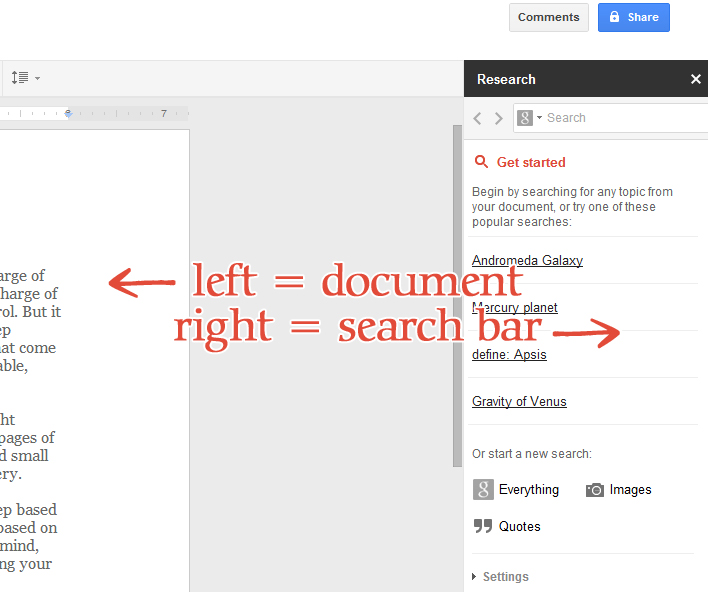
Google Docs recently became Google Drive (the new cloud storage service and collaboration tool) and now offers a search sidebar when using Drive as a means of improving efficiency with use so that users can research while in Drive. Imagine creating a spreadsheet about popular smartphones, and while working are able to search from the same window without having to open a new tab.
Next time you are in a document, go to tools and select “Research” or simply use the keyboard shortcut “Ctrl+Alt+R” to access a sidebar within the document. It behaves just as search, allowing users to search everything on the web, or immediately access icons to limit the search to images, quotes, and more.
Gmail gets Google+
Gmail already features Google+ profiles and status updates in the sidebar of the person you are emailing with, but now further integration has been added to Gmail. New features include quick access to contact details when viewing past conversations, as well as deeper integration with Google+ circles.
Google says that when you search for an email address, search results include that person’s profile photo and all communications with them. Additionally, when you select a circle while in Gmail, you’ll see profile photos of people in that circle on top of the page and when clicked, you’ll go directly to search results with contact details. Circles are now supported in search in filters, and can be found by typing in search “circle:[circle name]”
Confirming our assertion
In a statement, Google said, “These updates are helping us to provide a more consistent, beautiful experience across all of our products.” Not only does this confirm our continued assertion that Google seeks to integrate its products into one another, there is a good chance that over time, we won’t say “Google+ and Gmail,” or “GCal and Google Drive,” rather we’ll just say “Google” which implies all of their services as they appear consistent and as they integrate more deeply into one another, they become one.
According to the Mortgage Bankers Association’s (MBA) Weekly Mortgage Applications Survey for the week ending May 11, 2012, mortgage application volume rose 9.2 percent from the week prior with the Refinance Index rising 13 percent and Purchase Index 2.4 percent during the same period.
After weeks of falling, the refinance share of mortgage activity rose to 74.9 percent of the total applications from 72.1 percent the week prior and the adjustable-rate mortgage (ARM) share continues to fall, now at 5.4 percent of total applications.
“A flare up of the sovereign debt troubles in Europe once again led investors to flee to the safety of US Treasury securities last week. As a result, mortgage rates have reached new lows in our survey, and refinancing application volumes picked up substantially as a result,” said Michael Fratantoni, MBA’s Vice President of Research and Economics.
Fratantoni continued, “Survey participants indicated that this was not due primarily to HARP volume – the HARP share of refinances fell to 28 percent of refinance applications, down relative to last week and last month, when the share was just above 30 percent in April. The increase in refinance activity last week was concentrated in the conventional sector, which was up around 14 percent for the week, while government refinance applications were up only 4 percent.”
In April, the MBA reports that the investor share of applications for home purchases was unchanged from March, at 5.7 percent, noting that the Pacific region saw the largest investor share of applications for home purchase at 9.5 percent.
Interest rate trends
According to the MBA:
The average contract interest rate for 30-year fixed-rate mortgages with conforming loan balances ($417,500 or less) decreased to 3.96 percent, the lowest rate in the history of the survey, from 4.01 percent, with points decreasing to 0.37 from 0.41 (including the origination fee) for 80 percent loan-to-value ratio (LTV) loans. The effective rate decreased from last week.
The average contract interest rate for 30-year fixed-rate mortgages with jumbo loan balances (greater than $417,500) decreased to 4.20 percent, the lowest rate in the history of the survey, from 4.29 percent, with points remaining unchanged at 0.36 (including the origination fee) for 80 percent LTV loans. The effective rate decreased from last week.
The average contract interest rate for 30-year fixed-rate mortgages backed by the FHA decreased to 3.75 percent, the lowest rate in the history of the survey, from 3.81 percent, with points increasing to 0.66 from 0.45 (including the origination fee) for 80 percent LTV loans. The effective rate increased from last week.
The average contract interest rate for 15-year fixed-rate mortgages decreased to 3.26 percent, the lowest rate in the history of the survey, from 3.29 percent, with points increasing to 0.41 from 0.32 (including the origination fee) for 80 percent LTV loans. The effective rate decreased from last week.
The average contract interest rate for 5/1 ARMs decreased to 2.80 percent from 2.83 percent, with points increasing to 0.37 from 0.36 (including the origination fee) for 80 percent LTV loans. The effective rate decreased from last week.
According to the Mortgage Bankers Association’s (MBA) National Delinquency Survey, mortgage delinquencies dropped to 7.4 percent of all loans outstanding as of the end of the first quarter 2012, a decrease of 18 basis points from the fourth quarter of 2011, but a decrease of 92 basis points from one year ago.
The combined percentage of loans in foreclosure or at least one payment past due was 11.33 percent on a non-seasonally adjusted basis, a 120 basis point decrease from last quarter and was 98 basis points lower than a year ago. This was the lowest that this measure has been since 2008.
The percentage of loans on which foreclosure actions were started during the fourth quarter was 0.96 percent, down 3.0 basis points from last quarter and down 12 basis points from one year ago. The MBA reports that the delinquency rate includes loans that are at least one payment past due but does not include loans in the process of foreclosure.
The percentage of loans in the foreclosure process at the end of the first quarter was 4.39 percent, up one basis point from the fourth quarter and 13 basis points lower than one year ago. The serious delinquency rate (90+ days past due) was 7.44 percent, a decrease of 29 basis points from last quarter, and a decrease of 66 basis points from the first quarter of last year.
Inventory rates, foreclosure starts
The MBA notes that “Given the challenges in interpreting the true seasonal effects in these data when comparing quarter to quarter changes, it is important to highlight the year over year changes of the non-seasonally adjusted results.”
Compared with the first quarter of 2011, the foreclosure inventory rate: decreased 77 basis points for prime ARM loans, remained unchanged prime fixed loans, decreased five basis points for subprime fixed, decreased 71 basis points for subprime ARM loans, increased 48 basis points for FHA loans and increased seven basis points for VA loans.
Over the past year, the non-seasonally adjusted foreclosure starts rate: decreased six basis points for prime fixed loans, decreased 21 basis points for prime ARM loans, decreased 43 basis points for subprime fixed, decreased 45 basis points for subprime ARM loans, increased three basis points for FHA loans and decreased eight basis points for VA loans.
Greater declines than expected
“Mortgage delinquencies normally fall during the first quarter of the year, but the declines we saw were even greater than the normal seasonal adjustments would predict, so delinquencies are clearly continuing to improve,” said Michael Fratantoni, MBA’s Vice President of Research and Economics. “Newer delinquencies, loans one payment past due as of March 31, are down to the lowest level since the middle of 2007, indicating fewer new problems we will need to deal with in the future. The percentage of loans three payments or more past due, the loans that represent the backlog of problems that still need to be handled, is down to the lowest level since the end of 2008. Foreclosure starts are at their lowest level since the end of 2007.”
“The improvement in loan performance was widespread: only four states (Maryland, Delaware, New Jersey and Washington) experienced increases in their 90+ day delinquency rates. Forty one states had decreases in foreclosure starts and 22 states had decreases in the percentage of loans in foreclosure,” added Fratantoni.
Fratantoni continued, “The problem continues to be the slow-moving judicial foreclosure systems in some of the largest states. While the rate of foreclosure starts is essentially the same in judicial and non-judicial foreclosure states, the percent of loans in the foreclosure process has reached another all-time high in the judicial states, 6.9 percent. In contrast, that rate has fallen to 2.8 percent in non-judicial states, the lowest since early 2009. As the foreclosure starts rate is essentially the same in both groups of states, that difference is due entirely to the systems some states have in place that effectively block timely resolution of non-performing loans and is not an indicator of the fundamental health of the housing market or the economy. In fact, hard-hit markets like Arizona that have moved through their foreclosure backlog quickly are seeing home price gains this spring.”
In many European countries, gender quotas on corporate boards have been in place for several years, first in Norway, then Spain, France, Italy and the Netherlands The European Union Commissioner is pushing for quotas in companies as well, stating1 that companies have done little to remedy the disparity between male and female leadership. The quotas could be implemented in coming years if the gender imbalances persist.
Quotas are a contentious issue in Europe, but an even more hot button topic in America. The problem internationally with how the gender imbalance is being portrayed is that when companies report this data, they do not cite stats for the entire company, rather, it is female leadership and management that is reported, and those numbers are admittedly improving in the U.S.
But not so fast – the numbers being reported as women in leadership roles is not necessarily C-level executives, and more often than not, it is low level management being portrayed as female leaders, so just promote a few gals into lower management and your company has solved the gender gap crisis, right?
Not only is reporting flawed and skewing how the dilemma is being portrayed, a new Wall Street Journal (WSJ) report2, there is a dramatic preference for promoting men over women. Here is how the gender balance breaks down by each level, according to the WSJ:
Graduate entry level – 53 percent female, 47 percent male
Director level – 35 percent female, 65 percent male
Senior level – 24 percent female, 76 percent male
C-suite – 19 percent female, 81 percent male
Gender imbalances, what is the cure?
A recent report3 unveils that Millennial businesswomen do not ask for raises or promotions as often as their male counterparts, which is fascinating, as the generation grew up under the mantra that we are all equal, no matter our gender, race, or religion. Other generations that were not raised under this banner are also likely to be comprised of women that do not insist on promotions or raises.
For years, I have personally written on the topic of gender equality and have taken the unpopular stance that there is no such thing as a glass ceiling, and that women must not fear being considered a bitch at work if that is what it takes to succeed, and must never see themselves as inferior, particularly when their experience and education level is on par with or better than their male counterparts.
The idea that women are not as assumptive about raises or promotions is a clear indicator that the glass ceiling is somewhat self-imposed, but there are things our nation can do to make progress with gender equality at work without having to follow Europe down the path of gender quotas.
First, reporting must be accurate. Saying a company has a 50/50 balance between men and women, yet there are no C-suite executives that are female, only 5 percent in the senior level, but a massive number in the director level, the reporting is nothing more than back-patting and a back door way to show gender equality.
Secondly, women must push harder and insist on promotions and raises, because their male counterparts are doing it assumptively. Take away the self-imposed glass ceiling and our gender gets one step closer to equality.
Third, new leaders, young leaders must evaluate their company culture. Is twisting numbers a reasonable way to solve a company’s gender inequality problem, or is really looking at the culture a more effective path toward long term change? That’s a rhetorical question.
Lastly, as we’ve written about several times, encouraging young women, mentoring young women, and providing tools for their entry into the workplace as more than a receptionist. STEM (science, tech, engineering, and math) careers are always short female talent, and the pool employers have to choose from is very small, so encouraging and empowering young girls to be interested in STEM careers is the best way to bridge the gender gap in the long run.
There are many excuses companies can make as to why the gap exists, and many excuses women can make for themselves as to why they are not in leadership roles, but with improved reporting, improved culture, and mentorship of young women, the next generation has a chance at making some real headway on the gender imbalance dilemma.
According to newly released figures from the U.S. Census Bureau and the U.S. Department of Housing and Urban Development, national housing production rose 2.6 percent in April from March, with a 2.3 percent increase in single family homes, and a 3.2 percent rise in the multi-family sector.
“April’s increase in housing production comes on top of strong upward revisions to the previous month’s data, and is an encouraging sign that we are returning to a gradual, upward trend that should continue in the year ahead as builders respond to improving demand for new homes in certain markets,” said Barry Rutenberg, chairman of the National Association of Home Builders (NAHB) and a home builder from Gainesville, Fla. “Unfortunately, overly restrictive lending conditions for builders and buyers are slowing the pace of this trend considerably.”
“While still less than half the pace of what we would expect in a fully healthy market, the rate of housing production in April was very solid for this point of the recovery and in keeping with the findings of our latest builder surveys that have registered modest improvements in buyer traffic and near-term sales expectations for single-family homes,” said NAHB Chief Economist David Crowe.
Regional starts were mixed
In the Midwest, housing starts rose 6.7 percent, while the South saw an impressive 11.6 percent gain. The Northeast plummeted 20.7 percent while the West fell 8.1 percent. Regional starts were mixed and performance varied widely.
Permit levels fell 7.0 percent in April after a very large gain in March, with again the sliding numbers because of the wild ride multifamily is on, which alone fell 20.8 percent.
Regionally in April, permit activity held unchanged in the Northeast while declining 12.3 percent in the Midwest, 3.2 percent in the South and 13.9 percent in the West, respectively.