Home Blog Page 353

MRIS brings on Imprev to power integrated real estate marketing

New integrated real estate marketing center

Next week at the National Association of Realtors (NAR) MidYear Conference, the Metropolitan Regional Information Systems (MRIS), the Mid-Atlantic Multiple Listing Service (MLS) will announce that it has selected Imprev, Inc., a leading real estate marketing technology firm to power MRIS’s new “My Marketing Center.” MRIS’ 45,000 members based in Maryland, Virginia, Washington, D.C., and parts of Pennsylvania, Delaware, and West Virgnia facilitated $33.6 billion in real estate sales in 2011

My Marketing Center will provide a vital marketing tool for MRIS’s new suite of real-time, integrated business tools, providing MRIS customers free and unlimited access to “an integrated suite of professionally designed and simple to create digital and print marketing products and tools including Flyers, eFlyers, Postcards, ePostcards, and Virtual Tours,” taking advantage of live listing data without having to re-enter data, images or descriptions.

Time savings for Realtors equals cash

“My Marketing Center will be the fastest way to reach home buyers and sellers with real-time, in-depth marketing information instantly. In seconds, a link to a polished Virtual Tour is posted to Realtor.com or to the agents website, another click and an eFlyer with the broker’s template and branding is posted on Facebook or sent out on Twitter,” said John L. Heithaus, MRIS Chief Marketing Officer, adding, “The faster an agent can respond in today’s digitally-driven economy in real time, the more successful he or she will be to generate more sales commissions.”

MRIS and Imprev will also offer a Premium version of the digital and printable marketing products and tools for an additional cost, which is expected to include premium Craigslist Display Ads, eCards, Newsletters, eNewsletters, Digital Brochures, Brochures and more.

“Agents need three things from any business provider: quality, ease of use and value,” said Renwick Congdon, Imprev CEO and Founder. “At the end of the day, the finished product is what the consumer sees, so the quality of the product must reflect well on the agent and brokerage. Of course, if the agent can’t easily use the system they won’t, and cost is always a consideration. MRIS has addressed all three requirements with the ‘Gen M’ My Marketing Center.”

Picatic – the Kickstarter of event ticket sales

0

Kickstarting the event industry

The primary pain point for any event organizer is the risk of putting on an event and assuming all of the up front costs to secure a venue, advertise, procure speaking talent, bringing on event staff, and selling tickets. It appears easy, which is why so many jump into the space, but the risks do not always meet the rewards and companies often take a loss on their events.

Picatic.com was developed by a team of event talent that first created a traditional ticketing company that has done very well, but has expanded into an innovative new vertical to solve the problem of risk for event organizers by changing how people purchase tickets for events and the platform “guarantees successful events,” the company says.

Everything from a photography class to a large concert can be served through Picatic, and like Kickstarter.com, a certain goal of revenue is set by the event organizer, and if that goal is met, they are obligated to host the event, and if not enough tickets are sold, they are not obligated to go forward with the event, which is how the company seeks to eliminate the risk, as buyers know they may or may not get their desired event, which adds to the demand, as it encourages attendees to campaign for events they want to attend.

So let’s say you wanted to host a class on how to build tables. You get a customizable event page to promote across your social networks and email, and the system allows you to collect money and manage the event in real time. So you say you want to sell 25 tickets at $20 each, and your goal is to do so by the week prior to your class. If you hit your goal, you’ve made your sales and made the event worth it, and if you fail to hit your goal, you have the option to cancel the event and not take a loss on it, thus taking the guess work out of it.

Add in a layer of airline ticket sales flair, and you have magic

Picatic CEO, Jayesh Parmar tells AGBeat that the idea is to not only de-risk events, but to empower consumers who get to vote with their dollars. Additionally, the company creates urgency through price segmentation so that early sales are incentivized and prices increase as the event nears or as a certain amount of tickets have been sold, so it functions like airline ticket sales or even concert arena tickets, with the best deals going to the early buyers.

The company hinted that their next release could be a LinkedIn for event professionals to introduce relevancy to all of the connections the industry typically keeps private, opening opportunities for event organizers, especially when going into a new market.

Parmar notes that the Kickstarter plus airline ticket sales method improves the forecasting of any event host, and their commission is comparable to any ticket sales company (averaging 2.0 to 4.0 percent on a sliding scale). The San Francisco based company has been a bootstrapped organization that recently moved from Canada to the Valley – we expect they will be funded in the 2012 calendar year, as their overhead seems to be low and revenue high.

Freddie Mac’s new CEO recruited from the private sector

Freddie Mac leadership announced

Last fall, Freddie Mac CEO Ed Haldeman announced that he would retire in 2012, and a handful of Freddie executives are either reaching mandatory retirement age, retiring voluntarily, or leaving the organization, also without a successor.

After a six month wait, Freddie Mac has announced that its Board of Directors has appointed Donald Layton as the new CEO, starting May 21, 2012. Layton worked for three decades at JPMorgan Chase, climbing the corporate ladder from a trainee to vice chairman, retiring in 2004, then serving as chairman and CEO of E*TRADE Financial, along with being a member of the board for several financial services firm and advising a financial association. Layton earned his Bachelor and Master of Science degrees in economist from MIT and his MBA from Harvard Business School.

Layton’s career has included involvement in capital markets, investment banking, consumer banking and operating services, including two years overseeing the Chase Financial Services unit, thus one of the largest mortgage banks in the nation. He has also overseen international trading activities, risk management products, emerging markets, and the bank’s investment portfolio.

Attracting a private sector leader

“I’m pleased that the Board was able to attract a private sector leader of Don’s caliber,” said former CEO, Ed Haldeman. “His capital markets and banking background coupled with his ability to manage large, complex organizations will serve him well as he leads Freddie Mac’s 5,000 dedicated employees going forward.”

“Don brings strong executive leadership and a deep understanding of financial markets at a pivotal time for Freddie Mac,” said Christopher S. Lynch, Freddie Mac’s non-executive chairman. “His operating experience, analytical rigor and boundless energy make Don the right leader to continue our important work of supporting the nation’s housing market and helping America’s families, and to guide Freddie Mac in helping build a stronger framework for the future of housing finance.”

Fannie Mae’s CEO steps down, Freddie wants more money

In January, it was announced that Fannie Mae’s CEO, Michael Williams would be stepping down as well, leaving yet another opening.

As Layton takes over, there remains a pending request to the U.S. Treasury Department for another $19 million from taxpayers to cover what they came up short for their dividend payment owed to taxpayers. It remains unseen as to what Layton’s plans are for curbing these types of requests.

Sortbox streamlines your Dropbox chaos

Productivity booster – Sortbox

Professional productivity can mean the difference between a streamlined work experience and one of chaos. Chances are, you already have your email inbox organized with relevant folders from some kind of personal sorting system. But you can take it one step further and actually create a sorting system for your Dropbox files. And it’s not just creating a system that you can follow; you can actually create an automatic sorting system based on keywords and file extensions. All you have to do is set up your specifications and Sortbox will do the rest.

Sortbox is a specialized folder that you can just pop right into your Dropbox folder. After that, you have complete control to create sorting rules that match your specific professional and personal needs. You can have Sortbox automatically sort your pictures from your text documents. Or, you can make it even more specific and sort your files based on keywords. This means that you have countless options for sorting your important files and documents.

Set it up and forget about it

Once you create your rules, you don’t have to do anything else. Sortbox will check your special folder every fifteen minutes. It is said to be consistent and reliable. While the automatic and regular sorting may stress you out a little, there’s no need for that. You will never lose a file because all moved files are tracked, recorded, and logged. If you currently have shared folders with coworkers or even clients, the file tracking feature will be a great asset.

Staying productive and organized has been made easier through Sortbox’s features. It’s simple and effective. Using Sortbox to its fullest capabilities can save you hours per week by doing the tedious, mind-numbing tasks for you. Sortbox completes the small daily necessities so you can focus on more important things, like finding new clients, improving your product or services, and expanding your web presence and reputation.

Spark of Genius – the business camp

Introducing Spark of Genius Camp

Are you tired of seeing the same “experts” on stage, regurgitating what you already know or what you’ve already read on AG? Don’t you want to have a frank discussion with other professionals that are actually solving problems on the ground, and learn about their successes and failures, and maybe even share your own?

We feel the same way, which is why after years of being the leader in facilitating this conversation online, we have finally found the perfect format to take the conversation offline in a way that is not about speaker egos, and not about shoving vendors down your throat.

Introducing the Spark of Genius Camp, kicking off in AGBeat’s hometown of Austin, Texas on May 21st and 22nd. Whether your brand is B2B or B2C, this is a camp designed to turn down the hype, spark ideas, and send you off with actionable solutions to ignite your business.

Camp dates

Camp details

The Austin Spark of Genius Camp series is hosted at the JJ Pickle Research Campus
Participant sign-in and topic voting from 9am – 10am
Breakfast is provided, lunch can be purchased on-site

Hourly peer-led discussions take place throughout the day
Topics to include tech, marketing, leadership, finance, and more

The cost of attending Spark of Genius is your participation
Come share, learn, and network with fellow professionals

We know that there are amazing people using amazing tools in amazing ways, because we feature these innovations every day on AG, and it is time to share those tips and techniques with peers inside and outside of your industry. Help us to facilitate this much needed conversation on actionable and measurable business techniques by submitting your discussion topic and we’ll take care of the rest.

Registering, demanding Spark in your town, more details

Unemployment still above 8%, Small Biz Tax Cut Act could help

Unemployment making slight improvements

As a measure of the pace of layoffs, the number of people applying for unemployment benefits slid slightly last week by 1,000, according to the U.S. Labor Department who also reports that the four week average experienced its first decline since late March, marking a drop of 5,250 applications which many believe is a less volatile indicator than the weekly numbers.

When applications for unemployment benefits stay below 375,000 consistently, the implication is that job growth is strong enough to lower the unemployment rate, which has dropped a full percentage since August, but unemployment for April sits at 8.1 percent, still unable to break the 8.0 percent barrier.

This winter saw improvements in hiring, and the weak April has some worried that the gains from previous months may be lost as hiring remains weak this spring.

The Small Business Tax Cut Act

Representative Joe Bonner (R-AL) opined1, “Even as President Obama continues to push questionable government spending as the cure for an anemic job market, the House of Representatives has prescribed a robust treatment targeted to stimulate the country’s principal employers, small businesses. On April 19, the House passed the Small Business Tax Cut Act – the latest in more than two dozen bills also passed by the House since January 2011 to spur job growth.”

Rep. Bonner added, “Small businesses are the heart and soul of America’s economy — they are everywhere and form the backbone of our local communities. Collectively, they represent 99.9 percent of the country’s 28 million businesses and employ half of all private sector employees. Small businesses with less than 500 workers created 65 percent of all new jobs in America during the last 17 years.”

Concluding, Rep. Bonner said, “The Republican House’s latest effort to restore small business confidence is the passage of a 20 percent tax cut for businesses with fewer than 500 employees. The Small Business Tax Cut Act, which I supported, allows employers of less than 500 workers to take a tax deduction equal to 20 percent of their active business income.”

Job openings at four year high

Business Week reports2that the number of open job positions in America grew by 172,000 in April to 3.74 million, the most since July 2008, and that small companies were more optimistic on their outlook. BW notes that “more vacancies are a sign American companies were planning to expand at the end of the first quarter, undaunted by the jump in fuel costs or concerns that global economic growth will slow.”

Economist Lou Crandall told BW that the pickup is a “positive” development after a report last week showed payrolls in April grew at the slowest pace in six months.

“Businesses were becoming a bit more willing to commit to new hires,” Crandall told BW. “The progress is incremental at best and the levels are still very low.”

1 Rep. Bonner’s statement
2 Business Week report

11 inspirational quotes: getting past professional adversity

Being an entrepreneur isn’t easy.

While it offers flexibility, professional freedom, and some degree of control, it isn’t as stable, secure, or as stress-free as a traditional 9-to-5 job can be. Being your own boss and owning your own company comes with ample stress. And sometimes, that stress can become overwhelming and debilitating.

When these moments hit, it’s crucial that you find ways to relieve and understand that stress. After all, not all stress is bad stress, as it can be used as motivation. Take a look at these five quotes below that can help you regain control of your stress levels so you can continue to build your brand.

Regaining control of your stress levels

“When we change our perception, we gain control. The stress becomes a challenge, not a threat. When we commit to action, to actually doing something rather than feeling trapped by events, the stress in our life becomes manageable.” – Greg Anderson

“You learn to train the mind to stay more focused. We’re not always present. We’re usually thinking about the past or worrying about the future, which creates stress and emotional anxiety. If you find the balance between effort and relaxation and don’t let your mind get carried away, you can react to that stress. You’re able to stay more calm and centered during a stressful situation.” – Laurie Sabourin

“Things get bad for all of us, almost continually, and what we do under the constant stress reveals who/what we are.” – Charles Bukowski

“In times of great stress or adversity, it’s always best to keep busy, to plow your anger and your energy into something positive.” – Lee Iococca

“The key to winning is poise under stress.” – Paul Brown

Moving forward after you fall

Sometimes, no matter how well you handle the stress that comes with being a business professional and owner, there comes a time that you may have to let go of your struggling business, a once promising vertical, or even a major client. As is true in many aspects of life, letting go and taking that first step to moving forward can be the hardest part. Just because you have to walk away doesn’t mean you’re a failure. Sometimes it’s about changing your perspective and seeing it as a learning opportunity. Here are six quotes to help you get there.

“The truth is, unless you let go…unless you forgive the situation, unless you realize the situation is over, you cannot move forward.” – Steve Maraboli

“Whenever you make a mistake or get knocked down by life, don’t look back at it too long. Mistakes are life’s way of teaching you. Your capacity for occasional blunders is inseparable from your capacity to reach your goals. No one wins them all, and your failures, when they happen, are just part of your growth. Shake off your blunders. How will you know your limits without an occasional failure? Never quit. Your turn will come.” – Og Mandino

“There is no failure except no longer trying.” – Elbert Hubbard

“I have not failed. I’ve just found 10,000 ways that won’t work.” – Thomas Edison

“Success is not final, failure is not fatal: it is the courage to continue that counts.” – Winston Churchill

“You must make a decision that you are going to move on. It won’t happen automatically. You will have to rise up and say, ‘I don’t care how hard this is, I don’t care how disappointed I am, I’m not going to let this get the best of me. I’m moving on with my life.” – Joel Osteen

Success is relative and not absolute.

Even when you feel that you have failed, you surely have had little successes along the way. Use those small successes and the positive stress you experience as fuel to meet and create even bigger and better success in the future. Being an entrepreneur means improving and redefining yourself and the professional world around you. Keep moving forward, even if it’s only one step at a time. Eventually, you’ll be able to look behind you and see the distance you’ve covered.

AGBeat launches the 2012 Acts of Genius List


The Acts of Genius List is officially live! From SMB to enterprise, AG is looking for acts of extraordinary insight, inspiration and innovation.

Whether it’s effectively leveraging the power of the social web, inspiring a team to tackle and solve a complex problem, or coming up with an individual solution that rocks the bottom line, we’re looking to feature acts of genius in business that others can look to and learn from.” – Lani Rosales, Chief Operating Officer

The online nomination form, available at https://theamericangenius.com/actsofgenius, asks for:

  • Company that committed the Act of Genius
  • Industry
  • Size
  • Name and role of individual that led the charge
  • Impact of the Act of Genius
  • Email of person nominating the Act of Genius

AG plans to write feature stories on selected Acts of Genius and will ultimately identify its top 250 for 2012. To nominate you company or someone else’s, just click here and fill out the brief form.

Questions? Contact VP of Interactive, Elijah May, at elijah@theamericangenius.com.

AGBeat celebrates five happy years with its loyal readers

Thank you for five wonderful years, readers!

Today marks five years since the launch of this organization, and we want to thank you, our loyal readers, for commenting over the years, digesting the free content, and sharing it through social networks and word of mouth. We are eternally grateful!

AG started out as a single person blog, but within the first few months exploded into a national forum with dozens of writers. We’ve been lucky to expand into new markets and extend our news coverage and are proud to be first to the story and have unique angles that others typically miss.

We have pushed ourselves hard to maintain our integrity and to keep pushing the idea that we can change the world by helping business professionals to be better informed, thus giving consumers a better experience.

What the next five years have in store

In 2007, if you had told us we would be right here right now, we would be so enthusiastic about this success, and maybe a little skeptical that we could turn a one-man blog into a vital news organization. This week, we are making several major announcements that will give you clues as to what is in store for the next five years, but we have lofty goals and a lot of coffee for late nights to reach those goals, because ultimately, we want to do the best job possible for you.

We would love to hear from you in the comments – do you remember how you learned about AG? When did you first begin reading? What has been your favorite columnist or article? What have you learned here? What impact has our team made on your business life?

We thank you so much for giving us five amazing years! Happy Anniversary, readers!

NAR: home prices firming, sales to rise 7 to 10 percent in 2012

Median home price report

According to data from the quarterly report released by the National Association of Realtors (NAR), median existing single-family home prices, based on contract closings, “are firming in many metropolitan areas, while improving sales and declining inventory are creating more balanced conditions.”

The median existing single-family home price rose in half (74) of all 146 metropolitan statistical areas (MSAs) that NAR tracked in the first quarter, compared to the same quarter in 2011, while 2 MSAs saw no change and the remaining 72 saw price declines. NAR points out that in the last quarter of 2011, only 29 MSAs showed gains from the year prior, marking this first quarter as one of improvement.

Surprisingly, NAR observed that “a new breakout of income requirements on a metro basis shows most buyers have the necessary income to buy a home in their area, assuming a favorable credit rating.”

“Qualifying incomes are well below median incomes in most of the country, which means home buyers generally can stay well within their means,” said Dr. Lawrence Yun, NAR chief economist. “For example, a buyer in Indianapolis making a 10 percent downpayment would need an annual income of $24,0004 to purchase a median-priced home, while in Seattle it would be $55,300. For now, buyers are facing an extraordinarily advantageous situation if they can obtain a mortgage.”

Volatility in the price performance

Dr. Yun said there is some volatility in the price performance. “Home prices are more volatile than normal because of sudden upswings in buyer activity in some localities, and also are affected by the prevalence of distressed sales,” he said. “Home prices lag sales activity because the transactions were negotiated mostly in the previous quarter. Given the steadily dwindling supply of inventory and notably higher listing prices that are being negotiated today, prices are expected to show further improvements in the near future.”

Yun said a big part of the story is housing inventory. “We now have broad shortages of lower priced homes in much of the country, with very tight supply in Western states for homes through the middle price ranges. This is good news for many sellers who wish to list now, or for those waiting for prices to improve.”

Total home sales should rise 7 to 10 percent

Inventory levels are falling nationally, down to 2.37 million existing homes available for sale in the first quarter, down 21.8 percent from the first quarter of 2011, and much further below the 4.04 million in the summer of 2007.

The national median existing single-family home price was $158,100 in the first quarter, falling 0.4 percent below the first quarter of 2011. Distressed homes accounted for 32 percent of first quarter sales, down 6.0 percent over the year. Total closings rose 4.7 percent in the first quarter, and were 5.3 percent above the first quarter of 2011 when sales spiked. First time buyers purchased 33 percent of homes in the first quarter, and this share of purchase activity has been consistent for over a year now. All-cash buyers accounted for 32 percent of purchases in the first quarter, up 3.0 percent from the previous quarter, but up only 1.0 percent over the year.

“This is the highest first quarter sales pace since 2007,” Yun said. “With strong market fundamentals, total home sales this year should rise 7 to 10 percent.”

Closings varied according to region

Regionally, existing-home sales in the Northeast jumped 8.6 percent in the first quarter and are 6.6 percent above the first quarter of 2011. The median existing single-family home price in the Northeast declined 3.2 percent to $226,300 in the first quarter from a year ago.

In the Midwest, existing-home sales rose 5.5 percent in the first quarter and are 11.7 percent higher than a year ago. The median existing single-family home price in the Midwest increased 0.8 percent to $125,300 in the first quarter from the same quarter in 2011.

Existing-home sales in the South increased 2.1 percent in the first quarter and are 4.1 percent above the first quarter in 2011. The median existing single-family home price in the South rose 1.2 percent to $143,600 in the first quarter from a year earlier.

Existing-home sales in the West rose 5.9 percent in the first quarter and are 1.4 percent higher than a year ago. The median existing single-family home price in the West slipped 0.9 percent to $196,200 in the first quarter from the first quarter of 2011.

Sellers on an even footing

NAR President Moe Veissi, broker-owner of Veissi & Associates Inc., in Miami, said there are more opportunities in today’s market. “Historically favorable housing affordability conditions are making it easier for buyers to enter the market despite the unnecessarily tight credit conditions,” he said.

“Housing supply and demand are roughly balanced with overall housing supply at the lowest level in six years, putting sellers on an even footing with buyers in most markets.”

Mortgage application volume up 1.7 percent

Mortgage apps up for the week

According to the Mortgage Banker’s Association (MBA) Weekly Mortgage Applications Survey for the week ending May 4, 2012, mortgage application volume increased 1.7 percent from the week prior on a seasonally adjusted basis, and 2.0 percent on an unadjusted basis. The MBA reports that the increase was driven by increases in their Conventional components.

Application activity within the Government market decreased for the week, while the Refinance Index rose 1.3 percent, the Conventional Refinance Index rose 1.8 percent, and the Government Refinance Index fell 2.3 percent in the same period. The Conventional Purchase Index jumped up 5.4 percent, and the seasonally adjusted Purchase Index rose 3.4 percent. The refinance share of mortgage activity continued to slowly decrease, losing 0.5 percent of volume from the previous week.

Current mortgage rates

According to the MBA:

  • The average contract interest rate for 30-year fixed-rate mortgages with conforming loan balances ($417,500 or less) decreased to 4.01 percent from 4.05 percent, with points decreasing to 0.41 from 0.44 (including the origination fee) for 80 percent loan-to-value ratio (LTV) loans. This is the lowest 30-year fixed interest rate recorded in the history of the survey. The effective rate decreased from last week.
  • The average contract interest rate for 30-year fixed-rate mortgages with jumbo loan balances (greater than $417,500) decreased to 4.29 percent from 4.32 percent, with points decreasing to 0.36 from 0.38 (including the origination fee) for 80 percent LTV loans. The effective rate decreased from last week.
  • The average contract interest rate for 30-year fixed-rate mortgages backed by the FHA increased to 3.81 percent from 3.80 percent, with points decreasing to 0.45 from 0.50 (including the origination fee) for 80 percent LTV loans. The effective rate decreased from last week.
  • The average contract interest rate for 15-year fixed-rate mortgages decreased to 3.29 percent from 3.31 percent, with points decreasing to 0.32 from 0.41 (including the origination fee) for 80 percent LTV loans. This is the lowest 15-year fixed interest rate recorded in the history of the survey. The effective rate decreased from last week.
  • The average contract interest rate for 5/1 ARMs decreased to 2.83 percent from 2.87 percent, with points increasing to 0.36 from 0.35 (including the origination fee) for 80 percent LTV loans. The effective rate decreased from last week.

“Pizza launch” and other cheesy property listing bloopers


Trust me folks, the Blooper Moon must be in retrograde, because a lot of real estate agents went astray this week. The bloopers keep coming in from all over the U.S., but I’m sending out a special thanks to Bruce Walter who sent me some beauties this week. Enjoy these hilarious gaffes:

Sour Grapes

“A raisin to buy now” (If you just picked that up off the carpet, it may not be a raisin…)

“Marbles on floor” (The ones you lost perhaps?)

“Small mut nice” (It seems John Edwards wasn’t the only dog in the dog house.)

“Two dedroom house” (Let me guess – the top 2 reasons for divorce?)

A Mammal of Taste?

“Mammal work needed” (Looking in a mirror, dear?)

“Come for pizza launch” (How do you keep the cheese from sliding off?)

“This has the Woe factor!” (Self-analysis, I presume?)

“Ingest your tax refund now.” (Trust me, it was small enough that I wouldn’t even have to chew.)

“Must be scene” (Another night out with Kim Kardashian…)

Get Out While You Can”

“You will not have to pay an astronaut price” (Translation: You will not have to pee in a jar in zero gravity while sipping Tang,)

“Great area to vacate” (Welcome sign near the St Andreas Fault.)

“New presidence” (Muttered Obama as he heaved W’s suitcases into the rose garden.)

“Garage with tree pkg spaces” (For those who drive like Stevie Wonder…)

“Big horse coral”  –  (Steroidal seahorses no doubt…)

Blooper of the Week (Way To Step In It!)

“Don’t mess this one” (Said the attendant to Granny as he handed her another Depends.)


Wells Fargo to be sued by Feds for steering minorities into risky mortgages

Another discrimination suit for Wells Fargo

Not yet announced formally by the government, the Chicago Tribune1 is reporting that Wells Fargo has disclosed through a filing with the Securities and Exchange Commission (SEC) that the Justice Department (DOJ) may soon allege that the bank was involved in discriminating against minority mortgage applicants.

Although no formal accusations have been charged, it is not news that the Justice Department has been investigating claims that Wells Fargo steered minority applicants into risky, higher cost mortgages than what they qualified for, particularly subprime loans.

Although in the SEC filing, Wells Fargo asserted that it did nothing wrong and that no charges should be brought against them, this is not the first legal trouble they’ve seen over alleged steering of minorities, take the 2011 lawsuit filed by the Illinois Attorney General make the same allegations as the DOJ is said to be on the verge of making.

Wells already hit by Federal Reserve for $85M

The bank has already been penalized $85 million by the Federal Reserve who also alleged that Wells Fargo steered applicants who would have qualified for standard mortgages into high risk adjustable-rate loans.

Similarly, the DOJ settled with Countrywide (now owned by Bank of America) last winter for $335 over similar charges that Countrywide’s policy was to steer minorities into subprime mortgages, whether they qualified for a standard loan or not.

In the case of the Illinois AG lawsuit, Wells Fargo allegedly gave financial incentives to employees who steered borrowers eligible for prime mortgages into riskier, more expensive mortgage loans. Wells Fargo denies these charges, claiming they have filters in place to prevent steering, but the lawsuit says those filters were very easy to skirt and it was common for employees to do so in exchange for bonuses.

Although some have blamed subprime mortgages for the housing crash, others claim otherwise; but with the DOJ likely to announce a case against Wells Fargo, it is certain that their $85 million payout is only just the beginning.

1 Chicago Tribune story

How Yelp’s algorithm is said to suppress legitimate reviews

Keeping a small business alive

Verbal recommendations used to keep small businesses alive, especially small businesses with small advertising or marketing budgets. These days, however, internet is king and online business reviews have taken the place of those verbal recommendations. That can mean that a simple recommendation is no longer so simple, for you or your prospective clients. Online reviews and recommendations are only helpful if they’re done correctly, the way it was intended – honestly.

Fake online reviews are sometimes not as easy to spot as they should be. And some business review sites, like Yelp, are said to be promoting the fake reviews and hiding the real, genuine ones—perhaps unintentionally – because of an unrealistic and unreliable algorithm. This causes customers to be deceived and for honest companies to be placed and ranked lower than they actually deserve.

$2,000 down the drain as a result

Justin Vincent described one such Yelp experience with a local moving company. Because of several five-star reviews, Vincent chose to hire a specific moving company, which cost him $2,000 over what he was originally quoted and the experience left him without his furniture for forty days.

When he looked further into the matter, he discovered that reviews made by one-time reviewers and those who are not active participants on the site were hidden and marked as spam. This means that marketing companies or businesses who post review upon review for different companies and even the same company will be showcased while real reviews are hidden.

Business owners, take note

While it’s easy to understand how frustrating the suppression of genuine reviews can be for consumers, it is even more detrimental for small business professionals. Highly-rated, fake business reviews of your competitors can do enough damage to stunt your professional growth. Not only does it give your competition a leg-up that they haven’t earned, reviews from your happy customers will never be seen, meaning they won’t show in search queries of any kind. But if they did, think of the professional benefits and improved web presence you might have experienced.

While there isn’t much you can do about review sites’ algorithms, you can encourage your happy customers and clients to use other social networking tools to post reviews. Or, you can put it directly on your website. There are ways around using these sites, and perhaps one day they’ll figure out a way to post, promote, and showcase legitimate comments and reviews. Until then, monitor review sites and be aware of how your brand is being represented, and use your other resources to promote your brand and encourage your customers to do the same.

Navy veteran with real estate in his blood joins ListHub

Move, Inc.’s high profile hire

ListHub, a Move, Inc. company, recently brought on John Whitney as their VP of Industry Relations. Whitney graduated Cum Laude from Chapman University, and began his career in active service in the U.S. Navy as a Database Installation and Training Manager, and earned the Navy Achievement Medal for outstanding performance of duty. Whitney is a veteran of the Gulf War and most recently was the Director of National Sales at Sentrilock, and was previously the Executive Director at the Central Valley Association of Realtors and at the Southwest Multiple Listing Service.

Whitney said, “Real estate is my family business. My parents were brokers and my wife and I have devoted the bulk of our careers to the industry. As I sit on the cusp of a 20 year relationship with this family, I feel a special responsibility to the industry to make things better, to use my past experiences to bring unique insights to the discussion, to be a collaborative partner, and to serve in any way I can. I owe a lot to the real estate community that has served me and my family so well.”

When we touched base with Whitney to see how his transition is going, he told us that his biggest surprise is that he originally believed ListHub syndication to be a datafeed. “I was surprised to learn that it is much more than that. It’s a platform that allows MLSs and brokers to manage their businesses much more effectively. They are looking to provide more choices to agents and their clients. But, they are looking to do that in a controlled way under a set of guidelines that protect the integrity of their information and ensure a great experience for sellers and consumers. I see a lot of opportunity and was encouraged by the potential for this platform.”

Whitney told AGBeat that the most difficult part of his transition has been “shifting focus and learning where I can use my experiences to bring unique contributions – layered on top of all the “new-ness” that a transition like this brings,” but quickly notes that “The easiest transition has been with the people. The people most passionate about this industry tend to stick around. It gives us a great opportunity to build quality relationships and support each other as we bring our talents to different arenas. I’ve been overwhelmed with the amount of support they have given me.”

Whitney’s new role, navigating muddy waters

Whitney’s role at ListHub is to ensure that data providers have all of their needs met, which Whitney says “includes keeping our partners aware and informed as well as engaging with the industry to ensure that our platform and services provide real value.”

“We need to be proactively identifying challenges and opportunities so we can be part of the solution,” he added. “We have unique responsibility to this industry. A key part of that is continuously fostering an excellent experience so we can all encourage choices to meet the evolving needs and expectations of MLSs, Associations, franchises, brokers, agents, and consumers.”

Whitney is aware that he is changing his role in the industry in an era of contention surrounding listing syndication. “The real estate industry is quick to grab onto new technologies and in many cases plays a pioneering role. Sometimes when you swim in new waters the way is unclear, the waters are muddy. What ListHub offers is clarity, data to confirm the route, a compass to keep things on track. As we continue to forge ahead through the murkiness, we know where we are going, because we have the data to confirm our direction and tell us when to turn when we need to.”

As a fresh pair of eyes on the company, Whitney says it’s hard to tell what the company will look like in the future. “Our responsibility is to ensure consumers have the best experience possible and are fully engaged with real estate professionals. Their expectations will expand, morph, and adapt in ways we can’t imagine. We can’t predict how this will change us, but we know it will. We want it to. It’s exciting to be part of it.”

Wearable glove is a cell phone made from a 3D printer

Glove One takes tech one step further

Milwaukee designer and artist, Bryan Cera specialises in re-purposed electronics and custom built circuits, and has now revealed his prototype of “Glove One,” a wearable glove that acts as a cell phone, and uses numbers on the underside of fingers to dial out.

Cera says his glove is not meant to be used by everyone on the planet, rather makes a statement that the creation represents a future where smartphones have become an actual part of our bodies, and our hands become a vestigial limb replaced by a handset. It sounds very Star Trek-like, but Cera explains, “It presents a futile and fragile technology with which to augment ourselves. A cell phone which, in order to use, one must sacrifice their hand. It is both the literalization of Sherry Turkle’s notion of technology as a “phantom limb”, in how we augment ourselves through an ambivalent reliance on it, as well as a celebration of the freedom we seek in our devices.”

“Emotional investment becomes physical,” Cera adds, “as the functionality of the device depends on the dysfunctionality of the wearer. While we enjoy the fantasies they offer, we rethink the technologies we construct and reflect on how they construct us.”

Built with a 3D printer

Three-dimensional printing has come a long way, printing everything from columns for commercial buildings to edible chocolate, and now a cell phone glove, and while Cera has made many modifications to the device, in the video above, he actually demonstrates the working prototype.

The Glove One is no more than a prototype, but is it really that far off to think that Cera is right, and although his theory is very lofty, could we all have gloves or implants or chips or other devices that are part of us? We think Google is already showing their hand that they too believe in the future of technologies integrated with the human body, just look at the Google Glasses prototype.


Small business owner optimism at highest rate in over a year

Small business confidence levels rise

Hitting its highest point in over a year, small business confidence rose in April by 2.0 percentage points, according to the National Federation of Independent Business (NFIB), as companies stepped up plans for hiring and investing.

“While the Index remains historically weak, there was good news in the details of April’s report. Job creation plans, job openings and capital spending plans all increased. Hopefully, this performance will hold in the coming months,” said NFIB Chief Economist, Dr. William Dunkelberg.

Dr. Dunkelberg added, “However, GDP and employment growth news has not been good; the Euro debt crisis continues to make news and Congress leaves us on an identical path: huge deficits, a terrifying amount of liquidity at the Fed, and no indication that anything positive will be done. Most likely, there will be only small improvements on Main Street in optimism or hiring and spending this year. With the election six months away, the Index will signal how small firm owners see the economy’s future unfolding—and their outlook will be telling.”

Companies added to payrolls

The NFIB reports that companies added to payrolls in April, although at a slower pace of growth than in March. Tuesday’s report showed more companies also plan to spend money on things like buildings, land and machinery. Additionally, the percent of owners reporting positive sales trends quarter on quarter reached the highest level seen since April 2006. This was a major contributing factor to the huge improvement in reported profit trends, an 11 point gain and equal to half the improvement of the Index.

“Inflation may become a problem for the small-business community in the months to come,” the NFIB reported, adding that 26 percent of NFIB owners reported raising their average selling prices in the last 90 days (up 1.0 point), contrasted by only 16 percent reporting price reductions (down 1.0 point). “Price-cutting appears to be fading and this will put upward pressure on the inflation measures,” the organization noted.

1 NFIB April Report

Housing finds a balance between supply and demand

Home prices stabilizing

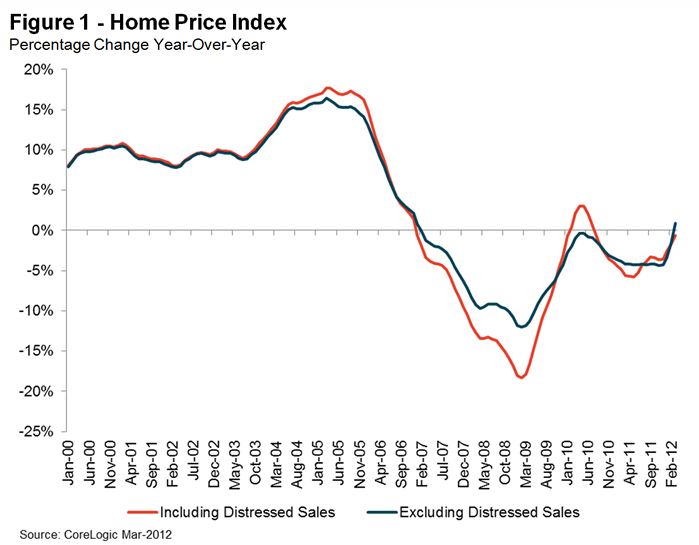
With a 0.6 percent drop in home prices between March 2011 and March 2012 and a 0.6 percent increase in prices from February, CoreLogic’s Home Price Index (HPI) shows that national home prices not only saw the first month-over-month increase since July 2011, the movement up and down is slight, indicating the market has found its bottom. Excluding distressed sales, month-over-month prices increased for the third month in a row. The CoreLogic HPI also shows that year-over-year prices, excluding distressed sales, rose by 0.9 percent in March 2012 compared to March 2011.

“This spring the housing market is responding to an improving balance between real estate supply and demand which is causing stabilization in house prices,” said Dr. Mark Fleming, chief economist for CoreLogic. “Although this has been the case in each of the last two years, the difference this year is that stabilization is occurring without the support of tax credits and in spite of a declining share of REO sales.”

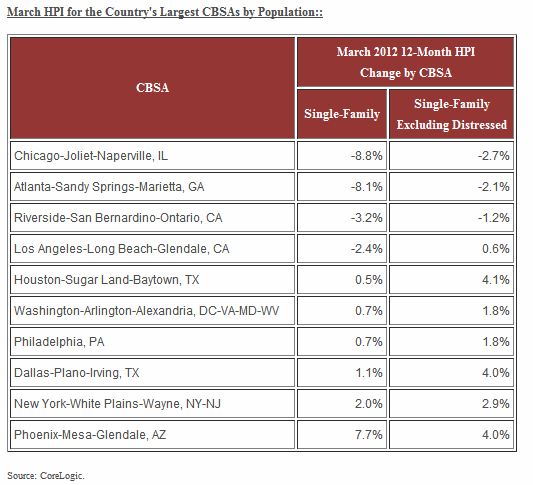
“While housing prices remain flat nationally, in many markets tighter inventories are beginning to lift home prices,” said Anand Nallathambi, president and chief executive officer of CoreLogic. “This is true in Phoenix, New York and Washington, for example, which all reflect higher home price values than a year ago. A continuation of this trend will be good for our industry across U.S. markets.”

Regional performances vary

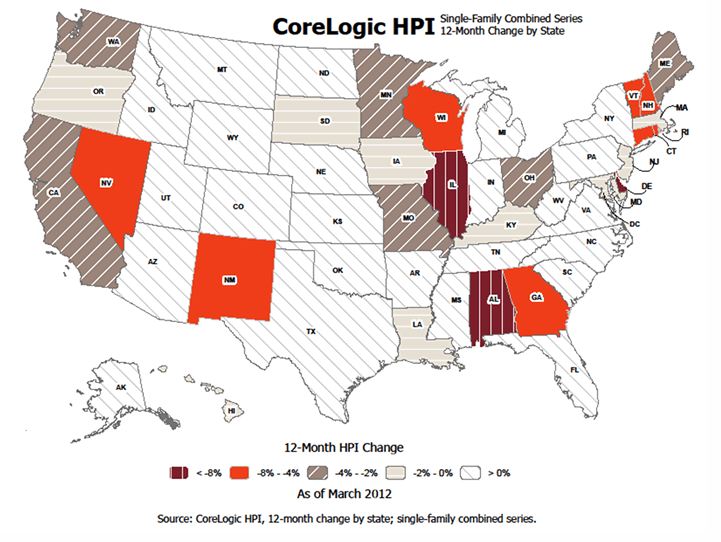
As always, all real estate is local and some states continue to perform extremely well while others continue to decline. Including distressed sales, the states with the highest appreciation were Wyoming (+5.9 percent), West Virginia (+5.3 percent), Arizona (+5.1 percent), North Dakota (+4.7 percent) and Florida (+4.5 percent) and excluding distressed sales, the top performers for March were Idaho (+5.4 percent), North Dakota (+5.1 percent), South Carolina (+4.7 percent), Montana (+3.5 percent) and Kansas (+3.4 percent).

Not everyone had such stellar results, however, as CoreLogic reports that including distressed sales, the states with the greatest depreciation were Delaware (-10.6 percent), Illinois (-8.3 percent), Alabama (-8.0 percent), Georgia (-7.3 percent) and Nevada (-5.8 percent), and excluding distressed sales, the poorest performers were Delaware (-7.6 percent), Alabama (-4.1 percent), Nevada (-3.9 percent), Vermont (-3.9 percent) and Rhode Island (-2.9 percent).

Including distressed transactions, the peak-to-current change in the national HPI (from April 2006 to March 2012) was -33.7 percent. Excluding distressed transactions, the peak-to-current change in the HPI for the same period was -24.5 percent. The five states with the largest peak-to-current declines including distressed transactions are Nevada (-59.9 percent), Arizona (-48.6 percent), Florida (-48.1 percent), Michigan (-45.1 percent) and California (-42.7 percent). Of the top 100 Core Based Statistical Areas (CBSAs) measured by population, 57 are showing year-over-year declines in March, eight fewer than in February.


Quick tips for working with tenants in short sale listings

A sticky situation

It’s been a long time since I’ve read Dale Carnegie’s book, but I’m pretty certain that collecting rent and not paying the mortgage on that same rental was not a suggestion that came from How to Win Friends and Influence People.

It is not uncommon for those who own a rental and are having trouble making the bills to cease making the mortgage payments on the rental. It’s also not uncommon for the owner of the home (the one who is still collecting the rent, but not paying the mortgage) to neglect to mention to the tenant that the end of tenancy may be imminent.

Listing a rental as a short sale can be challenging. Tenants are often a little bit disturbed when they learn that they have been paying the mortgage, yet those payments have not been making it to the bank. So, when the tenant learns that he (or she) now was to be flexible and allow prospective buyers into the property for showings, the tenant is generally not a happy camper.

It is nearly impossible to quickly and efficiently sell a property with an uncooperative tenant. And, since time is of the essence in a short sale where the mortgage payments have ceased, it is vital that tenant and landlord get on the same page.

Two Tips for Working with Tenants in Short Sales

  1. Ask the tenant to find a new place to live immediately; offer a cash incentive if necessary.
  2. Offer a reduction in monthly rent during the course of the process in order to motivate the tenant to be accommodating to requests for showings among other things.

I recently heard a story about a tenant that was so irritated with his landlord that he trashed the property on day prior to the short sale closing. As a result of the tenant’s behavior, the landlord (the short sale seller) had to pay a few thousand dollars in repairs and clean up so that the buyer would continue with the purchase.

Like I said (and maybe it’s an understatement), the landlord-tenant relationship in a short sale situation was not addressed in How to Win Friends and Influence People.

Old School mentoring: the missing ingredient in business today

What passes today for mentorship

If you are under 35 years old, ask your parents, or better yet your grandparents, if they were mentored. If they were, especially your grandparents, listen to all of their stories. I suspect you’ll be hungry to live their experiences yourself. Being mentored back in the day meant being taught a trade or profession by an experienced, and yes, trusted advisor. Over the years, I’ve spoken with dozens of recent high school and college grads who have given me an understanding of what now passes for mentorship.

On the positive side, those who go into most of the construction trades are often the best trained, relatively speaking. Back in the Pliocene Epoch, I was once a brick tender. That was the guy who ensured the brick layer was always sufficiently supplied with mortar, called mud, and the brick or block with which they were workin’ that day. There were two basic ways to learn brick tending. You hired on as a below market rookie, working for a non-union company and learned on the job at half the pay of the guy showin’ you the ropes. That’s how I learned. Or, you applied for membership in the local union, which had a very effective training program. Either way, you ended up a very competent brick tender.

Who’s being mentored in today’s job culture?

According to most industries, everyone is. Having been mentored myself within an inch of my life, I can tell you first hand, that today the concept has been thoroughly bastardized. Part of the agreement with my many mentors was to eventually pay it forward, when I was qualified to do so. In the last 15 years or so I’ve been blessed to have made good on that promise.

Mentoring 2,000 years ago:

Back a couple thousand years ago, being mentored was not only pivotal to success, if not survival, but a serious privilege. It often took several years, resulting in the universally respected title of Journeyman. It denoted that your work’s product was worthy of pay and of the highest quality, and that you were no longer indentured to the ‘master’ as their apprentice. It was a very sober undertaking, the implied contract being between the master and the apprentice, both of whom took their obligations very seriously. Back then the only reason for a union’s existence was to ensure the highest quality of workmanship — as it should be.

As a mentor, I prefer the Old School approach

As the owner/broker of a real estate investment firm, those who I’ve mentored have been young agents aspiring to open their own investment brokerage at some point. Their first job is to learn the most basic activities of an assistant. This entails learning the various players involved when investing in real estate. Then, there are the forms, which are endless. Being mentored means you’re with me at least 80% of the time. Clients meeting me in the office? You’re there. Five year after tax cash flow analysis? You’re doin’ yours on the same property, but separately. Those are but two of the myriad tasks and skill sets to be learned, or rather, mastered.

My mentors? They didn’t understand grading on the ‘curve.’ What they understood was that either I got it, completely, or I didn’t. Don’t get me wrong, it definitely wasn’t pass/fail, it was master it or you failed and started over. Were they brutal? I was ridiculed often. Two of ’em employed the occasional back of the head slap. No, really, they did. To them, ensuring I was always learning was a deadly serious undertaking. They cared. It showed. I learned.

The other side of the coin — my experience as a mentor

Of those mentees who swore on their momma’s life to be ‘all in’, a total of, count ’em, four have stayed the course. Three were nuclear, glow-in-the-dark rookies. One is an established brokerage owner who, as I did, transitioned from homes into the investment side. I’ve easily had over a couple hundred begin the difficult journey apprentices must travel. Four were dead serious. So, when we constantly hear and read about lousy training programs, understand there’s another side. Hundreds, more likely thousands around the country who were offered the chance for wicked good mentoring by highly qualified professionals, didn’t even slack off, they completely flaked out.

In plain English, my batting average for mentoring success, when viewed objectively, sucks. I began offering to mentor serious agents back in 1996. In over 15 years, that means I’ve successfully taken four of over 200 agents to the point of earning a pretty good living. The rest? Most are doing something else, completely out of the business. The irony is that almost all of ’em came to me asking to be seriously mentored. Yeah, I know about human nature. But, to seek out the mentor themselves proactively, then flake out? The average flake out time was less than a week, sometimes less than a work day.

On the other hand, those four who stayed the course? The first two did well. One became a full blown real estate investment agent. In fact, he made $15,000 his first month on his own. The second guy not only succeeded, he later opened his own brokerage exactly as he’d planned. Of the latter two, one ended up coordinating my operation from the inside. That meant being ‘operations manager’ for tax deferred exchanges involving multiple properties/multiple states. It mean handling all transactions after they were negotiated. No, he wasn’t a transaction coordinator. He literally ran the business for 90% of what needed to be accomplished. TCs from three states reported to him. Brokers, lenders, escrow, title — everyone called him first, not me. That’s how good he was.

The fourth guy was a house broker, a one-horse operation, more or less. Since he was in another state, the ‘mentoring’ takes place online, on the phone, and in person whenever I’m in his state. Fortunately for him, he’s a whole lot smarter than I am. He’s significantly increased not only his real time operating knowledge, but enhanced that immeasurably by attending some very difficult, highly sophisticated, and rather expensive training I strongly ‘recommended.’ Each year, his income has increased impressively. The guy can take a new concept and take it to the street faster than most I’ve known.

I believe this and told him as much — he’ll experience what I call a 2-comma income year before he’s 40. He’s 32 now, I think. ‘Course, by then he’ll be mentoring others, paying it forward just as he promised. I also suspect he’ll be a bunch better at it than I ever was.

Old School mentoring assumes that mutual responsibility is the glue for success, bonding the mentor and the student together. Once that responsibility has been embraced, the relationship is almost assured of success.

Finding a mentor

Need mentoring? Find one. Are you highly experienced at what you do? Let it be known you’ll mentor the right person. I look back on my mentors, some of whom were literally icons, and wonder how I came to be blessed so many times. There are very few of us who are successful without being mentored, whether it was formal or not. We all owe them to pay it forward. Why? Simple — what we were taught was priceless. Without them. I would have been trapped doing something I hated. With them, I was given the key unlocking the door to a life I only dreamed of back then.

Old School mentoring — get it — give it back.

Related: Mentorship Report

Frequent email checkers are less focused and productive

The stress of email

According to a new study by The University of California, Irvine in conjunction with the U.S. Army, people cut off from work email experienced stress reduction and their focus improved dramatically.

In this study, heart rate monitors were attached to computer-dependent civilian workers in a suburban office setting, while software sensors detected how often they switched windows. The results were astonishing – people who read email changed screens twice as often and were in a steady “high alert” state, with more constant heart rates, while those removed from work email for five days experienced more natural, variable heart rates. Those with no email reported feeling better able to do their jobs and stay on task, with fewer stressful and time-wasting interruptions.

“We found that when you remove email from workers’ lives, they multitask less and experience less stress,” said UCI informatics professor Dr. Gloria Mark who presented the results at the Computing Machinery’s Computer-Human Interaction Conference in Austin today.

37 window switches per hour

The report noted that the email users averaged 37 switched windows per hour, while those without email focused for longer periods of time and only switched screens 18 times per hour.

Dr. Mark says the findings could be useful for boosting productivity and suggested that controlling email login times, batching messages or other strategies might be helpful, and although it was difficult to recruit volunteers, she said, that “participants loved being without email, especially if their manager said it was OK. In general, they were much happier to interact in person.”

Lacking email forced employees to walk to other employees’ desks, also offering physical relief as an added benefit, but those without email did report a feeling of “feeling somewhat isolated,” but were able to garner critical information from their colleagues with email.

High alert hear rates may be a health hazard

UC Irvine says that other research has shown that people with steady “high alert” heart rates have more cortisol, a hormone linked to stress. Stress on the job, in turn, has been linked to a variety of health problems, particularly reduction of the strength of a worker’s immune system and ability fight off illness and infection.

Dr. Mark suggests controlling email login times, batching messages or other strategies to streamline email use. For reasons of productivity not based on this new study, some companies are banning email altogether and funneling employees into the company intranet, like a French company who recently banned 80,000 employees from using email, after extensive internal studies of productivity.

Perhaps we will see a middle ground between email obsession and an email ban for most American companies in coming years as more research reveals how email is linked to productivity.

Agent Manager claims to be the most user friendly CRM

Increased Realtor productivity

With a variety of tools available on the market today, it has become a common practice for real estate professionals to figuratively duct tape tech tools together to create a suite that allows for proficient work in the field, particularly with the rise in popularity of cloud computing.

Agent Manager Solutions, based in Texas, has developed a product that they say answers this need without requiring any duct tape. Agent Manager’s Director of Marketing, Brad Sharp says that the company is often told that real estate customer relationship management (CRM) software is too complicated to learn or use, but argues their product is the “most user friendly CRM on the market.”

Additionally, the company was founded by and designed by Realtors for Realtors and took over a year to develop prior to launching in the Apple iTunes store.

Agent Manager is a web and smartphone software solution that allows agents to manage most business functions from their iPhone or computer, depending on their location. The company offers checklists, alerts, and easy access to information so agents can “put your office in your pocket” and keep all business activity synced between devices.

The company says, “From the moment you meet a potential client until you are at the closing table, you’ll now be able to track every move and ultimately grow your business. Stay connected without being in front of your computer, and focus on what you do best: making the sale.”

One minute explanation and demonstration of Agent Manager:

Homeowners staying put: kitchen, bathroom remodels on the rise

Remodeling projects on the rise

Compared to 2010, the volume of common remodeling projects has increased, according to a survey by the National Association of Home Builders (NAHB), with remodelers reporting that kitchen and bathroom projects remain the most popular remodeling jobs with home owners, as they decide to stay in their current homes longer and upgrading these rooms while making major repairs.

Nearly half of all remomdelers report seeing an increase in the number of homeowners who undergo remodels to “avoid moving,” compared to the 2010 survey. Bathroom remodels were cited as a common job by 78 percent of remodelers, and 69 percent said kitchen remodels were common, both up 17 percent from two years ago. Since 2009, the NAHB reports that bathrooms and kitchens have switched places in popularity, with bathrooms sliding into the top spot. Other popular remodeling projects include window and/or door replacements (44 percent), whole house remodels (35 percent), and room additions (33 percent), all in support of the report’s assertion that homeowners are staying put.

“As the priorities of home owners shift, remodelers have to adjust to the needs of their clients,” said NAHB Remodelers Chairman George Moore Jr., and owner/president of Moore-Built Construction & Restoration Inc. in Elm Grove, LA. “And while the motivation behind a home owner’s decision to remodel may have changed, their desire for quality, professional results have not. Professional remodelers remain committed to the highest industry standards.”

Repurposing spaces, hiring remodelers

The top reasons cited for customers hiring a remodeler is for repairs and replacements of old components, along with upgrading amenities – more than three in five remodelers reported increased demand for repairs and replacements of old components over the last two years, with over half saying a desire for upgraded amenities rose.

The NAHB points out that over 20 percent of remodelers said there was a drop in customers remodeling to increase their home values as an investment.

“Home owners are repurposing spaces and making more efficient use of their home’s square footage,” Moore said. “Whether it be young families or couples aging in their homes, people want to let their house adapt with their needs as they change over time.”

Last month, the NAHB released their 2012 home design trends report which repeats much of what Moore notes – homeowners are not only staying longer, but reworking spaces, expanding amenities, focusing on efficiency, and building around multi-generational living.

Hey Pinterest, who is Mike and why am I stuck liking him?

What is MikeLike?

A few weeks ago, I noticed in my Google Chrome when I right click on a photo, a small blue icon and the words “Pin to MikeLike,” and red alarms immediately went off in my head – who the bleep is Mike and why is he up in my Chrome? I’ve never heard of MikeLike, nor have I ever installed anything from the Pinterest clone, so where did this come from?

I put on my Sherlock Holmes hat, stuffed my pipe with pretend tobacco, and began sleuthing. First, I headed over to the MikeLike site and read their about page and terms, and found nothing about uninstalling MikeLike from Google Chrome. Maybe I accidentally downloaded some Google Chrome extension, so I dug through all of my Google Chrome settings and there was nothing called MikeLike that I could delete or uninstall.

Nothing? I checked my browser history that goes back nearly 12 months, and I found no instance of having visited anything named MikeLike. Google searching didn’t reveal much information about it, so I headed over to the Google Chrome Web App Store and found a MikeLike extension, but it wasn’t installed on my Chrome.

The mystery deepens

This mystery is frustrating. Who is Mike? Someone please tell me! In desperation, I ran a sweep on my computer to make sure it wasn’t some malware I had been exposed to, and all was clear. I quickly decided that Pinterest was out to get me, but just in case that wasn’t true, I kept searching for answers.

With a little digging, I found someone complaining that the Pinterest Right Click Google Chrome Extension had added the ability to “Pin to MikeLike,” so I searched to see if I had downloaded that extension. I could tell from the “Add to Chrome” button on the page that I did not have it installed.

It seemed like a dead end, until I remembered that I had tested out several Chrome Extensions for pinning to Pinterest and settled on the “Pinterest Button” which is not designed by Pinterest, so it can technically make any changes it wants to, even if it is just one guy who built an app once upon a time.

By uninstalling the “Pinterest Button” Chrome extension, there was no more “Pin to MikeLike” when I right click an image, and when I am in Pinterest, I no longer have a stupid extra button when I hover over a picture.

Problem solved, what was the lesson learned?

It may seem minor to some, but this felt like a major violation to me – the brand was inconsistent and not even named the same thing as the Pinterest Button extension, and there was no way for most people to stumble upon the answer as to who the hell MikeLike is. I panicked and wasted a lot of time trying to uninstall this and that, and to no avail. MikeLike may be useful for some, as it offers private pin boards, but through no fault of Pinterest, a rogue extension downloaded to Chrome led to a great deal of confusion.

The lesson: when installing Chrome Extensions or any sort of browser tool, try to use the official extension from the source if you can, even if the functionality lacks. Although there is no official Pinterest extension on Chrome, the closest, most legitimate extension is the Pinterest Pin It Button (by Shareaholic) which works just fine and doesn’t force you into liking Mike, who is still a mystery person.

Servicers incentivized to bet against homeowners, may hurt housing

Force-placed insurance’s impact on housing

“Force-placed” insurance, or property insurance the bank takes out for homeowners who miss an insurance payment has recently come under fire by Bloomberg News Editors1 who say the policies cover less and cost more, and will likely end up putting homeowners into foreclosure regardless of the force-placed insurance policies.

Deeper analysis of the forced-place policies revealed that the loss ratio is much lower than expected, in other words, the percentage of premiums paid out on claims is severely low, paying out $0.20 cents on the dollar, when the average $0.55 cents on the dollar payout of most other types of policies. The implication is that the insurance companies are charging extremely high premiums, and when the policies actually pay out, they barely cover the bank’s losses.

Bloomberg reports that banks not only receive commissions on the forced-place policies, they make even more money by re-insuring them, so the bank takes out a policy to protect the property but is making a more lucrative bet that the policy will never pay out. Fannie Mae has already instructed servicers of Fannie-backed loans to reduce the cost of insurance premiums, but Bloomberg implies that these directives are weak and more can be done.

Although the Consumer Financial Protection Bureau is looking into forced-place insurance, Bloomberg urges the CFPB to require all servicers to pick up the homeowner’s lapsed policy when possible, otherwise seek bids for lower cost options, and notes that Freddie mac should demand its servicers to get competitive bids on insurance policies.

The crux of the forced issue

The CFPB should investigate the commissions made by banks on these policies, says Bloomberg, as they are a major incentive to put homeowners into policies they cannot possibly afford. “Many homeowners who experience coverage gaps have severe financial problems that lead them to stop paying their insurance bills,” notes Bloomberg. “They are already at great risk of foreclosure. Banks and insurers shouldn’t be allowed to add to the likelihood of default by artificially inflating the cost of insurance.”

1 Bloomberg story