Home Blog Page 354

Trulia initiatives unveiled: broker strategy now apparent

Three Trulia initiatives

2012 has been an important year for real estate media company, Trulia. The company snatched up talent from the National Association of Realtors, and brought on a new VP, they launched “Trulia Insights,” a mobile app dedicated to rentals, and “Trulia Local,” got the direct MLS feed from the largest MLS in the U.S., and Trulia Estimates exited beta and went national. They also launched a mobile ad platform for agents, became entrenched in a heated public debate over listing syndication, and most importantly, hired JPMorgan Chase to oversee their IPO.

Today, the company is announcing three initiatives that are indicative of what they have been working on behind the scenes, as CEO Pete Flint has been traveling across the country, having face to face discussions with brokers across the nation, as have most of the senior executives, Flint tells AGBeat.

Initiative one: data accuracy

One of the hottest contentions, and likely one of the biggest challenges to a successful IPO is public perception of the accuracy of listing data on all real estate media sites. In response, Trulia is not only relying more heavily on broker feeds to improve accuracy, but Flint says that data accuracy is something the company is focused on, and is “working really hard to improve.”

In January, Trulia published their Data Pledge and in March, the company launched “Trulia Direct Reference” which works with the MLS to report and remove errors. Now, they are tightening the ability for agents to claim listings, which Realtors have always been able to do, but Trulia is now verifying through the MLS that the uploader is, in fact, the listing agent.

Initiative two: agent attribution

Like other real estate media companies, Trulia has come under fire for how listing agent and broker information is displayed, and after many direct discussions with brokers, Flint says they are responding by increasing attribution on all pages, even if the listing agent and broker are not paying clients of Trulia.

Below are screenshots provided to AGBeat of (a) broker attribution higher up and less hidden on a listing, (b) listing agent attribution underneath the listing, which is much more prominent, and (c) the new appearance of agent ads, now noting “buyer’s agent” up top:



Initiative three: Trulia local ads

Lastly, Trulia is announcing that they will remove Trulia local ads from paid listings on Trulia. When asked if this was in response to any particular broker’s public appeals for how ads appear, Flint told AGBeat that this move has been in the works for a while and that it had been a concern of various brokers that Trulia seeks to meet.

Regarding the public airing of opinions regarding listing syndication, ads, or any real estate industry matter, Flint notes that it is just the world we live in right now, but argues that it is “a good thing, the airing of opinions,” adding that Trulia listens to all opinions of the company, across social networks, and although he does not believe the brokers who are pulling out of syndicating to any particular real estate media site are representative of less than a small percentage of private conversations brokers are having with him.

Message from CEO, Pete Flint

The ultimate checklist: build stronger relationships with clients


Are you keeping in touch with your sphere of influence (SOI) effectively? Many professionals overlook the details when it comes to maintaining relationships with current and past clients, rather focus on the allure of prospecting and winning over new consumers. To build stronger relationships with clients, check out the list below – it is a quick and easy checklist to ensure you’re taking the right steps to build strong relationships and stay “top of mind.”

  • Send out a monthly e-Newsletter that your clients will find interesting and informative
  • Make quarterly keep in touch calls
  • Send out monthly direct mail pieces to your best clients
  • Plan client appreciation events
  • Sponsor local sports teams, clubs, or organizations that your clients or their children participate in
  • Set up your clients on drip email nurture campaigns
  • Wish your clients a happy birthday when the time comes
  • Refer the services your clients offer (if applicable and if you trust that they do good work)
  • Volunteer to recommend clients the services of other reputable professionals in your industry (professionals who offer services that don’t conflict with yours, of course)
  • Conduct a seminar every quarter (for example, a REALTOR® may want to conduct seminars on home ownership)
  • Get to know your “A- List” clients on a personal level, showing a genuine interest in their family, job, and hobbies
  • Meet your “A-List” clients face-to-face on a regular basis for coffee, lunch, or a round of golf

We hope that this checklist has given you some useful ideas on ways to better keep in touch and build relationships with your clients. Remember, it costs five times more money to get a new client then to retain an existing one. Acquiring new clients is the hard part. Once the client is yours, make sure you implement the suggestions in the above checklist to keep them.

Phoenix skyrockets in top 20 improving markets list

The rise of Phoenix

Based on the National Association of Home Builders/First American Improving Markets Index (IMI) report released on Monday which monitors housing markets showing measurable and sustained improvement, there was little change from the month prior, with one major exception – Phoenix, Arizona, previously not in the top 20 improving markets list, shot to the second most improving market in the nation.

With 35 states represented in the top 100 improving markets remains steady this month as well. The index identifies metropolitan areas that have shown improvement from their respective troughs in housing permits, employment and house prices for at least six consecutive months.

The top spot continues to be taken by Little Rock, AR and most others simply moved up one spot, but including Phoenix, four new cities entered the top 20 for the month – Pensacola, Florida, Hinesville, Georgia, and Warner Robbins, Georgia, which is fascinating given how much Georgia’s capital is struggling. Much of the list continues to be dominated by Florida with a strong showing in Colorado and now Georgia.

The top 20 improving housing markets are:

  1. Little Rock, AR
  2. Phoenix, AZ (new to the list)
  3. Boulder, CO
  4. Denver, CO
  5. Fort Collins, CO
  6. New Haven, CT
  7. Washington, D.C.
  8. Cape Coral, FL
  9. Crestview, FL
  10. Deltona, FL
  11. Jacksonville, FL
  12. North Port, FL
  13. Orlando, FL
  14. Panama City, FL
  15. Pensacola, FL (new to the list)
  16. Punta Gorda, FL
  17. Tampa, FL
  18. Hinesville, GA (new to the list)
  19. Rome, GA
  20. Warner Robbins, GA (new to the list)

The mantra still rings true – all real estate is local

“The fact that there are 100 markets in 34 states and the District of Columbia represented on the improving list illustrates that all housing markets are local, and that the national headlines often don’t apply to what’s happening in a specific metropolitan area,” said NAHB Chairman Barry Rutenberg, a home builder from Gainesville, Fla. “In places where employment is firming up along with demand for new homes, the main factors weighing down the housing market continue to be access to credit (for both builders and buyers) and the difficulty of obtaining accurate appraisals on new construction.”

“The overall number of markets on the IMI continued to plateau this month, with more than a quarter of all U.S. metros still showing signs of improvement,” said NAHB Chief Economist, Dr. David Crowe. “Many of these are relatively small markets in terms of their population and building volume, which is why their improvement is barely registering on the national scale as of yet. Moreover, we are seeing some shifting of markets on and off the list primarily due to small seasonal house price changes in areas that have had flat, stable prices rather than a boom-and-bust cycle.”

“The fact that the number of improving metros continued to hold its own with 100 entries in May shows that there are many places across the country where confidence and consumers are returning to the housing market,” observed Kurt Pfotenhauer, vice chairman of First American Title Insurance Company.

Weighing opportunity costs as a business, Goldilocks style

Goldilocks enters the business world?

Sometimes when you least expect it, business ideas blossom. Even at lunch with dear friends, when you are sort of gossiping. Yeah. Don’t judge:

“He seriously wouldn’t help you move?”

“No. He said it wouldn’t benefit him. He was going to be working on his hedges this weekend.”

“Wow. It always seems like he weasels his way out of everything.”

“Nah, I think that he is actually really good at saying no and identifying things that are good for him. It might actually be a good trait. I’m impressed that he got out of this; good for him, right? No wonder he’s a lawyer now.”

When talking about a friend who seems to always have plans, or a way to get around everything you ever ask of him, be it a fun event at the park, or a quick assist in a one bedroom apartment move… a business concept was highlighted. Saying yes to the right things can be more valuable to a small business than saying yes to everything. Apparently my pal that I was chatting with thought that the opportunity cost of saying “yes” to everything is lost when you say “yes to things that bog you down.” The opportunity cost is won when you say no to everything except for the things that you really want to do and in things that will prove your value. 

The magic question is then, when do you say “no?”

Enter your inner business Goldilocks:

In a boutique business, you are in constant negotiations with yourself: Is the job too big? Is the job too small? Is the job just right? How do you ever really know if the value is there and if you should take a job or if you’re just starting to say yes to every little thing? No one wants to spin their wheels. That is why we assess things like our internal motivators, like what drives us in our business and what are our current business needs.

Saying yes to everything.

Maybe you are one of those people who can manage to take on every task and tackle it with brilliance and grace; however, what happens when you start to slip? People notice these things and business will start to go elsewhere. Are you saying yes because you can’t say no? Hmmm… Deeper issues maybe?

Things to think about to get to your inner Goldilocks

  1.     Bid… No bid??? Do I/we have the right skill-set to win this job and be successful?
  2.     Dollar bills, y’all. How much money will this project make your business?
  3.     You’ve got a problem? I’ve got a solution. Identify the issue and know how to fix the problem.
  4.     Time is money. How much man power do you need on this job?

Everyone wants to set their business up for success and a great way to do this is to identify projects that will show your value, just like the “weasel friend” who isn’t such a weasel after all… just a smart businessman who knows how to get what he wants, when he wants it. I think this job will be just right…

Check your Facebook Page before it is deleted: rule breakdown

Facebook Page owners should be aware

While it is important to read all Terms of Service when using any website, we all know the reality is that people rarely do, but as a business, it is important to pay attention, particularly when it comes to Facebook Pages, because you can open your page one day and the entire thing has been shut down, just ask Hell Pizza in New Zealand.

“We reserve the right to reject or remove Pages for any reason,” Facebook says, and they are extremely serious. Without warning, your brand’s Facebook Page could be eliminated – content, fans, and all. There are ways to properly use Facebook Pages, and there are ways to get your Page completely removed from the face of the Facebook planet. Let’s talk about both.

Your Facebook Page cover photo

It seems like a good idea to use your cover photo the same way you would a roadside billboard, right? Wrong. You may not use your cover photo as an ad. Period. Here is what Facebook has banned from appearing in any cover photo, and any infraction may result in complete elimination of your Facebook Page forever (not to be dramatic, but in most cases, appeals fall on deaf ears, say our sources):

  1. No calls to action. You can’t say “get yours now” or “tell a friend” or anything like that in your cover photo.
  2. No contact information. You can’t list your website, phone number, email, address, or anything that Facebook believes should be in your “About” section.”
  3. No purchase information. You can’t say “40% off,” or “$99 special,” or “get yours now on our site.”
  4. No references to Facebook features or actions. You can’t tell people to “like” or “share” or put an arrow pointing from the cover photo to any of these features.
  5. No images you do not own or have the right to use. Also, no deception or misleading visitors.
  6. No encouraging users to upload your cover image to their personal timeline.

Promotions on your Facebook Page

Promotions have always been tricky on Facebook because it is in their best interest to charge you for ad space and promotions, so they are extremely strict and unforgiving, which is why most brands are forced into using sweepstakes apps through Facebook.

The company disallows all of the following not only within a promotion on Facebook, but in advertising your promotion or referencing your promotion elsewhere:

  1. You cannot run any sort of competition, promotion, or sweepstakes on your Facebook Page using Facebook’s features and functionality. You can use one of the apps on Facebook to do it, but you cannot tell anyone to “like/share this update/photo/video for a chance to win,” or “the 1,000th fan wins,” or “photo with the most likes wins,” or even “add a comment to enter.”
  2. You cannot hold Facebook responsible, so you are required to include a disclaimer releasing Facebook from any liability (like “This contest is not associated with or endorsed by Facebook”), so you can include it in the terms of service of your app or your own website.
  3. You cannot collect information without disclosing who receives the information, making sure to note that Facebook is not collecting the data.
  4. You cannot use Facebook features as part of any promotion or participation other than liking your Page, checking in, or connecting to your app. You cannot automatically register any entrant based on a Facebook action (liking, checking in, etc.).
  5. You cannot notify winners through Facebook. You may not use a Facebook message, chat, a post on their wall or your Page, or anywhere on Facebook.

Your Facebook Page name

Facebook has restrictions on what you can and cannot name your Facebook Page and how it is formatted:

  1. Your Page name must match your company name.
  2. You cannot use generic terms and name your Page just “beer,” rather it must be “South Tennessee Hops Beer.”
  3. Your Page name cannot be in all capital letters unless your brand’s name is an acronym.
  4. You cannot use character symbols in the name of your Page, even trademark symbols, bullet points, or excessive punctuation.

The full terms

Click to visit the Facebook terms, or read below, the most recent Terms of Service as of publication of this story. Facebook is quite serious about these rules, and removal of a Page does not come with warning, is not usually restored, and is often brought to Facebook’s attention through someone flagging a page for Facebook’s review.

Real estate listing syndication debate continues, reasons begin to vary

ARG’s public statements regarding listing syndication

Third party real estate media sites Realtor.com, Trulia and Zillow have come under fire recently, with small brokers in the spotlight making public declarations as to which listing sites they will not syndicate to and why. In January, we reported that San Diego-based Abbot Realty Group (ARG) President and Managing Broker, Jim Abbott released a video on YouTube explaining why their brokerage will no longer permit third party syndication sites like Trulia, Realtor.com and Zillow to syndicate their listings, but will continue to syndicate company listings to their local MLS, Sandicor.

Last fall, AGBeat broke the story that 75 big brokers were rumored to be considering refusal of syndication of their listings, suspecting that others would also follow. ARG’s plea for industry professionals to consider their own syndication and for buyers and sellers to do their homework is a more tangible, public-facing and viral proclamation than other brokers have delivered to date.

Abbott now offers an update of how his business has been impacted in the last three months, making allegations that Zillow directly contacted the brokerage’s customers to inform them of ARG’s choice to cut their syndication feed, calling ARG’s competence into question. Abbott says they have not lost one seller and homes are selling faster, noting, “Let me assure you, there is life after listing syndication and it’s a better life. No more sad messages from disappointed buyers calling on properties that sold months ago. No more frustrated buyers forced to comb through thousands of unavailable homes. No more wildly incorrect value estimates and improbably mortgage offers.”

Boutique brokerage pulls listings from Trulia

Most companies that have pulled listings from syndication sites have primarily cited inaccuracy of data, but The Goodlife Team, a boutique brokerage in Austin has publicly declared they will not syndicate to Trulia, noting that ads for competing agents are routing calls on the properties they list away from their brokerage, thus breaking their brand promise to sellers, as their policy is to respond within a certain time frame to all inquiries on listings.

Goodlife’s CTO, Jack Miller said that Trulia ads underperform for them and until the company makes changes to their policies to allow their brokerage to offer consistent customer service, they will not syndicate listings on the site.

Other voices weigh in

When ARG originally de-syndicated, AGBeat reached out to Zillow and Realtor.com who chose not to comment on brokers pulling listings from syndication, but Trulia’s company spokesperson, Ken Shuman said, “The accessibility of open and accurate listing information benefits everyone in the home buying and selling process–consumers, agents and brokers. We know that Trulia has a transaction-ready consumer audience and we are confident that brokers and agents who syndicate their listings to Trulia have a greater opportunity to meet new clients and close more transactions.”

Alex Zoghlin, CEO of VHT Inc. told AGBeat, “I’m not surprised there’s an escalating firestorm over third-party listing aggregators. They’re using brokers’ most valuable assets to make money, build their businesses and divert customers away. Contrary to what many brokers believe, their competition isn’t the brokerage down the street – it’s the fast-growing, third party ecosystem of listing aggregators, online publishers, virtual tour providers, advertising networks and media companies that are dominating search engine results in order to capture online leads.”

Zoghlin explains, “Popular search engines such as Google strive to balance user experience with revenue opportunities. They aggregate information and provide users with relevant and unbiased search results and links to authoritative sources of data. They separate organic results from sponsored ads, knowing that too many ads on top erodes consumer confidence in their brands.”

“But real estate aggregator sites don’t hold themselves to the same standards,” Zoghlin adds. “They make it difficult for consumers and search engines to determine who owns the property listings displayed on their sites and make it harder to for brokers to use their own websites as a lead generation tool. They “cook” their search results by giving preferential treatment to agents/brokers who pay for featured listings. They provide incorrect property details and out-of-date information that frustrates consumers and reflects poorly on brokers.”

What many believe kicked off the entire listing syndication debate was Milwaukee brokerage Shorewest’s pulling of their real estate listings from syndication last fall. WAV Group Partner, Victor Lund told AGBeat in early 2012, “Shorewest is the #1 website in their market, and they do not syndicate – proving that brokers and agents do not need to syndicate to drive traffic and leads on their listings. In fact, this may argue that the opposite is true – if you do not syndicate, you provide consumers with an incentive to visit your broker or agent website to find the cheeze. In this case, the cheeze is listing accuracy, comprehensive listing inventory, and most of all, the service of a real estate professional.”

Flickr, Pinterest team up, signal movement toward better attribution

Flickr and Pinterest team up

There is an unquestionably high volume of Flickr photos being shared on visual bookmarking site, Pinterest from photo hosting site Flickr, so the two have teamed up to ensure proper attribution when Flickr photos are shared on Pinterest, according to Flickr.

A “Pinterest” Pin-It button has been added on the Flickr site which not only enables users to share photographs via Flickr, photographers have proper attribution, which is very important as in many cases, the visual medium is their livelihood.

“We made sure that every image shared from Flickr will be clearly attributed with the name of the photographer, the title, as well as a link to the photo page,” Flickr said in a statement. “Because the attribution cannot be edited, photographers can rest assured that pins and repins of their images will be credited and linked back as well, ensuring people can leave comments, fave the photo, or contact you directly on Flickr.”

Photographers have the ability to disable sharing if they want to opt out of their work being shared through Pinterest, and visitors to their Flickr page that has sharing disabled do not see a Pinterest button or the share menu, otherwise, sharing is now offered automatically on all Flickr images as seen below:

Flickr notes, “And to top it all off, if someone has embedded your Flickr photo on their website or blog, and it is pinned from there, the photo will automatically be attributed on Pinterest and linked back to the Flickr photo page.”

Flickr notes that Pinterest has gone back in time to add proper attribution to all photos previously shared on Pinterest from Flickr. We suspect that more partnerships will arise like this one, especially from companies like the Associated Press, as one of the primary concerns still surrounding Pinterest is what rights content producers have when images are shared on Pinterest.

Report: density of Realtors by state

Is there room for more?

At its highest point in history, membership levels at the National Association of Realtors (NAR) hit 1.37 million in October of 2006, and has declined by nearly 30 percent, yet in states like Arizona, the number of Realtors per capita is tremendously high. Although membership levels change seasonally, and they are currently stable, and even rising in some months recently, it is an interesting study to look at membership levels more locally.

According to NAR, the top 10 states with the most Realtors per capita are:

  1. Arizona, where 1 in every 168 residents is a Realtor
  2. Hawaii, where 1 in every 173 residents is a Realtor
  3. Florida, where 1 in every 175 residents is a Realtor
  4. D.C., where 1 in every 193 residents is a Realtor
  5. Nevada, where 1 in every 200 residents is a Realtor
  6. New Jersey, where 1 in every 201 residents is a Realtor
  7. Connecticut, where 1 in every 229 residents is a Realtor
  8. California, where 1 in every 241 residents is a Realtor
  9. Colorado, where 1 in every 257 residents is a Realtor
  10. Idaho, where 1 in every 267 residents is a Realtor

Each state has a unique reason for being so highly populated with Realtors, but the most common reason is opportunity. Some would argue that with numbers like these, educational standards and even apprenticeship should be required to protect consumers from the fly by night hobbyist Realtor, while others see this as a golden opportunity to recruit in lower population states. Imagine getting a postcard that says, “did you know that Pennsylvania has one of the lowest Realtor density counts? Competition is low, pay is high, call today!”

Realtors care about the density levels because it speaks to the competitiveness of a given state – if the density is high, everyone in the state has a cousin, brother, friend, or pastor who is a Realtor, and procuring new business can be a challenge. Most of all, however, these density numbers are just plain interesting:

Full report

Pinstagram: why this Pinterest clone might actually succeed

Pinstagram is apparently real

There are many mock sites and clones of visual bookmarking site, Pinterest.com, but most are poised for failure, as being a copy of an existing service without offering anything special is a recipe for a flop.

As companies come out of the woodwork to attach themselves to the Pinterest cash cow and put their own spin on it, a two-person design and development team in San Francisco may have struck gold with their launch of Pinstagram, the product of their “self-imposed hackathon” that combined Pinterest and Instagram, which they say started out with a joke, but quickly developed into a viable creation.

Visitors to Pinstagram sign into Instagram, and their default feed of friends’ photos, their photos, favorites, and popular pictures, are all pulled together into a Pinterest-esque interface, giving Instagram photos a more meaningful web presence through a nod to Pinterest’s now famous tile design, allowing likes, comments, or the ability to pin the photos directly to Pinterest.

The Pinterest for Instagram

Co-creator Pek Pongpaet said1, “I love using Instagram. The problem with Instagram however is their web experience is non-existent. I’ve been frustrated that the only way to consume Instagram is through my iPhone. Lately, Pinterest and Instagram have been getting a lot of press because of Instagram’s 1 billion dollar purchase by Facebook and Pinterest’s hypergrowth.”

Pongpaet added, “My cofounder Brandon and I were having a discussion on startup pitches, especially the ones that go “we’re an X for Y” and thought a hilarious VC pitch would be “we’re a Pinterest for Instagram”. The more I thought about it, the more I liked the idea. I liked Instagram, and this was a real need for me. There was nothing like it out there that I would use. So last weekend I decided I would make it a weekend project.” He says the site is a very simple Ruby and Sinatra app without a database, with a front end built on Twitter Bootstrap.

Pinstagram is unlike other clones in that it seeks to offer something special, something extra, and so after a weekend of hacking, the two made a Pinterest for Instagram, and given the wild popularity of the two, and the fact that Pinstagram enriches the experience of both the Pinterest community and the Instagram community, it has a great chance at actually succeeding despite being one of many companies inspired by Pinterest.

1 Pongpaet’s blog post

Freddie Mac asks taxpayers for another $19 million

The $19 million deficit

According to a new U.S. Securities and Exchange Commission (SEC) filing, mortgage giant, Freddie Mac plans to ask the U.S. Treasury Department for another $19 million in aid after their first quarter profit of $577 million left a $19 million deficit, failing to offset a dividend payment owed on the U.S. government’s nearly 80 percent stake.

The SEC filing shows the company had a total income of $1.79 billion before accounting for the $1.81 billion payment on the Treasury’s stake.

“In the first quarter, Freddie Mac sharpened its focus on building value for the industry, homeowners and taxpayers by aligning its resources and internal business plans to meet the goals and objectives laid out in our new Conservatorship Scorecard and Strategic Plan,” Chief Executive Officer Charles E. Haldeman Jr. said in a statement1.

Haldeman added, “Today, we are executing against that plan, working with our regulator to build a new infrastructure for the housing finance system and establish a path for shifting risk to private investors. These steps will ultimately reduce the size of the government’s role in the market, and complement the work we’ve already started to streamline the company.”

Portrait of a mortgage giant

Freddie Mac, along with Fannie Mae were seized by the government in 2008 as foreclosures plagued the two, and now combined, they own or guarantee nearly half of all loans in America, and continue to be sustained by the Treasury Department, which under the current administration, was not limited by a dollar amount, which is why they are able to continue requesting funds.

Freddie Mac reported a $619 million profit for the fourth quarter of last year, and a full-year net loss of $5.3 billion for 2011. The company reports $114 billion provided of liquidity to the mortgage market for the first quarter, aiding over 577,000 Americans. This included $89 billion in single-family refinances, which Freddie says resulted in $1.4 billion in aggregate annual interest savings for over 416,000 borrowers. Additionally, Freddie says they helped over 40,000 borrowers avoid foreclosure in the first quarter.

1 Freddie Mac statement

NAR: tight lending choking commercial real estate sector

Market recovery hindered by lending conditions

According to the National Association of Realtors’ (NAR) annual Commercial Real Estate Lending Survey, commercial markets showed signs of recovery in 2011, but commercial lending standards have tightened in the past year for small businesses, which NAR has said “scuttled a major portion of contracted transactions for smaller properties.”

Tight lending conditions have been pointed to as the culprit of a stalled commercial real estate sector, as the National Association of Home Builders has been carrying this banner for several years.

Dr. Lawrence Yun, NAR chief economist, said there is a significant split in commercial lending depending on value. “This is very much a tale of two markets. There have been notable improvements in capital for large commercial transactions valued at $2.5 million or higher, but there remain significant challenges for small business,” he said.

“Our Realtor members typically are involved in helping commercial clients with purchases under $2 million, where a lack of capital has caused two out of three respondents to report deals have fallen through. Given that most jobs are created through small business, the lack of capital is hurting small businesses and the overall economic recovery.”

Alternative funding sources

According to Real Capital Analytics, more than 13,000 major properties valued at $2.5 million or higher traded hands in 2011. Sales volume increased 51 percent over 2010 to $205.8 billion, with the lion’s share of lending funds coming from big banks. Other funding sources include insurance companies and institutional investors.

NAR contrasts this data with their survey, saying that “small business transactions rely heavily on smaller regional and local banks, and small private investors, for lending capital.”

Survey respondents indicate that nearly one in three smaller commercial properties are purchased with cash, and many are seller financed, which NAR says reflects the tight lending environment. “When credit is tight, cash is king,” Dr. Yun added.

Difficulty in borrowing

NAR members report that the system is clogged with property that must be sold or refinanced, which is hindering the recovery. Investors with a long track record are finding even their loan applications declined.

According to the NAR Commercial Real Estate Lending Survey, over half of all respondents say lending is just as stringent as a year ago, 23 percent say it has become more stringent, and 20 percent say it is less stringent, but not near historic averages. Respondents opined that bans are over-regulated and refinancing is being denied because of strict underwriting internally or low appraisal valuations.

Trulia: housing prices have bottomed, now rising

Asking prices on the rise

According to the Trulia Price Monitor and Trulia Rent Monitor released this morning, listings on Trulia through April 30th show asking prices of homes for sale are up 0.5 percent for the month, marking the third consecutive month of rising asking prices. Asking prices rose 0.2 percent year over year, pointing to national price stabilization.

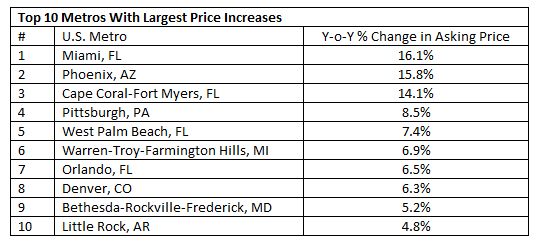
Trulia reports that the largest asking price increases were in Miami and Phoenix, noting that 44 out of the 100 largest metros had year over year price increases, and fully 92 percent had quarter over quarter increases, seasonally adjusted.

Rents on the rise

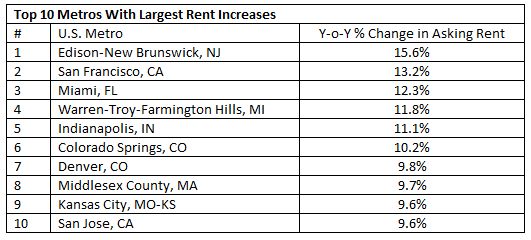
Rents rose 5.6 percent year over year nationally, but rents varied wildly depending on the area, with Trulia reporting rent increases tending to be the highest in regions experiencing fast employment growth such as suburban Detroit (Warren-Troy-Farmington Hills, MI) and Silicon Valley (San Jose, CA) with the largest decline in Las Vegas where job growth is still struggling.

“Houing prices have already bottomed”

“Housing prices have already bottomed with asking prices on the rise for three straight months. Aside from a stumble in December, asking prices have been stable or rising for the last eight months,” said Dr. Jed Kolko, Trulia’s Chief Economist. “Prices have joined the recovery, alongside sales and construction. But foreclosures threaten prices, especially in judicial-foreclosure states like Florida, New Jersey, Illinois and New York, where many more distressed sales are still to come.”

“Rents have steadily increased as people who lost their homes in the crash became renters. At the same time, high unemployment and tight credit sidelined would-be homeowners,” said Dr. Kolko. “But relief for strapped renters may be in sight. Construction of multi-family buildings revved up last year. These new rental units will come to market later this year, giving renters more choices and less fierce competition.”

Residential real estate already recovering

“The single-family market has already begun to recover,” observed Dr. Kolko. “New home starts are more than 30% higher than their low in early 2009. And asking prices on for-sale homes (single family + condo) have risen for three months in a row, according to the Trulia Price Monitor.”

“There are still risks to single-family prices, primarily from soon-to-come foreclosures that could depress prices, but that risk might turn out to be localized in states with larger foreclosure backlogs like Florida, New York, New Jersey, and Illinois,” concluded Dr. Kolko.

Housing policies during an election year

Dr. Kolko told AGBeat, “The upcoming election means we won’t see bold new housing policies. The political atmosphere is too charged for agreement on major housing policy issues. And, because the market is now recovering, there’s less of a sense of urgency than there was several years ago.”

He added, “The inaction will probably not have much impact on the housing market, though. At this point, the coming turnaround in prices and other positive indicators will do more to boost confidence than government action.”

Zillow acquires RentJuice for $40 million in cash

RentJuice acquired for $40 million in cash

After rumors and speculation, Zillow has finally announced1 that they have signed a definitive agreement to acquire rental relationship management (RRM) software company, RentJuice for $40 million in cash, to “help Zillow propel its rental marketplace years ahead of where it is today.” RentJuice’s acquisition is one of the several acquired so far after being featured in the 60 Genius Brands to Watch in 2012 list.

AGBeat first introduced you to RentJuice.com over a year ago, as they acquired one of their closest competitors and the company was funded to the tune of over $6 million. Last fall, they introduced the first of its kind directory of rental industry insiders, blowing the doors off of what has long been a closed-door, almost secret network.

Recently, the company launched a massive undertaking by releasing a “Common Application” for renters to complete through their system either on their computer, iPad or iPhone, complete with digital signatures. The new feature is poised to disrupt the industry, adding to the many likely reasons they were acquired.

The acquisition is expected to close in the second quarter subject to customary terms and conditions, and the talent acquisition includes RentJuice’s 31 employees which will add to Zillow’s 400+ employee count.

RentJuice is Zillow’s third major accquisition, following the acquisition of Postlets last spring and Diverse Solutions last winter. Zillow says, “These companies deliver valuable marketing and business services to local professionals, supporting Zillow’s strategic expansion beyond a traditional media model to become a central hub for a broad range of “freemium” services that help local professionals manage their businesses.”

Zillow’s Q1 Results

Zillow is riding high on their record revenue of $22.8 million for the quarter2, up 103 percent year over year, marking the sixth consecutive quarter of over 100 percent year over year revenue growth. Additionally, their Marketplace revenue hit $16.6 million, up 141 percent over the year.

The company is reporting a net income of $1.7 million and say that record usage across mobile and web as homes viewed on mobile devices exceeded the web for the first time.

Spencer Rascoff, chief executive officer of Zillow said, “We continue to expand our addressable market and competitive advantage as we extend our mobile leadership, launch more services for real estate professionals, and grow our mortgage and rentals marketplaces. In particular, we took a giant leap forward in growing our rentals marketplace with today’s announcement that Zillow is acquiring RentJuice. This acquisition will provide us with a comprehensive suite of business and marketing services for rental professionals, similar to what took us years to build and grow in our parallel marketplace for real estate agents.”

1 Press Release: RentJuice acquired
2 Press Release: Zillow’s Q1 Report

Americans favoring city life, moving out of suburbs

Moving out of the burbs, becoming city folk

According to the U.S. Census Bureau, in many American cities, residents are migrating inward, populating downtown urban areas after populating the neighboring suburbs, but what is most fascinating is how rapid the migration is in some cities over others.

The graph below shows net migration per 10,000 population by Metropolitan Statistical Area from July, 2010 to July, 2011 for the 40 largest MSAs in 2011:

Austin Realtor, Sam Chapman noted, “With these numbers and a shrinking inventory of homes listed for sale, it is no wonder that home prices in the Austin area are rising.”

Although the Census Bureau does not speculate as to why there is a massive migration in cities like Austin, Tampa and Denver, it is conceivable that living expenses are high across the board, and many are choosing to live where they want rather than where they have to. When it costs as much to live in a home in the suburbs as it does in a desirable part of town, or if both are unreasonably priced, it makes sense to live downtown.

Environmentalists would likely point to the fact that many people are reducing the number of cars they own, in fact, it was recently speculated that an entire generation (Millennials) may not buy cars in the future, making walkability one of the highest priorities as the badge of honor is earned by people who brag that they don’t have to have a car because they live across the street from a park, a grocery store, and a famous music theater.

The school systems also have a great deal to do with peoples’ living choices, and as some improve while others decline, the choice of living in a rural or urban area is sometimes shifted as school performance shifts. Some cities are ramping up police forces in urban areas, making people more comfortable living in downtown corridors, while in other cities, the opposite is true.

A blanket statement cannot necessarily be made that people are moving out of the suburbs, but in many cities, like Austin, it is exactly true, meanwhile Chicago and Detroit are seeing a migration out of the city. All real estate is local, as the tired mantra goes, and migration patterns may vary, but for many cities in the chart above, people are favoring city life.

Fannie, Freddie’s new 30 day rule for short sales: realistic?

The new 30 day rule

Both Fannie Mae and Freddie Mac have issued new guidelines that they both say are designed to improve the consistency in the short sales process and to expedite the process, but many are questioning if the new guidelines are realistic and if they can be achieved in the real world, according to the SFGate.com

So what are these changes that some call unrealistic? The new guidelines will go into effect on June 15, giving servicers 30 days to review and respond to all short sale requests and short sale offers. If the servicer deems it necessary to take more than 30 days, they must provide the borrower weekly updates and issue a final response within 60 days.

Additionally, if the borrower requests a short sale under the government’s Home Affordable Foreclosure Alternative (HAFA) program, the 30 day clock begins when the borrower submits a completed borrower response package requesting consideration of a short sale. When not requesting a short sale under HAFA, the 30 day clock begins when the borrower submits a short sale offer from a potential buyer and a completed borrower response package.

“With the average short sale nationwide taking about six months to complete, real estate agents are happy to see the new timetable but wonder if it’s realistic,” SFGate observes. Among other concerns with the expedited process is being able to handle the training and staff levels it would take servicers to rapidly handle the current volume of short sales. Consistency is another goal of Fannie and Freddie, but many have expressed concerns over this topic as well.

Another flaw being pointed out by the industry is that Fannie and Freddie fail to mention any repercussions of failing to meet the 30 day deadline. They vow to closely monitor servicers’ performance, but do not issue any penalties for failure. It is possible that this could change in the future.

Construction spending up slightly, new home sector improving

Construction spending up slightly

Between February and March, construction spending rose a slight 0.1 percent, according to the U.S. Census Bureau of the Department of Commerce, hitting $808.1 billion, up 6.0 percent from March 2011.

Private construction was $531.9 billion for March, 0.7 percent above February, while residential construction accounted for $244.1 billion for the month. Public construction spending was $276.2 billion, falling 1.1 percent below February, with highway construction also falling slightly (0.8 percent) for the month.

CalculatedRiskBlog.com observed, “On a year-over-year basis, both private residential and non-residential construction spending are positive, but public spending is down on a year-over-year basis. The year-over-year improvements in private non-residential are mostly due to energy spending (power and electric). The year-over-year improvement in private residential investment is an important change (the positive in 2010 was related to the tax credit), and this suggest the bottom is in for residential investment.”

Of note, commercial construction spending rose 8.9 percent over the year, and the spend for construction of manufacturing grow at the most rapid clip, rising 39.6 percent in the last 12 months, according to the U.S. Census Bureau. Construction spending on lodging grew 5.9 percent for the month while public safety construction spending fell 3.8 percent.

Residential construction spending

The Census Bureau reports that spending on single family units rose 3.8 percent for the month, and rose 10.3 percent for the year. Multi-family construction spending hiccuped by falling 3.1 percent in the month, but remains an astonishing 23.3 percent higher than a year ago.

The new home sector of housing was among the worst hit during the recession, but with signs of life in the market, Wells Fargo and the National Association of Home Builders (NAHB) have revised their forecasts for this spring to be more optimistic and positive, a hopeful sign for the real estate market overall.

NAHB reported last month that “Most builders and realtors report significant gains in buyer interest and sales. Moreover, the gains are organic rather than incentive induced. Unfortunately, conservative appraisals and tight mortgage underwriting continue to undermine a large number of deals. We suspect that the undertow from these two hindrances will subside over the course of this year, as the fog surrounding shadow inventories lightens up a bit and more lenders come back to the market.”

How to create an investor-ready business plan


When I am introduced to an early-stage company – either to explore helping them as an advisor or as an investor – if I like the initial discussion, I ask for a formal business plan as follow up. Far too often I am then sent a PowerPoint presentation. The PPT is colorful, packed with infographics and does help illustrate the industry and the opportunity. But it is NOT a business plan.

As discussed in last week’s column, the first step to creating a business plan is to develop an executive summary. If you hope to grow your business, raise capital and/or hire partners and employees in the future, you’ll also want to take Step 2: creating a formal business plan.

A business plan allows you to detail a strategic operating plan, define and execute your value to customers and verses others in the market, and develop a robust financial model that details what you need to accomplish in order to meet your projections. This is an extremely valuable process to go through and document to have. You will find that a business plan is an invaluable tool if you want to bring on a business partner or get in sync with existing partners or employees, and if you ever want to raise money it will likely be required by a potential investor or for bank loan.

I believe the sections introduced below are the most valuable topics to cover in a business plan. Some may be more relevant to you specifically, and others not as much, so use this as a guide rather than a golden rule.

Cover Page and Table of Contents: It may seem simple, but these are important. The cover page should make it clear what the plan will discuss. The table of contents will allow anyone reading the plan to skip ahead to the sections most important to them.

Executive Summary: Your previously developed executive summary should lead off the business plan.

General Company Description: Discuss how the business was born, the current state of operations and where you want to go.

Objectives & Exit: What are your “end game” goals? Do you want to save enough money to retire? How about sell the business to a larger competitor? Pass along the business to your children or a protégé? It is important to honestly define what you want the outcome to be so that you can tailor the rest of your plan towards these ends. It is also important to set expectations for those working with you.

Management: Provide a detailed biography for all the key leaders involved (even if it is just you) and discuss how prior experience and success will help achieve current goals. You should also discuss any leadership positions that will need to be hired for as your business (and the plan) matures.

Product & Service Description: Provide details on what you provide to your customers. You should prioritize the most important revenue streams first, but all should be mentioned. You should also talk about how and how much you get paid for each product you sell or service you provide.

Market Analysis: This section should provide a detailed description about your specific market. Include objective details like total market size, growth trends and customer behavior statistics. You should also provide subjective analysis on where you fit in and where customer behavior is headed. This section should also detail your competition. You may also want to do a SWOT analysis for the company here (Strengths – Weaknesses – Opportunities – Threats).

Marketing Strategy: Detail your strategy to acquire and retain customers, and to provide an exceptional customer experience. Include overall goals as well as specific and tangible strategies like online advertising, public relations and original content creation.

Investment Opportunity: This section is only relevant if you need to raise money to fund your business, but this includes both external money (i.e. bank, venture capital or angel investor) and internal money (i.e. your savings or family/friends money). Detail how much money you need, the premium that an “investor” will get for providing this money and how/when it will be paid pack. Even if it’s your personal money, you want to make sure you have a solid plan and a strong return on investment.

Financials: This is a vital component of every business plan, and as such it needs it’s own column. This will also be covered in the near future. Even if you only develop an executive summary and don’t do the full business plan – make sure you develop detailed financials. You need to build a sophisticated model that discusses all your revenue and costs. You should not work backwards from your financial goals to build this model – that is a common and big mistake. You need to start with realistic business assumptions that match up to your plan and then work towards determining accurate final projections.

As with your executive summary, the process of creating this document is as important as the document itself. Once complete your business plan is a detailed capsulation of everything about you and your business. You can use it to recruit employees, add strategic partners in peripheral industries and raise money. Do not ignore its value for you personally (and your management team) though. Make sure your efforts are in line with the strategy you have mapped out.

If market conditions change, then your plan likely has to change too. Finally, your financial model and projections should be used as an important management tool. If your assumptions prove to be off, correct them and project how this will affect your business. If done well, this plan and your financial model will help you optimize your business and avoid problems as you grow. It will be your roadmap to success.

5.6 million mortgages in America are delinquent

Foreclosure sales slump to December 2010 levels

According to the Lender Processing Services (LPS) Mortgage Monitor report, March foreclosure starts rose 8.1 percent from the previous month, remaining 31 percent below March 2011 levels, and first-time foreclosure starts hit a five month high. LPS notes that despite the increase, the number of first-time foreclosure starts in March was still far below those seen throughout much of 2011 and all of the previous three years. The total U.S. loan delinquency rate is now at 7.09 percent, or 5,591,000 loans delinquent or in foreclosure, which is down 6.3 percent from February.

Foreclosure inventory levels remain steady ad their historically high levels maintained since the end of 2010, with varying performance rates betwen judicial and non-judicial foreclosure states. Inventory levels at judicial states are at 6.5 percent while non-judicial state levels are at 2.45 percent (2.5 times lower than judicial states’ levels), with the total U.S. foreclosure pre-sale inventory rate hitting 4.14 percent, down 0.1 percent from the month prior.

Florida, Mississippi, New Jersey, Nevada and Illinois have the highest percentage of non-current loans, LPS reports, while Montana, Alaska, South Dakota, Wyoming and North Dakota have the lowest percentage of non-current loans.

LPS’ Mortgage Monitor report reveals that mortgage delinquencies have continued to slide, reaching their lowest level since August 2008, with loans 90+ days delinquent falling across the board. The rate of loans that were current six months ago but are now delinquent continues to improve nationally, but LPS observes that “the LPS March mortgage performance data did show that foreclosure sales continued to behave somewhat erratically, dropping to their lowest level since December 2010, and most sharply in non-judicial states.”

Mortgage application volume stablizes

Mortgage application volume increases slightly

After some slight increases and decreases in recent weeks in the volume of mortgage applications, the Mortgage Bankers Association’s (MBA) Weekly Mortgage Applications Survey for last week shows an increase of 0.1, pointing to signs of stabilization with no wild swings recently as it rests just 3.0 percent higher than a year ago.

According to the MBA, the refinance share of mortgage activity decreased to 72.6 percent of total applications from 73.4 percent the previous week, continuing the trend of refinances accounting for less of all volume. The government share of purchase applications remained steady at 37.0 percent, a slight increase from a couple of weeks ago when the share was 36.4 percent. The government share of purchase applications over the last three weeks has been at the lowest level since 2009.

During the month of March, the investor share of applications for home purchase was at 5.7 percent, a slight decrease from 6.1 percent in February. This change was led by a decline in the West South Central region. In addition, the share of purchase mortgages for second homes remained constant at 5.8 percent.

Current average rates

What kind of deals are people getting on mortgages? According to the MBA:

  • The average contract interest rate for 30-year fixed-rate mortgages with conforming loan balances ($417,500 or less) increased to 4.05 percent from 4.04 percent, with points increasing to 0.44 from 0.40 (including the origination fee) for 80 percent loan-to-value ratio (LTV) loans. The effective rate increased from last week.
  • The average contract interest rate for 30-year fixed-rate mortgages with jumbo loan balances (greater than $417,500) increased to 4.32 percent from 4.27 percent, with points decreasing to 0.38 from 0.44 (including the origination fee) for 80 percent LTV loans. The effective rate increased from last week.
  • The average contract interest rate for 30-year fixed-rate mortgages backed by the FHA decreased to 3.80 percent, the lowest rate in the history of the survey, from 3.81 percent, with points decreasing to 0.50 from 0.52 (including the origination fee) for 80 percent LTV loans. The effective rate decreased from last week.
  • The average contract interest rate for 15-year fixed-rate mortgages decreased to 3.31 percent, the lowest rate in the history of the survey, from 3.32 percent, with points decreasing to 0.41 from 0.41 (including the origination fee) for 80 percent LTV loans. The effective rate decreased from last week.
  • The average contract interest rate for 5/1 ARMs increased to 2.87 percent from 2.81 percent, with points decreasing to 0.35 from 0.37 (including the origination fee) for 80 percent LTV loans. The effective rate increased from last week.

Canyon dropoff: MLS gaffes that sink listings


Hmmm… this week I couldn’t figure out if folks were dropping in, dropping out, or just dropping acid. The Blooper Scooper is back, my friends. Check out this week’s spectacular MLS gaffes:

Please Tell Me You Don’t Plan to Reproduce

“Beautiful progeny” (You must be referring to Brangelina’s kids.)

“High c’lings and interisting ankles” (Nonetheless, Jim, I think you could find a more flattering pair of high heels.)

“Large carpart” (Screamed the tourist while dodging metal on the Hollywood freeway.)

“Kitchen w/ pass trough” (I’ll alert the cows.)

“Proberty has extra space” (So does your brain.)

“Take advantage o floss” (Said the dentist while examining Gary Busey’s enormous teeth.)

Oops, Man Down

“New gavel in drive” (Dead judge under wife’s tire.)

“Just got shine” (Groused the bootlegger while trying to pull Bubba’s head out of the still.)

“Big deck to enjoy the stun” (If you’re going to taser ’em, I suggest you drag them off the property.)

“Contact me at.” (Seems that third martini was a killer.)

“You can see the canyon dropoff” (Screamed my drunken neighbor the during the last L.A.  quake.)

“For chefs and backers” (At last, a place for broken NFL players to call home.)

Overstated and PG – Rated

“Member to include approval” (Uh, I’ll be the judge as to whether your member meets approval.)

“Auction Day Cuntdown” (Oh dear Lord, do you know how much restraint I am exercising right now,  you bumbling idiot???)

That’s it for this week, folks. Remember: Spell and Sell! 

RealtorWives Has A New Home!

Go deeper - join us!

Create your account, choose weekly or yearly billing, and ALL STORIES are instantly available.
Your email address is 100% safe from spam!

Building stronger relationships with prospects and clients

Improving efficiency

In this article, we will discuss how you can make your life a whole lot easier and your business a great deal more efficient. You’ll learn how you can follow-up and communicate with prospects and clients more, while saving time and maximizing your efficiency.

Make sure you have a “Contact Us” form on your website that automatically pulls leads into your CRM database. As soon as a lead fills out your form, you’ll want to be notified by email so you can contact that lead right away and assign them to a drip email marketing plan. A good CRM will have drip marketing plans pre-designed for you. A drip marketing plan is a series of emails that get sent out automatically at various time intervals.

It’s important to assign all new leads that you’ve captured to a drip marketing plan so you can “nurture” that lead, build a long-term relationship with them, and stay “top of mind.” When the lead is ready to finally become a client, you’ll win the business, not one of your competitors.

Marketing plans

A good CRM should have a number of pre-designed marketing plans to choose from. These should range from marketing to prospects to keeping in touch with clients. One of the challenges busy professionals and small businesses face is keeping in touch with past clients on a consistent basis. The beauty of drip marketing plans is that they automate much of your marketing communications, which frees up time for you. While you’re on the road at appointments, you’re also keeping in touch with hot leads and building stronger relationships with past clients at the same time.

The best way to keep in touch with people is to use a multi-pronged approach. This means using a variety of marketing communication channels such as email, direct mail, phone calls, and face-to-face meetings or events. Use your CRM to plan and schedule all of your “keep in touch events” in your CRM. You’re reminded when key dates arise and when certain actions have to be performed. It’s like having a virtual assistant by your side! If you’d like to wish your clients a “Happy Birthday” you can also use your CRM to automatically alert you.

Staying organized and proactive

Effectively following up with your prospects can mean the difference between a highly successful business built from referrals and repeat clients versus just making enough money to get by. It can mean life or death for your business.

When you have the right systems in place, like the right industry-specific CRM, it’s easy to stay organized and proactive. When you take the correct steps to keep in touch effectively, you’ll see your referral and repeat business grow, and more of your leads turn into valuable, lifelong clients.

How to command the short sale lender’s attention

All about the attention

Many people believe that Lady Gaga is all about the attention. She arrived at the Grammy awards last year in an egg, and she also wore a dress made of meat to the VMAs in 2010. Clearly, that’s all about attention, and drawing attention to her cause—whatever it might be.

When working on a tough short sale, you often want to draw attention to your cause (getting your short sale approved quickly and efficiently). Sometimes that’s hard, because you cannot dress up your short sale in a meat dress.

Public attention can be good, but you don’t want to your behavior to work against you and the processing of your short sale transaction.

Here are four tips for effective short sale escalation:

  • Make sure that the short sale package submitted to the bank is complete (including all bank-required addenda).
  • Be nice. You attract bees with honey, not vinegar.
  • Establish relationships. Remember that a short sale is a mutually beneficial transaction. If you are known as a closer, this will go a long way towards lots of short sale closings.
  • When all else fails, use Twitter (it’s your meat dress). Twitter is an extremely effective way to draw attention to your cause in real time.
    • Wells Fargo @ask_wellsfargo
    • Bank of America @bofa_help
    • Citibank @askciti

    If you follow these tips and respect the corporate processes employed by the mortgage servicers for managing the short sales, you will go a long way to making sure that you files get the attention that they deserve.

Brydge iPad case turns your tablet into a laptop

Adding functionality to an iPad

While most iPad users are content to use the touchscreen on their beloved devices, some have difficulty doing so, or have just not found their fingers to be fast enough without a keyboard. Enter The Brydge as demonstrated in the video above.

Bridge calls itself “an elegant solution to the lack of quality iPad keyboards and accessories currently on the market,” and offers aerospace-grade aluminum rather than painted plastic for the keyboard. It simply connects to your iPad using a hinge that the company has a patent-pending on, and connects via bluetooth.

The iPad clicks when attached properly, and opens and closes up to 180 degrees, acting as a keyboard and a stand for multi-media viewing. Additionally, the Brydge has an option for on-board speakers, which will be a bonus for many who have complained the stock speakers on the iPad are poor quality.

When connected, the Brydge and iPad together are roughly the same size and weight as a MacBook Air. The company says their goal was to make a product that is worthy of the iPad, as it adheres to the Apple design standards and aesthetic. The team used Kickstarter.com to fundraise, and raised more than three times their goal of $90,000. The device will ship this fall for $170.

Can’t wait until this fall? Try Logitech

As an alternative, if you do not have the patience to wait until this fall, or care to spend $170, and are willing to explore other options, we introduced you to the Logitech iPad keyboard that was previously $100 and has dropped to $79.99. It too has aircraft-quality aluminum and connects via Bluetooth, and although it is arguably not as sexy as the Brydge, it is a tested product and has extra features like padding to protect an iPad during a fall. Visit Logitech for more information.

WP Engine parody: how businesses can better use web video

Taking advantage of an opportunity to shine

Last fall, AGBeat underwent a massive challenge of vetting a proper host for a publication of our massive size and traffic and chose WP Engine (full notes here) to support our site. One of the appeals of the company was not just that we are supporting a local business, as AGBeat and WP Engine are headquartered in Austin, but because the team is brilliant, approachable, and they are the only hosting company that specializes in in WordPress, and when we have problems, we never hear, “uh, have you turned your computer off and then on again or whatever?”

Yesterday, the company hit the Town Lake (or Lady Bird Lake if you’re not a native) running trails as part of the Automattic Worldwide WP 5k where “all Automatticians from 79 cities & 24 countries to run/walk a 5k on the same day! This way we can get some exercise together as a company even though we’re apart (though we won’t rule out a softball or Texas scramble at our next meetup),” Automattic said in a statement.

Rather than just go running for health, the company brought cameras and stirred up some fun to show off their “four times the speed” shirts and attitude via video. Founder Jason Cohen and his dry wit are perfect for any stage or camera, and on his birthday yesterday, he and his team (who in the video he parodies, saying “I think of them as numbers in a spreadsheet, with little googly eyes… that follow me around”) hit the trails.

What is fantastic about this video is that it is a way for the company to show off their culture, be human, silly, and approachable, just as their brand can be. Rather than shoot a 30 second promo of the team in shirts starched within an inch of their life, this startup makes a short film about something fun they did on a Sunday afternoon – genius!

Without further ado, here is a great example of creative video to inspire you to think outside of the 30 second promo box: