Home Blog Page 358

Case study: how the extend and pretend era continues

Viva extend and pretend

“Extend and pretend” is a practice wherein banks extend securitized loans in an effort to avoid foreclosure on properties whose values have plummeted. The practice is an attempt at spreading out the bank’s losses over a longer period so they can cover the losses (also known as buying time).

Dr. Mark Dotzour of the Real Estate Center at Texas A&M recently asserted that the era of “extend and pretend” was nowhere near over, and today released a statement1 that offers a case study that showcases not only how banks are extending and pretending but how this “regime” is being promoted by the U.S. government.

HUD vs. Flagstar Bank

In a settlement brought forth by the U.S. Department of Housing and Urban Development (HUD) against Flagstar Bank2, one of the largest mortgage originators in America, the bank agreed to pay $132.8 million in penalties and damages for false certifications on FHA loans it originated, thus accepting “responsibility for its conduct, and committed to reform its business practices,” according to HUD.

Dr. Dotzour points out that in the fine print of HUD’s press release, the bank only has to pay $15 million in 30 days, until they can meet “certain financial benchmarks” to repay the remaining $117.8 million. He also notes that this could be a long process given that Flagstar’s stock was $280 in 2004 and now trades at around $0.86.

This is really just a “hope note”

The “punch line,” according to Dr. Dotzour is HUD’s statement that, “The settlement payments represent the maximum that Flagstar can pay, consistent with its banking regulatory requirements and other requirements, including capital requirements imposed by the Office of the Comptroller of the Currency and the obligation of its parent holding company to satisfy its obligations in connection with the Troubled Asset Relief Program.”

“So, here is the bottom line,” Dr. Dotzour summarizes, “A huge bank made false certifications on a large amount of FHA loans they created. The government caught them and fined them. But the bank can’t pay the fine and remain solvent. The fine really is just a “hope note” that won’t be paid until the bank can earn enough profits to pay it back. We have a long way to go before the commercial real estate market clears.”

1 Dr. Dotzour’s statement
2 HUD statement

15Five streamlines team reporting, jump starts productivity

Tools for bosses, team leaders

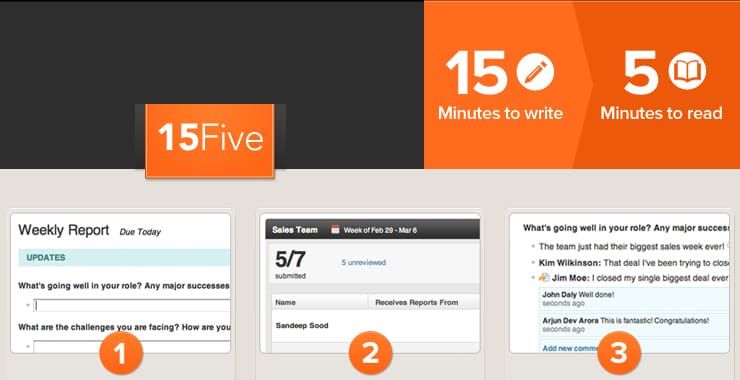
Employee management is just as important as staying within budget, networking with like-minded professionals, and streamlining your professional productivity and staying on-task during any given workday. And yet, employee management often gets pushed onto the back burner so the focus and attention can be placed on immediately-lucrative projects. It’s true, however; effectively managing your employees is time-consuming and tedious. But it doesn’t have to be. A new company, 15Five makes sure of that by providing a methodical, organized, and effective way to submit, receive, and compile weekly employee reports.

With the downturn of the current economy, one of the first things to go out the window was employee morale. Now that the job market is harsh and unforgiving, some business owners have discovered that employee morale is no longer as important as it was in a healthy, competitive economy. With less job opportunities, many employers know that their employees aren’t going anywhere, even if they’re unhappy. But that isn’t any way to run a successful or noteworthy business. 15Five’s professional solution can boost employee morale. It can also keep your employee reports organized and focused.

A simple premise to simplify your life

According to their site, “15Five is based on a simple idea. Have each employee spend 15 minutes a week writing a report that takes their manager no more than 5 minutes to read. We’ve taken that idea to the next level by turning reports into conversations, and making it simple for managers to roll up the most important problems, insights, ideas and success stories.”

15Five’s reporting system has a basic question and answer approach. Instead of leaving the focus of the report open-ended, which can cause long-winded and abstract reporting, you have the option to include specific and detailed questions for your employees to answer in their weekly reports. Questions could include that week’s challenges, successes, or new ideas for the company. These simple weekly reports will show your employees that they’re welcome, needed, and appreciated, and it will give them a regular, consistent, dependable method for expressing concerns, questions, and innovative ideas.

Happy employees = better bottom line

Happy employees mean harder, more dedicated and loyal workers. It means your company is built on a stable foundation, and word will always get around when you treat your employees well.All in all, 15Five’s report-generating options will only strengthen your business, from the lowest level to the top.

Builder sentiment dips for the first time in seven months

Builder sentiment indicates poor sales conditions

According to the National Association of Home Builders (NAHB)/Wells Fargo Housing Market Index (HMI) released today, builder confidence in the market for newly built, single-family homes dropped to 25 in April, after March remained stagnant, and economists projected the index would rise to 29. When the index drops below 50, builders surveyed agree that sales conditions are poor.

This drop marks the first decline in seven months, bringing it back to January levels, which the NAHB notes was the highest level since 2007.

Builders’ confidence in current sales conditions fell three points to 26, and sales expectations for the next six months fell three points to 32, but the worst news is that sentiment regarding current foot traffic of prospective buyers fell four points to 18.

Regionally, the HMI results were somewhat mixed in April, with the Northeast posting a four-point gain to 29 (its highest level since May of 2010), the West posting no change at 32, the South posting a three-point decline to 24 and the Midwest posting an eight-point decline to 23.

Hesitant consumers, says the NAHB

“Although builders in many markets are noting increased interest among potential buyers, consumers are still very hesitant to go forward with a purchase, and our members are realigning their expectations somewhat until they see more actual signed sales contracts,” noted Barry Rutenberg, chairman of the National Association of Home Builders (NAHB) and a home builder from Gainesville, Fla.

“What we’re seeing is essentially a pause in what had been a fairly rapid build-up in builder confidence that started last September,” said NAHB Chief Economist David Crowe. “This is partly because interest expressed by buyers in the past few months has yet to translate into expected sales activity, but is also reflective of the ongoing challenges that are slowing the housing recovery – particularly tight credit conditions for builders and buyers, competition from foreclosures and problems with obtaining accurate appraisals.”

How tech advancements are changing real estate, and what’s next

The biggest challenge of a startup

One of the most difficult things I face as a start-up in real estate is not keeping up with the Joneses, but keeping up with the pace of technology advancement. As recently as five years ago, it seemed like there was no innovation (or very little) in real estate technology. Now, I feel like there is something new everyday and the new releases are coming at a blistering pace.

As an entrepreneur with a small dev team and a shoestring budget, this can cause anxiety-filled days and sleepless nights.

As Realtors, we have to account for iOS, iPhones, iPads and Android. We now have tools like Docusign, DotLoop and CloudCMA. And you better be pulling out all the stops and all of your technology during a listing presentation because consumers want it!

Recently, 1000watt Consulting in partnership with W&R Studios released Nudge, an application to help move clients and prospects to action and I’m in love with the user interface.

Recent tech innovations transform the industry

Zillow, Trulia, Realtor, Redfin, Zip and Sawbuck are all names that we are quite familiar with and that seem to be at the forefront of this technology explosion. Even though several started as early as 2005, it seems that lately there have been tremendous strides in terms of new features and ideas to hit the real estate technology space and I certainly don’t expect it to slowdown.

What are the coolest new tools in use? The real estate industry has leveraged a wide spectrum of technologies. Geo-location, geo-fencing, augmented reality, cloud syncing, social, collaboration and advanced mapping technologies. All are great examples of where we are today.

Redfin just launched native apps for both the iPhone and iPad. They had a good marketing blitz to create something out of nothing when they announced real-time updates, and while their map clusters are not new or even unique at this point, I still think they are cool.

An identity crisis

When I think of Redfin, one thing that I can’t help but think about every time is a comment Glenn Kelman made once, where he declared Redfin as a real estate company with an identity crisis, because they were so focused on technology at the time.

Traditionally, real estate brokerages have not been considered technology guru’s. Is just being a brokerage good enough today? Or do you need to be a technology company as well?

Redfin is a Seattle start-up. One of their early investors is Vulcan Capital, for crying out loud. That’s Paul Allen, co-founder of Microsoft!

Let’s not forget Spencer Rascoff of Zillow. He was the founder of Hotwire.com and then also a top executive at Expedia.com. Trulia is a San Francisco company founded by a Stanford grad.

It is my understanding that the two guys who started Sawbuck were coders who wanted to make the best map search in the industry. Now, they have created the equivalent of facial recognition for homes with their new app, HomeSnap. What’s it going to take in the future? A PhD in computer science? It might.

The big question is: what’s next?

Individual brokerages (I already know a few) will begin to explore predictive technologies, algorithmic modeling, and artificial intelligence.

I saw first hand and played a part in the financial industry from the late 80’s to today as I watched it move from showing consumers one bid and one offer to now seeing the entire “book” or Level II quote. A client can now open an account online and basically have access to the same tools traders use on trading desks at the largest investment banks. Their only disadvantage is not having the order flow.

I am not comparing the real estate industry to the financial industry, but I am saying there is a lot of room left to further the advancement of technology in real estate.

7 ways New York City real estate differs from the rest of the U.S.

The wild, wild west of New York City real estate

Everyone knows New York City marches to the beat of its own drum, and because of the fabric of how the real estate industry works in the city, it is very much the wild west of real estate, an anomaly to how the rest of the real estate sector functions in America.

Anthony Lolli is the CEO of Rapid Realty, a decade old real estate firm which became a franchise nearly three years go. Since franchising, they’ve grown from one location to 50, with 800 agents.

How NYC real estate is different

There has not been widespread adoption of a single MLS for all boroughs in the city, so the very fabric of real estate is different than in other American cities. Add to that the vacancy rates are extremely low and finding a quality home to rent or buy is a challenge, and you’ve got the wild west where real estate is almost a sport amongst consumers and brokers.

In an effort to enlighten the rest of us that live in traditional real estate cities, Lolli has shared seven ways in which NYC real estate is different, particularly with rentals, as the city has seen a rapid rise in demand for rentals.

1. How broker fees are paid

Lolli told AGBeat that in NYC, “clients (tenants) are expected to pay the broker fee when they rent an apartment or commercial space. There is such a high demand for apartments, and there are so many people renting, that landlords often feel they don’t ‘need’ to pay the fee in order to rent their space. In almost all other states the owner pays the fee to the broker to get their space rented.”

2. Brokers pay to list

“Not only is NYC the only city where the tenant pays a fee, it’s also the only place in America where the brokers have to pay for housing posts on craigslist, the most popular go-to website for anyone looking to rent an apartment or commercial space,” said Lolli.

3. A different pace

Another factor that separates NYC from other cities is the pace. Lolli said, “Renting in NYC is extremely fast paced compared to most other places. If you see an apartment you like, you have to snap it up immediately. Oftentimes when clients decide they need more time to decide if an apartment they just saw is right for them, by the time they come back on, two, or three days later, the apartment is usually not still available.”

Lolli added that “In NYC, it is almost impossible to look for a place more than four weeks before your move-in date. If you need a place for May 1st, you start looking in the beginning of April. There is such a high volume of renters, the landlord knows that he will always find someone looking to move into his apartment immediately and as a result will not voluntarily keep it off the market. In most other states renters are able to start their search two or even three months before they plan to move.”

4. What consumers get for the money

Lolli said, “Apartments and commercial spaces are much more expensive in NYC. For the amount of money you spend on rent, the square footage is much, much less than what you can expect to find elsewhere.”

5. How consumers search

Lolli says that NYC is “unique” in how renters search for their next apartment. “Clients may come to us asking to live in Brooklyn, and end up in an apartment in Queens. Websites like walkscore.com come in to play because people pick where to live based on ease of transport – the proximity to subways stations, laundromats, grocery stores and other amenities.

Generally, the most popular NY neighborhoods are ones that have grown as a result of their being near to a major transport hub. Most New Yorker’s don’t drive. In most other states neighbourhoods vary so dramatically, and are farther apart, so it is unusual for renters to be willing to focus their search on more than one area.”

6. Landlords are unusual

“New York landlords are unusual in that they are accustomed to, and even expect, a very high turnover rate,” said Lolli. “Many apartments are rented out for one year at a time, people move very frequently. This constant turnover allows landlords to raise rents often in-between occupancies. Landlords are also used to a hugely varied tenant-base. One year they rent their 2bedroom apartment to a couple, the next year to room-mates, the next to a single person with a dog, etc.”

7. Tougher to rent without a broker

Lolli said, “It is noticeably harder in NYC to rent an apartment without the help of a broker. The city is vast, and landlords have many requirements that renters aren’t always accustomed to – paperwork typically includes a professionally run credit and background checks, bank statements, letters of employment, paycheck stubs, tax information, previous rent receipts etc. Landlords are used to expecting this type of paperwork and it becomes a task that can be quite intimidating for the renter to do alone!”

Vivogig: how a non-developer created a widely popular tech startup

From South Africa to Austin

AGBeat is headquartered in Austin, the Live Music Capital of the World and birthplace of Austin City Limits and South by Southwest, so we are surrounded with music and most people in the city has friends in the industry, be they performers, producers or writers. This environment is what brought Vivogig founder, Daniel Senyard to Austin all the way from South Africa.

I first bonded with Senyard over a wild band from South Africa via something a mutual friend shared on Facebook, and when we met in person at the Big Ass Social Happy Hour, our discussion focused solely on music, with his passion shining much more brightly than mine, despite my growing up in Austin surrounded by music. Senyard is a family man first and foremost, a music junkie second, and his passion has required sacrifice, but has now blossomed into one of the hottest, most popular tech startups in the music industry – and he did it without having any experience developing an application.

New solution for an obvious problem

As a frequent concert-goer, Senyard noticed two things. First, that people collect their concert tickets and photos of concerts almost like a “trophy case” and refer to them later so they can say they saw a band before they went mainstream. Second, people are generating endless content that is specifically relevant to the person standing next to them at a concert, but there was no way to really connect all of that media with the users. As a social media strategist, Senyard had spent time using and studying geolocation apps like Gowalla (before it sold to Facebook) and Foursquare, but found himself using them more out of obligation, not fun, and found there were no real discovery options and that most content was unrelated.

These three observations came together to form a solution to this complex problem: Vivogig, which allows users to capture live music photos and compete to earn the top spot on the photo charts. The startup gives music fans a place to put their concert-specific photos, much like a geolocation app, and comment on the photos, thus creating an instant community for music fans which is something all music industry insiders want and need.

Challenges in creating a tech startup

Senyard says that technology is like religion – everyone has a different answer as to what the right way to go is. When he arrived, he didn’t know anyone in Austin, he didn’t have a tech background, or have endless contacts in the music industry, so his battle was uphill from the start.

Early on, he began asking questions of anyone who would talk to him, especially non-developers, and found inspiration by learning about how other startups came to be. Ultimately, the company used a Ruby on Rails backend with an HTML5 web app as their choice of technology.

Advice from a founder: don’t hide your idea

The first thing most people do when they believe they have an innovative idea is they shut their mouth in fear of someone stealing the idea. Senyard said that this was his first instinct as well, but he credits Austin entrepreneur, Matt Curtin with inspiring him to loosen up, telling Senyard that only 1 in 100 people will try to steal the idea.

With that knowledge, Senyard said he began “getting out there” and advises innovators to “socialize” their idea, and talk to others about it to gain insight as to how to make the product better, or find the missing piece to their puzzle, or to find co-founders or coding talent. Senyard advises startup founders to go to every happy hour possible in their city, and to get on the scene and talk to as many people as possible about that brilliant idea.

What this entrepreneur loses sleep over

It is well known that entrepreneurs are frequently perfectionists, and most lose sleep over one company pain point or another. Senyard was honest with us in sharing that his lost sleep is mainly over seeking funding. In pitching to raise money, investors typically want the company to have an army of investors, but Vivogig has a very small team and needs funding to expand the team – a common catch-22 for startup founders.

The company has bootstrapped but is now on a mission to show investors how the company makes money, a feat that keeps any entrepreneur awake at night. Senyard has experienced setbacks, but is still running as fast as he can to expand the company so there is less strain on his personal and family life – yet another sleep killer for many entrepreneurs.

The finish line

As the company continues to seek investment, they gained an injection of international attention at the recent South by Southwest festival, as they were part of the massive LaunchRock retreat where startups went to take a break from the festival and chill at a campground with acoustic live music (with Vivogig’s logo projected on all of the building walls nearby, of course). Additionally, they were part of the City of Austin’s showcase of local startups for international media to highlight up and coming tech startups hailing from Austin.

Vivogig has wider implications than simply music, and although the company seeks to go the route of investment, we can easily see Senyard’s company acquired for a hefty chunk of money – just think of all of the types of events the technology could apply to and create a legitimate showcase for music and music fans.

Tech Wildcatters seeds, incubates B2B tech startups

Tech Wildcatters seed companies seeking to serve you as a professional

Headquartered in Dallas, nestled in between the Dallas Design District of Lower Oak Lawn and the affluent Lakewood neighborhood, Tech Wildcatters offers up to $25,000 in seed money for founders accepted into their 12 week boot camp program wherein startups are intensively mentored, and given access to resources like office space and legal counsel in exchange for equity in their company.

Tech Wildcatters seeks startups that are tech and web related that serve small to medium businesses (SMBs), rather than consumers, and the program wraps up with a “pitch day” where the founders pitch their companies to angel investors, venture capitalists, and corporate development teams. It is not uncommon for pitch day to end in offers from $500,000 to several million in funding for these startups.

Graduating dozens of successful businesses

The young incubator already has 30 alumni companies, and several alumni founders actually populate their mentor program. One alumni company is RentSavvy.com who AGBeat introduced you to last fall and went on to be named among the “60 Genius Brands to Watch in 2012.”

Tech Wildcatters has been named in Forbes’ Top 10 Hottest Startup Incubator list and because the application deadline recently passed, the next “class” of startups to be accepted will be up on stage at pitch day in July.

The Ivy League for grownups

The incubator accepts the Unified Seed Accelerator Application as do more than a dozen others. Tech incubators used to be attached to colleges, but now investors have gone out on their own to found incubators like Tech Wildcatters, most of which are highly selective, and getting accepted is said to be more difficult and rare than getting into an Ivy League school, as hundreds of founders apply for the Tech Wildcatter program, which selects only a handful at a time.

But there is no money in Dallas, right?

The myth perpetuated by tech bloggers and raunchy television shows is that investment money is all in the Silicon Valley or New York City, and Dallas is just an oil town full of cowboys, but Tech Wildcatters points out that they are in a city with a higher saturation of Fortune 500 companies than nearly any other, and we would add that living and operating expenses are far less expensive than on the coasts.

Look for Tech Wildcatter graduates to be less fluff, less games, and more legitimate tools that someone like you can use in your business.

Williams-Sonoma gets bitten by the sustainable lifestyle bug

Sustainability is now totally mainstream

Did you recently get the new Williams-Sonoma catolog in the mail? Yeah, I did, too. See, my husband is in the habit of buying “presents for me” and by “presents for me,” I mean, mini pie makers along with cute books about how to make said mini pies and then, the sweet note of, “oh, babe, I thought, we could do this together… don’t the spinach feta ones sound good? I bought spinach, and feta…” – beer bottle cap hiss here- couch plop. -Insert me in kitchen holding mini pie making book and looking at mini pie making press with my head cocked and my eyes sort of squinty.

Nah, I love the “presents for me!” Keep ’em comin’! I digress. This isn’t therapy time. I totally love Williams-Sonoma’s new wave. They have the recipes in the catalog and you can find things online, but today… oooh lala, today was something different that made a sustainability nerd like me do a little happy dance while flipping through the back pages.

Testing the Waters.

You see, recently the buzz has been that there is no more “green living” people are saying it is all about “blue” or being water wise. I say that the thing is sustainability and doing things or living life in the way that makes sense for you, the individual. Williams-Sonoma on the back pages is saying ” Fresh Ideas for Healthy Living- plus free shipping.” Ha. Well, that is an added bonus, isn’t it? From dehydrators to making your own yogurt, cheese, honey and jams, Williams-Sonoma is trying to give the regular kitchen gadget getter the one stop shop for growing, creating, killing and cooking.

Do you want raised beds to grow your own organic veggies? Done. Page 101. Thinking about starting a bee hive in your back yard? Better check your HOA, then look at page 102 for the whole starter kit, sans bees. Have you been desiring a chicken coop that would have Martha Stewart’s American hens clucking in jealousy… yep, they have one on page103. Even grow your own mushrooms; I nearly skipped that, when I saw that on page 104 they were highlighting a local chef who sources farm-fresh-local cuisine right here at the Liberty Tavern. Pretty cool.

Building Up Steam

So, what put Williams-Sonoma on this track? I would have to say that, even though they may be testing the sustainability waters with their catalog, many people are going that route in the way that they live their daily lives. Folks value sustainability, be it maintaining the vitality of a community by supporting farm-fresh-local food sources, or by trying to avoid chemicals by growing their own organics.

Maybe someone on the marketing team at Williams-Sonoma was toying around on Pinterest and saw all of the thousands upon thousands of re-pinned “creative edible gardens” that can be done on a roof top terrace, a balcony or in a full scale garden. Who knows, but the one answer could be that the culture of sustainability and living healthier lifestyles is building up steam and I hope that it keeps on truckin’.

Analysis of three types of Realtors: producers, improvers, blamers

Success vs. failure in the real estate practice

When talking about success and failure in the real estate practice, I’ll begin by using myself as an example, as I don’t wish anyone to take offense. The facts of life, and the reality they construct, are often painful to acknowledge. Being brutal about myself is easy — now. Anywho, I hope we can all be honest with ourselves as a culture, and face facts as they are, good, bad, or ugly as the case may be. If reality is the building in which we hope to live, facts are the bricks giving it strength and durability.

I miss Grandma. Her wisdom was a never-ending source of learning and correction, not always a pleasurable process. The wisest, most kindhearted person I’ve ever known, she had the ability to cut through ignorant claptrap like mower blades through grass on a warm Saturday morning. Lookin’ back, it’s a wonder my picture didn’t end up next to the definition of the phrase, ignorant claptrap, in the dictionary. Facts were  often my sworn enemy. That’s the natural consequence when your ignorance is analogous to the bottomless pit of the black abyss.

Reality may be the first casualty of ignorance

Am I being too harsh on myself as a youngster? Not even close. Replacing ignorance with knowledge is the normal progression for most of us. For some it’s more painful than others. Human nature often dictates we wanna believe what we wanna believe.

Even though Grandma taught me tough lessons, she did so with a gentle heart. Knowing facts and the reality they deliver can be difficult pills to swallow, she sought to avoid adding to the discomfort. The learning/growing up process becomes harder as we age. Expectations increase. We’re expected to deal with things as they are. ‘Course if we all did that, denial wouldn’t have developed a cottage industry based upon treating it. But I digress.

Denial of reality makes us appear the fools we truly are

Licensed earlier than most, I was thrown into the deep end of the pool on Day 1. How green was I? I didn’t know enough to be nervous, much less scared. As a full time college student, my part time real estate hours were faux productive. I did what I was told, and listed properties. If memory serves, three of ’em sold outa the first 15 or so. Even that had to be due to a merciful God.

It was marvelous training though, as I learned rejection is rarely fatal. I also got to see, firsthand, what world class denial looks like. Though I learned to list property well, it turns out listing doesn’t necessarily mean selling. I learned this at the dinner table listening to an entirely different version of Grandma — that is, sans any fear of injuring my delicate feelings. Dad understood reality and the communication thereof. He cared not for subjectivity, excuses, or anything but results. There was no dishonor in failure, only in not facing the reasons for said failure, and refusing to adjust.

Fastest route to success: failure, and not in the cliché way

He taught me failure is nothing if not the quickest way to both learning and success. My bristling at his critiques of my performance didn’t phase him in the least. He was not a respecter of excuses. Those agents in his employ who complained about other agents being ‘lucky’ were fired on the spot. (Different days back then, as employers weren’t required by law to suffer fools. PC was still only a fantasy.) The idea was to produce results.

There were three kinds of agents: Those who produced results; those who were learning how to produce results; and those who blamed everyone but themselves for their inability to produce results.

The last had predictably short professional lifespans in Dad’s company. Even back then, late ’69 through the early 70s, he told me how the agent population ‘pie’ was divided. About 5-10% made the vast majority of the money. The rest of ’em fought over the scraps. I say fought, which is a misnomer. He never stopped pointing out how 80-90% of full time agents were barely worth the energy it took to fire them.

When I asked him at dinner one night why he was so cynical. so brutally critical, he responded with a very different tone of voice. It was soft, and yet it eerily intense. I’ve subsequently surmised that it was evidence of how intent he was on me grasping what he wanted me to understand. I’ll do my best to paraphrase.

Dad’s dinner speech:

“Facts are the bricks that build reality. Sometimes they make us feel badly about ourselves or our efforts. Sometimes we give them too much power. We can’t compare our first year in real estate brokerage with 10 year vets. But if those same 10 year vets aren’t doing far better than their rookie year, they need to find something else to do. The fact is, some refuse to work hard. Others work hard, but don’t have the capacity to work smart. Then there are those capable of working hard and smart, but chose not to. Their failures, according to them, were never the consequence of their own choices.

Wanna know why they don’t disappear sooner? It’s because their wives have full time jobs. (In those days, there were far fewer women licensees.) In fact, it’s been my observation that working wives are the backbone of the real estate industry. (The sarcasm was nearly tangible.)

Others succeeded, working at the desk just four feet away due to pure luck. They got the best ad calls. They knew more people, yadda yadda, blah blah. See, to admit the other guy produced superior results simply due to his hard work, and effective learning curve, leaves the failed agent with no defense. Therefore, luck must be the answer.

So when I tell you not to make excuses when failing to list or sell something, I’m not saying you’re a failure. I’m saying to consciously learn from the experience. Become better from it, then move on. Failure isn’t personal, it’s merely a fact. The only real losers in life are those who won’t face reality, forcing those in their orbit to conform to their personal fantasy. Don’t be that person. Keep failing right up to the point of success.

It’s the way reality works. The facts of failure are the bricks building your success. Embrace reality. Don’t be like the average agent who thinks talking about reality is negative. The vast majority of real estate agents fail almost before they begin. I know you think I’m unnecessarily caustic or rude because I constantly remind you of the failure surrounding you. But the alternative to boldly recognizing the facts, and therefore reality for what it is, makes you just another excuse generator.

The refusal to acknowledge facts and the reality they create is the mentality of a loser. Losers don’t like anyone openly recognizing the fact that 8-9 of every 10 agents fail themselves completely out of the business almost before people learn their names. They were there Friday, then were never heard from again. It’s called reality, Son. Nothin’ more, and nothin’ less.

Be brutally honest with yourself when you fail, and your learning curve will be relatively short. Refuse what the facts clearly convey and you’ll not only fail, you’ll be thought of as a fool.”

The loud echo of a wakeup call

The few minutes it took for me to hear those words at dinner that night, had a profound affect on my thinking from that point on. Did I mention that my wife of just a few months was sitting next to me? To make it worse, that conversation took place the day after I was told this by a tax preparer.

“Mr. Brown, it would’ve been better if you hadn’t worked at all.”

My wife was sitting next to me then, too. Talk about reality. Little did I know she was gonna be called ‘the backbone of real estate’ just a day later by my own dad.

Grandma used to say experiences like that, were wakeup calls. The master of understatement. It woke me up, and I was never the same. Results became the reason I got up in the morning. Excuses became the scourge of my existence. Failure needs no excuse. It just is. Recognize it for the blessing it is, and learn from it.

Facts aren’t offensive, and saying them aloud isn’t out of line. Attacking those openly  declare facts says volumes about the speaker.

Don’t make excuses — make good.

To those refusing to admit the reality of the real estate brokerage business, I refer you to both Ron White and Bill Engval, quoting each.

The former famously said, “Ya can’t fix stupid.”

But I prefer the latter — “Here’s your sign.”

As predicted, Pinspire begins showing signs of failure

Pinspire shows signs of failure

The rising web star and visual bookmarking site, Pinterest.com has inspired web designers, bloggers, social media gurus and coders alike and charmed the world with the simplicity of their product that focuses on doing one thing and doing it well – visual sharing.

Some companies are so inspired that they create their own spinoffs, and earlier this month, AGBeat features 33 Pinterest clones, predicting very specifically that Pinspire would fail.

Now, German startup blog, GruenderSzene is reporting that 70 Pinspire employees have been laid off and the company is in trouble of seeing their final days. Given that the site is an exact clone with very minor tweaks, we were initially shocked that even more than one person worked at the company, much less dozens, despite being part of a tech incubator in Berlin.

Astro-turfing, dummy accounts and falsified giveaways, oh my!

Tech blogger Mike Butcher is reporting that Pinspire staff has allegedly been caught deleting, hiding, and removing pins, re-pins, comments, and likes which all rank a user for giveaways through Pinspire. Butcher says they have discovered evidence of people with Pinspire email addresses astro-turfing other blogs, “asking for coverage in return for cash payments and gifts of iPads.”

Besides our coverage of Pinspire, forecasting that the company would fail, Butcher agrees that most interest in the company is from the company itself, noting that “a search for “Pinspire” on Twitter reveals that the vast majority of mentions for the site were by Pinspire-run Twitter accounts.”

The company has done some backpedaling, by restoring the hidden content and pointing to automation rules, but much of the site is populated by dummy accounts, and there are allegations that consumers that win the giveaways are not actually alerted.

The astro-turfing is very evident online as seen in the several examples Butcher offers, and traffic to Pinspire is suffering, despite the many, many dummy accounts set up. The 70 employees are gone and the damage may have already been done, regardless of whether or not all allegations are true. The company is showing signs of failure, and this Pinterest clone has tried to game the system to “pinspire” others, but alas, it appears the writing is on the wall.

Report: mortgage foreclosure scams surge 60 percent in 2012

Dangerous increase in foreclosure scams

According to a new report from the Homeownership Preservation Foundation (HPF)1, mortgage foreclosure scams have increased nearly 60 percent this year, which HPF says is due to the plethora of federal programs recently launched that has caused vulnerability in the market as no homeowner can be expected to fully know each program or the validity of an offer for counseling.

“Regretfully, every new government initiative spawns a slew of foreclosure avoidance scams, often from the same cast of characters doing business under various names to avoid easy detection and identification,” said Colleen Hernandez, CEO of HPF. “Most of these scams involve individuals supposedly offering mortgage foreclosure avoidance assistance that trained HPF counselors provide at no cost. Sadly, with most scams, no meaningful services are ever provided.”

Scam warnings

“HPF’s trained counselors can provide distressed homeowners with all the assistance they need to understand their options, prepare the necessary paperwork, and negotiate with their mortgage servicers,” said Hernandez, adding that distressed homeowners should never pay upfront fees for these services.

Hernandez also warned that some scam organizations are making unauthorized use of HPF’s logo and brand in their promotional materials, creating the impression that they are affiliated with the organization. The various government programs that have been launched or revised this year and that are likely responsible for this increase in calls reporting scams include the National Mortgage Settlement, expanded Home Affordable Modification Program (HAMP) and Home Affordable Refinace Program (HARP), and OCC Independent Foreclosure Review.

In addition to its free counseling to help avoid foreclosure, HPF also operates a national hotline for troubled homeowners to report instances where they believe they have been defrauded. While not all reported instances are necessarily fraud, HPF refers the information to a national database accessed by appropriate regulators and law enforcement agencies. About half of the reported scams involve attorneys or individuals claiming to offer specialized “legal services.”

1HPF report

The problem with a self-policing industry: you have to be a narc

An animated discussion on ethics training

“Does anyone else find it ironic that NAR – the trade association for Realtors – has to mandate that members take an ethics class every four years?” An agent who attended one of my company’s broker opens yesterday posed that question to the wine and cheese grazing attendees. Of course, that opened up an animated discussion on the value of etchics training and the lack of enforcement when the rules are violated.

One agent volunteered that the guy sitting next to her in her last ethics class played games on his cell phone and then cheated during the test at the end of the class. Seriously, dude? You cannot even pay attention long enough to pass what should be the easiest test you’ll ever have to take in your career? Perhaps he was just seeing how far he could push it by cheating during an ethics test, to see if anyone else around him caught the extreme irony there. None of the other agents around him – including the agent he cheated off – turned him in and the instructor didn’t notice.

This same agent later called one of my sellers and tried to convince him to break a listing contract with me, because he had a “guaranteed buyer” in the wings. The seller was an attorney, and this bozo tried to get me cut out of the deal, offering the seller a reduced fee to dump me. The seller held firm and directed the agent to call me, then the seller called to let me know about the conversation.

“But you know if you file something the other agent will know.”

It gets better. After the deal closed, I requested paperwork from our local Board of Realtors to file an ethics complaint. The person in charge said, “But you know if you file something the other agent will know.” Gee. Really? I asked her to send the paperwork over anyway.

I called the seller/attorney and asked him to repeat the conversation to me, because I was documenting it to file a complaint. He turned wishy washy on me at that point and his story changed from “The other agent tried to get me to dump you as the listing agent to cut you out” to “Well he really only asked a few questions and I told him to call you. He probably didn’t mean any harm by it.” So there goes my star witness, who doesn’t want to rock the boat.

I didn’t file the complaint. I resorted to the “turn the blind eye but never trust the sleazeball again” path. And that is what happens to almost all ethics issues I hear about / see in person.

That’s what happens when you have a self-policing group of “professionals” who would rather not “narc” on a fellow agent. After all you’re probably going to end up on the other side of a deal from this guy some day, right? The guy in my example has sold two of my houses since that run-in. Why tick him off by filing a complaint and going through all that hassle? If he stops bringing buyers to my properties then my sellers ultimately lose, right?

Boiling down the CoE

The NAR Code of Ethics takes up pages and pages of tiny print, and it runs each year in their trade magazine (I think it’s the January issue). Does anybody read that? Probably not many. I’d argue none of us ever should have to read it again. Simply follow this advice instead. The thousands of words in the Code boil down to one thing: Do unto other agents, and consumers, and clients, what you would have them do unto you. It’s the Golden Rule. Simple. Well, obviously not, for many agents and brokers.

The sad part is the agent in my example had no clue how close I was to filing that compaint, and if he did know he’d probably scratch his head and wonder why his actions were “wrong.” Making us take a one-day class every few years won’t “make” the unethical agents suddenly operate ethically. Most of them just don’t get it.

FaceFlow: free Skype alternative for video calls

Free online video calls

While the appeal of free online video calls is obvious for the average consumer, there are many benefits for working professionals, especially small business owners with tight budgets. FaceFlow is just over 24 months old and is steadily gaining in interest and popularity for its video chat services. FaceFlow is a free online service that allows you to connect with friends, family members, business partners, or even complete strangers.

For you, part of running your business may mean that you need to communicate with contractors or remote employees. While regular online text chat or a phone conversation can be helpful, a video chat is ideal. This way, you can determine someone’s true meaning and intention from facial and voice cues, which often get misunderstood and taken out of context over text chatting or emails. While many of FaceFlow’s competitors offer similar services, FaceFlow is unique because you can chat with up to four people at one time, as a large group, revolutionizing and reinventing mediocre conference calls.

If you prefer to have the option to video chat or live text chat with your employees, clients, or business partners, FaceFlow gives you that option. You can easily switch between the two at your convenience. Other features include a full screen chat mode, easy-to-use video chat invite through a simple link, and everyone involved in your chat can watch the same YouTube video simultaneously. How’s that for productivity? Using FaceFlow for your professional needs means that you can retain your budget and also that you don’t have to download any software. All video chats are hosted on FaceFlow’s website, meaning your computers won’t be bogged down with unnecessary software and required software updates.

If you’re feeling extra adventurous, you can use FaceFlow to reach out to potential clients and customers through their random chat system, but the random system is most likely just a novelty. Consider it a new and unique way to market your business, and it’s free. As of February of this year, FaceFlow provides video chatting services to over 250,000. And while their services are limited to being web-based, they’re currently working on a mobile extension.

Interior design trend: built-in dog beds

Built-in doggie beds

There are two reasons people now build dog beds into cabinetry or nooks – first, because they love their four legged friend and want only the best, or second, because they love their dog but really need a place for it to go to be out of the way.

Crate trained dogs already are accustomed to going to their bed on voice command, so getting rid of the unsightly plastic or metal crates that look more like dog jails, is a plus. Additionally, custom dog beds can be more comfortable and stylish.

Below are seven built-in dog beds to inspire you to find unused space in your home for a special doggie area:


Images courtesy of Houzz.com

The value of trusting your instincts over your critics

In constant pursuit of improvement

Most successful entrepreneurs are constantly seeking ways to improve their product, their marketing, their communications, their company culture, and the like. Most entrepreneurs are also typically open to criticism, even when it is not constructive, and many entrepreneurs are constantly mulling over how to improve, even when the world loves what they do – there is always a next step.

Some choose to informally ask contrarian voices for their opinion in an effort to broaden their horizons, others choose to do endless focus groups, while others rely on the wisdom inside of their own company. No approach is wrong or right, they are just different means of business decision makers forming opinions.

Weighing the options

Imagine if in 1937, Walt Disney had listened to his brother Roy who said, “He’s passé. Nobody cares about Mickey anymore… I think we should phase him out.”

Just picture that – if Walt Disney had gone a different direction, who knows if the company would ever be the multi-billion dollar conglomerate it is today? Imagine if Walt had not trusted his gut instincts and continued on his path toward what has become an empire?

As a decision maker, you are forced to take action every day to improve your company from every angle, but the most important metric of all is your own gut instinct formed after absorbing as much information as possible. Your gut feeling will likely conflict with another’s opinion, but as the leader, it is your gut instincts that steer the ship, while everyone else simply paddles.

Mobile real estate website creator app

Cutting through the competition

Being a successful realtor in the current industry means that you have lots of tough competition, and that means you have to step up your game and be one step ahead of everyone else, or at least keep up with them. However, this isn’t as easy if you’re just starting out as a real estate agent. But don’t let that stress you out. There are now tools and resources available to you that can get you started on the right professional path, and couple that with the latest technology. And one way to start down the path is with the Mobile Realty Site Creator App.

The app gives you the power to create mobile webpages for your listings – it’s a mobile website generator designed for realtors. This free service gets rid of your initial need to hire a website designer, which can save you lots of money, and while it is not as robust as a fully custom site, it is a good start. Realty mobile sites through the mobile site creator don’t have monthly subscription or hosting fees at all. All you have to do is create an account online and upload the images of your listings, and that’s it. It plugs it all into their basic template. You can also generate and download corresponding QR codes, which can be printed onto your print marketing—fliers, signs, and posters. This will allow your potential buyers to use their Smartphones to access your mobile sites instantly, providing them with instant information and details about the home they’re interested in.

Other features of the free app

While this service is great for the new real estate agent, it also has limitations and drawbacks. Sometimes the old adage is true: you get what you pay for. Because this service is free, you can’t expect anything more than the basic template, making every mobile realty site through this service look exactly the same. There will be no distinction between your mobile realty sites and the next person’s. When every page looks the same, it doesn’t exactly draw visitors in. Also, with a template mobile site, every meta keyword and description is essentially the same, meaning it can negatively affect your search result rankings if someone wanted to search for a particular house online.

A second limitation is that you can only upload up to seven photos of your property. As a real estate agent, you know that potential buyers want to see every aspect and angle of a house or property. That’s where most of the interest comes from. So, to limit each property to seven pictures can ultimately be detrimental to your professional success, even if it does save your marketing budget today. Also, be aware that solely marketing through mobile sites and QR codes means you’re leaving a significant part of the population out of the loop. Not everyone owns a Smartphone that can handle and use QR codes, namely the older, more mature generation. So, while this free service is a great complementary tool, it shouldn’t be your sole means of marketing and providing that valuable information about each property for sale.

Even with its limitations, the Mobile Realty Site Creator App is a great place to start as a newly licensed realtor. Once you have this in place, you can start to build your clientele, your business, and your name. This is the perfect temporary or complementary solution for those with smaller budgets. But once you secure your spot among your tier of realtors, always be on the lookout for the tool that will take you to the next level.

NAR Director of Digital Engagement leaves membership for Trulia gig

Todd Carpenter to leave NAR

AGBeat has confirmed that Todd Carpenter, National Association of Realtors’ Director of Digital Engagement has accepted a position at real estate search giant, Trulia. Carpenter is the first to have been in the Digital Engagement role, and as he leaves, it is unclear as to whether or not the position will remain within the trade organization.

Carpenter’s new title will be the Senior Management Industry Engagement and he will be starting toward the end of the month. A Trulia spokesperson told AGBeat that Carpenter “will be an industry voice” and that the company plans on putting him front and center as he engages the real estate industry.

Zillow has recently made several high profile hires including industry leaders Duane Fouts and Bob Bemis alongside blogger/broker Jay Thompson, all hailing from Arizona. Trulia is marching toward their bid for IPO, and more new hires are possible, not only to match their competitor’s pace, but to impress investors with titled talent acquisitions.

NAR CEO, Dale Stinton told AGBeat, “Todd has indicated he would like to move back to Denver for personal reasons and the overall opportunity was excellent for him. We wish Todd the best of luck and look forward to working with him down the road.”

As pieces of the puzzle continue moving, it will be interesting to watch how the talent shifts from association and real estate practices to large real estate media companies during their hiring spree and it is hard to tell how membership will react as talent leaks.

FlareWatch and how a niche app was born from necessity

How FlareWatch was conceived

Startups are often founded when someone sees a need in their life that no product fills, and with a passionate charge, they march off to fill that need. This is exactly what founder of FlareWatch, Enrique “Henry” Perez did which led him to the creation of his tech startup.

Perez shares with AGBeat his own personal trials with family members in 2006 – two of his immediate family members were diagnosed with similar forms of arthritis, and another family member, who happened to be a health professional, instinctively began to document their daily symptoms.

On a typical day, documenting would occur in an ad-hock fashion, just as important events might occur. Documenting may occur on the way to school, while outside playing, or before bedtime and resulted in notes being captured in various places.

When the time came to visit the rheumatologist, it was necessary to aggregate all of the notes and build a timeline of symptoms and important changes in medications. Perez explains, “This timeline was very helpful to the rheumatologist, as it gave him a picture of how the patient had been doing in between visits. Documenting using a pen and paper has its limitations, such as at some point before each doctor’s visit, you have to aggregate and re-enter your notes into a digital form. This can be a very labor-intensive process.”

And the startup was born

It wasn’t until a year and a half ago that Perez realized that he could build a cloud application that would allow a person to easily enter daily metrics enabling them to capture their loved one’s auto-immune symptoms.

It occurred to Perez during the development of this application that he could build in additional services than would allow the user to correlate their flare data with their diet, exercise, medications, as well as pollen and weather information. Weather changes, such as cold fronts, can be a trigger for flares. Similarly pollen outbreaks can trigger allergies that can also trigger flares. Providing a way to easily generate a report with all of this data, along with flare occurrences, is an invaluable tool in helping individuals manage their conditions.

The one-man show

Over the course of the last 18 months, Perez has dedicated his nights and weekends to building this cloud application. For him, the biggest challenge has been working as a one-man show. He has continued to push forward regardless of how he felt about the project. Perez said, “When working solo, you need to push yourself to stay focused and continue to move things forward, even on bad days. When driving something like this by yourself, you need to push through, especially during the down times.”

Perez rates himself as not being a perfect 10, especially during very low points, but can look back and confidently say that he has done some “pretty damn good work.” The road to get FlareWatch where Perez envisions is still a long one, but he reassures himself that he is entering a new phase of the company where things are becoming more satisfying.

Another burst of momentum

Another huge burst of momentum came when he began to see the positive effects people were having from the direct benefits of FlareWatch. “I have been working with a couple of dozen beta-testers over the last 6 months. The biggest surprise is how grateful and loyal these testers have become. This is truly an under-served group of people. No one has built any type of application specifically targeted to his or her needs.”

Part of Perez’s likely success is that he is offering a life time of free use for all beta testers as a thanks for their going through the building process with him. Perez says it is important to stay focused on getting this cloud application just right. “These people have endured quite a bit of daily struggles with their respective conditions.”

How FlareWatch works

The same autoimmune conditions can present themselves differently in individual patients. From patient to patient, symptoms may vary slightly and can be present with varying degrees of severity. For some autoimmune patients, lifestyle changes along with the appropriate medications can help them minimize flares or possibly even go into remission. FlareWatch is not a cure, but has been designed and implemented as a tool to help enable patients that make changes in their lifestyle see if these changes are helping them manage their condition.

Users can access FlareWatch using any desktop browser, tablets and wireless devices such as the iPad / iPod Touch and mobile devices such as the iPhone and Android. Entering daily symptom metrics has been designed to be quick and easy. With a click of a button, a comprehensive report can be generated showing symptom metrics along with correlations with lifestyle and external data such as diet, exercise, medications and weather.

Another advantage of using FlareWatch is that when a user signs up, they define a family, and within each family they define who is the patient. In the simplest case, the user is the patient and they are adding metrics for themselves.

But for other scenarios where the individual with the condition is a child, both parents can each have their own user account, and can both enter metrics for their child during the day. If the patient is an elderly parent, both the elderly parent and/or their respective adult son or daughter can also add flare information as needed.

At the end of the day, when the report is generated for the patient, it will contain all of the data that all authorized users have entered for the respective patent. FlareWatch is very flexible on how a user defines the patient and who can or can’t add metrics for that patient.

This cloud application won’t be for everyone, but for that percentage of individuals that want to take control, track and monitor their symptoms, they will be able correlate flares to external factors and lifestyle.

The company’s future goals

Perez’s number one focus right now is to continue to improve usability for the patients of FlareWatch. He says he wants to make it so easy to use that a person can enter in their daily symptom metrics in less than a minute.

“Everyone is busy, but my group of users also struggles with debilitating illnesses. These users are normally not feeling well when they sign into FlareWatch, so I am doing everything I can to make their experience as quick, easy and pleasant as possible.” The ability to enter data using a mobile device, a tablet device, or a desktop browser allow patients to easily access FlareWatch when it’s most convenient for them.

In addition to usability improvement ideas, requests have been received from international users about adding support for weather data outside of the United States. FlareWatch is also continuing to add support for more autoimmune conditions. Currently, FlareWatch supports about 16 autoimmune conditions, but another 14 are in the pipeline.

Maintaining focus

FlareWatch is 100% focused on autoimmune conditions. Perez is aware of other terrible diseases out there, but emphasizes that his interest is focusing on autoimmune conditions.  Perez pledges, “I plan to support every autoimmune condition regardless of how few patients have these conditions. With all of this in place, I plan to start promoting FlareWatch very aggressively.”

Perez likes to think of himself as a gardener. “I believe FlareWatch will have a significant impact on the auto-immune community, but for now I am nurturing and tending to it. I am making sure it gets water and sunlight and that it grows straight. With this in mind I will allow it to grow in the way that helps the autoimmune patient community as much as possible.”

Expanding the definition of Business Intelligence to fit modernity

46

Expanding the definition of Business Intelligence

In order to have a conversation about expanding the core definition of “Business Intelligence,” we have to start with the traditional definition of Business Intelligence (BI).

  • Business Intelligence is the process of identifying, extracting, and analyzing business data according to associated costs and incomes.

There also the commonly discussed subset of BI, Competitive Intelligence, which is typically defined as such.

  • Competitive Intelligence is the process behind early identification of risks and opportunities in the market.

The limitations of these definitions

While these definitions are certainly useful, and applicable within their self-defined parameters, we at AGBeat believe that they are fundamentally limited to a “left-brained” perspective1. That is to say that while academia has been working on understanding and integrating multiple intelligences for nearly three decades now, business seems to have lagged behind in this regard.

Interpersonal intelligence – also known as emotional intelligence – for example, may not factor into the traditional definition of business intelligence, but few would dispute that this “soft skill” can have a profound impact on business outcomes. Likewise, because we cannot measure intuition – that is, the right-brain’s innate ability to process patterns and therefore predict outcomes – we are unlikely to include it in any competitive intelligence process, useful though it may be.

However, much the way a musical prodigy can tie together an otherwise cacophonous collection of notes into a symphony – there are in fact “futurists” out there who consistently predict business trends.

Putting forth an alternative definition of business intelligence

In talking to BI professionals of great… well… intelligence, we were surprised to find that their definition of business intelligence was thus limited. They truly seem to focus, almost exclusively, on those processes that can be meticulously measured with current technology. Certainly, the problem with this approach is that it excludes the input of those whose abilities are beyond our ken – our business virtuosos, if you will. As such, AGBeat would like to put forth an alternative definition of business intelligence.

  • True Business Intelligence is all information, systems, and processes that help people make better business decisions.

Competitive Intelligence in turn, without having to be redefined, takes on a whole new meaning. To understand that science is bigger than our understanding of it is to allow oneself the opportunity to learn from undefined genius.

At the end of the day, that is why AG exists – to deliver business intelligence to you, in all of its forms. If we need to expand the definition in order to do that, that is exactly what we will do. Don’t get us wrong, we won’t be hiring an astrologer, Tarot card reader, or any other meta-physical prognosticator any time soon. What we will be doing is continuing to seek out and deliver the information and inspiration that helps you drive your business forward each and every day.

1 Note: for the time-being, we will set aside the debate within circles of neuroscience, as to whether or not the left-right brain theory – as we have come to accept it – is correct.

Three tech tools to boost your productivity

Wasted time is annoying

Needless to say, there are some aspects of your day-to-day activities that are somewhat annoying and feel like a waste of time. These tasks include:

  • Sending the same emails, memos, and proposals over and over again.
  • Having to log on to Twitter, Facebook, or LinkedIn every single time you want to post something to your profile.
  • Keeping track of all your projects and everything that you have going on right now.

Regardless of your industry, these are all elements of your business that are necessary but can seem tedious to deal with day to day. When more pressing and urgent things come up, you don’t want to have to keep these things on the back burner and worry about responding to emails or updating your Facebook page. Another time-waster can be trying to find the file folder or emails regarding a specific project you’re working on. If all of these things were in one place, wouldn’t it be a bit easier? The short answer is yes, but there’s another word that can prove to be a solution to this ever-present problem of wasting time on menial tasks, and that is technology.

All of us have more or less embraced technology. We all buy iPads or tech tablets, have joined a social media site and have more or less become addicted to our smart phones. What many haven’t been doing, however, is using the technology tools available to actually boost productivity in their business. That’s where some of these services will come in handy.

Problem #1: Redundant Emails

Solution: Yesware. This Chrome extension allows you to save email templates, and it will also track the open rates of each email you send. Think of how much time you’ll save: instead of having to type out the same, redundant email you’re already typing out five times a day, you can go to the template and have it ready to send instantly. The tracking feature is also great for promotional emails or campaigns. You can see which emails are getting opened and which aren’t and tweak your marketing efforts accordingly.

Problem #2: Logging in to each social networking site in order to post

Solution: A social media dashboard. Have you heard of HootSuite? How about Tweetdeck? These are social media dashboards that are free to install. Essentially, all you have to do is set up your dashboard by linking it up to all of your social media profiles, and from there you can maintain every profile in one place. You can schedule tweets or Facebook posts or LinkedIn updates to go out throughout the day, making it look like you are active online. You can also monitor mentions, wall posts, new fans and followers and direct messaging. Essentially, you can spend 30-45 minutes per day scheduling posts to go out and maintaining your online presence without logging in to each site individually. It’ll save time, and you can pick and choose when you want to spend time on maintenance.

Problem #3: Keeping track of too many projects at one time.

Solution: Trello. This project management system is perfect for those who have a marketing team or have outsourced various marketing tasks and projects. Essentially, this a free service that you can use in which you create a variety of project cards on one dashboard. You can add notes to each card per project, to keep up with the status of it and add reminders and to-do’s to each card. You can even break down each card by process and keep track of who is working on what.

Each account can have several team members access it, meaning that anyone on the team can add updates and notes to each project at any time. It’s a great way to see where you are with multiple, ongoing projects all at once. Organization is the huge benefit here. Instead of looking through a bunch of files for the information you need, you can simply log in to Trello and take a peek at the notes. It will save you tons of time AND boost your productivity.

These tech tips are just the beginning of how you can use technology to boost your business’s productivity, become more organized, and save time on some of those menial, day-to-day tasks and responsibilities. This will free up your time to focus on the important and urgent elements of your company. In today’s business landscape, technology is your friend. Embrace it and use it to take your business to the next level.

CX.com offers cloud storage, group collaboration and more

What can “the cloud” do?

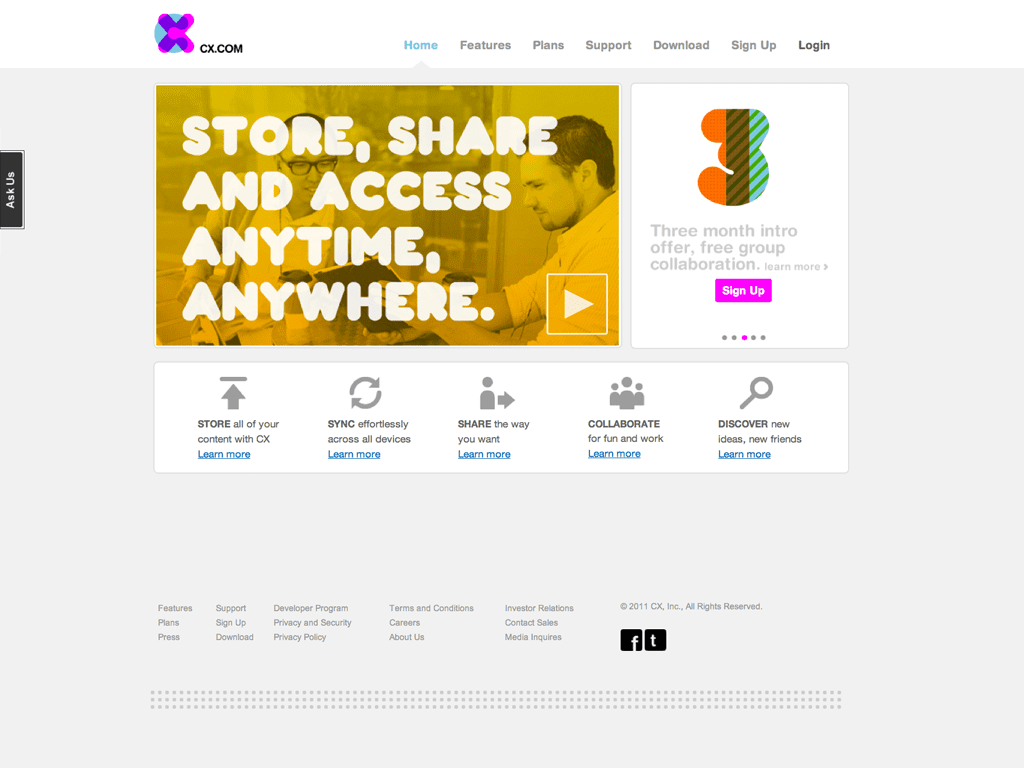
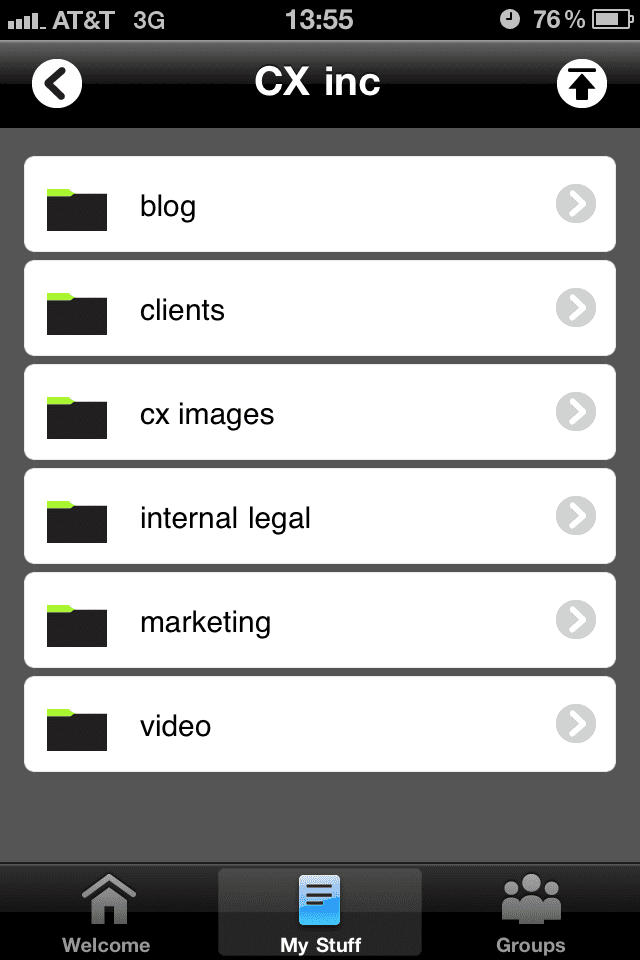
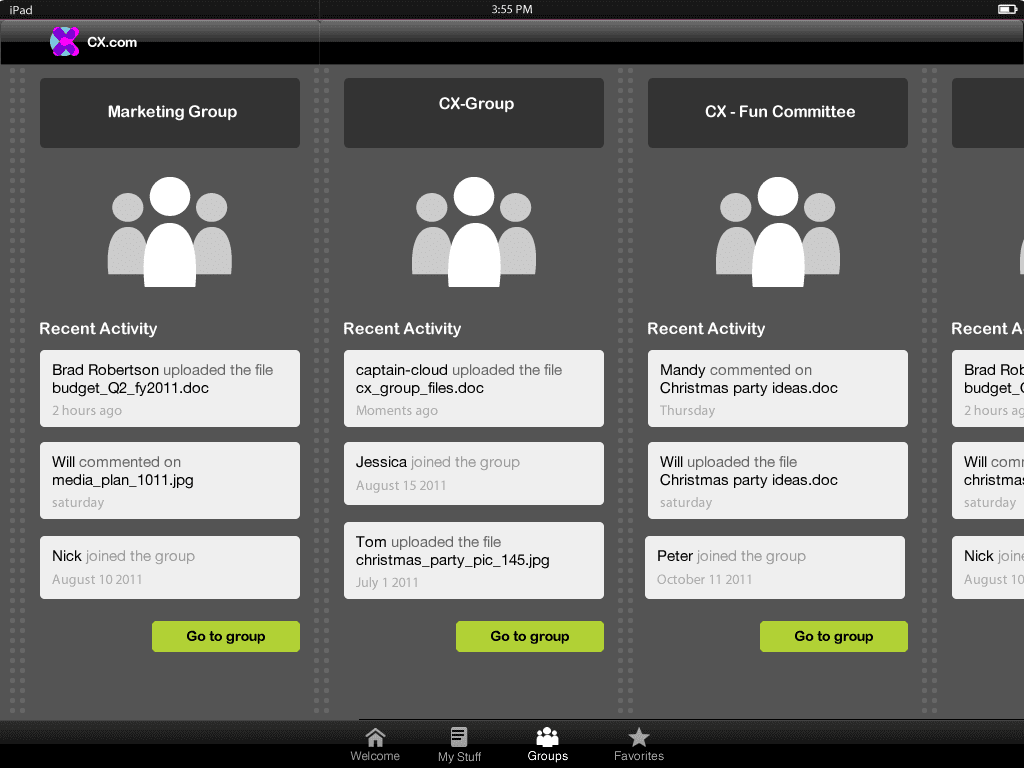
You’ve heard about “the cloud” and perhaps you’ve ignored all of the hype, but trust us, it’s just online storage and it’s worth the hype. One cloud solution businesses are turning to is the streamlined, easy to use (even for the non-tech inclined) CX.com which is a cloud storage and data file management system that provides users with a secure, stable, scalable platform to backup, synchronize, share, and manage their documents, photos and music, videos across all of their devices – which includes desktops, laptops, netbooks, and mobile devices (iPad/iPhone/iPod Touch, Android, and coming soon to BlackBerry).

In January 2011, the company launched their “Proof of Concept” that was supposed to be a testing ground and allow the company to bring on a few thousand customers, but it very quickly got the company to around 500,000 customers and became “unwieldy,” they tell AGBeat. In April last year, they completely rewrote everything (clients, services, integration, storage, etc.) to build a new platform for stability, security and scalability/growth.

The new platform launched in early October and they have been performing rolling releases nearly weekly to add new functions and to tune their systems. This January, CX released their Android/Kindle Fire clients and will soon release some asynchronous and possibly synchronous communications ability layered on top of existing services.

The newest feature: Group Chat to Cloud

One of the newest features is an extremely useful tool for small businesses, particularly those managing virtual teams:

A shift in the company

CX had adapted their offering as user behavior has changed from people uploading and storing music and pictures to sharing files with friends and family, and finally to their life ecosystem partners like lawyers, accountants, team members, etc.

The company is focusing on collaboration tools, giving users complete control on when and how their content is shared, be it through public or private individual shares to full collaboration in teams through “CX Groups” as demonstrated in the video above.

There is a free version of CX.com, and even the most expensive option (outside of enterprise) is only $24.99 per month, so it is reasonable compared to competitors, given the group offering built in to CX and expanding offering.

The company, with offices in Phoenix/Scottsdale, Palo Alto, Calif. and Buenos Aires, Argentina is backed by Hanna Capital and Tomorrow Ventures. The company left Alpha in early January 2011 and within weeks was adding 15,000 new users a week to most recently over 25,000 users per week.

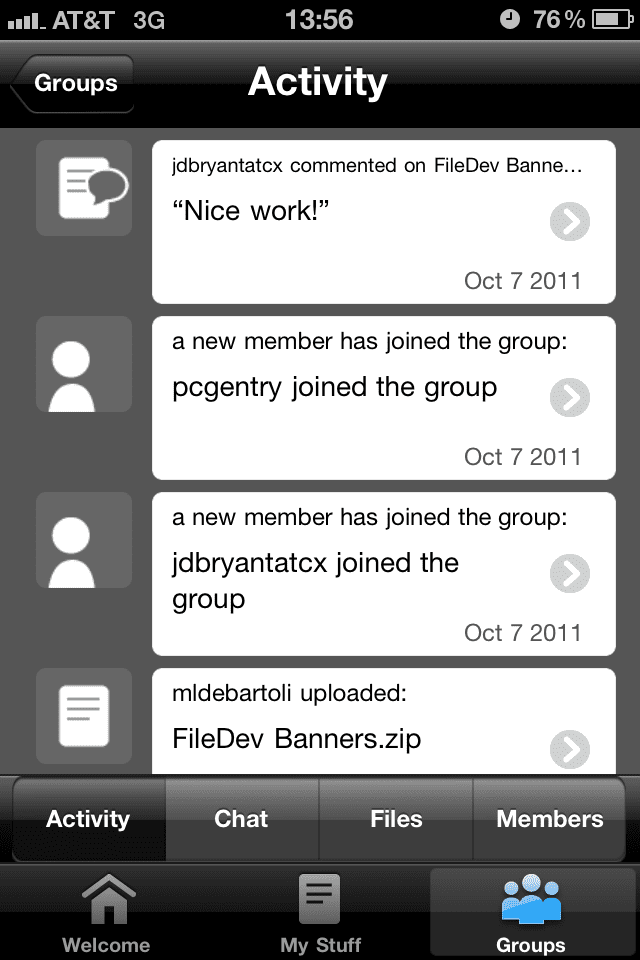
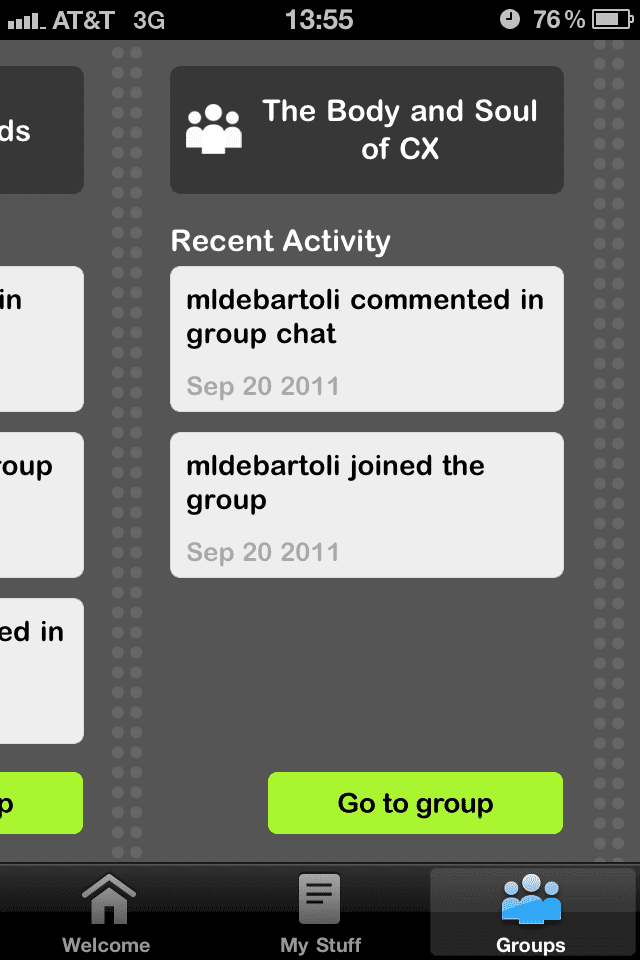
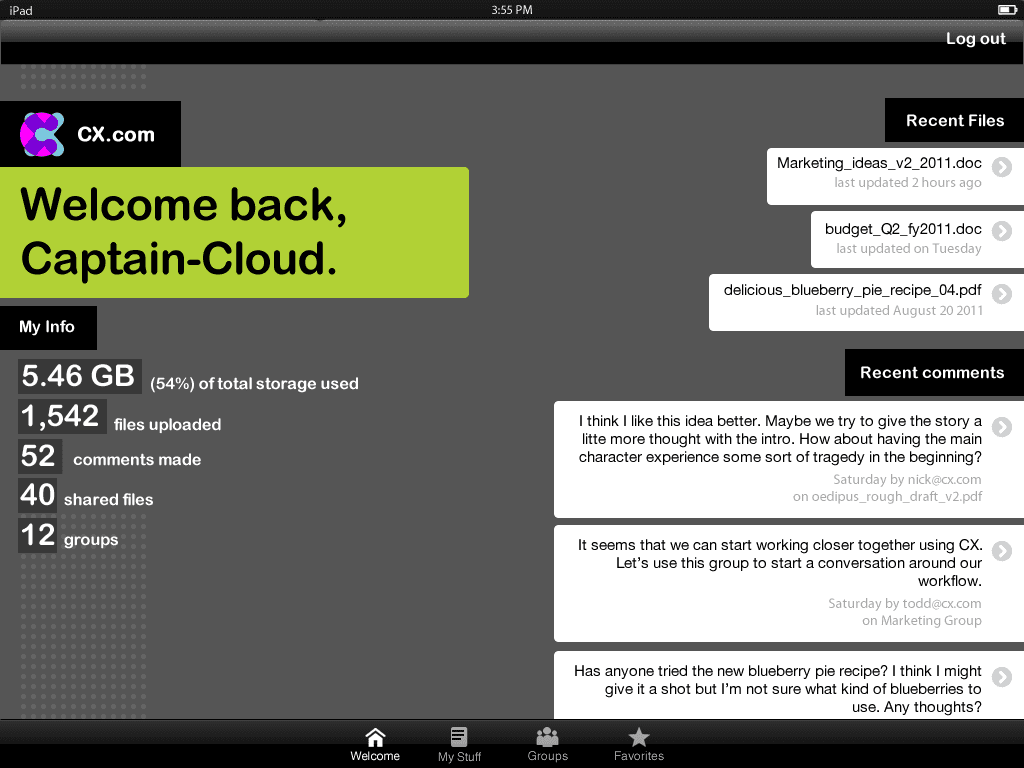
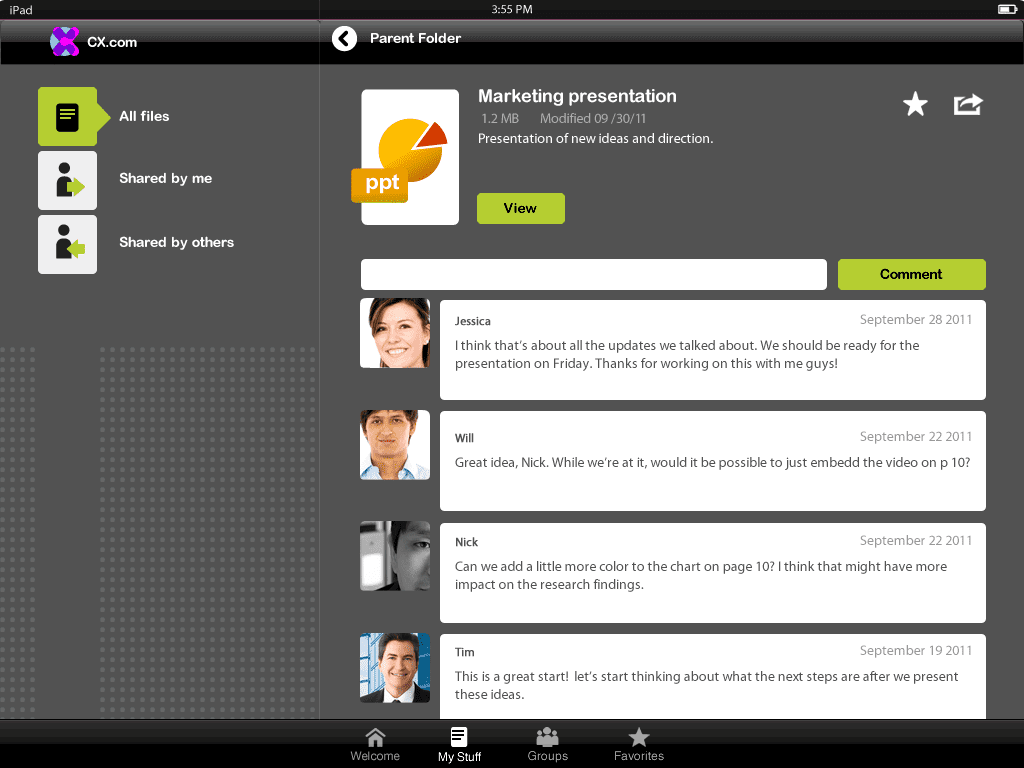
Photo tour of CX

Click any image to enlarge and note that some pictures are of the iPhone experience, others are iPad, others are the web interface:

RentJuice launches Common Application, shakes up rental industry

RentJuice pushes the envelope. Again.

AGBeat first introduced you to RentJuice.com over a year ago, as they acquired one of their closest competitors was funded to the tune of over $6 million. Last fall, they introduced the first of its kind directory of rental industry insiders, blowing the doors off of what has long been a closed-door, almost secret network.

Now, they are attempting the impossible by launching a “Common Application” for renters to complete through their system either on their computer, iPad or iPhone, complete with digital signatures. A video demo is available here.

Common Application and the implications

In many markets, renters race against the clock to get available units, and with vacancy rates diminishing, this is becoming problematic. The new RentJuice “Common Application” is similar to Facebook Connect in that consumers fill out the common application once and their personal information can prepouplate any real estate office’s custom leasing-related forms including applications for separate rental units.

The company said in a statement, “The time-and-effort-saving Common Application is a key component of RentJuice’s new online leasing process, which gives renters working with a RentJuice broker the chance to initiate and complete the rental application process immediately. Landlords and agents can send a client a consolidated set of online forms for a property in their RentJuice account using a smartphone or tablet, eliminating the need to make a trip to the office. No pen and paper, scanner, fax machine or envelope is needed – applicants can even sign leasing forms online using a mouse or their finger with any touchscreen mobile device.”

RentJuice is already available in Boston, Chicago, Miami, New York, and was recently launched in San Francisco. Since the limited pilot program was launched in February, they say nearly 4,000 new lease deals have been created in these markets with RentJuice.

Security of the global renter identity database

The company says the service is more secure than sending scanned documents over email and that all personal information is password-protected in a 256-bit-security rental data repository. The company says that the details collected from consumers come standard with every RentJuice account – live and as a downloadable PDF – but the platform also supports the numerous, varied applications for which different landlords ask, simplifying them to the most common set of questions and information. Landlords and leasing managers that are RentJuice users can link into this global renter identity database to receive and compare applications easily – online, in one place.

“In recognition of an aggressive rental market, this is a giant step toward expediting the leasing process, bringing it almost entirely online in a completely unique way,” said David Vivero, CEO of RentJuice. “Online lease signing and the Common Application iron out a pretty complex process for renters while respecting the unique needs of each landlord or broker. It allows all business to be conducted remotely with just an Internet connection and mobile device – this is not just an app; it’s a way of doing business.”


About: “RentJuice is an online platform that allows property managers and landlords to instantly share their availabilities with partner companies for free to shorten vacancies and improve communication. The Company also offers a paid upgrade that provides agents, brokers and leasing offices a “virtual rental office,” available from a browser, iPhone or iPad. From powering a leasing agent’s Facebook page and WordPress website to offering outsourced data entry and automatic ad syndication to dozens of consumer websites such as HotPads, Zillow and Trulia, RentJuice makes every step of the rental marketing process simpler.”

Card Swapp innovates QR code business card swapping

Modern business cards

Traditional business cards have helped businesses grow, attain clients, and spread the word about their services. Consider it a timeless and classic way to market yourself and your company and provide an easy way for potential customers to have the information they need to get in contact with you. While handing out business cards has always been a great business tactic, they have recently morphed, improved, and embraced modern technology—just like most marketing tools these days. One modern technological advancement and marketing tool is the QR code. Now, imagine what can be done if someone combines the ingenuity of QR codes and the convenience of a Smartphone with the proven effectiveness of the business card. Enter Card Swapp.

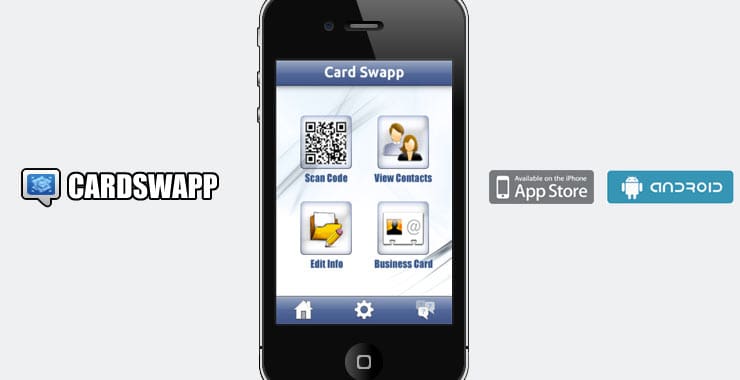
Card Swapp is a web-based service – also offering an iPhone and Android app – that allows users to create mobile business cards that can be given and received through QR codes. But it’s more than that. The traditional and semi-permanent nature of the physical business card means that your personal and professional information either has to stay the same for a long time or you have to reprint new business cards every time you change your phone number, your business or email address, or even update your website’s URL. QR code business cards eradicate the need for such actions, saving you time, effort, and money. Card Swapp allows you to log in to your account and update your professional information instantly. And everyone that has received your QR code business card will instantly receive that update as well.

Interesting feature: built-in newsfeed

However, Card Swapp is more than just swapping business cards through QR codes and having them update automatically—although, this is an interesting feat on its own. It also offers a built-in newsfeed that those who have your mobile business card can follow, allowing your customers, clients, and business partners access to up-to-date information on your company. Card Swapp is determined to prove that QR codes will revolutionize the professional world and how individual businesses are run. And to prove this idea, Card Swapp’s services are free. Just log in to their website and create a free QR code. Or, use the free Card Swapp Lite iPhone or Android app.

Card Swapp can be used for a variety of reasons, including receiving the latest news of school closings due to inclement weather, to-the-minute traffic repots, and even saving a take-out menu at your favorite restaurant. While you do have several options when it comes to creating and distributing business-related QR codes, Card Swapp has a few major differences.

For starters, instead of sending a QR code recipient to a website, it actually delivers the information right to the recipient’s phone, and it holds all the data without distorting the image. One of the best differences, however, is that you can share your QR code business card with more than one person at a time. Say, for instance, you were giving a professional presentation at a conference. You could actually share your business card with everyone in the audience. And not only do Card Swapp’s QR codes work well on mobile devices, they can also be used on printed materials, like brochures, flyers, and pamphlets.

QR Code business cards make it easy to market your business and keep your current clients up-to-date on important changes and professional updates and while the top challenges are having users remember to open the app, and for consumers to buy into the QR code movement. For the users that stick with it, Card Swapp is just one more way that to connect with customers, creating stronger professional relationships and loyalty.

MapQuest’s hyperlocal hotspot guide: mqVibe

18

MapQuest gets hyperlocal

On mobile and web, MapQuest.com offers a tool called “mqVibe” that, according to the company, “is a collection of millions and millions of MapQuest searches/directions, aggregated at the neighborhood level.”

As opposed to a generic map search, this tool is specifically for someone looking to get a feel for a new area, somewhere they plan to visit or move, or to learn more about their local area and trends within. The tool highlights cool “hotspots” and the most popular restaurants, shopping areas, venues, etc. and breaks down results based on the “Vibe Score,” popularity, walkability, going out, edginess, burbiness, and residentiality. Even the names of the sections are edgy, which appears to be the goal with promoting the “vibe” of an area.

The design is sleek and easy to use, and city information is offered via Wikipedia for any area. While everything is ranked in a list of top 10, underneath all of the area lists are specific business listings that offer people a view of actual hotspots to check out.

It is easy to see that a tool like this could be used by people looking to relocate to a new city or new part of town, to check out what the area has to offer and get the feel of what locals think of the area and what’s hot. It will be interesting to check your city right now, and then go back in a year to check how things have changed – most cities go through a natural evolution, so it stands to reason that today’s hotspots may not be tomorrow’s hotspots.

Pinterest now supports YouTube and Vimeo videos

Adding more features

As Pinterest continues to grow, they have slowly rolled out features that improve their offering. At the beginning of the year, we made 30 suggestions for Pinterest, one of which was to add better video support for users that want to pin images.

Pinterest has supported the pinning of YouTube videos for some time, but today announces support for Vimeo videos, which we supported not only because Vimeo makes up a substantial amount of videos online, but because the video quality is better, thus it is more commonly used for high production videos, which is often what many of our readers are looking to share as small business professionals.

Pinning videos works the same way as pinning images on the site, and you can check out videos that have been pinned on YouTube or those just pinned from Vimeo to see how they render. Being able to pin videos is a no-brainer for a visual bookmarking site, and this simple addition will most definitely help users spend more time on the site.

Other updates to come

Pinterest remains tight lipped about features that they are working on and what features will be next, but we anticipate that more features from our recommendation list will be added, such as private boards, viewing users similar to you, improved search, allowing users to pin a single pin to multiple boards from the same upload, bulk pin transfers in case you want to reorganize boards, improved notifications, and an offering of metrics.

Suggestions we doubt the company will undertake range from curing pin duplication within a stream (so that if I see a pin at the top of the page, image recognition should remove that image from the rest of my stream), support of un-pinnable static content through screengrabs native to Pinterest, support for animated gifs so users don’t have to be told to click out, to better categorization.