Home Blog Page 344

Construction spending at highest level in 2.5 years

residential construction spending

Overall construction spending improving

According to new data from the U.S. Census Bureau of the Department of Commerce, construction spending during May 2012 rose 0.9 percent to an annual rate of $830.0 billion, the highest level since December 2009. This increase followed an upwardly revised 0.6 percent rise in April.

Construction spending in May is up 7.0 percent above the May 2011 estimate of $775.8 billion, and the Department of Commerce is reporting that during the first five months of 2012, construction spending totaled $310.5 billion, 9.4 percent above the same period in 2011.

Many look to this economic indicator as a sign of health in the overall market, as building implies the ability to get at least some lending, and a sign of buyers, depending on the sector.

Private vs. public construction levels

Spending on private construction was at a seasonally adjusted annual rate of $560.4 billion, 1.6 percent above the revised April estimate of $551.8 billion.

Residential construction rose 3.0 percent for the month to $261.3 billion in May, and nonresidential construction rose 0.4 percent. Spending on multifamily residential projects jumped 6.3 percent, while investment in single family buildings rose 1.8 percent.

Public construction actually fell 0.4 percent for the month, with educational construction spending down 3.0 percent, and highway construction falling 0.5 percent.

The takeaway

While the American economy has quite a long road ahead toward recovery, spending is a positive sign as investment in the residential sector improves. Real estate has been one of the hardest hit sectors in the economy, and new home construction has been one of the hardest hit sectors within real estate, making spending a promising sign for the market.

Residential construction is expected to be the bright spot in the economy, contributing to the nation’s growth in 2012 for the first time in eight years.

VoicePad: improved lead generation for Realtors

voicepad

Advancing real estate technologies

The real estate market may be caught in a slump when compared with previous years’ successes, but that doesn’t mean improvements and advancements have not been made. One company in particular has decided to jump on the chance to combine new and traditional real estate technologies to make for an improved home-buying experience. VoicePad has developed a way for your potential homebuyers to stay even more connected with your listings, and all from their phones.

VoicePad is based out of Louisville, Kentucky and is all about lead-generating mobile technology specific to the real estate industry. They offer three distinct and connected services. Each of the following services is enough to make a huge difference in your leads, but the combination of the three has the potential to revolutionize how your do business, and how often you do it.

Call Capture – Call Capture allows homebuyers to call on any home on the market and hear listing information right on their phones. One of the great things about this for you is that you don’t have to rerecord new information when the price changes, as the recording is all about the property’s features. This means you may get leads from those who drive past a property and want more information but aren’t quite ready to speak to a realtor.

Text – If those potential leads like what they hear on the Call Capture recording, they can request a text of all the information about the home. All they have to do is text a specific code relating to the property, and the text will be sent straight to their phones.

Mobile Web – In that text message, they’ll receive a web link that will give them GPS property directions and photos of the property. If they want to continue their search, they can input their ideal property criteria and find the property of their dreams.

Improved lead generation

All of these services collect lead information for agents, lending to more relevant lead generation. VoicePad has generated over 2.5 million leads in the last year, all revolved around providing relevant and up-to-date information, information that can build your business and help homebuyers connect with the right property.

Epic breakup: LinkedIn may no longer display tweets

twitter stops syndicating updates to linkedin

What happened to Twitter and LinkedIn?

In what could be the biggest social media breakup so far, Twitter has announced1 that to make their service more consistent, they will no longer be syndicating tweets to LinkedIn, encouraging users to visit their own services rather than consume tweets through the LinkedIn dashboard.

For the past three years, LinkedIn users have been able to syndicate their Twitter updates as LinkedIn updates, and this new change means that LinkedIn members may still send updates to Twitter from their accounts by checking the box for tweets when updates are created, but tweets will no longer automatically show up in the LinkedIn ecosystem.

Twitter’s move is part of a broader effort to get eyeballs back on their sites and apps so that they can make a legitimate run at advertising revenue, given that they remain one of the most highly funded startups in the nation. If users are bypassing Twitter to consume tweets, they are also handicapping Twitter’s ability to make money, hemorrhaging which Twitter is desperately trying to stop.

Twitter said in their announcement, “We’re building tools for publishers and investing more and more in our own apps to ensure that you have a great experience everywhere you experience Twitter, no matter what device you’re using.”

LinkedIn’s announcement2 was gracious and supported Twitter’s efforts to create a “consistent set of products and tools” for their social network. “We know many of you value Twitter as an additional way to broadcast professional content beyond your LinkedIn connections,” the LinkedIn announcement stated. “Moving forward, you will still be able to share your updates with your Twitter audience by posting them on LinkedIn.”

Good news or bad news?

Many took to the social media airwaves to complain that this limits their ability to grow their networks, but we would assert that this is the best possible thing that could have ever happened to LinkedIn, as the duplicated noise has turned off many users. This move could actually make LinkedIn the relevant business network it once was. We believe this move will strengthen the community and get users back that had wandered away in frustration.

Auto-syndication was initially useful, but has simply added to the irrelevant noise of each network, so it is highly likely that others will follow suit and take back the syndication rights it has given its users and allow selective sharing rather than blanket sharing as it stands right now. This move helps Twitter make money, and gets LinkedIn back to its original culture where it was never okay to pipe in a tweet about the donuts that just went straight to your thighs. Everybody wins!

1 Twitter announcement
2 LinkedIn announcement

Facebook’s brilliance: Instagram is the kids’ next Facebook

facebook, instagram, and teens

Why Facebook is brilliant

Although photo sharing app Instagram is simple, fun, and a growing community, it is not so far superior to the dozens of competitors, but what it has in common with Facebook is that it has users, and the unfortunate truth about social networks is that the highest level of consumer interest is typically in the most populated network. It’s human nature – most people, particularly young people, will always choose a bar or club that is jumpin’ and is loud, and looks fun, over the quiet dive next door with the lone hipster drinking a Lone Star beer. The vibe and the atmosphere of a crowd conveys to the web just as it does in person.

The brilliance of Facebook giving a billion dollars to Instagram to acquire it is not in the technology, nor the amazing hipstery filters, nor the ease of being able to share photos across social networks, no, Facebook made a brilliant move because Instagram is the next Facebook, at least with teens who are the future adult users of the web.

“Pinterest is for old people.”

This summer, our daughter announced to me that she was considering quitting Facebook and switching to Instagram, having no knowledge that Facebook actually owns Instagram. She didn’t care. Why? She says Instagram has less drama, that people stick to commenting on photos, and everyone knows what everyone else is up to visually, plus it’s fun to scroll through friends’ photos. Why not Pinterest? “Pinterest is for old people,” she told me. Ouch.

To me, Instagram could be in danger of becoming the next MySpace, populated with pre-teens doing “duck face” and showing cleavage, but because MySpace is dead, teens that jumped ship from MySpace to Facebook are now considering deleting their Facebook profiles and jumping to Instagram.

Austin Realtor, Nanette Labastida said her teen considers ditching Facebook for Instagram “about every other week,” and Julie Marschewski Austin at Arkansas Office Products affirms that her teen is also on both networks, but is spending much more time on Instagram.

So why the switch?

The migration from Facebook is happening for two main reasons – one, Instagram is easier. Point, click, share, done. No thought about whether you look stupid because you can’t tell the difference between “your” and “you’re,” no more having to use brains to communicate. And two, teenagers’ parents, grandparents, great grandparents, teachers, and priests are probably on Facebook, but they’re not active on Instagram, so they can get away with a bit more than where their family members are watching. Bet you didn’t think we’d notice, did you, kiddos?

What will this mean for Facebook? Nothing – Instagram users are already theirs, but this could definitely shape the way Facebook behaviors change in the next five years as many of these future consumers make social networking choices.

The looming Canadian real estate bubble

canadian real estate bubble

Mixed signals in the market

According to the Association for Canadian Studies, the median household income for Canadians is now $68,560 per year, with the average Canadian paying $11,000 annually in income taxes, donating $260 to charity, and contributing $2,790 to a Registered Retirement Savings Plan. Mortgage and household debt is at $112,329 with the average credit card balance carried hitting $3,462.

According to Statistics Canda, Canadians’ net worth is up to $193,500, having benefited from home prices doubling in the last ten years, but the market is now cooling and prices and sales are beginning to slip. While savings rates have fallen to 3.1 percent from double digits just 20 years ago, as personal debt to income has hit a historic high of 153 percent, making a dent in the net worth gains seen in recent years. As credit card debt continues rising, and savings are falling, real estate’s pending correction could see that high net worth take a dive in the next few years.

The pending bubble burst

New West reporter, Brian Pybus calls the state of real estate more than a correction, he calls a huge bubble. Pybus writes, “The continued policy of low interest rates is as harmful to the best financial interests of Canadian consumers as was the record high interest period of the early 1980s,” referring to the ugly side of the popular record-low interest rates, as consumers see low interest rates as “cheap money,” which has led Canadians down the primrose path of running up their debt and leading to a market influenced more heavily by speculators than families.

While there is not a consensus on what the bubble looks like, most speculate it is between 30 and 40 percent, which is less than favorable news not only for the average family whose net worth may have just peaked and are fooled by low interest rates into an unnecessary buying frenzy that looks to be ending in short order.

Dispelling gender discrimination myths in Asian business

“Heavy Man, Light Woman”

I remember when I first learned the concept of the “son-preference phenomenon.” My Chinese teacher was adamant about drilling into our Western minds the concept of gender discrimination and how it applies to all walks of life in China, including business. In her defense, she was trying to prepare us for a life overseas, albeit a life from the 80’s.

We understood these grand ideas of China being a patriarchal society and the impacts of the “Family Planning Policy,” but what we didn’t realize was just how much of the ancient ideologies were falling by the wayside as more and more Chinese were not only being educated overseas but were emulating the Western life.

How the Cultural Revolution Catapulted Chinese Feminism

What many foreigners don’t know is that prior to China’s “Open Door” policy of the 1980s, China has had a very strong feminist agenda since the “Great Leap Forward,” a precursor to the “Cultural Revolution” in the 1950s. Economic changes were just the tip of the iceberg. Many social changes were introduced that drastically changed China practically over night (or at least over the course of a decade).

The “Great Leap Forward” was just that, and it ushered in new concepts such as the importance of female education (even in rural countrysides), increased female voice and rights (freedom to divorce at will), refusal to practice foot-binding, and sexual freedoms that were previously frowned upon.

My favorite quotes from Mao’s “Little Red Book” can be found in chapter 31-the Chapter on women. Quotations such “Men and women are equal” and “Women hold up half the sky” found as early as 1949 show that the socialist and communist ideologies bolstered equality for women not only in society but also in the workplace.

Girls compete, too!

We all see how Chinese women dominate sports at the Olympics (gymnastics, swimming, badminton, etc.), but women are being elevated to equal standing as men in the workplace. Just last Friday, the first Chinese woman astronaut returned from space. Granted, China is still male-dominated in terms of executive level employees, like most countries are. But with the remaining feminism from the cultural revolution, it is common to see women in management positions abroad.

In my own personal experiences in working in China, I was able to see firsthand how my own antiquated ideas from high school Chinese class were hindering my success. While there is still much debate about foreign women having more freedoms than local women, the fact still remains that women can and do compete in the current Chinese business landscape.

On more than one occasion, I have been welcomed to business dinners by being offered the “seat of importance” or offered baijiu* and cigarettes (normally in social settings reserved for men). It’s important to keep in mind that just as you would see a female VP or bank executive in the states, chances are that you’ll run into more of them in China merely due to scale and population size. While gender roles are still present, women do in fact still hold up half the sky alongside men.

Key takeaways

Gender discrimination and gender roles should not be confused. Prominent gender roles still exist (nurturing mothers, working fathers, social responsibility, etc) but women and men have equality in the work space.

*baijiu – “white liquor” typically made from rice with a higher alcohol content than vodka

Microsoft’s support of four time cancer survivor’s battle

Mike Thompson

Fourth time leukemia survivor forges ahead

At age 10, Mike Thompson was diagnosed with a rare blood cancer that he battled for many years, fighting through pain, anxiety, fear, depression, two bone marrow transplants, and a 12 hour facial reconstruction procedure that used part of his fibula to replace his jaw after a tumor was removed. Fast forward to today, and “Iron Mikey” is a fourth time leukemia survivor devoted to not only raising awareness about cancer and cancer research, but has become a multi-sport athlete currently training for his next Ironman competition after competing in the IronMan Texas competition in 2011.

Currently, Thompson is participating in a video contest that could send him to compete in the Ironman World Championship in Kona, Hawaii in October. His video entry, entitled “Love for Life – My Own Finish Line,” has catapulted him into the finals where he will have to place first or second place out of the 15 finalists to secure his space in the competition. Voting (done by clicking “vote for this” under his video) ends on July third and one vote per day is allowed per IP user, and winners are chosen based on unique votes and view counts.

Thompson’s trainer, Steve Blackmon calls Mikey a butterfly, referencing not only his small frame and powerful internal engine, but his perpetual optimism, cheerfulness, and difficulty focusing. Blackmon joked that he often chastises Thompson for missing a training session or not uploading his workout stats because he’s out speaking about blood cancer research, or visiting with children in the hospital, alluding to Thompson’s massive ambition and dedication to the cause.

How Microsoft is helping to launch Iron Mikey into the finals

Three years ago, Albert Springall, a Solutions Manager for Enterprise Accounts at Microsoft joined the Board of Advisors at the Central Texas Chapter at The Leukemia & Lymphoma Society (LLS), and met “Iron Mikey” when he raced to raise money for blood cancer research. Later, Springall joined the Board of Directors of Go Mitch Go, a charity set up by the parents of Mitchell Whitaker who lost his 26 month battle with Acute Lymphyocytic Leukemia in September 2007, at the age of 10.

Go Mitch Go was born out of the Whitaker parents’ efforts during his illness to find ways to help and encourage other children with blood cancers and their respective families by organizing fundraisers, providing supplies, enlisting support, giving encouragement, and participating in many events sponsored by the Leukemia Lymphoma Society (LLS) and the Oklahoma University (OU) Children’s Hospital. Mitchell’s last words were “keep fighting,” which the family says has adopted since his initial diagnosis. The family’s goal is to raise one million dollars during their lifetime for blood cancer research, and are doing so by fundraising for research, supporting children and families battling the disease, and assisting the families in crisis.

According to the LLS, research is critical in light of research that reveals one person in the United States is diagnosed with a blood cancer approximately every four minutes. Springall consistently raises funds and raises awareness and encourages people to vote for Mikey or donate to Go Mitch Go to help families impacted by blood cancers.

Springall’s involvement in blood cancer research, the LLS, and Go Mitch Go culminated in the organization of a massive voting event in support of his friend, Mikey. On Friday, the new Microsoft Store in Austin, Texas was filled with supporters that were invited to the facilities to use the computers in a round robin type voting, wherein each person would log in to their Facebook account, vote, sign out, then move on to the computer to their right, since each voter is limited to one vote per day, unless a separate IP address is used. The Microsoft Store offered up 50 IP addresses, and all demo devices for attendees to show their support for Mikey’s bid at getting to the IronMan World Championship.

Goosebumps in the midst of so many people present to vote

Looking out over all of the people in the store voting for Mikey, he said it was giving him goosebumps just witnessing it, and was honored not only for their support, but because people were there because they were inspired. “There’s so much to be negative about- your team losing in the NBA finals, politics, and stuff going on in the world, and people don’t focus on the fact that there is so much to celebrate, like having food, and voting parties, or group work outs, or even the ability to watch dancing competitions on tv. These little things should be celebrated every day.”

Microsoft not only opened up their retail location in support of the cause, but offers all employees $17 per hour when they are doing charity work, which is donated directly to that charity, and matches up to $12,000 raised for charities by Microsoft employees, urging all employees to get involved in their communities and to help others, shedding light on a massive corporation’s often overlooked philanthropic side.

When asked if being a triathlete was part of Thompson’s long term plans, he said, “I want to do it for as long as I’m able. More than that though, I just want other people to pursue their goals. It doesn’t have to be a triathlon or run a marathon, or anything like that, it simply has to be something that makes them happy so they’ll pursue it and make dreams out of it, make goals out of it, and accomplish it.”

Thompson added that people should do anything they can to be happy, “because people like Mitchell would do anything to be alive with their family doing those things.” He tells supporters, “I’ve been blessed with an incredible amount of support from this campaign. Your words of encouragement have made me feel more privileged than ever to still be alive, and I’m eternally thankful for you. I love you all, and thank you for making this life worth living.”

Watch the video, go vote

If you would like to support Iron Mikey, watch, vote, and share his video here (or here for mobile viewers) once per day through July 3, 2012.
[ba-youtubeflex videoid=”ostdLIK7Z3c”]

vote for mikey

Photos from the Microsoft Store voting event

gomitchgo
flip flop events georgetown
Mikey Thompson, Go Mitch Go

Thumb – a social network for instant opinions

thumb 3.0 - social network for opinions

The modern era of instant gratification

We live in a quick-paced modern society. We have access to instant information from our computers and phones. We can keep in contact with long-lost friends and family members with just a few clicks, no matter what we’re using to connect. While we’re shopping online, we can see instant reviews from other satisfied or dissatisfied customers. These type of instant responses help us make important and everyday decisions. With this in mind, Thumb 3.0 offers a valuable service for those wanting to know instant opinions and they’re not alone in those opinions, perspectives, interests, and passions.

Thumb is a social network for those who want or need to express their opinions and ideas or are seeking the opinions of others. It’s easy to use – all you have to do is sign up, and you’re ready to share your opinions and gather the opinions of others. While using Thumb can be fun and entertaining–because you can vote a thumbs up or thumbs down on an unending stream of photos, brief content, and ideas–there is a real professional value in gathering the opinions of others.

Using Thumb in your business

Imagine what you could do with the responses you receive from your target audience or potential companies on an ad campaign or the newest version of your website. Just show a simple picture and let your fellow Thumbers instantly share their opinions. Through this simple, free service, you can get valuable feedback from potential customers. And that can speak volumes, even with just a simple thumb. Once you gather all the opinions, you can then make changes or push forever your campaign or professional movement.

Whether you participate by voting or you’re adding items to be voted on, Thumb will create an instant public profile, showcasing all your likes and dislikes. From there, you can find connections that have similar interests or shared thumb-downs. This is a great way to find networking opportunities and just to form valuable relationships, online and offline. The profile is a true representation of your opinions, more so than any other social network , as it’s naturally created based on your votes rather than how you want yourself to be portrayed.

The newest version of Thumb offers its users real-time messaging, so you can chat with those you find interesting based on their likes and dislikes. Or you could even use the in-app messaging feature to get more feedback about some of the content you posted onto Thumb. What better way to build new online relationships?

While there are many ways to connect online these days, Thumb is a uniquely new option to consider using, both for your business and your personal use. Thumb tells AGBeat that they “believe that the sentiment rich data [their] users share could have a huge upside for both the users themselves and brands.” Thumb is more about getting an initial reaction, as the pictures switch as soon as a thumb is chosen. A gut reaction can usually be trusted, and that’s great for testing your newest form of marketing. Thumb is about instant engagement, a way to share important opinions, and valuable connections.

How retailers could skyrocket revenue with one tweak

qr codes in marketing

One simple tweak

Shopping at Target recently, I encountered a major frustration that shoppers have had for eras, that a simple tweak to the company’s marketing could completely fix. A tweak that no major retailer is taking advantage of, and the world has made overly complicated – QR codes. Many of you will say to yourself, but you told us that QR codes are a passing trend, and you’re right, but they are useless in most cases because they are poorly used. Let’s talk about one extremely specific use that could boost in-store sales.

In the aisle at Target, I saw print collateral of a beautiful young girl wearing a navy, white, and yellow skirt. I wanted that skirt. I needed that skirt. But look at the photo below and tell me what the problem is with my quest for that skirt:

target retail marketing

Where is the skirt? Is it on the top row near the photo of the skirt? The bottom row? Nope. Is it around the corner? Is it in the section to the right or the left? No. The goal has always been to have images that entice someone to shop around, and as they seek out that item, they will find other items. Okay, I get that, but when you ask a Target employee where that skirt is, they go on the fruitless hunt with you, because they don’t know where the skirt is either.

So I get frustrated, and no one knows that the skirt exists except for the model in the picture. Perhaps it is a tease and I need to order the skirt online. But searching Target.com on a mobile is not exactly friendly, no matter what their design team tells you, and reception in the back of the big metal big box is horrendous, so ten minutes into searching online for dozens of variations with the colors, length, and type of skirt ending in no matches, and scrolling through the available skirts became as frustrating as the deer-in-the-headlights employee helping me around the store in hopes that maybe it exists in the toddler section or something.

Mobile failed, in-person failed, and after all of that time I wasted devoted to a Target skirt I didn’t know I cared about in the first place resulted in my putting back the top that I had picked to go with the skirt. I was so over it. I caught up with the family and refused to buy anything for myself. I didn’t even order an in-store Starbucks on the way out.

How retailers fix this

There are two reasons this problem must be fixed after decades of this method of using glossy models to lure you into non-existent products. First, this must stop because the internet exists. Users can look up products online while in the store, and if your mobile site is horrible, they can move on to your competitor and shop them while in your store. Secondly, the Millennial generation proving to be impatient and value a fast experience over a lengthy customer service endeavor, meaning that a helpful sales person is a bonus, but my grabbing a skirt from a shelf underneath where the model told me it should be is more important.

So how do retailers fix this? Easy:
qr code retail marketing

Can you see the tiny difference? With that simple QR code, I could have given an employee a product number or just ordered it online immediately (which I would have). While I have said many times on stage and here at AG that QR codes are mostly a waste of time, this is one use that is legitimately useful.

Why this works – it’s not a gimmick

A QR code used in this fashion is not to lure me in and make me give up my email address or phone number, I don’t have to answer a quiz question or enter some stupid competition or raffle, it doesn’t make me tweet anything, and there is no gimmick, it just allows me to spend money. Imagine a world where QR codes were available to consumers on in-store marketing – not only could people order online (or get online-only options while shopping in store), but could more readily locate items that they want to spend money on.

This isn’t a proposition for big box retailers only, this is a simple and often free measure that any brick and mortar location could use, that is more meaningfully measured than foot traffic or web wanderers.

7 tips on training virtual team members across the globe

managing global virtual teams

The rise of the virtual team

Your graphic designer is in Israel, your coder is in Russia, your customer support team is in Costa Rica, your sales team is in Utah, and you are in Toronto. The internet has obviously paved the way for a new world which does not require bricks and mortar, or for you to even have been face to face with your team members, be they employees or contractors.

Although the barrier to doing business globally is quickly falling, the challenge of training a global team is unique, and one that ProProfs.com CEO, Sameer Bhatia is familiar with. Bhatia says that managers who understand the potential pitfalls can avoid making mistakes when working with geographically dispersed groups.

These seven tips from Bhatia can help ensure your global virtual team training program runs smoothly – some are common sense, but hopefully you will read this and take away at least one action you can take back to your company and improve your virtual team efforts, or begin them if you have been waiting for that push to get started.

1. Ensure Cross-Device, Operating System and Browser Compliance

Your global employees will likely use different devices, operating systems and browsers to access your learning content. Devices can include cellphones, tablets, laptops or desktops – all with different screen sizes and running various operating systems, such as those powered by Windows, Apple, Android or Blackberry.

Your team will probably also use different browsers, including Internet Explorer, Google Chrome, Firefox or Safari. Ensuring compliance across all these devices, systems and browsers is not an easy task; make sure your learning management solution works in all operating environments.

2. Use Training Software that Supports Multiple Languages

With a global workforce spread across many different countries, you may be required to provide your training content in multiple languages and translate existing courses. Ensure that you use training software that supports this requirement.

3. Give and Get Immediate and Detailed Feedback on Training

Before, during and after your training, you’ll want to solicit feedback from your team. Asking questions, doing surveys and getting individual team member’s thoughts about the training materials will help you to revise and improve your training program. Feedback from training is an essential element for continual improvement of your global team. Make sure your online training system integrates surveys and feedback with the content you produce.

4. Be Mindful of Time Differences

Remember that if you have team members in China, Brazil, Uruguay, Germany and Kenya, for example, you’ll have to work across multiple time zones. Consider using asynchronous training – training that can be accessed 24/7/365 by your team, on their schedule, and delivered through a content management system.

As trainer, keep in mind that your team is working through your content at all times, which means you’ll need to keep up with feedback, sending detailed responses promptly. Select a training tool that allows you to set up notifications and group level reporting to stay up to date.

5. Be Aware of Cultural Differences

As a global training leader, you’ll need to study the cultures of the people you are working with to be effective. Some words have different meanings in other cultures, and it’s important to avoid misunderstandings. Also make sure that your team understands the importance of cultural differences, and take steps to ensure that they can work with other people in an environment of trust and respect.

6. Make Testing an Integral Part of Your Training

Training without testing is incomplete. Remember that all training is designed to get your team to perform certain tasks in a certain way, so it’s important to make sure learners understand training goals and how you are going to measure what they learn. Include tests and quizzes to ensure learners are meeting your training objectives. If your company’s human resources department requires certifications, consider a training system that automatically issues certificates of completion if a trainee passes the final test with a minimum score.

7. Understand Organizational Reporting Requirements

Depending on organizational requirements, a global workforce may require a way for many managers to view and share reports for their business units. It is essential that you understand and plan for reporting requirements to effectively manage the trainings you conduct. Ensure that you use a training tool that will meet these requirements so you can share the reports effortlessly across the organization.

Managing a global training program is a challenging task, but it can be highly rewarding when you improve organizational skill levels with an effective training strategy. With these small steps, you will go a long way toward ensuring that your team is productive, happy and ready to work together on many future projects.

About:”ProProfs (www.ProProfs.com) is the leading provider of comprehensive online tools for building, testing and applying knowledge. Through its QuizSurvey and Online Training products,ProProfs offers trainers, marketers and educators powerfully-simple features without requiring users to download or learn expensive software. With the largest library of public quizzes and assessment tools on the Web, as well as a powerful tracking and measurement dashboard, ProProfs empowers users with a valuable feedback engine to apply knowledge, helping them increase productivity, efficiency and profitability. ProProfs is a privately-held company based in Santa Monica, Calif.”

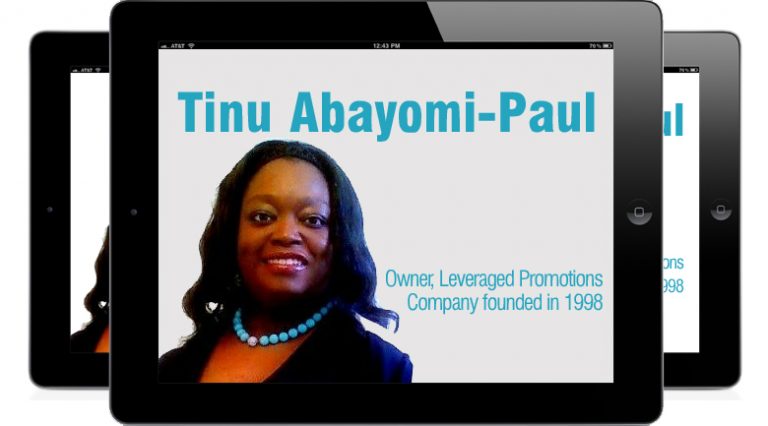
Tinu Abayomi-Paul: business leader showcase

Tinu Abayomi-Paul

Business leader showcase

This East Coast gal is stuck on West Coast time, and once dreamed of being called the Honorable Abayomi-Paul. Tinu Abayomi-Paul is the Owner of Leveraged Promotions, established in 1998, and today spends time telling AG readers what her days look like, what keeps her up at night, and things that only people very close to her would know.

We often revere leaders, but often for their current work, without knowing where they came from, but by knowing what makes people tick, we can not only better connect with one another, but we stand to gain by being able to identify with traits shared with various leaders as a means of inspiring our own leadership paths.

Below is an unedited interview with Abayomi-Paul, in her own words:

Tell us about yourself and your work.

There arel all kinds of fancy words and phrases used to describe what I do but it boils down to this: I help businesses get more customers via the web, which includes mobile.

I’ve been doing this since 1998, at first working just with friends’ sites or organizations that weren’t pursuing a profit. At one point I owned the third most popular poetry site in the world, after poetry.com and Def Poetry Jam. It was called Fireseek, then later Urban Poetic. We had a partnership with About.com which included advertising. At the time I had a full time job, and that advertising got me the equivalent of an extra paycheck after I shared it with my partner.

Due to some health concerns and losing my job, I started thinking about how great it would be to help other people do what I did with the poetry site. At first it started out as helping other people get an extra paycheck a month. Then in 2004, I made more in one day than I did in a month at my temp job. The place I was working for went back on a promise to give me time off for my sister’s wedding. I quit and never looked back. I taught myself everything I could about promoting a business via the web – while promoting my business via the web. I tested things, then sold the knowledge or did the same for other companies.

Walk us through a typical day in your life.

My days living in Las Vegas, where I started my business, have spoiled me – my body won’t switch back from West coast time no matter what I do. I typically get up around 9 am East coast time unless I have something pressing to do. I start the day with research – what has happened with Google, social media, marketing, or PR since I went to bed? Have my colleagues written anything that would inspire me to debate or creation?

Then I share what I’ve discovered, do some commenting. Then I write. Articles, blog posts, work on books I’m writing, ghostwriting sometimes. About once a week I incorporate the creation of audio and video content – new habit I’m forming. By this time it’s midday.

At this point I check in with all my teams to make sure all the client projects are going well. Then I double-check my email, text, social media and phone messages to make sure I haven’t missed any fires that need to be put out.

After lunch is when I have the majority of my meetings. I find myself mentally sharper as the day goes on, even though I tend to get physically tired faster if I don’t pace myself.

I try to wrap it up by 6 pm, but I fail about 40% of the time, so my day often ends around 8, much as it pains me to admit.

What did you do before your current career?

I was in IT, mostly Help Desk. My last long-term job was with the MGM Mirage. They have this cool command center wall – you know how in the movies, NASA has this wall full of screens with lots of different information? It was like that. Before I moved to Vegas, I worked on the Help Desk at the IMF. I was working the swing shift with the Mission Travelers. People would go to remote areas where sometimes there was only dial-up access, so we couldn’t connect to a person’s computer like we could if they were in the building. Nor could we have come drop off their computers. So we would have to visualize the problem and give them oral instructions for how to fix things.

It was ideal for me because I have a kind of photographic memory. It’s not like on TV – it’s more like if I’ve seen something recently and enough times, I can remember something I’ve seen like I’m still looking at it. Like I can be in the supermarket, and look at the last time I saw the refrigerator to know if we have something.

What is something unique that you do to balance work and life?

I meditate and read affirmations. It reduces stress and helps me focus. I used to do it daily, and that what when I was most successful with the least effort. Working my way back to that.

What keeps you up at night?

I don’t have payroll, because I hire other companies instead of other people. It’s cleaner until I need permanent people. But making sure I have enough work to keep working with the same teams keeps me up at night. I am also almost at the point where I need a permanent assistant. So I worry about finding room for that in the budget on a consistent basis, someone trainable but who already has the basic skills I need. I was burned once by someone who was a sharp self-starter, but turned out to be untrustworthy.

If you could spend one day in the life of another industry leader, who would it be?

Toni Morrison. She was an editor for a long time, then started writing at 45. She later won a Pulitzer Price and a Nobel Peace Price. At heart, I’m a writer, I think what we read fuels who we are. So I’d love to see how her mind works from the inside.

What tools can you not live without?

I’d throw my phone in a lake if I could. I hate texting, and I want my phone to do less, not more. answer calls consistently and stfu. But my work and my life need to be mobile. Not to mention the fact that I’m addicted to mobile apps.

So I’d have to say my iPad. A very close second would be Jungle Disk – a product by Rackspace that, in conjunction with Amazon s3, gives my company network drives. I also adore LastPass. I kill PC laptops in six months on average, so instead of constantly losing everything, I just save it all to the cloud. I back stuff up to a brick too but with a network drive you don’t have to go through the restore process.

If you could start your current career over, what would you do differently?

I would have skipped directly to owning a company that builds useful or fun software, and focused on creating content for the people who liked the software my company built. I thought I had to be able to code and all that. And I had a serious problem, which I’m currently still getting over, with thinking I had to do everything 1- myself and 2- perfectly. Now i know it’s more important to be timely, and that I can correct as I go. The grammar police and the haters will find something wrong with what you’re doing no matter what.

I’d be making mobile apps and web apps for business now. I still will but it would have been nice to have been doing this from the beginning.

At age 15, what did you want to be when you grew up?

As my mother constantly reminds me, I wanted to get a PhD like my father, and also be a judge. I fantasized about being called the Honorable Dr. Abayomi-Paul. I will likely still get a doctorate, but I eventually realized that my dream was to go to law school, not to be a lawyer. And I decided I’d wait until I could afford to go without getting deeper into school loan debt, and if I still wanted to do it, I would.

Tell us something about you that people wouldn’t believe unless they knew you.

I’m much quieter in person than my long, rambly writing would have you believe. MUCH.

What inspirational quote has stuck with you the longest?

I’m paraphrasing what I was told is Emerson, but I can’t remember what essay this quote is in, nor have I had much luck Googling it.

“Your attitude towards a given situation is more important than the facts that actually prevail.”

I’ve found that to be universally true. Most of think our thoughts and emotions are just electrical impulses that happen to us, that we’re enslaved to them. In life I’ve learned that your thoughts are a choice that you can make conscious, and that we can control a great deal of our emotions. Some of my early close friends think it odd the way I often deal with conflict, because they grew up with me being confrontational, even when the situation didn’t necessarily call for it.

But around college, I began to realize that if my TRUE goal is to resolve a conflict, and not just to win an argument or stress myself, then what’s the point of arguing over stupid things? It’s not like your anger can Do anything. It’s not like worry makes things better. It’s not as if your tears have curative powers. I’m not dead inside or anything – I still have so-called negative emotions. But now, instead of something bothering me for weeks or months, I have learned to shift my focus so it only affects me for minutes or hours.

Most incredibly, it’s what frees up my energy for achieving what I want to in life. Drop as much of your baggage as you can – no one helps you carry it.

Mortgage application volume loses ground

mortgage rates, mortgage bankers association

Mortgage applications down this week

According to data from the Mortgage Bankers Association’s (MBA) Weekly Mortgage Applications Survey for the week ending June 22, 2012, mortgage applications decreased 7.1 percent from the week prior, losing gains made earlier in the month.

The Market Composite Index, a measure of mortgage loan application volume, decreased 7.1 percent on a seasonally adjusted basis from one week earlier. On an unadjusted basis, the Index also decreased 7.1 percent compared with the previous week.

The Refinance Index decreased 8 percent from the previous week. The seasonally adjusted Purchase Index decreased 1 percent from one week earlier. The unadjusted Purchase Index decreased more than 2 percent compared with the previous week and was almost 3 percent lower than the same week one year ago.

“Refinance volume fell last week due largely to a fall-off in refinance applications for government loans, which had more than doubled the prior week,” said Michael Fratantoni, MBA’s Vice President of Research and Economics. “The large swings in activity were due to the implementation of FHA’s new premiums on streamline refinances, and borrowers timing their applications to lower their premiums.”

The refinance share of mortgage activity decreased to 79 percent of total applications from over 80 percent the previous week. The adjustable-rate mortgage (ARM) share of activity is about 4 percent of total applications.

Average contract interest rates

  • The average contract interest rate for 30-year fixed-rate mortgages with conforming loan balances ($417,500 or less) increased to 3.88 percent from 3.87 percent, with points decreasing to 0.40 from 0.49 (including the origination fee) for 80 percent loan-to-value ratio (LTV) loans. The effective rate decreased from last week.
  • The average contract interest rate for 30-year fixed-rate mortgages with jumbo loan balances (greater than $417,500) increased to 4.12 percent from 4.06 percent, with points decreasing to 0.35 from 0.38 (including the origination fee) for 80 percent LTV loans. The effective rate increased from last week.
  • The average contract interest rate for 30-year fixed-rate mortgages backed by the FHA decreased to 3.71 percent from 3.72 percent, with points decreasing to 0.46 from 0.47 (including the origination fee) for 80 percent LTV loans. The effective rate decreased from last week.
  • The average contract interest rate for 15-year fixed-rate mortgages decreased to 3.24 percent from 3.25 percent, with points decreasing to 0.44 from 0.45 (including the origination fee) for 80 percent LTV loans. The effective rate decreased from last week.
  • The average contract interest rate for 5/1 ARMs increased to 2.81 percent from 2.75 percent, with points increasing to 0.41 from 0.33 (including the origination fee) for 80 percent LTV loans. The effective rate increased from last week.

MLS bloopers: new top soiled and sitting by the poop

surprised man
There were a lot of laughable errors on this week’s MLS and in local real estate ads, friends. These were the best of the worst:

Food for Thought

“Walk to church’s” (So my choices are God or fried chicken?)

“This will swell fast” (That’s what I say about my a__ every time I eat chips.)

“Good valuu” (And how’s the tandoori chicken, Samir?)

“Best dal in town” (OMG, Samir, walk away from the keyboard and let someone else type the menu!)

Drink For Pleasure

“Plantation shurrere” (Never type after 5 tequila shooters and a worm!)

“Laker view” (The remaining image the Celtics see when peering through Kobe’s smoke.)

“Has guess house” (The agent is questionable, too.)

“New top soiled” (Did you also soil your trousers?)

R & R

“Very rested and quiet area” (The space between your ears?)

“White Tex around pool and deck” (First day of summer at the Houston Social Club?)

“This is the beast” (Description under the yearbook mug shot of King Kong.)

“Choose wither one” (Explanation of why Playmates dig Hefner.)

“Sirius buyers only” (Reason # 1 not to let Howard Stern type your listing remarks.)

Jaw Droppers of the Week

“Relax by the poop” (For those whose lives have turned to sh_t.)

“Many models to prick” (Said Keith to Mick backstage during the Steel Wheels tour.)

That’s it for this week, friends. Remember: Spell Well to Sell.  Or is it “swell”? 🙂

Pavlov’s dog experiment and the modern professional

pavlov experiment

Pavlov, Pavlov… that rings a bell…

If you’ve ever taken a beginning psychology class, chances are you’ve heard of Pavlov, his experiments, and his dog. Pavlov conditioned his dog to salivate at the sound of a bell by feeding him a treat whenever he rang the bell and then by slowly taking away the treats and only ringing the bell. His dog associated the ringing of the bell with food.

As such, the dog’s mind and body eventually learned to react to the bell, even when there wasn’t a treat being offered. Believe it or not, Pavlov’s dog actually has a lot to do with your professional progress and achievement. Just as Pavlov’s dog was conditioned, you have been too.

Conditioned business professionals

In our modern professional world, most of us have been conditioned. Because of the current downturned economy and job market, you may have been turned down for job promotions time and time again. Other professionals who perhaps are over-qualified are landing the jobs that you are qualified for, the jobs that could take your career to the next level.

If it happens enough to you, you learn to stop asking or applying for a promotion or a new position. You make up your mind that you’re not meant to move forward, that you’re stuck right where you are, and you’d better be happy about it. Just as Pavlov proved with his dog and his many experiments, conditioning is a natural part of life through learned experiences. But it’s time to break through that mindset and not let it hold you back anymore.

Moving past poor conditioning

Before you can move forward professionally, you’ll have to learn how to decondition your brain, undo all the negative learned behavior. The only way to do that is to fight against your mental constraints. That means apply for that position or promotion you’ve been daydreaming about. It may not be easy and you’ll be afraid of rejection, again, but it’s a necessary part of the process. Every time you push against that conditioning, you’ll become more confident in yourself, your abilities, and your potential.

Don’t let this define your career

Even as you move forward, you still may meet rejection. But don’t let this define who you are as a professional. See it as it is—an isolated, individual event. Being rejected doesn’t mean you’re not good enough and that you have to settle in your career goals. What it’s really about is progress and improving yourself.

If you feel you’re underappreciated at your current job, find another. Go where you’re appreciated, and do what you love. Don’t let rejection create a learned behavior. Improve and strengthen yourself in spite of rejection. You no longer have to be conditioned into believing you’re stuck where you are. Push past that and achieve professional success.

When it comes to social media, focus on the visual

visual social media

What Pinterest’s and Instagram’s popularity means

As the rise of social media sites like Pinterest and applications like Instagram has shown, people are far more receptive to visual content than they are to written. Short, sweet and to-the-point writing coupled with an enticing graphic or video typically sees much more interaction than a long, written-out paragraph or slew of tweets featuring “How To” articles. This seems like common sense to many small business owners; however you’d be surprised how many social media sites I come across that have yet to really utilize the power of visual content. Today’s tech tools make it much easier for you to share photos and video from essentially anywhere.

[ba-pullquote align=”right”]I’m not talking about sharing your innermost personal experiences each day. I’m referring to sharing little bits of your day to day activity through photos and video and using that to connect with your online network. [/ba-pullquote]Many small business professionals are still gun-shy about “getting too personal” on social media sites, but what I’m here to tell you is that the personal element is what is going to make your Facebook business page, Twitter account, Pinterest boards and blog successful. I’m not talking about sharing your innermost personal experiences each day. I’m referring to sharing little bits of your day to day activity through photos and video and using that to connect with your online network.

Ideas for keeping visual content professional

Think about our culture today: people are obsessed with one another’s day to day lives. Various reality shows and our celebrity fixation prove that, as does Facebook’s success. People want to know what their peers and online network are up to. You need to use that mindset in your social media presence. You don’t have to get too personal. All you have to do is get creative. Here are a few ideas on great, visual content you can post that will still keep things professional:

•    Infographics. If you look around on various online magazines and news sites, people create interesting infographics all the time. These are interesting images that people create that showcase facts about a particular topic in a visual, intriguing way. These are a great tool to use to give your network informative information in a way that will interest them.
•    Short Videos. Whether you give a “quick tip of the day” or brief news updates, posting 1-2 minute informative videos once or twice a week is always a great way to get people interested and encourages interaction. It’s getting easier to film and upload video on the go, too, so you can definitely implement something like this into your day to day routine.
•    Photos of your community and day to day life. If you pass a funny sign on the street one day, snap a photo and upload it to Facebook. Did you recently win an award? Instead of just announcing it, take a photo of it and tweet it. People want to know what you’re up to each day in your business. There’s nothing wrong with taking a few photos each week and sharing them with your online community.

•    “Share” photos from other businesses you are connected with. This tactic is one of the best ways to give other businesses you interact with online some recognition, and it shows them that you like their content. Someday down the line, they’ll reciprocate the action and give YOUR profile some more exposure.

If you start utilizing some of these methods of “visual” sharing, then I can practically guarantee you’ll start seeing some more interaction from your online network. Keep it professional, but don’t be afraid to get a little personal from time to time. It will show that you’re a human and not some automated robot hiding behind a computer screen. Think about the content you’d want to see and apply it to your pages. Over time, you’ll see a jump in your page’s presence and it will all have been worth it.

When receiving short sale advice, consider the source

short sale expert

Obtain Reliable Information

Back in the days when I taught high school English, we always used to do a research paper. So, each and every year, we would discuss how to select reliable sources when writing on a given topic. For example, you may not want to ask Katy Perry for information on the American Revolution.

The same goes for any information you are looking in the field of real estate. Say, for example, that your client wants to know whether he or she will qualify for a the new short sale incentive program at Bank of America or for the HAFA Program. In these examples, you need to do a proper and thorough investigation and consider the source of your information.

Just a few weeks ago, I ran into a situation where a seller allegedly called one of the major lending institutions and inquired as to whether he would qualify for an incentive program. He told me that the bank employee said that he would not qualify for anything. I thought that I could get him some relocation assistance, and he kept on insisting that the bank employee told him ‘no’. He even stated that I was just wasting my time. The thing is that I know that the first line of triage at many of the major lenders does not have access to all of the information required to address certain borrower questions. And, it seems that I was right: three weeks later, the short sale lender has verbally approved several thousand in relocation assistance.

How to Assess Reliable Sources

That’s why you need to consider the source. When you contact the short sale lender, you need to keep the following in mind:

  • Not everyone bank employee that answers the telephone has been thoroughly schooled on the short sale process.
  • Not everyone who works at the banks is familiar with the ins and outs of all of the short sale programs available
  • Unless agents are actively working the distressed property market, they may not be familiar with some of the subtle nuances associated with short sales.

One of the best ways to work around these issues and to be able to get answers is to know when it is time to make a call. I’ll be the first to admit that I don’t know everything. But, the one skill I have in my pocket is the ability to know when and who to call to get the answers that I need.

That’s what I did for Mr. I Don’t Qualify. I was so confused to why he was asserting that he was correct that I called one of my friends at the bank (someone who is in the know) and confirmed that he may have gotten incorrect information when he dialed in.

So, the short sale lesson of the day is to consider the source. Make a list of people ‘in the know’ and use it when you need answers to tough questions about the distressed property arena.

PicYou, the 6 year old photo sharing community

picyou.com

Adios, picplz, hello PicYou

Sharing your photos has never been easier. Today, there are so many options when choosing the right photo-sharing site to use. Most, if not all, of these sites allow you to upload photos, apply a cool filter, and then share it with your friends or with the online community in general. And one of the many great things about using any of these sites is that it’s perfect for both business and personal photos, as you can connect them right to your social media accounts.

Unfortunately, PicPlz, a well-known photo-sharing site is shutting down, but that doesn’t mean you don’t have options. A great alternative to PicPlz is PicYou.

Just as with PicPlz and many of its competitors, you can easily upload your photo, make it unique and your own, and then share it. PicYou is fast and it’s free. PicYou is a miniature social networking tool, too. You can browse other users’ photos and you can show your support. Doing so will enable you to make new friends and contacts in the process, expanding your professional and personal networks.

Sharing, making connections across the globe

When you decide you want to explore other photos than your own, you can search recently added photos or the most popular. Either way, you’re bound to make connections with users all across the country, and maybe you’ll receive the photo inspiration you’ve been looking for to take your promotional or social sharing photos to the next level.

PicYou is based out of San Francisco, and you can sign up with your Twitter or Facebook account. Or, you have the option to download the free iPhone app. According to PicYou’s website, “It makes sending photos to your friends easy and fun. Upload your photos and add a filter to create new and unique enhancements. Best of all, it’s available to anyone and always free.” It seems that PicYou’s simplicity is really its biggest strength.

The personal uses are obvious. But take the opportunity to find productive and valuable ways to enhance the professional side of your life. You could use it to show life behind the scenes in your office or even create a photo network with your clients, customers, and fans. However you decide to use it, PicYou is a great asset to any company.

Refinancing underwater jumbo loans hopeless for most

jumbo loans nearly impossible to refinance

Homeowners feeling alienated

Although there are slight hints that housing has been flirting with the bottom and may begin its painfully slow recovery, there are some groups of homeowners that are feeling alienated as waves of supposed relief hit the market in the form of the historic $25 billion mortgage settlement and other settlements trickling in by the week.

The San Francisco Chronicle reports that refinancing underwater jumbo loans has become nearly impossible. Carolyn Said at the Chronicle interviews a frustrated San Francisco family. “The four-bedroom split-level they bought for $799,000 has plunged in value to $566,000 – and they owe $648,000. … The couple, who have perfect credit, don’t want to blemish it by walking away from the house or doing a short sale.”

Trapped in a high rate mortgage

Said notes that “they’re trapped in a mortgage with a 6.375 interest rate – sky-high compared with current rates, which average 3.7 percent – and they can’t refinance because their house is underwater and their jumbo mortgage is excluded from government plans for underwater refis.”

The homeowner tells The Chronicle, “It makes me sick when I think about it. We could save between $800 and $1,200 a month.”

Four options available, few are reasonable

Bill McBride at the CalculatedRiskBlog.com said that since their loan is from a private lender, they have four options. In McBride’s words:

  1. Walk away (they can afford the payments and don’t want to walk away)
  2. Try to talk the lender into refinancing (good luck)
  3. Pay down the loan in one lump sum enough to refinance
  4. Try to pay more each month and get the loan balance down

Draining savings and retirement accounts

Said reports on a couple who tried the third option offered above, buying their home in 2005 for just over $1 million with a seven-year adjustable rate mortgage, and when they went to refinance late last year, the home appraised at $730,000. They still owed $834,000. The couple resorted to taking $140,000 out of their retirement and savings to pay down the mortgage enough to refinance into a 30-year fixed rate mortgage at 4.25 percent.

“We felt we were up against the wall,” the woman told The Chronicle. Refinancing “would bring our interest rate down and save a lot of money over the life of the loan. It was a hard decision but we made the financial calculation that it was worth it.”

Even homeowners with perfect credit and perfect payment history are feeling alienated, as the mortgage settlements are not tailored to reach them, nor is any plan, and the assumption by the masses tends to be that if they had such a big loan, they probably have the money to cough up a lump sum, which is not necessarily true. For now, underwater jumbo loans are stuck underwater, as more homeowners are reporting their options for refinancing are slim to none.

New home sales jump 20% for the year, hitting two year high

new home sales

Single family home sales skyrocket

According to the U.S. Census Bureau and the U.S. Department of Housing and Urban Development (HUD), sales of single family homes jumped 19.8 percent from May 2011 to May 2012, and prices are on the rise as well, signaling the beginning of a slow recovery for one of the hardest hit sectors in the economy.

Between April and May, new home sales jumped 7.6 percent to a seasonally adjusted 369,000-unit annual rate, hitting a two year high, beating forecasts for the month. The last time sales were this high was when the homebuyer tax credit was fueling sales in spring of 2010.

Some are reserving their enthusiasm for a recovery, however, as sales are barely at 25 percent of their summer 2005 peak, and tight lending combined with extremely competitive pricing of distressed homes continue to hold back the new home sector.

Permits, starts, and builder confidence

According to the U.S. Census Bureau data released last week, home builders applied for permits in May to build new homes at a seasonally adjusted annual rate of 780,000, jumping 7.9 percent above April 2012, and 25 percent above May 2011, hitting their highest rate since September 2008. The increase in permits echoes the increase in builder confidence during the month of May which was at its highest level in five years.

There is a growing disparity, however, between the improving single family sector and the increasingly volatile multifamily sector as actual housing starts for single family rose 3.2 percent for the month while multifamily took a 24.2 percent dive. Overall, housing starts increased 2.85 percent over the year when looking at both sectors together.

Regional performance varied

According to the report, new home sales were boosted primarily by a spike in the Northeast which saw a 36.7 percent increase in sales in May, their highest level in nearly three years, as the South jumped 12.7 percent, reaching a two year high.

Slumping sales of 10.6 percent for the month in the Midwest did not drag down the national numbers, nor did the slight 3.5 percent drop in sales in the West.

The new home sector is expected to continue recovering, but it is certain that after a punishing recession, there is a long way to go in order to reach what used to be “normal.”

Sustainable lifestyle stores for homes

Growing these Green Big Box Stores

Have you been trying to live a life of more healthy, energy efficient, non-toxic, sustainability this-that and the other thing? Have you been trying to reinvent the wheel in creating a shopping list at a big box store that when you got there huffing and puffing through the chemically treated lumber section when all you really wanted was some sort of mosquito repellent so you could grill in peace?

Then… all you could find was a super-pesticide which was marked “pet-friendly” when it markedly wasn’t? There are places for you! No, these places are not just online and they are not just in the crunchy-granola mama section of the store; I promise.

Planting the Seed

It is pretty amazing that even five years ago, the thought of a consolidated place for sustainable products for home building and living in a big box store format was so far-fetched. Like a dandelion in the wind – just fluttering about. Some of these bad-boys have planted the seed and watched this wisp of an idea blossom. Actually, I take that back. There was this place over on South Congress and Elizabeth in Austin called the Eco-Depot that was sort of an un-known- off the beaten path- spot that my mother would drag my sister and I into on random days to check out the bamboo floors, look at compressed hemp-hulls in whiskey barrels and for her to buy refrigerated ladybugs out of little white paper bags as beneficial bugs for the garden.

I just had a flashback; it smelled like lavender in there and it was always breezy because the owner kept all of the doors open. End flashback… Now, there are quite a few locations where others with the grand vision of living a healthier, more sustainable lifestyle have consolidated the resources for the public to come and learn and buy.

Live in a Tree House

A very well developed plan gives Tree House the leg up on the sustainable product market in Austin. Nice website. Nice storefront. Blog. DIY seminars. Products out the wazoo. They have a lovely mission that is planted on deep in their “roots” on their about us page and they go into community, nature and the ethereal. Something that gives Tree House an interesting twist is not only their local product chain, but also that they have the capacity for the service and installation of many of their products (more than likely subcontracted).

Many of the sustainability focused shops that are growing know that they need to have a well trained, and well educated staff and the Tree House team has a whole open concept surrounding the education factor- not just their staff, but they want to educate their client base as well. Smart.

Get to know a friend in Amicus

Locally owned and operated shops such as Amicus Green Building Center specialize in creating a design, build construction center where people who are actively seeking to live a more sustainable lifestyle can grow their home and lifestyle in a healthier, more environmentally conscious way. From milk-based paints, totally recycled content insulation and even garlic based mosquito repellents for the yard, this green-big-box store, may not be so big, but it is getting there.

Based out of Kensington, Maryland and the brainchild of owner, founder Jason Holstine, Amicus is the perfect place to find ideas for a healthier home and then have the people to make them happen. Holstine frames it well : “the Amicus Green Building Center is a one-stop source of genuine ‘green’ products, resources, and expert support to help you create a healthy, environmentally friendly, stylish, energy smart and sustainable building.”

House+Earth in Austin

Also way down south, in Austin, Texas, House+Earth was founded by two friends who had nearly the same vision as Holstine up in Kensington. A local chain focusing on the environmental impact that building has, House+Earth is another design center that is no stranger to healthy living concepts, products and services that enable and empower clients to discover what it means to live sustainably.

Two years ago, after visiting right after their grand opening, I wrote this: “Artfully and meaningfully designed to help you love where you live. Both your house plus the earth; thus, House+Earth- the scion of years of planning by the House family of Austin, Texas. Owner and founder, Zach House, a native Austinite and LEED AP put a lot of heart and conscientiousness into  a little shop that is going to make a huge impact both regionally and hopefully- nationally.”

Interestingly enough, this blossoming store has just been regionally recognized as a champion for sustainability in Austin and has regular news spots for their sustainability knowledge. One of my favorite things about House+Earth’s program is that they are educators: Offering seminars and how-to classes, House+Earth puts the element of education back into their tight knit community.The appropriately sized staged areas meander through the warehouse like space echoing the call of the store’s manifesto: “For the home you live in. And the home you live on.” I love that.

The takeaway

I have said it before and I’ll say it again: this “green thing” is more than a phase, and stores such as Amicus and House+Earth and the like are paving the way for all people to start building, and improving their homes in sustainable, healthy ways. I bet if you have found a store around you that features sustainable homegoods and building products, share it! We’d love to hear about it these places.

Realtor ratings site launches humorous web video series

mountain of agents web video series

Realtor rating site video series

MountainOfAgents.com, introduced to you by AGBeat in early 2011, is a Realtor ratings site that solicits ratings based on less subjective set of criteria including marketing expertise, geographical mastery, trust and compassion, active interest, helpfulness, and how easy it is to refer to an agent.

“Most compelling to me personally are the criteria of trust and compassion- elements that are difficult to critique but highly important in a down economy like we are in now,” said AGBeat Chief Operating Officer, Lani Rosales.

Seeking to add transparency to the Realtor selection process, the company has now launched a series of web videos on their Facebook page (which users must “Like” in order to view). We recently outlined the ways to execute humor in web videos, particularly ads, and while most fail, these two videos do quite well for themselves to hit the funny bone, make their point relevantly, and keep it concise, as well as memorable.

Videos one and two

MountainOfAgents.com Founder, Michael Becker tells AG that there will be three more videos in the web series. The following videos star Sean Ely and Jason Sadler from IWearYourShirt.com, a company that originated as a (you guessed it) “I wear your shirt” featuring your company’s name, wherein the founder and other “shirt wearers” paraded around in your shirt for the day in exchange for payment. The company has expanded into video production, with the result below:

“Our simple, objective consumer real estate agent ratings categories focus on what matters most to the people who are deciding to buy or sell a home,” the company says, which is matched by the tone of the less than trustworthy Realtor depicted humorously in the web video series, a theme which rings true with many enthusiastic agents that may not particularly match every consumer’s needs.

[ba-youtubeflex videoid=”O5fOiZgRAuI”]

[ba-youtubeflex videoid=”rbZGTMNmmNc”]

Missing social cues: three cultural blunders

international business culture

A look at three blunders with the seamstress, the translator, and me

Picture it: me – an English speaker, a friend who speaks English and Malayalam, her mother who speaks Malayalam and Hindi, a seamstress who only speaks Hindi. While trying to get a blouse stitched (the shirt thing-y that goes under a sari), I had a chuckle to myself as I was in the position of so many of my clients. For once, I was the one not “in the know.” I took this rare opportunity to be a fly on the wall of a situation in which I was the cause of the cultural blunders.

Blunder #1

I removed my shoes AFTER entering the home.

While I know shoes are never worn in most Indian and Indian-American homes, I allowed my surroundings to cloud my awareness. It’s easy to remember the cultural cues when you are living in that culture, but it’s completely another to straddle the line of “here” and “there.” One tip is to do what I call a quick “culture check.”

If I know I have a meeting with someone from another country, I try to remind myself of the most important greetings. If I’m engaging with a new culture with which I have limited experience, I watch others around me. Graciously offer for someone else to speak or act first. Not only do you seem meek and nice, you also gain the added advantage of “going second.” Once inside the home, I quickly kicked off my shoes and did a quick “Namaste, Auntie*!” to the seamstress. Crisis averted.

Blunder #2:

I didn’t match the seamstresses vocal tone.

When the seamstress wanted me to try on the blouse, I picked up on the social cue because she was handing it to me and pointing to a door off around the corner. But when I came out all smiles, excited that it fit, I was confused. She frowned, yelled and shook her head “no”. To be quite honest, I thought she was yelling at me!

After a quick mental check (blouse on correctly: check, pants zipped: check, everything in order: good to go), I had to ask my translator “Did I do something wrong?” I quickly discovered, much like Asian culture, craftsmanship is prided but the crafter is often modest and self-deprecating. I missed the cue to fawn over the blouse and reassure her just how perfect it was. Once I realized this blunder, I raised my voice and prided her in my very broken Hindi.

Blunder #3:

I tried to pay for all services before the job was completed.

I was quite pleased with the first blouse and had two more that needed to be made. When the topic of payment was broached, I offered to pay for the completed blouse and the two that she had yet to start. Thinking this a good idea, I handed the seamstress all of the money. She counted it, looked confused and gave me back the amount for the two blouses she would soon start. Imagine my surprise when the translator asked me with an apologetic look “Do you mind paying next time, when they are completed?” Of course not.

Afterward, I had the chance to ask why she didn’t want the money in advance. Again, from my American point of view, payment in advance is a plus. And even without an iron-clad contract, I was confident that the work would be done well. Most companies urge you to close sales early, get contracts signed as soon as possible so you can begin billing! My translator explained the importance of me being satisfied. The seamstress only wanted me to pay if and when I was happy with the finished product. Talk about customer service!

The takeaways

(1) Even in America, there are opportunities to be culturally savvy. Take a trip to a local ethnic grocer or cultural event for a complimentary lesson on cultural understanding.

(2) While we can’t always put ourselves in another culture’s shoes, we can take a moment to think about alternate possibilities. Consider alternate scenarios and how they would play out.

(3) Don’t mistake yelling for anger. Many cultures (African, Middle Eastern and Indian) speak with raised voice in intimate settings.

*Polite way to address someone of Indian descent who is older (Auntie/Uncle)

What businesses can learn from pro sports’ farm teams

farm teams for business

Comparing a sports team to business – ludicrous?

As a business, the thought of being compared to a sports team might seem a little outrageous, but there is something to learn from professional sport teams that could truly take our businesses to the next level.

Almost every professional sport (other than the NFL) has farm systems that they use to foster talent. A farm team’s role is to act as a training ground for young players to gain experience, and ultimately move to a higher level. It is a formal way to identify top performers and groom professional athletes. To their benefit, the farm teams practice regularly, engage in competition, and learn the culture of the sports franchise.

Why don’t businesses have farm systems to identify future top performers? Sure, business school can be considered a farm system, but are business students really learning the culture of a particular organization, and is the company really able to identify high potentials? So what can businesses do to have their own farm team?

Building the farm team

Are you ready for the answer? Internship programs.

No, not the intern that fetches you coffee and makes copies. It is unfortunate to realize that what most interns are used for is not conducive to the “farm team” analogy, but actually quite the opposite. An internship is supposed to be a formal or informal program that provides on-the-job training to gain practical experience in a given field. Now that sounds a lot more like a farm team.

The obvious next questions is, what do we need to be doing to create an internship program that serves as a training ground to identify high potentials and create future employees? You need structure, training, management, and metrics

  • Structure – Who is responsible for the intern(s), what will the intern(s) be working on, how will they be completing their tasks and where will the intern(s) be working?
  • Training – Create and implement an on-boarding process for your intern(s). Acclimate them to the culture, workplace, responsibilities, people, and systems.
  • Supervision – Set up schedules, create best practices, identify and train management and identify mentors.
  • Metrics – Set benchmarks and evaluate regularly.

Having a well-organized and well-implemented internship program is like having a farm team at your organization. The key is to provide structure while allowing some leverage for creativity. The benefits of an internship program are lower recruiting costs, increased productivity, improved morale, and raised company public profile. Not to mention, having a team of people working on real business projects in an environment for learning and identifying top talent.

It turns out that businesses can actually learn a lot from sports teams. Who knows, we might start seeing sports teams learning from us.

Chris Treadaway: business leader showcase

Chris Treadaway, Founder and CEO of Polygraph Media

An early rising Southern entrepreneur

From LSU to Microsoft to CEO of Polygraph Media, Chris Treadaway reveals to AG what makes him tick, what his day looks like, where he has been, what keeps him up at night, and what he wanted to be when he grew up.

We often revere leaders, but often for their current work, without knowing where they came from, but by knowing what makes people tick, we can not only better connect with one another, but we stand to gain by being able to identify with traits shared with various leaders as a means of inspiring our own leadership paths.

Below is an unedited interview with Treadaway, in his own words:

Tell us about yourself and your work.

CEO, Polygraph Media — we help organizations make better decisions with social data mining & analytics. Facebook, Twitter, and other social media today are perhaps the greatest repositories of consumer data the world has ever seen. We help people unlock the potential of what is there.

Walk us through a typical day in your life.

I roll out of bed anywhere between 4:30-7:00am depending on the morning schedule. I’ll usually focus on one part of our business — whatever needs the most work — until lunch, then spend the afternoon on business development.

Where were you raised? Where all have you lived?

  • Raised in Louisiana
  • High school in Mississippi, which was great
  • College in Louisiana
  • Started Career in Austin TX
  • Moved to Seattle to work for Microsoft for 3 1/2 years
  • Back in Austin, hopefully to stay

How did you get into your current career?

I was going to go to Law School, but met George Friedman at LSU when he was starting the Center for Geopolitical Studies. That research center became Stratfor, which we then moved to Austin. Stratfor hooked me on the startup life.

What did you do before your current career?

My one & only corporate job was at Microsoft. My last year I was responsible for pulling the company’s web & social strategy together across business groups. It was an impossible task, just because Microsoft is a diversified tech company which is run via largely independent business units.

At age 15, what did you want to be when you grew up?

Attorney

What is something unique that you do to balance work and life?

Exercise 3-4x per week — specifically playing basketball. There is nothing like a good, hard run to clear the mind.

What keeps you up at night?

Fear of failure

A day in the life of another leader

If you could spend one day in the life of another industry leader, who would it be?
I’ve always appreciated the clarity with which Mark Cuban sees the world. He has a way of cutting through the clutter and getting to the point. I also think he’s a pretty fun guy who can balance that with demanding the best.

What tools can you not live without?

Excel, Outlook, iPad, Skype

What wouldn’t people believe about you?

Tell us something about yourself that most people wouldn’t believe unless they knew you.
Even though I didn’t love it, I was on my way to a musical career as a kid. My mom got me involved in singing. I was in two operas and performed at the 1984 World’s Fair in New Orleans. But I lost interest after awhile and wanted to move on to something else. That part is something that most people who know me well would believe.