Home Blog Page 345

Commute times as heat maps added to Trulia search

trulia commute times

Trulia adds commute maps

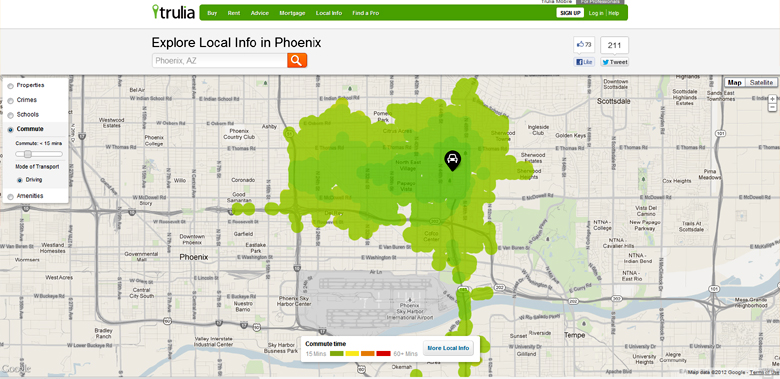
For years, we at AG have advocated for better data visualization, but more importantly, we have long advocated for more useful information in visualizations. Real estate search company, Trulia, has just launched commute maps in beta to show how far one can drive from any given point in a select number of minutes.

A commute is put in context, so that travel time to work or any regular location is well understood, which is critical given that the age old mantra of real estate is “location, location, location.” Now, that location makes sense on a map for anyone considering moving to a new neighborhood. The heat map shows commute times as a user slides the time allotment up or down.

trulia commute times

Currently, the heat maps show commute times for driving and public transit, joining the lineup of information layered onto Trulia’s local maps (currently including crime, schools, and amenities like grocery stores and restaurants).

The company says they are launching driving times in every city, but are limited to public transit data available from government data. Additionally, the driving data is derived from Open Street Maps and the public transit data is from local government transit agencies.

trulia commute times

“From a technical standpoint, nobody has been able to build what we are unveiling today. Our geo-engineering team has been focused on creating a one of a kind experience that is easy to use and super helpful for homebuyers and renters,” said Ken Shuman, company spokesperson.

“Consumers tell us time and time again that the visual tools we create is one of the things that sets us apart from the competitors. As a company we will continue to invest in these solutions and continue to deliver the best tools for consumers and the industry,” said Lee Clancy, VP of Consumer Products.

Apartment search startup blocked by Craigslist

craigslist vs. padmapper

Craigslist vs. Padmapper

Padmapper is a location-based apartment rental search engine with live filtering, syndicating listings from Oodle, ForRent.com, Apartments.com, Craigslist and other to fill their full-screen map with results that change as the map is moved. It is a popular site that was founded and is run primarily by one young entrepreneur, Eric DeMenthon.

DeMenthon wrote a blog post entitled, “Bye Bye Craigslist,” in which he said, “It’s with a heavy heart that I must announce that PadMapper is no longer including Craigslist rental listings – they’re currently being wiped from the search index. I recently received a Cease and Desist letter from Craigslist, and wasn’t able to get a meeting or convince Craigslist’s lawyer that PadMapper was beneficial to Craigslist and apartment hunters in general. They allow mobile apps to display their listings if you buy a license from them, but not websites.”

The Padmapper founder urged people to reach out to the Craigslist CEO as well as Founder, but implored his supporters to “please, please keep it civil. Perhaps if they see how many people PadMapper has helped, they’ll be willing to consider changing their minds.”

The blog post has garnered over 100 comments as of publication of this story, and responses are rolling in across the web, with many calling for Craigslist to reinstate their feed to Padmapper, even Posterous Co-Founder and YCombinator partner, Garry Tan writing an open letter to Craig Newmark, Craigslist’s founder, stating that “In a fair society, punishments like this are handed down for bad action. Padmapper has not engaged in this whatsoever. Please consider allowing Padmapper to continue to live. It is one of the top essential tools for anyone who is looking for a place to live. As a fan and user of both sites, I urge you to reconsider your decision.”

Tan, like DeMenthon asks people to reach out to Craigslist directly to urge their reconsideration. As of publication, Craigslist has not responded to our request for comment, but this story will be updated as they do.

This highlights the continued mess in real estate

Real estate is a tangled mess of data right now with rules, laws, and uses changing by the minute, but it still looks like the back of an old computer with hundreds of components plugged in, no one really agreeing on the order, or where each plug goes.

Listing syndication is tricky, and at every phase, individuals, legacy brands, and startups are interpreting the data as theirs. When a listing is entered into the MLS, an agent typically believes it is theirs, while a broker will tell you that they have the rights to the content, yet both often sign over copyright to their MLS, and then real estate syndication sites often say content syndicated to them becomes their copyright, and then you have homeowners raising their hand saying, “but it’s MY home! What about my rights?”

This Craigslist letter is likely one of many that the company sends out every month, but it is just like hundreds that are being passed around the circle described above. Craigslist is unique in that it is completely user generated content, so it is not like most listings took major investment of time or money like a MLS listing may, but even so, they are just like everyone in the circle trying to get their piece of the pie.

Craigslist wants people that use the content from their site to pay, especially when the users make money from the content, which is not a new concept, but people don’t understand yet that they are upset about this situation. The real reason it is upsetting most is because this attitude contrasts what most understand their ethos to be – just look at the Craigslist logo.

How will this end? Just like the rest of the real estate data mess – someone’s blood, sweat, and tears will be squashed, and it remains to be seen if David or Goliath will win this battle royale.

UPDATE July 9, 2012: according to the Padmapper Blog, Craigslist’s feed has been restored, but through a third party, not by Craigslist directly.

4 new smartphone photography gadgets

smartphone photography tools

Four new tools from Photojojo

Whether you’re a novice or an expert photographer, Photojojo has four new tools to turn your phone into the perfect on-the-go camera. The combination of your phone’s technology and Photojojo’s awesome tools make the ordinary pictures from your camera phone obsolete.

Why settle for anything less than amazing? In honor of making the ordinary extraordinary, here are four cellphone attachment tools that you need to get today in order to redefine how you take photos and capture memories.

1. Fisheye, Macro/Wide Angle, and Telephoto Lenses

iphone-photo-lense
Fisheye, Macro/Wide Angle, and Telephoto Lenses
: These lenses are high-clarity and high-quality glass. Instead of the foggy and sometimes fuzzy photos that grace the normal camera phone, these lenses create clear, crisp photos. They may be small, but they pack a powerful punch. You can choose to shoot a super close-up or zoomed picture or set it for wide and warp the dimensions. This attachment will fit on any camera phone, including the iPhone 4.

2. iPhone Shutter Grip

photojojo shutter handle
iPhone Shutter Grip
: This iPhone-specific attachment allows you to adjust the shutter speed, just like a SLR. It adds buttons for photo and video, and it’s placed right where a shutter button would be on any camera, making it comfortable and convenient to use. Another useful feature of the Shutter Grip is that “when you realize mid-shoot that you should really be capturing video, just press the black video record button. You can even capture stills of your video by pressing the shutter button again, mid-shoot!” Does it get any cooler than that?

3. iPhone Shutter Remote

iphone remote
iPhone Shutter Remote
: Just as it sounds, this tool gives you the control of a shutter attachment on your iPhone. You can stand up to thirty feet away and it still responds. That’s quite a distance!

This makes it a great tool for taking group portraits without having to launch yourself into the photo at the perfect moment. If you’re trying to capture a long exposure photo, using the iPhone Shutter Remote means you don’t have to risk shaken hand syndrome.

4. iPhone Scuba Suit

iphone scuba diving
iPhone Scuba Suit
: Think of the pictures you could take from under water or just near water. Now, imagine taking those pictures with your iPhone. Well, now you can. The iPhone Scuba Suit makes your phone completely water-proof. It keeps everything locked up tight and easy to use.  Now you never have to worry about ruining your iPhone from moisture, whether you’re at the beach or you’re playing in the snow.

Don’t settle for ordinary photos from your phone. Your photos don’t need to be second class, not with the four above Photojojo tools. It can take your photography business to the next level while keeping costs down. Or, you can use these tools just for fun. Either way, you’ll see a major difference, so much of a difference that you’ll never go back to an ordinary phone camera again.

Agent Success Tracker helps Realtors make more money

agent success tracker

All Realtors have goals

It is no secret that all Realtors have goals, but what those look like vary, and how they are met do as well, but what varies the most widely is how it is tracked. Some agents just say to themselves, “if I can pay my mortgage on time every month, my sales goals are met,” while others commit to their team publicly that they plan on closing a minimum of 20 sides per quarter.

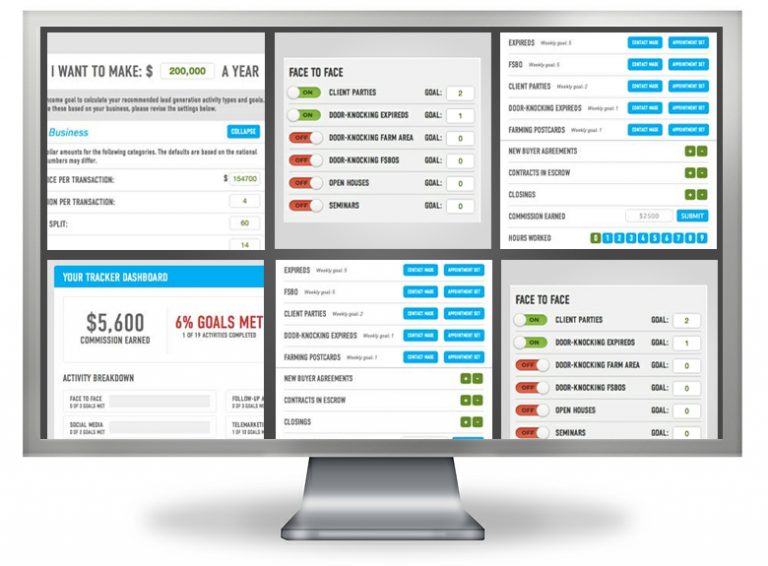
Regardless of the goal or the means to meet that goal, Curved Labs LLC has announced the launch of Agent Success Tracker, a web-based sales activity management product designed for real estate professionals to set their income goals and record their daily lead generation activity.

Keeping the tool simple

The company has sought to keep the tool simple – just enter an annual income goal, and it will automatically calculate how many contacts, appointments, agreements, contracts in escrow, and closed transactions are necessary to reach that goal. While there are task trackers in existence, the calculations specific to Realtors is sorely lacking.

Agents record their daily lead generation activity and any appointments, agreements, contracts in escrow, closed transactions, or commissions for that day and Agent Success Tracker analyzes this activity to provide feedback and insights on what the agent is doing right, what they need to do more of, and what they need to improve.

Holding yourself accountable

Jason Blackburn, CEO and Co-Founder says, “Success as a real estate agent begins and ends with your ability to hold yourself accountable. Each of us has a responsibility to produce results. We owe this to ourselves, our clients, our brokers, and our families. We cannot fulfill this responsibility without managing ourselves. No one can succeed without self-discipline, determination, initiative, and resourcefulness. You are going to need all these things and more. That is why we created AgentSuccessTracker.com: to help agents keep the commitments they have made to themselves and others. It is technology that helps you stay accountable. It is technology that helps you stay focused on what is important to your success.”

The product is a month-to-month subscription service and offers a 30-day free trial for real estate agents. The company has plans to release mobile versions by the end of the year.

Tracking and refining these methods to reach goals is a method to improve income and make more money, simply by being aware at every stage of production and making changes in real time, rather than when making new year’s resolutions.

Why your Facebook Cover Photo actually matters now

Facebook Timeline Pop-ups

Facebook adds a sneaky new feature

When Facebook turned on the new Timeline feature for all users, it asked everyone to upload a “Cover Photo” which is the large banner on top of personal profiles and Facebook Pages. People added silly pictures, or images of their city, with little thought because the Cover Photo was only visible when someone physically visited the profile or page, which is a less common activity, as most users see updates in their timeline feed rather than visiting a page directly.

This week, Facebook has changed all of that by adding a popup of a user or Page’s profile picture and Cover Photo when any user hovers over their name or profile picture while on a timeline, even if they are not following that user or Page:

Why it matters now

That picture of you drinking at a conference is fun, but is now much more highly visible, so make sure your Cover Photo is something useful, but more importantly, is something eye catching that shows at a glance who you are when someone hovers over your name or face, especially if accidental.

Punchy, colorful images are a good idea for Cover Photos, but remember, Facebook has extremely rigorous rules that you must follow with Cover Photos, that if disobeyed could result in permanent page deletion without warning (see the related reading below). Additionally, the templates that allow you to creatively position your profile to fit in cleverly with your Cover Page do not convey in the new pop up, but remain as a working feature for the full sized Cover Photo on a profile or Page.

Get creative, think of using a large, oversized image that catches the eye at a glance, and remember that your Cover Photo and profile now pop up, even for people you are not friends with, in the event you have been mentioned or commented on anothers’ timeline.

Related critical reading:

Can social media big data predict Romney’s VP pick?

Polygraph big data mining

Big data making predictions

AG introduced you to Polygraph Media in April, showing you how the big data company mines Facebook pages for stats on you and your competitors, and it has gotten rave reviews.

The company’s entire business is focused on social data mining and says, “Data is great and all, but what good is data if you can’t make decisions with it?” With this question, they were inspired to put their tools and reports to work, and have analyzed performance, engagement, and sentiment on Facebook of the top eight potential Republican Vice President candidates.

They call it “Vice President Survivor” which they believe is accurate given the history of social media’s predictive powers, citing a 2010 study that accurately predicted Harry Reid’s victory based on Twitter data, and social data used to predict Boris Boris Johnson’s victory in the London mayoral race this month, and even Facebook has pointed out correlations in the data following the 2010 US mid-term election, noting that candidates with more fans won Congressional races 74 percent of the time and Senate races 81 percent of the time.

Facebook, “an accurate barometer of American preferences”

Marco Rubio netted out as the best candidate for Romney running mate, across many different metrics and factors. Polygraph says that “With an estimated 150+ million Americans on Facebook (true, in the 13 and older category, versus 18 and older), Facebook should be a powerful tool for political candidates, if not an accurate barometer of American preferences.”

“We know the selection process for the Vice President candidate is extremely intense. Every political, social, and personal decision of a candidate is unearthed and analyzed by teams of Washington insiders,” said Polygraph founder, Chris Treadaway, who is also the author of Facebook Marketing: An Hour A Day. “Beyond the mountains of filings and records, business deals and personal issues, today we have another entire data set to analyze: Facebook data.”

“All potential running mates have been using Facebook avidly as a voice for their political brand and a place to communicate with their supporters. This highly visible, deep interaction between politicians and those they represent provides us with tons of data ripe for mining. Each interaction (like, post, comment, etc.) is a discrete data point that might have more to tell regarding this Vice Presidential selection process than what many may realize,” added Treadaway. “Can recent activity on Facebook help the Romney campaign identify the right and best running mate? This is just what Polygraph Media does for our clients every day so we took a look at what Facebook data would reveal.”

Polygraph Media says they believe deeply in the immense value of data in Facebook and built its business around finding easy, affordable ways for brands – or candidates – to access and assess that information.

VP Survivor Results:

A deeper look at the VP Survivor Study

To read more about how the company came to the above conclusions, read the announcement or watch the video below:
[ba-youtubeflex videoid=”KmGcYx9yuuE”]

Top 5 challenges of being a female leader

challenges of being a female leader

Leadership shifting, still in flux

The days of companies being led only by men contrasted by exclusively women sitting behind the receptionist desk are over, but that setup is still the norm, presenting challenges not only to women in leadership roles, or those looking to climb the ladder, but for companies looking to modernize and shed the antiquated idea that a CEO can’t wear heels.

Some are not aware of the continuing challenges to female leaders. Some challenges are subtle, and others are overt attitudes that make no excuses. Some women leaders never meet any resistance and do not believe any challenges are unique to women that men are not also challenged by, while others see a distinct difference between the challenges each sex is met with as they become leaders.

A top female leader weighs in

Deborah Sweeney is the CEO of MyCorporation, where any entrepreneur can access online document filing services to start, maintain, and protect their business without spending a fortune. Sweeney is an ambitious leader who earned her BA in Criminology, Law and Society & Psychology and Social Behavior, then went on to earn her JD from Pepperdine University School of Law, and her MBA from the George L. Graziadio School of Business and Management at Pepperdine University.

She has been named a Top 40 under 40 by the Business Journal, and a Top Ten Women-Owned Business in the San Fernando Valley. She is no stranger to the challenges of leadership, particularly in the male-dominated law and technology sectors she has spent her career focused on.

According to Sweeney, below are the top five challenges women leaders face:

  1. Men. Leaders tend to be male. Women leaders often have a difficult time finding mentors who are in a similar circumstance. I found WPO (Women President’s Organization), which has been wonderful in helping me connect with other women business leaders.
  2. Balance. It is hard to balance everything. Female leaders, especially if they are moms, have a lot on their plate. Keeping it all together at the business and at home can be a challenge.
  3. Staying healthy. It is very hard to get sick when you’re a leader. Finding the time to eat right and exercise is critically important.
  4. Time. Finding the time to get everything done can be a challenge. I find keeping a list to keep me on task helps to ensure that I get things done in a timely fashion and can get right back on task when things come up that take me off task.
  5. Business growth. Many women find it difficult to reach that $1m in revenue mark. I imagine a lot has to do with the four other challenges above. Many times business growth also depends on financing and business relationships. These endeavors may be secondary for women, hence business growth tends to be a challenge for women.

About MyCorporation: a leading provider of online document filing services for clients who wish to form a corporation or limited liability company. For nearly ten years, MyCorporation has helped small business clients and real estate investors incorporate their businesses in a reliable and affordable manner. In addition to offering document filing services for online incorporation, MyCorporation also offers trademark searches and applications, copyright registrations, DBA registrations, registered agent services and many more products that help customers protect and maintain the legitimacy of their businesses.

NAHB: student loan debt linked to housing slump

College Debt and Housing

NAHB finds a link between student loans and housing

New analysis of government data by the National Association of Home Builders1 (NAHB) reveals a connection between rising student loan debt and the onset of the housing slump, and the Association says the data “offers yet another example of how lower home values have hurt millions of middle class households and threatens the fragile economic recovery.”

“The rising student loan debt problem is another consequence of the housing downturn,” said NAHB Chairman Barry Rutenberg, a home builder from Gainesville, FL. “As more and more parents face tighter budget restraints as a result of lower home values, this is forcing an increasing number of students to take out loans for tuition, essentially shifting some of the burden of paying for college from parents to students.”

“An urgent wake-up call for policymakers”

The link between rising student loan debt and the start of the housing crisis comes on the heels of a recent report from the Federal Reserve showing that U.S. household wealth plunged nearly 40 percent from 2007 to 2010 as a result of declining home values.

“Together, these findings should serve as an urgent wake-up call for policymakers to do their part to ensure a full-fledged housing recovery moves forward to restore the balance sheets of tens of millions of home owning families, create jobs and spur economic growth,” said Rutenberg.

NAHB calls on political leaders

The NAHB says that “to get housing back on track and provide the foundation for a long-lasting economic recovery, Rutenberg called on leaders in Washington to provide access to mortgage credit for qualified borrowers; demonstrate their support for the mortgage interest deduction; support affordable downpayments for home buyers; enact reforms in appraisal practices and oversight to ensure that appraisals accurately reflect true market values; and establish a strong housing finance system that retains a federal backstop to ensure that standard 30-year fixed-rate loans and adjustable rate mortgages remain readily available for working class households.”

“Young Americans need to have the ability to pay for college in order to prepare for the jobs of the future,” said Rutenberg. “Homeownership has historically generated a thriving middle class by creating wealth and helping families to cover higher education costs. Hard-working American families and the economy will continue to struggle until we get housing back on track.”

1 NAHB study

Lessons from Readability’s nixing of fees

Business experiments on the rise

Within the last few years, businesses have increased their experimentation with fees and product presentation. Some have added fees and some have taken those fees away. We all remember the backlash Netflix received when they upped their fees, separated their services, and tried to place a service that was once a part of a package deal under a new company name.

They withdrew the latter very quickly, but kept the other two changes. And they lost a lot of business as a result. While change and admittance of supposed error is good, it’s better when it happens naturally and honestly rather than as a last resort or to save face.

Example: Readability’s fees

Take Readability, for example. They introduced a fee-based service that was ultimately meant to reward and pay the owners of the content that they used. However, it just left them with a lot of unclaimed money because a limited number of content owners actually signed up to receive payment. As a result, Readability decided to forego their fee scale for now, at least until they can decide what changes could make their business model successful. They made a public announcement detailing what they were trying to achieve, what happened, what went wrong, and how they’re going to fix it.

Whether or not you agree with the service they provide and no matter how you feel about the legalities and the ethics of how they take content from businesses and take out all of the ads – which is how many websites make money – one principle can be learned: honesty is imperative to positive change.

Readability tried something new and it didn’t work. Instead of covering it up with cliché excuses, they were upfront and transparent. And that’s commendable. They opened themselves up to backlash and angry comments. But they also opened themselves up to customer loyalty and consumer and professional respect.

The takeaway

So, what can you take away from Readability’s recent announcement and experimentation? As a business professional, you know it’s important to have the trust and respect of your target audience and your contemporaries. Without that trust, you’ll never succeed.  Consumers need to feel comfortable with you, your brand, your services, and your company’s reputation. The more they can trust you, the more loyal they’ll be.  Be clear, blatantly honest, and professional, just like Readability, and you will see the positive effects.

Young entrepreneur helps sports champs master the stage

Promentum Group Dallas

Inspiring career path of a driven entrepreneur

Do you remember in high school there was that one guy or gal who knew what they wanted to do with their life? They wanted to be a vet and dedicated themselves very early to it, joining every club possible to make it happen, and now own a massively successful chain of clinics? Most people go to school when they’re young, and even during college to simply get out, and a career or passion is often lost until well into one’s twenties.

Not Curt Steinhorst. Steinhorst knew very early on that he wanted to be in sports and communications, and has worked tirelessly to combine the two. He chuckles as he confesses he was not built like an athlete, rather was small and slower than the top athletes, so he focused on the communications portion and forged on as a die hard sports fanatic rather than participant. He went on to become the President of his class at Texas A&M University, further refining his communications career.

Major flaws in the speaker bureau model

[ba-pullquote align=”right”]Steinhorst realized that most speakers were not booked based on the quality of their speaking, and that most lacked basic skills that he says could have been taught to them in just one day.[/ba-pullquote]After college, Steinhorst went on to work for the largest speaker bureau in Texas as an agent booking speakers, but realized most speakers were not booked based on the quality of their speaking, and that most lacked basic skills that he says could have been taught to them in just one day. He learned the market, and found the other major flaw was that the speaker bureau model was based on an era before the internet, before conferences and companies could simply contact a speaker directly.

As the market crashed and Steinhorst saw a massive gap between speakers being booked and events getting quality speakers, he founded Promentum Group, a firm that works with a small number of highly accomplished speaker consultants, speechwriters, and speaker management specialists who collectively have worked in virtually every facet of the speaking industry: from talent management and speaker representation to speech coaching, speechwriting, and even keynote speaking. The company is so much more than a speaker’s bureau that acts as a matchmaker, they write speeches, train speakers, and coach them along the way to make sure they give the best presentation possible.

The company’s focus is currently on Steinhorst’s passion: sports, which he is fluent in and enthusiastic about. Besides his affinity for sports, Steinhorst says that athlete speakers represent the largest gap between quality and compensation, with many athletes booked to speak that lack basic skills and offer little content of relevance. He saw the major need for communications support, so the company has launched an independent division devoted to education of speakers.

A company filled to the brim with talent

[ba-pullquote align=”right”]Steinhorst chooses to surround himself with extremely intelligent and accomplished people like Zig Ziglar’s righ-hand man, a Bush speech writer, and a famous life coach.[/ba-pullquote]While many entrepreneurs believe they are the sole expert in their field, Steinhorst chooses to surround himself with extremely intelligent and accomplished people like team members Erin Vargo, a Standford graduate who was a speech writer for President Bush, Bryan Flanagan, who was Zig Ziglar’s long time right-hand man, Bill Biggs, who has a Master’s in Psychology and spent over a decade as a pastor and life coach, mentoring college students, and even former Philadelphia Eagles veteran, Ken Reeves contributes his talent.

Not shy about his ambitions, Steinhorst says his long term goal is to be the world leader in speaker management, as they will ultimately expand beyond just sports to politicians and other public speaking roles.

Home prices up for third month, hitting 2004 levels

home prices fhfa

Home prices rise, says FHFA

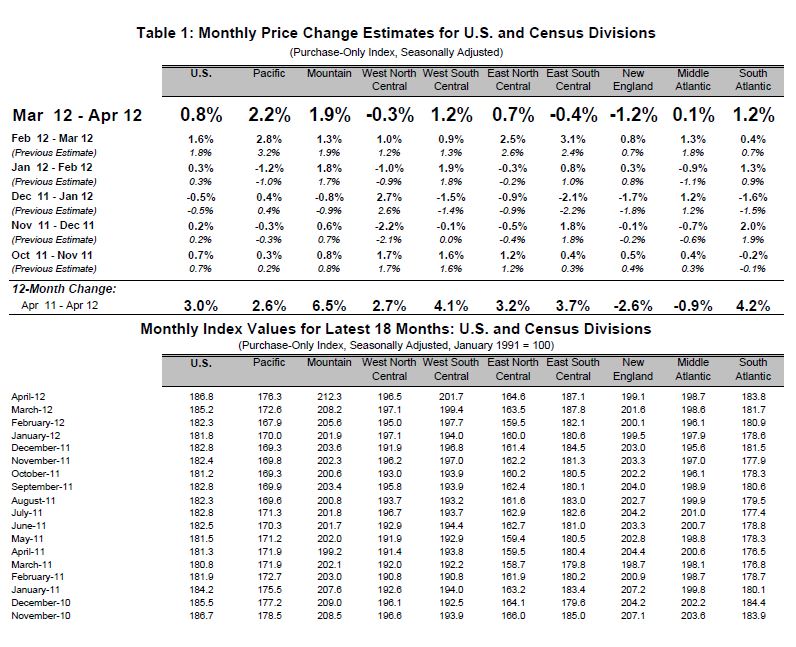
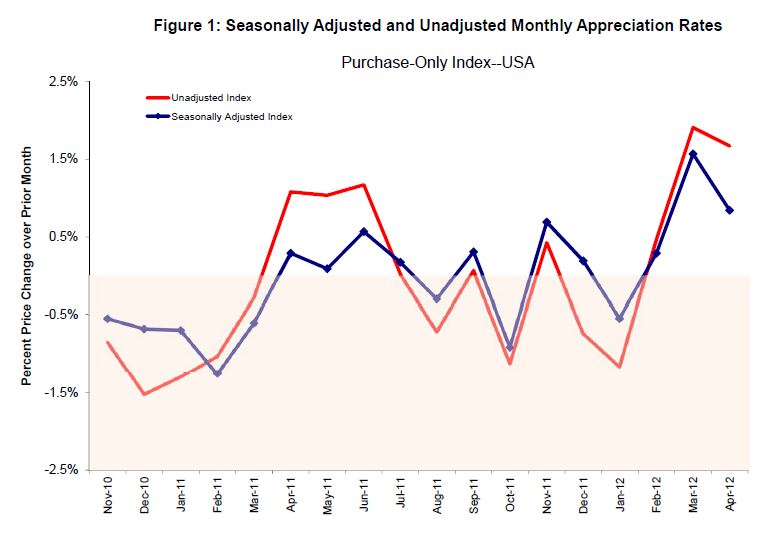
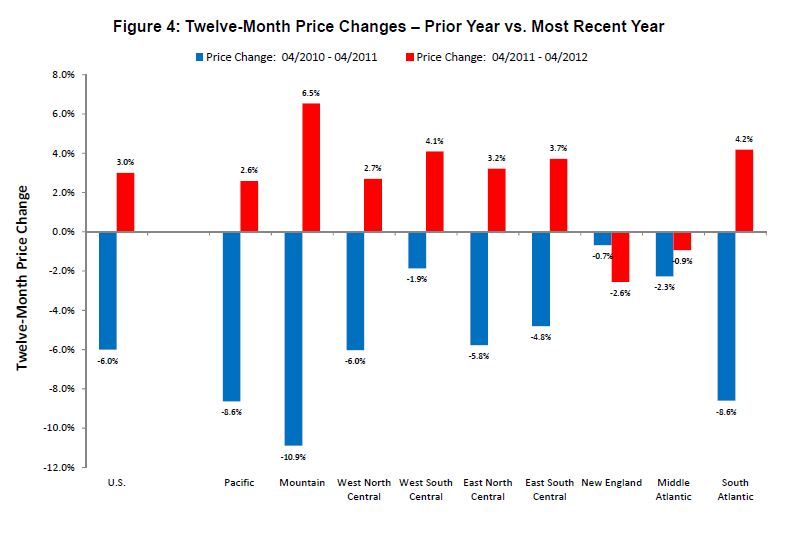
According to the Federal Housing Finance Agency’s (FHFA’s) monthly House Price Index (HPI), home prices rose 0.8 percent between March and April, on a seasonally adjusted basis. Previously, the FHFA had reported a 1.8 percent price increase in March, which has been revised to a 1.6 percent increase. Over the last year, home prices have risen 3.0 percent, the Agency reports.

The results were better than what was forecasted, as economists surveyed by Dow Jones Newswires had only expected a 0.4 percent monthly increase.

Prices, sales, and inventory levels

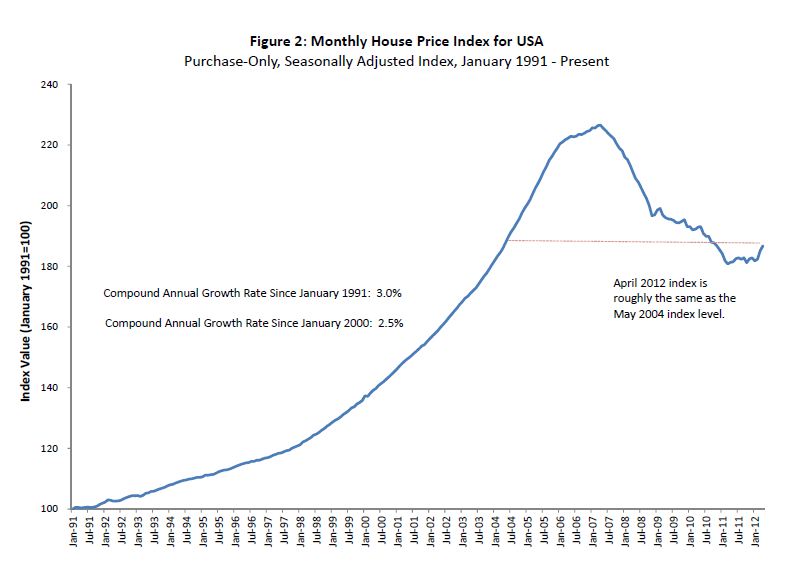
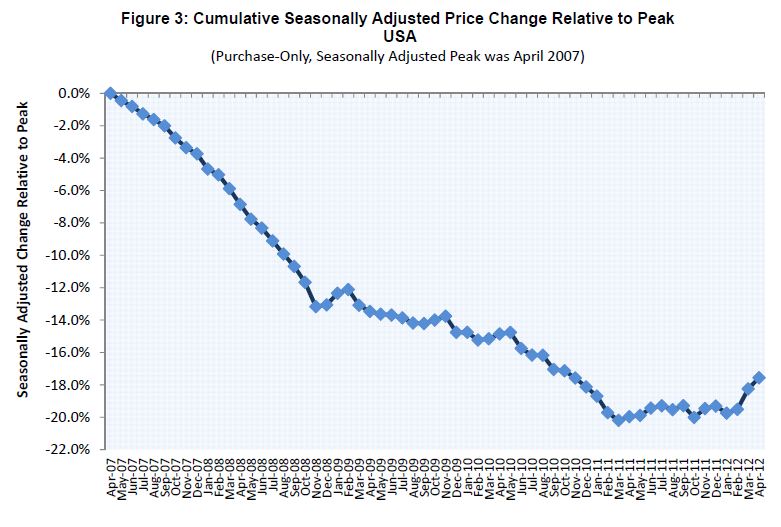
The U.S. index is down 17.6 percent from its April 2007 peak and is now roughly the same as the April 2004 index level. Today, the National Association of Realtors reported that in May, home prices rose, and sales are slowed slightly by tight supply levels.

According to Freddie Mac, the national average commitment rate for a 30-year, conventional, fixed-rate mortgage declined to a record low 3.80 percent in May from 3.91 percent in April; the rate was 4.64 percent in May 2011; recordkeeping began in 1971.

Meanwhile, banks are looking to alternatives to foreclosures that continue to punish home values, as seen in the reduced number of seizures, falling 18 percent between May 2011 and May 2012, according to RealtyTrac.

Call it a comeback?

Speaking to May’s data (one month ahead of FHFA data), the National Association of Realtors’ Chief Economist, Dr. Lawrence Yun said, “The recovery is occurring despite excessively tight credit conditions and higher downpayment requirements, which are negating the impact of record high affordability conditions.”

The FHFA monthly index is calculated using purchase prices of houses backing mortgages that have been sold to or guaranteed by Fannie Mae or Freddie Mac. For the nine census divisions, seasonally adjusted monthly price changes from March to April ranged from -1.2 percent in the New England division to +2.2 percent in the Pacific division.

fhfa housing data
fhfa housing data
fhfa housing data
fhfa housing data
fhfa housing data

Home prices rise, sales constrained as supply remains tight

Inventory said to be holding back sales

According to the National Association of Realtors (NAR), there is a really good news, really bad news scenario regarding existing home sales (completed transactions) for May – existing home sales declined 1.5 percent for the month, but NAR points to tight inventory levels holding back closings. The trade association reports that sales maintained a strong lead (up 9.6 percent) over May 2011 levels, adding that home prices are on a “sustained uptrend in all regions.”

Dr. Lawrence Yun, NAR chief economist, said inventory shortages in certain areas have been building all year. “The slight pullback in monthly home sales is more likely due to supply constraints rather than softening demand. The normal seasonal upturn in inventory did not occur this spring,” he said.

“Even with the monthly decline,” Dr. Yun added, “home sales have moved markedly higher with 11 consecutive months of gains over the same month a year earlier.”

The inventory slide and housing’s recovery

NAR reports that total housing inventory at the end of May slipped 0.4 percent to a 6.6 month supply at the current sales pace, while listed inventory is 20.4 percent below a year ago when there was a 9.1 month supply. Unsold inventory has trended down from a record 4.04 million in July 2007, and supplies reached a cyclical peak of 12.1 months in July 2010.

Dr. Yun interprets the data to mean that “The recovery is occurring despite excessively tight credit conditions and higher downpayment requirements, which are negating the impact of record high affordability conditions.”

Low mortgage rates, rising home prices

According to Freddie Mac, the national average commitment rate for a 30-year, conventional, fixed-rate mortgage declined to a record low 3.80 percent in May from 3.91 percent in April; the rate was 4.64 percent in May 2011; recordkeeping began in 1971.

The national median existing-home price for all housing types rose 7.9 percent to $182,600 in May from a year ago, the third consecutive month of year over year price gains. The NAR reports that the last time there were three back-to-back price increases from the same month a year earlier was from March to May of 2006.

“Some of the price gain results from a shrinking share distressed homes in the sales mix,” Dr. Yun explained. Distressed homes accounted for one in four sales in May (15 percent foreclosures, 10 percent short sales), down 3.0 percent for the month, and 6.0 percent for the year. Foreclosures sold for an average discount of 19 percent below market value in May, while short sales were discounted an average of 14 percent.

Prices up, but sales are slipping

First-time buyers accounted for 34 percent of purchasers in May, down 1.0 percent for the month and 2.0 percent for the year. All-cash sales fell 1.0 percent for the month to 28 percent, down 2.0 percent for the year.

Single-family home sales slipped 1.0 percent for the month, but are 10.4 percent May 2011 with the new median existing single-family home price hitting $182,900 in May, up 7.7 percent from a year ago.

Existing condominium and co-op sales fell 5.7 percent in April, but are 4.2 percent higher than one year ago. The median existing condo price was $180,000 in May, fully 8.8 percent above May 2011.

NAR reports that investors, who account for the majority of cash transactions purchased 17 percent of homes in May, down from 20 percent in April and 19 percent in May 2011. “These figures reflect a modest increase in traditional repeat home buyers in May,” Dr. Yun said.

Regional performances varied

NAR is reporting widespread inventory shortages in lower price ranges across all regions except the Northeast, adding that the West has tight supply in all price ranges except for the top price points. “Realtors® in Western states have been calling for an expedited process to get additional foreclosed properties onto the market because they have more buyers than available property,” Dr. Yun added.

Existing-home sales in the Northeast fell 4.8 percent to an annual level of 590,000 in May but are 7.3 percent higher than May 2011. The median price in the Northeast was $250,700, up 3.8 percent from a year ago.

Existing-home sales in the Midwest rose 1.0 percent in May to a pace of 1.04 million and are 19.5 percent above a year ago. The median price in the Midwest was $147,700, up 6.4 percent from May 2011.

In the South, existing-home sales slipped 0.6 percent to an annual level of 1.78 million in May but are 9.2 percent higher May 2011. The median price in the South was $159,700, up 7.8 percent from a year ago.

Existing-home sales in the West declined 3.4 percent to an annual pace of 1.14 million in May but are 3.6 percent above a year ago. The median price in the West was $233,900, up 13.4 percent from May 2011.

[ba-pdfviewer pdfurl=”https://theamericangenius.com/wp-content/uploads/2012/06/RELSF.pdf” width=”100%” height=”600px”]

Meet less, do more: eliminating pre-meetings at work

meet less, do more

Meet less, do more

Productivity is an important factor of any successful business. And one way to make sure everyone is productive and on the same page is to hold consistent meetings. Some more enthusiastic professionals have taken the traditional meeting one step further by holding pre-meetings. Just as the name suggests, pre-meetings are meetings held before the actual meeting, just to plan agendas and topics of discussion and to make sure everyone agrees before the start of the regularly planned meeting. Some may think that it will make everyone more productive; it’s actually quite the opposite. Pre-meetings are ultimately a waste of time.

Everything that is discussed in a pre-meeting should be saved for the actual meeting. Planning what will be discussed at the meeting can be done on an individual level rather than meeting an additional time to plan. If you need to discuss a few agenda items before the meeting, you can meet one-on-one with the relevant person, just so every essential item is covered by a representing manager.

Two leaders as examples

So, cut out pre-meetings and focus on making your real meetings more productive and on-point. The best two things you can do are to experiment with different methods and use brilliant entrepreneurs as examples. Take Steve Jobs, for instance. He believed that meetings should be brief and should only involve those absolutely necessary. He cut out anyone that wasn’t essential to the process. This kept all his company meetings intimate, basic, and fruitful. Steve Jobs understood that the longer the meeting didn’t mean increased productivity. He understood that just the opposite was true. Keep your meetings brief and focused and then let everyone get back to work.

Another example is Donald Trump. He’s known for being brutal and completely business-minded. He said, “If you’re honest, you should know the questions that should be asked, as well as the answers.” Use that mindset as you prepare for the meetings and throughout your company’s meetings. Be honest and be verbal. That’s the only way to make any real professional progress.

There needs to be less meeting together and more doing what needs to be done. Meet regularly, but keep your meetings concise and full of rich content. Cancel all of your pre-meetings and use that time to move your business to the next level. Your time is valuable. And so are your meetings.


Feel free to steal this image we created and use as your desktop wallpaper as a reminder of where your focus should be.

Housing recovery optimism outpacing market reality

Trulia’s American Dream Survey

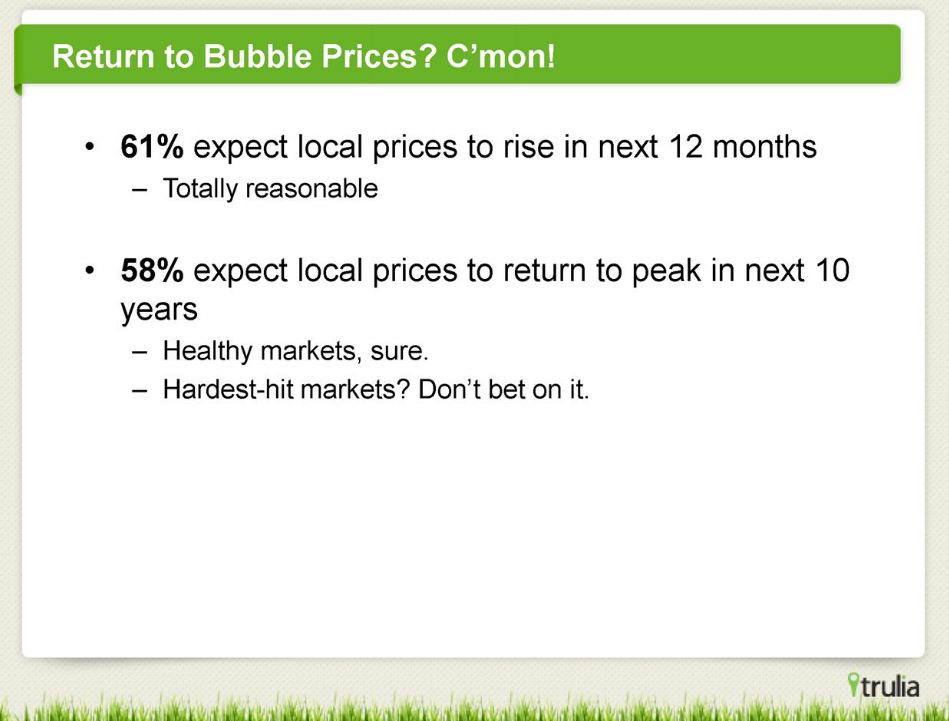
Trulia released the results of its American Dream Survey Wednesday, tracking American attitudes toward homeownership since 2008, revealing that 58 percent of Americans think prices will return to their peak within 10 years, 78 percent of renters plan to buy someday, and interest in supersized homes (3,200+ sf) nearly doubled in the last year.

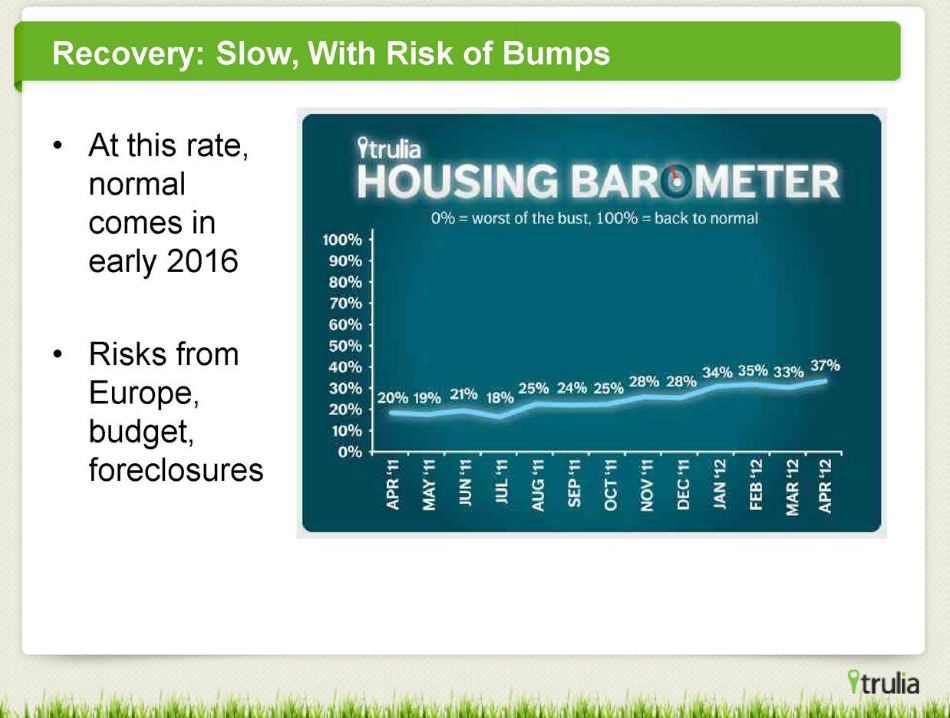
Trulia’s Chief Economist, Dr. Jed Kolko projects that at its current pace of recovery, the housing market will be back to pre-recession normal by 2016, as will the turnaround rate for renters waiting to become homeowners.

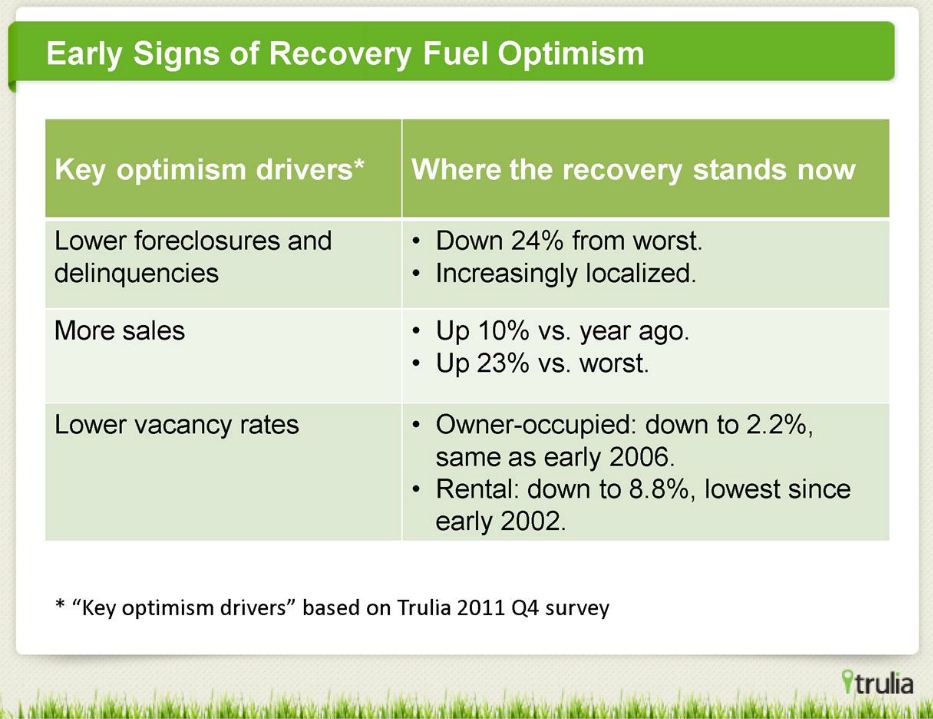
Despite recent reports that the recession cut Americans’ net worth in half, Dr. Kolko reports that there is renewed optimism “for a good reason,” even if there are unrealistic price expectations in the market, particularly in the hardest hit areas. The top three key optimism drivers for consumers are lower foreclosures and delinquencies (which have dropped 24 percent from its worst point during the recession), increased sales (up 10 percent in the last year), and lower vacancy rates (rental vacancies have hit ten year low).

“Optimism is essential for housing recovery,” said Dr. Kolko, “but too much optimism could lead to next bubble. Right now, optimism is outpacing the reality of what is on the market.”

Optimism outpacing the market realities

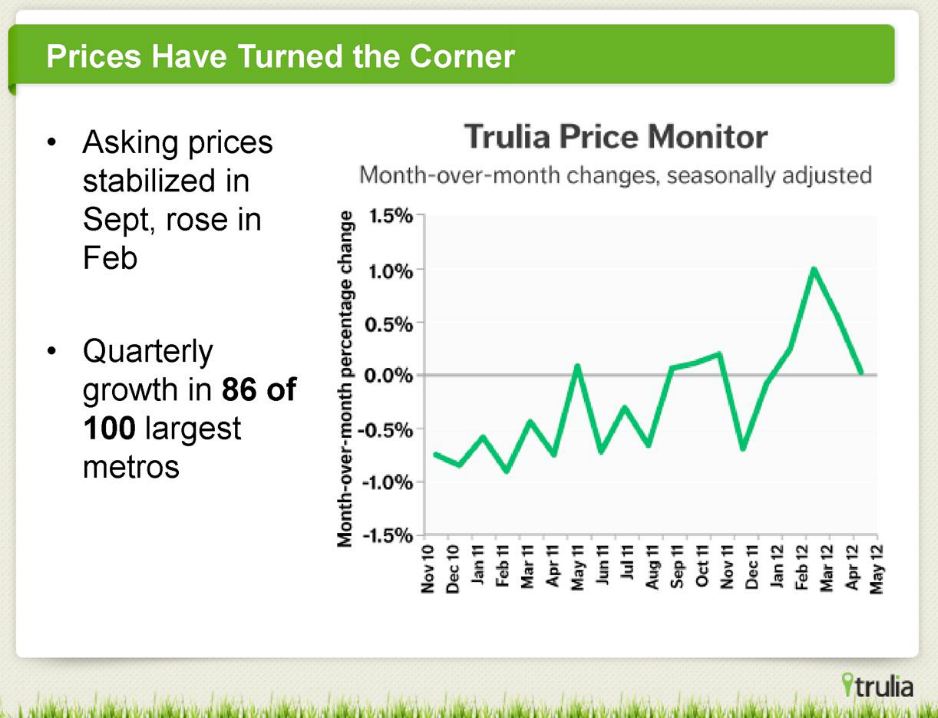
Trulia reports that sales prices of homes on their site have risen quarter over quarter in 86 of the 100 largest U.S. metros as of May, and cites that 61 percent of Americans believe home prices in their local market will rise in the next year.

“American’s hope for a real estate market bounce-back may be too high,” the company reports. “Even though prices in many markets reached unprecedented and unsustainable levels during the boom, 58 percent of Americans believe home prices in their local markets will return to their previous high in the next 10 years.”

Supersize me

During the recession, Americans got quite realistic about what their next home looked like, and as housing shows signs of improvement, even though slight, the affinity for big homes is on the rise.

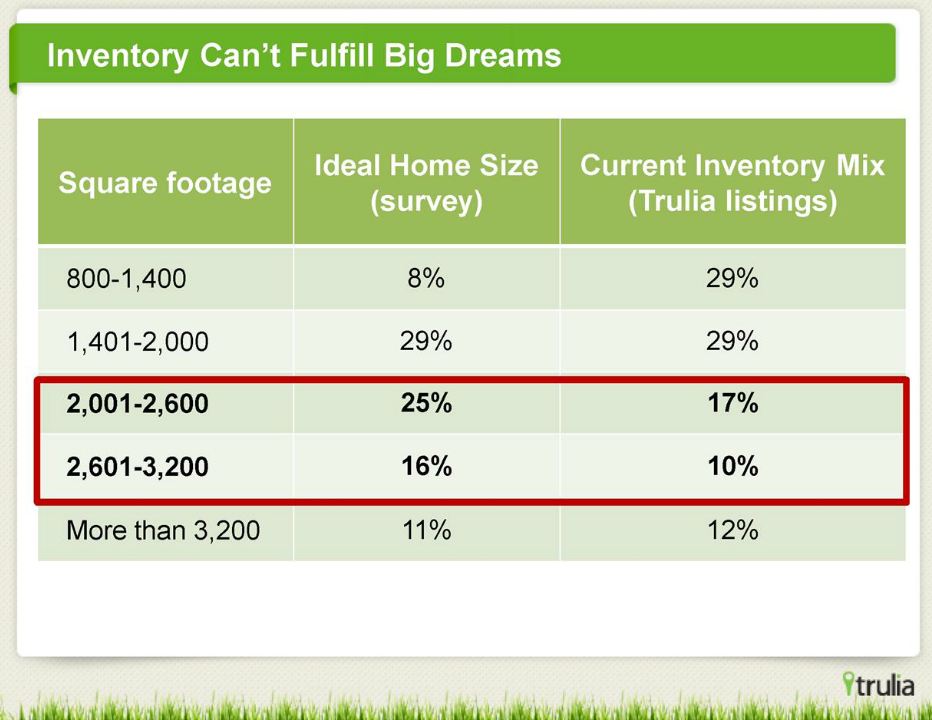
According to the survey, more than one in four Americans who believe home ownership is part of achieving their personal American Dream said that their ideal home size is over 2,600 square feet – up from 17 percent in 2011. In fact, interest in homes of more than 3,200 square feet nearly doubled in the last year from 6 percent in 2011 to 11 percent in 2012.

Dr. Kolko noted that “developers are on top of this trend and are responding” by increasing the size once again of new homes being built. We have not seen a dramatic increase in the size of homes built this year, but Dr. Kolko points out that builders are shifting their plans.

Starter home reality check

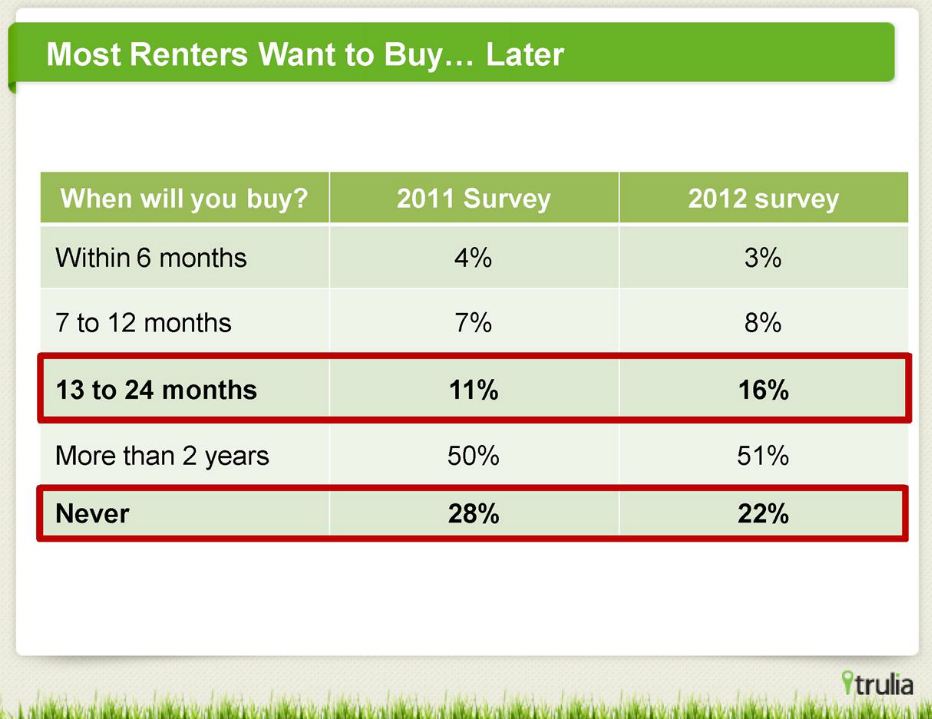
Homeownership remains central to the American Dream. Fully 72 percent said owning a home is part of achieving their personal American Dream, and the number of renters saying they’ll never buy a home has fallen.

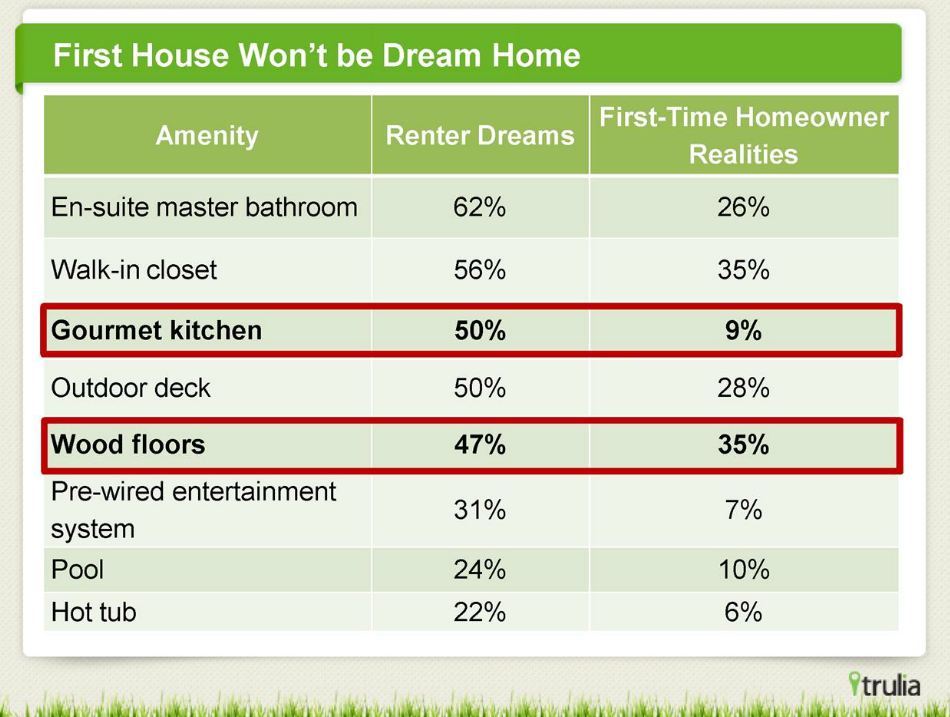
This take us back to unrealistic optimism, as future homeowners were asked what would make them fall in love with a home if they were in the market for a home today. The top amenities were a master bathroom (62 percent), walk-in closet (56 percent) and gourmet kitchen (50 percent), but only 26 percent of homeowners said that they had an en-suite master bathroom in their first home, while just 35 percent had a walk-in closet and 9 percent had a gourmet kitchen.

It is our assertion that these expectations could be set not only by optimism about housing, but with the improving multifamily units coming online, as renters in many markets are getting used to luxury amenities, and wishing for them in their first home. Additionally, overall optimism is naturally fueled by the bargains being found in short sales and foreclosures, setting consumers’ expectations high that they too will get a good deal, then wait out the recovery to gain equity.

Returning to normal by 2016?

“As the economy recovers, people are dreaming bigger, but most won’t realize their dreams anytime soon,” said Dr. Kolko. “Few homebuyers – and even fewer first-timers – can afford 3,000 square feet and a gourmet kitchen. Buyers need to take a hard look at what they can actually afford, and give themselves some cushion in case a Euro crisis or federal budget battle pushes us back into recession.”

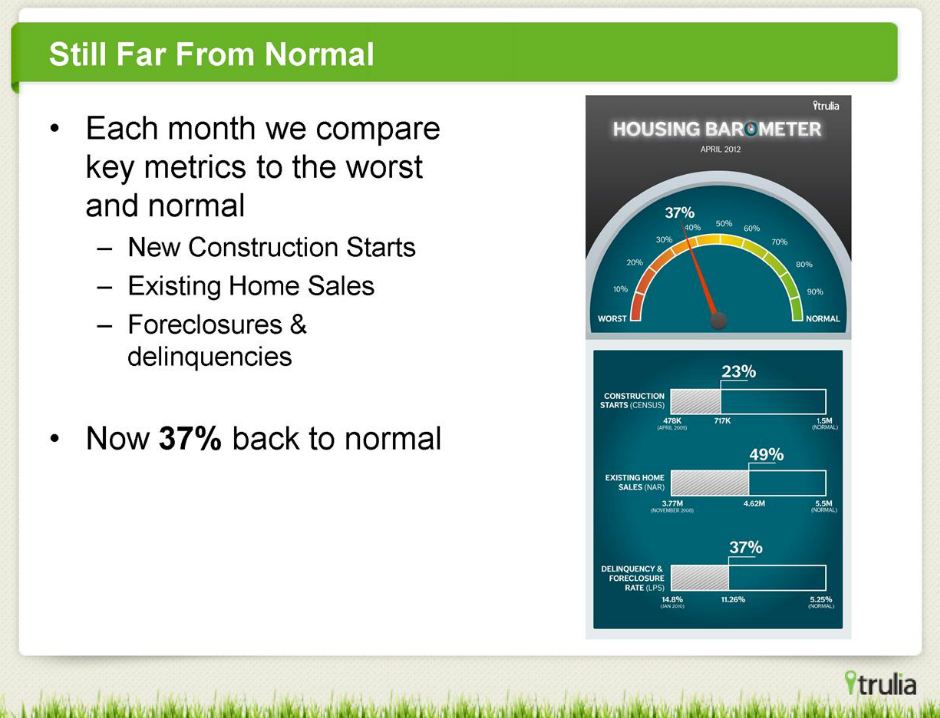
Trulia reports that a year ago, housing was at 20 percent of its normal, pre-recession rate, which has risen to 37 percent this year. At the current pace, Trulia predicts a housing recovery, or a return to “normal” to be achieved by 2016, but cautions that the hardest hit cities like Las Vegas may not match the national norms.

Additionally, 78 percent of renters plan to buy someday, but when exactly is “someday” for them? New data from Freddie Mac reveals that 1.5 million households moved to rental units in the last year, and as rents rise, vacancies continue to drop, so how will the market recover as we become a renter nation?

Dr. Kolko tells AGBeat, “Credit is still tight and rising rents are hurting renters’ ability to save for a down payment. Recovery is several years away, and the turnaround rate [for renters to become homeowners] is closer to 2016 as well.”

American Dream Survey

Below are some of the key findings of Trulia’s American Dream Survey:
housing optimism
housing stabilization
home sizes increasing
disparity
dream home amenities
buying expectations
home prices rising
housing recovery
housing recovery outlook

About the survey: Harris Interactive conducted this online survey on behalf of Trulia among 2,205 U.S. adults, age 18 and over, between May 22 – 24 and among 2,230 U.S. adults, age 18 and older, between June 4-6, 2012.

Freddie Mac forecasts increasingly hot rental market

Rental market activity data

According to Freddie Mac’s U.S. Economic and Housing Market Outlook for June, the residential rental market is on fire, and is expected to continue heating up as homeownership continues to be postponed by many Americans.

“Further increases in rental demand are likely in the coming year as newly formed households postpone homeownership decisions until the economy strengthens and they have accumulated sufficient savings,” said Frank Nothaft, vice president and chief economist of Freddie Mac. “Overall apartment market trends may show further vacancy declines and rent gains, with property values improving as well.”

Freddie reports that from March 2011 to March 2012, the rental market saw a 4.0 percent increase in occupancy, with an additional 1.5 million households moving into rental units.

Vacancies down, rents up

Rental vacancy rates have dropped roughly two percentage points over the past two years, the report notes, and while nominal rents rose two to four percent during the year ending March 2012, average rent on an inflation-adjusted basis remained below where it had been for much of the decade prior to the Great Recession. Some cities have seen rents spike up to 30 percent recently, and it is nearly unanimous that rents will continue rising across the board.

The report says, “Multifamily property values are up on average about 25 percent during the past two years from their trough during the first quarter of 2010, according to the National Council of Real Estate Investment Fiduciaries index, but still about 14 percent below their peak prior to the Great Recession.”

Freddie notes that starts of buildings with at least five apartments have jumped 48 percent in the first five months of this year when compared to the same period a year ago. The National Association of Home Builders data released yesterday reveals volatility in the multifamily sector as completions fell 25 percent between April and May alone.

Regardless of inventory levels, starts, permits, or completions, Freddie is forecasting higher rents and lower vacancies as more families postpone homeownership.

Full report:
[ba-pdfviewer pdfurl=”https://theamericangenius.com/wp-content/uploads/2012/06/Jun_2012_public_outlook.pdf” width=”100%” height=”800px”]

Mortgage application volume stagnates, purchases fall

Mortgage application volume data

According to data from the Mortgage Bankers Association’s (MBA) Weekly Mortgage Applications Survey for the week ending June 15, 2012, mortgage applications decreased 0.8 percent from one week earlier.

The Market Composite Index (MCI) measures mortgage loan application volume, which fell 0.8 percent on a seasonally adjusted basis from one week earlier, while on an unadjusted basis, the MCI decreased more than 1.0 percent. The Refinance Index increased 1.0 percent from the previous week and the seasonally adjusted Purchase Index fell 9.0 percent from one week earlier, falling 2.0 percent lower than the same week one year ago.

“Refinance volume increased again last week, but the composition of activity changed markedly. Despite rates remaining near all-time lows, conventional refinance application volume declined, and the HARP share of refinance activity dropped to 20 percent,” said Michael Fratantoni, MBA’s Vice President of Research and Economics.

Fratantoni continued, “On the other hand, FHA refinance volume exploded to an all-time high, more than doubling over the week. New, lower FHA premiums on streamlined refinance loans came fully into effect, and borrowers seized the opportunity to lower their mortgage rates without increasing their FHA premiums. Purchase activity fell off last week, but this is likely only a recalibration following the Memorial Day holiday, as the level of activity remains within the narrow band seen for the past 3 years.”

The refinance share of mortgage activity increased to 81 percent of total applications from 79 percent the previous week, and the adjustable-rate mortgage (ARM) share of activity decreased to 4.0 percent of total applications.

In May, the investor share of applications for home purchase was at 6.0 percent, unchanged from the previous month, even though regions including East South Central and South Atlantic increased by 0.5 percent.

According to the MBA:

  • The average contract interest rate for 30-year fixed-rate mortgages with conforming loan balances ($417,500 or less) decreased to 3.87 percent, matching the lowest rate in the history of the survey, from 3.88 percent, with points increasing to 0.49 from 0.43 (including the origination fee) for 80 percent loan-to-value ratio (LTV) loans. The effective rate increased from last week.
  • The average contract interest rate for 30-year fixed-rate mortgages with jumbo loan balances (greater than $417,500) decreased to 4.06 percent, the lowest rate in the history of the survey, from 4.12 percent, with points decreasing to 0.38 from 0.41 (including the origination fee) for 80 percent LTV loans. The effective rate decreased from last week.
  • The average contract interest rate for 30-year fixed-rate mortgages backed by the FHA increased to 3.72 percent from 3.71 percent, with points decreasing to 0.47 from 0.59 (including the origination fee) for 80 percent LTV loans. The effective rate decreased from last week.
  • The average contract interest rate for 15-year fixed-rate mortgages increased to 3.25 percent from 3.23 percent, with points decreasing to 0.45 from 0.48 (including the origination fee) for 80 percent LTV loans. The effective rate increased from last week.
  • The average contract interest rate for 5/1 ARMs decreased to 2.75 percent, the lowest rate in the history of the survey, from 2.78 percent, with points decreasing to 0.33 from 0.49 (including the origination fee) for 80 percent LTV loans. The effective rate decreased from last week.

MLS blooper marathon: proof or goof

picking a winner
Just when you think you’ve seen ’em all, a new batch of  MLS and real estate advertising bloopers pops up. This group had me in tears:

A Few Good Laughs

“Walk to clinic” (How novel – a sales pitch for those who itch!)

“Good valu for the moaning” (…Oozed the hooker at Hollywood and Vine.)

“Breeze and sunshit”  (The sun didn’t sh_t, sweetheart…but that large bird overhead looks quite content.)

“Dip into the pook” (Pook must be code for “tequila.”)

“Style and elephants” (This home must have sold for peanuts.)

Now I Can’t Breathe

“Beutiful Spinach decor” (This gives new meaning to “green building.”)

“Lovely graftsman home” ( …Chirped the tour guide to a rapt group of White House visitors.)

“Lots of chiropractor” (I suggest you call for an adjustment.)

“Buy only one or separately” (Hint: When you’re seeing double, the keg is empty.)

Rolling On The Floor

“Cook off in the pool” (Reason # 1 not to swim while blow-drying your hair.)

“Hellside home” (Sign on the lawn next to Charlie Sheen’s estate.)

“Highin building” (That’s fairly obvious, Sunshine.)

“Colorful generation garden” (It seems to have generated is a nitwit.)

‘Graveful living” (That’s an oxymoron, moron.)

I Think I Wet My Pants

“Owner is licentious agent” –  (Well that explains the naked guy in the kitchen.)

That’s it for this week, folks. Remember: Spell Well and Sell!

Boost productivity with “accelerators” in Internet Explorer 9

internet explorer 9

IE9 giving browsers a run for their money

Many tech-savvy business professionals today will tell you that when there’s a choice between Firefox and Internet Explorer, always choose Firefox. This is because Internet Explorer is sometimes seen as outdated and doesn’t have as many useful features as Firefox. But Internet Explorer is giving Firefox a run for its money with the accelerators feature for IE9.

What are IE9 Accelerators?

IE9 accelerators are easy-to-use add-ons that “accelerate” your web browsing experience. They make it easier to complete common tasks without having to open new tabs and never leaving your current page, so you can continue with your work without wasting time. IE9 Accelerators streamline your Internet Explorer experience by providing accelerators to help you get things done, and quickly.

Available Accelerators

The newest version of Internet Explorer— IE9—comes with a few default accelerators to get you started. These include mapping an address quickly or even looking up a definition for industry jargon that you may not be familiar with. Other accelerators include translating a selected portion of text, searching a phrase on Bing, and even emailing content through Windows Live with only just a few clicks of the mouse.

How To Use the Accelerators

Using the accelerators is easy. If you want to translate a portion of the text, for instance, you just have to highlight it and right click. You’ll see your accelerator options. All you have to do is hover over the correct accelerator and you’ll see a preview box of what it will look like. Oftentimes, this is all you need to do to get the information you need. This works for looking up definitions and mapping locations, too. If you decide you’d like to open a new tab with an accelerator, that’s an option also. You would simply click on the accelerator you want to use and it will open it up for you quickly.

While you’ll have access to the default accelerators from the very beginning, you’re not limited to just those. You can right click on any selected text and choose the “All Accelerators” option. This will bring up an extensive list of your accelerating options, making your personal and professional lives that much easier.

The IE9 accelerators are just one more weapon for your professional arsenal. It will save you time and increase your productivity, as all your regular actions are just a right-click away. Even if you’re not an avid Internet Explorer user, it may be worth a brief switch just to try it out. Maybe this is the productivity secret you’ve been looking for.

Surface: Microsoft unveils new tablet

Microsoft Surface Tablet

Microsoft adds the sexy Surface tablet to its lineup

Microsoft today unveiled the new Microsoft Surface, made exclusively by Microsoft, following drawn out rumors over the last several months. Most of the specifications and details were not confirmed with the announcement, but it was revealed that they plan on releasing two versions of the tablet.

One version is set to compete with Android tablets and the iPad, while the second, and more advanced version is set to operate like a PC.

What is known about the basic version is that it will be powered by Windows RT, a pared down version of Windows 8, and it will ave a 10.6-inch screen, weighing in at 1.5 pounds (roughly the same as the iPad’s 1.44 pounds), will be 9.33mm thin, and offer either 32GB or 64 GB. The magnesium casing will include a built-in kickstand and attachable keyboard.

The more advanced version will run the full suite of Windows 8, have the same screen size, and weigh 1.9 pounds, and will measure 13.5mm thin. This version will have USB 3.0 support, also includes a built-in kickstand, magnesium casing and will come in 64GB or 128GB variations. Additionally, this version will have a full HD resolution.

Both tablets also have fully functioning keyboards in touch and type versions, both with a trackpad, and while pricing has not been announced, it is said that the basic version will be released this fall, likely in October, and the advanced version should hit shelves 90 days later.

[ba-youtubeflex videoid=”dpzu3HM2CIo”]
Microsoft Surface Tablet

The iPad killer and other questions

Infoweek points out eight unanswered questions. Price, availability, performance, durability, unvetted touch covers, Xbox compatibility, OEMs, and of course, what happens to the current Microsoft Surface (remember that giant coffee table slash tablet?). Until these questions are answered by Microsoft, the tech world will remain reserved, despite the sex appeal of the device.

CNN says the five reasons the Microsoft Surface could be better than the iPad is the keyboard, size, power, USB ports, and Xbox SmartGlass. Many technologists are already calling it an iPad killer without seeing the specs, because most small businesses run on and are familiar with Windows, but until sales begin, it remains unseen, but it is clear that Android and iPad won’t be the only tablet competitors on the field for long.

4 simple ways to improve your professional finances

tighten belt professional finances

Improving financial organization to improve revenues

Are you like most American business professionals in that your belt feels pretty tight and may be getting tighter? Did you know you may be flushing money down the drain by skipping some simple steps to improving your professional finances without much effort?

Outright.com CEO, Steven Aldrich put together handy, and often unknown ways to improve your financial organization for your small business below.

Four simple ways to improve your finances:

1.) Take a picture of your home office and bring it to your accountant. Your financial pro may actually ‘see’ more deductions that you didn’t think to include in your expense reporting.

2.) When choosing a bank, find one that is supported by Yodlee. Yodlee integrates with most online services like Outright.com (for businesses) or Mint.com (for personal) and can save you tons of time when it comes to data entry by directly importing your transactions. You can find out if your potential bank is supported in the Yodlee Money Center.

3.) Your smartphone is your friend with it comes to organizing small business finances. Use an app like Shoeboxed to snap pictures of receipts in real time so you don’t lose proof of valuable deductions.

4.) Come tax time, you need to have good records of your expenses. Spend five minutes setting up an account at Outright.com. Outright will pull in your transaction data nightly and provide you with totals for various fees and expenses at the end of the year. You can “set it and forget it”, but it’ll be there when you need it.

5.) A recent survey1 showed that mileage is the most missed tax deduction for small businesses. Don’t let that be you. It can be easy to track mileage – use a smartphone app or write down your business trips on a calendar that you keep in your car.

6.) Evernote, the free notetaking service, can help you track what you are doing right in your business. When you make a change to your marketing, write yourself a note. If your results improve, you can look back to see what it was that you changed that made things better.

1 Tax deduction survey

Stock drops after J.C. Penney executive departs

J.C. Penny executive out

After ruffling feathers and making changes to how department stores traditionally operate, J.C. Penney is undergoing another shakeup to their acclaimed executive team. Marketing Chief, Michael Francis is leaving after taking over merchandising, marketing, and product development in October, as part of an effort to revamp and refocus the brand.

Francis, Former Target executive, was handpicked by J.C. Penney’s Chief Executive Officer, Ron Johnson and made responsible for marketing and product development, and merchandising, which will now be controlled by Johnson.

In one of the shortest news releases1 we’ve seen in a long time, the only statement was that Francis was leaving, with a note from Johnson that said, “We thank Michael for his hard work at J.C. Penney and wish him the best in his future endeavors.”

Why the departure?

The changes at the department store were highly criticized, despite praise. Some believe he will be the scapegoat for the company’s use of ads featuring gay couples as parents, or keeping on Ellen Degeneres as a spokesperson. Others note that the company lost $163 million in the first quarter alone, with revenues down 20.1 percent. In the first quarter, the company says that same-store sales dropped 19 percent compared to the first quarter of 2011.

A recent marketing campaign was said to have confused customers, leading them to actually shop at their competitors, and inconsistent commercials, despite removing confusing couponing systems which some say many were addicted to, have consumers rejecting the new brand.

According to Bloomberg, J.C. Penney stocks fell 10 percent to $21.84 at 11:18 a.m. in New York, the biggest intraday drop since May 16.

It is unclear as to whether this exit was truly voluntary, or if there will be more departures, but Johnson, who was formerly the Senior Vice President of Retail Operations for Apple, Inc. will likely turn around the executive team, just like he turned around the interiors of the once drab stores.

1 J.C. Penney news release of Francis’ departure

Giant machine spits out bikes, kayaks to promote tourism

creative vending machine

Creative street campaign

Tourism British Columbia placed a 14 foot tall and 10 foot wide vending machine in the middle of Justin Herman Plaza in San Francisco for several days to capture the imaginations, and more importantly, the attention of people passing by. Instead of junk food and sugary sodas, the giant interactive vending machine spews out bicycles, kayaks, surfboards made in BC, and more!

They call it the “BC Moments Machine” as part of its “100 BC Moments” campaign which encourages travellers to experience what BC has to offer during the summer, promoting tourism for this and future seasons.

[ba-youtubeflex videoid=”VWbQtK4N8cM”]

It appears they had staff on hand (or even inside the machine!?) to hand out glossy, well designed flyers with “BC Moments” numbered one through 100 on them. The promotion was so successful, that at many times, there was an extensive line in front of the giant vending machine, and people clapped as new items popped out.

The creative campaign took minimal funding when compared to say, a Super Bowl ad, and they tied in social media nicely by having a hashtag (#100BCMoments) and their Twitter account not only tweets the “BC Moments” but for retweets, enters people into a drawing for a free BC vacation for that winner plus up to ten friends.

While the impact is not international, their creative use of high impact rewards for low work got the crowd excited and buzzing, and quality videography gave them promotional pieces to use on YouTube to be picked up on digital sites like this. While most people didn’t hit a “buy” button while standing in the crowd, the loyalty for those who were wowed is likely to be extremely high, and it is very possible that quite a few people will walk away with plans to visit BC either this summer or in the future.

For more video on the thrilling three days:
[ba-youtubeflex videoid=”BHOT6gyOcgM”]

Single family construction improves, multifamily still volatile

Permits up, starts down. Why?

According to the U.S. Census Bureau, home builders applied for permits in May to build new homes at a seasonally adjusted annual rate of 780,000, jumping 7.9 percent above April 2012, and 25 percent above May 2011, hitting their highest rate since September 2008. The increase in permits echoes the increase in builder confidence during the month of May which was at its highest level in five years.

There is a growing disparity, however, between the improving single family sector and the increasingly volatile multifamily sector as actual housing starts for single family rose 3.2 percent for the month while multifamily took a 24.2 percent dive. Overall, housing starts increased 2.85 percent over the year when looking at both sectors together.

Privately-owned housing completions in May were at a seasonally adjusted annual rate of 598,000, down 10.3 percent from April, but up 10.1 percent from May 2011. Again, the disparity between single family and multifamily is clear, as single family completions fell 6.3 percent for the month, while multifamily fell 25.7 percent for the month.

Is this good news or bad news?

Although housing starts were below expectations and pulled down by the multifamily sector, single family starts rose, and permits jumped, showing strength for the new home sector. Additionally, the Census Bureau revised previous months up, showing previously unseen signs of strength in housing.

“This month’s modest uptick in builder confidence comes on the heels of a four-point gain in May and is reflective of the continued, gradual improvement we are seeing in many individual housing markets as more buyers decide to take advantage of today’s low prices and interest rates,” said Barry Rutenberg, chairman of the National Association of Home Builders (NAHB) and a home builder from Gainesville, FL in response to the recent news of improving builder confidence.

While builders remain cautious with their optimism, and do not see the sector as healthy, inventory levels are looking good, and despite continued tight lending, and fierce competition from the foreclosure homes pulling down pricing, builders are building up to an autumn that we haven’t seen for some time, which could not only include more starts and completions, but actual sales.

How to prepare your call to the short sale lender

short sale communications

Your First Call

We have a volunteer in our office, a woman that wants to learn the ins and outs of the short sale process (clearly a glutton for punishment). So, just last week, we gave her a file where the short sale package was recently submitted to the bank, and asked her to call to confirm receipt of the short sale package.

That’s the first call for lenders that do not use the Equator system. (Actually that’s the second call.) The real first call would be to obtain information for how to submit the third-party authorization and the short sale package. (Tip: The third-party authorization at certain lenders goes to a completely different fax number then the short sale package.)

So, after you have sent your short sale package on its merry way (don’t forget to save and document confirmation that you fax went through), you need to wait a day or two (or three) and call the short sale lender to verify that your short sale package has been received.

Information You Need for Your Call

When you dial up the lender (you can obtain the phone number off of the seller’s mortgage statement if you do not have it already), the bank employee/customer service representative is going to ask you for most (or all) the following information:

  • Seller’s Name
  • Seller’s Loan Number
  • Property Address
  • Seller’s Mailing Address if Different from Property Address
  • Seller’s Phone
  • Last for digits of Seller’s Social Security Number
  • Your Name and Your Company

Note that if your third party authorization is not in the system yet, the call will be over fast. Lenders will generally not move forward with the call unless they can confirm that you have the written permission of the borrower to speak to the lender on the borrower’s behalf.

So, our volunteer called the lender to confirm that the short sale package had been received. Then, when the customer service representative answered the phone and started asking questions, she had all the answers.

In order to have all the answers to the lender questions, it’s important to keep good records. You could keep a hard file with a single page that has all the answers to those bank questions in chart form. You can also include the information on the top portion of your communication log (remember to log each and every call and fax).

For the tech-savvy, you can use Outlook, Excel, Evernote or many of the other available programs in order to keep a good online record of all your calls and conversations with the short sale lender. Just like the Boy Scouts, whatever you do, remember that it is important to be prepared.

3 simple things to keep you on the fundraising track

fundraising for startups

Getting in front of financing partners

Even as a boutique advisory and investment firm, Morgan Investments is getting requests from at least 3 start-ups per week. Combined with all the work we have going on with our current partners, this doesn’t leave enough time to fully evaluate all our new opportunities. As I work with entrepreneurs, I often find them missing on a few fairly simple things that make it very easy for me to let them fall off of my radar (and therefore save time for the companies that don’t miss on these).

Here are a few simple and straightforward suggestions to help you get – and stay – in front of financing partners.

1. Always do what you say, when you say you will do it

When you promise to deliver tomorrow a pro forma that explains channel marketing verses direct sales expenses, make sure you send it tomorrow and make sure it successfully explains the specific question of channel verses direct. Far too often, entrepreneurs miss deadlines. That is an easy one, but endlessly frustrating and a very bad indicator for investors.

Further, even when time expectations are met the materials shared often don’t successfully answer the concerns discussed. Your may have to evolve your standard materials in order to satisfy your different targets. I suggest doing a quick outline of what your potential investor wants to know, and then read through your materials and check off each question that they specifically address. Don’t send that document until you check off 100% of the issues.

2. Make sure to cover your business bases

Most start-ups need to continue to build out a team, and financing helps the ability to do this. Entrepreneurs should present a plan, though, to discuss how current and future management talent will successfully lead at least the 4 major disciplines: Sales/Marketing, Finance, Operations and Technology. Don’t be afraid to highlight weaknesses as long as you display an understanding about what and how you will turn them into strengths. If you can present a current team that has experience and success in all 4, then you have a big head start on success… as a business and to secure capital.

3. Work after hours – or at least make it seem like you do

Most private finance (Angel, VC and PE) professionals have extensive entrepreneurial experience of their own. We have been in your shoes. We’ve made mistakes and we’ve had successes. And we have worked all hours of the day, night and weekend for our companies. If you are an entrepreneur on the fundraising trail, be available to take a meeting and provide answers, 24/7. Let your potential investors know you are willing to work all hours and do anything to make your company successful (and to protect their future investment).

The takeaway

There certainly is a lot more to building a business and to impressing investors than the above three points. If you don’t take care of these relatively easy and straightforward things, though, you may never get the chance to show off the real value of your start-up.