Home Blog Page 343

More reasons for the rise of the visual web

visual social media is hot

Prominence of the visual web

In late 2011 and all of 2012, we have been talking a lot about the visual web, or visual social media, asserting that it is what we will all remember as the big shift in 2012, as consumers favor the simplicity of taking and consuming photos in lieu of words. Umages are easier to consume and create, and all demographics from wealthy British men, to American teens are grabbing on to the trend, hence the explosive growth of Instagram and Pinterest. Facebook already owns Instagram, spending the equivalent of their first quarter revenues of $1B on acquiring the company, technology, and talent, a brilliant move given the rise of the visual web.

While some studies show that tablet users are far more likely to make a purchase from their device than smartphone users, Dirk Singer (@dirktherabbit) raises additional reasons for the increasing popularity of the visual web:

Continuing the theory

For many years, we have used large images on all stories as visualization of a story is extremely important and helps readers to remember a story better, as they connect a visual with the content. Social media updates are tiny pieces of content, and they are similar in that they are consumed by transitional multi-taskers, but differ in that in the sense of updates, the caption or content is far less important than the image.

Images are not only rising in prominence because the tools have made it easier, but because editing tools have become more readily available, and smartphone/tablet photography has gone mainstream, even with professional photographers. The mobile photography niche has risen dramatically, thus the rise in popularity of Instagram. A photo invokes a stronger response than written word, especially with the A.D.D. culture of today wherein we all have dozens of tabs open on our computers and are using multiple apps all at once. The visual web is rising, and it’s not stopping anytime soon.

Why prices ending in 9 sell best: MIT study

pricing with nines

Why the number nine is so powerful

[ba-pullquote align=”right”]Finding the right price to attach to a product or service is an art.[/ba-pullquote]Pricing your product or services may be one of the most stressful parts of owning a business. You know your service is valuable. You know there is an audience out there that understands that value. But finding the right price to attach to a product or service is an art. If you price something too high, you won’t be as successful. If you price things too low, customers may not think your service is valuable and you won’t be making what you deserve. Finding the perfect balance is important, but it’s also about knowing how customers view prices, especially prices that end in the number nine.

We’ve all seen pricing that ends in the number nine. Take purchasing gasoline, for instance. It always has the same formatting, no matter which gas station you frequent. You’ve seen it in nearly every store you’ve walked into. So, how do you take all of this and apply it to your own pricing? First you must understand the effect that ending a price with a nine can have on your customers or clients.

Experiment: women’s clothing

[ba-pullquote align=”right”]The $39 item sold the best, even better than the cheaper price of $34.[/ba-pullquote]MIT and the University of Chicago conducted an experiment with prices on women’s clothing. They had three basic prices, $34, $39, and $44. Surprisingly, the $39 item sold the best, even better than the cheaper price of $34. However, they did find that sales prices that are listed by the original price can easily beat out a price ending in nine. One reason is the mind sees the first set of numbers and registers it as priced in the 30-dollar range, even when it’s closer to the 40-dollar range. Purchasing an item for $39.99 will seem more of a value than purchasing the same item for $40 even. It’s only different by a penny, but that one penny seemingly takes the price to an entirely lower level, thus increasing the value and the deal.

Customers also sometimes prefer to pay a middle price rather than either end because it can feel as though they’re getting a great deal and it’s better quality than the lowest price. Customers are looking for bargains and value, and that combination can be difficult to come by. And that’s where you and your business come into the picture.

Pricing your own services

[ba-pullquote align=”right”]Be open to change and improvement. Be open to progression.[/ba-pullquote]When pricing your services, consider offering a few price points and end them with a nine for good measure. You may find that your most popular service is the one priced right in the middle. Don’t feel as though you’re trapped once you choose your prices. You can always switch them if they’re not giving you the response you’re looking for. Be open to change and improvement. Be open to progression. That’s when you’ll find success and reach your professional goal.

Spanning Stats: analytics for Google Drive usage

spanning stats chrome extension

For the productivity obsessed

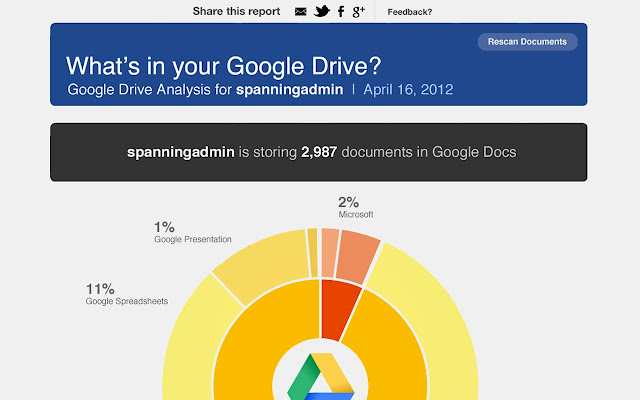
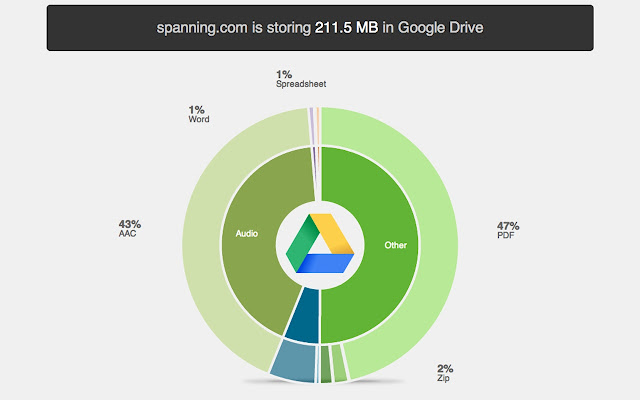
If you are obsesses with fine tuning your productivity, or if you just enjoy getting visualizations about your technology usage, and you need more than just statistics on your Gmail account, then the Google Chrome browser extension, Spanning Stats is for you.

Downloading the free app offers you visualization and analytics on your Google Drive (thus, your Google Docs) usage. Gaining insight into your domain’s use of these tools can not only help you to improve your productivity by seeing any potential flaws, but help you to understand how you are using the tool so that you can do more of what is working well.

chrome extension stats

How the data can be used

The creators offer the following questions to reveal what the app can be used to answer:
[ba-list style=”plus”]

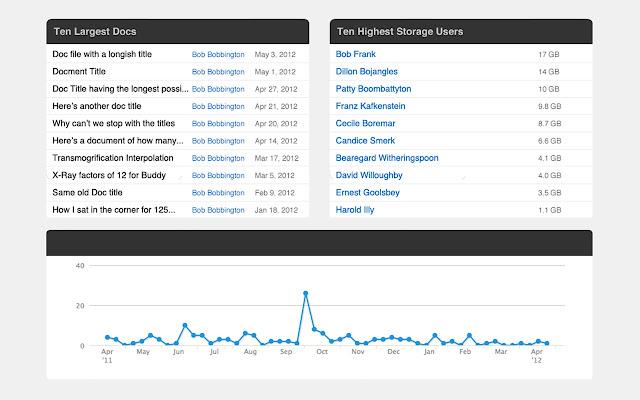
  • How many files of what types are you storing in Google Drive?
  • How has your use of Google Drive and Docs changed over time?
  • How much of your storage is being consumed by movies, music, and photos?
  • What are the biggest and newest files you’re storing in Google Drive?
  • When during the day are you most actively using Google Drive and Docs?

[/ba-list]
The developers note that “Google Drive makes it easy to share files, collaborate, and access your stuff from anywhere on any device. But how are you actually using it?” Using the Spanning Stats for Google Drive app can answer all of these questions and at no cost.

spanning stats app

Nearly every review gives the app a perfect score, with one reviewer said, “This app is awesome!!! It show the stats on your Google drive insanely fast! The animations are fun. The ui is cool and it displays your data of how you use your Google drive space in an easy to understand way. I then tried it on my Google Business Drive account and worked like a charm with a bunch of files.”

spanning stats extension

google drive analytics

Quick tip for getting Facebook attention

reciprocation on facebook

The overlooked step of reciprocation

Reciprocity is still overlooked as a part of a digital marketing strategy, no matter how many classes or consultants a brand brings on. The two habits of using social media as either a megaphone without regard to what others are saying, or as a watercooler for gossip, remain the most common behaviors online. Very few professionals use the social networking tools to the best of their ability, rather plug in something automated or talk about their lunch, then walk away, expecting leads.

Doing business through social media is extremely lucrative if done well, but we’ll beat the dead horse that has been buried for years, and remind everyone that social media is a conversational tool, not a megaphone, and you must give back. In order to get Facebook love (mentions from other people, interaction from others, brand loyalty in public, etc.), you must give Facebook love that is sincere, legitimate, and done because you care about your community, not because you expect a 12.5% ROI on the efforts made.

Giving back is not just going to other peoples’ Facebook pages and saying “happy birthday,” or “nice post,” or “cool picture,” then moving on as if your good deed of the day is done. No, giving back takes legitimate effort, but it can be extremely simple.

Without developing your strategy for you, shall we visit a tiny, easy to miss feature that Facebook added a long time ago, but is often overlooked by the masses?

Enter the secret Facebook weapon

Imagine for a moment that you are a restaurant owner. You are used to people checking into your venue on Foursquare and Facebook Places, and you monitor those checkins. But imagine that you see something pop up through Facebook Places check-in that is not live, rather a recommendation, a photo that has been tagged of a visit to Austin last summer that someone is telling their friends about.

Facebook Places is the equivalent to Foursquare, but is an easy way for you as a professional to spread some love on Facebook to local businesses, which by the way, alerts them that they have been tagged in a status update. Think of the last five things you spent money on, take a picture related to that, then tag the local business in the photo update. Did you get your tires changed last month and got a hell of a deal? Take your phone, snap a shot, upload and tag. Did you buy a new brand of milk at the store that is pretty tasty? Shoot, upload, tag the store. Did your plumber do an amazing job for you? Photograph the sink or share a before picture of the leaking pipe destroying your bathroom, tag, and share.

So how exactly does one do this?

Don’t worry, we’re not going to just use obscure terms and not help you. Here is a quick photo tutorial of a neat line of sausages I recently bought at a local store, and instead of “checking in” to a location, I tagged the item on a map which not only shows up on their page, but on my map page.

Step one: after taking a picture of an item or place, in this case sausage, upload like you would any other picture, but notice the tiny map marker on the bottom of the status update box. Typically this is used via mobile to check in to a location, but you’re going to use it to spread Facebook love:

facebook update

Step two: start typing in the name of the location, venue, retailer, etc. and select the one that matches the address you are alluding to. If it does not exist, you may be a hero by adding it from scratch – this takes extra homework, but it can be done.

facebook update map

Result: this is what your update looks like. Note that “at H-E-B” is blue. It is a link to their page. Bingo! Are you feeling the love yet?

facebook places

Your profile: all of these photos tagged with locations will show up in your Facebook Timeline under the maps, which can be found on your (or anyone’s) profile page like so:

facebook places on page

Maps: below, you will see what it looks like when the map on a profile page is clicked. When you enter your own, it will prompt you to begin filling in your map by asking you to tag existing photos of you, or telling Facebook where all you have lived. This is a personal preference – note that my own profile does not have many dots outside of Austin. I am very private and don’t care to tell Facebook that I have lived in Spain, Mexico, Dallas, and all over Austin, because it already knows enough about me, but you should feel free to use your own discretion… adding sausage shots is not going to hurt anything (don’t you dare misinterpret that last line, you bad kids).

facebook map

Want to see your map or someone else’s map? Simply type in “/map” after any profile you are connected with to see someone else’s maps. Try it with a few of your friends and you will see how few people are tagging locations in their photos or updates.

facebook map url

The takeaway and special notes

You do not have to take a picture for this to work, you can simply update a status, but in the era of visual social media, pictures reign and require very little extra effort. If you are a true ambassador in your community and are consistent about recognizing others and giving Facebook love, you will be seen by your network as the authority on the area, but you will eventually get back some of the love you give – it’s human nature, so get out there and spread the love by tagging the locations of local businesses and professionals in updates!

Realtor background checks include reputation, character: legal?

questionable background checks

A questionable new industry standard

We have a new “industry standard” making an appearance for both Appraisers and Realtors®. Those of us who do work with Appraisal Management Companies (AMCs) and complete Broker Price Opinions (BPOs) are being asked to submit to and pass mandatory criminal background checks – “to ensure that every person who conducts business on their clients’ behalf observes the highest of standards and professional ethics,” according to an email from the LSI Division of Lender Processing Services (LPS).

This isn’t exactly new in terms of many states’ professional licensing protocol, or even the majority of most companies hiring policies these days. It is a subpar procedure in the way that the policy is being implemented, and possibly a violation of the Fair Credit Reporting Act (FCRA).

States which require criminal background checks for licensees utilize their own State Bureau of Investigations and FBI databases to determine if there have been any felony or misdemeanor convictions. Some states will also look at court records for additional information, if available online. 

The current requests for background checks

The current requests many of us have been receiving for background checks, from companies like LPS/LSI (a preferred valuation partner of National Association of Realtors’ (NAR’s) Realtors Property Resource (RPR), and thereby those Realtors® who hold NAR’s Broker Price Opinion Resource (BPOR) certification) along with DataQuick, are being conducted by third parties, such as LexisNexis and Sterling. 

At least as far as LPS/LSI is concerned, in their email, which includes a link to LexisNexis, and explains that four questions will have to be answered to verify identity, which product to select (there was only one option), it also says what LPS/LSI wants SSN verification, a felony/misdemeanor record check, a national criminal record file check, and a global sanction search. 

However, upon getting ready to pay for (yes, Realtors® and Appraisers have to fork over the bucks for these) these verifications and searches, LexisNexis has a disclaimer/authorization as to what they themselves may be pulling up, looking into, whatever, and it’s a hell of a lot more than mere criminal records. 

Reading the fine (and questionable) print

According to the LexisNexis website, items may include; “information regarding my credit worthiness, credit standing, credit capacity, character, general reputation, personal characteristics, or mode of living. This report may be compiled with information from credit bureaus, court record repositories, department of motor vehicles, past or present employers and educational institutions, governmental occupational licensing or registration entities, business or personal references, and any other source required to verify information that I have voluntary supplied. I understand that I may request a complete and accurate disclosure of the nature and scope of the background verification; the extent such investigation includes information bearing on my character, general reputation, personal characteristics, or mode of living.

It is one huge leap from requiring criminal records and verifying identity to potentially pulling credit, other court records, DMV records, speaking with past employers, personal references, obtaining school records, and digging into one’s character, reputation, or mode of living – a person’s way of life (which is quite subjective – does one become disqualified if their “way of life” is gay, anti-semitic, or nudist?). 

While LexisNexis has a nice CYA in the form of a checkbox authorizing the go-ahead and appears to be in compliance with current laws, LPS/LSI has failed miserably at doing so – enter the potential FCRA issues. LPS/LSI did not, in the email sent out to current providers like myself, give notice of the policy change, i.e. that Appraisers and Realtors® would be subject to background checks and ultimately have an investigative consumer report compiled as a condition of employment, separate from any other information, nor did they request any kind of permission to obtain said reports, written, verbal, or electronic.

Time for Appraisers and Realtors® to defend themselves

Per the FTC, employers also have obligations under the Fair Credit Reporting Act. When background checks are conducted for employment purposes, including, hiring, advancement, or maintaining an employer/employee relationship, a disclosure must be given out, and it must be separate from other information. Consent from the employee has to be obtained, preferably in writing. If investigative consumer reports will be used, an additional notice has to be given out that one may be generated, and that the employee has a right for additional disclosures and the scope and summary of the report.

There are times when Appraisers and Realtors® need to join forces and become advocates for ourselves. This is one of those times. We have to know our rights (and we do have them) instead of rolling over and taking it, because something may be becoming a new standard in the industry.

Tablet growth to surpass notebooks within four years

1

tablets taking over the world

Tablets are taking over the world

Hop on a train in San Francisco, go to a conference in Atlanta, or enter a Starbucks in Boston, and you’ll inevitably see people using their tablets. It is becoming more and more common to see tablets over laptops, or even smartphones in some cities, as the popularity is rapidly increasing.

NPD DisplaySearch has studied this trend in their Quarterly Mobile PC Shipment and Forecast Report1, and assert that tablets like the iPad and Kindle Fire, will be the growth driver for the mobile PC market in upcoming years, forecasting that tablet shipments will surpass notebook shipments in 2016 – faster than some had predicted previously.

[ba-pullquote align=”right”]”Mobile PC shipments will grow from 347M units in 2012 to over 809M units by 2017.”[/ba-pullquote]The report says that overall mobile PC shipments will grow from 347M units in 2012 to over 809M units by 2017 and that while notebook PC shipments are expected to increase from 208M units in 2012 to 393M units by 2017, tablet PC shipments are expected to grow from 121M units to 416M units in this period, for a compound annual growth rate of 28%.

tablet shipment forecast

[ba-pullquote align=”right”]”While the lines between tablet and notebook PCs are blurring, we expect mature markets to be the primary regions for tablet PC adoption.”[/ba-pullquote]“Consumer preference for mobile computing devices is shifting from notebook to tablet PCs, particularly in mature markets,” said Richard Shim, senior analyst at NPD DisplaySearch. “While the lines between tablet and notebook PCs are blurring, we expect mature markets to be the primary regions for tablet PC adoption. New entrants are tending to launch their initial products in mature markets. Services and infrastructure needed to create compelling new usage models are often better established in mature markets.”

Why the massive growth?

NPD cites adoption in mature markets like Japan, North America, and Western Europe as the key driver for tablet PC growth, which they say will account for 66 percent of shipments in 2012 alone, and remain in the 60 percent range through 2016. The report adds that tablet PC shipments into mature markets will grow from 80M units in 2012 to 254M units by 2017.

tablets emerging

[ba-pullquote align=”right”]”Tablet PCs are expected to evolve in form factor and performance, making them a compelling alternative to notebook PCs.”[/ba-pullquote]”Building upon convenience-oriented features including instant-on capability, long battery life and extreme portability, tablet PCs are expected to evolve in form factor and performance, making them a compelling alternative to notebook PCs,” the report says. “Tablet PCs are expected to incorporate multi-core processors, increasingly stable operating systems, growing app libraries and higher resolution displays.”

As a side effect, notebooks are evolving to retain market share by reducing their thickness, to adding touch functionality to screens. NPD says the notebook PC market will remain the largest part of the mobile PC market during the forecast period, accounting for 60 percent of mobile PC shipments in 2012, declining to 49 percent by 2017.

1 NPD DisplaySearch Quarterly Mobile PC Shipment and Forecast Report

Does your website need a facelift? Take the test

website facelift

Some sites are good, others are ineffective

Throughout my many years of assisting real estate agents with their marketing efforts, I have seen a number of real estate agents’ websites. Some are great. They have clear call to actions, quality content, an eye-catching aesthetic and they’re easy to navigate.

Others have a website that is, for lack of a better word, ineffective. The site doesn’t have the power of speech that is needed to get today’s consumer interested in finding out more about what they have to offer as an agent.

Take the test

Before deciding whether or not you need to give your site some serious work, answer the following questions:
•    Do you have a blog?
•    Do you have testimonials on your website?
•    Does your site include a community or news section?
•    Is there clear call to actions on your site?
•    Do you have a section of your site where viewers can opt-in to email updates?
•    Do you offer video content?
•    Do you have a mobile version of your site?
•    Does your site encourage feedback, commentary or sharing?
•    Does your home page change often?
•    Do you use analytics to view how visitors use your site?

If you answered “no” to any of the above questions, then I have news for you: your website might need a little bit of improvement. Before you go about making the necessary changes to your site, however, it’s important to understand why you need to make them. I’ll take it one update at a time.

Understanding why changes must be made

The blog. If you don’t have a blog either built in to your website or linked from your website, this is the absolute first thing that you need to change. Blogging will increase your website traffic, boost your rankings in search engines like Google and Bing and give you authority in your industry. If you’re not blogging at least once per month, you need to start. You’ll soon find that you will get more traffic to your website and more leads coming in.

Testimonials. People like to hear what others have to say about your services, so having a testimonials page is crucial. It gives your website visitors the opportunities to find out more about how you do business and hear your success stories. You should be asking your clients for testimonials after you’re finished working with them and always add new ones to your site.

Community information. As a real estate agent, you want to establish yourself as more than just a housing expert. Remember, you’re assisting people as they move to a new community. You should be marketing yourself as a neighborhood expert in your area. That’s where having community pages, all of which are optimized with keywords and hyperlinks, will be helpful on your website. You can market yourself as an expert and boost your SEO at the same time.

Clear call to actions. When you first visit a website and are looking for service, you want to know what it is that makes the business you are looking at stand out from their competition. Whether you offer first-time home buyer seminars or a complimentary coupon book, you need to advertise what makes you special on the front page of your website so people will see it right when they first visit. Once the calls to actions are clicked, there should be the section where your website visitors can “opt-in” to your newsletter and email updates, as well. This will bring you more leads.

The latest technology. There are two well-known facts about today’s consumer. The first is that they’re more visual. People are more responsive to video content than they are to written these days, hence the success of sites like YouTube. The other well-known fact is that people are using their mobile devices and tech tablets more than their laptops. With that in mind, you need to tweak your web content to keep up with the trends. Offer video content that is easily accessible to website visitors and make sure you have a mobile-friendly version of your site or app for smartphone and iPad users.

Switching it up. You should always be adding new content to your website. Whether it’s through updating your blog regularly or creating various monthly promotions, it’s the little changes that will keep visitors coming back for more. One way to monitor the changes you could or should be making is by using analytics programs to see your website’s stats. You can monitor the activity on your site and see what its visitors are really doing. Using these as a guide, you can make certain features of your website more prominent and make the appropriate changes.

Now that you know why you need to make these changes, make a plan, get in gear and start giving your website a little TLC. It will take your site from ineffective to a fully-functioning roadway between you and your leads. No excuses. Now that you know what you need to do, it’s time to start doing it!

Why California’s population is packing their bags for Texas

texas versus california homes

One example of the taker mentality: California

The false foundational premises of TakerNation’s ideological belief system are numerous. However, there’s one that unfailingly, as in every single time, gets ’em in the end. It says they’ll always have ProducerNation to plunder. This is why Takers often appear slightly  irritated. On one hand they despise Producers for being individuals, taking responsibility for themselves, earning their own way, and not having a feeling of entitlement. On the other hand, they realize their ideology dies on the vine without wealth. They can’t create wealth themselves, but they need it. See, without the ability to plunder the wealth of ProducerNation, TakerNation dies of malnourishment. The most recent and glaring example of this is now happening in real time in California, my native state.

There’s another false premise which has always lead them to trust in Producers generating wealth without end. They think you and I don’t alter our behavior due to agendas they’ve passed into law. For example, they believe the 30-something couple with two kids and one on the way, who both work, will ignore their ever shrinking take-home pay. Yet, Californians are leaving in droves for states who view bona fide Producers not as sheep to fleece, but as families who wanna be left alone to live their lives the way they see fit. Many fleeing the so-called Golden State are taking jobs with ’em. This baffles Takers no end. “After all we’ve done to make everything in life completely fair, they leave?!”

California’s ProducerNation is relocating

As I write this in my home office, I can see out my front picture window. It’s 80° with blue skies and a superb ocean breeze. Kids are picnicking with their moms a couple blocks away at the park. I can drive to a gorgeous beach in under 25 minutes. It rains just 8-12 inches yearly. Yet with all that and much, much more, people are making the choice to leave. They’re turning their lives upside down in the process, and they know this before they go. They leave family. They leave friends, some lifelong. They leave everything.

Why? Cuz they’re sick and tired and beyond angry at TakerNation leaders legally confiscating their hard earned money. They’re tired of being fleeced by TakerNation employees who think they should be paid high wages for showing up and not screwin’ things up most days. They’re sick and tired of courts allowing — no, wrong word — helping the tenants in their residential rental properties get away with non-payment of rent. They’re sick and tired of having worked their butts off so the entitled can whine incessantly about them not doing their fair share. They’re sick and tired of their kids being indoctrinated in California’s public schools.

Essentially, they’re sick and tired of being sick and tired. They’re good folk. They mind their own business. They teach their children OldSchool American core values — the ones by which they’ve always lived.

Then it happens. Let’s talk about the Porters.

The Porters’ favorite cousin, Sharon, comes to visit from a place like Texas. One night over a couple beers, they tire of hearing her rhapsodize about how good they have it, living in SoCal and all. They begin to rant. The cousin is caught off guard by the reality she begins to hear. “You paid over $5,000 in state income taxes?!” “Your house payment is how much?!!” “Excuse me, but for this?” And so on, and so forth, into the night. Fast forward to the following morning.

There’s been a good night’s sleep, kinda sorta, and fresh coffee. They’re enjoying the cool early summer morning weather, as they resume last night’s conversation.

That’s when the bovine refuse hits the spinning metal blades, big time. Our hard working, law abiding SoCal 30-somethings discover that cousin Sharon lives in a 4,000 square foot home she bought earlier this year in a great San Antonio neighborhood, for around $290,000. In SoCal’s neck of the woods, that much gets you a small, not so well located, old home. How old? At least 30.  Sharon’s monthly payment? Just under $1,900 a month including taxes and insurance. Since the Porter’s make over $90,000 between them, they could swing that without much trouble.

See where this is headed?

The Porter’s will be completely relocated into either San Antonio, or maybe Austin, in time to have an eight foot tree in their new family room by Christmas. California will only be fodder for stories they tell at family gatherings. California, the state blueprint for TakerNation, will have lost another household, the children they’ll have, and 30-50 years of their productive lives. Instead, they’ll be contributing to the vibrant ProducerNation that is Texas.

Multiply this by the thousands who’ve already left California, plus the, who knows how many families who’ll surely do so in the future, and you can see how the TakerNation script plays out. California is losing its best and brightest. Meanwhile those who come here illegally or from other states lookin’ for California’s famous (infamous?) welfare gig, are multiplying like freakin’ rabbits in spring time. Take a moment and play ‘Final Jeopardy’ with me.

Considering the two trends — Takers movin’ in while Producers racin’ for the exits — what would your prediction be for California’s economy in the next few years?

Remember the false premise. Takers believe in their heart of hearts that Producers and the wealth they create will forever be available to pillage. Takers, like goldfish, are repeatedly surprised when they find out Producers will take their wealth creation where they’re treated well, not like involuntary daily blood donors. Goldfish? You know. We put ’em in a bowl of water with a small plastic castle in the middle. Every three seconds they swim around and the castle comes into view. “Oh, wow! A castle!!”

Every time a Taker in California hears of someone they know having moved outa state, they’re shocked. They’ll say something like, “Boy, didn’t see that comin’.”

That’s their version of “Hey, look! It’s a castle!”

3 ways Realtors can stay organized

organization methods
As a REALTOR®, you often have (or feel like you have) a million and one things coming at you. So naturally, you’d like to be more organized and proactive. In this article I’ll show you three things you can do to become more organized and in-control.

Keep a consolidated contact database

When client and prospect contact information is scattered across multiple places (an iPhone, an Excel spreadsheet, and pieces of scrap paper, for example), organization becomes anything but easy. That’s why it’s vital to have one consolidated database to store and manage your contacts and information about them, such as their email address, phone numbers, interests, spouse information, and birthdates.

When we forget or loose important information about our clients, which is often the case when we don’t have a consolidated contact database, we not only look highly unprofessional in their eyes but we also lose out on thousands of dollars worth of potential business.

Effectively manage your active business

When I refer to “active business,” I’m referring to buyers and sellers you’re currently working with, either to list their home or to help buy a new home. It’s important to have one place you can go to view all your current listings and their details/ status as well as all your active buyers and what each of their requirements are. Most of us don’t have a memory like an elephant which is why having this consolidated view of active business is so important.

If the system you’re using lets you quickly and easily generate a service report, record listing notes, and schedule listing reminders, this is an added plus that will work wonders for increasing your organization.

Track communication history and “keep in touch” activities

Wouldn’t it be nice to promptly pull up your communication history for a client or prospect before giving them a call so you’re aware of what you spoke about with them last and have something relevant to begin the conversation with? This is easy when you track communication history.

Moreover, we need to track “keep in touch” activities which consist of anything we do to stay in touch with our contacts. Keep in touch activities can range from a phone call to a round of golf to a client appreciation event to a drip email campaign. As a Realtor, you likely know how important keeping in touch is in building a business based on referrals and repeat client transactions. In order to stay top of mind with our clients effectively, we need to know how many times we’re reaching out to them and be able to plan keep in touch initiatives effectively.

The takeaway

If you implement the suggestions in this article, you’ll surely be more organized, but you may be wondering how this all comes together. With a real estate contact management system, you can keep a consolidated database, manage your active business, and track communication history and keep in touch activities in one place. Think of your real estate contact management system as software you use to manage and organize your entire business. In no time, you’ll be on the path to an improving your organizational skills three fold.

Ohio lawsuit accuses Freddie Mac of fraud

scales of justice

Freddie Mac sued by county in Ohio

Last year, Mortgage Electronic Registration Systems Inc. (MERS) became the subject of lawsuits from counties across the nation as District Attorneys allege the company never owned the loans they were facilitating foreclosures for, and in most cases, judges agree, and their authority to facilitate has been denied in several counties. Dallas County alleges the mortgage-tracking system violates Texas laws and shorted the county anywhere from $58 million to over $100 million in uncollected filing fees due to the MERS system, dating back to 1997.

Others sued MERS as well; in February, in the U.S. Court for the Western District of Kentucky, Chief Judge Joseph McKinley Jr. dismissed a lawsuit filed by the Christian County Clerk, denying relief to the County for the same relief sought by Dallas County and others.

Rampant mortgage fraud, continued robosigning

Studies have shown that MERS destroyed the chain of title in America, and other studies reveal that illegal robosigning is still in play, and that foreclosure fraud has occurred in the majority of loans.

As the courts have not yet rewarded cities, counties, or states pursuing action against MERS, other tactics are being taken by these entities, for example, Louisiana is using RICO laws to sue MERS.

Summit County, Ohio taking a different approach

Summit County, Ohio filed a lawsuit1 Tuesday against Freddie Mac, alleging a failure to pay fees on transfer taxes on over 3,500 real estate transactions over six years. Court documents show that the Federal Home Loan Mortgage Corporation is accused of committing fraud by claiming it was a government entity, thereby exempt from transfer taxes. The County has not released a final assessment of the amount they believe is due, but they will also be seeking interest and penalties.

This approach is far different than going after MERS (which coincidentally was established by Fannie Mae and Freddie Mac over 15 years ago), rather going directly after the still-functioning Freddie Mac.

“The reality is Freddie Mac is a federally chartered, private corporation and they should have been paying these fees and taxes,” Assistant Prosecutor Joe Fantozzi told the Akron Beacon Journal.

Freddie Mac and Fannie Mae began paying transfer taxes in 2009, so the lawsuit is only seeking transfer taxes due from 2002 through 2008, which in Summit County are $4 per $1,000 on all real estate transactions. Additionally, the county also charges a 50-cent lot fee and recording fees, which are $28 for the first two pages and $8 for each additional page.

Fannie Mae not named, FHFA already fighting back

Although Geauga County in Ohio sued MERS, Chase Bank, and CoreLogic, the Akron Beacon Journal reports that Summit County is believed to be the first county in the state to file legal action against Freddie Mac. Fannie Mae was not named in the suit due to the low volume of mortgages in the county it handled during the time period.

The Federal Housing Finance Agency (FHFA), the conservator of Fannie and Freddie, is fighting back on these same battle lines, suing in Illinois to validate the two mortgage giants’ tax-exempt status, the Chicago Tribune reported. This move is likely an effort to circumvent more lawsuits like the one currently being filed in Summit County.

1 Summit County Court records
2 Akron Beacon Journal report

Freudian slips in real estate marketing

real estate listing errors
Sink, sank, sunk and stunk. The MLS and real estate ads this week continue to go down faster than Greece’s economy. Thanks to Bruce Walter of Lafayette, IN for some great material this week. Check out these hysterical bloopers (particularly the Freudian slips, as we saved the best for last):

 Something Missing…

“Too mush to describe” (Uh, your recent brain  diagnosis?)

“Turn one” (Heidi Fleiss’s explanation when asked her line of work.)

“2 dedroom house” (That explains the divorce summons…)

“Mall area for kids”  (I believe that called a mosh pit…)

Something Extra

“Deck furniture i sperm” (So not something I want to sit on…)

“This is a greta house” (For those who are into Swedish Modern…)

“Refrigerator imploded”  (Reason #1 not to hide explosives in your freezer.)

“Double sank” (Let me guess – your career and your partner’s?)

Something Shady

“Pat holder in kitchen” (Pat’s husband snoring on the couch.)

“New scrams” (Pat’s husband just entered bearing firearms…)

“Close to palesides” (Said Tonto when viewing The Lone Ranger in a Speedo.)

“Covered with veins” (Uh, Betty White in a bathing suit?)

“Wraparound clock” (Some architecture is timeless.)

Something For Adults Only…

“Large swimming pole” (At last – a home for aquatic strippers!)

“Dick on the link” (Said the former Mrs. Tiger Woods when asked where Tiger was hiding out.)

That’s it for this week, folks. Remember: Spell and Sell!

Oreo’s ad: inspirational, even for non-supporters

oreo pride day 2012

Oreo’s support for Pride Day 2012

There is always something to learn from companies that aren’t afraid to make a statement, to take a stand. Oreo is no exception. For June 25th, also known as Pride Day, Oreo released a picture of an Oreo cookie with six layers of filling, each one a different color of the rainbow, as seen above. The ad was simple. Just the picture, the date, and the word “pride.” That’s it. But it spoke volumes, and everyone that viewed that ad knew exactly what Oreo was trying to say. Unsurprisingly, the response was prolific and represented all sides of that hot-topic issue. So, what can you and your brand learn from all of this?

The Good

As a result of this straightforward, yet simple, ad, Oreo had more than 117 stories written about them, the majority being published in tier-1 publications. That’s not counting the social media coverage and blogs written about the ad and the company in general. That one ad was shared over and over again. So, it comes down to this: Oreo earned that free publicity. And that’s the best kind of publicity. They earned every article, every Facebook share, every tweet, and every blog post. It doesn’t matter how you feel about the statement they made, but they deserved that attention because they took a stand for their beliefs and what they wanted their company to represent.

The bad

While Oreo did take a stand, the truth is that they undoubtedly alienated a portion of the loyal customers. Again, leaving the politics and ethics out of the ad and analysis, Oreo could have retained every customer’s loyalty just by staying neutral. It wasn’t absolutely necessary for them to take a stand; they weren’t being called to take action. However, they did. They must have known their ad would cause a controversial stir. And it did.

The Takeaway

Oreo may have rubbed some of their customers the wrong way, but it also created an even more loyal customer-base of those who agree with the statement their rainbow-colored Oreo made. So, take Oreo as an example for your business. Pick an issue that’s important to you or your business and be direct.

Take a stand for what you feel is right. Be assertive. Earn free publicity the right way, by adhering to your beliefs and the beliefs of your brand. Don’t make a statement that you’re not willing to back up in the present and in the future, just like Oreo.

Facebook, Pinterest, Google+, Twitter image size cheat sheet

social media cheat sheet

Getting your image sizes right

With all of the rapid changes in social media, it can be tough to keep up with what you as a user, particularly a brand, are supposed to keep up with. Facebook released the new timeline features and changed all of the dimensions required of profile pictures, while introducing cover photos. Pinterest users do not always know the image sizes allowed, and Google+ has updated the dimensions of their own cover photos, and allowed users to upload animated gifs. On top of all of that, you have Twitter which has also had changes to its design in recent months.

We introduced you to a template for Facebook profile pictures and custom cover photos, as new updates left the old templates defunct, but what about the other social networks?

Below is a list of all of the required image sizes across the networks, courtesy of Luna Metrics. If typed lists are not your jam, check out the infographic below, giving a visual that outlines all of the required social media profile picture requirements – think of it as a cheat sheet!

Facebook Image Sizes

  • Cover Photo: 851 x 315 pixels
  • Profile Picture: 160 x 160 pixes (must be uploaded sized at least 180 x 180 pixels)
  • Distance between left boundary and profile picture: 23 pixels
  • Distance between top boundary and profile picture: 210 pixels
  • Profile Picture border size: 5 pixels
  • App Preview Image: 111 x 74 pixels
  • Distance between App preview images: 8 pixels
  • Total length of adjustable app preview images, with gaps: 349 pixels
  • Shared Image size on Timeline: 403 x 403 pixels
  • Up to 960 x 720 pixels in lightbox, can be uploaded up to 2048 pixels
  • Status Update: 63,206 characters
  • Link Preview: 90 x 90 pixels
  • Both Title Tag and Meta Description can be edited by clicking on the preview text
  • Highlighted Post/Milestone: 843 x 403 pixels
  • Profile Picture In Stream: 50 x 50 pixels
  • Shared Image In Stream: 398 x 298 pixels
  • Profile Picture on Facebook Sponsored Story Ads: 32 x 32 pixels
  • Sponsored Story Body Copy: 90 Characters
  • Sponsored Story Image Size: 194 x 139 pixels
  • Album Image Preview type 1: 129 x 129 pixels (can show either 6 or 9 photos at this size)
  • Album Image Preview type 2: 398 x 264 pixels (three 129 x 129 pixel boxes underneath)
  • Album Image Sizing type 3: 196 x 196 pixels (two preview images)
  • Facebook Ad Image Size: 100 x 72 pixels
  • Facebook Ad Title Copy: 25 characters
  • Facebook Ad Body Copy: 90 characters
  • Shared YouTube Video Preview: 130 x 73 pixels
  • Shared Facebook Video preview: 398 x 223 pixels

Twitter Image Sizes

  • Profile Picture: 128 x 128 pixels
  • Brand Banner: 835 x 90 pixels (only available to select Twitter partners)
  • Tweet Length: 140 Characters

Background Sizing (visible space between left side and content):

  • 90% see 71 pixels
  • 65% see 199 pixels
  • 40% see 242 pixels
  • 20% see 279 pixes

Google+ Image Sizes

  • Cover Photo: 940 x 180 pixels (can be animated using a .gif)
  • Profile Picture: 250 x 250 pixels
  • Profile Picture border size: 5 pixels
  • Ribbon Photo: 5 x 110 pixels each (can be animated using .gifs)
  • Profile Picture In Stream: 48 x 48 pixels
  • Shared Images: 497 x 373 pixels (up to 2048 pixels in lightbox)
  • Post length: 100,000+ characters (Cannot edit link Title Tags or Meta Descriptions)

Pinterest Image Sizes

  • Profile Picture: 49 x49 pixels
  • Resized from 160 x 160 pixel profile picture
  • Pinned Images: 600 x Infinite pixels
  • Pin Description Length: 500 Characters (can include hyperlinks)

Small business challenge: government regulations

small business government regulations

Small business’ biggest challenge: regulations

Many entrepreneurs start their own businesses because they want the freedom that comes along with owning a small business. They want to be a part of something they’re passionate about. They want to define themselves and their professional lives on their own terms and not on the terms of a micromanaging boss. It’s estimated that over 89% of all businesses within the United States are actually classified as small businesses. That’s a huge majority that speaks volumes about the path that this country is on. However, being a part of small business isn’t all positive. Because of current government regulations and taxes, small businesses are suffering and suffocating.

ChamberofCommerce.com published a report1, asserting that government mandated regulatory costs are fixed costs and not necessarily based on the number of employees. This means that a company with just a handful of employees pays the same fees as a company with thousands of employees. The current regulations don’t account for the limited budgets of a small business with a few employees.

Instead, it ultimately rewards bigger companies than small homegrown businesses. Twenty-two percent of polled business owners said that their biggest professional challenge is complying with these regulations and taxes, and that was their number one complaint and struggle with owning their own business.

The burden on small businesses

When the small business regulations and taxes are broken down, the direct burden on business amounts to about $970 billion. When broken down even more, ChamberofCommerce.com found that companies are basically paying $8,000 per employee and $161,000 as a total company. That’s enough to shut a struggling business down for good. And many entrepreneurs only get a few shots at professional success to match or exceed their goals.

Entrepreneurs across the country are trying their hands at success and finding ways to incorporate their passions, interests, and skills into their professional lives. And while entrepreneurs are encouraged to build their small businesses, current federal regulations make it nearly impossible for many businesses to survive and thrive.

The only immediate solutions are to foot the bill or hire more employees to qualify for more tax breaks. But that’s not always a smart move. Instead, the federal regulations themselves need to change and that will require the collaboration and persistence of all small business owners.

1 Chamber of Commerce Report

Keller Williams, Coldwell Banker to pull listings from Trulia?

trulia keller williams coldwell banker

Rumors of threats loom overhead

In two separate emails provided to AGBeat, rumors abound that Keller Williams and Coldwell Banker have both threatened to pull their listings from Trulia, citing that the two real estate companies insist that Trulia must change their business model to position the listing agent ahead of (or in place of) subscribed buyer agents. One agent at Keller Williams told AGBeat they believed listings were already in the process of being pulled from Trulia.

In May, boutique brokerage, Goodlife Team made the choice to stop syndicating based on a similar reason, and the listing syndication debate rages on, as reasons for pulling are now diversifying, as each brokerage becomes more aware of what the real estate search companies have been offering.

Truth to the rumors?

Trulia spokesperson, Ken Shuman told AGBeat, “KW and Coldwell Banker never threatened to pull listings. We have been very proactive meeting with all our partners and the results of those meetings have lead to all the new offerings being rolled put now.”

Shuman added that Trulia recently completed updates to their Industry Offerings. “Based on a regular feedback process with Trulia’s broker partners, several updates were made to Trulia listings pages that benefit brokers, agents and consumers. All listings on Trulia now include clear listing broker attribution, display listing agent contact information and prominently mark real estate advertisements.”

Separately, Trulia recently added new features for Trulia Local Ads customers for free, allowing subscribers to receive “higher quality leads with phone numbers and pre-qualification information,” Shuman stated.

“These improvements are part of Trulia’s continual process of evolving our product lineup to help agents meet more clients and complete more transactions,” said Shuman, reaffirming that the rumors are false, and that Keller Williams and Coldwell Banker have not threatened to pull listings, particularly in light of recent changes at Trulia that have circumvented the threats.

When asked if specific teams or brokers were threatening to pull listings from Trulia, Shuman said, “My feedback comes from the top of KW and the top of Realogy. Neither has ever threatened.”

As of publication, Coldwell Banker has not responded to AG’s request for comment. Keller Williams’ Executive Director of IT, Cary Sylvester said, “At Keller Williams, we maintain a philosophy of ‘my listing, my lead.’ In exchange for receiving our listings, we hold every publishing site we work with to return all leads back to the agent and not to anyone else. The listing agent worked hard to earn that listing; they deserve all the leads from it.”

Sony Xperia’s inspiring video campaign

sony xperia

Sony’s “Made of Imagination” campaign

As campaigns go viral through web video, Sony has pushed their “Made of Imagination” campaign for their new Sony Xperia device, which is known for its Android operating system and ten hours of battery life. Sony seeks to be more memorable than just a sleek device with speed and sexy design, no, the company has set out to inspire people with the capabilities of their device.

The first two videos in their “Made of Imagination” video campaign focus on the minds of children and what they foresee as special about smartphones, with one child in particular having a standout imagination:

[ba-youtubeflex videoid=”mo8U8qeuFWg”]

The video ad created around Jake’s vision:

[ba-youtubeflex videoid=”HMnlfPvd5AI”]

Second leg focuses on creativity as well

With less animation and more real life creativity, “Made of Imagination” asked fans to come up with challenges, then took to the field to make those challenges real life, be they making music by kicking soccer balls with Sony Xperias inside, each making a different noise, or using the Xperia camera to film a soccer ball aiming for a toy helicopter equipped with a separate Xperia camera:

[ba-youtubeflex videoid=”DIMkFM1_u9s”]

The takeaway

The reason Sony’s campaign is so well done is not just the production value, but because they focus on feelings over functions. Consumers value entertainment and evoking emotions in advertising today, not just a list of device specs. The company has a separate YouTube page that focuses on the devices so that consumers may get to know their offering, but this simple, creative campaign should serve as inspiration for companies large and small seeking to improve their campaigns, or start a new one.

The trend is to focus on emotion, as people remember feelings far longer than they remember product details and being directly sold. This method is passive selling, and far outperforms direct selling through web video campaigns.


Steps all storm damage victims should take

lightning strikes freak storm june 29, 2012

The “freak storm” on the Eastern seaboard

The American Homeowners Foundation (AHF), has outlined the steps that the thousands of homeowners “whose homes were damaged by the freak June 29 storm that struck the eastern U.S.” should take.

The AHF advises homeowners to carefully document all damage with photographs in order to prove damages to insurance adjusters and the IRS if eligible for tax deductions as a result of uninsured losses. They also advise homeowners to contact their homeowners insurance company immediately to understand what is and is not covered, noting that in some cases, for example, damage from a falling tree is typically covered, but the removal of a tree in your yard without damaging a home may not be covered.

Flood coverage

Flood coverage is often misunderstood, says the AHF. “Most standard flood insurance only covers damage caused by rising waters from a river, creek, lake or pond. It doesn’t cover such things as water backups caused by overflowing drain pipes, or when the drain in a basement stairwell gets clogged with debris, causing water to fill the stairwell and come in under the basement door.”

“That once happened to me during a big storm,” said AHF President Bruce Hahn. “After I learned that the extensive damage to our finished basement was not covered by our insurance policy, I reconsidered how much I could afford to spend out of my own pocket to repair the damage.” Homeowners shouldn’t commit to expensive repairs until they learn what is covered and what isn’t, and the terms of the coverage of things that are.

Finding a qualified contractor

Finding a qualified contractor after a major event like the recent storms is another challenge, as rates tend to go up with demand, and con men abound. Homeowners can use technologies like HouseFix to check contractors’ reputations, and even avoid sticker shock by getting price ranges through Redbeacon which also allows users to take a photo of damage and get bids over their device from local contractors.

AHF advises that contractor credentials should be checked carefully, particularly their license status, and whether or not they are insured for worker’s compensation, property, and personal liability, adding that it is perfectly acceptable to ask for a copy of their insurance certificate and a list of references on similar jobs. The nonprofit asserts that belonging to trade organizations like the National Association of the Remodeling Industry, or the National Association of Home Builders Remodelers Council “is a sign of commitment to their trade and to professionalism.”

Homeowners should get a comprehensive bid, detailing as many of the specifications as possible, the AHF notes, and that homeowners should try to get two or three bids where possible. Use tools like Redbeacon mentioned previously, or MinuteBid (not a free service, completely designed for landlords, but could easily be used by consumers) to manage the bidding process, lest you be married to a fax machine.

“One of the most important suggestions is to use a comprehensive written contract,” the AHF advises. “It will greatly reduce the likelihood of disputes with your contractor. Make sure the contract covers the description of the project, timetable, payment schedule, etc., and has general provisions defining the responsibility of the contractor and the subcontractors, defects and correction, change order procedures, warranties, right to termination, and alternative dispute settlement mechanisms (since many of the costs of lawsuits are for legal fees, homeowners and contractors will almost always be better off with mediation, conciliation, and/or binding arbitration clauses should a disagreement arise). Some contractors use their own standard contract forms, but read the provisions carefully before signing them. If you feel some of the provisions in their contract are unreasonable, ask them to make reasonable modifications.”

Never hire a contractor by signing a brief proposal or worse yet, on a handshake, the nonprofit notes. You can also hire an attorney to draw up a contract that includes the aforementioned provisions to protect you. Another alternative is to use the American Homeowners Foundation’s standard six page remodeling and repair contract, which contains these protections and fill in the blank areas for the specifics of your job.

The takeaway

Do your homework, protect yourself, and document everything along the way, and this terrible storm damage situation will go as smoothly as possible and be over before you know it.

Millennials’ unique attitude toward homeownership

Americans optimistic about housing

In the recent American Dream Survey by real estate search giant, Trulia, Chief Economist, Dr. Jed Kolko notes that renewed optimism about housing is not without reason, but the pendulum may have swung to far as expectations do no meet the market’s reality.

The study revealed that 58 percent of Americans think prices will return to their peak within 10 years, 78 percent of renters plan to buy someday, and interest in supersized homes (3,200+ sf) nearly doubled in the last year. Dr. Kolko projects that at its current pace of recovery, the housing market will be back to pre-recession normal by 2016, as will the turnaround rate for renters waiting to become homeowners.

With this news, AG asked Trulia to separate out Millennials’ attitudes toward homeownership, because many believe that this generation is content with renting and behaving almost like nomads, but does the data support that theory?

Identifying the 18-34 age group (which has a four year overlap with Generation X, but the points remain), Trulia did see quite a bit of difference in attitudes when compared to the overall adult population.

Millennials are quite optimistic

Dr. Kolko noted that not surprisingly, Millennials are much more likely to be renters, 47 percent compared to the 32 percent for the overall adult population. Millennials are also more likely to want to own in the future, as 92 percent of Millenial renters plan to buy at some point in the future, compared with 78 percent of all renters.

“However, their perspective is shorter-term,” Dr. Kolko added, “and they’re less likely to stay in their next home for a long time. Among Millenials, 17 percent said that if they buy a home they will stay it in less than five years, compared with 11 percent of the overall adult population.”

The takeaway

While Millennials are more certain they’ll own a home in the future, they are also certain that they will live in that home for a shorter period of time, when compared to the overall adult population. This is good news for a sector that will be relying on new buyers to become part of the buyer pool, as existing homeowners are naturally a tad less optimistic, having seen their values drop in most metros.

How to make your real estate business matter

make your business matter

A Food Cart Analogy

On a recent trip to New York City, I became enthralled with a food cart that was located next to our hotel. I know that food trucks and food carts are en vogue right now, but this one was something to see. No matter what time I left the hotel and no matter what time I returned, there was always a line. At one point, I counted 58 people in line.

This particular food cart sold Halal food and had about six items on the menu, the most expensive of which cost six dollars. But what intrigued me was not the taste (although the food was pretty yummy) but the fact that there are hundreds of Halal food carts in New York City, and this was the only one with a significant line.

What was it that made the people line up around the block? And, what could I learn about how to improve my real estate business from the success of this cart? (By the way, I made a mental calculation that this single cart grosses about $140,000 per month).

Here’s what I came up with:

  1. You need to give people what they want and what they need. Passersby at 53rd and 6th Avenue wanted affordable and tasty food that is prepared in a New York minute. In California, Arizona, Nevada, Florida and other states, there are still many unemployed and underemployed borrowers that may need to sell their homes in a short sale. Any areas of the US and beyond that have a high foreclosure rate will have lots of people looking for rentals. So, property management and short sale expertise are two niches that could be almost as successful as the Halal cart.
  2. Word of mouth is vital. I didn’t see too much going on in the way of food cart advertising. Most people probably visit this food cart because they hear that the food is great. As Realtors®, we need our past clients, our friends and our family to spread the word.
  3. Volume business trumps high-end almost every day of the week. The cart was selling a six dollar items and likely grossing $140,000 per month. Why not take that philosophy to the streets? You don’t have to go after all of the multi-million dollar listings; after all, in most parts of the US, there are less buyers for that market. Why not focus on a price point where there is a huge demand and homes can get sold quickly?

There are probably lots more things that can be learned from the business model of the Halal cart. And, if you are heading to Manhattan anytime soon, check it out and let me know what you think. It’s at the corner of 53rd and 6th Avenue.

Sidebar: I actually investigated on Google and learned that it 2006, someone was actually killed for cutting the line. Last lesson learned: never take cuts.

Top 7 success traits a good leader should have

boss ceo executive
Photo of Aaron Levie, the CEO and Co-founder of Box.net.

Will your boss lead you to success?

I have had the privilege of working with some truly inspirational leaders throughout my career, some as my bosses, and some as my partners. Looking back, I can identify common traits that they all shared. These traits led them – and our companies – to success. They also helped me develop as a businessman and as a person.

I believe that seven of the most important success traits a leader can have are:

Wisdom: The world – especially the tech world – is packed with very smart people. Raw intelligence is important, but the breakout winners will use this intelligence wisely. They will understand when to push forward and when to pull back. They will be experienced (maybe beyond their years) in understanding people and situations. They will avoid unnecessary conflict but engage passionately to protect the company, their employees and their customers when it matters. Does your boss dazzle with big words, calculations and IQ intelligence – or does she further impress with a unique and innovative perception of your environment?

Passion: Nothing is more inspirational than a leader who loves his work, loves his people and loves his customers. Passion ignites personal accomplishment and more importantly, it ignites a fire for work and success in the whole team. You can hear it in a CEO’s voice when he truly cares about the mission. And it matters.

Confidence: A leader needs to be confident in her mission, and the decisions she makes to support it. In front of her employees, she should be seen as a pillar of strength and support.

An open mind: While exhibiting confidence, a leader should also be receptive to alternative ideas, and even criticism. When evidence supporting a new direction is strong, a CEO who will change course can be seen as both a real teammate for employees and also very confident personally. Flip-flopping is a disaster for sure, but earnest listening and consideration is important for the company. It will allow people on the front lines to effectively contribute, and it will help ensure all employees feel ownership and responsibility for the business. When you speak with your boss, does he really listen, or is he waiting for his turn to speak?

Humility: I love a leader who shoulders blame and responsibility when things go wrong, and even more, one who shares the credit when they go well. When your CEO speaks at company meetings does he use the word “I” a lot, or does he attach a specific employee or team to the progress and accomplishments you have going on? How about when he speaks to the media?

Generosity: A very wise (and successful) business leader once told me: “I have never lost money by being overly generous with my employees.” Since then, I have experienced first hand how true this is. Providing cash, equity or sometimes even just public recognition for a personal job well done or company success is enormously powerful and effective. People will work hard. They will be loyal. And they will play it forward, furthering the positive environment even more. Do you find your boss nickel and diming you or your teammates while personally amassing as much as possible?

Work ethic: There is no substitute for hard work. No matter how wise, passionate, confident, open-minded, humble and generous you are, someone (or some company) out there is trying to take you out. At the end of the day, you have to out-work your competition. A CEO who shows up first and leaves last demonstrates an important understanding of this reality, and sets a powerful example.

How does your boss stack up?

Trulia: asking prices of homes continue rising

house for sale

Asking prices up in June

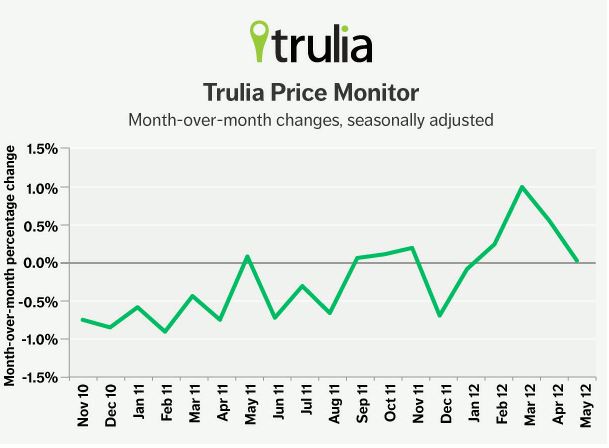
According to the Trulia Price Monitor and Trulia Rent Monitor released Tuesday, asking prices of homes are up 0.3 percent in June after being nearly flat in May, marking the fourth “solid increase” in the past five months. Asking prices rose 0.3 percent between June 2011 and June 2012 nationally, and rose 1.7 percent when excluding foreclosures. Asking prices rose in 44 percent of the 100 largest metros studied by Trulia, with rents rising 5.4 percent over the year, outpacing price increases in most markets.

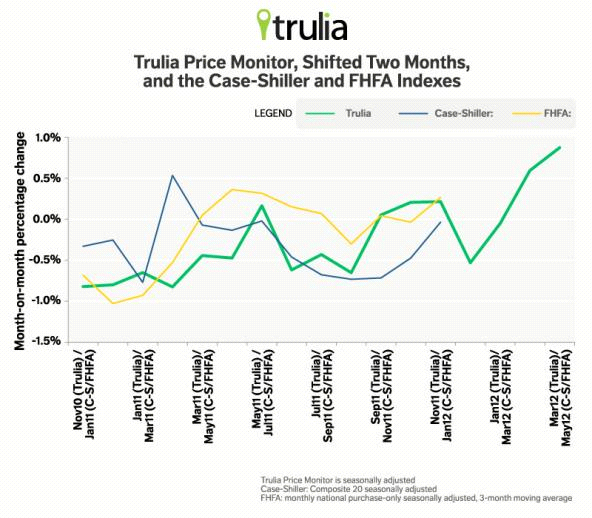
“We saw asking prices start to rise in February and predicted that other home price indexes would report sales price increases this summer for those homes – and they have,” said Dr. Jed Kolko, Trulia’s Chief Economist. “Since February, asking prices showed solid gains in four out of five months, including in June, so I expect to see the sales-price indexes show further increases in the months to come.”

Which cities are in the clear, which are at risk?

Trulia notes that metros with rising prices fall into two groups:

  1. Miami, Phoenix, Detroit, and many other “at-risk” metros still have a high share of homes still in foreclosure, and their price gains will shrink or even reverse as those foreclosed homes come onto the market. The metros with the very highest price increases are all “at-risk.”
  2. Denver, San Jose, Pittsburgh, and many others have strong price gains with a moderate or low share of homes still in foreclosure. These markets are “in the clear” and should hold their gains. “In the clear” markets also have stronger job growth and a more quickly rebounding construction industry than “at-risk” markets.

trulia price monitor

trulia price comparisons

Rise of rents nationally

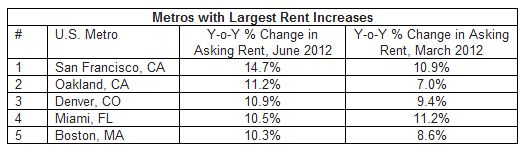
Trulia notes that rents increases have accelerated between March and June in most rental markets, and have risen 5.4 percent nationally year over year, outpacing price increases in 22 of the 25 largest rental markets. Rents increased in 24 of the 25 largest rental markets, except for Las Vegas, with San Francisco enjoying the largest rent increase for the year:

rent increases nationally

Surprises and predictions

Dr. Kolko tells AGBeat that “The price increases have been surprisingly consistent over the past five months. Asking prices have risen, either modestly or considerably, for the past five months, and had been stable for several months before that. Looking at asking prices, it is now clear that prices began to stabilize last fall, even though that wasn’t apparent at the time from other price indexes.”

“Prices are increasing in different markets for very different reasons. In Miami and Phoenix, price gains are a bounceback from the big price declines, which have attracted lots of investor and foreign interest. In contrast, Denver, San Jose, Austin, and other markets are seeing price gains due to job growth. There are many paths to housing recovery – and some are steadier while others have more risk,” Dr. Kolko added.

In a press statement, Dr. Kolko noted that “Slow and steady wins the housing recovery.”

Price, rent changes for 100 largest metros

[ba-pdfviewer pdfurl=”https://theamericangenius.com/wp-content/uploads/2012/07/trulia-price-and-rent-monitors.pdf” width=”100%” height=”500px”]

Study: Americans are working more, but on their own schedule

workaholic

Most Americans now voluntarily work overtime

Today, as a business professional, you can check back in to your work accounts whenever you feel the need or desire. You can check your email, respond to messages, and even return calls from customers, no matter where you are. While checking in outside of traditional office hours is common and normal these days, it has almost become expected by employers. No longer is your personal life simply that. Chances are, your professional life has slowly—or not so slowly—seeped into your home life. Even so, know that you’re not alone.

[ba-pullquote align=”right”]The study found that 80% of professionals log an extra seven hours of work per week, just from checking email outside of work.[/ba-pullquote]Good Technology recently conducted a study about how work and personal lives have blended for modern professionals. The study found that 80% of professionals log an extra seven hours of work per week, just from checking email outside of work.

About 68% of professionals check emails before eight in the morning and can’t go to bed without first checking it. One reason Good Technology found for professionals logging such long hours is that over 30% of those surveyed don’t know how to or find it extremely difficult to “switch off” from their professional duties.

The “always on” mobile environment

One problem this brings up is security, which is essential to big corporations and small businesses alike. The Senior Vice President of Corporate Strategy for Good Technology, John Herrema, said, “In today’s ‘always on’ mobile environment, secure access to corporate email and apps is a ‘must have’ vs. a ‘nice to have’ for nearly all companies.“

[ba-pullquote align=”right”]When you can find that balance, you’ll be more productive and successful in all facets of your life.[/ba-pullquote]When companies have the needed security, security that also allows convenient accessibility, both the professional and the company benefit. Businesses understand that employees need to feel secure when accessing private or sensitive information, and the proper security can encourage more work outside of the office.

Being accessible as a professional makes bosses happy and customers ecstatic. It can improve business and strengthen a brand’s reputation. Herrema went on to say, “While most of our customers believe their employees do more work hours as a result of this accessibility, they also appreciate and welcome the enhanced work-life balance that comes when employees have more freedom and choice to get work done whenever and wherever they need to –whether that’s in the office, on the road, or while sitting in the stands at the child’s baseball game.”

But in order to promote a healthy professional and personal life, it is important to find balance between work and non-work time. While it’s great that you can stay on top of work while at home, find ways to disconnect every once in a while and enjoy your family and your down time. When you can find that balance, you’ll be more productive and successful in all facets of your life.

Is yet another rental startup necessary?

rentobo rentals

Rental apps popping up like weeds

When we hear about a young startup in the rental sector, our ears always perk up, because it currently has the most room for improvement, and is light years behind the residential sector. We have highlighted dozens of them in recent years, watching them grow and make some of the same mistakes that residential search companies have made, namely the assumption that no one does what they do or can do.

TechCrunch recently wrote about Y Combinator-backed Rentobo.com, which at first glance was refreshingly beautiful. TechCrunch writes, “The team, which was part of the Y Combinator Summer 2011 class, started off originally with the idea of auctioning off apartment rentals. But it quickly realized that all the infrastructure it was building would be extremely useful in just getting most apartment listings online. So it began to focus instead on what it could do to automate the process and make things easier for both landlords and tenants.”

While an early pivot is never unhealthy, it made us immediately wonder why Y Combinator would back a company entering such a noisy space that is being pioneered by the big bucks? Although Rentobo is well designed and could possibly do the same tasks, RentJuice has already innovated the “common application” for renters and landlords, the crux of what appears to be Rentobo’s offering, and RentJuice also made headlines last year when they created the first ever directory of rental industry insiders.

Since then, RentJuice was acquired by Zillow for $40 million, so perhaps Rentobo sees flaws in the system and seeks to go head to head with Zillow, and why not? Zillow saw flaws in Realtor.com and came out doing something extremely similar, but in a way that they saw as superior.

Sexy design, but what’s next?

Although hailed for their beautiful design (by us and TechCrunch), it looks a bit like RentChimp, designed to compete with Nestio, a bookmarking site for real estate listings.

Rentobo also has to compete with LeaseRunner which has a loyal following for their making the leasing process paperless, automated, and easy enough for the non-tech savvy to understand, particularly landlords. Alternatively, RentMonitor simplifies property management and reduces paperwork, alongside their competitors.

Since the company already pivoted, it is conceivable that they could end up adding search, and not only go up against legacy brands like ForRent.com, but Inhabi, which matches renters and landlords, eHarmony style, or Lovely which is amazingly beautiful and going national.

Maybe the next iteration will include scoring for listings like Rentenna or throw in a mix of aggregated short term rentals with traditional rentals like Rentmix or stick to aggregating Craigslist and other listing sites like Padmapper is so famous for.

Perhaps lifestyle search could be thrown in to compete with RentSavvy or the focus could be on the investor portion of leasing, like RentScoper.

IS there room for Rentobo in this noisy sector?

So the question remains – is there room for Rentobo in the rental sector? Their design is beautiful, but not exactly unique, and their offering is being adopted already by Zillow through their new acquisition of RentJuice. They could pivot to go head to head with another company, but while the space is noisy, it is our assertion that there is tremendous room for improvement and innovation in the rental sector, particularly with multifamily and one-off landlords, as the actual leasing process remains a pain point for rental seekers every day.

So, while Rentobo’s offering is not overtly unique, they should take that Y Combinator seed money and keep forging ahead, and be aggressive about it, just like Zillow and Trulia did to Realtor.com – there’s room for improvement in the noisy space of everyone trying to innovate, but the rental sector is still coming up short. It will be fascinating to see Rentobo go after Zillow and their other competitors, as the cycle of young startups begin putting pressure on the companies that are no longer the new kids on the block. To Rentobo, we say go get ’em.

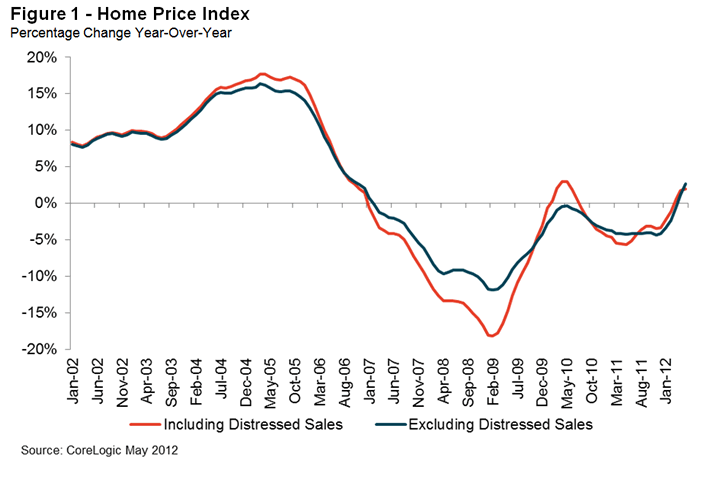
Home prices rise for third consecutive month

home price index up

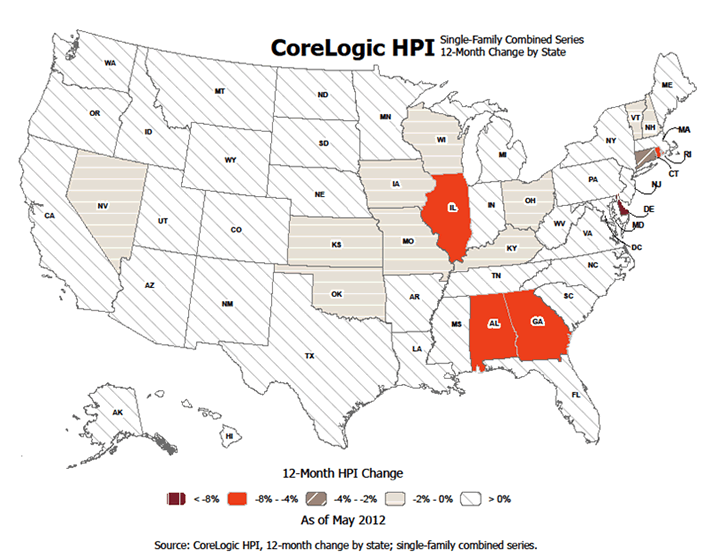
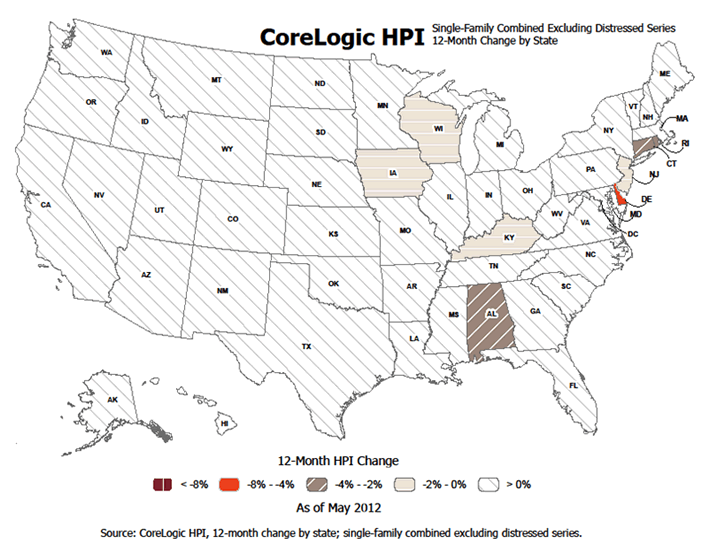
Home prices continue creeping up

According to CoreLogic’s May Home Price Index (HPI) report, home prices rose 2.0 percent in May 2012 nationally, compared to May 2011, and rose 1.8 percent for the month from an upwardly revised April. This home price increase is the third consecutive month of improvement on both a year-over-year and month-over-month basis.

CoreLogic reports that, excluding distressed sales, home prices nationwide increased on a year-over-year basis by 2.7 percent in May 2012 compared to May 2011. On a month-over-month basis excluding distressed sales, the CoreLogic HPI indicates home prices increased 2.3 percent in May 2012 compared to April 2012, the fourth month-over-month increase in a row.

corelogic home price index

After being introduced last month, the CoreLogic Pending HPI indicates that house prices, including distressed sales, will rise by at least another 1.4 percent from May 2012 to June 2012. Excluding distressed sales, CoreLogic says house prices are also poised to rise by 2.0 percent during that same time period. The new reporting is based on Multiple Listing Service (MLS) data that measure price changes in the most recent month.

“The recent upward trend in U.S. home prices is an encouraging signal that we may be seeing a bottoming of the housing down cycle,” said Anand Nallathambi, president and chief executive officer of CoreLogic. “Tighter inventory is contributing to broad, but modest, price gains nationwide and more significant gains in the harder-hit markets, like Phoenix.”

“Home price appreciation in the lower-priced segment of the market is rebounding more quickly than in the upper end,” said Dr. Mark Fleming, chief economist for CoreLogic. “Home prices below 75 percent of the national median increased 5.7 percent from a year ago, compared to only a 1.8 percent increase for prices 125 percent or more of the median.”

Arizona is on a roll

According to CoreLogic, the five states with the highest appreciation (including distressed sales) were Arizona (+12.0 percent), Idaho (+9.2 percent), South Dakota (+8.7 percent), Montana (+8.2 percent) and Michigan (+7.9 percent). When distressed sales are taken out of the equation, the five states with the highest appreciation were Montana (+9.1 percent), South Dakota (+8.5 percent), Arizona (+7.3 percent), Idaho (+6.6 percent) and Wyoming (+6.6 percent).

Including distressed sales, the five states with the greatest depreciation were Delaware (-9.0 percent), Rhode Island (-4.4 percent), Illinois (-4.2 percent), Alabama (-4.1 percent) and Georgia (-4.0 percent). Excluding distressed sales, the five states with the greatest depreciation were: Delaware (-7.8 percent), Rhode Island (-3.8 percent), Alabama (-2.8 percent), Connecticut (-2.2 percent) and Kentucky (-1.2 percent).

corelogic home price index

corelogic home prices increase

Including distressed transactions, the change in the national HPI from the peak (April 2006) to May was -30.1 percent. Excluding distressed transactions, the peak-to-current change in the HPI for the same period was -22.2 percent.

The five states with the largest peak-to-current declines including distressed transactions are Nevada (-57.7 percent), Florida (-45.6 percent), Arizona (-45.0 percent), Michigan (-40.5 percent) and California (-39.7 percent).

Of the top 100 Core Based Statistical Areas (CBSAs) measured by population, CoreLogic reports that 29 are showing year-over-year declines in May, 12 fewer than in April.

Microsoft shocks all, offer Windows 8 for $39.99

windows 8 pricing

Microsoft surprises everyone by making Windows affordable

Last June, images were leaked, showing the new features of Windows 8 to be released this fall, and sticking to the smartphone user interface of the increasingly popular Windows phone. The move to use the “Metro” tile design of their smartphones is a refreshing innovation for such a traditional, mature company. With the rise of the Android OS, Microsoft has had to come up with a way to regain some of their marketshare in mobile, and the rise of Apple has pushed them to improve their desktop OS to compete, and crossing over both could prove to be a winning move.

It’s not just the sexy design or sped up technology that Microsoft is adding to their arsenal, no, according to Microsoft, they will be selling upgrades for a price lower than any had predicted, especially given that previous upgrades cost around $199.

When Windows 8 launches this fall, Microsoft will offer upgrades for only $39.99 to current users of Windows Vista, Windows XP, or Windows 7. The upgrades can be downloaded from Windows.com when they launch, and the company says new computer purchasers may enroll in a similar update for $14.99. For users in need of the actual CD, the upgrade will cost $69.99.

“We believe that your upgrade experience in Windows 8 will be a breeze by offering a faster experience, a single upgrade path, and compatibility from prior versions of Windows,” Microsoft said in their announcement.

This pricing structure could be highly encouraging to users looking to modernize their experience with Windows 8 which will have the latest bells and whistles.

Different versions of Windows 8

The company did not make mention of the potentially different pricing to be announced for the various editions of Windows 8, as there is also Windows 8 Pro, and Windows RT, the differences between which are outlined below in a quick comparison chart:

windows 8 comparison chart

Windows has been the ugly stepchild of the tech world for many years, but with this massive overhaul to crossover to the mobile feel and functions, Microsoft could be the media darling again soon.