Home Blog Page 356

3 ways to generate buzz for your business


One of the biggest challenges for any business is getting people to pay attention, and an even bigger challenge to inspire them to evangelize on behalf of your brand. In this article, I’ll discuss three great ways to get people talking about you so you can generate buzz and positive word of mouth for your business.

Ideas for providing interesting content

Send out a monthly e-Newsletter to your database of clients and prospects. Write a new blog post at least once a week. Why? The former will help you to stay in touch with your clients and prospects so you’ll forever be “top of mind.” The latter will help you generate new leads. Blog posts, if optimized correctly for SEO, can work wonders in bringing you leads and increasing awareness of your services among those searching the web (and just about everyone Google searches nowadays).

It’s important to ensure that the content in your monthly e-Newsletter and the blog posts you write will be useful and interesting to your target audience. So, these articles shouldn’t be sales pitches but instead valuable information that your prospects will enjoy. The goal of your content should be to position yourself as the expert in your field. Once people begin to see you this way, they’ll reach out to you and a new client will be born.

When you stay relevant and memorable in the minds of your clients and prospects, and when you’re publishing great content on the web, you’ll begin to ignite the word of mouth volcano. As a side note, a great CRM system will include a monthly e-Newsletter that’s pre-designed and written for you to send out to your database. Absolutely no work is required on your end in some cases to create the e-Newsletter.

Tips on offering referral rewards

A great referral appreciation program will help you increase your referrals and get people talking about you. An effective referral appreciation program will encourage people to refer your services by rewarding them when they do. You could, for example, offer a gift certificate to the referrer for a certain amount of money once the referee becomes a client.

Make sure that you promote your referral appreciation program readily and have information about it on your website. Emphasize how important referrals are to your business and that you like to show appreciation to those who refer you. A good practice is to provide examples of the types of individuals people can refer to you. This makes it easy for people to think of someone they know who may be able to benefit from your services.

Be social media savvy

Depending on your clients (and perhaps their average age), it may be beneficial to create a Facebook page for your business, as well as a business page on other social media networks such as Twitter and Google Plus. Of course, there’s not a whole lot of value in doing this if you know your prospects and clients are not using social media.

Social media will give you another way to stay “top of mind” with your prospects and clients and another communication channel for them to reach out to you. And being active on multiple social networks, especially Google Plus, will help you to be found more in search engines. If you do decide to create business pages in the “social media universe,” just make sure you have the bandwidth to log-in to these pages regularly and connect with people. Think of social media as a relationship building tool that, if nurtured over time, will produce dividends.


Home with a god view: other-worldly MLS bloopers


The Blooper Scooper is back, folks. Bad-spelling-while-selling seams to be an epidemic. Thanks to Jane Peters and Bruce Walter for sending me some great contributions this week. These are from all over the country, lest you think all the nuts are here in L.A.
Check these out:

Splitting Hairs

“Lots of fres hair” (Thank you, Rosanne Rosannadanna.)

“Nice bungalou”  (Oh, Lucy – Desi’s bongos have been located.)

“Polish Peg Floors with visible knots” (Polish Peg needs to take a laxative.)

“Branch swerved” (Apparently the IQ delivery truck swerved, too.)

“Crow moldings” (And here I thought Alfred Hitchcock was dead…)

Room With A View

“Has god view”  (Let me guess – pearly gates, too?)

“Near subway” (…said Jared, while drooling at the thought of yet another sub club.)

“Creates a feeling of sanity” (Uh, I think that ship has sailed…)

“Lost parking” (Kinda like the agent?)

“Thi luncheon providedd” (Thi art out to lunch already.)

This One Is For The Birds

“Hear the birds chipping” (How do they hold on to the golf club?)

“Huge Malibu cornpound” (Can you whip me up some tortillas?)

“House overlooking buffs” (Don’t tease me like that.)

“Sun and swaying pams” (Pam needs to lay off the martinis.)

Blooper of the Week

“Cool de sack” (Well that explains the ice bag in your trousers.)


Google Drive cloud storage comparison chart, full guide

Google Drive finally launches

Last fall, hints of Google’s cloud storage solution, Google Drive (GDrive) were leaked, and after months of endless speculation about how Google Drive would work, appear, and integrate into other Google services, the company have finally announced the launch of Google Drive.

Sundar Pichai, SVP, Chrome & Apps at Google said that Google Drive is “a place where you can create, share, collaborate, and keep all of your stuff. Whether you’re working with a friend on a joint research project, planning a wedding with your fiancé or tracking a budget with roommates, you can do it in Drive. You can upload and access all of your files, including videos, photos, Google Docs, PDFs and beyond.”

Video demo of Google Drive:

Pichai notes that “Drive is built to work seamlessly with your overall Google experience. You can attach photos from Drive to posts in Google+, and soon you’ll be able to attach stuff from Drive directly to emails in Gmail. Drive is also an open platform, so we’re working with many third-party developers so you can do things like send faxesedit videos andcreate website mockups directly from Drive. To install these apps, visit the Chrome Web Store—and look out for even more useful apps in the future.”

Comparing Drive to other cloud storage options

Because many in the tech world are calling Google Drive a “killer” of its competitors, a comparison chart has been created by PCWorld to put the top cloud storage solutions side by side:

Meanwhile, there are a lot of questions surrounding the new Google Drive ranging from “is Google going to kill Dropbox?” to “what is the pricing model?” and “what features are missing?” To answer these and other questions, CNET has penned a “Google Drive FAQ” to address the common questions.

Loan delinquency levels remain high, but are improving

Loan delinquencies decline

According to Lender Processing Services’ (LPS’) new First Look report for March, although the percent of loans in the foreclosure process remain at a very high level, the percentage declined in March from February, dropping 6.3 percent, marking an 8.8 percent drop from March 2011. The number of properties that are 30 or more days delinquent or in foreclosure hit 5,591,000 in March.

LPS reported that the U.S. mortgage delinquency rate (loans 30 or more days past due, but not in foreclosure) fell to 7.09% from 7.57% in February, which is the lowest delinquency rate since August 2008. This is a marked improvement, as the percent of delinquent loans remains high above the normal rate between 4.5 percent to 5.0 percent and delinquencies peaked at 10.97 percent, so the volume is slowly getting back to what is considered normal.

Foreclosure pre-sale inventory remains steady

The total U.S. foreclosure pre-sale inventory rate is 4.14 percent, increasing only 0.1 percent from the month prior and dropping 1.6 percent from March 2011.

The ?number of properties that are 30 or more days past due, but not in foreclosure is 3,531,000 as of March, while properties 90+ days delinquent but not in foreclosure is at 1,643,000. There are 2,060,000 properties in foreclosure pre-sale inventory.

Florida and Wyoming stand out, but for opposite reasons

Florida, Mississippi, Nevada, New Jersey and Illinois have the highest percentage of non-current loans while Montana, Alaska, South Dakota, Wyoming and North Dakota have the lowest percentage of non-current mortgages.

LPS’ report is based on their March 2012 month-end mortgage performance statistics derived from its loan-level database of nearly 40 million mortgage loans.

Future expectations

As banks reshuffle the decks after settling a historic the way forward, the foreclosure backlog will continue clearing up which will put more foreclosures on the books, but give a more realistic depiction of the housing market.

New home sales sink 27% in the West, jump 7.7% in the Northeast

New home sales drop

Sales of newly built, single-family homes dropped 7.1 percent to a seasonally adjusted annual rate of 328,000 units in March from an upwardly revised, robust pace of 353,000 units in February, according to newly released figures from the U.S. Department of Housing and Urban Development and the U.S. Commerce Department.

“The March decline is from a stronger-than-expected sales pace in February, and looking at the first quarter as a whole, sales are up 3.7 percent from the fourth quarter of 2011,” noted NAHB Chief Economist, Dr. David Crowe. “This is exactly the kind of modest, but substantive, growth that we are expecting to see in the year ahead along with gradual firming of the economy and job market.”

Regional performances varied in March with sales activity in the Northeast increasing 7.7 percent and jumping 3.1 percent in the South, while the Midwest fell 20 percent and the West plummeted 27 percent, painting an extremely different portrait from one coast to the other.

The inventory of new homes for sale continued to shrink in March to a new record low of just 144,000 units, which at the current sales pace is a 5.3-month supply.

Have new home sales bottomed out?

“Even though sales are still very low, new home sales have clearly bottomed. New home sales have averaged 335 thousand SAAR over the last 5 months, after averaging under 300 thousand for the previous 18 months. All of the recent revisions have been up too. This was a solid report and above the consensus forecast,” opines the Calculated Risk Blog.

“Some new-home sales that would have happened this March were likely pulled forward as a result of exceedingly good weather conditions across much of the country in February, when we recorded the quickest sales pace since the end of the home buyer tax credit,” noted Barry Rutenberg, chairman of the National Association of Home Builders (NAHB) and a home builder from Gainesville, Fla. “The bottom line is that builders in many markets are reporting more interest among prospective buyers, with the main sticking points for sales right now being access to credit for builders and buyers, and problems with obtaining accurate appraisals.”

Home prices hit new lows in nine cities, as five cities improve

Home prices may vary

S&P/Case-Shiller’s Home Price Indices through February 2012 reveal annual declines of 3.6 percent and 3.5 percent for 10- and 20-City Composites, respectively, marking an improvement over the annual rates posted for January (when they were down 4.1 percent and down 3.9 percent, respectively).

As of February 2012, nine Metropolitan Statistical Areas (MSAs) saw new post-crisis lows – Atlanta, Charlotte, Chicago, Cleveland, Las Vegas, New York, Portland, Seattle and Tampa. The most notable sliding prices are in Atlanta whose slide continues to be the most dramatic, nationally, with home prices falling 17.3 percent from February 2011 to February 2012, and falling 2.5 percent between January and February of 2012. No other city comes close to the plummeting prices in Atlanta.

Zillow’s Chief Economist, Dr. Stan Humphries said, “February’s Case-Shiller indices tell more of the same story: Foreclosure re-sales continued to pull down home prices. Although sales were up in February, foreclosure re-sales still made up about one-fifth of all sales.”

5 cities up, 9 cities down

Although nine cities saw lows, five cities actually saw annual improvement – Denver, Detroit, Miami, Minneapolis and Phoenix. According to S&P, Phoenix, which is one of the cities that fared the worst during the crisis, has now posted two consecutive months of positive annual returns and five consecutive positive monthly returns. However, it is still down 54.2 percent from its peak. As a point of comparison, prices in Las Vegas are off 61.7 percent from the peak, and prices in Dallas only off 8.2 percent from the peak.

“While there might be pieces of good news in this report, such as some improvement in many annual rates of return, February 2012 data confirm that, broadly-speaking, home prices continued to decline in the early months of the year,” says David M. Blitzer, Chairman of the Index Committee at S&P Indices.

Dr. Humphries added, “Looking forward, we think homes sales will continue to trend upward, which ultimately will result in a slower rate of home value depreciation. But any housing recovery will be dependent on job growth. Continued progress in this area is essential to keeping the housing recovery, such as it is, on track.”

How to create a formal executive summary for any business

Your business strategy

Business schools across the United States and around the world are successfully teaching business strategy, tactical business solutions and business management, and in doing so often discuss the importance of a sound corporate business plan. Lost in translation, though, have been the skills for actually creating a robust business plan that can practically be used to maximize potential.

When done well, these plans are productive planning tools as well as a good tactical roadmap for executing one’s business. Let’s take a look at this process, and also about how to make your business plan work for you.

Step 1 – for corporations as well as individuals or small teams – is to develop a well thought out, focused and informative executive summary. This document should be a powerful 2-4 pages that captures what drives your business. It needs to succinctly illustrate your value to anyone reading the document. To do this you will be force to tightly define what really drives your business and where your true competitive advantages are. This article will walk you through how to create your own executive summary, and how to use this strategic document to increase your success.

Mission Statement

Your Mission statement is a powerful summary of what value your business brings to the market and what you focus on everyday to get better and better at what you do.

Example: Use unique content, interactive web technology and discount pricing to provide a a better shopping experience for expecting moms.

Goal: Your goal should be what your company wants to accomplish from a business perspective. Essentially, if you fulfill your mission, what will the results be?

Example: Achieve a 10% market share (by total revenue) in the United States maternity shopping industry.

Business Overview

Succinctly introduce your company’s history, the milestones you have hit and the current state of your operations. Has your business strategy evolved over time? Have you won any awards or received any advanced certifications? Finally, summarize your current business strategy.

Opportunity

Describe your industry and the business opportunity it presents. Identify total market size as well as market factors that you can take advantage of to earn business and grow your revenue.

Management

Provide a short bio of leaders in your organization. Describe past experience and success, and make it clear how this will help you succeed with this venture. Even if it’s just you, this section is important.

Unique Selling Advantage

What makes your company different from every other business in your industry? Advantages can be technology based, or a unique service you provide for clients, pricing and/or more. If you are going to succeed, you NEED a unique selling advantage.

Success

What have you achieved in this current business. Use specific examples or hard data to illustrate that you know how to achieve tangible results.

Strengths

What are your strengths verses the competition? How will you leverage them for success?

Weaknesses

What are your weaknesses verses the competition. How will you overcome them?

How You Get Paid

Detail how (and how much) your business makes money, and prioritize these ways if there are multiple revenue channels.

Projections

Make top line revenue, gross revenue and net profit projections for the next 2 years, broken out by quarter. Base these projections on actual market data and what your strategy, as it gets more and more effective, can achieve. Don’t guess.

Capital Needed / Requirements

What do you need to execute on your mission statement, successfully implement your strategic plan and hit your projections? List any essential investment money needs, technology development, content creation, marketing, etc. that are required to make your business succeed. Next, what is your plan for securing what you need?

Maximizing your success:

Developing a strong executive summary forces you to evaluate your business in a productive way and answer hard questions that are important to maximizing your success. Taking the creation of this document seriously is a productive process in itself, but it should not end there. I suggest having quarterly business reviews where you document the state of your business in all of the categories above including the financial projections. If you are off track, determine if the company has come up short or if the market has changed (if so, you may need to change your strategy and/or your projections). What have you learned that can make you more effective and more productive? Is everything still relevant?

It is important to create an executive summary (and later a business plan), but it is equally important to understand that this is not a static document. You should be evaluating your performance, the market and your strategy, and updating your plan and projections accordingly. If you do this well, your team will have a powerful tool to turn your business into a market leader… and stay a leader.

The most important tip for an effective short sale closing

The devil is in the details

You have probably heard the phrase, “The devil is in the details.” While I’m certain that the phrase was not invented by a real estate agent or short sale processor, there is no better example of this than the short sale transaction. Just a few weeks ago, I wrote about some diabolical details with respect to short sales and junior lien holders. However, details are not only important with respect to short sales and junior liens, paying attention to details is a vital component of any efficient short sale closing.

If someone were to ask me the most important tip for an effective short sale closing, I would say that it is imperative that the agent(s) involved in the short sale process get educated about short sales.

Experience shows that those who are educated about the process will achieve greater success.

Take Advantage of Online Resources

You can find almost everything you need to know about short sales (except life experience) on the Internet:

  • Keep up with the latest distressed property news. Subscribe to RSS feeds from news media outlets that report on the distressed property arena.
  • Learn the latest information about servicer processing guidelines. Join online forums and connect with other agents across the nation who are also in the same boat as you are—often struggling to get short sales approved.
  • Take free informational webinars. Bank servicers and local Realtor® boards often give free online webinar trainings in the field of short sale processing.
  • Understand the foreclosure process for your state. Conduct research online to learn about the foreclosure process for your state. Knowing this process will help you to better assist borrowers in distress.

Effective short sale processing requires knowledge and research. So, if you are interested in making short sales your thing in 2012, why not right here, right now? When it comes to getting educated about short sales, the Internet is your angel. And, if course, the devil is in the details.

5 ways to get in front of prospects in the next 5 minutes

The right place at the right time

Sometimes, business success means meeting the right people at the right moments. To meet your professional prospects, it means you have to find ways to get in front of them. And that means you may have to think outside the box, get creative, and make that extra effort to prove to them why they should do business with you and your company. With that in mind, here are five ways that you can do to get in front of your prospects right away.

1. Get active

Be an Active Participant in Your Industry – Go sign up for a conference, networking event, happy hour, or workshop that is relevant to your business and industry. Try to get to both local and national events so you can expand your professional influence. Even if you’re not yet a leader in your industry, you can absolutely be an active participant. Once signed up, seek out if the event has an online Facebook group or community where you can meet other attendees right this minute.

2. The old phone method

Pick Up that Phone – While it can be less intimidating to send an email to a prospect, this may not always be the best method. These days, emails are easy to ignore. They can also slip your prospect’s mind. So, pick up that phone and give them a call instead. Sometimes it’s the more traditional methods of contact that really show you’ve put in an extra effort. Reach out to current and past clients, or your personal network and get out there.

3. Free Service

Offer a Free Service and Gather Your Prospects– It’s no secret that people like free things. By offering a free product or service can get your foot in the door at any given business. However, why not take it one step further? Pair that free product or service with a free breakfast or lunch. This is perfect if you want to make a presentation and have a number of prospects there at the same time. Not only do you provide a free meal and a business opportunity to your prospects, but they also have a chance to network with like-minded professionals. It’s a win-win for everyone. Make arrangements, blog about it and announce it to your email database and get in front of people in the next five minutes.

4. Persistence

Persistence and Consistency are Linked to Success – Two of the most important things you can do for your business is to be persistent and consistent. The only way to get access to worthy prospects is to stay visible. And to do that you must continue to move forward with marketing yourself and getting in contact with prospects. However, it’s important to find the right balance being overly persistent and irritating and the right amount of follow-up so that you stay present in the minds of your prospects. In the next five minutes, work on emailing or reaching out via social media to your prospects, and go through your marketing for brand inconsistencies.

5. Be relevant

Be Relevant and Stay Relevant – You’re not going to get the feedback and professional response you want and need unless you’re relevant and on top and ahead of industry standards. There are many ways to showcase your relevancy, including web content, conferences and workshops, and published studies, books, and articles. Staying relevant also means staying in the news. And we all know that staying in the news means stable and increased interest in what your company offers its prospects. Spend the next five minutes writing down ways you can expand your relevant influence through outreach such as sending a list of news ideas to local media outlets that you could be their source about, or spend time creating a list of potential blog topics that could raise your profile.

Getting in front of prospects is a crucial part to building your business and your client list. Never wait for them to find you. Instead, do a little bit of the legwork yourself and go to them. Research their needs and present your product or services as a way to solve a problem or a way to better their lives. If you can do that, you’ll find success.

7 creative ifttt hacks that help automate your digital life

Conditional logic and duct taping social networks together

Using the “if this, then that” conditional logic we all learned in middle school, ifttt.com refers to itself as the “duct tape” that holds together social networks in a completely custom way. AGBeat introduced you to ifttt last fall, offering insight as to how the simple tool works and how genius it is in connecting all of the separate social networks together automatically. Then, in November, ifttt partnered with Buffer, allowing for updates and tasks to be scheduled into the future, solving yet another problem in the digital marketplace.

Our favorite analogy of how the site works is on the ifttt blog – duct tape and lightsabers… “ifttt isn’t a programming language or app building tool, but rather a much simpler solution. Digital duct tape if you will, allowing you to connect any two services together. You can leave the hard work of creating the individual tools to the engineers and designers. Much like in the physical world when a 12 year old wants a lightsaber, cuts the handle off an old broom and shoves a bike grip on the other end, you can take two things in the digital world and combine them in ways the original creators never imagined.”

7 creative hacks to automate your digital life

It can be truly overwhelming how many millions of options there are as you combine different recipes with each “ingredient” as a digital network or tool. Imagine getting a text every time an important client emails you, rather than getting email alerts for all 8 trillion emails you get every day, or when you’re in a meeting you want to escape from, getting a pre-scheduled text to yourself that looks urgent.

Conditional logic allows for infinite (well, almost) possibilities, and below are seven extremely useful recipes, click the recipe image to get set up.

IF I star a Gmail message, THEN send it to Evernote:

IF I take an Instagram photo, THEN publish it automatically on Tumblr:

IF I text ifttt a text tagged “mileage,” THEN publish it to my Google Calendar to track my mileage:

IF I post a Google+ update, THEN publish it on my Facebook wall automatically:

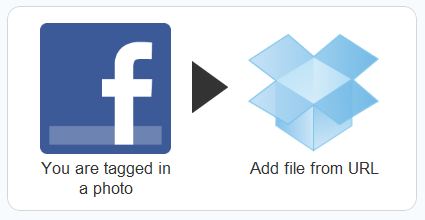
IF I am tagged in a photo on Facebook, THEN add that file to my Dropbox:

IF I check in on Foursquare, THEN add it to my Google Calendar:

IF I upload a photo to Facebook, THEN send it to Picasa:

Earlier this year, we highlighted 20 other recipes that are very useful for professionals in duct taping together digital networks, click the image below to access the list:

Possibly the simplest infographic generator online

Different styles of infographics

The rise in demand for visualization of information in the form of graphics and infographics is happening at a staggering pace and these visualizations are popping up in board rooms across America, on blogs and social networks, and in client presentations, in an effort to present data in a memorable, easy to digest visual format.

Truth be known, most of these visualizations are just as ugly as a Power Point presentation theme from 1994, but at least people are trying, we suppose. Speaking of Power Point, many people whip out their drag and drop skills and create “infographics” for lack of a better term, to achieve their goal of visualization, but this often falls short. Yesterday, AGBeat introduced you to Piktochart, an infographic app for busy professionals that come with pre-loaded themes of infographics that are far superior to most peoples’ PPT skills.

But sometimes, you may be looking for a fast, simple way to add a single chart to your blog to illustrate a point. Enter GOOD Labs, an “infographic” creator, which is more of a graph creator, but let’s go with “infographic” for the time being. Do you just want to do a quick pie chart or venn diagram but have horrible design skills? In seconds, with just a few options, you can create a quick image for a mailer or blog that is either serious or snarky.

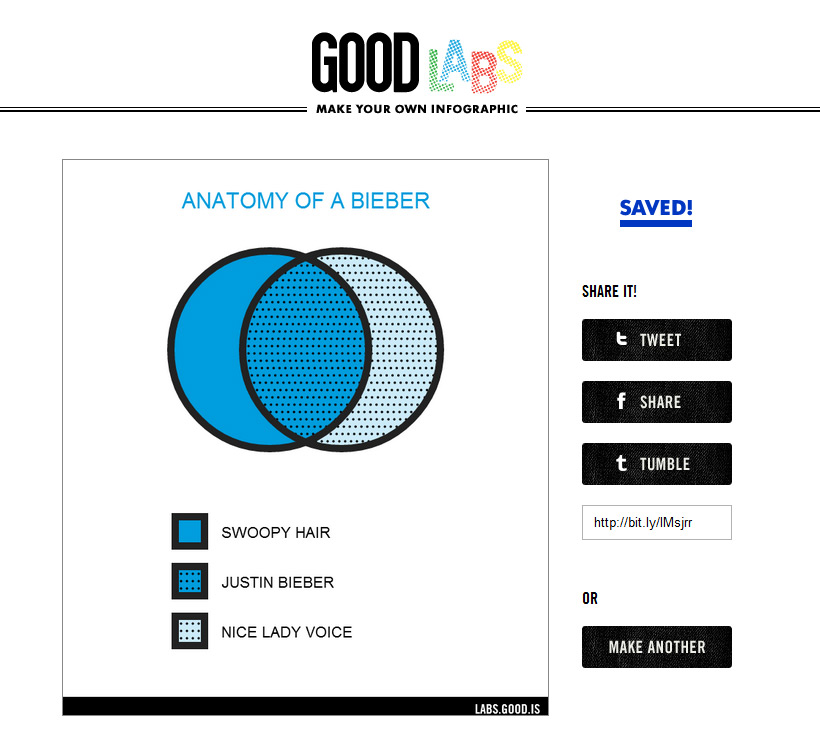
After choosing which type (pie chart or venn diagram), you drag and drop as to the placement of the circles, then pick a title, color, labels, and publish. It gives you a shortened URL directly to the new diagram, and the ability to share it across your social networks. It seriously could not be simpler.

Below is a finished product:

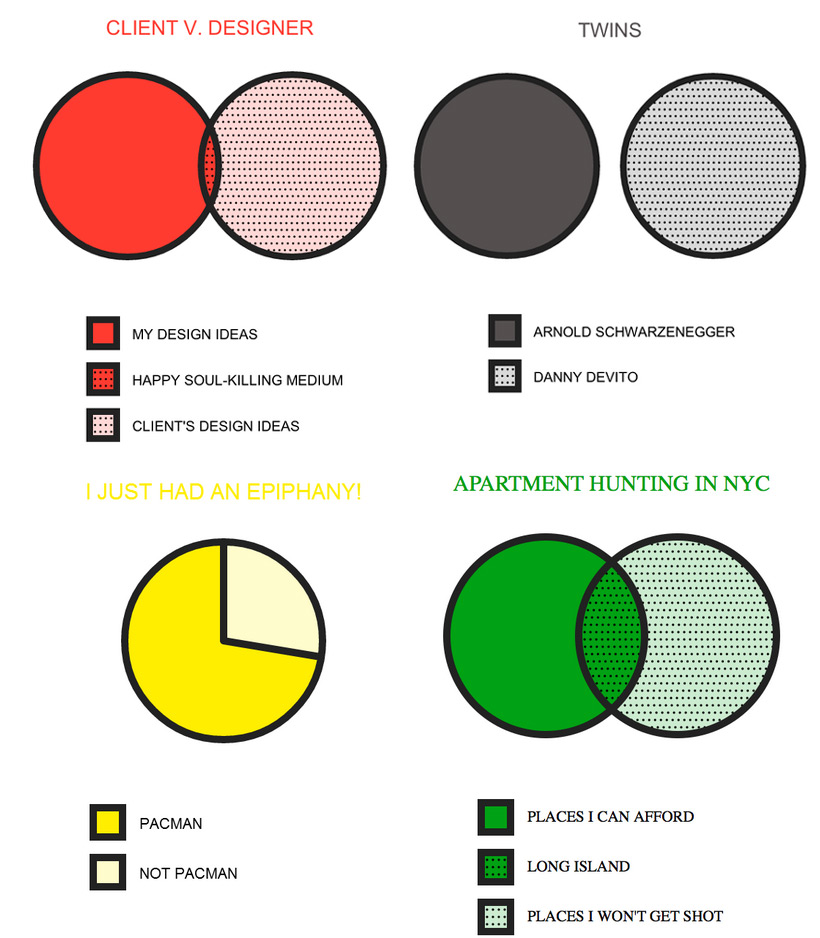
If you’re looking for inspiration, we’ve hand selected four graphics created through GOOD Labs, some are serious and some are silly, but it’s a good refresher for what you can do. You may want to illustrate your skills with a venn diagram about the intersection between your negotiation skills and wide professional network with making money as the sweet spot, or perhaps you want to blog that only 54% of transactions in your industry close within X days via a pie chart.

Facebook revenue exceeds $1B in first quarter, goes on patent shopping spree

13

Revealing documents filed by Facebook

Nearing what could be an approval of Facebook being publicly traded stock under the “FB” ticker, the company filed an amendment to its S-1 documents submitted to the U.S. Securities and Exchange Commission (SEC) in February to reflect their revenue and growth for the last quarter, and included the news of acquiring Instagram and purchasing bulk patents from Microsoft. Facebook’s valuation is now $100 billion and expects to raise $5 billion in its initial public offering (IPO).

As the company approaches a potential IPO date of May 17, Facebook’s amendment notes that monthly active users now total 901 million, up from 680 million last year and daily active users are reported to be 526 million, up from 372 million last year. Monthly mobile users total 488 million, according to Facebook’s amended S-1. Controversy over what Facebook considers an “active user” remains, however, so it is unclear as to whether this number continues to count users that do not log in to Facebook directly, rather visit a site that uses Facebook commenting or has other Facebook integration.

Also reported today, Facebook says 300 million photos are uploaded to the social network every day and 3.2 billion “likes” and comments are posted each day while 125 billion new friends connect daily.

Rising revenues, major acquisitions

Announced weeks ago, Facebook is in the process of acquiring photo-sharing app Instagram for $300 million in cash, plus 23 million shares of common stock, amounting to a $1 billion acquisition. The SEC filings note that if the Instagram deal fails to close, Facebook must pay $200 million.

Facebook reports revenue is on the rise, hitting $1.057 billion in the first quarter of this year, up from $731 million last year. Net income, however, dropped to $205 million for the quarter, down from $233 last year. As is traditional, Facebook updated their risk factors, adding an inherent risk being Facebook’s patent battle with Yahoo.

Facebook buys Microsoft patents just bought from AOL

Also revealed today was Facebook’s agreement signed to acquire $550 million in patents from Microsoft who purchased over $1 billion worth of patents from AOL just two weeks ago. Facebook has purchased 650 of Microsoft’s newly acquired 925 patents, “plus a license to the AOL patents and applications that Microsoft will purchase and own,” Facebook said in a release.

“Today’s agreement with Facebook enables us to recoup over half of our costs while achieving our goals from the AOL auction,” Brad Smith, executive vice president and general counsel of Microsoft, said in the release.

Facebook made a bid for the AOL patents as did Microsoft, but Facebook’s bid was too low, according to Businessweek sources close to the deal.

ListHub gives brokers more control over listing syndication

Brokers can better control their marketing choices

ListHub, a Move, Inc. company, provides Multiple Listing Services (MLSs) and real estate brokers and agents with a listing syndication platform. Today, the company gave AGBeat an exclusive sneak peek at the upcoming launch of new controls for their 43,000 broker users regarding where they syndicate their listings and what marketing choices they make.

Through the ListHub dashboard, brokers have been able to opt in or opt out of syndicating to particular real estate search sites, and recently, the company added a scorecard to each syndicator so that brokers can educate themselves on what exactly each site offers, their terms of service, and the like, and today, ListHub has added filtering through their system. Now, brokers can choose to syndicate based on filtered parameters based on how each site uses data or what practices they adhere to.

Current filters set for brokers

Brokers can query based on that criteria, so they can opt in or out of each real estate search site if, for example, a site does not display broker contact information or whether they provide metrics or not. The options include:

  1. No Re-Syndication
  2. Posts Redirect Link
  3. Provides Error Reports
  4. Provides Metrics
  5. Real Estate Network
  6. Shows Broker Contact Info
  7. Timely Listing Removal
  8. MLS Preferred

The company tells AGBeat that the list of filters will grow over time, based on feedback and demand. ListHub will also be soliciting broker ratings of each real estate search site and offering ratings and comments based on a five star system, featured next to each syndication option. All data can be sorted based on their score, which because the system is new, has few reviews, but ListHub anticipates this will grow so brokers can add their subjective thoughts on the matter.

For each real estate search site, brokers can drill down into very specific data presented by ListHub, viewing everything from response time to exact terms of use. For companies like Zillow that offer an “extended network,” there is also a frequently updated list of where all of the listing data from their company appears on other sites like local papers or other websites (note: data never leaves a real estate search site’s databases, but is framed in a search page elsewhere, as the search is “powered by” a company like Realtor.com, typically in a widget).

Brokers don’t have to keep up with hundreds of changes

If a broker decides they only want to syndicate under certain conditions, they are not required to keep up with the changes at each real estate site, rather ListHub does that and will automatically add or subtract sites from the list of where brokers syndicate based on the rules the broker has set (like “do not syndicate to any site that does not show broker contact information”), and notifies the broker of the changes. This is a tremendous advantage for brokers concerned with the minutia of real estate search site updates, which are quite complex.

Otherwise, if a broker has manually selected a real estate search site to syndicate to, rather than opting in or out of one rule, ListHub notifies the broker but does not flip any switches.

Agents and MLSs

Agents are also able to log into the ListHub dashboard and review the wealth of data on these real estate search sites and their scorecards, but only brokers can make any alterations to where their data is syndicated. This could change in the future, as it appears possible that one day, this option system could apply to each individual listing rather than a broker’s entire data feed.

Additionally, MLSs are now able to log in, as opposed to just getting monthly reports, and each MLS can now mark real estate search sites as preferred. ListHub notes that the demand and response for this feature has varied wildly, as some MLSs cannot imagine marking anything as preferred, while others have reviewed the practices of all of the search sites through legal review and wish to allow their brokers to filter based on their recommendation, and are willing to do so.

The new features will roll out to all ListHub users in the next 24 hours (and Georgia later this week), and are already live in five beta markets. ListHub tells AGBeat that they wish to offer flexibility with listing data, be a point of research, and offer transparency about data distribution so brokers can better evaluate their marketing choices.

5 tips for creating fresh web content

Web marketing challenge: standing out

We have all seen those run-of-the-mill, cookie-cutter social media and blog posts that many small businesses seem to put on their sites. It’s not that they’re doing anything wrong, exactly; it’s just that as a consumer, it can feel like you’re getting a lot of the same kinds of posts from several different kinds of businesses. This can present a huge challenge in online marketing. The more businesses hop on social media sites and maintain their blog on a regular basis, the more pressure there is to stand out. It has become more important than ever to create fresh content, which makes many scratch their head and ask, “How?”

Not everyone can just sit down behind a computer screen with a task at hand and be inspired. Even the most creative of people can struggle sometimes to create something new and innovative. What many don’t realize is that oftentimes, the most unique and interesting of content wasn’t over-thought. Often, your best ideas can come to you just by living your every day life. Below is a compilation of a few simple suggestions to help you use the resources immediately available to you each day to come up with fresh topics that you can write about on your social media and blogging sites.

Tip one: engage your enthusiasts

•    Use your biggest fans to your advantage. Everyone loves a good story. Reach out to past customers or clients who have had the best things to say about you and ask them to give you a testimonial of sorts. From there, use what they’ve said and tell a story about what their experience was like. This is something a bit more creative that you could throw in once in a while. Doing it too often could be a bit much, but throwing in positive feedback about your business on occasion could create interesting content that bolsters your business at the same time.

Tip two: tools at hand

•    Do you like an app, product or particular vendor? Consider writing about them if it pertains to your audience. Do it without “striking a deal” with the other party, and avoid direct endorsements, lest your site lose focus. Just think of a product that you particularly love to use that you think could help your consumers and write about it. From there, send what you wrote to the company whose product you endorsed and voila: you could have just formed a new business relationship that could come in handy down the line while providing content that people may actually find useful.

Tip three: pay attention to questions

•    Listen. I’m sure as you meet people and tell them what you do; people have questions to ask you about your line of business on occasion. They want to know what you do, how you do things, and what results you see. People are interested in these things. Pay attention to these questions and write them down, because they make great blog posts. Remember, if you’re a business to consumer organization, you’re going to want to write things that are meant for your customers. They may not understand all of the intricacies of your business. Blog and social media outlets are a great way to educate and inform as well as promote your brand.

Tip four: news in context

•    Do your research. It is okay to go off-topic once in awhile and write about a topic that is clearly trendy in the web world. Every day, as you log on Facebook, check out streaming Twitter feeds or see news scroll across the online media sites each day, take note of what people seem to be talking about. Granted, you want it to stay appropriate and interesting for business purposes, but you can take a piece that seems to be of interest to the public and write about it. Granted, you want to steer away from controversial news stories, but new tech releases or major news could make a great topic to post about in the right context.

Tip five: seek inspiration

•    Use others in your field to help you. While you don’t want to “copy” the competition on a regular basis, it is okay to monitor the social media and blogging sites of others in your field for inspiration. One of the benefits of having such awesome technology offered to us is that you can use it to compare ideas and benefit from others successes. In my opinion, there’s nothing wrong with learning from your competitors and using some of what they have to say in your marketing efforts. Focus on your own ideas most of the time, but know that it is okay to find inspiration through someone else.

The takeaway

As you read over these ideas just listed out, I’m sure you’ve noticed that a lot of these tactics involve things that we do every day, anyway. We all monitor the competition on a regular basis, surf online news sites, talk to our loved ones about our job, recommend products to others and market our business. It’s all about using these day to day activities in a way that’s creative and can benefit your online presence. If you can think outside the box, you’ll find that you can get inspiration from just about everywhere, and from there, the custom content will start to flow naturally.

Housing’s silver lining: turning REOs into rentals

REO-to-rental market

With a continually struggling housing market, the prognosis for the sector is still poor, but there are areas of the nation and types of investments that are improving greatly, pointing to signs of life in real estate. One company embodies the signs of health, a family-owned company in Memphis that focuses on the REO-to-rental market.

Memphis Invest converts distressed REO properties to rentals, and they place a tenant, so it is a performing asset for private investors. The company recently released their first quarter activity report, showing a 67 percent year-over-year increase in the number of its homes sold to investors. Of those, 82 percent were REO, thus providing the nation a great example of how the REO to rental strategy can help revitalize communities one home at a time.

Chris Clothier, Partner at Memphis Invest is one of the nation’s leading experts in single-family rental real estate services and attributes the company’s growth to lower prices and lower interest rates, as he notes they have “removed many barriers for both novice and experienced investors, and these individuals are now getting heavily involved in the single-family rental housing industry.”

Clothier added that many investors have no interest in being a landlord, so they work with companies like theirs to allow remote involvement. “That ease of entry and passive involvement also lead investors to move beyond two or three properties and into portfolios of seven to ten,” said Clothier.

Cities primed for growth

The REO conversion market is heating up, and Clothier points to Memphis, Dallas, and Atlanta as hot spots. “We obviously like Memphis and Dallas,” said Clothier, “and feel that they will continue to be strong markets for single-family rental investments, and we continue to look toward expansion into Atlanta and possibly Nashville. These southern cities are some of the fastest growing areas in the country and have solid, fundamental economies in place. Large employers, solid infrastructure and solid future demand for their core industries mean consistent demand for good housing in these markets. In light of the shift from home ownership to renting, much of that housing demand will be for high quality rental housing.”

Making an important distinction, Clothier adds, “So MSAs with growing economies, solid fundamental industries and growing populations are prime areas – not simply cities with high concentrations of foreclosures.”

What government programs should be expanded or contracted?

In an election year, there is much focus and introspection as a nation as to what our government is doing to help or hurt the economy, and Clothier takes an optimistic look at which programs are beneficial.

“A federal government program that I would like to see expanded is the Federal National Mortgage Association’s (FNMA) role in providing funding to SFH investors,” said Clothier. “This is a group that can and will adhere to stricter guidelines designed to offer protection to FNMA’s portfolio. I would love to see FNMA expand their financing options for investors beyond 10 properties and couple that expansion with tighter lending requirements such as higher down-payments. If investors were asked to put 35 percent to 45 percent down on investment properties in order to obtain mortgages number 11-20, I feel this would draw many investors who are sitting on the sidelines holding 10 mortgages back into the market. These are typically investors who would like to be participating but would prefer to stretch their capital further by using financing.”

Clothier noted, “In addition, I would love to see the federal government work with local governments to turn over foreclosed properties in extremely blighted areas for the local government to remove dwellings and take the properties back to unimproved land. This would greatly reduce crime in these areas, discourage vandalism and blight and when the time is right, allow a community to re-invest and rebuild areas.”

Company growth plans

Where does Memphis Invest see their company headed? “Our growth demands are predicated by the appetite of our clients,” said Clothier. “We are constantly being asked for more options to diversify portfolios and are answering that demand by entering Dallas and Atlanta.”

The company says they will be managing over 2,000 properties in Memphis, Dallas, and Atlanta by the end of 2013, representing $200 million in real estate value. “Future plans involve identifying additional markets that include Nashville, among others, and continuing to meet the demand of the new investor,” noted Clothier.

Make your iPad work like an SLR camera

14

Two new products to enhance iPad use

Two prototypes have been developed by Manhattan Edit Workshop founder Josh Apter to make an iPad work like an SLR camera. The Padcaster is designed to mount an iPad to a tripod, and the Lenscaster is a universal mount for attaching SLR lenses to the iPad’s camera. The aluminum frame of the Padcaster doubles as a DSLR rig, turning your iPad into a legitimate video recorder.

The Lenscaster allows you to use a standard 35mm adapter to attach any SLR optic, which Apter says adds shallow depth of field, zooming, and manual focus to your iPad camera. The Padcaster devices are currently on backorder and are said to go for around $200, and the Lenscaster attachment is $60.

The video below is of Apter describing and demonstrating the Padcaster and Lenscaster at a trade show, but offers a quick glance at the product already garnering so much buzz:

Below are two videos created using the Padcaster, which you can tell instantly are much higher quality than shooting with a standard iPad:


Other iPad accessories

While Padcaster and Lenscaster are on backorder, so is the iPhone/iPad boom mic that plugs right into either device to massively improve sound quality, but we imagine that these three devices paired together could make some incredible video happen right from your favorite device.

Video is rising in popularity and web video has gone mainstream, so videographers, hobbyists and regular business folks are looking for tools to make their videos stand out in a sea of mediocrity. The two videos above that were filmed and edited on an iPad are a perfect demonstration of the level of quality that can be achieved through something as simple as a tablet, and even an iPhone, as the Padcaster folks say they are working on a case that fits other tablets and smartphones as well.

Scraping real estate listing data is a red herring controversy

The red herring of protecting listing data

A recent blog post on the Realtor.com lockbox blog starts out with the rather definitive and provocative statement:

“Listing data.
It’s valuable, it’s important, and it’s something that a lot of folks are trying VERY hard to steal and misuse.”

So, I figured it would only be fair to start my editorial with something equally provocative:

“Listing data.
It’s so common online that it’s a commodity of far less value than you’ve been led to believe.”

Before the comments fill up with angry missives, I want to be clear that I don’t condone scraping, I think it’s unprofessional and undignified, and I fully support Realtor.com’s efforts to prevent it. But I also don’t lose any sleep over it, and here’s why I think it’s a red herring.

Realtors used to be valuable because we were the gatekeepers to listing data. We knew what was for sale, how much it cost, and where you could find it. And the only way to get that information was to work with us. Perhaps you saw a name and number on a lawn sign, or a friend suggested their agent, or you just walked into a real estate office and chatted with the available floor agent.

In an era where all of the information we once so closely guarded is now available for anyone online 2/47 without having to talk to a Realtor, it’s easy to feel irrelevant. Our value hasn’t gone away, and I’d say our value has actually increased because of the incredible amount of data now available online. Where is the value in a Realtor?

The modern value of a Realtor

First: Making all of the data make sense
We can make sense of all of that data and put it in a meaningful context in a way that makes it easy for a particular client to understand. For an agent that actively tours in their market and engages daily with buyers, sellers, lenders, appraisers, and other real estate professionals it’s so easy that we sometimes don’t realize how valuable it is to take a huge amount of data and distill it to the relevant, essential and important information. This isn’t meant to sound patronizing to home buyers and sellers. They aren’t babies who need to be gently spoon-fed an easy to digest puree of real estate information. But home buyers and sellers have jobs, lives, families, children, pets, travel plans and hobbies – and they can’t put all of those things on pause to buy or sell a home.

Second: Real Estate will always be about People
It’s about people buying and selling homes. Yes, square footage matters. Yes, location matters. Yes, bedrooms, bathrooms, school-districts and plenty of other data points factor into the decision. Research1 has shown that the greater number of data points involved, the worse our conscious minds are at making the decision. It’s the ability to trust your gut, and have someone that you trust – an expert – to cross-check that feeling by being able to turn and say “I can’t put my finger on it, but I really think I like this home. What do you think?” Moments like that are when real estate is more about the people involved than the home itself. While I might ask Siri where to help me hide a dead body (just for fun and games, I assure you), I can’t envision the day when people are comfortable asking her if they should buy this home or that home. There are too many intangibles for a computer program to ever capture the quirky, bizarre, hard-to-describe but important details in buying a home.

Third: Websites only capture the easy data
Beds, bath, Square Feet, Date of Construction, Schools, etc. Those are the easy fields to capture, display, sort, and generally manipulate. But what about those items that are highly subjective, periodic or otherwise hard to easily classify and assign a value to? What’s light and airy to you may be a cave to me. What about the house next to the high school field used for band practice late into the evenings – but only during certain months of the year? Can you imagine the number of data fields it would take to capture every possible aspect of a home throughout a year? And if you can, see point two above.

Fourth: Negotiating and Navigating Escrow
Ever gone white water rafting without a guide? If you have, and you’re still alive to tell the tale, then you are both insane and lucky. It’s common sense to hire a guide when you are negotiating and navigating wilderness that is unknown to you – particularly when your day job involves sitting in a cubicle and wearing stylish shoes. Plunging into the river called escrow without a Real Estate agent to smartly negotiate and navigate on your behalf is inviting disaster. Real estate is filled with wildly unpredictable animals, well-camouflaged dead-ends, and false mirages – the cost of a simple mistake can be far greater than it originally appears. Just like the wilderness!

Realtors are more valuable when listing data is a commodity

So if Realtors are more valuable when listing data becomes a commodity, why the concern with scraping?

One: it makes it easy to misrepresent who the listing agent for a property is. If you are going to display my listing on your website (and depending on who you are, I might or might not be okay with that), at a minimum, I want credit as the listing agent. Not because I want to represent both sides of the transaction (double-popping/agent level dual agency) but because I worked hard to get that listing and my reputation online is incredibly valuable to my business.

Two: Accuracy. If I had a dollar for every phone call I got from clients looking on Trulia, Redfin, or Zillow asking about listings that are advertised as available but really aren’t available, I’d have a Benjamin and a few extra Lincolns in my wallet. And these are from some of the big players that work hard at keeping their data up-to-date.

Three: I’d prefer to make money from my hard work, thanks very much. Plenty of sites using scraped or syndicated data have business models that don’t rely at all on selling houses. Trulia, Zillow and even Realtor.com (and these aren’t even the scrapers) are in the advertising business, making money by selling advertisting on their sites regardless of if a particular home sells or not. They aren’t interested in selling homes, they are interested in generating page views and click-throughs. But to generate those page views, they need your listing data. Which they get without ever offering me or my broker a few dollars…

The continuing evolution

Listing data is on the internet, and it’s not going anywhere. How and where it is displayed, how it is protected (or not protected), and who controls it will continue to change and evolve. Realtor.com wants you to know they are obsessed with defeating the scrapers. But like I said, I think it’s a red herring and pretty far down on my list of concerns. What about you?

1 Research about decision making

Visualizing the differences between UX and UI

What is UX? Isn’t that just UI?

It is common for people, even inside tech circles, to use the acronyms UX and UI as synonyms, but they are quite different. UX stands for “user experience” while UI stands for “user interface.”

We’ll let Wikipedia do the defining:

  • “User experience (UX) is the way a person feels about using a product, system or service. User experience highlights the experiential, affective, meaningful and valuable aspects of human-computer interaction and product ownership, but it also includes a person’s perceptions of the practical aspects such as utility, ease of use and efficiency of the system. User experience is subjective in nature, because it is about an individual’s feelings and thoughts about the system. User experience is dynamic, because it changes over time as the circumstances change.”
  • “A user interface is the system by which people (users) interact with a machine. The user interface includes hardware (physical) and software (logical) components. User interfaces exist for various systems, and provide a means of: (a) Input, allowing the users to manipulate a system, (b) Output, allowing the system to indicate the effects of the users’ manipulation.”

Visualizing these terms

Still too broadly defined? Need something more concrete? Designer Ed Lea designed a series of photographs which viewed in order creates a very simple visualization that define the differences between UX and UI, revealing how they are not, in fact, synonyms, and demonstrates how they relate to a product.

Further, the visualization shows the role of servers and data centers, and will make all of these terms much easier to understand:

See? That isn’t too complicated. Now, when you go to that tech happy hour and someone says that they do “UX and UI,” you know what they are talking about and can ask relevant questions (and in some cases, you’ll spot the acronyms being used interchangeably and you will know the difference).

New Photoshop template for creative Facebook Timeline Covers

Facebook makes more changes

After businesses have meticulously created custom designs for their Facebook Page cover photo to cleverly connect with their profile picture (as seen here), as have individuals for their page, Facebook has notified users that on April 26, they will be updating the size of the profile picture on all Pages to 160 x 160 pixels to site 23 pixels from the left and 210 pixels from the top of the page.

The change has altered the appearance of pages already, as seen below, rendering once beautiful and custom pages and profiles defunct:

All of that cleverness has gone down the tubes, but alas, we have the answer – an updated Photoshop template (courtesy of HongKiat.com) so you can get your creative juices flowing again and get your Page back to its once glorious appearance. Personal profiles have been impacted already, and Pages will be altered on April 26.

List of new dimensions

There are important dimensions that you should know:

  1. Cover photo size for Pages and Profiles: 850 pixels wide, 315 pixels tall
  2. New profile picture size: 160 pixels wide, 160 pixels tall
  3. New profile picture arrangement: 23 pixels from the left, 210 pixels from the top
  4. Cover photo size for Groups (which has no profile picture featured): 800 pixels wide, 250 pixels tall

Looking for inspiration?

Before the Timeline features were rolled out for Facebook, we hacked our way into using the cover photo features and found other people who had done the same, featuring 50 Facebook Timeline Covers as examples and offering best practices tips, including how to avoid looking like your Facebook is all mucked up like a MySpace profile.

Then, because you wanted more, we highlighted 50 more Facebook Timeline cover photos for you to peruse. And then you wanted more, so we showcased 40 brands using Timeline Cover photos on Facebook Pages.

That is 140 cover photos for you to peruse and get motivated by – not all of them are creative or even custom, but take from them the spirit of creativity and come up with your own through the Photoshop download, and if you don’t have the skills, ask your designer or a friend to help out.

Industrial hemp now being used to build homes

That creepy line from Dazed and Confused

“I get older and they stay the same age…” It happens to be my favorite- yet super-creepy- quote from Dazed and Confused. Why do I share this with you, you ask? I am sharing that with you because I feel that sometimes in construction, the foremen, or the builders themselves stay with their old-school trends while the evolution of the products changes around them… the builder might not move along with the trend… so they get older, and they stay the same age flip flops in construction.

It is common in the age of energy efficiency and sustainability for builders to be hesitant to change from what they know, so they are comfortable with the “same age,” in effect. Sometimes new products and technologies don’t appeal to builders who have been doing things the same way for 30+ years. They have to learn something new and learning about a new product can be confusing, especially when it involves something like hemp.

Hemp Board, Hempcrete, hemp hurds, what is all of this stuff, anyway?! Everything can move a bit more slowly a few days after 4/20, am I right? What would I know about that? Nothing really. I’m a smarty-pants. That’s all. Let’s move on, shall we? Industrial hemp is not what you roll up and smoke, let’s get that clear. That is cannabis sativa, and industrial hemp is a far cry from that stuff.

Let’s experiment, shall we?

20 years ago back in Ireland, some folks decided that they were going to experiment with the hemp hurds in another alternative way, mixing the material into a lime base that boasts itself as not only cost effective, but fire-proof, pest resistant, a good product for a carbon neutral home production, and more.

Some folks say that this product is more easily worked than the traditional concrete counterpart and that it does not require expansion joints which would lessen the costliness of a project. Along with these proclaimed benefits, this hemp-based product is said to have a higher R-value (thermal resistance) than that of traditional concrete- but this is still being investigated. Around the country, carbon neutral builders and designers such as the folks at NauHaus are giving their kudos for the strength, durability and sustainability they believe to have found in this hemp based construction application.

Hempcrete – a gateway product

Hempcrete isn’t the only hemp hurd based construction product out there. Learn some things about this gateway product! A few years ago at the 2009 Green Festival in DC, I was able to meet the folks who do the hemp board, and I got all excited about the possibility of building with this product, and now, the rage seems to be about the hempcrete product that boasts just about as many positives as the hemp board material.

Even back in 2009, the HempTraders had set up in front of the stage was a fort-like building made entirely of hemp. It was like “chunked and formed” made hardibacker, but it was made out of hemp! The man flashed a series of slides showing the progression of the process from the fields of hemp which seemed to stretch for thousands of acres to the chipped up final product. I was thinking that it could be a wonderful product for small or large projects where you are looking for an MDF alternative that provides for a healthier indoor air-quality.

It is impressive to know that not only can hemp be used for its fibrous stalks and oils, but also can be used in its hard pressed form as a sustainable, rapidly renewable building material. Hemp shives also known as hemp hurd is the “chunky part of the stalk that once it is stripped of the fiber” is used along with a no formaldehyde based resin to be pressed together to form the durable board that the aforementioned fort-like building was constructed. It really just look exactly like particle board, only it is smooth to the touch and you can see more of the grains of the fiber throughout the product.

The folks who were set up at the GreenFestival back in the day were the informative people of Hemptraders.com. On their website, they mention that their “real medium density fiberboard made entirely from 100% hemp hurds. No tree was sacrificed to make this board. The binder used to hold it together in entirely environmental and uses no formaldehyde based resins. Use this board to make environmental furniture, counter tops, walls, and shelving. The number of uses are infinite. Save trees and improve your home at the same time with Hempboard.” Hemptraders.com has a fairly comprehensive written history of the plant from its origins to its current uses and how “materials made from hemp have been discovered in tombs dating back to 8,000 B.C.E.” As a healthy alternative to MDF for your household projects, look into the Hempboard and hempcrete as options and see what other possible green products you can use on your green remodeling project.

Looking to the use of new products, and technologies when building is just one way that you can try to reduce your impact on the environment and strive towards a healthier lifestyle and sustainability in construction. It doesn’t have to be so confusing.

Photo: hempcrete home in Asheville, courtesy of Hemp.com

Piktochart: simple infographic creator online for the busy professional

Rise of the visualizations

Businesses of all sizes are taking advantage of the increasingly available web tools to better present information visually, be it at a company meeting or in presenting services and products to a client, and there is no shortage of infographics these days. But because the trend for the past few years has been toward visualizing any information possible, you end up with infographics that are more like this:

Even professionally designed infographics come out like the one above, or on the other extreme, professionals present data in the traditional, ugly form that is uninspiring, as below:

You can do better

The two images above are embarrassing for professionals as the information is convoluted or lost in a sea of bad design. Companies typically rely on their in-house or third party designers to create visualizations for them, and are now commissioning them for their own website and blog in a rising number, presenting information to the public about their inner workings, but also for internal use so that information is visually presented, simplified, and easy to overview.

Enter Picktochart.com, the infographic app that allows users to select a theme for their infographic, edit information and customize, then save to various formats. If you are capable of editing a PowerPoint presentation, you will master Picktochart.

In about 10 minutes, we created this infographic below through Piktochart (the information is fictional and is just a sample):

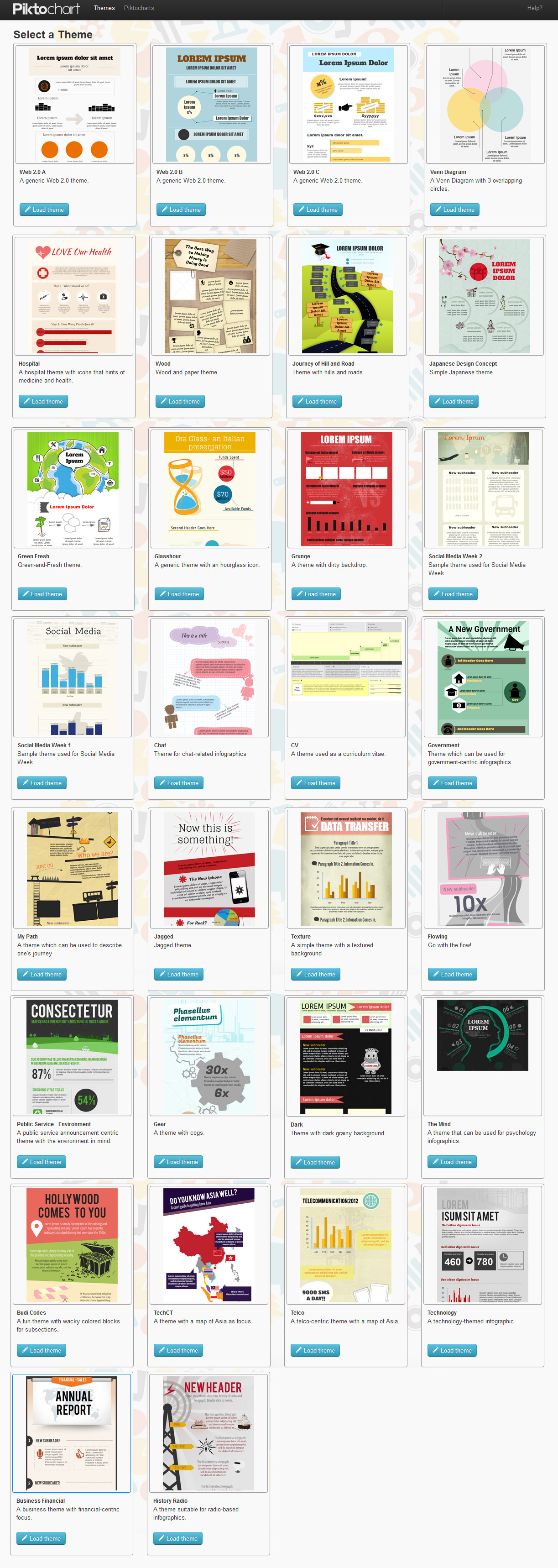
It’s not all about social media though, you can present a variety of information visually. Below are the 24 Picktochart themes, and the company says they will be adding more over time:

Piktochart does not require contracts or setup fees and has a free version which offers 3 themes, a $9.99/mo PRO version that offers 15 themes and customization, and an Annual Pro account for $99/year. It appears these prices are a launch special that ends this month, but compared to commissioning a professional infographic (which is notably more desirable), this is a good alternative for small businesses on a budget.

Alternative infographic makers

While Piktochart is an inexpensive, easy to use option, there are others on the market worth checking out.

  1. Piktochart – Transforms your information into memorable presentations.
  2. Infogr.am – Create interactive charts and infographics.
  3. Gephi – Like Photoshop for data. Graph visualization and manipulation software.
  4. Tableau Public – Free data visualization software.
  5. Free Vector Infographic Kit – Vector infographic elements from MediaLoot.
  6. easel.ly – Create infographics online.
  7. Weave – Web-based analysis and visualization environment.
  8. iCharts – Charts made easy.
  9. ChartsBin – A web-based data visualization tool.
  10. GeoCommons – See your data on a map.
  11. Prefuse – Information visualization software.
  12. StatSilk – Desktop and online software for mapping and visualization.
  13. Gliffy – Online diagram and flowchart software.
  14. Hohli – Online charts builder.
  15. Many Eyes – Lets you upload data and create visualizations.
  16. Google Chart Tools – Display live data on your site.

UPDATE: if you’re looking for hilarious inspiration or want a good laugh based on a Piktochart created by a busy professional, Kris Berg’s San Diego Home Blog has a great example for your perusal.

Intricate parody site targets Bank of America

Bank of America taken to task

It is unclear who has created and funded a new anti-Bank of America website that is part parody and part practical solution forum, dubbed “Your Bank of America” that is garnering quit a bit of traffic and attention.

Bank of America is the nation’s largest bailed out bank with many marks against them ranging from illegal foreclosures to major executive bonuses, and somehow the site has not yet been removed, but we suspect that with swift legal action from Bank of America suggesting it is damaging to their brand, the site will not likely remain forever.

There are many “[Xcompany]sucks.com” sites on the web, but this is a much more intricate effort than we traditionally see. Users can even create their own Bank of America advertisements, vote on the ideas to improve the bank, and while the facetiousness is rampant, there are some legitimate suggestions as to how the bank can improve.

About the site

To give you an idea of the tone of the site, this is their about page:

Born in the rubble of the great San Francisco earthquake of 1906, the story of Bank of America is the story of America. From handshake loans to complex derivative contracts, from the boom and bust commodities market of the early 20th century, to the red hot real estate market of recent years, Bank of America is the American dream writ large: humble yet bold. Both America’s neighborhood bank – and one of the largest financial institutions in the world.

And as America is adapting to change, Bank of America is too. With businesses across America emerging from the economic downturn leaner, more efficient and ready to grow, some companies see the opportunity to make acquisitions and others to expand into new growth areas. For years, even after the recent economic downturn, we too looked to growth as a reason in itself for being. But the results have given us pause – despite major acquisitions, and a number of restructurings, Bank of America stock has lost 75-80% of its value in five years, returning weak profits and ending in a near-junk credit rating.

Bankers are paid to see the writing on the wall – the future. And in Bank of America’s case it’s highly likely that the future involves federal receivership – a new relationship with the American taxpayer. As such we look to the future both chastened, and with a renewed sense of possibility. As the residents of earthquake stricken San Francisco dug themselves out of the rubble through elbow grease and cheap credit, Your Bank of America is rolling up its sleeves, and getting to work. We can’t wait to see what the future holds.


Report: the tight link between housing costs and school quality

Housing costs, income, and school quality levels

According to the Brookings Institute’s new report, “Housing Costs, Zoning, and Access to High-Scoring Schools,”1 the obvious correlation between high scoring schools and high costs is asserted, but exactly how much more does it cost to live in a quality school district? An extra $205,000, says researchers.

The report indicates that home values average $205,000 higher than public school districts with low scores. Other trends became clear as well, with researchers saying that homes in high-scoring neighborhoods have an average of 1.5 additional rooms, and less than one in three are rental homes.

Across the 100 largest metropolitan areas, housing costs an average of 2.4 times as much, or nearly $11,000 more per year, near a high-scoring public school than near a low-scoring public school.

Also not surprising is that areas with wide gaps in housing costs also have the widest gaps in school test scores. Brookings names the Bridgeport, CT area as having the widest gap in test scores between higher-income and lower-income neighborhood schools, with the largest difference in housing costs at $25,000.

Low-income and high-income areas and test scores

Additionally, income has a very high impact on school test scores – the Brookings report reveals that the average low-income student attends a school that scores that the 42nd percentile on state exams, while the average middle/high-income student attends a school ranking in the 61st percentile.

Brookings found that poor students have become more concentrated in schools with other poor students since 1998, and the average low-income student attends a school where 64 percent of fellow students are low-income, despite their representing only 48 percent of all public school students in America. The percentage of economically integrated schools is less than 7 percent.

Researchers conclude that “across the private, non-profit, and public sectors, there are many compelling efforts to improve the quality of education available to low-income children. In documenting the tight link between housing costs and access to high-scoring schools, this report illustrates the scale of the challenge, and yet, it also shows that reforms to housing and land use policy could have potentially large benefits to the nation’s future by making educational opportunity more equal.”

1 “Housing Costs, Zoning, and Access to High-Scoring Schools”

New HUD Deputy Secretary sworn in

Maurice Jones returns to public service

After President Obama nominated Maurice Jones last fall, Jones sailed through Senate confirmation hearings ending on March 29th. Jones was sworn in this week as the Deputy Secretary of the U.S. Department of Housing and Urban Development (HUD), becoming second in command to Secretary Shaun Donovan. Jones will manage HUD’s day-to-day operations, a nearly $47 billion annual operating budget, and the agency’s 8,900 employees.

During his confirmation hearings, Jones told the Senators, “Usually, your top challenge to moving any organization to a standard of excellence is having the right people in the right places. Second to that, you also – in these tough times – you have to make sure the organization is operating as efficiently as possible.”

“President Obama and Secretary Donovan have blessed me with the opportunity to join HUD during this critical period when we continue to support a fragile recovery from an historic housing crisis,” said Jones. “I’m ready to help continue transforming an organization charged with moving beyond the yesterday’s experiences to tackle today’s challenges and those we’ll face tomorrow.”

HUD’s Donovan emphasis on Jones’ skill is telling

“Maurice has one of the strongest public and private sector track records I’ve seen for building consensus and solving big problems,” said HUD Secretary Shaun Donovan “As we continue to confront our current housing challenges, HUD will certainly benefit from Maurice’s intellect, his proven management experience and his great people skills.”

Donovan’s comments are quite telling, as he emphasizes Jones’ ability to build “consensus,” which Donovan needs help with in light of his recent housing battles, including his persistence in pushing for principal reductions for troubled homeowners, which the Federal Housing Finance Finance Agency strongly opposes as a means to repair housing.

Jones’ public service and private sector background

Jones added, “Public service has been a passion of mine since my high school days in rural Lunenburg County, Virginia. As a ninth grader, I was fortunate enough to be selected to serve as a page during that year’s legislative session of the Virginia General Assembly. The experience changed my life. I resolved then and there to enter public service when I grew up so that I too could work to make things better.”

This appointment means a return to that public service for Jones, who was the deputy chief of staff for then-Governor Mark Warner, and later the commissioner of the Virginia Department of Social Services. Jones was also special assistant to the general counsel of the U.S. Treasury Department during the Clinton administration. Jones was also legal counsel to the Community Development Financial Institutions Fund and director of the fund during his time at the Treasury.

In the private sector, Jones joined Virginia news outlet, The Pilot in 2005 and was promoted to Vice President and General Manager in 2006, then Publisher in 2008. During the nomination process, he remained at The Pilot but did not engage in political endorsements.

Jones graduated from Hampden-Sydney College, then attended Oxford University in England on a Rhodes scholarship, and later earned a law degree from the University of Virginia.

Senator lodges odd argument to save the USPS as cities opt out of junk mail

The case for saving the USPS

The postal service in America is 237 years old and remains the second largest civilian employer in America, but its existence continues to be questioned as e-mail and electronic billing continues to threaten the need for physical delivery of print materials. Some argue that commerce continues to find success with direct mailers, but others argue it is damaging to the environment to kill trees to print and use gas to carry that print across the nation in bulk.

What no one expected was for a Senator to defend the USPS by making elderly Americans look like Steve Martin from The Jerk when he gets his phone book. But that is exactly what Senator Harry Reid did this week when he said, “Elderly Americans rely on the United States Postal Service… I’ll come home to my home here in Washington and there will be some mail there. A lot of it is what some people refer to as junk mail. But for the people that are sending that mail, it’s very important. And, talking about seniors — seniors love to get junk mail. It’s sometimes their only way of communicating or feeling they’re part of the real world.”

Really? Pizza coupons solve elderly peoples’ loneliness and that is worth preserving a government service that loses $3 billion per quarter?

The case against the USPS

Besides reduction of mail because of the digital era, many claim it has an adverse environmental impact on our nation and is a financial drain. One solution being used by cities is to push for the elimination of junk mail.

The City of Austin this week announced a new plan that would allow its residents to opt out of any or all junk mail, using a service called “Catalog Choice” which is also offered to residents of Cambridge (MA), Chicago, Santa Fe, Berkeley, Seattle, and San Jose.

“The first step to recycling is to reduce what we have,” said Bob Gerdert, Austin Resource Recovery director. “It will also reduce the cost the city pays to recycle this waste.”

Gerdert tells KXAN-TV that the money saved by this initiative could someday result in cost savings to Austin residents. “When it comes time to look at possible increases for solid waste services we may not have to increase it for residents because we have this cost savings.”