Home Blog Page 357

Real estate search sites: comparing 2007 to 2012

Five years of real estate search changes

In five short years, a lot about real estate search has changed, and Realtors are better educated now about the functionality and aesthetics of web design, and expect more from companies that seek to dip into their pockets. Rules have changed, new programming languages have been developed, and five years in the tech world is an eternity – we would say that five years in tech time is 20 years in non-tech time, as innovation is constantly happening all around us.

In these last five years, how have the largest real estate search sites progressed? Some, like Zillow, have innovated by becoming responsive, others have made updates by leaning toward minimalist design, others have updated their colors, and some remain somewhat outdated, we’ll let you decide which is which.

Some companies are publicly traded, others are not, some are funded by Silicon Valley, others are not, some are legacy brands with policies that restricts employees’ social media use under their brand name, while others are pushing the envelope in the name of transparency.

What is most fascinating is that while there is a great deal of disruption to the real estate industry as a whole, particularly the role of an agent, there is little disruption when it comes to major real estate search sites – several niche sites and rental sites have launched in the past five years, but no one has come out to compete with the big three (Zillow, Trulia, Realtor.com) in years.

Below, we step into the time machine and take a look at how five years has changed real estate search sites:

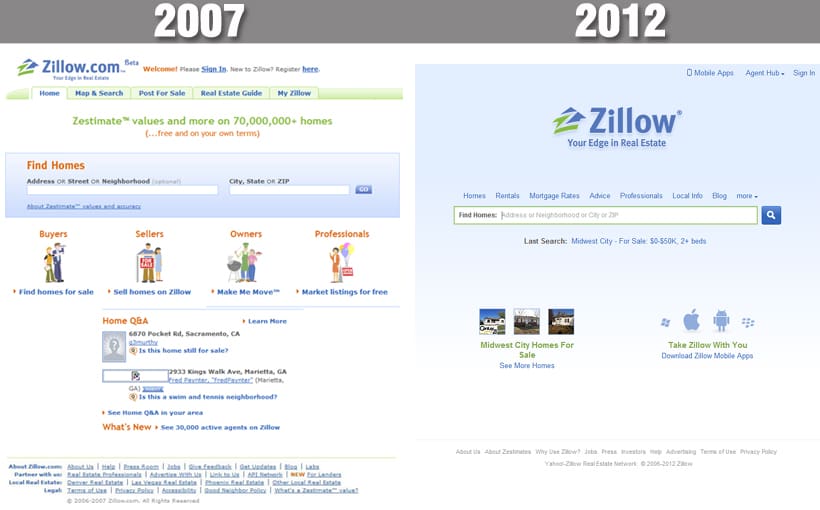
1. Zillow.com

Zillow in 2007 and Zillow today.

2. Trulia.com

Trulia in 2007 and Trulia today.

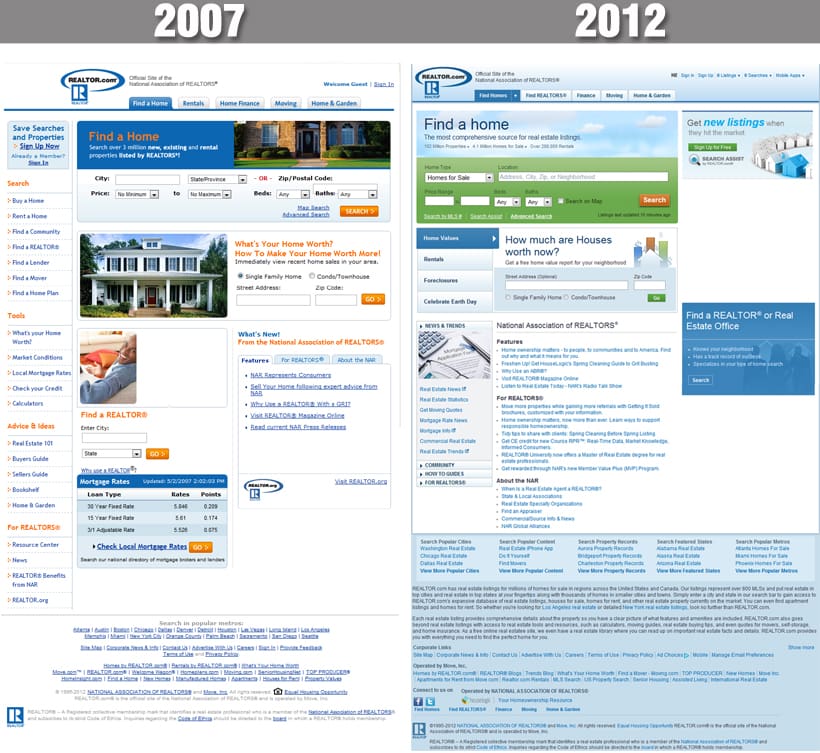
3. Realtor.com

Realtor.com in 2007 and Realtor.com today.

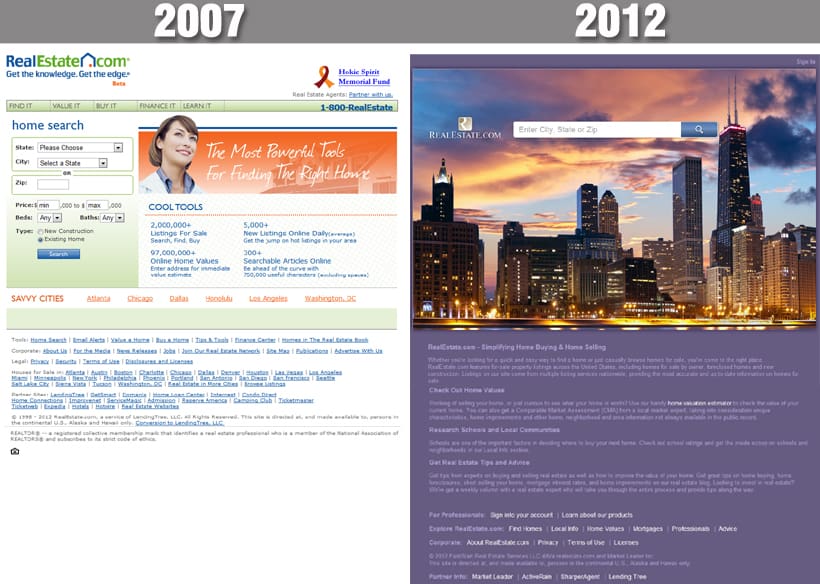
4. RealEstate.com

RealEstate.com in 2007 and RealEstate.com today.

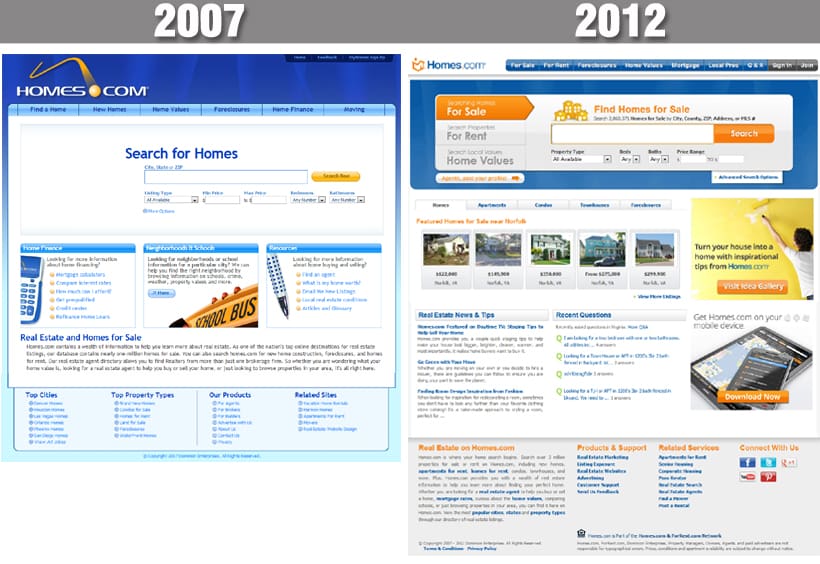
5. Homes.com

Homes.com in 2007 and Homes.com today.

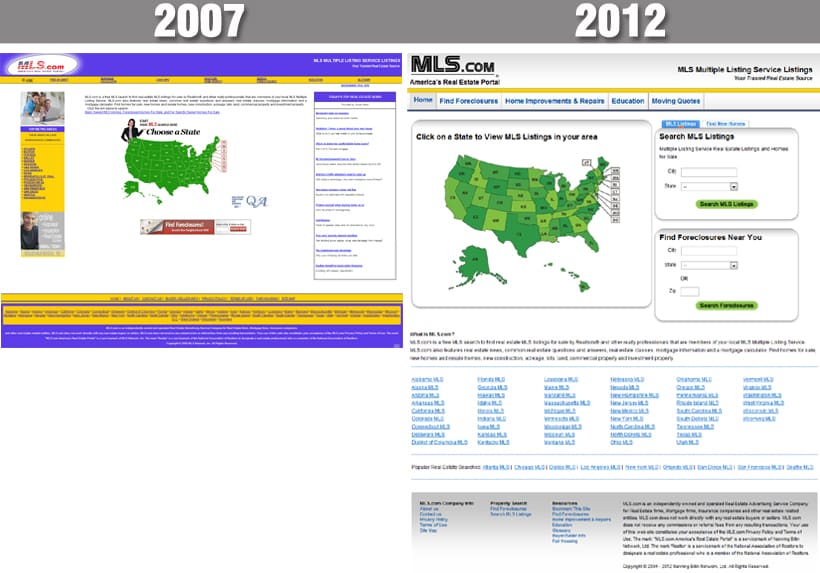
6. MLS.com

MLS.com in 2007 and MLS.com today.

A raw account of life inside of a brand new startup

The inner workings of startup-life

The goal of my column here is to reveal the inner workings of start-up life, and with that life comes an entire spectrum of emotions. I feel like I should post a large emoticon board on my wall so every day I can circle one of the emotions as to how I feel. That changes minute by minute depending on what I am dealing with. No, I am not bi-polar. That’s just how it feels to have a startup.

I was recently asked in a private Facebook group “why do you do what you do?” When I first read the question I did a double take just to read it correctly. That felt like a metaphor because I needed to think about what I was reading and then actually think about the answer. Why DO I do what I do? Because i’m passionate! I’m passionate about the consumer, transparency, being an entrepreneur, the need to make a living, disrupting, creating something people like, technology, the schizophrenic highs and lows of success and failure, seeing if others think like I do, making a great product, efficiency, useful data, the unknown, asking the question “why” and “why not,” and because someone told me once…”you cant do that!”

I have no idea if anyone will relate to these answers or not.

A third business venture

This is my third venture in business and I can happily say I wouldn’t trade my first two experiences for all the tea in China. They are what has made me who I am today, for better or for worse.

We were labeled “pioneers” at my first company. What did that translate to? Nothing but experience. What we did do was blaze a path for many who followed. We pushed forward the evolution of an entire industry. A lot of people who followed in our footsteps made a lot of money. I did not. But I helped changed the way an entire industry operated and I helped champion a cause for the consumer.

My second journey was by accident. It was after my first company was no longer in operation that I accidentally fell into homebuilding. The time was right. I had been raised in a family that was extremely architecturally conscious, I had an eye for design, I am crafty by nature, and many people over the years had said, “you should be a homebuilder. You would be great with your eye for detail.” So, I said what the heck? It was a great run for 10 years building million dollar plus spec homes, but we all know how that ended.

Back to the question of why

Which brings us to today. Why am I here? Why do I do what I do? I already listed the reasons. The problem is that doesn’t make it any easier and it doesn’t always make it fun.

Lately I have been struggling with the issue that nothing can happen fast enough or be good enough. One of my favorite commercials on TV is for Staples where a single person named Dave is cast in his office doing 12 different things all by himself. He walks down the hall, saying “Hi Dave”, as he waves to his alter ego. As an entrepreneur with my own startup, that is my life.

The real frustration for me is the reliance on others to do things I wish I could do myself but aren’t qualified. On the top of the list…WRITE CODE. I would give anything to be a programmer.

Currently, my programming is outsourced. This was the only option to create my beta product. My team is excellent! There are, however, inherent issues that I face. They have other projects. I am not in control of their time. I rely on them for application management. As an entrepreneur starting a company, there is NO ONE willing to work as hard as me, as long as me, or to create a product as well as me! If I could do all of the things I pay others to do, I would never sleep. It is very difficult to get others to share your start-up passion.

Getting others to share your start-up passion

Case and point: on occasion, we will push out a release to our production site. After the fact, I might notice a bug. If I was able, I would work tirelessly to push a fix, but I CAN’T. It kills me because no one feels quite the same about that [bug] as I do. Yes, I want perfection. Is that so bad? Everything I am creating depends on delivering the best product and the best customer experience possible and once it makes it to www, it is a reflection on us.

My team does their job and does it well, but I will soon face other issues. I need better controls on what we are doing. I am a one man show right now. Our dev takes place in a completely virtual environment. I work daily with a team of four. Three live almost an hour away and one is in London. We are extremely agile.

Two ways to develop

For those of you who dont know what I mean, let me explain. As I see it, there are two ways to develop:

First, you can sit down with a company, pay them to do a Scope & Discovery with you for a cost of $10,000 to $15,000 dollars where they will go over as many details of your application as you can think of. They will help you develop user stories, functionality, workflow, and if they provide assistance in business consulting, they will throw in some strategy planning as well. Strategy might consist of pre-launch planning such as creating a buzz, capturing sign-ups to keep prospects “in the know,” beta testers and when to take out your MVP (minimum viable product).

The BIG problem is after you have spent a week with these guys, they will want a big deposit. Then they will want you to GO AWAY! They will try to create and code your product, working from what they have as their understanding, with as little contact as possible. The reason for this is logical. They want to knock out as much code while not allowing for any scope creep. This is actually a good business practice [for them]. If you are a hands on type of person (like me), you will not be sleeping for an indefinite period of time.

Then you show up to review your deliverable and, VIOLA, it’s nothing like you expected. Now you have to pay for the time already spent in dev and the time it’s going to take make corrections. It becomes a “he said, she said” argument about how it was SUPPOSED to be. Everything becomes subject to interpretation. The developers say…”you never said that”. You say…”I thought that was understood,” and the cycle begins. I have painted a worst case scenario here, but it happens.

The second method is developing in a very agile environment which is more of a “make it up as you go along” routine. This is more favorable for the hands-on entrepreneur, and arguably better for the team because there are less mistakes along the way, and things are constantly being refined to be exactly the way you want it. However, with this model exists the dreaded “scope creeeep.”

Scope creep is when you want to add one “neat” little thing. That turns into three “neat” little things and so on and so on. Now you are off track from the prioritization of the deliverable. The devs have spent time appeasing your need for instant gratification, and the project is taking twice as long as anticipated on twice the budget. As ugly as this may sound, it is still my preference.

Every day, subject to their availability and other projects, my team and I are banging on IM’s, group calling on Skype, emailing, sharing files and previewing work on our dev site. This is as close to being a developer as I can be, without actually being one. I love that!

My next challenge

Now comes the first problem as we move forward. I want a dedicated code team. I want more input on a more frequent basis. When there are bugs, I want them fixed immediately. I dont want my project subject to someone else’s time based on commitments to other clients. I want a group that can brainstorm together and not feel like I am imposing on their time. I like a cohesive team working together in a single environment in a single place. I want a team that feels such a strong sense of commitment to our project that they will stay until it is done, and done right. Maybe I live in la la land. But that brings me back to… if I could do it myself… I would!

There are time to market concerns. I wrote last week about the blistering pace of technology roll outs in the real estate technology space right now. That keeps me up at night. I know of only a handful of companies that seem to be headed in the same direction as NuHabitat (my company), but I’m sure there are others. Some of these guys are the big boys with deep pockets, and others are like me.

My next challenges lie ahead and there is a great deal more I have to do to get my company where it needs to be, but that is the life of a start-up – constant pursuit of perfection.

7 challenges to becoming your own boss

Branching out to be the boss

In any economy, many branch out in an effort to become their own boss, be it in the real estate, marketing, design or other, seeking control over their finances or simply freedom from the corporate grind. In a down economy, some people do so when they have no options, but many don’t know the challenges they face.

While becoming your own boss sounds like the perfect solution to the woes of your everyday workday, that isn’t always the case. Being your own boss comes with numerous challenges and hurdles. But if you’re prepared to take on those challenges in order to ultimately improve yourself and reach your professional goals, you’ll be one step closer to making the entrepreneur experience your way of life. Here are seven challenges that you will run into when you make the switch to being your own boss.

Challenge one: motivation

1. Staying Motivated – With no one standing over you to complete your work, it can be hard to stay motivated. You have to push through those moments of resistance and keep working. No one is there to push you, only yourself.

Challenge two: customers

2. Dealing with Unhappy Clients or Customers – Because you’re the boss, you have to deal with the unhappy clients or customers yourself. When you worked for someone else, you could always transfer those clients to someone higher up on the chain. But as an entrepreneur, you’re it.

Challenge three: finances

3. Sometimes You’re Paid Last – As the boss, you’re the last one to be paid. When you’ve had a tight month, you have to pay your employees and your bills first. And then you get what is left over, and sometimes, that’s not a lot.

Challenge four: bad guy

4. Forced to Be the Bad Guy – If there is an employee you need to fire or client you need to let go, you are usually forced to be the bad guy. And because you’re the boss, every decision will be based on your personal decision, and everyone knows it.

Challenge five: the real boss

5. Your Clients Can Become Your Boss – While you don’t have a traditional boss, your clients can become your boss when they decide when to meet with you and when you should have project completed. If you’re not careful, your clients will start to make your professional decisions for you. You’ll have to find the balance between keeping your clients happy and maintaining your authority.

Challenge six: boundaries

6. Boundaries with Friends and Family – Because you’re in charge, your family and friends will assume that you can leave work or stop working whenever you want. They may expect you to leave at a moment’s notice to join them at a movie theater or out to lunch. Setting and enforcing those boundaries can be difficult.

Challenge seven: being alone

7. No One to Look Out for You – Since you’re at the top of your company, there’s no one there to look out for you like when you worked for someone else. Before, you had managers, supervisors, and company owners to make sure clients didn’t take advantage of you.

When you’re the boss, you have ample responsibility. You have to take the heat and ease things over with clients. You have to depend on yourself and have others depend on you. Even so, becoming your own boss can be fulfilling if you can handle the challenges that come along with it. When these challenges become too much, remember that every life goal requires some sacrifice. Otherwise, it wouldn’t be worth it.

Louisiana sues 17 banks under RICO laws for MERS scheme

Louisiana stands up to big banks

In the State of Louisiana, 30 judges representing 30 parishes are suing 17 banks, stating that the Mortgage Electronic Registration System (MERS) is a “scheme” set up to illegally defraud the government of transfer fees, and that mortgages transferred through MERS’ recording system are illegal as the promissory note of any mortgage is inseparable from the mortgage, which is what MERS does.

MERS was initially established by Fannie Mae and Freddie Mac nearly 20 years ago in conjunction with several major banks as a means to expedite the loan recording process as it used to be done through individual county clerk offices which was slow, and the founders went ahead even though most states did not have laws that authorized them to bypass the required filing with clerks.

Several states like Delaware and Ohio, along with the City of Dallas have already sued MERS and their bank partners, claiming millions were bypassed in filing fees due, and that the banks should have known that their filing system could lead to improper filing. These claims have been supported by numerous studies, one of which asserts that MERS destroyed the entire chain of title in America and is at the core of the housing crisis.

RICO laws took down the Gambinos, may penalize banks as well

What is different with Louisiana’s lawsuit is that they are pulling out the big guns and suing under RICO laws (Racketeer Influenced and Corrupt Organizations Act), alleging wire and mail fraud and a scheme intended to defraud the parishes out of their lawfully owed recording fees. RICO laws have taken down the Gambino crime family, the Genovese crime family, Hell’s Angels, and the Latin Kings and carry treble damages, which is triple the amount of actual damages.

The banks named in the suit, according to court documents are Bank of New York Mellon, Bank of America, Chase Home Mortgage of the Southeast, JP Morgan Chase, CitiMortgage, GMAC (now Ally Financial), HSBC, Merrill Lynch, Nationwide Advantage Mortgage Company, Suntrust Bank, United Guaranty Corporation, Washington Mutual (now owned by Chase), Wells Fargo, Deutsche Bank, U.S. Bank, and La Salle Bank.

For infractions dating back ten years, the 30 parishes are suing for the following and demanding a jury trial:

  1. Treble damages (which will likely be in the millions)
  2. Prejudgement interest as permitted by law
  3. Reasonable attorney’s fees and costs
  4. Interest on the judgment as provided by law
  5. A permanent injunction
  6. Such other relief as the Court deems just and proper

Gmail Meter: analytics now available through Google Apps

Maximizing email efficiency

We have long advocated for using Gmail in your business, but have also admitted that it is an incomplete tool, but has many extensions and add-ons that can maximize the efficiency of your emailing habits, particularly for small business professionals’ lives where every second counts. If you want to know not just basic information like how many email messages you have sent, but more important information regarding your habits as to response time, you can improve your habits just by knowing your strengths and weaknesses.

Google has announced that Romain Vialard, a Google Apps Script Top Contributor has developed a tool called “Gmail Meter” which is powered by Google Apps Script. The app runs on the first day of every month, or runs custom reports as you designate it to, offering statistics about your inbox.

According to Google, the report offers information on the following:

  • Volume Statistics show you the number of important and starred messages, the number of people who sent you emails, and more. Volume statistics can be very useful in determining how you are using email efficiency tools like Priority Inbox.
  • Daily Traffic gives you an estimate of when you receive messages and when you send them during a given month. For example, in the graph below you can see how the peaks in my “Sent” curve indicates that I write emails in spurts.
  • Traffic Pattern lets you get a sense of your overall email activity over the past week.
  • Email Categories tells you how you are managing your Inbox. In the pie chart below, you can see that the majority of my emails are labeled. My Inbox is tiny compared to other labels which indicates that I keep a lean and mean Inbox.
  • Time Before First Response shows you how long it takes you to reply, and how long it takes others to reply to you. By looking at this chart, I can infer that I reply faster than others I communicate with.
  • Word Count tells you whether you are writing long emails. The example below shows that most of my emails are shorter than 200 words.
  • Thread Lengths help you understand whether you participate in long conversations resulting in long threads. Top Senders and Top Recipients help you identify who you communicate with more frequently.

How to set up Gmail Meter

For the visually inclined, there is an instructional video below the steps outlined below:

  1. Go into Google Docs and start a blank/new spreadsheet, name it “Gmail Meter.”
  2. Go to the Tools menu, select Script Gallery.
  3. Search for “Gmail Meter,” and click the Install button.
  4. Authorize the script when prompted. Once you authorize, you’ll also need to grant access to the script.
  5. You’ll see a “Gmail Meter” menu option, click, then choose Get Report.
  6. When it asks what type of report you want, click “Monthly report” to get started.
  7. The script will start generating the report, and you will receive an email when it is ready (it took quite a bit of time when we tested it).

PeoplePerHour: find hourly talent for small businesses

Pay by the hour

Through their online platform, PeoplePerHour connects freelance talent to small businesses across the world. PeoplePerHour CEO Xenios Thrasyvoulou predicts that by 2020, over half of the West’s workforce will be made up of freelancers using cloud based file sharing services, Skype and platforms like theirs.

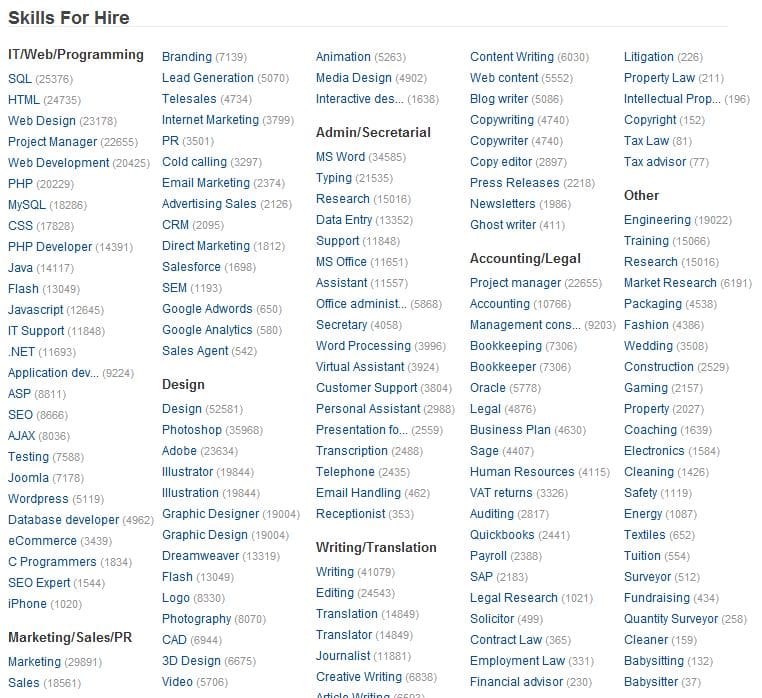
Small businesses can locate hourly help on projects ranging from graphic design, ghost writing, to legal or tech help. Below is the full list of skills offered through the platform:

The platform is not just useful for businesses looking to hire some freelance help rather than hire a new employee, it is obviously also useful for freelancers.

Greta Stojanovic, Director of Public Relations as PeoplePerHour told AGBeat, “What’s great about this concept is that people who are employed full time can dip their toes in the water and find work in the hours outside of the standard 9-5. Once a person builds a reputation on the platform, the chances of getting hired more regularly significantly increase,” which removes instability which is a standard risk for freelancers.

In January, we outlined 10 tasks to hire out to freelance talent, and AGBeat columnist Charlene Jimenez noted, “Getting things done in a timely manner can give your business the potential to be a well-oiled, money-making machine! One task at a time will get you there. And the best part is that you don’t even have to complete the tasks yourself.”

Business decision makers may be a single person operating an entire business that just needs help with some data entry, or a team leader within a major company that needs a flyer makeover – the talent is out there and can be found at reasonable hourly rates on sites like PeoplePerHour. It can be a time saver and a money saver, rather than hiring a new team member or trying to overcome the learning curve yourself.

Completed real estate transactions up 5.2% from March 2011

Existing home sales down

Existing home sales, or completed transactions, fell 2.6 percent in March, according to the National Association of Realtors (NAR), which is 5.2 percent above March 2011, and inventory levels are down 1.3 percent, which NAR calls “signs of stabilization.” The trade group continues their message of cautious optimism toward a housing recovery.

Dr. Lawrence Yun, NAR chief economist, said the recovery is in the process of settling into a higher level of home sales. “The recovery is happening though not at a breakout pace, but we have seen nine consecutive months of year-over-year sales increases.”

“Existing-home sales are moving up and down in a fairly narrow range that is well above the level of activity during the first half of last year,” Dr. Yun added. “With job growth, low interest rates, bargain home prices and an improving economy, the pent-up demand is coming to market and we expect housing to be notably better this year.”

Home prices, home sales

Although inventory levels slid slightly, the current levels remain at a 6.3 month supply at the current sales pace in March, just as in February, but NAR notes that listed inventory is 21.8 percent below March 2011 and below the record of 4.04 million in July 2007.

“We were expecting a seasonal increase in home listings, but a lack of inventory has suddenly become an issue in several markets with not enough homes for sale in relation to buyer interest,” Yun said. “Home sales could be held back because of supply factors and not by demand – we’re already seeing this in the Western states and in South Florida.”

The median existing home price rose 2.5 percent over the year to $163,800, with distressed homes accounting for one in three sales in March (29 percent), with 18 percent representing foreclosures and 11 percent short sales. NAR points to signs of distressed sales declining in volume, noting that distressed listings accounted for 34 percent in February and 40 percent in March 2011. Foreclosures typically sold for a 19 percent discount below market price in March, and short sales averaged a 16 percent discount.

Recent data from Lender Processing Services paints a different picture, claiming that as of January, the number of short sale transactions outnumber foreclosures. Regardless of NAR or LPS’ reporting, both consistently show that distressed sales of all types continue to have an impact on home values.

All-cash sales volume fell 1.0 percent to 32 percent in March, down 3.0 percent from March 2011. Investors account for one in five homes purchased in March, also sliding slightly. First time buyers rose a single percent to 33 percent of transactions in March, a level which has remained relatively consistent over the last year.

Traffic up, interest rates down

According to Freddie Mac, the national average commitment rate for a 30-year, conventional, fixed-rate mortgage was 3.95 percent in March, up from a record low 3.89 percent in February; the rate was 4.84 percent in March 2011; recordkeeping began in 1971.

NAR President Moe Veissi, broker-owner of Veissi & Associates Inc., in Miami, said buyer traffic is up. “Our members are reporting an increase in foot traffic from a year ago, but more importantly, home shoppers this year are much more serious about finding the right home and making an offer,” he said. “Stabilizing home prices and historically favorable affordability conditions are giving buyers more confidence, and Realtors® have become more optimistic since the beginning of the year from the positive shift in buyer patterns.”

Regional sales varied

Existing home sales fell 1.7 percent in the Northeast, yet rose 5.5 percent from March 2011. The median price was $228,300, falling 1.9 percent from March 2011.

In the Midwest, existing home sales were unchanged for the month, but are 15.9 percent above March 2011, with a median price up 5.2 percent over the year to $132,800.

Existing home sales fell 1.1 percent in the South, and are up 3.6 percent over March 2011. The median price was $146,500, a 6.2 percent increase from March 2011.

In the West, completed transactions fell 7.4 percent from February, but are only 0.9 percent below March 2011. The median price rose 1.6 percent from March 2011 to $198,300.

Free app checks your grammar across web and Microsoft products

17

More than just a spell checker

Spelling and grammar errors are not only the fault of rapid fingers, but of simple mistakes many people have no idea they are making. The errors are so rampant in the business world, particularly when a word is not misspelled, but is not used properly or in the right context. For years, AGBeat columnist Gwen Banta has featured errors from the multiple listing service, amounting to hundreds of humorous (and slightly educational) typos that could have otherwise been avoided.

Let’s face it, not everyone proofreads emails before they go out, or even memos, but there is a free app that not only spell checks (which we have become accustomed to), but checks for potential grammar errors.

Enter Ginger, an app that is an intelligent spell checker, recognizing words in context and provides the most appropriate corrections for spelling and grammar mistakes according to the intended meaning of your sentence. Ginger can tell when a correctly spelled word is misused and replaces it with the correct word.

Works across browsers and on MS

Ginger is available as a Google Chrome extension, a Firefox extension, and works on Microsoft Word, PowerPoint and Outlook (versions 2003+), as well as Internet Explorer 6.0+. It currently is not available for Mac, but the company implies on their site that it will be forthcoming.

We have tested Ginger as a Google Chrome extension, and it works well in Gmail, but not in Google Docs or even WordPress, so it does have limitations, but is a promising free tool for anyone nervous of typing “miner work needed” rather than “minor work needed,” and having their error witnessed by a client (or the public, as this error was featured here).

Test how Ginger works by going to their website and scrolling down until you see this:

Ginger also offers a Premium version with text-to-speech options to have your emails read to you, or multi-media English courses for those looking to improve their language skills.

Romney to eliminate mortgage interest deductions on second homes?

Mitt Romney speaking to supporters at a grassroots early voting rally in Mesa, Arizona, photo by Gage Skidmore.

Mitt Romney comments spur speculation

At a private fundraiser in Palm Beach, assumed Republican Presidential nominee Mitt Romney was overheard by eavesdropping reporters on the sidewalk, saying he wants to do away with the mortgage interest tax deduction for second homes. This potential elimination is likely part of his stated goal to cut individual tax rates by 20 percent, but is surrounded by speculation as Romney has not offered much information on his plans for housing.

According to Bloomberg1, the Tax Policy Center, a joint venture of the Urban Institute and Brookings Institution estimate this one cut could amount to $10 billion. There has been no mention that Romney intends to cut all of the mortgage interest deductions (MID) for Americans, just on second homes, but the National Association of Realtors (NAR) has fought and lobbied to keep the MID in tact.

Although NAR does not comment on the presidential race or candidates’ positions directly, or on hypotheticals (which is what some say Romney’s comments amount to), Pamela Kabati, Senior VP of Communications at NAR said to AGBeat, “That said, I can tell you that NAR opposes changes to the existing law regarding MID, and that any change to any aspect of current tax law will be an issue for Congress to decide. Given that the housing market is beginning to show improvement, NAR believes that now is not the time to speculate about hypothetical changes to existing law.”

Obama’s plans for the MID

As part of his fiscal year 2013 budget released in February, President Obama announced his plan to “cut waste,” which not only included the mortgage interest deductions for homeowners, but taxing of general partners in investment partnerships which NAR reports includes “real estate partnerships, as ordinary income rather than as capital gains, which is taxed at 15 percent. If taxed as ordinary income, it could be taxed at a higher rate, depending on the taxpayer’s tax bracket.” The intention of this tax is aimed at hedge fund partners, NAR notes, but real estate investors may be included in the tax.

Romney is said to plan elimination of the MID on second homes and Obama aims to eliminate the MID altogether, both of which the NAR opposes. NAR President Moe Veissi said, “The nation’s homeowners already pay 80 to 90 percent of U.S. federal income taxes. Raising taxes on them, now or in the future, could critically erode home values at all price levels.”

NAR may not win the overall battle to keep the MID completely in tact, but in an election year, it is unlikely that anything will change until after it is clear who the President will be in the next cycle, which dictates the destiny of mortgage interest deductions.

1 Bloomberg report

Google Cloud Print expands to include FedEx Office locations

9

Print from a mobile device without installing software

In 2010, Google announced Cloud Print in Beta, allowing users to print “from any app on any device, OS or browser without the need to install any software.” If your phone supports HTML5 (Android 2.1 and iOS 3 and newer), all you have to do is connect your printer to Google Cloud Print and you’ll have a print option from your smartphone or tablet, simply a Google Doc, Gmail message, PDF, .doc or several other attachments and choosing “Print” from the dropdown menu in the top right corner.

Until today, printing was limited to the connected printer, but now, Google has teamed up with FedEx Office (formerly Kinko’s), giving users another print option so that they can simply redeem a code upon arrival at FedEx Office, or provide the code for someone else to pick up – perfect for travelers or highly mobile professionals.

Now, you can print that contract while sitting in traffic or that blog article you want to read later because you are having a hard time focusing while on the treadmill. You can say to a client, “I’ll get the comps printed up for you” while on a tour and have them printing as you speak, waiting at the FedEx Office across the street, or one of the 1,800+ locations across the nation.

FedEx Office and Canon as new options

Google also announced today that have added Canon to the list of companies offering printers that are Google Cloud Print ready. Paolo Ferraris, Software Engineer at Google said, “Now you can choose from a variety of printers from Canon, Epson, Kodak and HP that make it easy to print from anywhere.”

Documents can now be sent from smartphones or tablets running Android 4.0, Ice Cream Sandwich through Google Cloud Print. Once you install Chrome for Android Beta and sign in, your Android device will appear as a destination in the Cloud Print dialog. After choosing your Android device, a PDF copy of your document will open in Chrome for Android Beta.

Google says, “Next time you need to print something to take on the go, save some paper and “print” it to your Android device instead!”

Trulia hires JPMorgan Chase, Deutsche bank to oversee IPO

Trulia inches toward going public

For months, speculation surrounding real estate media company, Trulia’s potential filing for initial public offering (IPO) has swirled, and now the company has hired JPMorgan Chase and Deutsche Bank to manage their IPO, according to Businessweek who points to “two people with knowledge of the matter” as their source.

It became clear that Trulia was inching closer to going public when the company hired high caliber senior management in December 2011, Sean Aggarwal as the new Chief Financial Officer, and Scott Darling as General Counsel, both of whom have experience in scaling companies, signaling preparations for going public. “As Silicon Valley veterans who’ve played crucial roles in other fast-growing tech companies, Sean and Scott will immediately play a crucial role in helping Trulia navigate an exciting, new path at rapid speed,” Trulia’s Head of Communications, Ken Shuman told AGBeat.

Timing and the “quiet period”

At the current pace, it is foreseeable that Trulia could go public later this year, and Businessweek reports it will be valued at less than $1 billion, adding that the real estate media company is also working with IPO advisory firm, Class V Group’s Lise Buyer. Trulia sees over 20 million visitors per month, both Realtors and consumers, and has made great strides in their mobile technology offering in the past year.

Trulia is the last of the big three real estate search companies (Realtor.com, Zillow) to become publicly traded, and they have long portrayed themselves as an underdog, a position they may continue to assert despite going public.

Although it will become clear with any U.S. Securities and Exchange Commission (SEC) filing, Trulia’s revenue and profit are unknown. When the company files for IPO as it is currently preparing to do, they will enter what is known as the “quiet period” wherein they may not make any moves or announcements that would alter the price of their stock until the process is completed through the SEC.

Trulia spokesperson, Ken Shuman had no comment on the matter.

If it walks and talks like a brokerage, it might be Zillow

Zillow’s expansion plans: compete with brokers?

Real estate media company, Zillow has recently made several big moves, some are being called game changers as they add value to their offering with the goal of better serving real estate practitioners and consumers. Not everyone sees it that way, however, including VHT Chairman, Brian Balduf, who is no stranger to controversy, recently taking on black hat SEO tactics of real estate media sites.

Balduf sees Zillow’s expansion plans as anti-broker and in a statement to be released later today, Balduf outlines why. The statement is featured in full below.

“If it walks and talks like a brokerage, it might be Zillow,” by Brian Balduf, VHT Chairman:

Zillow’s new Agent Hub tool

When Zillow rolled out a new CRM tool for real estate agents on Friday, it hit a nerve with brokers who are already offended by big aggregators’ controversial tactics to get in between them and their customers.  Now it looks like Zillow is also trying to get in between them and their agents.

Zillow describes Agent Hub as a key step in moving Zillow beyond advertising with a suite of tools and services giving agents a central hub for marketing and managing their businesses and becoming more productive.

Agent Hub is said to provide agents with analytics dashboards to monitor listing and agent profile metrics, as well as marketing and social media training and industry news updates.

All this prompted industry observers such as Geekwire to suggest that Zillow’s agent strategy is targeted at competing with Market Leader and other industry outsiders that are aggressively pursuing the billions spent annually by real estate professionals on marketing and advertising.

Brokerages are in Zillow’s crosshairs

But there’s more going on here than competition between two companies in the same space. In this battle, it’s real estate brokerages who are in the crosshairs of Zillow’s ongoing expansion plan.

Understanding why that’s the case requires understanding how the Internet has changed consumer buying habits. Once upon a time, agents were the source of clients for brokerages. But now, consumers have direct access to MLS listings and they’re spending weeks or months shopping for homes on the web without help from agents.

Today, agents have to pay Zillow and other third parties to help them find these online buyers. And these savvy third parties are investing big bucks in developing a range of CRM, lead management and other support services that are easy for agents to access and free or low-cost to use. (Zillow’s plan, the company disclosed this week, also includes opening a new California office and adding 100 employees to its sales force to promote the Agent Hub offering.)

An interesting comparison

Here’s an interesting comparison.  If you look at some advertising by brokers trying to attract agents, and at what these industry outsiders like Market Leader are marketing to agents, you’ll see some interesting similarities:  

The broker’s message in the above ad — about providing the “best tools, training, support and lead generation” to agents — has been borrowed by third party companies like Market Leader. Its brochure ware says it offers agents “integrated websites, contact management, a marketing center, and lead generation services that generate a steady stream of prospects plus provides the systems and training for converting those prospects into clients.”

The only difference in the services is that these third party players aren’t restricted by all the rules and regulations that a brokerage must adhere to.

Zillow undermines brokers’ value to agents

With Agent Hub, Zillow is helping to undermine brokers’ value to agents and eclipsing their role by providing services directly to agents – services that traditionally have been provided by brokers. Like Market Leader, they’re taking money out of brokers’ pockets, undermining agents’ loyalty to brokers, and basically competing for the low hanging fruit – agent marketing dollars.

No wonder agents are questioning the role of traditional brokers and demanding a larger share of commissions.  If the trend continues, will agents need brokers at all?

Brokers CAN actually strengthen their relationship with agents and increase their value proposition. But they need to spend less time trying to recruit more agents and more time using their resources to get leads for the agents they have. They should be helping agents nurture buyers through the sales process so they can close more sales.

This battle is all about trying to help agents generate leads and close deals more effectively. Whoever does it the best, wins, period.

AGBeat is not affiliated with VHT and the above comments expressed do not necessarily reflect the opinions and position of AGBeat officers and employees.

Mortgage application volume overcomes temporary setback

Mortgage application volume back up

In 2012, the volume of mortgage applications in the U.S. has been on a path of slight increases each week, but experienced a slight setback recently when volume dropped 2.4 percent.

According to the Mortgage Bankers Association, mortgage applications increased 6.9 percent in the week of April 13th, more than making up for the temporary setback. The share of applications that were refinance rose to 75.2 percent of total applications for the week, while new mortgage applications fell 11.2 percent in the same period.

The average loan amount for purchases in March was $233,381, up substantially from $225,463 in February, while the average refinance loan was $214,593, down from $222,048 in February.

“Renewed concerns about sovereign debt in Europe led to a drop in rates last week, with the 30-year rate tying our survey low, reached in early February. Refinance activity picked up in response, increasing 13.5 percent for the week. Participants in our survey indicated that about 32 percent of this refinance volume was for HARP loans,” said Jay Brinkmann, MBA’s Chief Economist and SVP of Research and Education.

Brinkmann added, “While purchase activity declined sharply for the week, this was mostly due to a 23 percent drop in applications for FHA purchase loans. This drop follows big increases in the demand for FHA loans over several weeks in anticipation of the FHA mortgage insurance premium increases that went into effect last week. This was the largest weekly drop in the government purchase index since the expiration of the first-time homebuyer tax credit in May 2010. The demand for conventional purchase loans was down only slightly.”

According to the MBA:

  • The average contract interest rate for 30-year fixed-rate mortgages with conforming loan balances ($417,500 or less) decreased to 4.05 percent from 4.10 percent, with points increasing to 0.45 from 0.43 (including the origination fee) for 80 percent loan-to-value ratio (LTV) loans. The effective rate decreased from last week.
  • The average contract interest rate for 30-year fixed-rate mortgages with jumbo loan balances (greater than $417,500) decreased to 4.36 percent from 4.43 percent, with points remaining unchanged at 0.36 (including the origination fee) for 80 percent LTV loans. The effective rate decreased from last week.
  • The average contract interest rate for 30-year fixed-rate mortgages backed by the FHA decreased to 3.83 percent from 3.87 percent, with points increasing to 0.61 from 0.55 (including the origination fee) for 80 percent LTV loans. The effective rate decreased from last week.
  • The average contract interest rate for 15-year fixed-rate mortgages decreased to 3.33 percent from 3.37 percent, with points increasing to 0.41 from 0.37 (including the origination fee) for 80 percent LTV loans. The effective rate decreased from last week.
  • The average contract interest rate for 5/1 ARMs decreased to 2.83 percent from 2.89 percent, with points decreasing to 0.35 from 0.38 (including the origination fee) for 80 percent LTV loans. The effective rate decreased from last week.

Killer view: death by multiple listing service


In spite of a recovering market, there was some subconscious hostility displayed in real estate this week, friends. Check out these Freudian bloopers I came across in local real estate ads and the MLS. Prozac anyone?

Flying High

“Planes available” (Advertised Jet Blue after the general populace finally realized they were a suicidal airline.)

“Lots of mirres” (Note the reflection of that stupid guy looking back at you.)

“Nice floor pan” (Wouldn’t roof repairs be a wiser choice?)

“Killer view” (Said Scary Mary just before she grabbed a kitchen knife and and threw open the doors at her open house.)

“Peckaboo view” (Said Randy Rooster while peering at the hot hens through a hole in the chicken coop wall.)

“Fresh cot of paint”  (Sorry, pal, but liquid furniture is only appealing to porpoises.)

How Low Can You Go?

“For clients and relators” (Can you relate to the word ‘idiot’?)

“Stained class add collar” (Said Lenin while trying to tame the proletariat.)

“Must qual with our brokes” (Frankly, it’s no wonder you’re brokes.)

“Sunday cancelled.” (Uh, shouldn’t that be God’s decision?)

“Wife installed” (I suggest you take the ol’ bag with you.)

“Dump to be removed” (I believed that’s referred to as “flushing.”)

And Finally, He-e-e-e-re’s Tor:

“Tor by invitation” (You’re not that hot, Tor.)

“Call tor private viewing” (Still no sale, Tor.)

“Size inaccurate” (Put up or shut up, Tor.)

That’s it for this week, folks. Remember: Spell and Sell!

Short sales now outnumber foreclosures, tides are turning

The state of short sales in America

According to new data from Lender Processing Services, Inc. (LPS), the number of short sales exceeded the number of foreclosures for the first time, pointing to evidence that banks have become more apt to sell homes for a small loss through a short sale than having foreclosed homes on their books indefinitely.

LPS reports that short sales accounted for 23.9 percent of all home purchases in January, which is the most recent month they are reporting for, so it is conceivable that the volume of sales that are short purchases could rise in coming data reports. Meanwhile, foreclosures account for 19.7 percent of home sales in the same period.

This marks a slow, yet significant rise as in January 2011, LPS reported that short sales accounted for 16.3 percent of transactions while 24.9 percent of sales were foreclosures – we are seeing a reversal of roles.

Many real estate practitioners would argue that it makes sense for all involved to pursue a short sale over a foreclosure, especially the banks, given the volume of foreclosures in the current economy. Now that banks are giving incentives on short sales in a push to close a deal, we will likely see more of a shift toward short sales rather than the stubborn old foreclosure playbook.

Inventory holding back a housing recovery

The secondary benefit of short sales being more common than foreclosures is that both depress surrounding home prices, and the faster distressed sale inventory can be depleted, the faster a recovery can begin.

In January, LPS reports that foreclosed homes sold on average 29 percent less than a comparable non-distressed listing, while short sales sold for an average of 23 percent less. Both are still destructive to the overall housing market, but a 6 percent margin is notable.

According to the National Association of Realtors (NAR), short sales accounted for 13 percent of transactions in January, while foreclosures accounted for 22 percent, but in February, short sales accounted for 14 percent of sales while foreclosures fell to 20 percent.

Foreclosure filings are still high, but slowing, and banks have expedited the short sale approval process and now incentivize the process, meanwhile requiring less strenuous paperwork. Banks overall are considering short sales as the better move for them in the long run, and homeowners and buyers benefit as well as the market finds its bottom faster than holding out for foreclosures.

QR code business cards for apps that stand out

A legitimate, creative use for QR codes

Creating a mobile or web app takes a lot of work, time, and dedication. But once all the hard work you put in to create or oversee the creation of your new app is over, then it can get even harder when you learn that you need to market your app, your company, and yourself. And why not use a more modern marketing technique to really spread the word? We’ve previously covered QR code personal business cards and how effective they can be, but creating a QR code business card specifically for your newly-designed app raises the bar.

As an app developer or business owner, you know that the competition is fierce. While your app may be unique and benefit many people, it can be hard to distinguish yourself from the masses of apps already floating around out there. And one way to do that is through App2Card’s unique product. These QR code app business cards are laser printed with a gloss finish on a 1.25”x 1.25” square. On one side is your app icon or logo, and the backside contains the actual QR code. You can buy one hundred of these cards for only $30, five hundred cards for $100, and so on. So, they’re unique, customized, and affordable.

While many scoff at QR codes, this is a viable reason to use them, as consumers expect to go through extra steps to download an app, whereas simply promoting a URL can be done on a card via a memorable URL rather than the extra steps of scanning/clicking. App2Card makes sense as it is completely focused on mobile.

Mini business cards

App2Card’s miniature business cards are easy to hand out, to include in outgoing mail, and to store and carry with you. It allows you to always be ready to market you app with just about everyone you meet, whether that’s at a conference, on the subway, or at a local movie theater. It comes down to convenience, uniqueness, and marketability. App2Card is a great mixture of the three.

Your app doesn’t have to blend in and disappear into the abyss that is the internet. You now have tools and resources that can bring your mobile or web app into the public eye, one QR code card at a time. Although the jury is still out about whether or not this will be the QR code era, App2Card offers a unique service that will complement any app development company or individual.

Chrome for Android Beta updates make mobile browsing more intuitive

Chrome browser updated on Android devices

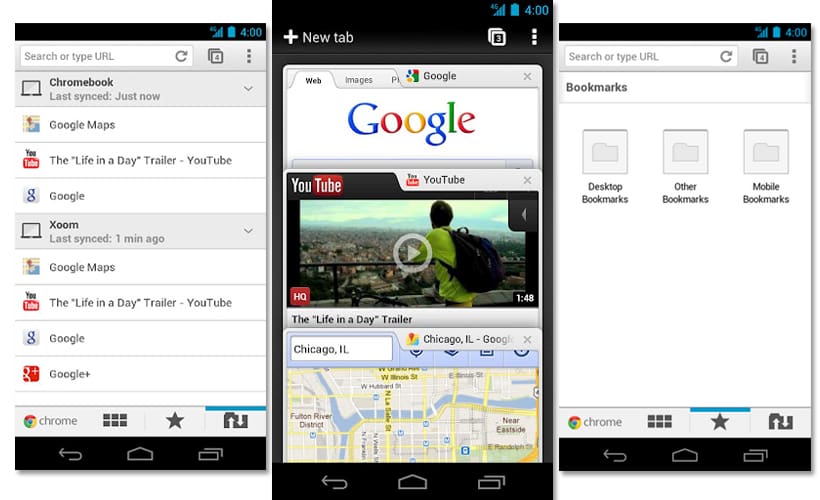
Today, Google has updated their mobile browser, Chrome for Android Beta, adding new features and functions.

Dan Alcantara and Oli Lan, Software Engineers on Chrome for Android said in a statement that Google has been listening to beta users’ feedback, adding that “It’s great to hear how so many of you love having the Chrome experience on your Android 4.0 phone or tablet.”

Today’s updates add support for 31 more languages, and the browser is now available in all countries where Google Play (formerly known as the Android market) is available.

The company says that they have added the most requested features, like the ability for users to request the desktop version of a website in case the mobile version of a site is less preferable. Additionally, bookmarks can now be added as shortcuts on your devices’ home screen so you can get to your web destinations faster – this is helpful, as any reduction in the number of clicks, particularly while browsing in the field can save quite a bit of time (and frustration).

New features also include the ability choose which apps handle links opened in Chrome, so the browser is less assumptive and behaves more as you naturally would (and again, reduces clicks, thus time and frustration). Also, users that have a proxy setup for wifi access can now use Chrome with the system proxy configured in Android settings.

Although the browser is still in beta, and only works on Android 4.0 devices (Ice Cream Sandwich operating system), the browsing experience is said to be much faster, smoother and more intuitive. To download the newest version with all of the updates outlined above, click the button below from your Android tablet or smartphone to get started:


Klout to offer brand pages with Red Bull as the pilot

Klout’s new “Brand Squads”

As is the trend with social networks, Klout is launching brand-specific pages to more prominently features companies. The social measurement tool Klout measures social influence across the major social networks like Twitter, Facebook, Google+, Foursquare, LinkedIn and more, now offering companies a way to engage with influencers of their brand.

The first brand to pilot is Red Bull as pictured above, whereas the traditional method for discovering influencers of a brand is to change the URL “https://klout.com/topic/red-bull” by deleting “red-bull” and adding the brand or topic you’re searching for. For example, here is the iPhone’s Klout page, but it is not yet equipped as a “Brand Squad.”

The “Brand Squad” is “Klout’s way of giving influencers a place to be recognized and have a direct impact on the brands they care about most,” according to Klout Product Manager, David Temple. Now, the brand has more control and a way to promote their influencers, as brands and fans can see a dynamic list of who the top influencers are and can see the conversations about that brand across social networks, featured within the “Brand Squad” page.

A “more reasonable use for Klout”

Brand fans can view recent news about the company and earn extra perks which are typically exclusive offers or experiences based on a user’s Klout score, which although not new, is a more controlled way for brands to reward influencers or to encourage individuals to become influencers.

David Svet, founder of Spur Communications, a 25 year marketing industry veteran said, “I think it’s interesting and a potentially more reasonable use for Klout. In a time where useless sports statistics are worshiped, this is a way to treat brand social teams as competitors in a sports sense. I don’t know if it will matter or change anything, but it could be an interesting opportunity for some brands to play on it as a sport.”

Clipboard, Pocket offer simple content bookmarking, organization

Two bookmarking sites to take on Evernote

While Evernote has long been the reigning king of bookmarking content and organizing information, it is not the only option on the market, and while there are many competitors, two stand out most brightly as they offer unique features that differentiate themselves and are both brand new to the public.

Clipboard

Clipboard is a virtual archive, allowing users to save anything online (not just text or images), and unlike other content bookmarking options, Clipboard keeps the original formatting, and hyperlinks and videos remain live within your clip. Once clipped, tags keep content organized and clips can be shared publicly, privately or with just a specific group of people.

Currently, Clipboard is invitation-only, but the site goes public in May. The company says, “Whether you’re clipping guitar tabs, potential rental properties, wedding ideas, research for a class or planning upcoming travel – Clipboard is a living archive.”

While Clipboard is currently available as a web app, we suspect the company will launch mobile support for devices soon.

Pocket

Formerly known as “Read it Later,” the company has relaunched as Pocket, seeks to take the pain out of bookmarking and having to remember where/what/how you bookmarked any web content, offering a new user interface that is simple and streamlined, presenting bookmarks in a magazine layout. What is most intriguing is that once saved, content does not even require an internet connection to be accessed, which can be a tremendous help for professionals on the go.

Users can integrate their Pocket account to save content from apps like Twitter, Zite, Flipboard and “more than 300 others,” adding that any app that currently integrates Read It Later will work with Pocket, just as before. Pocket lists can soon be accessed from almost any device, already available on the iPhone and iPad, and soon to be available on Android smartphones and tablets like the Kindle Fire.

Because Pocket is the next generation of Read It Later, the app is already well known in developer and publisher circles. The company says, “We’re dedicated to helping developers and publishers use Pocket to make the most of time-shifting and drive engagement inside their own apps and sites.”

Joe Davalos: how one agent sold more units than any other C21 agent in the world

Interview with a true top producer

In the real estate industry, it is not uncommon to hear an agent call themselves a top producer, and the metric is rather fuzzy – some are the top grossing agent in their office, but maybe they sold three mansions in a year, while others claim the label for selling the most units on their team of three, but the other two team members are part time agents.

That is not the case with Joe Davalos of CENTURY 21 United-Davalos in San Antonio, Texas who was recently named as the number one agent for having sold more units than any other CENTURY 21 agent in the world.

Davalos tells AGBeat that he has been in real estate for 30 years and was inspired to become a Realtor to follow in his father’s footsteps. “My father was an agent and I liked the challenge and enjoyed helping people,” Davalos said.

Making it to the top spot has not come without sacrifices. Davalos said, “For a time I was working 14 hours trying to keep up with the booming foreclosure market. I found out it was not healthy physically and spiritually. So I went out hired good support staff.”

Davalos credits his “loyal clients” and his “understanding family” for his international accomplishment, and says that in order to stay ahead, he stays focused and sets high goals and standards, which many in the industry fail to do.

Does a top producer use Twitter?

“I receive over 100 emails a day and I use my Blackberry for keeping track of my emails on the go,” said Davalos who adds that his emails are professional, not personal.

Did Davalos follow the convention guru’s advice this year to be the top producing agent in the world, selling the most units? Did he create a mobile app, or spend a healthy three hours on Twitter every day? Is he on Pinterest, Path, Instagram, and Foursquare?

Davalos has a LinkedIn profile that is active, but a parked Twitter handle that is not in use, and not much presence online outside of a template CENTURY 21 site, and another pixelated website with small font, neither of which are impressive.

So how did he do it? Davalos’ niche market is catering to lending institutions, none of which care about what his Twitter background looks like or how good he is at Pinterest, or that he took a picture from his iPhone of the sunset. None of those activities are wrong, but it is noteworthy that the one person who sold more units than any other CENTURY 21 agent engaged in none of them, pointing out once again that there is more than one way to skin a cat.

March housing starts fall as permits rise, builders cautiously optimistic

Mixed messages in the new home sector

According to the U.S. Commerce Department, housing starts failed to meet expectations, falling 5.8 percent in March, while permits reached their highest level in over three years. Multi-family starts fell 16.9 percent, continuing the trend of rapid increases and dramatic falls in the roller coaster of starts and permits in the sector. Single-family home starts fell a more modest 0.2 percent.

Permits rose 4.5 percent to their highest rate since September 2008 which was the edge of the recession cliff. Permits indicate future building, and this month’s rise beat most economists’ projections for March.

Challenges for new home builders

Distressed sales continue to pull prices down and add pressure to new home builders. While the Commerce Department is reporting on March numbers, the National Association of Home Builders has already released April builder sentiment numbers, which correlate with March starts and permits, revealing the first dip in confidence in seven months, despite what appeared to be growing optimism.

New home construction has been one of the hardest hit sectors in real estate during the recession, and tiny glimmers of recovery are popping up here and there, and while Reuters reports that this year, home building could add to economic growth for the first time since 2005, the challenge remains inventory levels of all housing types, particularly distressed sales.

“What we’re seeing is essentially a pause in what had been a fairly rapid build-up in builder confidence that started last September,” said NAHB Chief Economist David Crowe. “This is partly because interest expressed by buyers in the past few months has yet to translate into expected sales activity, but is also reflective of the ongoing challenges that are slowing the housing recovery – particularly tight credit conditions for builders and buyers, competition from foreclosures and problems with obtaining accurate appraisals.”

Short sale offers: why the highest may not be the best

How to Review Multiple Offers

I held an open house on Saturday at one of our short sale listings. It is a good listing: great price point, pristine condition, very close to the beach. There were over 80 people at the two-hour event. It was a frenzy of sorts.

Agents continued to call in all afternoon asking questions about how to write a good offer that would be accepted.  And, this is definitely going to be one of those multiple offer situations.

When reviewing offers for short sales, there are a few things to look out for. People always think that price is very important, and it is. But, price is not the only thing that is going to get the short sale closed.

Here is a list of items when working with a seller and reviewing short sale offers:

  1. What is the purchase price? Is it at market value? Short sale lenders really like offers at market value.
  2. Does the buyer want a closing cost credit? Will the buyer be willing to purchase the property if the lender is not providing the closing cost credit? Note that certain short sale lenders may not approve closing costs credits on any sort of loan, not even FHA and VA.
  3. What kind of financing, if any, is the buyer obtaining? How large is the buyer’s down payment? How solid is the buyer? Note that certain properties and certain condominium complexes may not qualify for FHA financing, so it is important to check out the buyer’s financing before accepting the offer.
  4. Is the buyer paying cash? Often times cash buyers have money burning a hole in their pockets and may not be willing to stick around throughout the entire short sale process—especially if it is lengthy.
  5. How long is the buyer willing to wait for short sale approval? Obtaining short sale approval can take 2-4 months. Is the buyer willing to wait that long?
  6. Does the buyer want pest control, septic clearance, a home warranty or other perceived extras? Is the buyer going to continue if the bank declines to accept payment for these items? Investigating the answers to these questions will save you from a migraine later on in the short sale process.

Listing agents have a fiduciary obligation to their sellers to aid them in selection of the best offer to submit to the short sale lender.* And, the highest offer often may not be the best one. The best one may be slightly lower but have a financially solid buyer that is willing to stick around through thick and through thin. After all, who wants to negotiate the same deal twice?


*There are many agents throughout the United States who prefer to use a method whereby they submit multiple offers to the short sale lender(s). However, in my experience, even when one has open and honest communication with the short sale negotiator about the number of offers on the table, most short sale lender(s) still prefer to review one offer at a time.

How to easily accelerate your marketing, grow your sales

Business return on investment

Business improvement is hard when you don’t “know your numbers” and fully understand the key drivers of your business.

We all want to increase our sales, earn more referrals, and keep existing clients loyal to us. We all spend money, too, on marketing that we hope will help us do this.

But we need to know the return on investment (ROI) of everything we spend our money on. We need to understand the impact, or lack of impact, these investments are having on the business goals we’re trying to achieve.

If we don’t, we could be spending thousands of dollars blindly, with no idea where to invest more money in and where to invest less, and subsequently this impacts our business results. It impacts the bottom line.

Where have you heard about me?

In order to evaluate ROI and get insight into what’s working and what’s not, we need to track where our business is coming from.

Do this by asking your prospects and clients where they heard about you. Was it from a website, a billboard ad, or maybe a social network?

Make sure to record every answer you receive in your contact management software. You’ll then be able to go into your contact management system and see how many prospects and clients you’ve received from where.

Key metrics

In addition to knowing where each prospect heard about us, there are other key business metrics we need to understand.

These metrics include total number of leads versus number of qualified leads, number of qualified leads versus sales presentations scheduled, and number of presentations versus new business.

For example, if you’re a REALTOR®, you’ll want to understand all of the above numbers in addition to ones such as percentage of listings versus solds, average number of days your listings are on the market, and selling price versus asking price of your listings.

Ensure that you’re maximizing your business performance

Let’s use Mark as an example. For a long time, Mark saw himself get many more leads than he’s ever seen in the history of his career. Yet, at the end of each month, he had very few listings to show for it. He saw an increase in leads but no increase in business.

Now, this could be due to a number of reasons but until Mark understood certain key business metrics, he was unable to pinpoint exactly why this was occurring.

The problem ended up being a very low presentation close rate. Once Mark took measures to improve his presentations and his presentation skills, he saw a lot more of those leads convert into valuable and potential lifelong clients.

Reap the rewards

At the end of the day, don’t be fooled by what what’s working and what’s not, where your business is coming from, and what you should be focusing on to improve and grow your sales.

The key is to know your numbers.

Invest more time and money into the actions and investments that produce the largest ROI. Scale back on those that are not performing as well or do not have the impact that you’d like them to have.

Use your contact management system to keep track of your data and generate various reports that will provide you with key insight into your business.

When you do the work that’s involved in understanding your business better, you’ll find that the payoff will be tremendous.

Millennials outnumber Boomers, behavior patterns emerging

Millennials now outnumber Boomers

In a new study by The Boston Consulting Group (BCG)1, Millennials, aged 16-34 and Non-Millennials were surveyed extensively, showing “negative or dismissive attitudes toward Millennials” by Non-Millennial (Baby Boomer) corporate decision makers.

According to the United Nations Department of Economic Social Affairs, the number of Millennials (79 million) already outnumber Baby Boomers (76 million) in America by 3.94 percent. This gap will widen in coming years as Boomers’ numbers decline, making the bias against Millennials risky for brands, as many enter their prime spending years.

Millennials and technology

Attitudes toward Millennials are very different between Millennials and Non-Millennials. Millennials have a positive perception of their generation, describing themselves as “tech-savvy, young, cool, hip, and innovative,” as Non-Millennials perceive the generation as “lazy, young, spoiled, entitled, and tech-savvy.”

Both agree that Millennials are young and tech-savvy, and the study indicates that while both spend equal amounts of time online, Millennials are consummate multi-taskers and much more likely to produce user-generated content.

  • Own smartphones: 59 percent of Millennials, 33 percent of Non-Millennials
  • Own desktop computers: 63 percent of Millennials, 80 percent of Non-Millennials
  • Rate brands online: 60 percent of Millennials, 46 percent of Non-Millennials
  • Upload pictures, videos, and blog: 60 percent of Millennials, 29 percent of Non-Millennials
  • Watch 20+ hours of tv per week: 26 percent of Millennials, 49 percent of Non-Millennials
  • Watch tv online: 42 percent of Millennials, 18 percent of Non-Millennials

The above data shows a major generational difference in that Millennials do much more online than Non-Millennials, and are more likely to do traditional activities from some form of a computer be it a smartphone or a tablet, like watching tv or making phone calls. Millennials are proven to be multi-taskers, typically engaging in various forms of social media, email, and web surfing simultaneously across various browser tabs and devices, and while many Non-Millennials engage in this behavior, brands must take note that while they have a Millennial’s attention, they may not have their complete attention, so messaging must be absorbed quickly before their eyes dart somewhere else.

Millennials’ behavior is impatient, yet optimistic

BCG asserts that Millennials exhibit four common themes in their evaluations of themselves as a generation, which is supported by their behaviors:

  1. “I want it fast, and I want it now.”
  2. “I trust my friends more than ‘corporate mouthpieces.'”
  3. “I’m a social creature – both online and offline.”
  4. “I can make the world a better place.”

Brands currently not engaging Millennials should note that the generation expects a different customer service model, and it may surprise some to know that the generation typically prefers efficient, expedient service over receiving a friendly response. Many Non-Millennials mistake the instant gratification need of Millennials as being self-entitled, but it is typically tied more to speed and BCG notes that Millennials are always in a hurry – they expect fast service just like they expect fast downloads and get annoyed and willing to purchase better devices when they slow down.

The challenge here for brands is how to get Millennials to spend time with your brand, when they barely sit still for long enough to read an entire news story, rather skim and get the highlights. As we previously asserted, brands will need to capture attention immediately and quit making consumers analyze data or messaging themselves – the era of a wall of 10 point font on a white paper won’t reach Millennials, but a large image depicting an economic indicator will perform much better, for example.

The crowd-sourcing generation

The report notes that Millennials trust their friends over corporate mouthpieces, but eMarketer data goes a step further and indicates that the generation actually values friends and family’s opinions as equally as they do strangers online evaluating products and brands. This supports BCG’s assertions that Millennials are the crowd-sourcing generation, and they constantly consult Google to verify what they’re told offline.

Half of all Millennials use their mobile device to check out reviews or research while they are shopping, yet only 21 percent of Non-Millennials do so. Brands will need to step up their mobile game in short order as the zoom-in/zoom-out game will become tiresome for Millennials who will move on to better resources (that you don’t control). Over half (53 percent) of Millennials will explore brands via social media, but only 37 percent of Non-Millennials will, further supporting the idea that Millennials highly value crowd-sourcing.

Millennials and social media

Millennials are validated by “likes” on Facebook, and they form tribes online, even with strangers. The BCG study reports the following:

  1. Use social media: 79 percent of Millennials, 59 percent of Non-Millennials
  2. Have over 200 friends on Facebook: 46 percent of Millennials, 19 percent of Non-Millennials
  3. Favor brands with Facebook pages, mobile sites: 33 percent of Millennials, 17 percent of Non-Millennials
  4. Lives feel richer when using social media: 47 percent of Millennials, 28 percent of Non-Millennials

What stood out to us is that the report indicates Millennials favor brands with “Facebook pages and mobile sites,” but those are two very, very different outlets, so we do not consider that quite a reliable metric, but the study’s assertion that mobile is critical in coming years remains.

Lastly, the study found Millennials to be more likely to encourage others to support their cause, participate in fundraising events, purchase items associated with a cause, and volunteer their time, but the study fails to report how much each generation actually donates in dollars, which we suspect would be dominated by Non-Millennials.

The reason generosity matters, however, is that Millennials who have been trained since they could walk that environmentalism and social justice issues are important, expect companies to publicly engage in corporate social responsibility programs and to support causes relevant to the companies, be it their employers, or brands they seek to purchase. It’s not just a stunt, and Millennials take charity quite seriously and expect brands they identify with to do the same.

The takeaway

The Millennial generation is quite misunderstood, and while there is a need for instant gratification, and yes, some self-righteousness, the generation is caring, smart, and fast. Brands with leaders that exhibit a bias against Millennials may be skewered by the growing number of purchasers as Millennials’ purchasing power quickly outgrows Boomers’.

The study surveyed 4,000 Millennials and 1,000 Non-Millennials, including “pivotal years” before and after each generation to get a true picture of behavior, but we find it interesting that the disparity between the volume of each generation surveyed is quite large, so we expect future studies to reflect similar results, but perhaps a little more favorable toward Non-Millennials. The point remains, however, that brands better adjust quickly, because this generation has money and they don’t blindly throw it away – they research, they are practical, they are mobile, they are in a hurry, they care about your corporate culture, and they want to tell their friends about their experience with your brand.

Related reading:

  1. Millennials are more difficult to reach, but respond well to creative ads
  2. Technology has made Millennials impatient yet more complex thinkers
  3. How Millennials are conditioned to be entrepreneurs
  4. Why Millennials rely on friends’ and online strangers’ advice equally
  5. Millennials learning from their Boomer parents’ mistakes
  6. Portrait of the new Millennial businesswoman
  7. The ultimate guide to reaching Millennials

1 BCG Millennial study

Picnik to shut down this week, replacements emerge

Adios, Picnik

In January, Google announced that after acquiring photo editing suite, Picnik.com, that they would be shutting the site down. Now, Google is referring users to three locations – Google+ which is where they will roll their acquired technology into, Aviary (which AGBeat named as a viable replacement, given the announcement of their partnership with Flickr.com) and finally, PicMonkey.com.

PicMonkey is like a sexier version of Picnik with better speed, more Instagram-ish effects, a simpler, easier interface, and less hunting and pecking and guessing than we’ve grown accustomed to with Picnik. According to GeekWire’s John Cook1, the company is expecting a massive influx of users once Picnik is finally turned off this Friday and users are forced to choose an alternative, and given that PicMonkey is created by two of Picnik’s original developers, it is an obvious transitional choice.

Photo editing made of win

The company calls itself a photo editor “made of win,” and is very slick and clever in its verbiage throughout the site, especially in describing themselves. “Here’s who we are: a bunch of dedicated, in-the-trenches people who just want to make this online photo editor experience ridiculously great. We’re getting PicMonkey up and running, and then watch out. Keep your eyes peeled for more. Because we’re gonna keep adding more features and more tools and not stop until you scream and say ‘Holy Macarena, people, go home and get a life because you’ve done. it. all!'”

Cook writes that PicMonkey co-founder Justin Huff said that they were “upfront with Google about their plans when they left, and he noted that the closure is just providing extra motivation for the team which is bootstrapping the company right now.”

“When a company like Google shuts down a product, they are telling the world that they don’t believe that there is a market for that,” Huff told GeekWire. “And it just happens that some of us think different, and that’s why we are here.”

1 GeekWire story