Home Blog Page 359

Mortgage application volume dips despite rock bottom interest rates

Mortgage application volume down again

After six weeks of decreasing mortgage application volume for new purchases and refinances, last week saw a slight uptick which has been tamped down by this week’s report from the Mortgage Banker’s Association (MBA) who says applications fell 2.4 percent last week from the week prior.

The MBA notes that there were no adjustments made for Good Friday and that the four week moving average for the seasonally adjusted Market Index is down 2.08 percent. The four week moving average is up 2.19 percent for the seasonally adjusted Purchase Index, while this average is down 3.45 percent for the Refinance Index.

Breakdown of volume share

For the eight week in a row, refinance volume dropped, resting at 70.5 percent of the total applications, the lowest share since July 2011. The adjustable-rate mortgage (ARM) share of activity remained unchanged at 5.5 percent of total applications from the previous week.

In March 2012, the share of applications for investment properties rose from 7.4 percent in february to 8.3 percent, which the MBA says was driven by refinance applications for investment homes falling for the month.

Interest rates

According to the MBA:

  • The average contract interest rate for 30-year fixed-rate mortgages with conforming loan balances ($417,500 or less) decreased to 4.10 percent from 4.16 percent, with points remaining unchanged at 0.43 (including the origination fee) for 80 percent loan-to-value ratio (LTV) loans. This is the lowest 30-year fixed rate since March 9, 2012. The effective rate decreased from last week.
  • The average contract interest rate for 30-year fixed-rate mortgages with jumbo loan balances (greater than $417,500) decreased to 4.43 percent from 4.46 percent, with points decreasing to 0.36 from 0.49 (including the origination fee) for 80 percent LTV loans. This is the lowest 30-year jumbo rate since March 9, 2012. The effective rate decreased from last week.
  • The average contract interest rate for 30-year fixed-rate mortgages backed by the FHA decreased to 3.87 percent from 3.89 percent, with points decreasing to 0.55 from 0.58 (including the origination fee) for 80 percent LTV loans. This is the lowest FHA rate since March 9, 2012. The effective rate decreased from last week.
  • The average contract interest rate for 15-year fixed-rate mortgages decreased to 3.37 percent from 3.40 percent, with points decreasing to 0.37 from 0.41 (including the origination fee) for 80 percent LTV loans. This is the lowest 15-year fixed rate since March 9, 2012. The effective rate decreased from last week.
  • The average contract interest rate for 5/1 ARMs decreased to 2.89 percent from 2.93 percent, with points increasing to 0.38 from 0.35 (including the origination fee) for 80 percent LTV loans. This is the lowest 5/1 ARM rate since March 9, 2012. The effective rate decreased from last week.

Timing coincides with principal reduction talks

As housing leaders continue to argue over whether or not banks should give mortgage debt forgiveness, mortgage application volume has fallen in recent weeks. Some project that mortgage activity will increase as they traditionally do during the spring, but as lending remains tight and the big servicers readjust to paying $25 billion per terms of the national settlement with federal and state agencies, with some lenders like Ally pulling out of mortgages altogether.

The MBA is not offering any predictions this week, but the reduced volume of mortgage applications and refinances is troubling as real estate sales and housing prices continue to slip.

1000Watt launches Nudge: marketing app for Realtors

Consumers and Realtors don’t have time for tradition

After extensive market research and user testing, 1000Watt Consulting in tandem with W&R Studios, has launched a web-based marketing tool for real estate professionals that answers to Realtors’ inability to devote endless hours to cluttery charts and graphs, and consumers’ unwillingness to look at an email for more than a split second.

With the Nudge app, market information can be shared beautifully with a modern market indicator visualization, in a way that is custom to each individual Realtor, not just because all indicators created within the app are customizable, but because they rely on the expertise of each creator. The app is written in HTML5 so that all users can access it from any device.

There is no ugly clip art, no outdated typography, no lengthy paragraphs, no endless lists of links or cluttery graphs, and the app very specifically answers to the pain points of Realtors and consumers so that an agent can spend a minute creating a laser focused report, and a consumer can spend a second looking at the email and getting an instant pulse on their market.

An agent opens Nudge, picks a report type (time on market, asking price, market balance, market activity, market inventory, buy now / sell later, short term rates and long term rates, with more reports to come soon), adds a brief title, a description of the indicator under 400 characters, and their contact information is below. Then, the report can be embedded, emailed, tweeted, or linked to, and if someone doesn’t open that email for a month, it remains live (so you can go back and update the indicator).

Crash course in creating a Nudge (in pictures):

Super easy, check out how you can create a Nudge in under a minute:


Appealing to the Twitter generation

1000watt discovered that consumers not only rarely read marketing from Realtors, but the relationship ends up degraded over time as consumers react negatively to long lists of arbitrary stats and endless charts which leaves them to discern what all of the data means – consumers don’t want to do work or spend time reading, but they do want to know how the market is doing in their area, so Nudge answers to both.

Marc Davison, Founding Partner at 1000watt Consulting told AGBeat that the goal is to allow agents to deliver what they know, beautifully. Agents often open a marketing tool and get stumped immediately about what to write or what information to leave or omit from local stat reports, and often resort to emails that work against them that are irrelevant. Davison noted that red arrows are scary, even if they imply something positive like prices dropping (see an example of a scary market report email here), so the app very specifically fixes the problem of inadvertently turning consumers off.

After blogging about the broken system for years and pushing the industry to repair the issue, Davison said they finally invested in taking action on their own, and through months of extensive discussion about the app, it is evident that it has been a labor of love by the team that refused to sit idly by.

Nudge adoption

Nudge is one of those rare apps that is a win-win-win for all involved, and pre-launch has already been licensed to Prudential California Realty, Southern California, A Home Services Company in San Diego, Orange County, Los Angeles and Santa Barbara as well as Residential Properties (Rhode Island) Houlihan Lawrence in Westchester, Dutchess and Putnam Counties and John Greene Realtors, Naperville in the west suburbs of Chicago.

Greg Dallaire, Dallaire Realty said, “I am completely blown away with the ability to create sexy marketing consumers can relate to. I’d highly recommend Nudge!”

Bonus: to get a feel for the lighthearted nature of the Nudge creators, here is their overly dramatic trailer for the app:

Quiz: email marketing best practices


Just how good are you at email marketing? Are you committing email marketing felonies or performing email marketing miracles? Take this quiz and find out!

1

My emails are personalized: they address recipients by their name so the emails sound like they were written just for them

T

F

2

My emails provide valuable, useful, and/ or interesting content to my recipients

T

F

3

The content of my emails is not just about me but is also focused on the needs and interests of my recipients

T

F

4

I don’t just express information through words (telling people what I mean) but I also show them what I mean through images

T

F

5

I use bullets, numbering, and or multiple short paragraphs in my emails so they are highly readable

T

F

6

My emails follow the RTP rule; they are relevant, timely, and personalized

T

F

7

My email marketing complies with anti-spam laws and includes an option for recipients to unsubscribe

T

F

8

I track and analyze the results of my email marketing. I look at statistics like open rate, bounce back rate, and click-through rate. This allows me to improve my email marketing moving forward and identify my hot leads

T

F

9

I use my CRM system to segment my contact list so I can send more relevant and personalized communications to different groups of people in my database

T

F

10

I run my email content through a spam checker to reduce the likelihood of my emails going into recipients’ spam folders

T

F

11

I ask recipients to add my email address to their address book or “safe senders” list

T

F

12

I keep my email deliverability high by deleting email addresses that “hard bounce.”

T

F

How well did you score?

One to five true answers: You need to change many of your email marketing practices in order to be effective. Don’t worry, it’s not too late.

Six to nine true answers: You have some work to do to ensure you’re doing everything you can to master email marketing. You’re on the right track, just not there yet.

10 or more true answers: You’re well aware of email marketing best practices and you’re doing the right things to maximize the effectiveness of your email marketing

CFPB to require mortgage servicers to be more transparent

Protecting consumers from mortgage surprises

Since the inception of the Consumer Financial Protection Bureau (CFPB), mortgage servicers have been a clear target for reform, with the agency announcing that they are considering new rules that would help protect consumers against “costly surprises” from lenders, requiring servicers issue “more clear” mortgage statements and offer better disclosures about fees or loan interest rate changes.

Acting director of the CFPB, Richard Cordray said in a speech, “We want to make sure that at all times consumers know how much they owe, what they are paying, and how their payments are being applied.”

While this seems like an easy task and an obvious step, it has taken quite some time for the agency to get to this point, as they make their first move to regulate the mortgage servicing sector. The new rules would require servicers to provide improved transparency for new borrowers as well as delinquent homeowners, effective January 2013.

Three main rules under consideration

One rule being considered is a requirement of all mortgage servicers to outline in monthly statements terms like a breakdown of mortgage payments of principal, interest and fees, as well as itemization of the fees and charges, and warnings of possible late fees.

Yet another rule under consideration is in regards to what the bureau calls “force-placed” insurance, or property insurance the bank takes out for homeowners who miss an insurance payment. Servicers may be required to request proof of insurance before charging for force-placed insurance.

Lastly, another rule could require servicers to explain in better detail how a new interest rate is calculated when it changes, when it will take effect, and issue warnings of future interest rate changes and penalty fees on mortgages paid off early.

Lab of luxury: the MLS goes to the dogs


Reading the MLS and local real estate ads is like reading the comics. I just wish I were artistic enough to accompany these bloopers with cartoon drawings. Thanks to Vicki Moore of San Mateo for her great contribution. Visualize these hilarious gaffes in a comic strip:

Resident President

“Set a president” (Set him where – on my mantle?)

“Lots of cass” (The reason the Mamas and the Papas traveled in an extra wide van.)

“AA good house – needs your touches” (Celebrity Rehab Rehab.)

“Microwake” (The time between when you hit the snooze button and “Oh-sh_t-I’ve-overslept-again!”)

“Studio with walking closet” (Like socks in a dryer, you never know where they wander off to.)

Nurses and Curses

“We’ll put out the welcome mad” (Cackled Nurse Ratchet of Ward B at Bellevue.)

“Sacks served” (Offered by Bag-Em-n-Tag-Em Realty.)

“Seller pays terminate”  (…Said the agent representing the Don Corleone Estate.)

“Lab of luxury” (Let me guess – A dog driving a Bentley?)

“Red private remarks” (Said Comrade Kharkov while wielding a scythe.)

Hi, High…

“Sink with vegetable spayer” (I assume this is the home of a “vegeternarian.”)

“Views of sun and scruf” (Apparently Mickey Rourke lives next door…)

“High cop rate” (Sign in the window at The Donut Palace.)

“Room for all your dishes and pot” ( Purred Betty Bong as she threw open the cupboards to hunt for munchies.)

 …and Higher

“Explosive views” (Another Hollywood meth lab goes skyward.)

That’s it for this week, folks. Remember: Spell Well and Sell!

Flexible tablet concept uses inductive charging

Foldable, flexible tablets

With the announcement last month that LG has already begun mass production of its electronic paper display (EPD) product, flexible tablet, smartphone, laptop and desktop concepts have become a more likely reality, and the industry is about to undergo a pivot in design in an industry that has become relatively stale when it comes to physical aesthetic design.

One such flexible concept is the “Breathebook,” which according to Yanko Design is not an official Fujitsu product, it was designed by Anthony Yu to fold into various forms and sit nicely inside the Fujitsu brand. That is not to say that if Fujitsu saw the design they wouldn’t be interested, but it is still a private design in its early concept phase.

The Breathebook has a flexible display, and the ability to work with a set of two cameras. It also takes advantage of inductive charging which uses an electromagnetic field to transfer energy between a charging station and the device.

The concept is that the technology is flexible and meant to fold over the side of your leg, replacing the idea that a tablet or laptop has to be balanced delicately or rest on a flat surface.

Look for more flexible designs to come to fruition as the technology and physical capacity for production have caught up with the genius ideas of international designers.


Ally Financial cuts the cord on mortgage lending

Ally Financial pulls out of mortgage lending

Ally Financial, Inc. has announced that its broker-dealer subsidiary, Ally Securities will bow out of mortgage-related activities as it continues their strategy of reducing noncore businesses and focusing on retail lending as they stated they would do back in 2011. The company said in a statement that they would be winding down the operation “in an orderly manner over the coming weeks.”

Ally is 74 percent owned by the U.S. government, having accepted over $17 billion in bailout funds during the mortgage meltdown, and is expected to pay back $134 million to the U.S. Department of the Treasury in short order, as they make their mortgage services exit.

The bank has paid back $5.5 billion since February of 2009, owing roughly $12 billion to the government, thus taxpayers. Ally is expected to put it subsidiary, Residential Capital (ResCap) mortgage into bankruptcy after supporting ResCap with financial support through forgiveness of intercompany debt which is not expected to continue.

According to the Wall Street Journal, ResCap faces maturity deadlines on two senior credit facilities that Ally provides it on Friday, and Standard & Poor’s has expressed uncertainty over whether Ally will extend the maturities as a reason for downgrading ResCap’s ratings in February.

In a regulatory filing, Ally said it has reached an agreement with the majority of its stockholders to waive the provision in their bylaws that requires stockholder approval for transactions over $5 million which has now been reset to $25 million.

Ally’s cutting their broker-dealer mortgage activities affects 33 employees which may be offered positions elsewhere in the company.

Google Chrome innovates with tabs accessible across devices

15

Making mobile computing more effective

Google announced today the newest Google Chrome Beta features it the ability for tabs open on one device to be available on all of your other devices (smartphones, tablets) by simply clicking “other devices” on the “New Tab” page, all you have to do is sign in to Chrome

Nicolas Zea and Patrick Dubroy, Software Engineers and Tab Teleportation Technicians at Google said, “Imagine you’ve looked up directions to a cool new restaurant on your home computer. Later, when you’re leaving work, you realize you can’t quite remember how to get there. If only you could quickly pull up the same directions on your office computer with one click!”

The team adds that with a single click, “you can find and open the tab with your directions and be on your way. The tab’s back and forward navigation history is also included, so you can pick up browsing right where you left off. If you use Chrome for Android Beta, the tab will also be available on your phone, right there in your pocket when you hit the road.”

The company says they’ll be rolling out the “other devices” menu to Beta channel users over the coming week, but Chrome Beta users can access it now by simply signing in.

Today’s multi-tasker

It is common for people today to have multiple tabs open as a means of multi-tasking, but this takes multi-tasking to a new level by keeping the experience consistent between devices.

If you have open a dozen news articles you want to read, but you get a call from a client and know you’ll be sitting in traffic for an hour, you can now access them from your tablet from your car while you waste away in a long line of cars. If you’re researching on your phone while on the go, but don’t want the hassle of manually typing in URLs to your desktop, you can now simply log in to Chrome on both and have full access, including back/forward navigation history. Genius!

Wells Fargo fined $3.1 million for mortgage abuse of a single borrower

A five year battle with Wells Fargo

Judge Elizabeth Magner in the Eastern District of Louisiana has ruled that Wells Fargo must pay a single homeowner $3.1 million in punitive damages for what the judge called the bank’s “highly reprehensible” behavior, according to The Huffington Post. This marks one of the single largest fines for mortgage abuse in American history, ending this five year legal battle.

“Wells Fargo has taken advantage of borrowers who rely on it to accurately apply payments and calculate the amounts owed,” Magner writes in the decision. “But perhaps more disturbing is Wells Fargo’s refusal to voluntarily correct its errors. It prefers to rely on the ignorance of borrowers or their inability to fund a challenge to its demands, rather than voluntarily relinquish gains obtained through improper accounting methods.”

Magner ruled in 2007 that Wells Fargo improperly charged the homeowner fees exceeding $24,000 because of a computer problem in the system used to account for his loan payments, putting him in default. Magner ruled that Wells Fargo should not have applied his payments to fees and interest, but to his principal, which threw him into an even deeper situation marred with fees and interest. The fees continued adding up, even after the homeowner declared bankruptcy.

Wells Fargo says they will likely pursue an appeal to Magner’s decision. “The ruling handed down by the court in an individual bankruptcy case covers allegations going back more than six years and ignores significant changes in servicing practices that have occurred since that time,” said a spokesman in a statement. “We believe that there are numerous factual and legal problems with the opinion and are reviewing our options regarding an appropriate legal response.”

Wells Fargo is no stranger to wrongful foreclosures

While this is among the largest of lawsuits, this is not the first mortgage abuse case Wells Fargo has grabbed headlines with. In a separate computer-glitch situation, Wells Fargo began the foreclosure process on a homeowner who had never missed a payment, and told another homeowner to skip payments, then only offered a $2 loan modification since they had missed payments (despite being advised to do so).

For abusive mortgage practices, Wells Fargo was fined $85 million by the Federal Reserve Board, and a class action lawsuit was filed for illegal HAMP denials by Wells Fargo, with states like Ohio suing the bank alongside MERS for illegal foreclosures. Last fall, it was discovered that many big banks, including Wells Fargo were still illegally using robosignature methods and foreclosing without human review (illegally).

Wells Fargo employees were allegedly incentivized to steer minorities into risky mortgages which many proclaim to be the first jenga block pulled out to cause housing to crash. The bank has not been immune to protest, however – a Texas man went on a hunger strike against the bank and a Philadelphia man found a loophole and foreclosed on his local Wells Fargo branch, becoming a folk hero.

UC Browser for Android dramatically speeds up page loads, navigation

UC Browser for Android

Named the best Android browser by About.com for 2012, UC Browser speeds up mobile browsing and is now the largest mobile browser globally, with 300 million users across 150 countries.

Instead of using the stock browser that your Android phone comes with, UC Browser is a free installation that offers cloud acceleration so your browsing is faster and you spend less time sitting around waiting for pages to load. The company says that with continuous optimization, UC browser’s “kernel can function better with UC cloud acceleration, giving you unprecedented speed in web surfing.”

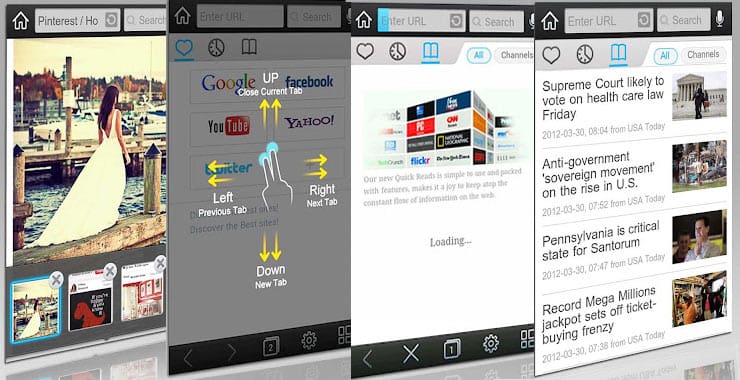
One of the most popular features is the multi-touch controls allowing you to swipe our fingers to open, close, switch tabs, go forward and backwards much easier than traditional web surfing, not to mention you can control your browser with your voice.

The UC Browser comes with an integrated RSS reader so you can get to your top sites faster through a single click. Also, the browser offers “auto-focus” so you can zoom in or out of a page with a click so that irrelevant or distracting elements can be put aside, allowing you to focus on the content that is most important to you.

For people that use their browser on Android frequently, there is a lot to be desired. Yes, the browser is improved and Google launched Chrome for Android this year, the voice controls and swiping features of UC Browser and their focus on constantly improving the speed is a tremendous help for professionals using their smartphone to run their business.

DeMarco: principal forgiveness is the wrong solution, risky

FHFA director speaks on next steps

This morning, at the Brookings Institute1, Edward DeMarco, acting director of the Federal Housing Finance Agency (FHFA) spoke2 on the issues surrounding Fannie Mae and Freddie Mac which is under the conservatorship of the FHFA. DeMarco addressed the flocks of homeowners that are struggling with paying their mortgage, and says that supporting those homeowners is the current objective of FHFA, Fannie and Freddie.

DeMarco said, “As FHFA makes its decision on whether the Enterprises should offer principal forgiveness with the HAMP triple incentives, we will look to the issues I have described: the NPV impact; borrower incentive effects; and operational costs. Those are the issues that are within our responsibilities as conservator of the Enterprises.”

The principal reduction controversy

Shaun Donovan, the United States Secretary of Housing and Urban Development, which operates under the FHFA said in an interview over the weekend that granting principal reductions is “the right decision for homeowners and for the taxpayer.”

The FHFA says it would cost taxpayers $100 billion to grant principal reductions, while Fannie and Freddie say it would save taxpayers $150 billion. Neither appears to be compromising on their positions on the topic of write-downs.

DeMarco addressed the division between all of the agencies. “Whether Fannie Mae or Freddie Mac forgive principal or not, the universe of Enterprise borrowers potentially eligible for a HAMP PRA is well less than one million households, a fraction of the estimated 11 million underwater borrowers in the country today. This is not about some huge difference-making program that will rescue the housing market.”

DeMarco continued, “It is a debate about which tools, at the margin, better balance two goals: maximizing assistance to several hundred thousand homeowners while minimizing further cost to all other homeowners and taxpayers. The anticipated benefit of principal forgiveness is that, by reducing foreclosures relative to other modification types, Enterprise losses would be lowered and house prices would stabilize faster, thereby producing broader benefits to all market participants.”

The risks of principal reduction

The greater contingent risk, according to DeMarco, is the larger group of underwater homeowners who have “remained faithful to paying their mortgage obligations” and that encouraging their continued success could have a more broad impact on the recovering of housing, more so than debating “which modification approach offered to troubled borrowers is preferable.”

DeMarco notes that a key risk in forgiving debts of delinquent borrowers is the incentive for some to cease paying in search of principal forgiveness modification.

In the coming weeks, the agencies are expected to come to a consensus on next steps, but for now, as each leader give a speech, the fight appears more polarized than ever.

1 DeMarco’s audio speech
2 DeMarco’s prepared speech

Via.me: free multi-media editing and sharing app for iPhone

18

Photo, video, sound sharing made simple

As demonstrated in the video above, via.me is an iPhone app designed to take photo sharing one step further by not only offering video sharing from the same app, but voice/sound sharing while also offering beautiful photo filters much like the Instagrams of the world.

The company promises that via.me will always be free, and they do not have any limits on content you can create and share. The concept is to make sharing simple, and after creating a photo, video or audio file, with one click, it can be shared on your chosen social networks.

What is also unique about via.me is that they offer push notifications so that if one of your friends comments on something on via.me, you are sent a notification on your iPhone, even if the app is not up and running.

The free app is extremely highly rated in the iTunes store and reviews allude to a massive bug fix the company recently underwent to improve their offering. Like competitors, users can follow each other on via.me and interact with one another, adding the social element to this media sharing site.

People leaving Instagram

Whether reasonable or misguided, Facebook’s defensive purchase of Instagram for $1 billion yesterday has led to a small exodus of displeased users.

Tech bloggers are publishing guides on how to save your Instagram photos and dump the service, leaving a vacancy in the photo sharing app arena. Some are flocking to PicPlz.com, Cinemagram, Camera+ and others, but these apps, like Instagram, are still limited to the singular function of taking a picture, adding a filter and sharing it, while via.me adds the functionality of video and audio which makes it an appealing alternative to Instagram, particularly power users that are frequently mobile.

Hopefully, via.me will launch an Android app and a Windows mobile app, but for now, iPhone users can check out the app and download it below:

Loku goes mobile, pushes boundaries of hyperlocal data

Live local information that is actually relevant

Last fall, AGBeat introduced you to Loku.com, a hyperlocal news site with an extremely sophisticated algorithm that surfaces only relevant (and very local) information like venues, events, and news, allowing anyone to feel like a local.

Today, Loku has announced their new app for the iPhone, Android and Windows smartphone, using HTML5 technology and rolling out initially to Austin, Chicago, Los Angeles, New York, San Francisco, and Washington DC, with other cities to follow throughout the year.

The new apps are the next evolution for the company, as now, users can add tips, opinions and commentary about local places, events, and activities and getting “real-time buzz” about their community.

Building local status

In the era of social proof, Loku approached establishing status differently, attempting to mimic offline behavior – a local can increase their ranking on the site by spending time in an area, visiting more places, adding more tips and comments, finding what’s new before others, inviting others to join, and supporting local businesses, the exact same way we all traditionally establish ourselves in a community without the web – we are involved.

The company seeks to make the sharing process enjoyable and real-time, with results changing as you walk a few blocks down. “The key feature of the app is a stream of everything happening in your local community, pulled from the entire Internet, social media, and more. The “Go Local” tab can be used to explore what’s happening nearby, or what’s popular across the city, and add your two cents. The app flips between pages that feature every aspect of local culture: events, music, food & drink, news, photos, local blogs, and more.”

Big data mining, uncovering local gems

As with the website, the Loku mobile app uses extensive big data mining techniques to reveal interesting information based on your location. “With Loku in your hand, you have a window into the community that simply doesn’t exist anywhere else,” said Loku CEO, Dan Street. “Our mobile app reveals what the locals care about like the free concert tonight, a new food truck opening, breaking news developing nearby, a happy hour going on, the popularity of an event, or the best dish at a restaurant. With this technology you can skip crowds of tourists, avoid the mainstream noise, and get a real taste of what’s local.”

“Our website update furthers our mission of bringing local people together to form deeper bonds of community” said Street. “You simply can’t offer a local-focused service without it being hyper-personalized, so we spent the time to build a very sophisticated platform that pulls and uses information from multiple sources. We also greatly expanded the amount of content available on the service, especially the events category, a change which has proved very popular with our user base.”

To get the app, simply go to Loku.com on your phone and add it to your homescreen when prompted.

Who is worth more: a Twitter, Yelp or Facebook user?

Comparing the value of social media users

As companies scramble to measure their social media efforts, new social networks emerge every quarter, forcing businesses to make decisions as to where they will or will not have a digital presence. Photo sharing sites take up effort, as do blogs, Twitter accounts, Facebook Pages, Pinterest boards, Foursquare accounts and the like. Decision makers are looking for legitimate ways to justify why the company is spending time and money on each branding effort on each social network.

Based on the estimated value of the following social networks, Backupify has estimated that accounting for the number of users each network has, each user is worth the following:

  1. Path – estimated value of $25 million, so $12.50 per user
  2. Yelp – estimated value of $1.4 billion, so $21.21 per user
  3. Pinterest – estimated value of $500 million, so $28.09 per user
  4. Foursquare – estimated value of $600 million, so $40.00 per user
  5. Twitter – estimated value of $10 billion, so $71.43 per user
  6. LinkedIn – estimated value of $9.61 billion, so $104.46 per user
  7. Facebook – estimated value of $100 billion, so $118.34 per user

Some of these numbers seem a bit off to us, but let’s go with this and focus on the point that a user is worth more or less, depending on the size of the community of each social network as proportionate to their estimated value.

The value of social media content

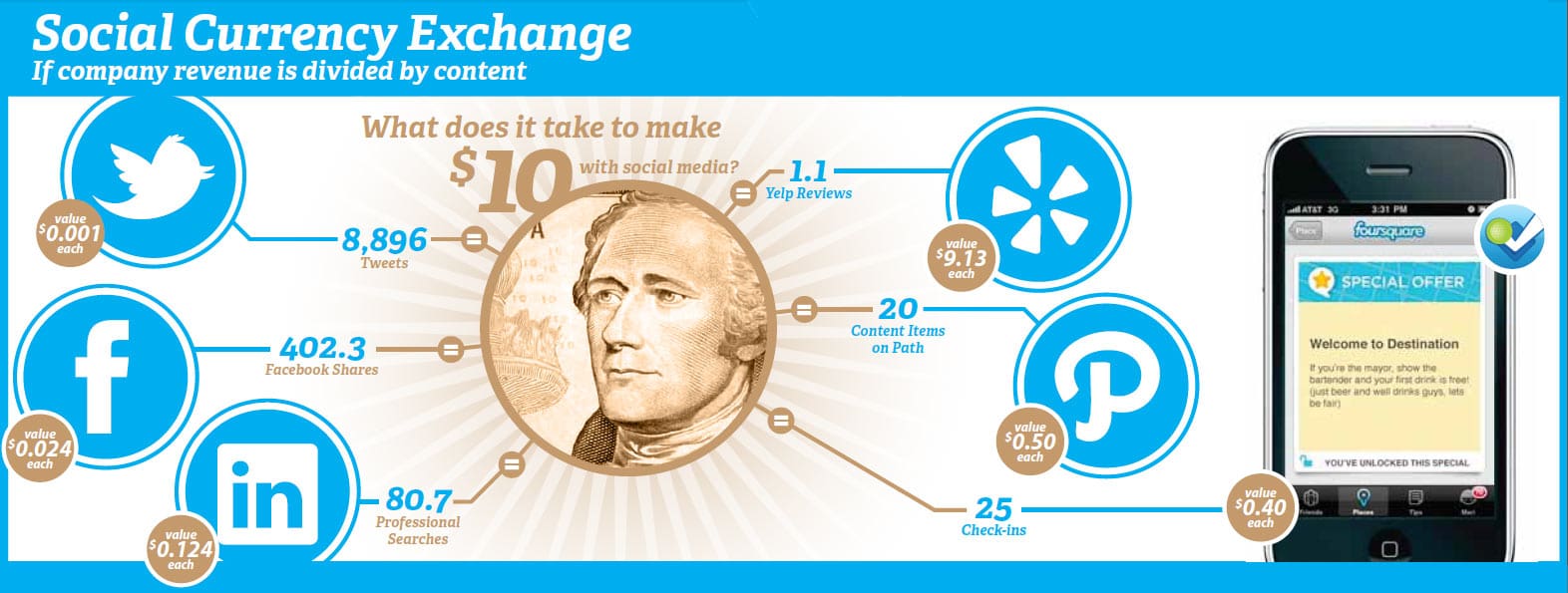
Backupify broke down what a user is worth to each social network, but they also divided each company’s revenue by content to reveal what they call the “Social Currency Exchange,” or the cost of each piece of content, for example, how much a single tweet is worth, asking the question, how many pieces of content does it take to make $10?

While this analysis pertains to what a user is worth and what a piece of content is worth to each of the social networks, it is a similar metric companies should be using as they closely track the results of their social media efforts. Are you measuring your brand’s efforts in a detailed enough way that you are aware of how much it actually costs (in time or money) for your company to obtain a new Facebook fan or to get someone to retweet you? It is time to start measuring results as more than just hits to a website because you might be putting time into an expensive Facebook effort when you could be pushing Yelp and getting much better ROI.

How a short sale listing can become like a quicksand trap


Have you ever stepped in quicksand? While I’ve never been near quicksand, I’ve certainly seen my fair share of it in cartoons and movies throughout the years. Those depictions make it seem like once you are in, it’s nearly impossible to get out. Taking a short sale listing without being aware to all of the different aspects of the short sale process may be a bit like drowning in quicksand.

Understanding the HAFA Program

In the last week or so, I’ve met up with two different agents that felt that they were drowning in quicksand—because they didn’t have all the correct information about the Treasury’s short sale incentive program, HAFA (Home Affordable Foreclosure Alternatives).

Let me tell you a little bit about this program. First off, any short sale seller can investigate whether they can sell their home through the HAFA program. However, just because the short sale seller learns that his first lien holder participates in the program does not mean that the seller’s loan is eligible for the program. There’s a difference there; a tiny one, but an important one just the same.

What are the benefits of HAFA? (Read the entire Treasury HAFA Bulletin.)

  • Short sale sellers who participate will receive $3000 in relocation assistance at closing.
  • A HAFA short sale releases the seller from any future liability on the mortgage note(s). (Depending upon the state where the property is located, this may be more or less important.)
  • There is the opportunity to obtain a pre-approved price for the short sale of your home.

Eligibility Requirements*

  • Seller lives in the home or vacated in the last 12 months.
  • Seller has a documented financial hardship.

  • Seller has not purchased a new home within the last 12 months.
  • First mortgage amount is less than $729,750.
  • Loan was obtained prior to 1/1/09.

*Note that the eligibility list is for guidance only. Certain loans are not eligible, despite the fact that the servicer participates in the program.

What If the Seller Has a Second Mortgage?

If the seller has a second mortgage, the second lien holder must agree to accept what is being offered by the first lien holder (currently no more than $6000, but soon to be changing). The second lien holder also must agree to waive the right to pursue deficiency. If the second lien holder will not release the lien under these terms, then the short sale seller may still participate in a short sale BUT will be ineligible for the HAFA program.

And, that, my friends is the quicksand, which has been stepped in by many short sale agents. If the seller wants to participate in HAFA, but the second lien holder will not agree to the terms, then the entire short sale is not eligible for HAFA. No ifs, ands or buts. Time to figure out a way to pull yourself out of that muddy mess, and get that short sale moving along towards a successful closing.


iPhone app for non-creatives: Facebook cover photos in seconds

Tools for the un-creatives

When Facebook launched the new Timeline features and forces users to upload new cover photos and engage in making creative choices, not everyone has accepted the changes well and one of the most common complaints we hear is that people do not know what to put on their cover page. AGBeat showcased 90 examples of Facebook cover photos both professional and personal, and published a Facebook timeline cover Photoshop template so that anyone with Photoshop or access to a graphic designer could pull together a unique cover. Still, some remain intimidated by the process.

For iPhone users, there is a simple app called “Facebook Cover Designer” that allows you to shoot a photo of anything and create a timeline cover photo and matching profile picture all in one go, with a few simple swipes – it’s as easy as point, shoot, click, swipe, done.

Take a picture of yourself at your office, your neighborhood or maybe at a football game or somewhere that shows off your interests, or pull in an existing photo from your camera, Facebook, Flickr, Photobucket, Instagram or Picasa.

Getting creative without having to be creative

Once you select your photo, you can rotate it, apply filters (special effects as shown below) and publish to your Facebook profile from the app. Simple. “Want to get even more creative?” the company asks. “Facebook Cover Designer allows you to mix your profile image within the timeline cover for an added photo effect.”


The Facebook Cover Designer is free and offers a pro account for $0.99 to unlock all filters and allow you to mix filters. The app solves the intimidation factor for many by allowing a simple point and shoot without requiring much creativity and offering a polished option. There are many Facebook cover photo creators, but most deviate from the standard photo sharing experience, whereas Facebook Cover Designer doesn’t try to reinvent the wheel and keeps it simple.

The other billion dollar deal of the week: Aol sells off patents

Microsoft buys two thirds of AOL’s patents

Aol’s decision to sell over 800 patents surprised many and caused a 40 percent increase in stock prices on Monday when the announcement was made that Microsoft would be the buyer and the price tag was $1 billion, according to their regulatory filing. The announcement was eclipsed by Facebook buying Instagram for $1 billion, but in reality, AOL’s sale of patents related to search, e-commerce, mobile and advertising have much broader implications for the tech industry than Facebook’s acquisition of what would ultimately have been a competitor to Facebook.

This patent deal represents roughly two thirds of Aol’s total patents, and the announcement led to a 40 percent stock increase on Monday. According to Reuters, the patents include AOL’s current and former businesses, ranging from Netscape, ICQ and MapQuest to CompuServe, Advertising.com, and others.

Some are saying Microsoft beat out Amazon, Google, Facebook, and eBay to the deal, which expected to close before the end of the year. If the deal fails to close, Microsoft will owe AOL a termination fee of $211.2 million.

This signals a shift in the patent wars

As Aol’s massive patent portfolio closes, the patent wars will shift a bit. Last fall when the patents were put up on auction, and the final buyer would change the landscape of which company is suing which, and with Microsoft being the final owner, several companies are now safe from being sued over these patents, as Microsoft has partnerships with various companies that otherwise would be in the line of fire for patent violations. Facebook is now obviously shielded from the patent lawsuits, as Microsoft is a major shareholder of Facebook, investing $240 million nearly six years ago.

While some companies are safe, others will now likely be in the line of fire as suing for patent violations is a popular revenue stream for tech companies, and we are in an era of “if you’re not with us, you’re against us” and companies are suing everyone they can that they are not in an existing partnership with.

PROskore: reputation management for professionals

The era of social proof: reputation management

Your professional reputation is an essential part of building your business and your clientele. Without a stellar and stable reputation, your business dealings can falter or become weak. While ample emphasis is placed on tips and advice on building your professional reputation, a less emphasized topic is how to know when you’ve created and maintained a reputation that speaks more about you than you could ever say yourself. That’s where PROskore comes into play.

PROskore, similar to Klout, measures your professional reputation by your social media influence and interaction and by three main scoring factors, which is unique to PROskore:

1. Your real-life professional résumé
2. Your social networking influence
3. The connections you make on PROskore

Key differences with PROskore’s system

PROskore has some key differences to what Klout offers its users and non-users alike. According to PROskore’s website, “Klout is designed to help advertisers generate business. PROskore is designed to help professionals like you generate business. Klout scoring is based entirely on your social media influence. PROskore scoring is based on multiple factors… Klout is not for networking. PROskore is built for networking and generating you business.” PROskore takes Klout’s well-known concept to a whole new level by offering a usefulness that can lift your business to a higher plane so you can surpass your competition.

With membership over 200k, PROskore’s goal is to provide every professional throughout the world with an accurate and worthwhile ranking, redefining the way society views, responds, and interacts with professionals. But PROskore is more than just providing a viewable profile to like-minded professionals and the curious consumer.

When you create a PROskore account and profile, you have the option to not only list and discuss your own services, but you can also list services and skills you’re looking to contract for projects or on a long-term basis. Once you have that set up, PROskore will send you leads based on your preferences and what you’re looking for in other professionals. It’s a true professional networking tool.

The basic account is free. However, they do offer a membership plan that gives you access to increased business opportunities and leads. But you don’t need a paid membership to reap the professional benefits. And the higher score you have, the more leads PROskore will send right to your inbox.

Quick video intro by the company:

LPS’ home price index drops 0.9 percent

Home Prices continue to slide

According to Lender Processing Services’ (LPS) Home Price Index (HPI) released today, home prices fell 0.9 percent to $195,000 in the month of January, marking levels not seen since March 2003. LPS measures residential home sales and is in line with other indicators that have previously been reported for this same period.

Raj Dosaj, Vice President of LPS Applied Analytics said the company sees two things, “First, prices on normal (non-distressed) properties are doing a bit better than had been estimated before. The dramatic fall in prices after the bubble is actually closer to 26 percent, less than the 30 percent which we and others have previously reported. This is due to the fact that many of the short sales appear to be the same homes that saw significant increases in values during the bubble.”

“The second piece of information gleaned is that banks are getting about the same price on both short sales and foreclosure sales in areas that have high levels of distressed transactions,” Dosaj continued. “Clearly the mortgage industry has made significant efforts to put distressed properties through the short sale process as an alternative to foreclosure.”

Updated reporting mechanisms

LPS also announced today that starting with this month’s report, “results are based on an updated view that more accurately tracks price changes for non-distressed homes. In addition to foreclosure price data the LPS HPI now accounts for the impact of short sale on estimates of normal market prices. It now reports monthly discounts from market prices for these distressed sales, allowing greater accuracy for loan loss estimates. In addition, this update now includes increased geographic coverage as a result of also including FHFA HPI data.”

LPS reports that most homeowners remained current on their mortgages in January, and that short sales have been a substantial part of the total home sales volume after the bubble. “The lack of proper accounting for short sales has exaggerated their effect on all the major HPIs, including the LPS HPI, until now. LPS computes its HPI exclusively from differences in prices that homeowners pay on their initial purchases and what they later receive when they sell.”

Why people do not complete your online sign up form

The top 8 reasons users aren’t filling out your form

Web interface designer, Anthony T of the UXMovement.com recently published a list of 8 reasons users do not fill out sign up forms1, primarily focusing on the fears and insecurity of web users, which is no surprise given the frequent headlines about security breaches and identity theft. He lists the top 8 reasons as:

  1. Fear of getting spammed
  2. Fear that a Facebook/Twitter sign up will spam followers and friends
  3. No option to delete account
  4. Feeling insecure with personal information handling
  5. Too much work to fill out compared to value gained
  6. Asking for information users don’t think you need
  7. Asking for their credit card number for a free trial
  8. Product/service is not clear or appealing

Another reason: the what happens next question

Marc Davison, Founding Partner at 1000watt Consulting tells AGBeat, “Users will hesitate to fill out a form when there isn’t a clear sense of what happens next and or that their personal info is protected. While the writer of this article [Anthony] mentions this, he left out how to provide assurance typically offered by a simple line of copy assuring the user that their privacy is respected. That they will never be spammed or have their data sold to a third party.”

Davison added, “In the case of a request for info form, users will be more apt to fill it out if there are clear instructions as to what happens next once the site receives their information. Offering that to a user is basic common sense often omitted by site developers.”

There must be trust

Constant Contact Senior Regional Development Director, Julie Neihoff said, “Joining the list – the act of signing up – is really an interruption, a break from the flow of seeing something you want and getting it. It can be a smooth process with few hurdles or it can be the reason that someone chooses not to join.”

“It must be quick,” Niehoff added, “don’t ask more than a couple of questions. It must be easy – don’t make me look for the button or click twelve times to get in. And above all else, there must be trust. I have to know that I can get off the list on my own, at any time. Groups using a respected, recognized third-party – like a Constant Contact – are more likely to grow their list because it will be quick, easy and trusted.”

What to start with?

Marc Lefton, Founder of the Half Fiction agency expounded on #6 above, adding that “If gathering a lot of information is still important to the functionality of your website, try starting with just the email and password. Once signed up, create opportunities to add the information little by little, even putting a question somewhere in a sidebar that’s easy to answer, like ‘how old are you.’ Using a profile completedness percentage can also encourage users to enter more information over time.”

Niehoff said, “The sign-up moment is almost invisible when it is managed correctly. A small speed bump, rather than a stop sign. It is a big factor in successful list growth. Not to mention, much easier for the business owner to manage – why bother with online forms and spreadsheets and manual data management when there are extremely low cost options that will do it for you without getting in the way?”

Experimenting with forms

SEO expert Larry Chase notes that common wisdom is that you lose 30 percent of your respondents for each registration field. He suggests that there are different “schools of thought” on what to do in this situation, in Chase’s words:

  1. Just get an email address so you can start as many new relationships as possible and get more registration info down the road.
  2. Get a few fields of data so you can more easily qualify your A leads from your B leads and C leads, etc.
  3. A good rule of thumb I find is ask for only the data the user thinks you’ll need to go about your business. If someone downloads a PDF white paper on industry trends, the visitor typically is sophisticated enough to know you’re considering her as a prospect. So a phone number, title, company, and maybe time frame of purchase seems reasonable. But income level is not.

While there is a science to converting on websites, each site and each industry differs, so experimentation (at least A/B testing) is advisable, but some common truths remain about why people refuse to complete a sign up form and the most common reasons revolve around fear, so you must do everything possible to establish trust in that split second that they see the sign up form.

1 8 reasons user don’t fill out forms
2 Landing page tips

What women must do to narrow the pay gap and gender inequalities

How far we’ve come and how far we have to go

For years, the pay gap between women and men has been narrowing, but progress has been extremely slow, despite a softening of international attitudes toward women in the workplace. In 1914, Berlin University Professor Hans Friedenthal published a paper about what would happen if women entered the workplace, noting that “brain work will cause [the ‘new woman’] to become bald.”

Barely 100 years later, women account for 46 percent of the American work force1, but 59 percent of that portion make under $8.00 per hour2, representing a disproportionate amount of opportunity. Add to that the fact that Hispanic women make 52 cents to every dollar of a white male in America, and even a bigot would agree the playing field is not level.

I am encouraged by the fact that women business owners now employ 35 percent more people than all the Fortune 500 companies combined3. I remain discouraged that four in ten businesses worldwide have no women in senior management4, despite women outnumbering men in management positions in female-dominated industries like education, health administration and human resources.

How women must narrow the gap in 2012

So what do women have to do to narrow the gap, earn equal pay, and be seated at the executive board room table? I have personally advocated loudly that women need to pull their own bootstraps and push their way into the board room, but with the case made above, much of the gap is cultural and cannot always be solved just because a woman has moxy. I published a controversial column about my own treatment in the workplace as a young woman, and I pushed the agenda that women need to worry less about being called a “bitch” and more about not playing into the “overly sensitive” role some men continue to impose on women – it’s well meaning but misguided.

In 1905, President Grover Cleveland said, “Sensible and responsible women do not want to vote.” So what did women do? They banded together, they marched, they published articles, they held rallies, they educated others, they fought, which is exactly what women have to do today. Do you need to pull out your poster paint? No, because you can’t just go scream at Washington to change things for you, and in this case, they’re not the bad guys taking rights away from you. Ladies, our fight today is an independent fight fought at the individual level.

The only way to make change is to persevere, challenge assumptions and keep forging ahead. Don’t pour the coffee of your male peer when you know damn good and well they would be offended if you ask the same of them, don’t pout when you’re reprimanded or fail to close a deal, don’t cry sexism when you get passed over for a promotion. Ladies, you get revenge and get ahead by succeeding and outdoing everyone else in your company – that is your 2012 protest sign and your modern rally cry.

1 10 facts about women in the workplace
2 Charting the wage gap
3 Women business owners employment levels
4 International Business Report

Facebook buys Instagram for $1 billion

Facebook’s big acquisition

According to Instagram, the photo application company has been acquired by Facebook for $1 billion in stock and cash. The company has already raised $47 million in funding through high profile firms like Benchmark Capital and Andreessen Horowitz.

Founder Kevin Systrom said in a statement1 that the app will remain in its current state with users still following the same users and having access to the same free features, and there will be more added as the Instagram team joins Facebook. Systrom notes that the company will be “working with Facebook to evolve Instagram and build the network. We’ll continue to add new features to the product and find new ways to create a better mobile photos experience.”

Systrom said, “When Mike and I started Instagram nearly two years ago, we set out to change and improve the way the world communicates and shares. We’ve had an amazing time watching Instagram grow into a vibrant community of people from all around the globe.”

On his personal timeline, Facebook founder, Mark Zuckerberg said, “For years, we’ve focused on building the best experience for sharing photos with your friends and family. Now, we’ll be able to work even more closely with the Instagram team to also offer the best experiences for sharing beautiful mobile photos with people based on your interests.”

Facebook doesn’t plan more major acquisitions

Zuckerberg adds, “This is an important milestone for Facebook because it’s the first time we’ve ever acquired a product and company with so many users. We don’t plan on doing many more of these, if any at all. But providing the best photo sharing experience is one reason why so many people love Facebook and we knew it would be worth bringing these two companies together.”

In March, Instagram’s user count surpassed that of Foursquare2 and had already added Facebook features in early January3. Instagram founders were named in the 2011 Genius 50 Power Moves list for their aggressive expansion, funding accomplishments and their app going mainstream.

Instagram was recently launched for Android devices after a long wait, but took heat4 for collecting emails for users to be “first in line” in exchange for their email, yet there was no line, and users found out long after the press – the company was obviously sidetracked with their acquisition, but we are left to wonder what they/Facebook will do with the still unexplained shady email address collection snafu.

1 Instagram’s statement
2 Instagram surpasses Foursquare
3 Instagram’s Facebook features
4 Instagram launches on Android

Give consumers what they want, ask for more in real estate commissions

real estate commissions

An innocent question posed in a Facebook group this morning was about the 6% commission debate and why commissions are 6% if it’s a myth. It is a simple question with a simple answer that I can give because I am no longer a Realtor, and I’m absolutely entitled to my opinion whether you like it or not, as are you.

The 6% isn’t really a myth, albeit the average actual paid real estate commission is much lower at around 5%. It is a fact that the commission is negotiable, but what consumers and Realtors have never understood is that from a sales perspective, that 3% per side has become more of a fictitious floor than a ceiling. When you ask a Realtor why, quite honestly, no one really knows, but the default knee-jerk response is, “but commissions are negotiable.”

Sure they are, it’s an absolute fact, but again, from a sales perspective (a lesson for any sales related business, not just real estate) negotiating from the floor is a failed proposition as a business.

Sure, people like to say it’s so easy to list a property because they have an iPad now, and possibly a responsive MLS they can enter data into, but quite frankly (and I know listing agents will mostly agree, or at the least successful ones anyway) the expectations on listing a property have grown exponentially, as well as the expectations on the property agent themselves. The amount of hours it takes to actually hammer a square transaction through the round hole of closing has indeed increased tenfold – this is just a round number factoring shortsales, troublesome financing, or combating a neighborhood marred by failed mortgages and foreclosures.

Technology has made this housing crash more bearable, not easier, so why haven’t real estate commissions increased tenfold? They haven’t, yet there is still this burning need to negotiate from a floor – do you think your home seller respects this? No way, they love easy prey, sucker.

As milk prices have increased, gas prices have exploded, the cost of paper, ink, technology, supplying real estate porn to aggregators, the costs of featuring property within online environments and so many other factors of day to day life and business have risen due to the cost of doing business, yet real estate commissions have remained the same – around 5%?

These costs have to be passed on somewhere, and to be quite blunt, volume listing of property is costly and in high demand – just ask Trulia, Zillow, and Homes.com and others why these portals are not out acquiring their own property listings? Their answer will be that it’s not profitable. And why aren’t consumers uploading their own properties for sale in greater numbers? Because in the end, real estate search sites cannot support the consumer demand side in service of the listing, and that’s a fact. Instead, that’s laid on the backs of the listing agent and broker in their model – another cost of doing business.

So, in summation, I’m not going to tell you what you should be charging as a real estate commission per side, but I do think listing agents that are really in business have to look at the reality of the cost of doing business. Buyers agents say every day that it’s easier because of technology, but that’s not true of the listing side.

It wouldn’t surprise me if in this very year you don’t see listing brokers increase their commissions for their side of the transaction and lower the buyer side offering, and if they are the smart sales professionals I believe them to be, that fictitious floor and cieling could burst upwards to 8 or 9%, and why stop there? In some ways the cieling is regulated, but I’m not sure that’s really been challenged in court. If you’re truly negotiating commissions, shouldn’t you negotiate from a position of strength? It’s just good business.

So I say that each broker needs to do a real analysis of their business models and listen to their consumer – they want to negotiate, and it’s about time listing brokers gave them what they’ve asked for.

What businesses can learn from celebrity rejection

Rejected celebrities

In 1964, National Review founder William F. Buckley said of The Beatles, “So unbelievably horrible, so appallingly unmusical, so dogmatically insensitive to the magic of the art, that they qualify as crowned heads of anti-music.”

Any person that enjoys international fame can tell you that they have been rejected at nearly every turn in their career, some more famously than others. The Beatles shook things up as they became popular and upset the musical balance of the world, but many predicted their demise before they were even known outside of the UK. Johnny Cash was rejected not only by the industry, but by Americans that had a problem with his rocky history. The same goes for almost any famous musician, or even actor.

In 1933, an MGM testing director took notes after an audition performed by Fred Astaire, “Can’t act. Slightly bald. Also dances.” Also dances? Decades after the height of his career, Astaire is still a household name, but the impression of the testing director was that of rejection, and Astaire was passed up for the part.

What businesses can learn

Buckley’s impression of the Beatles and MGM’s impression of Astaire may have been wrong, but what anyone that has achieved fame has in common is that these impressions did not stop them from pushing forward.

Professionals, especially people launching startups or small businesses, are often met with the same rejection. You will be told that your product or service is unimportant, irrelevant, broken, or bad, but if celebrities have anything positive to offer the world, it is a message of endurance. When you are met with rejection, if you believe in your brand, you must push forward.

Whether you meet rejection by the media, friends, family, on a sales call, or a during a pitch to investors, replay the words of Buckley in your head and remember how wrong people can be. If you believe in yourself and you know that you can make a difference with what you have to offer, just like The Beatles and Fred Astaire did, forge ahead and don’t look back at the list of rejections, because anyone that has ever achieved success has a list of rejections longer than anyone who ever failed.

Millennials learning from their Boomer-parents’ mistakes

2

A sizable Millennial clientele

Though the percentage of my clientele who’re 35 years old or younger is less than half, it is significantly sizable, and happily so. Roughly 20%. In any given year, I now have more clients in that age group than in any 10 year period between the time I opened my real estate investment firm, January of 1977, and 2006. This is an excellent trend, if six years can be counted as a trend — and for just one firm.

I bring this up in order to sound the alarm to the children of Boomers. As a Boomer, I view this development as possible evidence of Millennials and their big brothers ‘n sisters eschewing the advice of their elders. This is a good thing.

Millennials learning from others’ mistakes

I view that as a silly question. Boomers as a generation, are retiring ugly, or at best, boring, generally speaking. Millennials and their older sibs are simply using their heads, nothin’ more and nothin’ less. Would you take shooting lessons from a guy with three missing toes? Nor would I — and I wouldn’t take retirement advice from a 69 year old barely makin’ it, whether it was a parent or not.

Based upon first hand experience, I’ve come to admire Millennials. So many of ’em seem to be from Missouri — in other words, ‘show me’. They don’t necessarily buy the story sold them about 401Ks and IRAs being the likeliest road to a solid retirement. After all, it worked so well for their parents — NOT.

I applaud them. The fact so many of ’em are landing on real estate as a vehicle to retirement, shows freshly gained wisdom — and a lotta reading. History shows us that in good times and bad, in recession and in boom times, even, maybe especially in times of economic inflation, real estate not only holds its own, it triumphs. And no, citing your Uncle Fred’s disastrous experience with real estate doesn’t change any of it. People have lost fortunes investing in gold, yet it remains on the ‘A’ list of wise, long term investors.

Staying away from 401Ks and IRAs

So, in case I’m not being clear, the point is to STAY AWAY FROM 401Ks AND IRAS.

They will suck you dry for no readily apparent reason. Sometime around your 45th to 50th birthday it will hit you like a red hot anvil, falling from the sky. ‘Holy crap, I’ve screwed the pooch’. This nasty little thought bubble happens when a 40 to 50-something realizes they have $132,000 in their so-called ‘retirement plan’ at work. This is followed by the horrifying epiphany that there’s no way in hell they’re gonna build that paltry figure into even a laughably viable figure, allowing them to retire to a life of bitter resentment, and endless ‘StayCations’.

Here’s my advice: Get out of your 401K/IRA — period, end of sentence, no exceptions. 

If ya can’t get out, at least stop throwin’ good money after bad, and stop contributing. And no, your next objection about forgoing the ‘hugely beneficial’ employer match, is better left unsaid, to avoid embarrassment. Remember, the vast majority of your parents had employer matches too. Let’s review, OK? How’s that been workin’ out for THEM lately?

Invest in real estate.

Get outa your 401k/IRA if allowed. Pay the taxes and penalty. You’ll be lucky to end up with 50-60% of the original balance. That’s the bad news. The good news? If a solid real estate investment program, beginning with half your current capital balance can’t slaughter the ultimate long term results of your crummy employer retirement plan, then somebody’s not payin’ attention.

Let’s conclude with some real numbers, shall we?

If your parents had invested when they were your age, say back in 1975, they’d of enjoyed two impressive upturns, and one historically colossal upturn in real estate values. Same with rents. If their luck was less than cool, and they retired a couple days before the aforementioned historical bubble burst, where would they have been then, and where would they be now?

So happy you asked, as I lived through those times and know how the final chapter works out. They lost big time — give or take about a third of the value of their real estate investment portfolio, almost faster than they could watch it happen. Yet, having spent just over 30 years investing and/or exchanging when times were good, and waiting when times were bad, they easily built that portfolio into $2.5-3 Million. They paid off their home too. They’re debt free. Imagine that. They never bought into the myth of the employer match or any other such Barnum and Bailey hokum.

From the day they retired their monthly income has never fallen below five figures monthly. Most likely $12-15,000. Know what you’ll never hear them paid to say?

Hi — Welcome to WalMart! I rest my case.