Friday, April 3, 2026
Home Blog Page 362

Google Chrome version 18 offers better graphics

14

Google Chrome, now with “moar better graphics”

Google has released version 18 of their Chrome browser which they say features better graphics and several security fixes and this release also includes the new Adobe Flash Player 11.2. The new graphics capabilities will make graphics better, even on older devices and computers.

The update includes hardware-accelerated rendering for HTML5 Canvas for Windows and iOS and adds TransGaming’s SwiftShader engine so that 3D web graphics render properly, even on older computers. In short, the release offers “Moar better graphics” as Google puts it.

“Today’s web brings beautiful, rich experiences right into your browser,” Googler Vangelis Kokkevis said in a statement. “With Chrome’s most recent Stable channel release, we’ve sped up graphics and drawing performance for users on capable hardware, and enabled fancier 3D content for other users on older computers.”

Security fixes for Chrome

In version 18, Google has implemented nine security fixes; one categorized as low severity, five of medium severity and three high severity issues. The company will not say what the issues are and what vulnerabilities the new version fixes, until most Chrome users have updated to the most recent version. This is kept secret so that users that have not updated are not attacked by those aware of the security flaws.

The browser wars have continued with Chrome seeing increased adoption rates, especially from within the tech community. Updates that make for a faster, more aesthetically pleasing experience are highly welcomed and these updates could help Google Chrome accelerate their adoption rates. What we are most curious about is what security flaws were fixed with this update, and what vulnerabilities were or could have been taken advantage of by those in the know.

Regardless, some say Internet Explorer is dead, but with its most recent release (IE9), Google Chrome has to keep improving in order to compete. But who doesn’t want “moar better graphics?”

Click here go download Google Chrome.

3 unconventional ways to retain clients, save money

Methods for retaining clients

You’ll find article after article focused on getting new clients for your business. These articles contain tips for marketing to new target audiences and the best methods for attracting clients at conferences. While these articles contain great advice, the real work comes into play when trying to retain your current clientele.

Because it is actually more expensive to capture new clients than it is to retain, more emphasis should be placed on the latter. Retaining your clientele can mean increased profits. However, the same old tactics are becoming less effective. So, here are three unconventional and seemingly counterintuitive ways to retain your clients.

Method one: employees first

Focus on your employees. Focusing on your employees will ultimately benefit your clientele. It comes down to this basic truth: happy employees mean happy clients.

Treat your employees right and they will pass that along to your clients. Great customer service will never go out of style in the professional world. And your clients will thank you for it.

Method two: drop the jargon

Drop the industry jargon. Your natural instinct may be to spout your industry’s jargon. While it showcases your professional knowledge and can establish confidence in your industry, it can also push your clients away or keep them at an arm’s length.

Drop the jargon and talk to your clients as you would a trusted friend, but perhaps on a slightly more professional level. It’s about finding that balance, making them feel comfortable, but also retaining your professional confidence.

Method three: get picky

Be selective with your clients. Remember that you don’t have to take on every interested potential client. And to be completely honest, some clients aren’t worth the risk, stress, and negative attitudes that sometimes come with business-client relationships. If you’re selective with who you take on as clients, you will have less problems down the road, which means a better professional relationship that can help you increase your client retention.

Client retention efforts

A sure-fire way to ensure business success is through your client retention efforts. Clients are harder to keep than to bring on, but the profit and benefits that come along with your loyal and long-term clients are worth those efforts. Find new ways to reach out to your clients and they will thank you with their continued business. Once you have client retention down, then you can add an additional focus of getting new ones.

Online auction site, RealBay to launch in private beta

Holes in the online real estate sector

After completing nearly 300 online real estate purchases through eBay, Bay Area bulk REO specialist Stephan Piscano became frustrated with the online auction process like many others buying online. Through his first hand experience online, Piscano saw the holes in the system and sought out to build a solution that not only disrupted the online auction sector, but improves the very practice.

With only a splash page, a few thousand people have already signed up for Piscano’s RealBay.com which is on the verge of launching in private beta before being made public, and at launch, RealBay has 2,800 assets on the site. Piscano tells AGBeat that they will be partnering with Trulia.com to send out an email blast to their users which should boost RealBay traffic at launch, making it more valuable to participants.

RealBay is not only an online real estate marketplace, it is also an industry social network. The site has live bid auctions and fixed price property offerings and unlike competitors, RealBay is free to users, allowing real estate professionals to market themselves and their listings at no cost.

More value added, all completely free

Piscano explained that RealBay’s competitors (Auction.com, Bid4Assets.com, RealtyBid.com, etc.) typically make it complicated (or impossible) for users to communicate as a means of maintaining control, as they charge a few hundred dollars as an insertion fee and a backend buyer’s premium of two to ten percent. RealBay wanted to open that up and allow parties to directly communicate, especially given the speed of the online buying process which can be slowed down by the traditional model of calling a buyer’s agent who waits for a listing agent’s return call.

How is RealBay free? The company will soon launch targeted advertising, allowing related service providers to purchase zip codes, cities or regions. As a bulk investor, Piscano attests to the fact that the first step after investing is to seek post-purchase recommendations on local service providers, especially given that a large volume of purchases are made by non-locals, sight unseen. After winning a bid, a purchaser is emailed a list of RealBay approved service providers.

Traditional auction sites charge large fees and don’t typically offer service provider recommendations that go along with real estate purchases, while RealBay is free and offers more. Currently, Piscano has direct oversight of the approved providers, but in the long term, the company is committed to verification (licensing, etc.), but we suspect most providers will be national or regional.

Problem with traditional sites: lack of security

Besides high fees and a lack of service providers, RealBay saw a hole in the system with verification steps, citing a recent incident wherein an older couple in Idaho purchased a handful of properties online through a quick claim deed (which Piscano says anyone can sign), only to learn later that the person that sold the homes to them through an online auction site did not own the deed, and the couple therefore didn’t own the properties and the seller was long gone.
In response, RealBay offers more verification steps, including the ability to upload verification documents for buyers to review when they are considering bidding.

Another way they seek to curb fraud is by charging the fraudulent seller’s card an additional $250 for their infraction (half goes to the property purchaser), as opposed to systems like eBay wherein a seller can have three infractions before they are banned from the site.

A future of disruption for RealBay

The company tells AGBeat that they will eventually pull in MLS listings through Point2 for research purposes, making the site a “one-stop shop” for real estate investors, so in one part of the site, they can review standard MLS listings and in another can search user generated content and properties for live bidding.

RealBay will soon be launching to he public and has already forged strong industry partnerships, seeking to provide more to investors for free than competitors do for a hefty price. Look for this company to be a disrupter and make waves in the industry.

Sneak peek screen shots of RealBay:

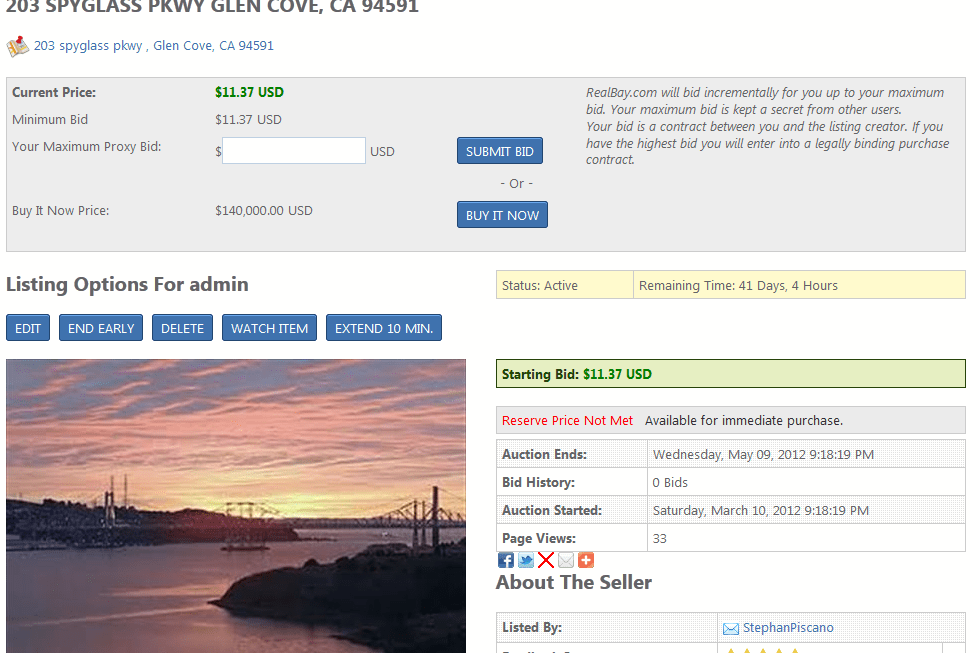
Exclusive to AGBeat, RealBay has shared some sneak peek screen shots of their product which will soon be in beta (which means it might have some bugs and it will get better over time). Click any image to enlarge:

Realtor typos make for humorous MLS bloopers


The Blooper Scooper is back, folks, and this week’s picks demonstrate the beauty of the written turd. Uh, word. Check out these absurdities if you want a few laughs:

Expect the Unexpected

“Please compact me” (Last words of Jimmy Hoffa)

“Good desin” (So the exorcism was a success?)

“Fax or bail docs” (If I bail out a doc, can I get a free colonoscopy?)

“House with colorful accent” (Must be an Italian villa…)

“Watch the sun set over the buffs” (Gold’s Gym must be up for sale.)

When Ordinary Just Won’t Do

“Showing Tim – 1:00 pm” (Does Tim have something to brag about?)

“Widow shudders” (Because an idiot just walked into the room?)

“Coffin ceilings”   (Perfect for an agent who is already DOA.)

“One car grudge” (Kia owner, I presume?)

“Ranch w/ 2 dunk houses” (When a coffee cup just won’t satisfy your donut…)

One Toke Over the Line

“Drop in sot” (Description under Uncle Paddy’s photo at Chuck-a-Jug.)

“Lick your own pants” (Recommended when you slosh your martini. )

“Designer saint” (Vera Wang before she left the convent…)

Typo of the Year:

“A wonderfuk house” – (Uh, I think that’s only legal in Nevada.)

Short sales, junior liens, and cash contributions

It’s the little things that matter most.

The devil is in the details, at least that is what they say. The other day I was reminded of that fact when helping a friend to complete the processing of her short sale. This friend had already received two approval letters from the short sale lenders–one from the first lien holder, and one from the second. She had even negotiated some additional terms (including a cash contribution) with a difficult second lien holder.

In short sale transactions with more than one lien holder, other lien holders will not just release their liens willy-nilly. This is probably their last opportunity to collect any money, so they want to get what they can from whomever they can. Often times, the first lien holder will offer the second lien holder enough money from the proceeds of the sale in order to get the second to agree to release their lien. And, other times, it is not so easy.

So, this second lien holder had agreed to accept six thousand from the first and another six thousand was offered up by the seller. All was good, and the agent had an approval letter from the second for $12000.

However, this is where the details get a little bit devilish.

In order to be fully transparent, you need to disclose to the first lien holder (on the settlement statement) that the second is going to receive a contribution from another source. And, this agent had forgotten to clear the cash contribution with the first lien holder.

Remember this detail.

Any contributions to any parties relative to the short sale transaction need to appear on the settlement statement at closing.

In order to assure that the short sale transaction closes smoothly and to demonstrate transparency, it is important to clear all contributions with the first lien holder and get that clearance in writing. One easy way to do that is to send an email or a message to your short sale negotiator at the bank and ask whether a cash contribution would be permitted. Make sure to submit a settlement statement to the first lien holder that shows the contributions for their review and possible submission to the investor for whom they are serving the mortgage.

There are so many little details that need to be considered when you are processing a short sale. Don’t forget to ask for help and support, and remember to pay attention to the details; they can be pretty diabolical.

TurnSocial share turns ups your lead generation game

2

TurnSocial goes pro

Last spring, AGBeat introduced you to TurnSocial, a free toolbar that nests at the bottom of a website and allows users to view yelp ratings, your facebook page, local information, walkability and the like without leaving your website, all through a pop up.

TurnSocial Founder, Matt Hendrick told AGBeat, “We’ve always wanted to find a better way to collect more qualified leads and provide the leasing teams with some helpful insights about the leads that they’ve received.”

To meet that goal, the company has launched the TurnSocial Leads Bar – a simple, single-click lead-capture tool for websites which upon installation instantly appears on every page of a website.

Hendrick says the TurnSocial Leads Bar does three things:

  • it turns every page into a lead-capture form, creating more opportunities to hear from interested prospects
  • it’s the first service that enables agents and marketers to understand potential renters’ likes, interests, current living situation & more, and
  • it helps agents identify the advertising & marketing sources that are driving qualified traffic to their websites.

In the real estate sector alone, the free sharing bar has been installed on over 3,000 apartment and Realtor websites, leading to a higher demand from consumers to “close the engagement loop” and convert more leads without spending thousands of dollars a month.

The TurnSocial Leads Bar rests at the top of every page of a website with a customizable space to create a unique call to action as seen on the 30Lines site:

The tool offers two ways to connect consumers with your business – traditional email sign up or Facebook Connect, sending all leads directly to your inbox and includes a personalized lead profile. For Facebook leads, the Facebook Open Graph is used to provide you with basic information about the lead such as their name, and interests, and what page they were viewing when they connected to your site.

In a statement, the company said, “Our goal is to not only increase the total amount of leads collected through your website, but also to provide you with instant customer insights to be used when crafting your follow up message. We think it’s a great start, but have even bigger plans for the future.”

The cost for mass leads is unknown and we suspect negotiated by each large site owner. We would like to see the service integrated into CRM systems and email services to reduce the number of steps it takes a professional to reach a lead. TurnSocial is currently offering a free 30 day trial, then a standard plan of $20 per month for up to 50 leads. The company promises the social bar will always remain free.

The anatomy of building a real estate startup

17

Building a real estate startup

It is my goal to share the triumphs and agony (and trust me… there is agony) I encounter while navigating the daily challenges of a start-up in the real estate industry. We are developing our own application to provide a better user experience to NuHabitat clients. As you might guess, we are on a limited budget.

I want to share a few of the issues we have dealt with in getting to where we are today.

Challenge one: beta app

My first milestone was to develop our VOW beta app. This would show proof of concept on several different levels and it would demonstrate our ability to produce a web application that replicated our entire MLS database. That is no easy task. We would also provide registered users with data they had not previously accessed unless provided by their agent. Days on market, historical price data and sold data is what I want to deliver to our clients. To some this seemed like a daunting task. To others, I guess it is no big deal.

While exchanging comments on a blog the other day, Russ Bergon, CEO of MRED said, “IDX v VOW. Again sounds good on paper. Years ago here in Chicago we add nearly 2000 VOW sites because of opt in versus opt out. IDX opt ins were at about 30% Today we have a handful of VOWs. Why? Because consumers did not want to register to see listings and we are now at near 100 percent opted in to IDX.”

Where are they now? Had I known, I would have just bought one on the cheap! That is an amazing statistic to me.

Challenge two: RETS

We are utilizing RETS, the Real Estate Transaction Standard. In simple terms, RETS was supposed to be developed to help standardize the delivery of real estate data and simplify development of real estate software. The problem is, to date, RETS has not accomplished its stated goal (to the best of my knowledge), however, they are making substantial progress.

One of the toughest issues we faced in working with the protocol was having no real instruction. My developers said documentation is poor. It may exist out there but we were not aware of it. I reached out to several different professionals for guidance. No assistance was offerred  from our MLS on how to code what we needed. We spoke with Mark Lesswing at NAR and he did his best to help. We called several consultants. For the most part, we were flying blind. The good news is that we were able to get past several issues with our data and things started to fall into place.

Challenge three: consumers’ real needs

From here it was necessary to determine what feature set to include in our beta release. With search at the core, we needed to decide if we should just create a simple search or have an advanced search as well? I have read blogs that question why the heck we have both simple and advanced search. Why not just one search? I kind of agree with that and think it is worth consideration. Do consumers use simple search differently than advanced? Is there a needed distinction between the two? I’m looking forward to the A/B testing we will create to answer this question.

Challenge four: moving pieces

Other considerations include the need for a a blog. You’re probably asking who would have a real estate site without a blog? I think you would be surprised. What about a twitter feed? A way to provide feedback? A contact us page? These are the things we needed to create a successful minimally viable product.

Some of you may think differently, but our goal was to get a unique search product operational and on the internet for consumer use. Call it a “Field of Dreams” if you want, but I believe that if you build it, they will come …IF you have a better value proposition. In the first month, we have over 500 registrations and over 2,000 unique visitors. All this for a no-name beta product that just wants to get consumers the data they are looking for – I was pleased with the initial consumer reaction.

Next steps

Following the development of core search, we are now faced with what to tackle next. The obvious features are map search and user profiles. There are challenges here as well and creating a unique map experience won’t be easy. Should we use Google maps, or Bing, or maybe even a different map? Believe it or not, there are other options. Do we use clusters or splatter the map with the maximum number of pins allowed? We will also include geo-location, specific boundaries and maybe even light box displays. I sure would like some statistical information on what map interface provides the best user experience.

Then there are user profiles to consider. This is where we are able to allow a user to create and save their user preferences, but more importantly, allows for us to begin tailoring the user experience. It may be customary for many sites to create profiles, but I believe in terms of creating a “sticky” user experience and keeping your clients engaged on a real estate application provided by a brokerage, you must provide a value proposition that keeps your clients checking in frequently. This will be our version of drip marketing, except the goal is to bring the clients back to me rather than always pushing to them.

We are still creating our basic user experience, but in my opinion this is the most critical element, because these are the things that users expect to be right. They expect accurate, timely data. They expect results to be fast. Lacking those fundamental qualities, you will immediately lose them to any other site, and there are plenty of them, so yours better be good.

Showcase: LG flexible screen to make tech innovations possible

13

LG’s big production announcement

LG has announced it has begun mass production of its electronic paper display (EPD) product, and while there is no word on an American launch, the company plans to launch in Europe at the beginning of next month, according to ECN mag.

The LG EPD is not just flexible, allowing the screen to bend up to 40 degrees from its center, it is a 6 inch, 1024 x 768 e-ink plastic screen. The technology used mimics the way traditional ink appears on paper, which many prefer over the backlit flat panel displays of tablets and computers.

The EPD is only 0.7mm thick, weighs 14 grams (that’s 1/33 of a pound) and is said to be scratch resistant when dropped.

“With the world’s first plastic EPD, LG Display has once again proven its reputation for leadership and innovation with a product we believe will help greatly popularize the E-Book market,” said Sang Duck Yeo, Head of Operations for LG Display’s Mobile/OLED division in a statement.

Making tech innovations possible

AGBeat has shared with you many technology concepts that rely on the flexibility of screens, which until now has been little more than a concept.

Take for example the “User Feeling Option (UFO)” design concept that sits just at the intersection between phone, projector and television, all relying on the flexibility of a screen:

Then, there is the design concept that BlackBerry has invested in by designer John Anstasiadis that features a “smart” wrap around screen which can tell the difference between an intentional command and a hand holding the phone:

Also, Kunihiko Nakata’s Palette smartphone concept shown below is that of a wraparound smartphone that uses technologies that in 2011 we projected could realistically hit the market in 2012 – LG’s announcement puts production one step closer:

What about the odd concept combining a tablet, smartphone and lamp – WAVIEW that relies strictly on flexible screen technology:

Don’t forget the Samsung Galaxy Flexi Skin Android Smartphone concept, a flexible, ultra thin, powerful smartphone that acts as a phone, projector, a camera and more even though it is ultra bendy – we even admitted to having a crush on this device last summer:

The Rolltop laptop can act as a traditional laptop or be folded to become a full 17? touch screen. The cylindrical center acts as a base and has a power cord, speaker, USB port and webcam:

Then there is the very creative “Rollerphone” designed by Alexey Chugunnikov, which is more than a sexy futuristic bracelet watch, it works as a phone, media center and internet, much like smartphones, hello!

The takeaway

LG is not the only company working on flexible technologies, but they are the first to get to the masses, which makes some of the concepts that have been shelved one step closer to being possible. Flexibility is here, and it is one of the biggest innovations that will go mainstream in the next 24 months and make us all feel a little bit more like we’re Marty McFly in the future.

Is the extend and pretend era of commercial real estate over?

Troubled commercial assets

Dr. Mark Dotzour of the Real Estate Center at Texas A&M recently spoke at the Information Management Network’s Bank and Financial Institutions Special Asset Executive Conference on Real Estate Workouts in New York City and observed1 several emerging trends regarding the state of commercial real estate.

First, Dr. Dotzour observed that troubled commercial real estate is starting to be sold by banks to private investors, but says it is too early to say the era of “extend and pretend” is over despite some product beginning to flow. For the past two years, Dr. Dotzour notes that most investor focus has been on Boston, New York, Washington D.C., and San Francisco, the “gateway cities” where prices have plummeted as have returns. “This is the impetus for investor interest increasing in the rest of America.”

Worries over loans

Because of the large volume of commercial mortgage-backed securities made in 2007 that are set to mature this year and need refinancing, worries loom over the refinancing of maturing debt.

“But so far, there have been few examples of big failures to refinance or extend these maturing loans,” Dr. Dotzour observed, adding that many are being extended two or three years, with borrowers being asked to pay down their loan and for those unable, the trend is to “marry up” with private equity firms that supply the funds, requiring a high rate of return.

Banks extending and pretending?

Conference speakers agreed that the extend and pretend era has been a success for the banking system, where many have remained due to shortfalls in the budget, making it difficult to write off the real estate losses when foreclosures hit.

“As prices stabilized and increased in some cities, the expected losses on real estate loans has also stabilized or gone down,” Dr. Dotzour noted.

Deal volume to rise

“The capital markets were completely dead a few years ago; now there is some liquidity in secondary markets,” Dr. Dotzour said. “Hopefully, it will bring more deal volume in 2012. As the general financial markets improve, the number of deals coming out of banks will increase. Private equity is stepping in to rescue these deals.”

A common theme Dr. Dotzour observed from panelists is that they feel they cannot purchase because of “all the irrational bidders out there,” which will likely continue as there appears to be a rush to snatch up troubled commercial real estate from banks and CMBS special providers. “Prices are high, and yields are lower than expected,” Dr. Dotzour added.

Discounted payoffs

Panelists also focused on the topic of discounted payoff (DPO) as explained by Dr. Dotzour. “Suppose a borrower has a $1 million loan that is maturing, and the bank doesn’t want to refinance it. The borrower may make an offer to completely pay off the loan at a discount. Some banks have a real aversion to offering a DPO to a borrower because it sends a bad signal to all its loan customers that you can pay off at a discount.

“However, banks may not have an aversion to accepting a DPO from a third party. In this case, the bank will actually sell the note rather than foreclose on the property. Some banks will allow the borrower a DPO in conjunction with a note sale. If the borrower is the highest bidder for their note, then they can buy it from the bank at a discount.”

Overview and forecasting

One panelist forecast that the $20 billion in private equity funds raised in 2011 is looking for U.S. real estate deals in all land uses and that while prices increased substantially in gateway cities, prices are still on average 40 percent less than the 2007 peak elsewhere. Transaction volume picked up in 2011 and distressed sales accounted for one in every four sales.

Troubled real estate loans look to stay on the books for a while longer little execution despite all of the “thinking and planning” on the topic. Banks struggling with capital ratios remain hesitant to sell while healthy banks are taking charge-offs. The FDIC is pressuring the banking system to recapitalize to get the bad loans off of the books.

The era of extend and pretend is still alive and well, but there are signs pointing to a shift away from this practice.

1Dr. Dotzour’s observations

Investment, vacation home purchases spike dramatically

Buyer survey results are in

According to the National Association of Realtors’ 2012 Investment and Vacation Home Buyers Survey, investment home sales surged 64.5 percent in 2011 from 2010, while vacation home sales rose 7.0 percent, and owner-occupied purchases fell 15.5 percent. Vacation home sales accounted for 11.0 percent of all transactions in 2011, up only 1.0 percent for the year, while investment sales surged dramatically to 27 percent, up 10.0 percent from 2010.

NAR Chief Economist Dr. Lawrence Yun said investors with cash took advantage of market conditions in 2011. “During the past year investors have been swooping into the market to take advantage of bargain home prices. Rising rental income easily beat cash sitting in banks as an added inducement. In addition, 41 percent of investment buyers purchased more than one property.”

Investors to absorb foreclosures hitting market

Dr. Yun said the shift in investment buyer patterns in 2011 shows the market, for the large part, is able to absorb foreclosures hitting the market.

“Small-time investors are helping the market heal since REO (bank real estate owned) inventory is not lingering for an extended period. Any government program to sell REO inventory in bulk to large institutional companies should be limited to small geographic areas. Even where alternatives are needed, it’s best to rely on the expertise of local businesses, nonprofit organizations and government,” Dr. Yun said.

Cash buyers in the market

According to the survey, all-cash transactions are becoming the common way for investors to buy investment and vacation homes with roughly half of all investment buyers paying cash in 2011 and 42 percent of vacation home buyers paying cash. Dr. Yun points to tight credit conditions for the decline in owner-occupant purchases.

Half of all investment home purchases in 2011 were distressed homes, as were 39 percent of vacation homes. The median investment home price in 2011 was $100,000, up 6.4 percent over the year, while the median vacation home price was $121,300, down 19.1 percent.

“Clearly we’re looking at investors with financial resources who see real estate as a good investment and who aren’t hesitant to use cash,” Dr. Yun said.

Dr. Yun also pointed out that for investment and vacation home buyers that used mortgage financing, the median downpayment was 27 percent in 2011.

Buyer demographics

The typical investment home buyer in 2011 is 50 years old, earns $86,100, and usually invested within 25 miles of their primary residence.

The typical vacation home buyer is also 50 years old, has a median income of $88,600 and purchased a property within 305 miles of their primary home. Although 37 percent purchased vacation homes over 500 miles away, 35 percent stayed within 100 miles.

Flipping is down

The 2012 study reveals that buyers plan to own their recreational property for a median of 10 years.

“The share of investment buyers who flipped property remained low in 2011, and many of those homes likely were renovated before reselling,” Yun said. Five percent of homes purchased by investment buyers last year have already been resold, up from 2 percent in 2010. The typical investment buyer plans to hold the property for a median of 5 years, down from 10 years for buyers in 2010.

Most (82 percent) of vacation home buyers said the primary reason for buying was to use the property themselves for vacations, and while 32 percent plan to use the property as a primary residence in the future, only 22 percent plan to rent their property to others.

Half of investment buyers purchased in order to generate rental income, and 34 percent indicated they wanted to diversify their investments or saw a good investment opportunity.

Fully 16 percent of vacation buyers and 14 percent of investment buyers purchased the property for a family member, friend or relative to use, often for a son or daughter to use while attending school.

Hot spots for vacation home and investment purchases

The South is very popular for investors and vacation purchases, accounting for nearly half of all 2011 purchases.

Fully 42 percent of vacation homes purchased were in the South, 30 percent in the West, 15 percent in the Northeast and 12 percent in the Midwest; 1 percent were located outside of the U.S.

Additionally, 42 percent of investment properties were in in the South, 23 percent in the West, 17 percent in the Midwest and 15 percent in the Northeast.

Positive outlook for second home purchases

Eight out of 10 second home buyers said it was a good time to buy and nearly half of investment buyers said they were likely to purchase another property within two years, as did one-third of vacation-home buyers.

The study anticipates that with the growth patterns of the American population, second home sales will increase. Dr. Yun noted, “Given that the number of people who are in their 40s is somewhat larger than the 50-somethings, the long-term demographic demand for purchasing vacation homes is favorable because these younger households are likely to enter the market as their desire for these kinds of properties grows, and individual circumstances allow.”

Study: user generated videos complement professional videos

Digital measuring firm comScore and consumer video network, EXPO released study results on the synergy of professionally produced video content and user generated product videos in marketing campaigns, indicating that the two are “highly synergistic, driving higher levels of sales effectiveness when used in tandem.”

“This study aimed to answer a critical question for today’s digital advertisers: ‘how do user-generated videos complement professionally-produced content, if at all.’ What we found was strong evidence of incremental benefit with exposure to both forms of media,” said Frank Findley, Vice President, Research and Development at comScore. “In the campaign examined, professionally-produced content and product videos drove strikingly higher lifts when used together than when either was used individually. While marketers may already be familiar with the effectiveness of professional video content alone, these results suggest that even greater returns can be had by combining their use with authentic, user-generated content.”

Sales effectiveness increased when combined

The first consumer group study participated in a veiled exercise to determine the sales effectiveness of the professional videos, user generated videos and both together:

“This demonstrates not only the value of each of these media individually, but also the powerful combination when used together,” noted comScore.

Combining professional and user-generated videos improved results

The second consumer group participated in a cued exposure exercise and were surveyed after being directly exposed to the content:

comScore said, “On its own, professionally-produced content resulted in a higher percentage of respondents understanding the importance of the key message presented than user-generated content, while the user-generated product videos were more successful at producing emotional intensity, key message communication, and ease of relating to. When consumers were exposed to both professionally-produced and user-generated content, the combined increases were greater than for either of the individual media exposures.”

Comparing the two

“It seems that professionally-produced content and user-generated product videos are each successful at delivering different key elements to a consumer through video ‘advertising’,” said Jessica Thorpe, Vice President of Marketing at EXPO.

Thorpe continued, “We found that consumers perceived feature benefits as more believable when coming directly from the brand through professionally-produced content, while the unbiased user-gen videos were more believable in verifying specific product claims, such as superiority and convenience. When used together, all of the perceived gaps get filled in and consumers become more confident in their purchase decision, resulting in better sales effectiveness from the advertising.”

Getting into video

For professionals and small businesses, although this is not a large study, it is a new indicator that just producing professional video or just producing user-generated video can be dramatically improved when combined, so consider sharing this with your videographer and strategize on how to add user-generated video to professional video through editing, or by featuring them side by side on a website.

The EXPO and comScore indicates that the two combined improves effectiveness of video, a result that can’t be ignored.

6 Big Data trends, 5 ways companies of all size are adapting

Defining Big Data

Recently, AGBeat addressed “Big Data” which is defined as large data sets which cannot be managed with simple, common software that captures and processes the data, and is typically consisting of at least dozens of terabytes in a single data set. The challenges of Big Data are, well, big, and most attention is being paid to the massive amounts of data being generated by social media sites like Facebook and Foursquare.

In fact, Big Data was a popular theme at the recent South by Southwest Conference in Austin, with technologists and marketers bringing their unique backgrounds to the conversation, each addressing the collection of and processing of the unprecedented data being collected, for the first time outside of the government, and the concerns that go along with consumers blindly offering up the data.

6 Big Data trends

Bassel Ojjeh, CEO of nPario and former Senior VP of the Data Technology division at Yahoo gave AGBeat an exclusive look at what he is seeing as the top six trends in Big Data:

  1. Consolidation of Big Data players by either system integrators or hardware makers. Big Data has a big appetite for consulting as well as hardware and storage.
  2. Hadoop becoming the source of raw data and connectors from there to enterprise data warehouses like Netezza, etc.
  3. The slow death of RDBMS as we grew up to know them. Which makes for a good question of what will Oracle do.
  4. Evolution of startups from those who focused on infrastructure plays (Cloudera as an example) to industry specific and application specific plays.
  5. Integration of data from Natural user interfaces and smart devices with social and behavioral data.
  6. “Global Impact – Big Data empowering more Arab Springs around the world”. We already saw this in few occasions.

Operating at the intersection of technology and advertising, nPario delivers Big Data publisher and marketing solutions. nPario provides “Audience DNA” to reduce consumer data complexity and to deliver ROI and is the only player in the industry offering these solutions on an open and extensible architecture. nPario is able to extract consumer insights from all sources and transform them into a set of integrated marketing apps that product owners, account executives and clients can use to drive their campaigns. The company helps business users to drive more relevant experiences for their customers through data. They have a multi-patented Big Data platform that was built for and managed by one of the largest online portals in the world.

5 ways professionals are mastering Big Data

Kami Huyse, CEO of Zoetica (an agency that connects brands and nonprofits with their communities for social good) recently crafted a list of five essential skills to master Big Data that is geared toward public relations professionals but we believe is applicable to almost any professional:

  1. Become an analyst. Don’t be intimidated by data and analytics.
  2. Learn Excel. One of the best gifts you can give yourself is to take an advanced Excel course to learn how to manipulate data in spreadsheets.
  3. Collect Data. Consider collecting your own data to supplement what you get from any tools you use.
  4. Evaluate Tools. By all means keep an eye out for new tools.
  5. Ask questions. Lots of them. With all of these big data tools, understanding the methodology new tools use to analyze data will be critical.

More details can be found on SpinSucks.com, but Huyse mainly notes that it is important not to get intimidated – the very phrase Big Data can be intimidating, but it is within reach of companies to grasp the wealth of information available to them.

Tonia Ries, founder of Modern Media and The Realtime Report and conferences said, “Understanding how to query, read, map and manipulate data — not what the typical PR or marketing person signed up for, but so critical. I look at it the same way I look at programming: I don’t need to know exactly how to do it, but I need to understand enough about it so I can ask the right questions and use the tools that are built by the programmers.”

“There is a ton of data that people can get their heads around and gain valuable insights with a few simple tools,” said Matt Hixson, CEO of Tellagence. “Learning excel is a great example of DIY analytics. You can gain a ton of insights from doing that. Where it gets complex is when you get to relationships and groups of relationships around specific subjects that form communities. We have tons of data points today but most of us end up putting a mental model of how it all fits together in our head. I think over the coming months people will see new accessible applications that allow them to visualize and understand what they have only pieced together in the past.”

The takeaway

Big Data is here and it is not for the nerds, it is something many companies are already tackling, and all businesses will be thinking about in coming years – it is better to get a jump on it sooner than later to maximize its potential.

Public relations professionals, marketing and communications staff or even CEOs have DIY options, but have amazing tools like nPario within reach, but the commonality of what everyone above is saying is that it is not a trendy phrase, it is a relevant business concept, and we would add that it is a concept most will ignore because it sounds too sophisticated and data nerdy, so professionals in the know will have the advantage.

New foreclosure filings fell in fourth quarter

Foreclosure filings fell

According to the Office of the Comptroller of the Currency (OCC), the number of new foreclosure filings on American homes fell in the fourth quarter and while OCC official Bruce Krueger notes there has yet to be a robust recovery in the overall health of loans, programs are keeping borrowers in their homes.

Fourth quarter filings fell 16 percent from the previous quarter, marking an 18 percent drop from a year earlier. Foreclosures in process for the quarter fell 4.1 percent from the third quarter of 2011.

Kreuger notes that part of the dip is due to regulators’ efforts to get banks to stop “dual tracking” (wherein a foreclosure is filed while a loan modification is pending). Bank and government programs are seeking ways to keep homeowners in their homes rather than following the trend in recent years of going straight to foreclosure filings.

“I think we’re certainly seeing signs that servicers are starting to clamp down on that dual-tracking process,” Kreuger told reporters. “We certainly are not yet seeing signs of a robust recovery in the overall quality of the mortgage servicing portfolio.”

Market stabilization on the horizon?

Signs of market stabilization are here and Kreuger said that there is evidence that banks are pulling more borrowers out of the foreclosure process to negotiate a loan modification, a trend others are echoing. While incentives from the government are higher now for modifying loans and banks are more willing, modification programs do not always work.

Last month, after a year of heated negotiations, Bank of America, Cigitroup, Wells Fargo, JPMorgan Chase, and Ally Financial settled with 49 state attorneys general and the federal government for $25 billion to settle foreclosure abuses.

Settlement details were not immediately made public, but after thousands of pages of documents were released, AGBeat published a detailed breakdown of the $25 billion settlement which is pending final judicial approval but is expected to sail through.

Krueger said that going forward, the settlement will aide in the amount of loan modifications (particularly principal reductions) being offered, thus keeping homeowners in their homes.

Quiz: rate how effectively you keep in touch with clients

Quiz: keeping in touch

How well are you doing at keeping in touch with past clients and your sphere of influence (SOI)? What can you be doing better? Answer the below questions and see for yourself. The more “true” answers you get, the better you are at keeping in touch and maximizing your referral and repeat business.

01I send out a monthly newsletter or e-newsletterTF
02I have all my contacts set up on drip email marketing campaignsTF
03I schedule consistent “keep in touch” calls with my contactsTF
04I organize events every month or year, such as home buyer seminars and client appreciation daysTF
05I sponsor events, teams, and/ or clubs that I know my clients are involved in so I can stay “top of mind”TF
06I use a real estate CRM to schedule and organize my “keep in touch” and communication activities with everyone in my databaseTF
07I send out direct marketing pieces to my “A List” contactsTF
08I wish everyone in my database a “Happy Birthday” when the time comesTF
09I connect with clients and my SOI through social mediaTF
10I send “Thank You” notes to clients to thank them for their referrals and for doing business with meTF
11I send “Thank You” notes or small gifts to clients on their move-in date anniversariesTF

See how you scored:

Eight or more true answers: You’re an expert at keeping in touch. You have the right mindset when running your business and you know that keeping in touch and staying “top of mind” leads to referrals and repeat business. You work in a highly proactive manner and understand what long-term success in real estate sales entails.

Five to seven true answers: You’re on the right track but you still have some work to do to ensure you’re doing everything you can to get the most return from your past clients.

Less than five true answers:  You may be doing some things right but there’s a lot of work that still needs to be done to become a true expert when it comes to keeping in touch and maximizing your number of referrals and returning clients. With some changes, you can make a real, positive impact on your business.

Fame: the terrible, horrible, no good, very bad Twitter tool

Fame: a viral Twitter game invoking the name of Lady Gaga

Fame is designed by New Yorker Adam Ludwin as a side project to give random users a gigantic follower count once a day. Users to to the Fame site, give it permission to access their Twitter account which enters them into a raffle with everyone else who connect, and daily, a random winner is chosen. The winner is automatically followed for the day by everyone who has entered the raffle.

The San Francisco Chronicle reports that Ludwin has actually spoken with Twitter about the project and had their blessing, especially given that Twitter’s API allows developers to add or remove followers from a user’s account, making the temporary mass following possible.

The tool/game/service is free and the company says they have no plans to monetize the site and through the API, they simply follow and unfollow the daily winner on your behalf, and as the site grows in number, they seek to be as big as or bigger than Lady Gaga, giving each daily winner a taste of the glory, as daily winners have a Fame logo on their avatar for the day to set them apart from others.

The game is just like a good ol’ fashioned raffle where you get one entry, but in the case of Fame, you earn more entries by inviting friends to join Fame. Anyone can unfollow the current winner if they dislike them, or manually follow them after their 24 hours are up if the winner is interesting.

The good news

It is hard to criticize a free, fun game that is simply built as someone’s side project, so we’ll start off by noting that this looks fun. Honestly. Imagine potentially having millions of followers for a day – what would you say? My personal Twitter stream would either terrify or bore the average American as I tweet mostly about very specific economic indicators, Ben Bernanke speeches, kittens and unicorns.

Wouldn’t that be fun? And if someone liked my tweets and remembered to go back and follow me the next day after my temporary fame was stripped away, the ecosystem is stroked and new connections are made. Sounds like a win, no?

Why it is terrible, horrible, no good and very bad

First and foremost, unorganic connections no matter how temporary are bogus. In the early days of Twitter, before they knew what they were doing, a simple script would allow users to follow thousands of others based on simple parameters such as words in their profile like “follow back,” thus gaming the system. While Fame is not gaming the system in a permanent way, this really feels like a wet T-shirt contest… a girl gets on stage with a bunch of other girls, bounces around, then the next morning, no one remembers who she is or that she even had a name.

Secondly, any service of any kind that incentivizes people to flood my already overflowing direct message box on Twitter with invitations to join them, it makes me think of FarmVille and I want to hulk out. This part is not Fame’s fault, they’re just trying to spread the word, but trust me, it’s going to get very, very old, very quickly – I predict people will be annoyed before the system hits half a million people.

Thirdly, their FAQ is very clear in that “if the winner is a spammer or bot, we draw again. Only real humans can win FAME!” But what happens when the winner becomes a spammer as soon as they win? Check out the most recent winner below and tell me if you see spam:

While the person above is a radio DJ and is expected to be somewhat spammy, imagine giving the mic to most teenagers on Twitter (like this kid, found with only 5 seconds of searching for an example on Twitter). Fame says, “If you Tweet anything harmful or abusive we will revoke your win. Examples of harmful or abusive Tweets include links to malicious software, pornography, or hate sites. If you abuse or troll FAME players in any way, we will ban you from playing. We have sole discretion to determine what is harmful or abusive.” This should prove to be a challenge – have you ever given a drunk the mic at a bar? It’s never, ever, ever pretty – nor is an excited college kid with a loud Twitter mic.

Fourth, most people that sign up will not read the permissions, understand the game, or know that to stop playing, they have to contact the company by email. The system is beautifully designed to rope in the cattle, gate them and know that they won’t intuitively understand how to get out. Brilliant, yet kind of inadvertently evil genius (which is actually a compliment, not a real criticism).

Lastly, a daily winner is unlikely to stand out in anyone’s stream that is following more than 20 people. I often hear, “you didn’t see me tweet about my baby taking her first steps?” with that hurt puppy look in their eyes, to which I always say “I follow thousands of people and only log on intermittently throughout the day, I can’t possibly read everything everyone says, it’s not personal.” It sounds mean, but it’s true and I’m in the majority.

It’s all good fun

All of the criticism aside, it looks like a fun game, but for our readers that are professionals, business owners, entrepreneurs and c-suite level, skip the Fame and build your own, lest you join the ranks of the teen Twitterati. Ludwin’s concept is fun and we know that it will explode in the coming weeks, but for professionals looking to grow their Twitter following, this isn’t on the list of things to do.

Updated LinkedIn feature makes connecting easier

24

Updated LinkedIn feature is a huge improvement

LinkedIn announced an update to the People You May Know feature to be rolled out to all users in the coming weeks to better connect users based on their affiliations. The company says that since their original launch, “this powerful feature has helped millions of professionals discover and grow their professional network with personalized and relevant suggestions of people you may know and should connect with.”

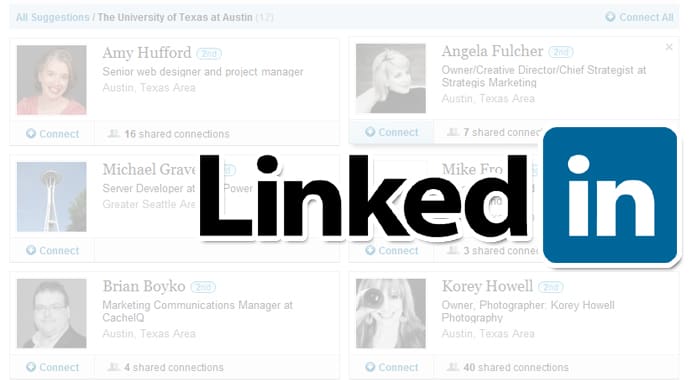
The interface is more streamlined and uses tiles with users’ faces and basic information, narrowed down by different parts of your professional life. LinkedIn’s goal was to make it easier to find and connect with people in your network. Our team tried it out today and was surprised at how many people were not already in our networks that should have been, indicating to us that the feature is most definitely improved.

The company said in a statement, “Behind the scenes, our algorithm identifies people you may want to connect with based on factors like your existing network, past workplaces, and where you’ve gone to school. With these changes, you’ll see more relevant results as you scroll down the page.”

These improvements will be rolled out to all users soon, but if you’re impatient like us, you can get early access to the new feature here.

Video intro to the new features:

Toll Brothers has best spring sales in 5 years, Lennar orders up 33%

Overall new home sale stats

According to the U.S. Commerce Department, new home building permits jumped 5.1 percent in February and rose 34.7 percent over the year, hitting its highest point since October 2008, while housing starts fell 1.1 percent, suggesting signs of a slow recovery.

Despite increasing permit levels, builders remain cautious in their optimism, with confidence levelsat a five year high this month, yet not surging at a dramatic rate.

Lennar orders up 33%

The new home sector has been one of the hardest hit in real estate, making any signs of recovery more than welcome for builders.

Stuart Miller, Chief Executive Officer of Lennar Corporation said, “New sales orders in the first quarter were encouraging. We have seen the market stabilize, driven by a combination of low home prices and low interest rates, making the decision to purchase a new home more attractive, compared to the heated rental market.”

Miller added, “We recorded our strongest first quarter sales since 2008, with new orders increasing 33% year-over-year. We have been able to increase sales prices and have started to reduce sales incentives in some of our communities. We have also seen a noticeable improvement in our sales pace per community, which should lead to a significant increase in the operating leverage of our homebuilding segment in the second half of the year.”

Toll has best spring in five years

Another builder seeing signs of improvement is Toll Brothers whose CEO, Douglas Yearley told CNBC that this has been their best spring in five years. This year, the company’s orders are “up significantly and continue to be up significantly. I’m optimistic right now.”

Yearley added, “25 percent of our communities have seen a price increase since Jan 1. That’s encouraging. There are places where we don’t have pricing power (but) we’re not dropping prices. We haven’t dropped prices in over a year.”

“In the last month, Phoenix is back in a big way,” Yearley said, noting that Phoenix has gone from 14 to 16 months of supply to four or five months.

KB Home sales drop

According to CalculatedRiskBlog.com, analyst Tom Lawler said today that “KB Home’s surprise YOY drop in net orders for the quarter ended February 29th was company specific, and may have been related to its ‘preferred mortgage lender’ issue.”

“Bumping along the bottom”

While luxury and mid-level builders are reporting great improvements in sales, builders like KB are not seeing quite the same levels of improvement across the board.

While Yearley speaks specifically to Toll Brothers’ sales, his comment inadvertently applies to most of the new home sector overall – “We’re bumping along the bottom in certain locations but we’re clearly off the bottom in other locations.”

Yesware Chrome extension enhances Gmail for business

Gmail for business use

If you already use Gmail for your small business email needs, you know how convenient it is, as you can access it from anywhere and customize many of its features to fit your professional needs. One thing you may not know, however, is that there is awesome tool you can use alongside your Gmail account to streamline your professional efforts.

Enter Chrome extension Yesware, an easy-to-use online tool geared toward salespeople, but it can be used by any small business professional.

Track your emails

It’s no wonder why Yesware is perfect for salespeople with this feature. Yesware allows you to track your emails—from it leaving your outbox and arriving at its end destination. “Yesware can detect when it is opened, who opened it, the reader’s location and even computer type.” Yesware will even compile a report for you to view whenever you want.

This particular feature will help you confirm and keep track of who is receiving and actually opening your messages. If it’s a sales pitch email, for instance, you will be one step closer to determining who is actually interested and who you can follow up with.

Team sharing

Sharing information as a team is an important part of working together. Having access to the same information and reports can streamline your professional interactions and make everyone a cohesive unit.

Yesware’s reports can be accessed by multiple users or even by your entire company. This will ensure that your clients or customers aren’t emailed multiple times for the same thing because there will always be an up-to-date report to review first.

Email templates

Whether you regularly send out similar emails or you hit the perfect note with yesterday’s email, you can save it as a template. Using Yesware to save email templates is a great way to save time, as you don’t have to go searching for it. It’s also great if you send many of the same emails, but you need to customize each one with the recipient’s name or personal information.

These templates can also be shared with every member on your team, so all of your outgoing emails have a unified front.

Convenient enhancement

Because Yesware can be added onto your current Gmail account, its convenience enhances your Gmail experience and enables you to be more productive throughout your day. Yesware’s email features and shortcuts will put you back in control of your daily tasks and time management. Email is no longer just a tool you can use to communicate with others. You can now use it to also stay organized. And organization is often the first key to a healthy business.

Video, photo tour of Yesware:


U.S. migration report: top growing cities and states

Migration trends in America

U-Haul International, Inc. has released the results of their annual “U-Haul National Migration Trend Report” which is often used to measure top growth areas based on where people are moving. The 2011 Top U.S. Growth Cities Report names Nashville, TN as the top growing city for areas with more than 5,000 families moving, with the highest percentage of growth at 10.39 percent. Nashville was in the 15th spot in 2010, making this city a notable hotspot for growth.

“The report, reflective of growth patterns in the United States during 2011, was compiled based on nationwide trends in cities of all sizes and reflects communities with more than 5,000 families moving in or out of the area,” stated John Taylor, U-Haul president of Phoenix Operations. “Growth cities were then determined by calculating the percentage of inbound moves vs. outbound moves for each area.”

U-Haul says that the 2011 Top U.S. Growth Cities Report was compiled from more than 1.6 million U-Haul one-way truck transactions occurring during a recent 12-month period.

Fascinatingly, the company says that the annual mileage of North American U-Haul trucks, trailers and tow dollies would move a family to the moon and back again more than 9.9 times per day, every day of the year. The annual mileage of North American U-Haul trucks, trailers and tow dollies would travel around the Earth more than 177 times per day, every day of the year.

Top 30 growth cities

January – December 2011, With More Than 5,000 Families Moving
(Rank, City, Growth)

  1. Nashville, TN (10.39%)
  2. Oakland, CA (10.29%)
  3. Denver, CO (8.05%)
  4. San Francisco, CA (6.99%)
  5. Vancouver, WA (5.31%)
  6. Louisville, KY (4.97%)
  7. Dallas, TX (4.77%)
  8. Raleigh, NC (4.68%)
  9. New York City, NY (4.64%)
  10. Columbus, OH (4.42%)
  11. Bakersfield, CA (4.30%)
  12. Austin, TX (3.90%)
  13. Phoenix, AZ (3.66%)
  14. Spokane, WA (3.64%)
  15. Tacoma, WA (3.11%)
  16. Albuquerque, NM (2.99%)
  17. Sacramento, CA (2.98%)
  18. Seattle, WA (2.96%)
  19. Tucson, AZ (2.78%)
  20. Chicago, IL (2.41%)
  21. Omaha, NE (2.18%)
  22. Madison, WI (1.88%)
  23. Houston, TX (1.75%)
  24. Los Angeles, CA (1.71%)
  25. Reno, NV (1.5%)
  26. Plano, TX (0.90%)
  27. Mesa, AZ (0.76%)
  28. Oklahoma City, OK (0.74%)
  29. Jersey City, NJ (0.30%)
  30. Charlotte, NC (0.24%)

Top 10 growth states

January – December 2011, With More Than 20,000 Families Moving:

  1. Florida, 4.11%
  2. Washington, 3.61%
  3. North Carolina, 3.44%
  4. Louisiana, 2.99%
  5. Alabama, 2.83%
  6. Kentucky, 2.20%
  7. Arizona, 1.96%
  8. Georgia, 1.77%
  9. Colorado, 1.14%
  10. Oklahoma, 1.04%

January – December 2011, With 5,000 – 20,000 Families Moving:

  1. Kansas, 6.72%
  2. Utah, 6.63%
  3. Idaho, 5.73%
  4. Minnesota, 3.76%
  5. Nebraska, 2.01%
  6. Montana, 2.00%
  7. Delaware, 1.89%
  8. West Virginia, 1.82%
  9. South Dakota, 1.51%
  10. Maine, 1.39%

Boom Mic is affordable, solves iPhone’s video sound shortcomings

9

Making iPhone a trillion times better

Earlier this month, AGBeat showcased 6 insanely innovative photojojo tools that transform your iPhone photography. Today, we would like to introduce you to one of our favorite tools that transform your iPhone videography – enter the iPhone Boom Mic.

Even the latest iPhone 4S is not famous for good sound quality, as the built-in mic is inferior, primarily because of size restrictions – it’s good enough for phone calls, but not much else. The iPhone Boom Mic is a simple iPhone accessorie that plugs into the jack at the top of an iphone and clips to the phone with a plastic screw and goes for only $40 with reduced price shipping through photojojo.

The accessory is small enough to carry in a purse or pocket, fits over most cases, and is strictly made for improving the sound quality when you take video (there is a video on the photojojo site that demonstrates sound with and without the Boom Mic that is extremely impressive).

The company says the Boom Mic is super lightweight, so it won’t throw off the balance of your phone as you record and offers directional settings to capture all of the sound coming from specific areas. The mic works through the LiveAction app, which also lets you upload your videos instantly. It is easy to see that the Boom Mic can even actually double as a stand for the iPhone as demonstrated via photo below, which would help with professional interviews.

The iPhone Boom Mic’s top features, according to photojojo:

  • A boom mic for crisp, clear sound recordings on your iPhone
  • 2 directional settings let you control the recording
  • Small enough to always keep with you
  • Attaches to your phone’s headphone jack
  • Fits over your case
  • For iPhone 4 and 4S
  • 4 ¾” x ¾”
  • Takes 1 AAA battery (included)

Photo tour of the iPhone Boom Mic:


Homeowner never pays late, gets foreclosure notices

A foreclosure tale

For three decades, Claireather Mason was timely in paying her mortgage but last June after making her monthly payment and a statement from her lender reporting it as received and processed, she got her first default notice in the mail, according to NBC12 in Petersburg, Virginia.

This is nowhere near the first story of a homeowner who has not missed a payment yet receives foreclosure notices, in fact, a study last fall claims that housing has been so irreparably damaged by the destruction of the chain of title that it is unclear who the real owners of most of the titles in America are.

In Mason’s case, Ocwen Financial took over her mortgage and despite verification payment had been made, they began rejecting her payments month after month, and pushed forward with foreclosure.

“They taped [my payments] together and they’re still taped together and they mailed them back to me,” said Ms. Mason. She eventually called Central Virginia Legal Aid for help, but even letters from lawyers could not get Ocwen to listen.

The twist in the story is the same twist in all of these stories – the homeowner who is being wrongfully foreclosed upon is ignored and so is their lawyer, but when a news outlet begins making phone calls, the gears begin turning.

An Ocwen Financial spokesperson said in a statement that “someone from our office will be reaching out to her quickly to rectify the situation,” noting that mistakes happen.

How did this happen? How does it end?

The hiccup in the system that was not pinpointed by Ocwen staff is that Mason’s loan was extended over 20 years ago through a Housing and Urban Development program. “Their computer was saying that her loan had matured and the entire balance on her loan has come due, of course that wasn’t true,” said Mason’s attorney Sara Blose.

Through NBC12’s pressing and Blose’s insistence, Ocwen has called off the foreclosure, accepted all payments without penalty or interest, and corrected the problem in her file and have committed to correct the record to restore her credit rating.

Mason is grateful yet angry, telling NBC12, “I was just devastated because I had tried all I knew how to talk to them to explain that I paid my money and nobody would listen.”

“Their own company just doesn’t know what’s going on in the records that they have. They’re supposed to be the custodian of these records, but they don’t look into what’s going on with it,” said Blose, noting that cases like this are becoming common.

BrightNest launches beautiful pro tools for Realtors

BrightNest’s big first quarter move

Last fall, AGBeat introduced you to BrightNest, a budding startup seeking to “redefine home maintenance,” the company says as it offers home care tips, weekly reminders to users and step-by-step instructions for home maintenance. “Think of us as the owner’s manual for the American Dream.”

We were so impressed with their offering and potential for rapid growth, they were named a 60 Genius Brand to watch in 2012, noting “The AGBeat team is pretty savvy about home maintenance, but we have all learned a lot from the BrightNest tips and if we love the look, feel and content they produce, we know consumers do as well. Watch for BrightNest to go mainstream and get some serious funding in 2012.”

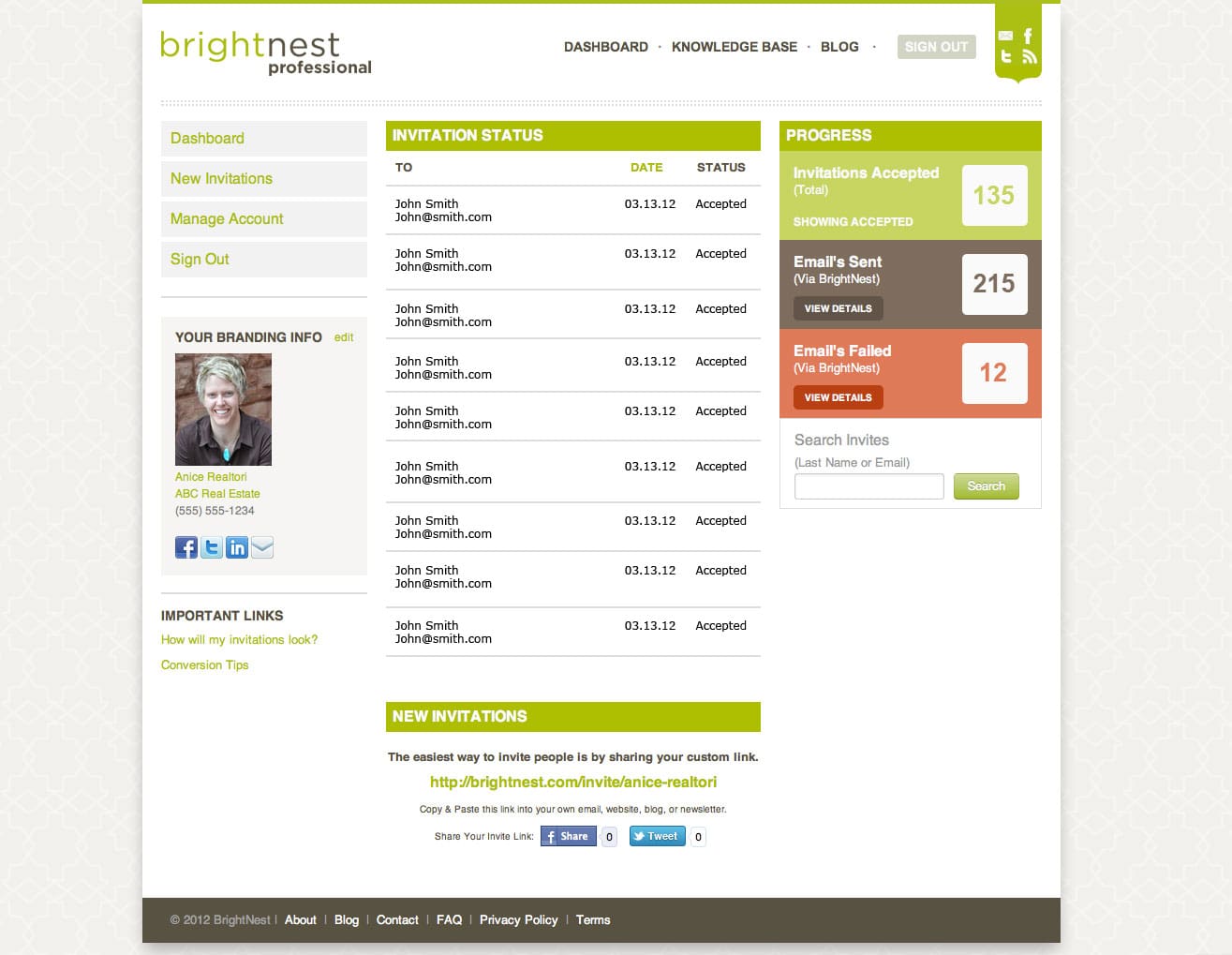
Here were are in 2012, and BrightNest is making a huge, brilliant and logical move with their “BrightNest Professional” launch, giving real estate and mortgage professionals tools to “effortlessly stay in touch with their clients” through a weekly emailer and customized dashboard providing tools and tips to keep their homes in shape.

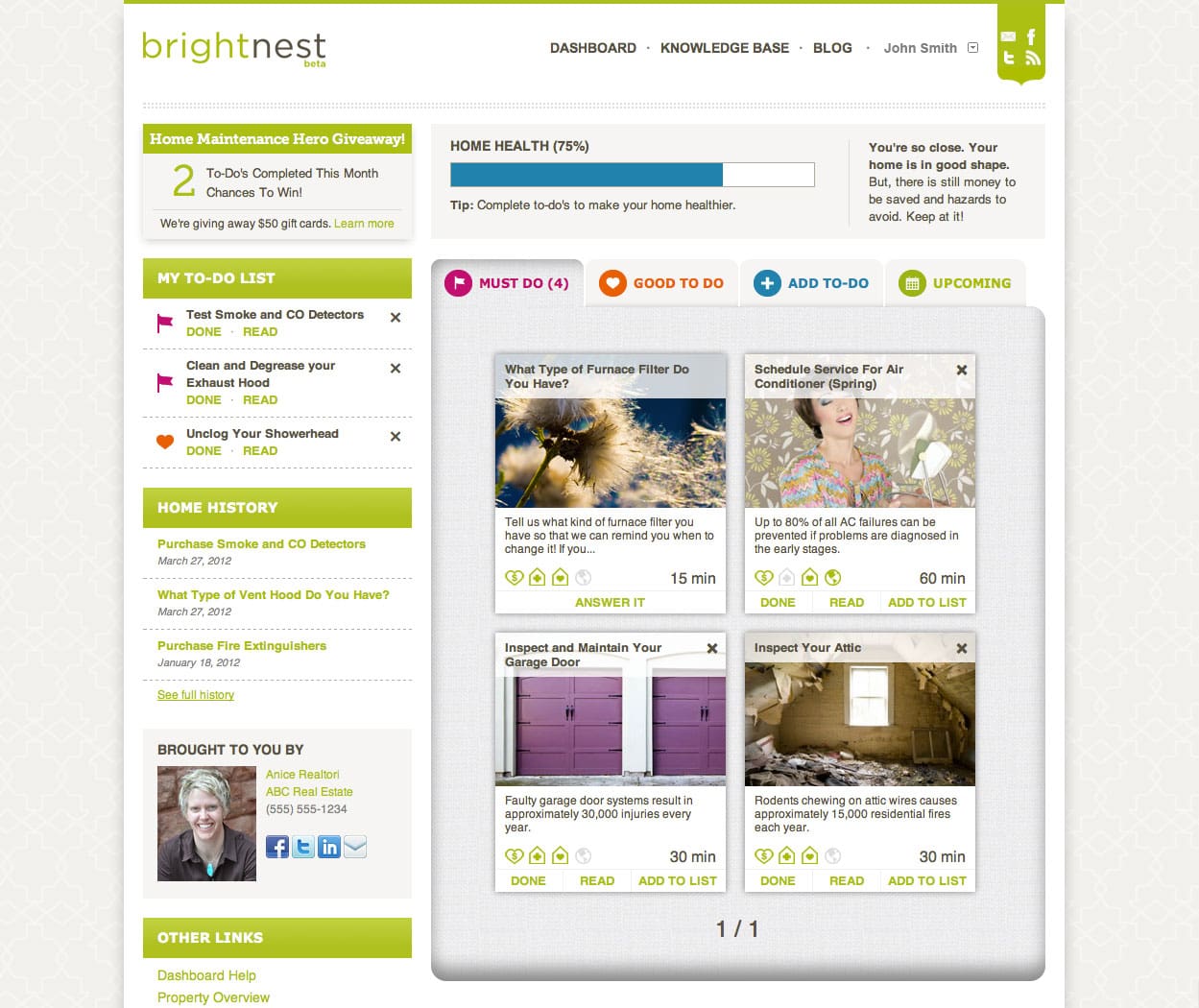
Once professionals upload their basic branding and give BrightNest gift subscriptions to clients, BrightNest Professional does the work of engaging homeowners weekly with customized tasks, money-saving tips and expert advice for their home’s most critical needs.

Realtors rely on word of mouth

“Word-of-mouth still reigns supreme when it comes to generating business for real estate professionals,” said Allen Shulman, chief executive officer of BrightNest. “BrightNest Professional is a gift with more value and staying power than a bottle of wine and it allows real estate pros to easily keep their name and brand in front of clients long after the deal is done.”

“For me, BrightNest is an incredibly easy way to attract new clients and build loyalty among my existing ones,” said Mark Kinslow II, a real estate agent with Coldwell Banker Southeast Metro. “It’s a simple way to stay in touch with clients year-round, and give them valuable expert advice that can help maintain or even improve their home’s value and make it a better, safer and happier place to live.”

Designed for real estate agents, mortgage brokers, insurance agents and others in the real estate industry, BrightNest Professional lets subscribers give up to 2,000 BrightNest gift subscriptions for $30 per month or $300 annually. Each BrightNest gift includes an online dashboard where homeowners can find customized home maintenance tasks, search optional tasks or add their own to do’s. Homeowners can track their home’s health and history, and get reminders through a weekly email digest that is co-branded with the real estate professional’s logo, contact and social media information.

“Real estate professionals wear a lot of hats. So, we created BrightNest Professional with the mindset that simplicity rules,” said Shulman. “After real estate professionals send out the initial invitation to clients, we maintain the relationship for them from that point forward. This allows them to build long-term relationships and generate leads without sacrificing quality.”

AGBeat readers can try out the consumer side of the site by visiting BrightNest.com and using invite code “AGBeat” for access.

Click any image below to enlarge:


U.S. home prices have fallen 34.4% since the recession hit

Home price index for January

According to the S&P/Case-Shiller Home Price Index (HPI) report released today, home prices fell for the fifth month in a row this January, dropping to their lowest level in nearly a decade. Prices have plummeted 34.4 percent from the pre-recession housing peak in July 2006 and in January, seven of the cities were down by 1.0 percent or more over the month.

In January, the average home lost 0.8 percent of its value from December and 3.8 percent from January 2011. Although this HPI report only studies 20 major markets, it is widely recognized as a reliable housing indicator. The 10-City Composite was down 3.9 percent and the 20-City was down 3.8 percent compared to January 2011.

“Despite some positive economic signs, home prices continued to drop,” said David M. Blitzer, Chairman of the Index Committee at S&P Indices. “The 10- and 20- City Composites and eight cities – Atlanta, Chicago, Cleveland, Las Vegas, New York, Portland, Seattle and Tampa – made new lows.”

Blitzer noted that having suffered “massive price declines,” Phoenix and Detroit saw a price increase over the year, along with Denver. Although those three areas are improving, Blitzer points to Atlanta as continuing to “stand out in terms of recent relative weakness. It was down 2.1% over the month, and has fallen by a cumulative 19.7% over the last six months. It also posted the worst annual return, down 14.8%.”

This month, reporting was incomplete, which is quite rare. “Due to delays in reporting for Mecklenburg County, we did not publish a January index level for Charlotte, North Carolina. There was not enough January data to publish an accurate index level this month. We are not sure of the reasons for the delays, but do expect to see the data with next month’s release. We did include data we received from Gaston County, NC, and York County, SC, in the calculation of the 20-City Composite.”


Social discovery tool, colourDNA launches iPhone app

Social discovery tool launches iPhone app

British tech startup, colourDNA is built to make social discovery easier and tailored to users whether they are looking for a restaurant, a service or even a gadget, using their unique algorithm to match users to their interests.

The company says, “It’s hard to find new things to enjoy in life. The web has become so cluttered that search is now too time consuming and results often conflict with each other. Written review sites are impersonal, untrusted and time consuming because you have to read through paragraph after paragraph to narrow down your search. Your friends can give you great recommendations but they tend to be expert in only a very small set of things, plus you’ll have lots of interests you don’t share with them.”

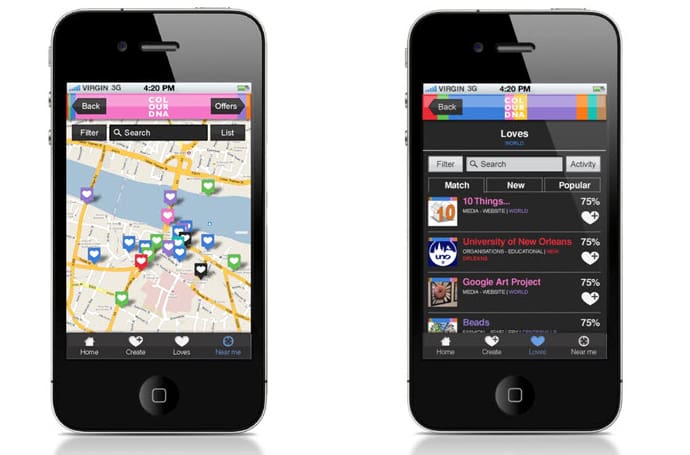
Today, the colourDNA iPhone app hits the market to add location and community to the mobile experience to discover users’ interest matches.

“We continue to see social recommendation services getting more personal and more contextual,” said Ben Poynter, Cofounder and CEO of colourDNA. “This is one of the reasons we cover everything in our taste graph, and why doing our first mobile app was so important. We also see these services needing to offer more than just a platform for sharing, taking the experience further by giving the users something back that is meaningful. That’s what we are trying to achieve with colourDNA and we are really excited about its potential”

The company lists the full features of the app:

  • Activity feeds to see what is being loved all around the world right now
  • Matches personalised to you so you can discover new things to enjoy
  • Near Me to find places to go and try out near your current location
  • Tools to let you Create what you love on the go and as your enjoying them

Video and photo tour of colourDNA


Employers requiring Facebook passwords may be investigated by feds

25

Questionable interview requirement

A new trend was recently unveiled that has shaken the business world, as some companies are requiring their employees to divulge the passwords to their private Facebook accounts during job interviews, which AGBeat was the first to point out is a violation of the Facebook Terms of Service and would render that user in violation and at risk of losing their entire account.

In other words, it is not even okay with Facebook, a company that many consider one of the reigning rulers of questionable privacy practices.

Senators calling for a federal investigation

According to Fox News, Democratic Senators Chuck Schumer of New York and Richard Blumenthal of Connecticut are calling on Attorney General Eric Holder to investigate the mattter of employers asking for Facebook passwords during interviews, as it violates federal law.

The Senators are asking the Department of Justice and U.S. Equal Opportunity Commission to launch investigations, notifying the heads of the agencies via letter, according to Fox News.

Facebook says it will “take action”

“Facebook takes your privacy seriously,” Facebook Chief Privacy Officer, Erin Egan said in a statement. “We’ll take action to protect the privacy and security of our users, whether by engaging policymakers or, where appropriate, by initiating legal action, including by shutting down applications that abuse their privileges.”

Egan continued, “We don’t think employers should be asking prospective employees to provide their passwords because we don’t think it’s the right thing to do. But it also may cause problems for the employers that they are not anticipating. For example, if an employer sees on Facebook that someone is a member of a protected group (e.g. over a certain age, etc.) that employer may open themselves up to claims of discrimination if they don’t hire that person.”

Another angle many employers have not considered is that they “may not have the proper policies and training for reviewers to handle private information,” Egan noted. “If they don’t—and actually, even if they do—the employer may assume liability for the protection of the information they have seen or for knowing what responsibilities may arise based on different types of information (e.g. if the information suggests the commission of a crime).”