Friday, April 3, 2026
Home Blog Page 151

Lenovo’s new Yoga Book is perfect for students or designers

Somewhere in between

Lenovo’s new product is neither a laptop nor a tablet, but it performs some of the functions of both. It’s a “book,” a “Yoga Book” to be exact, perhaps referring to the electronics’ flexibility.

bar
Like a laptop, the 10 inch Yoga Book folds like a clamshell – a very thin clamshell, at only .16” thick and weighing just 1.5 pounds. But the Yoga Book does something completely new that we haven’t seen yet – you can use it to automatically convert handwritten notes into a digital document.

Better note-taking

Instead of a keyboard, the Yoga Book is equipped with a flat digitizer pad that responds to a specific stylus called a Real Pen. But unlike other styluses, Real Pen actually writes with real ink.

When you lay a pad of paper over Yoga Book’s digitizer pad, it picks up your pen strokes, instantly transferring your scribbles to your screen.

This function might seem pointless to some – if you’re going to power up your device anyway, why not just type your notes? But the feature could be useful for folks who type slowly, for students, or for those whose notes include sketches, diagrams, and flow charts. You’ll have a paper copy for your files and reference, plus a digital copy on the cloud. You can then search your notes with keywords, reorganize them, merge them with other notes, or share them over your network or via email and social media.

Perfect for designers

Artists and designers will appreciate a computer that can create digital drawings with the subtlety you can only get from a real ink pen.

The Yoga Book can detect over 2,000 levels of pressure, so you can achieve light pen sketches or bold paint strokes.

Don’t worry, you’ll have a keyboard when you need it. Yoga Book’s “Halo” keyboard can be toggled on or off. With a totally flat keyboard, your fingers may miss the satisfaction of depressing an actual button, but the keyboard’s haptic feedback will provide vibrations to create a more tactile experience.

Our questions and caveats

Will Lenovo’s Yoga Book be functional for businesses? That remains to be seen. People who type a lot will probably miss the feeling and sound of a real keyboard. The Real Pen will eventually run out of ink, and there’s no information available so far about how much the replacement cartridges will cost.

But for those who prefer to take notes by hand, to doodle, or design, the Yoga Book has all the benefits of pen-and-paper with a high tech twist.

Unboxing the YogaBook

#YogaBook

How a crazy idea turned into a multi-billion dollar brand #Nike

$300 and 12 pairs of shoes

Some of our greatest successes (in the US, at least) happened almost by chance. By someone rolling the dice on fate or destiny or whatever. Take Walt Disney – in 1924 he was pretty much a down-on-his-luck cartoonist and on a whim he makes a cartoon about a little mouse he sees scurrying around his office. Next thing you know, he has a multi-million dollar brand, hundreds of artists and they all work in anonymity because everything that gets produced is a “Walt Disney Production.” Go figure.

Or take the Wright Brothers. How the heck are you gonna get out to the East Coast when you live on the other side of the USA? Of course! Build a plane (and then sell the patent to the US military).

bar
You get the idea. Hey, nothing is that simple, but the point is, sometimes you just gotta do it. Follow the pang of hunger in your belly that makes you climb over that ridge. Sometimes, as Tom Cruise so eloquently said in the 1983 movie “Risky Business”, you just have to say “What the heck” (actually, his choice of words was a little more colorful, but this is a professional publication).

The land of the setting sun

Take Nike CEO Phil Knight, for example. In 1963 he parlayed $300 into a what would ultimately become a multi-bazillion dollar shoe company. Of course, things were a little simpler back then. Knight, on a whim, flew to Japan and talked himself into a deal importing running shoes. After some clumsy conversation with company execs, he walked out with a dozen pair of shoes to show as samples. Pretty sure you can’t just fly to Japan on a whim anymore and these days, Nikes are so expensive I don’t think you can even get one pair for $300 dollars, let alone one dozen. But I digress.

Knight would then spend weekends and evenings selling shoes to high school kids. Said Knight in an interview, “The idea was to get started. So we got 300 in and the next order was 1,000. That’s the way it got going. First year sales were $8,000. A far cry from the $30.6 billion brought in in 2015.”

Still the same playing field?

Every generation feels the one before it was “simpler.” I say it’s all relative. Knight didn’t have nearly the access to cash and partners and networking in 1963 as he does in 2016. But you play in your sandbox with the tools you have. Comments Knight, “The flip side of that is there are venture capital firms now. So you have access to money now that you never had in the 60s, so that makes it easier.”

Whether its running shoes or comic books, airplanes or automobiles, the entrepreneurial spirit is what makes the difference.

Now let me tell you you about an idea I have to make a pencil that never needs to be sharpened…

A special thank you to Greta Van Susteren her perfectly crafted interview with Knight.

#Nike

This calculator determines if you’re going to be rich or poor

Do you want to know?

Just last week, the U.S. received the most positive feedback on average household income since 2007. According to the census data, the median income rose by more than 5% in 2015, with family household’s making approximately $72,165 and non-family households around $33,805.

bar
That rise in income, the first in 9 years, helped to curb poverty rates with a 1.2 percent decrease from 2014-2015 and could mean a continual decrease, so long as income continues to improve.

But is it accurate?

As we learned from the economic crash in 1929, the early 80’s recession, Black Monday, and the Great Recession, no matter how constant finances may “seem”, poverty can come knocking at any time and destroy whatever you have built. This devastating reality makes the recent wave of good income news the perfect time to address our individual poverty risk, and thanks to Thomas Hirschl we can.

A sociology professor at Cornell University, Hirschl understands the nebulous nature of financial security, and developed the “Poverty Risk Calculator” as a result.

This calculator uses research on poverty and income from decades of longitudinal studies to produce a final report. 

With the calculator, and bits of personal information about your socio-economic present in hand, you will be able to predict your personal chances of ending up impoverished in the years ahead.

How it works…

The general risk of living in poverty hasn’t changed much since 1970, teetering between 11% and 15%. An individual’s actual risk, however, can vary widely. Hirschl explains, with race as the most powerful predictor of economic hardship, there are many other contributing factors.

For example, the poverty risk for a white male, between the ages of 20-24 who has a college education, is a low 20%. Alternatively, if you’re a non-white male with the same education, your risk of poverty over the same period of time is a stunning 45%.

According to Hirschl and his studies, some 39% of Americans between 25 and 60, will deal with one or more years of life below poverty level. He also added, “People are ill prepared for this kind of thing,” and we’d have to agree. How many people are waiting patiently with open arms to be poverty stricken?

Why this calculator is kind of a huge deal

Aside from the fact that financial security is never promised, job security isn’t either. “Even though people might have a job right now their long term outlook is not security, it’s insecurity,” says Thomas Hirschl, brilliant creator of the “Risk Calculator”.

“There’s a group of people who are feeling very secure, they’re creative people they have jobs they love. And there are other people who are not doing well – they lost their job in the factory or they have a roofing business they used to make $100,000 now they’re making $30,000.”

This calculator aims to help the people who may find themselves in similar unexpected situations whether they are in a creative position, or working in a warehouse.

I’m personally going to wait it out one more week before I try the calculator, that way I can mentally prepare for the results. But if you are braver than I, and would like to use the calculator, you can find it here. Let us know what you think in the comments below!

#PovertyCalculator

Looks like Austin ridesharing options can’t handle major surges

0

The post-Uber apocalypse in Austin

We are now several months into the aftermath of Austin’s post-Uber/Lyft debacle, and the question on everyone’s mind has been how the new services will fare in keeping up with demand.

Then, a major college football game rolled into town, and we quickly realized just how bad Austin City Limits is really going to be.

bar
According to this account from political buff Matt Mackowiak, he and riders like him found several of the alternative rideshare apps had no drivers available, and certain apps were crashing due to server demands.

I myself had to wait 15 minutes for one of these apps to call a ride, which is several minutes longer than it should take. Oh, and did we mention this was FOUR HOURS BEFORE KICKOFF?!? You can only imagine how much worse things became when the game let out around 10 that night…

Takeaways from the widespread failure

This whole episode proves a few key points to show that the city failed to meet or consider any political goals (beyond general tomfoolery) and economic realities associated with ridesharing:

1. Uber and Lyft were right; fingerprinting doesn’t scale. This isn’t the first time Austin’s alternative services have had issues with a lack of drivers; you can see it on any given Friday night. The night of the Notre Dame/UT game just proved how broken and understaffed these companies really were.

2. What’s even scarier is how RideAustin isn’t immune. This service was established by city council as a non-profit option in the ride-sharing market. However, Mackowski points out, “RideAustin, with all of their deep relationships at city hall and their pursuit of ‘saving rideshare in Austin,’ is waving the warning flag. Getting drivers signed up and driving is a big concern.”

3. Even if there was a way for these companies to fix their staffing situation, we as a city can’t afford them the time to do so. Austin has TWO weekends of musical festival activity arriving in mere weeks, along with Formula One racing events and even more UT football games. South By Southwest 2017 will be here before we know it. What happens then?

Ultimately, this will all get worse before it gets better.

It seems unlikely city council repeals the law mandating the background checks before some of these events take place. Some believe they might remove this obstacle as soon as possible to mitigate any further damage.

Meanwhile, RideAustin is speaking openly about the challenges and asking the community for input.

Bottom line: The city will continue to adjust.

#AustinRidesharing

Skype Teams: Microsoft is building a mega Slack competitor

Slack is the cool new kids of apps

The popular workplace communications platform, Slack, was created in 2009, and has racked up over 2 million users; over a quarter of those are actually paid users.

But you’re a fan of Slack or considering all of your team communications options, you may want to keep on the lookout for Microsoft’s up-and-coming competitor, Skype Teams.

bar
Back in March, Microsoft briefly considered buying Slack for $8 million, but backed out after Bill Gates and CEO Satya Nadell ultimately rejected the proposal. Insiders suspect that the founder and CEO wanted to encourage the company to improve Skype and create a Slack alternative, rather than just buying up their competitor.

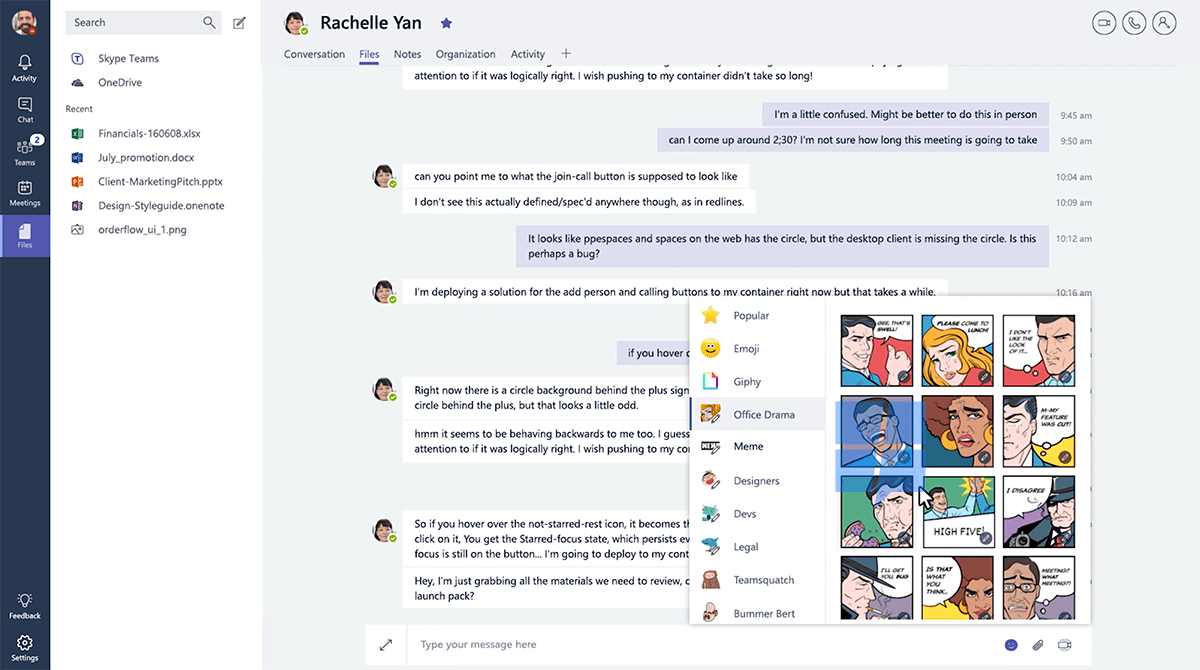
Now, rumors have leaked that Skype Teams will perform many of the same functions as Slack, facilitating group conversations via chat and Skype. Users can communicate with different groups of people, known as “channels.”

Features rumored to be part of the new platform

Skype Teams will include in-app video calls, direct messaging, file and note sharing, and group scheduling. A lot like Slack.

Unlike Slack, Skype Teams will include a feature called “Threaded Conversations” that allows anyone to join a topic by simply hitting reply and leaving a message, similar to Facebook comments.

Skype Teams will also be automatically integrated with the entire Microsoft suite of products, including Office 365, Word, PowerPoint, and OneDrive.

Will you have to give up your GIFs if you switch from Slack to Skype Teams? No way. Skype Teams’ “Fun Picker” will give you a gallery of emojis, GIFs, and memes to attach to your messages.

skype-teams

They’re testing it out internally

Skype Teams will be divided into tabs. The Activity Tab will list your notifications. All of your conversations will be archived under the Chat Tab. You can switch between different groups in the Teams Tab, and collectively schedule with the Meetings Tab. Finally, the Files Tab helps you share documents and notes, and syncs your work with One Drive.

Microsoft is currently testing Skype Teams internally and they haven’t said when they’ll release the product to the general public. They may start out by pre-installing it with Office 365, but will eventually make the app available for the web, Android, iOS, and Windows phone users.

#SkypeTeams

Walmart patents autobots (aka autonomous rolling carts)

1

Hello, I am RoboCart

Walmart didn’t become number one by resting on any laurels. The chain strives to put a store in virtually every neighborhood in every city. It tries to offer products for every taste and some that even taste pretty good. And in some locations, they’re even doing the shopping for you and bringing your purchases to your car without you ever having to turn off the a/c.

Now, they are gearing up for the logical next step in the planned takeover of the free world: Automated shopping carts.

You’re laughing, but I would ask you to consider that the one thing that can shake a society to its knees isn’t going to the grocery store only to discover it doesn’t have any milk. Nope, it’s going to the grocery store and not finding any shopping carts.

That manual labor, tho

This is why Walmart recently filed a patent for carts that move themselves around independently. These carts wouldn’t just put themselves away, though – the devices would be connected to a central computer that uses cameras and sensors to navigate stores and lots, driving themselves to customers who need them.

There are other applications for a system like this, too. Instead of those college kids you always see in the parking lot rounding up abandoned shopping carts, the robocart will, in theory, be able to identify an unattended shopping cart in a store or parking lot and return it to a docking station, according to the filing.

While the patent paperwork shows the “motorized transport units” attached to carts, they could be attached to other things within a store or a Walmart warehouse.

For example, the potential is there for the carts to help Walmart manage its inventory. One portion of the filing describes a scenario in which the system receives a request for an item, searches an inventory database, then sends the motorized unit to a store shelf to ensure the product is there.

Coming to a store near you

The RoboCart – for lack of a better name – is just another example of tech doing the type of things that humans would rather avoid. Or can do cheaper and more efficiently. Stocking shelves, retrieving shopping carts, and who knows what else – coming soon to a Walmart near you.

#autobotsrollout

Fair Chance Hiring: Austin workers should know their rights

1

Ordinance opens doors

This year, the Austin City Council approved the Fair Chance Hiring Ordinance, affording ex-criminals a better opportunity to secure jobs. More than an ordinance, I believe it is a move in the right direction to eliminate social injustice among those who have already paid their debt to society.

District 4 City Council Member Greg Casar, who proposed the policy last year said, “It was a really long journey, but I think it really shows this new council is dedicated to thinking of local government in a more bold and progressive way than we might be used to,” adding, “This is, at heart, an anti-discrimination, civil rights piece of legislation, but I believe it also to have great benefits [for public safety and economic development].”

So what is the Fair Chance Hiring Ordinance?

As you already know, background checks are typically performed in the very beginning of the hiring process, as a way to weed out applicants with a criminal history. The Fair Chance Hiring Ordinance now delays an employer from running a background check on a potential candidate until just before the candidate is about to be offered the job.

bar
The new ordinance, also known as “banning the box” applies to business in Austin TX, with 15 or more employees. It does not, however, apply to positions for which prior law disqualifies candidates with a criminal history, or where a federal, state, or local law, or compliance with legally mandated insurance or bond requirement disqualifies an individual based on criminal history. Nor does it do away with criminal background checks.

Other cities, in an effort to eliminate social injustice in their respective areas, have also started to consider some form of “fair chance” hiring. In Ohio, Georgia, and Wisconsin, it is state policy and applies to public employers only.

In other states like Florida and Louisiana, there are certain cities and counties that enforce “fair chance” hiring, but not the entire state, and applies only to public employers. For a complete map of states, and areas that practice some form of “ban the box” are listed here:

fair-chance-hiring-nationwide
(Image by Community Impact)

Advantages for employees

For employees, there are a number of advantages presented by the Fair Chance Hiring Ordinance. If you have any sort of criminal background for example, like an embarrassing drunk college evening that resulted in trespassing, you won’t be automatically eliminated from the job pool.

Those with criminal backgrounds are also less likely to be limited to low-rank, low-paying positions, which is what some companies do that accept ex-criminals, but not promote them.

If you don’t have a criminal background, this policy still impacts you, as it is projected to create a more diverse, and resourceful workplace for you to feed off of and contribute to.

Disadvantages for employees

The biggest foreseeable disadvantage for employees is the increase in job competition with the new access to talent. Employees may also theoretically experience companies eliminating positions due to their perceived effect of the ordinance on their business goals.

Additionally, some businesses assert that the new act will increase the cost of the hiring process.

Know your rights

Although the Fair Chance Hiring Ordinance has a lot of benefits for employees, especially those with criminal backgrounds, you must also know that that nothing in the ordinance limits an employer’s authority to withdraw a conditional offer of employment for any lawful reason, including the determination that an individual is unsuitable for the job based on an individualized assessment of the individual’s criminal history.

It’s also important to note that recourse for workplace discrimination is handled completely differently than issues handled by Federal Agencies such as the Equal Employment Opportunity Commission. If an employee intends to file a complaint, they must do so with the city, since it is a city-level ordinance, which may result in the company being fined, but employees will not receive compensation.

Austin businesses have until April 2017 to adopt the ordinance, after which employers found in violation will receive a warning for a first-time offense and a fine of up to $500 for subsequent offenses. Businesses will receive written notification of the new law, but the city’s manager will also implement a public education campaign to inform employers and residents of the requirements.

#FairChanceHiring

Spotify is crushing Apple Music in subscriptions

“40 is the new 30. Million.”

In a semi-cryptic tweet, Founder and CEO of Spotify hinted that their sales had already outpaced Apple’s, stating, “40 is the new 30. Million.” While Spotify hasn’t officially confirmed they’ve reached the 40 million subscribers mark, they did unofficially confirm it via email to >9to5Mac. This is pretty significant given that Apple Music recently announced (and emphasized, even bragged) they had 17 million subscribers during their iPhone 7 event.

bar
Apple made a point to state they had accumulated 17 million subscribers since Apple Music’s subscription-streaming service began in June 2015. They also stated that they added an additional two million subscribers in less than three months. While this is an impressive increase in subscribers, Spotify is still rocking the numbers; Apple just doesn’t want you to know.

Streaming is the name of the game

In both cases, it’s clear that subscription-streaming services seem to be much more popular than the old school way of paying for and downloading individual songs. Both companies have given us relatively regular updates as to their service growth. However, mathematically, both Apple and Spotify have grown the same amount.

Consider this: Spotify added nine million members to achieve their 40 million milestone from the end of March to nearly the end of August. Similarly, Apple gained four million subscribers to reach their 17 million milestone from late April to early August.

For both companies, this is roughly a 30 percent growth during this period, however, since Spotify has a much larger pool of subscribers, the actual number of people who signed up was more than double those who joined Apple.

To be fair, Spotify’s nearly a decade old

Given that Spotify launched nearly eight years ago, this shouldn’t be too surprising. Spotify has had plenty of time to learn and adapt to the needs of their consumers. Spotify streams free, on-demand music with advertising. Consider also that when Apple launched their platform it came with a few hiccups, including one that completely wrecked users’ iTunes libraries and shuffled album art and other metadata around without warning.

It’s a bit early to claim Spotify as the clear winner here, but if Apple wants to win, they’ll need to focus on gaining additional followers, and nailing down some artist exclusives.

With so many subscription services being offered, exclusives are believed to be a good way for Apple to distance themselves from the pack. I foresee exclusives such as Apple-only bonus tracks, free digital downloads of other albums, or other bonus features that would help people choose Apple over Spotify, Napster, or Pandora.

What do you think: will Apple Music climb their way to the top of the pack, or will Spotify reign supreme?

#StreamingWars

Crowdfunding’s first report card – good enough for the fridge?

Head of the class

Think about it: There are two primary reasons that you should care about crowdfunding: Either (A) because you’re considering tapping into this funding source or (B) you’re seeking information on general business trends (of which this is one). Whatever your motivation, you’d do well to check out a brief overview on how crowdfunding has done since it’s inception.

bar

A good student

It’s been about three months since Title III of the JOBS Act legalized true equity crowdfunding where startups can now raise up to $1 million in capital online to jump-start and grow their company. If you’re a startup or even an established company and you’re looking to raise funds through crowdfunding, Regulation CF’s first “report card” shows some very encouraging grades for entrepreneurs everywhere.

The JOBS Act was signed into law on April 5, 2012 although it took the Securities and Exchange Commission (SEC) several weeks to put out the rules that allowed this law to finally go into effect, finally becoming law on May 19, 2016. Three months later, reports regarding early results look promising.

Despite limitations in the law (crowdfunding can’t pass itself off as a Kickstarter wannabe) 82 Title III equity crowdfunding campaigns were filed with the Securities and Exchange Commission in the first quarter and 20 campaigns have exceeded their target amounts, which is nothing to sneeze at. That’s a 24.4 percent success rate which is two to three times the success rate that most rewards-based crowdfunding sites like Indiegogo or GoFundMe reportedly have.

Show me the money

The average investment commitment to date is about $810, which is more than 10 times the average donation on Kickstarter, the most well-known rewards-based crowdfunding site. This should not be surprising, given that investors are actually buying equity and owning stock in these companies, not just paying for a “reward” or a pre-sale of a product to be manufactured.

In fact, the target goal of Regulation CF offerings so far has been a huge predictor of success. Companies that set lower and realistic target goals (the minimum amount they need to raise to be allowed to keep the committed investment funds) have exceeded these minimums by 423 percent.

Companies that have set unrealistic target goals have failed miserably.

An even better part of the JOBS Act points out SeedInvest is the Regulation A+ Mini-IPO which gives a company the ability to raise up to rather than being capped at $1 million.

I don’t want to beat this topic to death with a bunch of “report card metaphors,” but suffice to say that at this point Regulation CF appears to be a success despite the legal limitations it imposes.

#Crowdfunding

Allt: Collaboration and project management finally rocks

Calling all team members

“Work better together. Now.” This sounds like what every team striving for productivity would love to hear.

It is the goal of in-beta Allt, which is aimed towards helping teams collaborate in a more seamless way.  The idea is to craft new ideas, work together on tasks, and share reports and files with clients.

From the mouth of Allt

“Allt is your very own productivity suite which lets you get things done in less than 5 seconds. Whenever a new project comes in, you just create a new domain, invite your team, write your ideas and requirements on a Board, let your team collaborate on it, turn them into tasks and get things done.

bar
Before you realize, Allt will be your home for ideas, tasks, reports, workflow management, work files and everything else in your company. It is super simple to use,” according to Allt.

Features include:

So, how does it work? There is an assortment of tools, including: groups, boards, tasks, notes, files, and heart cheer, that helps teams collaborate.

Each project has it’s own group to allow for simplicity while boards allow for sharing ideas, gaining feedback, and turning them into tasks.

Take said task and create a “task list” which has the option for sub-tasks.

Sharing within your team

You can then take notes to share with your team and they can comment. With ‘files,’ you can view all files under your domain while uploading new files to share with your team and clients.

The final tool, “heart cheer,” allows for sharing your gratitude with team members.

When a team member does something awesome, give them a shout out with a heart cheer.

Everything happening in real time

Other features include: live updates on everything happening within your domain, public links you can share with customers and vendors.

Allt also has granular controls that give you the option to customize how you are notified.

The engineers collaborating on Allt promise users will receive: Skubot (the internal robot that handles development and operations,) data backup, privacy, an eco-friendly approach, encryptions with SSL/HTTPS, and 24-hour bug fix.

Simplicity is key

The dashboard is laid out to be as simple a platform as possible. Quick notes, files, and reports all exist in this space for easy upload, sharing, and communication.

Allt is currently in-beta and is offering email sign-up for early access.

#Allt

Famed digital media pioneers join forces to launch Brain+Trust Partners

Five heavyweights join forces

After moving far beyond their initial industry fame to lead massive teams and companies across America, five digital media pioneers (that anyone in tech, marketing, or communications can name) have come together to form Brain+Trust Partners.

“Five years ago, there were roughly 500 [marketing technology] tools on the market, and now there are over 5,000,” said partner Tim Hayden. “It has become tough to believe the 55 emails a day that business leaders get, proclaiming there’s a better conversion tool, a better social listening tool.”

That’s the crux of Brain+Trust, “to come in as a common sense, experienced partner for a build-to-buy strategy, to offer strategic guidance and insight” to companies and executives inundated by the noise of the onslaught of promises the tech industry offers.

You know the five founders:

The five partners are all names you know for their work at Ford, GM, the US Missile Defense Agency, Comcast, Zignal, IBM, Edelman, Voce, and their many industry-altering efforts that have landed them in college textbooks and countless case studies (in alphabetical order):

Hayden tells us that all of the partners have learned from the front lines, noting that the corporate world is changing – Walmart acquired Jet.com, Unilever acquired Dollar Shave Club, Starbucks developed their own payment system prior to partnering with Square. Brands are “making economic moves in acquiring proven technologies instead of building them [in-house].”

And that’s where we predict Brain+Trust Partners’ sweet spot will be. They’re experts on all corners of the process and have experienced the ups and downs of the market.

Hayden says they’re a “light solution to standard consulting partners,” as their focus is strategy as they “vet vendors, tools, and agencies, reducing the cost of business with assured confidence.” Brands now have help in going to market and move forward with plans with more confidence. #CompetitiveAdvantage

“I’m thrilled to be part of Brain+Trust,” Barger opined, “because my partners are all brilliant thinkers who fit this mold; we share outlooks and approaches, and we have a similar desire to emphasize business results. When you find a cadre of colleagues who share your perspectives and priorities, AND you enjoy working with them and consider them friends, the sky’s the limit on what you can accomplish — for yourselves, and for your clients.”

Why headquartered in Austin?

If you note in the list above, the partners live all over the nation, but the company will call Austin home (as do we at The American Genius). But why?

Hayden noted six sensible reasons they’re headquartered in Austin:

  1. It’s business friendly. Hayden says they were advised by counsel that Texas is the most business friendly, from a taxation, court, and regulatory perspective. If they were seeking VC funds or going IPO, they would have considered other cities.
  2. Austin offers better access. If you’re in California and want to meet Tim Cook or Ross Perot, Hayden notes it might take six weeks if you’re able to get a meeting. In Austin if you’re an entrepreneur seeking to meet with Brett Hurt or Michael Dell, it could be this week. Austin is collaborative.
  3. Austin is the center of an “incredible engineering community,” supported by so many universities like the University of Texas, the Austin Community College system, Texas State, St. Edward’s University, Southwestern University, and even nearby Texas A&M.
  4. People stay. When Trilogy shipped in people from across the nation years ago, they stayed. When Dell brought in so many MBA folks, most stayed. Tivoli? They stayed.
  5. Austin has a burgeoning cottage industry – Whole Foods, Central Market, Sweet Leaf Tea, the list goes on.
  6. Logistics. “We’re in the middle of the country, and it’s only a 3.5 hour flight anywhere in the nation,” said Hayden.
  7. “Plus, it’s home,” asserts Hayden, who spent the last two years in the valley, keeping his home in Austin unoccupied and furnished for an eventual return. “Austin has the best of combined values, environment, and ecosystem for an organization that is about change and tackling the future with confidence.”

We’ll be watching for Brain+Trust Partners here in our own back yard to start their next professional chapter as a united front and be referenced in even more case studies and college textbooks.

#BrainTrust

This startup simplifies the hell of customer service

Oh, the tangled webs we weave

Let’s face it, dealing with all of your customer interactions is a lot to handle. The web of contacts, emails, leads, conversions, interactions, complaints, and more is a tangled jumble that can be hard to track, sucking up valuable time and requiring multiple team members tackling different angles.

bar

CRM – automated

Intercom promises to dramatically simplify the entire process. It’s a platform that not only automates multiple CRM tasks, but it also helps make your interactions with customers more personal. And these days, personalization is everything. Paul Adams, VP of Product at Intercom, encourages us to “say goodbye to ‘Dear valued customer, your ticket number is x,’ and say hello to more, ‘Hey Tom, your new shoes in the right size are on their way.”

The basic Intercom platform is absolutely free, and is essentially a database of current customer information that you can use to track leads and perform filtered searches.  Beyond the basic platform, Intercom offers three products that you can add to your package for an additional fee: Acquire, Engage and Support.

Acquire is for live chatting, Engage is for automating your marketing, and Support is for customer service.

Acquire, Engage, and Support

Acquire is a live chat program for your website, but it goes beyond the typical customer support chat. Instead of waiting for confused customers to reach out to you, Acquire can be set to send targeted messages to customers based on behaviors that you specify. In fact, I got to see Acquire in action; after exploring Intercom’s website for about ten minutes, a rep named Sean sent me a chat message to see if I needed more information.

Acquire also captures email addresses from chats so that you can follow up, and chats become part of a “continuous record” in your customer database. Chatting with acquire doesn’t have to be stiff and businesslike – you can make conversations fun and personal by adding stickers, emojis, and GIFs.

You can also use Acquire to track the impact of your chat conversations, measuring whether or not they are leading to sales.

Engage is all about automating the messages you send your customers, whether they be within your app, on social media, or in email. You can use Engage’s composer to design attractive messages, or select from their templates. You can automate the delivery of targeted marketing messages for the best times and platforms, then track their impact. You can even compare different versions of the same messages to see which ones are performing best.

Support is all about fielding customer questions and complaints. Intercom speeds up the process by helping you automate the delivery of questions to the most appropriate team member.

By using a shared inbox, several different team members can tackle difficult questions behind the scenes, collaboratively.

Discounts for small teams

Intercom boasts some pretty big-name customers, including Yahoo, Ancestry, and Hudl. But the startup wants to help out other small businesses, which is why they are offering a discounted Early Stage package for qualifying startups with fewer than five teammates.

Check out Intercom to learn more.

#Intercom

How to prep for the tech jobs of the future

3

Because robots are about to steal all your jobs

It’s no mystery that the job market is changing. Technology is rapidly automating certain tasks; by the year 2020, robots and other technology will remove 5 million human jobs, according to a report from the Future of Jobs study. However, this same technology will also create over 2 million new jobs.

bar
So, how can you avoid becoming obsolete and leverage new technology to make yourself valuable?

Value beyond robot-abilities

Well, someone has to have to the skill to use all these machines and information, right? So start building up analytical skills and computational thinking. Those 2 million new jobs will largely come from fields like computing, mathematics, architecture and engineering.

In short, those that can build and analyze systems and information will be very handy.

However, there’s also a lot of value in soft skills. Until artificial intelligence really picks up steam, robots will have a tough time emulating such human interactions, emotional intelligence, coaching and negotiating. Building your skills in those areas will keep you employed for the long term.

Additionally, and most importantly, it’s not enough to do just one of these things really well.

Multi-disciplinary workers who combine analytical and interpersonal skillsets will come out on top in this job market.

Those folks with only analytical skills can find their job automated, as is the case with bank tellers and statistical clerks. Those with only interpersonal skills are still useful, but they face lots of competition and lower salaries.

Filling in the gaps

As we see singular-skilled laborers pushed out of a job market less catered to their skills, the importance of this shift becomes clear. Without a way to train current and future employees this combination of analytical and interpersonal skills, we’ll develop a dangerous skills gap.

Folks in the tech sector find this happening on the programming side, where companies continue to compete for top-tier programmers. As that gap spreads to other areas of the economy, we as a nation will witness greater income inequality and civil unrest. At the same time, out-of-work Americans aren’t going to be reinvesting money back into their respective economies, and businesses will suffer as a result.

#FutureofTech

Austin’s Fair Chance Hiring Ordinance now in full effect

2

Eliminating discrimination

In an effort to eliminate job discrimination in Austin TX, the city’s council officially voted and approved the Fair Chance Hiring Ordinance April 4th, 2016. This ordinance, the first of its kind in Austin, has been enforced in a majority of states across the US, in a move towards eliminating social injustice for ex-convicts.

bar
District 4 City Council Member Greg Casar, who proposed the policy last year said “It was a really long journey, but I think it really shows this new council is dedicated to thinking of local government in a more bold and progressive way than we might be used to,” adding:

“This is, at heart, an anti-discrimination, civil rights piece of legislation, but I believe it also to have great benefits for public safety and economic development.”

What does it mean for employers?

Before fair chance hiring, background checks were typically performed in the very beginning of the hiring process, as a way to separate applicants with criminal histories.

The Fair Chance hiring ordinance, though, changes the order of things, and now requires background checks to be performed towards the end of the hiring process for businesses with over 15 employees.

The ordinance, which can be read in its entirety here, requires employers to give candidates, regardless of criminal backgrounds, a fair chance at the job.

While ex-convicts may see this as a good thing, some employers and business owners throughout Austin have expressed some concern or doubt. Opposing council members, one being Jose Carrillo, say the new policy may not be simple, or cost-effective to implement by the one year deadline.

“We don’t feel that it’s good business to have the background check when you make somebody a job offer, which is toward the end of the [hiring] process, because there are costs involved,” Carrillo said.

Other foreseeable issues

Pamela Bratton, vice president of Meador Staffing Services in Austin opines that the new policy will have a negative effect on temporary staffing firms, who need to provide qualified employees in little time. If the background check is postponed until the end, the staffing firm and employer have to essentially wait to get the background check back before moving forward. City Council responded to Bratton’s concerns with an amended exception to the legislation that allows temporary staffing firms to run background checks after placing applicants in a pool of qualified candidates, but before offering them an official assignment.

Other business owners have expressed additional concerns for companies that manage or do business in multiple cities, and will have to use different hiring policies. Austin Apartment Association spokesperson Paul Cauduro said while the property management industry recommends running background checks later on anyway, a mandate to hold checks until the end could cause problems.

“Finding a good maintenance technician is very difficult, so [property managers] don’t want to lose out,” Cauduro said. “They want to find out up front someone is disqualified so they can keep their options open.”

Another opposing council member, Ellen Troxclair, expressed an entirely different concern than just financial and time burdens. She feels the ordinance gives the government too much power over what used to be a voluntary process. “The size of the bigger businesses already allows them to enforce a policy like this, but it’s not the government’s job to mandate when a private business owner should be permitted to do a background check,” she said.

It is important to note, this does not mean employers are forced to choose a candidate regardless of their criminal history. After receiving the results from the background check, employers have complete autonomy to deny the candidate.

But don’t fret

Flux Resources, a recruitment firm based in Austin, TX, already employs a fair chance hiring process and hopes to encourage other businesses about the new citywide policy. Bobby Dettmer, Flux Vice President, said “I just feel like if people start doing it the way we’re doing it, I think they’ll notice it takes them a lot less time to find the right person,” he said. “That’s what I’m hoping.”

At Flux, the background check, which includes a drug screening, costs a total of around $87.

Dettmer says they save additional money by only running background checks on candidates who have been offered a position by a client, instead of every single person who interviews.

According to him, he has only had to restart the hiring process because of a background check a handful of times.

This new ordinance also allows businesses in Austin to stand on the forefront and teach other areas of a policy that may soon be nationwide. States like Washington, Minnesota, Oregon and California are already utilizing some form of fair chance hiring.

Implementation

Austin businesses with over 15 employees, which amounts to just over 7,000 companies, have one year to adopt the fair chance hiring policy. After that point, employers found in violation will receive a warning for a first-time offense and a fine of up to $500 for subsequent offenses.

Businesses will receive written notification of the new law, but the city’s manager will also implement a public education campaign to inform employers and residents of the requirements. City staff estimates the first-year cost of education and implementation would be $345,000.

#FairChance

After lawsuit, AirBnB makes steps towards diversity

After a lawsuit

After complaints from users and a civil rights lawsuit, Airbnb is taking major steps to address discrimination.

bar
Finding a place to stay through Airbnb should be easy for anyone. Unfortunately, this is not always the case for blacks and members of other nonwhite ethnic groups. Property owners often turn down reservations from black users, who can be identified by their photographs, or by distinctly black-sounding names.

#AirBnBWhileBlack

In fact, there have been so many complaints from black travelers about racial discrimination from Airbnb hosts that Twitter users began to share their stories with the hashtag #Airbnbwhileblack. Meanwhile, a startup called Noirbnb has cropped up hoping to provide an equal opportunity alternative to Airbnb.

The San-Francisco based company has released a thirty-two page report addressing discrimination, and laying out plans to improve the problem.

To write the report, they hired Laura Murphy, former head of the American Civil Liberties Union. They also enlisted former U.S. Attorney General Eric Holder and civil rights attorney John Relman to write new rules for Airbnb hosts.

Steps in the right direction

Hosts will now be asked to agree to an inclusivity policy that bars them from discriminating against guests on the basis of “race, religion, national origin, disability, sex, gender identity, sexual orientation or age.”

The company was sued by Gregory Selden after he was told that an Airbnb rental was not available. He returned to the site the next day to find the rental listed as available for the day he’d tried to book it.

He created fake profiles picturing a white man, and was able to book the listing.

In order to prevent this kind of racial vetting, Airbnb will now prevent hosts from re-listing rooms if they told someone it wasn’t available. Guests can also use a new feature called “Instant Book” to avoid being screened by hosts. A new Open Door policy will guarantee accomodations to those who’ve faced discrimination.

Diversifying

These changes will certainly help, but some users still wish Airbnb would remove user photos, which are used to identify and discriminate against racial minorities.

Murphy ultimately rejected this proposal. “I came to believe that Airbnb guests should not be asked or required to hide behind curtains of anonymity when trying to find a place to stay,” she said.

Airbnb also hopes to diversity its staff and supply chain. By 2017 they’d like 11 percent of their employees to be minorities, and they’d like to purchase at least 10 percent of their supplies from companies owned by racial minorities, women, and veterans.

#AirBnB

House passes bill making it illegal to sue for bad online reviews

3

Fiscal retribution a thing of the past

The U.S. House of Representatives finally passed a bill that will make it illegal for companies to put “gag clauses” in their contracts that block or penalize customers for posting negative online reviews. It’s expected to move through the Senate soon.

bar
This is not the first time I’ve reported on this issue (you can read more here) so it’s nice to see there is some sense of resolution taking place that supports the consumer.

Action and reaction

Just to recap a bit. This bill, officially called the Consumer Review Fairness Act, is a bipartisan piece of legislation that will void any existing non-disparagement clauses in consumer contracts and give the Federal Trade Commission and state attorneys general the authority to take enforcement action against businesses that attempt to use “non-disparagement” clauses to quiet consumers.

Crazy stuff, right?

But the bill is a reaction to several lawsuits that have been levied by companies trying to penalize their customers who speak poorly about them online.

Forget about free speech. A number of businesses insert provisions into contracts and terms of service declaring that if the customer writes or says anything negative about the transaction, the company can seek damages.

For example, points out an Consumerist, gadget and apparel company KlearGear once sued a costumer for nearly $4,000 because the individual wrote a negative review online.

Or how about this one: a pet-sitter sought 1 million dollars in damages over a negative Yelp review.

All it takes is a voice

Congressman Leonard Lance (NJ) and Rep. Joe Kennedy (MA) took up the cause in the House this spring with the Fairness Act. Though the bill garnered significant bipartisan support, it still took quite some time getting to the House floor for a vote.

The issue at stake is about posting and protecting honest feedback online.

Explains Rep. Lance, “Online reviews and ratings are critical in the 21st Century and consumers should be able to post, comment and tweet their honest and accurate feedback without fear of retribution. Too many companies are burying non-disparagement clauses in fine print and going after consumers when they post negative feedback online.”

Onward and upward

Now that the bill has passed the House, it goes to the Senate. That would normally seem like another political roadblock, but seeing as how the Senate already passed a version of the same bill last year, all that’s left really is ironing out the small print in order to combine the two versions before pushing forward for the President to sign.

#ConsumerReview

India and Eastern Europe are ready for the Hyperloop

It’s Jetson’s time, you guys!

India and Eastern Europe are ready for the Hyperloop, even if America isn’t.

bar
India offereda large piece of land to Elon Musk and permission to test the Hyperloop in the city of Pune. Musk has had a hard time securing land rights required to test the project in the United States.

Shaving 13.5 hours off your commute

The offer to test the technology in Pune, which is about 118 kilometers outside Mumbai, was made by Union transport minister Nitin Gadkari during a recent visit to the United States.

Development of such a plan would mean that people could travel between Mumbai and Nagpur in 35 minutes instead of 14 hours by train.

“I just offered them… they want some road for experimental purpose. I offered them the westerly bypass of Pune connected to the Express Highway. The idea is they can take an experiment between Mumbai and Pune as a pilot project”

Is SpaceX next?

Devendra Fadnavis, the Chief Minister of the western Indian state of Maharashtra, added that his state government had also contacted SpaceX volunteering to be a test area for the potentially world-changing travel technology.

The decision would be left up to the heads of testing at SpaceX, who haven’t commented yet on the offer. Earlier this year, however, Hyperloop Transportation Technologies announced that it had signed an agreement with the government of the Slovak Republic to explore using Hyperloop technology to connect Bratislava with Vienna and Budapest.

#Hyperloop

Is Nigeria the next Silicon Valley?

Partnering with Zuck

Watch out, Silicon Valley. The West-African country of Nigeria has an up-and-coming tech industry, and even Facebook’s Mark Zuckerberg has noticed.

bar
Facebook recently partnered with AirTel Africa to provide a service called Internet.org Free Basics. The service will allow millions of Nigerians to access news, health information, and other web-based services on their smartphones, all without paying data charges. Internet.org Free Basics is already live in forty countries, half of which are African nations.

Shouting out to innovators

In his May 10 announcement, Zuckerberg gave a major shout-out to Jobberman, a website founded by three Nigerian students in their dorm room. Opeyemi Awoyemi, Olálekan Olude, and Ayodji Adewunmi founded the site in 2009 to help connect job applicants to hiring companies. Within its first year, Jobberman became one of Nigeria’s most popular sites. Jobberman receives 5,000 applications daily. The company recently moved to Lagos.

Zuckerberg’s post declared that “There’s a lot of innovation across Africa right now, and Nigeria in particular is home to a lot of talented developers.” The post cited Jobberman as an example of such talent and innovation.

“Zuckerberg just made us the poster-children of Nigeria’s burgeoning internet technology space,” said Awoyemi.

Morale boost to Africa tech

Zuckerberg concluded his post, “I’m excited to see what Nigerians build next!” He traveled to Nigeria in August to find out for himself, attending a closed-door meeting with President Muhammadu Buhari and meeting with entrepreneurs and developers in Yaba, a tech hub. “This is my first trip to sub-Saharan Africa. I’ll be…learning about the startup ecosystem in Nigeria. The energy here is amazing and I’m excited to learn as much as I can,” he told the staff of the startup incubator Co-Creation Hub.

These comments provided a morale boost to Nigerian entrepreneurs, who have many infrastructural struggles to overcome (some of which are said to be insurmountable, but only time will tell).

Zuckerberg has also put his money where his mouth is, investing millions of dollars in a Lagos startup called Andela.

#NigeriaAndZuck

Rubio introduces bill to help small businesses affected by Zika

Businesses feeling the sting

Zika, the mosquito-borne virus that causes flu-like symptoms and birth defects, has traveled from South America to the United States, making it not only a public health issue, but also an economic concern for many small businesses.

bar
South Florida’s economy relies heavily on tourism and outdoor activities. Businesses have taken a hit, sometimes even closing up shop, as a result of Zika-related travel advisories issued by the Centers for Disease Control (CDC).

Restaurants with outdoor dining, tours, hotels, and other popular spots for vacationers have been particularly vulnerable as travelers change their plan to avoid Zika.

Small emergency loans

Last week, U.S. Senator Marco Rubio (R-FL), introduced a bill to the U.S. Congress in hopes of providing emergency relief for the small businesses affected by Zika. He highlighted the community of Wynwood, where many small businesses had to close temporarily after the CDC issued a travel advisory for Miami-Dade country in August.

The bill, titled the Small Business Relief from Disease Induced Economic Hardship Act of 2016, would amend the Small Business Act.

It would empower the Small Business Administration (SBA) to give low-interest, emergency loans to businesses who’ve lost revenue after the CDC’s travel advisories.

Rubio has already appealed to the SBA to make emergency loans available, and he hopes that this legislation will ensure that those loans happen quickly without “any holdup.”

“As I have said time and time again, the Zika outbreak is not just a public health emergency; it is an economic one as well. Some businesses had to reduce their hours or shut their doors after the CDC’s Zika advisories, and I want to make sure some short-term relief is available in case they need it…I hope the Administration will provide it.”

Take it to the house

The bill has been introduced and must pass through both the House and Senate. Along with this legislation, Rubio has also introduced a bill that would provide additional assistance to military personnel and their families affected by Zika.

#ZikaBill

Austin tech sector arms itself politically overnight

Prop 1 lit the fire

Prior to 2016, tech and politics in Austin swam in their respective lanes for the most part. But with the failure of Proposition 1, a fire has been lit. What was once disorganized, individual efforts happening in their own vacuums, has been organized and kickstarted overnight, taking form as a new tech PAC, and a separate policy coalition, both aimed directly at Austin City Council.

How did these organizations take shape, how are they finding their way, and are politicians in town really ready for what’s about to happen?

How politics and tech overlapped pre-2016

Prior to this year, Austin technologists gave generously to political campaigns independently, for their own personal reasons.

People like BuildASign CEO, Dan Graham, and Capital Factory Founder, Joshua Baer are well known for their ambitions for the tech sector’s overlap with politics.

William Hurley (whurley), Founder and CEO at Honest Dollar is also active, hosting a fundraiser for Hillary Clinton and rubbing elbows with Clinton herself.

Austin Technology Council Senior Advisor, Grover Bynum began laying the groundwork back in 2013 for the tech sector to interact with policymakers.

Traditionally, large companies like Microsoft sent out government relations folks to connect with local politicians. But all of this existed separately.

Transformers, roll out

Enter 2016, the year that the tech sector loudly lamented what they felt was a local government that worked against innovation, running off ridesharing giants like Uber and Lyft, while hampering the short term rental sector through over-regulation, impacting large tech companies like Airbnb, and HomeAway (headquartered in Austin).

The tech industry was repeatedly outraged, but had no collective voice. Combine that lack of a voice with what Austin Technology Council (ATC) CEO, Barbary Brunner calls the local tech sector’s “maturation,” and like a transformer turning from a rusty Camaro into a shiny, powerful 18-wheeler, new political efforts have taken shape.

The ATC Policy Coalition combines Bynum’s years of efforts organizing with Brunner’s tech career which was pre-dated by a career in the policy arena. The Coalition is focused on “creating policy and a representative environment that supports and grows Austin’s innovation brand.”

Simultaneously, Baer created a Facebook group called the Austin Tech Alliance (ATA) which has already hired their first full time lobbyist to accomplish their mission of connecting “elected officials with the Austin Technology, Entrepreneurship & Innovation Community.” The political action committee (PAC) will fundraise and ultimately, endorse candidates.

The ATC Policy Coalition and the ATA PAC are in the early stages of formation and are both independently finding their way. Brunner says ATC’s focus is on collaboration to best serve the sector, which is logical given that more policy and PAC efforts are already being discussed in various tech circles.

Meanwhile, the sector is focused on voter registration which is offered at all ATC events and separately is being done through Tech Votes, a new effort led by Aceable CPO, Erin Defosse.

Challenges moving forward

What happens when you fill a room of t-shirt wearing, casual technologists with blazer wearing hierarchical politicians? How will this group of tech folks that are accustomed to mutual respect and accessibility (meaning a junior developer can easily chat openly with the CEO) work with a group of political leaders that are accustomed to gatekeepers, agendas, and tradition? We’ll see.

There could be a future culture clash coming, but with the people in tech that are currently involved in the rapid deployment of these efforts, it will likely be a very private clash as all parties will be interested in progressing together.

So what can individuals in the tech sector do right now to get involved? Unfortunately, Brunner notes “there is no mechanism for individual involvement at this time,” but that will eventually change. She recommends getting involved in neighborhood organizations.

Perhaps that’s the only mechanism that is useful while the tech industry transforms into a unified voice.

Ultimately, there is currently no way to hold local or state candidates’ feet to the fire as an industry. But that’s changing overnight, primarily through the ATC Policy Coalition and the Austin Tech Alliance.

Says Austin-based The American Genius Founder and CEO, Benn Rosales, “Currently leading the charge is optimistic tech executives seeking to support policies that promote business growth, reduce over-regulation, lower tax rates, and offer initiatives that treat fairly tech employees from startup founder to entry level developer to the C-suite, as part of the Texas tradition of pro-growth.”

The final question is: How will politicians react after years of technologists quietly swimming in their own lane, and what advantages will the tech sector gain from these efforts?

#TechPolitics

How to nix those “storage full” notices on your phone

Team Apple

Let me preface this article by saying how much I love my iPhone. I have been Team Apple since my cellular get-go; and, if there ever comes a day where I own something other than an iPhone, something has gone horribly wrong.

bar
That being said, I do often battle with storage management. The “Storage Almost Full” notification is the bane of my mobile existence.

Photo fan

While I can live without a large number of apps, I do struggle with maintaining a photo and video collection conducive to my phone’s storage.

I have a hard time letting go of photos, so, they add up rather fast. But, as we all know, if there’s a will, there’s a way.

Google Photos is love

My will is to keep all of the photos I want. The way is Google Photos. And, I’ve fallen in love with the way.

Google Photos will sync with your mobile device to back up all photos on said device in your Google account. This allows you to keep all photos and videos on the app (and, therefore, still accessible on your device) while giving you the space (literally) to remove them from the device itself.

How it works

If you’re the holder of a Google account, you can download the app to your phone and it will begin syncing right away.

It will take every single photo and every single video on your device and will place them in the photos section of your Google Drive.

Once all of your photos and videos have synced, Google’s algorithms begin organizing your photos in a variety of ways.

Organization station

First, it organizes the pictures based by date, just as it would in your phone. However, it senses dates and makes specified albums.

For example, when I synced my photos, it created an album titled “Halloween” with photos that were taken on October 31.

Other albums it feeds into are: Shared, People, Places, Things, Videos, Collages, Animations, and Movies. While most of these are self-explanatory, some of them offer cool components.

People, places, and things

The People album uses face recognition to allow you to make albums that can be labeled by name (example: “Mom,” “Kevin,” “Laurie.”) You are then able to search a name and the app will find their photos.

With Things, the algorithm can sense things like cars, dogs, etc. and will make albums based off of these recurrences. You can also make your own albums.

Thank you, Google Photos

While the features are smart and user-friendly, the overall greatest aspect of Google Photos is how much space it can save. In addition, you can find your photos easily on a desktop.

#GooglePhotos

Power up your Slack with personal AI assistant, Skylar

Communicate, collaborate

Startups nationwide, listen up: if you haven’t already, now is the time to get your Slack on.

bar
Slack, for those not in the know, is the fruit of California-based startups’ labor back in 2013. It takes the best aspects of Gmail, Skype, Dropbox, and other productivity apps and combines them into a powerful team communication tool for businesses of any size.

The program boasts features such as real-time messaging, archiving, and a search function, leaving very little to be desired from the veritable workhorse.

Taking it a step further

So how does one make an incredibly efficient productivity tool even more productive?

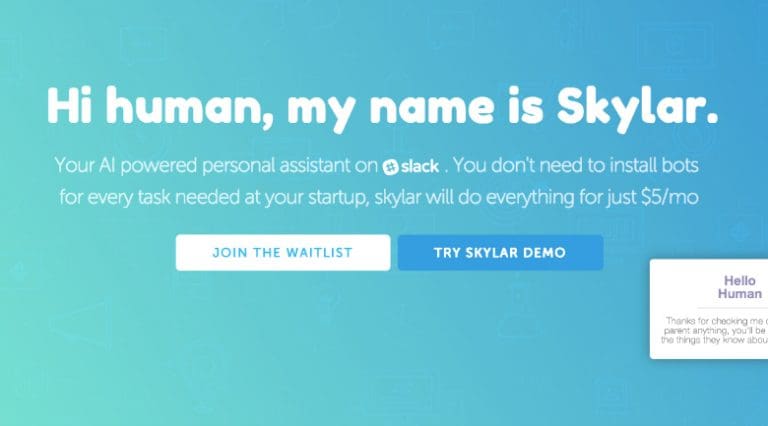
The London-based app, Skylar has an answer: add a conversational AI to the mix.

Like a growing stack of papers on a cluttered desk, the amount of transferable information in Slack can quickly become cumbersome; files get buried, conversations become extensive and, subsequently, unreadable, and you can easily spend just as much time searching for retroactive information as you do processing it.

Skylar, a sort of Siri dedicated to Slack, fixes this problem by working to consolidate and locate information for you while you direct your attention elsewhere.

Consider Skylar your personal, automated secretary – it does the tedious sorting and reviving for which you just don’t have time — and all for as low as $0/month.

Skylar lets you Slack

Free’s a pretty hard price to beat, folks.

Skylar also has the capacity to work outside the confines of Slack – for example, it can send and receive emails, attachments, and files, and then process them directly back into Slack for your convenience — meaning you can stay productive without breaking your in-Slack focus.

Skylar’s freedom outside of Slack even allows it to perform functions such as ordering food (then sending you the bill so you can pay, all while staying in Slack), reserving coworking space, and calling an Uber driver.

Simply put, Skylar lets you Slack without slacking.

Skylar’s pricing ranges from the aforementioned free package to a $15/month unlimited plan that promises to “scale infinitely for any company.” The free plan still includes basic functionality—100 requests per day, a service plug-in, and the like—whereas the $5/month midrange plan offers exponentially more requests and service plug-ins, and unlimited expense reports.

Bottom line: If your business runs on Slack, spring for whatever Skylar plan your budget can afford. You’ll make that monthly bill back in a day purely from a productivity standpoint, and you’ll probably spend infinitely less time perusing your archives.

#SkylarForSlack

What’s your retirement score? Will you ever actually retire?

0

When the future is cloudy

Retirement is inevitable.  When the big day comes, will you be ready? The idea is to be able to retire and have enough savings to balance out your pension in such a way as to afford you a comfortable standard of living. The earlier you start the better off you’ll be, but the important thing is that you start.

bar
Fidelity Investments offers a brilliantly simple retirement calculator that, after you to plug in your age and few other number, gives you a quick overview of where you financially and where you need to be in order to retirement without living the risk of living n a cardboard box on a cold wintery day.

Clear the way

Fidelity points out a simple savings strategy: “Spend less than you earn.” In other words, says Fidelity professionals, “Having a budget puts you in control, so you can enjoy your money, instead of worrying about the bills.”

Other sage advice includes taking advantage of matching contributions, pay off high interest rate credit card debt, establish an emergency fund that will last at least three months and finally fund an IRA.

It’s not rocket science. But apparently if planning for your retirement was this easy, everybody would be doing it. The missing ingredient here is DISCIPLINE. And no one, not Fidelity, not your parents or best friend can ingrain that quality in you.

You need to have the fortitude to spend less, save more and do it consistently.

A few words about building wealth

The Fidelity Retirement Tracker can put you on the fast track to a common sense blue print for planning for your retirement. According to Fidelity.com, once you’re in a position to save for other important priorities in addition to retirement, consider the following:

– Identify and prioritize your short- and long-term savings goals (i.e., buying a car or home renovations vs. saving for college or a second home).

– Examining the tradeoffs, time horizons, and costs of each of your financial goals; and learning about the types of investments that may help you achieve your goals.

– And finally ensure you don’t lose sight of your retirement savings goals.

Your future is one thing you CAN control. Don’t save for a rainy day, save for a sunny retirement!

#Retire

Analytics for Instagram is super basic, easy to use

0

For the metric minimalist

For all of us Instagram fanatics, there is now another reason for us to be obsessed with the photo sharing app, as if we really needed another. Edward Marks brings us Analytics for Instagram, a new, simplified way of monitoring followers, followings and posts.

bar

For the Instagram minimalist

We’ve all seen similar apps, most of them offering additional analytics such as counting ghost followers, followers who aren’t following back, and popularity ratings over a period of time; and while we appreciate all of the bells and whistles, sometimes simplicity reigns supreme. Especially when simplicity translates into saving time, and money for business owners. With it’s simple tracking, and easy to use interface, Analytics is sure to be a hit for the Instagram obsessed, statistical minimalists.

Easy and free

Once the user gives the application permission to connect with their Instagram, the app immediately begins tracking total followers, new followers, total following, new following, total posts, and new posts; and can be viewed by toggling between day, week or month. For each “Total Category” (i.e. Total followers, total posts) is a detailed line graph that gives an accurate account of activity over time. For each “New” Category (i.e. new followings, new posts) is an easy-to-read bar graph that does the same, along with calculating percentage change, again nothing too complex.

In case the ease in maneuverability isn’t enough to catch your attention, I’m sure this will: the app is completely free for use with a single account!

Have multiple accounts? No worries, with a low cost of $0.99 per month, this app is still cheaper than most of its competitors.

No more wasting time

Right now, Analytics for Instagram is only available in the Apple app store, and because it’s so new, there’s no word if Android users will have access. But, like all early apps, it is expected to continue developing, hopefully including Android users, adding more accessibility options, and fixing any operating issues while maintaining simplicity.

So, if you want to accurately monitor your Instagram statistics without wasting time and money on other apps, this is the perfect app for you. Head to GetAnalytics to check it out.

#AnalyticsforInstagram

Finally, a social media network just for entrepreneurs and freelancers

The entrepreneur’s struggle for connection

A problem that entrepreneurs and freelancers continue to face is a lack of networking. They tend to work against the grain of 9-to-5 normalcy and, as a result, they do not always have the best means of connecting with others.

bar
While social networking tools, especially LinkedIn, have helped to bridge this gap, there is little available in terms of networking specifically for entrepreneurs or freelancers. The new smartphone app, Fount, is looking to change that.

What is Fount?

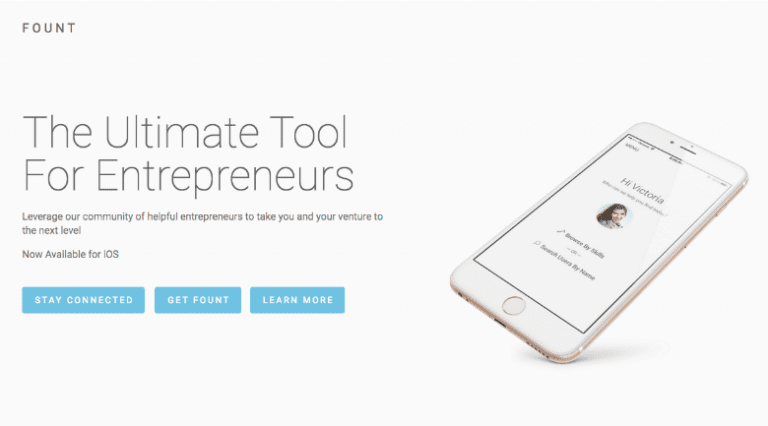
According to the company, “Fount is a mobile app that connects entrepreneurs based on what they are looking for. Simply type in what skill you need (i.e.- Graphic Designer, Mobile App Developer, UX/UI Designer, Growth Hacker, etc.) and instantly a list will populate with people who can help you. Perfect for entrepreneurs, freelancers, and small businesses.

Don’t have time to browse for what you are looking for? No problem! Type a post into our ‘need feed’, sit back, and let people contact you. Follow people you want to stay in touch with, message those you want to work with, and create something special! This is the app for entrepreneurs in 2016 and beyond!”

Their initiative is simple: find people you need from friends you can trust.

Fount works by utilizing four key elements: simplifying your extended network, collecting all of your contacts in one place, sorting by skills, proximity, and mutual friends, and leveraging your network to get the skills you need.

Steps to building the ultimate network

First, you simplify your extended network in a skill-based version of the Six Degrees of Kevin Bacon game. Organize your second degree of connections by their top skill set.

Second, organize all of your contacts in one place by bookmarking users and filtering through them by what they do best.

Third, you can sort connections by skills, proximity, and mutual friends. If you are looking for people with a particular skill set, or people in your area, Fount’s filtering system allows you to find the top connections based on your needs.

Lastly, you have the ability to leverage your network in order to get the skills you need. This works through Fount’s “Need Feed”, which is a feed that includes people offering or searching for specific skills. This gives you the chance to help your contacts by sending their needs to your friends or connections who can assist them.

Fount is currently available for free download in the Apple Store and Android users can sign up on Fount’s waiting list. Despite it’s usage being entirely phone and not desktop based, this simple tool is an advancement on the downfall of the Rolodex.

#Fount