Home Blog Page 174

Twitter is nixing TweetDeck for Windows

Twitter for “power users”

If you are a heavy Twitter user, chances are you’ve heard of and used TweetDeck. TweetDeck is a great dashboard application that lets you manage your Twitter account(s) like a pro. Unfortunately, if you’re a Windows user, Twitter has announced their intention to end support for TweetDeck Window app, beginning April 15th.

bar
This move will force PC users to rely on the web version instead of the standalone app they’ve become accustomed to. TweetDeck was intended for Twitter power users, allowing users to see and organize posts by mentions, notifications, and lists. With the elimination of the standalone Windows app, PC users will have to adapt to the not-as-viewer-friendly version on the web.

Why nix the standalone app?

post, Amy Zima, project manager, stated they want “to better focus on enhancing your TweetDeck experience.”

They also stated they’d, “been working on infrastructure projects like [TweetDeck] to ensure we have a stable foundation to continue improving [it] in the future.” While Twitter is adamant nothing is changing about TweetDeck itself, merely how you access it; longtime TweetDeck fans will probably notice a few differences in the layout and organization.

Don’t panic yet

According to Twitter’s blog post, users should be automatically logged into the TweetDeck Chrome and Mac apps as long as you’re on twitter.com or Twitter’s analytics page. This should allow for faster access to the new TweetDeck. Also, Twitter gave instructions on how to pin the web version of TweetDeck to your Windows taskbar, but this may not be as useful, especially if you’ve gotten used to the standalone app. For one, the readability in the web view isn’t the same as the standalone app, but it is better than losing the capability altogether. You may remember the iOS and Android app version were also nixed, so in a way, in makes sense for Twitter to end the Windows app as well.

Perhaps, by offering TweetDeck in one place, Twitter will be able to offer more relevant, timely, updates to the service. What do you think about Twitter’s decision to nix the Windows app?

#TweetDeck

Kasita won at SXSW and Doctor Dumpster must be stoked

The tiny house movement

We all know that less is more – and the same is true when it comes to housing. More and more home owners and renters are getting jazzed about tiny houses. People want to simplify their lives. After all, a bigger house just means bigger bills and more chores. The tiny house movement recently got a boost when Kasita, a tiny house design company, won a SXSW Interactive Innovation Award.

bar

Based out of Austin

Kasita is a design company based in Austin, Texas, a “growing city in need of affordable, urban housing.” Kasita hopes to address this problem by building prefabricated housing units that are stocked with all the amenities, despite their diminutive square footage.

Kasita units are 270 square feet with nine foot high ceilings. By using thoughtful, smart design, these small homes are still able to house a queen sized bed, a dishwasher, and laundry facilities. Currently there are prototypes in use in East Austin, and you can sign up now to have your own unit by late 2016.

Emergency housing and more

The company is even “building close ties with city representatives” to see if Kasita could be used to alleviate Austin’s housing shortage. The units can be stacked on simple racks to create apartment buildings ten stories high, making quick work of adding much needed housing to Austin’s overcrowded downtown. Kasitas, which are quickly and easily installed, could also be used in the future as temporary and reusable emergency housing for crisis situations and natural disasters.

Good ol’ “Doctor Dumpster”

Founder Jeff Wilson is no stranger to living in tiny spaces. He’s known around Austin as Doctor Dumpster, having made a name for himself by living for a year in a 33 square foot, used commercial dumpster. The former Silicon Valley exec buried his Rolex in the late 90’s and has never looked back. He’s followed his passion for minimalism, all the way to South by Southwest, which has given Kasita its Smart Cities award “for innovations in eco-friendly or sustainable” enterprises that make “life in a connected world smarter, cleaner, greener, and more efficient.”

#KasitaSXSW

Where have manufacturing jobs gone and why aren’t they coming back?

Production on the rise, and yet…

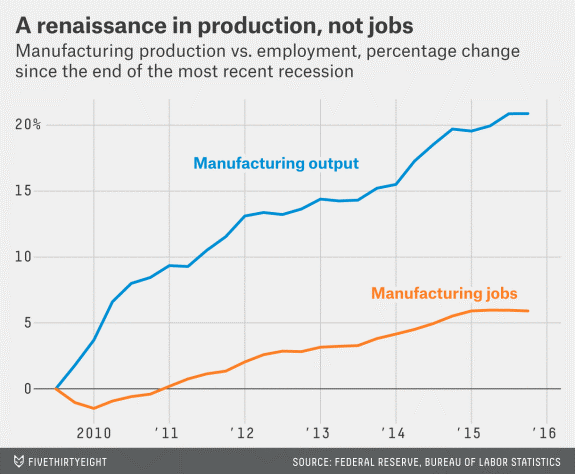
The discussion of US manufacturing jobs or the lack of same makes for a great argument during election time. And it doesn’t really matter what side of the fence you ride. Candidates pound their fists and raise their voices and you’d think China was stealing bids on jobs during the dead of night or something. Hey we can use a scapegoat. It helps deflect the realities but the truth lies somewhere in between: slowly but surely, production is rising back in the US.

bar

Automation is phasing out these jobs

Manufacturing is becoming more and more automated. Automation may be the wave of the future but it takes jobs away and what’s worse these displaced workers aren’t being re-directed into other areas of production as a way to utilize their skills. Studies show that the United States has lost more than 4.5 million manufacturing jobs since NAFTA took effect in 1994 and those jobs aren’t coming back any time soon.

manufacturing

A double-edged sword

In 1994 there were 3.5 million more Americans working in manufacturing than in retail. According to an article on Fivethirtyeight.com, today, those numbers have almost exactly reversed, and the gap is widening. More than 80 percent of all private jobs, reports Bls.gov, are now in the service sector.

Ensuring employment for manufacturers

Avoidance may be the only solution. None of the candidates seems to be offering up any tangible solutions. At least nothing that we all haven’t heard of before. Adds NY Times economist Eduardo Porter, “Candidates ought to be talking about ways to ensure that the service sector can fill manufacturing’s former role as a provider of dependable, decent-paying jobs.”

I’m not sure when that will ever happen, but until it does it makes for spirited discussion among Presidential hopefuls.

#WelcomeOurOverlords

Has Twitter changed their mind about upping the character count?

Pivoting into long-form content

As we previously reported, Twitter was rumored to be changing the amount of characters they allow in a Tweet. The controversial hints would change their signature character count from 140 to an astounding 10,000. This would be an interesting move given most marketing experts concur less is more in our instant gratification, low attention span society.

bar
However, it seems as though Twitter users dreaming of more room to express themselves will be sorely disappointed. In an interview with TODAY, Twitter CEO, Jack Dorsey, answered Matt Lauer’s question regarding the change of the Twitter character count. Dorsey stated that their signature character count would remain unchanged because they wanted to preserve the feeling of “of-the-moment brevity.” While he did state “they were always going to make Twitter better,” this does not include increasing the character count.

What happened to the 10,000 characters we were supposed to get?

The tweet that started all the scuttlebutt, hinted that character count would be increased in an effort to make Twitter more user-friendly. Ironically, since Dorsey himself used a screenshot to post his letter. He stated he wanted users to have a way to post what they wanted instead of screenshoting text and then tweeting the image. Twitter wants to make this text searchable, highlightable, and useful; but how can they do this without increasing the character limit? My guess is with links. Links are shortened on Twitter already, but with the advent of hashtags and other categorizing methods, I feel like you can still get your message across in 140 characters. Perhaps Twitter has something else in mind, but we do know 140 characters are here to stay.

What happens next?

Perhaps Twitter will give users the long awaited “edit” option? I’m not sure where they are headed, but it looks like they have something in mind. While change always seems to stir up a bit of controversy, where social media is concerned, the controversy doesn’t seem to last long. All those Facebook users who were upset about the changes to the layout have long since gotten over them. All the Twitter users who were irate about background images have adapted to the change. Social media is a constant struggle of who can offer the best platform, that engages users and business alike and it seems like Twitter is doing nothing more than trying to keep themselves at the top of their game. What do you think about the decision to keep the character count where it is?

#Keeping140Characters

FBI issues warning regarding vulnerabilities and car hacking

Tech updates increasing vulnerability

When my old car finally quit, the only “special” thing I wanted in my new-to-me car was a CD player. Technology has come a long way in the past ten years, but I still have the car with the CD player. However, I also use a FM transmitter to play my iPhone through the speakers. Newer cars come with a whole host of features aimed at keeping us safer and simplifying our lives through Bluetooth, Wi-Fi, and more, but do the vulnerabilities and risks of these features, outweigh the rewards?

bar

The FBI weighs in

The FBI along with the National Highway Traffic Safety Administration, have issued a safety bulletin addressing concerns that vehicles are being targeted more and more by hackers. While the latest issues of this have been resolved, they do want to make consumers and manufacturers aware of the potential problems. They stated in the bulletin: “The FBI and NHTSA are warning the general public and manufacturers of vehicles, vehicle components, and aftermarket devices to maintain awareness of potential issues and cybersecurity threats related to connected vehicle technologies in modern vehicles.”

Where are the vulnerabilities?

You may have heard about one of the more recent issues concerning the testing of the radio module. In August of 2015, a study [PDF] was published regarding researchers testing, targeting, and exploiting this particular device through attacking the vehicle through Wi-Fi and cellular connections. The radio module contained multiple wireless communication and entertainment functions and was connected to two controller area network (CAN) buses in the vehicle. Through their testing, researchers were able to shutdown the engine, disable the brakes and steering, trigger the door locks and turn signals, manipulate the tachometer, radio, HVAC, and GPS.

Vulnerabilities may exist within a vehicle’s wireless communication functions, within a mobile device – such as a cellular phone or tablet connected to the vehicle via USB, Bluetooth, or Wi-Fi – or within a third-party device connected through a vehicle diagnostic port. In these cases, it may be possible for an attacker to remotely exploit these vulnerabilities and gain access to the vehicle’s controller network or to data stored on the vehicle. Although vulnerabilities may not always result in an attacker being able to access all parts of the system, the safety risk to consumers could increase significantly if the access involves the ability to manipulate critical vehicle control systems.

Worried? Here’s 5 ways to minimize the chances of being hacked

1. Ensure your vehicle software is up to date: If your manufacturer issues a notification to update, it’s important that you do, but, verify that the update is genuine. Verify any recall or update notices by visiting your car’s manufacturer website. Clicking through emailed links presents the opportunity for hackers to send malicious links. Also, be wary of receiving USB and SD cards via the mail. Hackers could use this method to introduce malicious software into your car. Instead, check on your vehicle’s manufacturer’s website to identify the latest software updates. Use your own USB or SD card where necessary to download and transfer information. You can always check with your dealer or manufacturer before updating.

2. Be careful when making any modifications to vehicle software: Unauthorized updates could create increased vulnerabilities and change the way your car works.

3. Maintain awareness and exercise discretion when connecting third-party devices to your vehicle: Most modern vehicles have a standardized diagnostic port (OBD-II), which provides connectivity to the in-vehicle communication. Keeping these third-party devices secure is critical as a hacker may target them remotely as a way into your other systems. Do not connect any unknown or untrusted devices to the OBD-II port.

4. Be aware of who has physical access to the vehicle: Treat your vehicle the same way you do an unlocked smartphone, or computer: you don’t let people you don’t know touch it. Be cautious of who you leave your vehicle with; it only takes a few moments to upload hacking software.

Improving cyber security

While there are risks with using any technology, you want to be especially mindful of your automotive technology. The last thing anyone wants is to lose control of your vehicle. While the chances of this are minimal, you can decrease them even further by being actively aware of whom you leave your car with, your surroundings, and your technology system.

The rewards of technology outweigh the risks, especially when you consider the increased safety benefits of advanced technology; however, there is always a chance someone will turn this technology to their advantage. The NHTSA is actively working on initiatives to improve cyber security in vehicles.

To increase your security, please, follow the FBI’s tips above, or you can reach out to local law enforcement and the FBI with questions and concerns via the Internet Crime Complaint Center, or file a complaint with them.

#ProtectingYourSmartCar

Timeneye: Gorgeous time-tracking tool for freelancers

“Your time is priceless, take better care of it”

While freelancers are able to enjoy different luxuries including working from home and making their own schedule, some things are harder to do outside of a typical workplace. Being that there is, theoretically, no clock to punch while freelancing, it is up to the worker to track their own hours.

bar
According to Timeneye, “your time is priceless, take better care of it”. This is why they have developed an easier way for freelancers to keep an eye on their time tracking. They also take it one step further by allowing teams to integrate and track time together.

More than just a punch clock

The company has created a new platform for tracking time on the web or on the go with a mobile device. The site offers time tracking, team status, project monitoring, and time reports.

With time tracking, users are able to either track time manually or with a timer. They can browse between projects, select tasks, and add descriptions. There is also the option to view a personal recap, which includes monitoring daily, weekly, and monthly efforts with a real-time pie chart.

Team status offers a collaborative element for people working together. Project managers are able to keep an eye on team performances and projects workflow in real-time. This element also offers recaps as well as engagement statistics.

Manage and monitor projects

Project monitoring includes statuses on projects as well as budget monitoring. There is also a way to boost productivity by analyzing team productivity and workflow by seeing how each user budgets time.

With time reports, users are able to generate reports that allow them to see where the business is allocating its time. There are options for different filters that let users monitor projects, single users, and clients.

Integrates with all the best team software

Timeneye has already implemented integration with teamwork software, including: Basecamp, Trello, Redbooth, Wunderlist, Asana, Google Calendar, Breeze, Podio, and Chrome widget.

There are different pricing plans available depending on the size of the team. For solo use, the interface is free to use, while team plans include a free 14-day trial.

A mobile app is available in conjuction with Timeneye and can be downloaded by both Apple and Android users.

#Timeneye

How to find temporary Facebook profile picture frames and why you need them

A new way to stand out

Taking steps to stand out on social media can often be the difference between success and failure. Everyone has a different idea about what makes your profile stand out and these ideas vary again from platform to platform. One of the newest ways to make your profile picture stand out on Facebook is to use their temporary profile picture frames.

bar

What’s new with Facebook’s frames

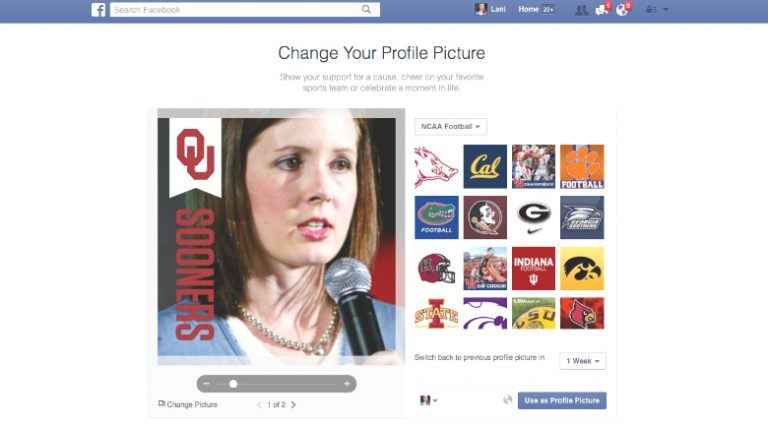
Previously, these frames were available to sports fanatics and worthy causes across the globe. Now, their images have expanded to include a few Hollywood blockbusters, like Star Wars, and other charitable foundations. Before, when you went to look for a profile picture frame, it was difficult to see all the options. You almost had to know what you were going after, in order to find it. In most cases, Facebookers saw a frame on a friend’s page and wanted the same thing for their own profile.

In an attempt to make this easier, Zuckerberg provided this link in an embedded Facebook post. From Facebook.com/ProfilePicFrames , users can access a pull-down menu that provides them with all the available options for temporary profile picture frames.

Snapchat has been using frames for quite a while and it is a good way to differentiate yourself for other users. Now, it seems like Facebook is fully on-board with profile picture frames. Originally, there were only a handful of frames available. Currently, they have rolled out hundreds of frames from which to choose.

Why you might want to try them

Aside from showing support for your favorite causes, companies, sports teams, or life events, when you select a profile picture frame, it re-engages your followers. Every time you update your profile picture (unless you choose otherwise) it posts to your Timeline.

The same is true when you add a frame to an existing Facebook profile pictures. When you add a frame, it effectively draws your followers back to your page as they receive an “update” that you have added a new picture, even if it’s the same image with a new frame. This makes a quick, easy, way to draw your followers back to the page without the need to create new content.

Have you had a chance to take a look at the temporary Facebook frames? What do you think?

#FacebookFrames

Why your company should stop focusing on growing

Expert has an interesting perspective

Doug Rushkoff has been referred to as a kind of Media Theorist. He spends much of his time studying the human condition as it applies to our digital lives and dreams of how we can use cyberspace to maintain and create a spirit of empowerment.

bar
Podcast host Jodi Avrigan recently spoke to Doug Rushkoff and they riffed on a number of topics including why companies should concentrate on doing what they do best and stop succumbing to boardroom and investor pressure to keep growing.

Stop growing and start living

An early advocate of the internet, Doug Rushkoff could confidently say he’s seen it all or close to it. What he sees as the current [and destructive trend] of companies that are told to expand rather than do what it is they do best.

Says Rushkoff, “We need to optimize the digital economy. Not for its extraction value or its conversion into capital but for the circulation of money [in the right directions].” In other words, in a perfect world Rushkoff envisions companies making their millions or billions and putting that money back into the company or at the very least putting those profits back into the hands of the people that are doing the work. At least some of it.

Growth, growth, growth

In terms of growth Rushkoff cites Walmart as an excellent example of abuse: they rushed to open so many stores that ultimately there are no longer enough people to sell to. And now Walmart is closing stores.

The website Edhltd.com postulates this even further when author Edward D. Hess (Distinguished Executive in Residence and Adjunct Professor of Management at Emory University) states, “Most companies can tolerate incremental growth or growth to replace unprofitable customers fairly easily over time. But successive years of high growth challenge the competencies and risk tolerances of most companies.”

So the issue of growth is really two issues: The first is to ask at what pace or rate should you grow and secondly what is your capacity and risk tolerance for growth?
Another way of thinking is that if you make a good living painting and selling 5 paintings a year why stretch and paint eight a year and risk the quality suffer at the expense of making a profit?”

Sustainability

Platforms that extract more from their platform than they facilitate was another topic-in-real-time and Rushkoff cited Uber as a good example. Rushkoff feels the Uber driver/operator is just a resource with no plan in place to protect them or incentive for long-term career growth.

Rushkoff refers to it as looking for ways to optimize one’s business (especially if it’s smaller). Part of it has to do with what he calls “boundary-investment.” Which is simply investing in way that the money comes back to you.

Real vs. virtual communities

New technology will create a lot of growth. Internet economy in particular has the ability to make money in many different ways. What has happened though is that Wall Street noticed how much was to be made with the internet and suddenly THAT is the priority.

Twitter is an example say Rushkoff. Twitter can no longer just be a platform that is able to send 140 characters from one phone to another. After making billions of dollars Twitter must concentrate on making [even more] money. All at the expense of a great app. Why? Because extraction is now the focal point.

Says Rushkoff in the interview, “The original internet was not created to make a whole lot of money just so the founders have nothing to do. It was created with the intention to make money doing what you love and turning it back into the community.”

Another twist on this concept again comes from Edward Hess, who points out, “By growing at high rates for several years – yes, you will capture market share but also you rise on the business food chain and come into the sights of very big, well-capitalized, highly-efficient and well-managed competitors.”

The takeaway

The key point: As you grow, your competition changes. As you grow, you become both a threat and a target. 

All in all a great interview. Check it out. Ol’ Gar’ gives it 5 stars. And the read the book by Doug Rushkoff as well (Throwing Rocks at the Google Bus).

#Growth

Pinterest tests video ads: Will the experiment boom or bust?

Pinterest opening up a new avenue

Pinterest, which has been, in expert opinion, a little slow to set up the infrastructure to draw investment from advertisers, has been considering adding videos for several months, and now appears to be testing a batch of promoted video pins internally and amongst a small group of users. The company is testing for optimal video length, and to see how users react.

bar
User reaction will be an important part of the experiment, considering that Pinterest is not a go-to destination for videos, and that video behavior is somewhat at odds with Pinterest’s scrolling user interface.

“Video behavior is not an organic one on Pinterest”

Orli LeWinter, a social marketing strategist, points out that “video behavior is not an organic one on Pinterest, so I’d be interested to see how they end up performing.”

However, LeWinter still applauds Pinterest’s investment in video infrastructure, saying “they would be wise to launch video ads, as video consumption trends continue to rise.” After all, Facebook currently boasts over 8 million video views per day, adding up to over 100 million hours of video.

The path has been long

The company has been tiptoeing slowly towards video ads over the past year. Last year, the site introduced Cinematic Pins, which are short animations that played while the user scrolls over them, and stop when the user stops scrolling. Cinematic Pins are utilized by several major brands, including Wendy’s, Walgreens, Suave, Unilever, The Gap, L’Oreal, Target, and Visa.

The new video ads will only play when a user stops scrolling long enough to see the video.
Pinterest declined to comment, so we don’t know yet which brands are biting, and how much Pinterest will charge for a video ad.

LeWinter, who commented that Cinematic Pins are a “very interesting and engaging format” that “perform pretty well,” think the success of Cinematic Pins bodes well for video advertising on Pinterest.

#PinterestVids

The new dream team: The U.S. Digital Service [editorial]

Do you know what Uncle Sam’s up to?

The U.S. Digital Service team. Think of them as digital stealth drones: They come in, they get the job done and they get out. Then on to the next job. Unheralded but leaving a lasting impact. They are you and me.

bar
The USDS is rebuilding vast swaths of government social media platforms that quite plainly just didn’t make a lot of sense and weren’t helping the people that needed it the most. Good on the US government for figuring out that this flat tire needed fixing.

All about teamwork

Says the Obama administration, “The core work of the U.S. Digital Service is done in agency teams, where small groups of developers, designers, and product leads work with dedicated public servants to dramatically improve the government’s most impactful services.”

In 2015, the US Digital Team recruited its founding members of a new set of agency teams to work on a large number of critical services. The first being a total makeover of the Healthcare.gov website. That done, the team shifted gear to the Veteran’s Administration and a host of other projects. Along the way the US Digital Team began actively recruiting new members. A search that continues to this day.

Do you have what it takes?

The year 2015 saw intense recruiting taking place but it was recruiting with a difference: This wasn’t for some misconceived government couch job meant to be wrapped around an entire career. According to Mike Dickerson, Chief Administrator of the USDS, he was upfront in telling prospective candidates, “Don’t come here if you’re looking for a fun, easy thing to do, if you think you’re going to make a lot of money, if you think it’s going to advance your interest in some particular way. Come because there’s work to be done that can impact millions of people.”

You’d think that approach was scare people away, but a funny thing happened as a result of Dickerson’s aggressive recruitment pitch: Even MORE people applied.

In a Backchannel interview, Dickerson pointed out, “The active ingredient I think is we are relentless about trying to hang onto the ruthless mission focus here. We are built for short term appointments. We’re not building a permanent piece of bureaucracy.”

Think you have what it takes? Then click here and saddle up for an exciting ride. In the meantime, the US Digital Service team is redefining the US government’s digital imprint. I mean, what good is it if no one understands the message? Adds Dickerson, “The work of the [talent pool] that we’re pulling in from across the country will actually have a chance to influence and change the way the government is operated.

I love it. What a concept.

#USDS

Do you live in any of America’s hardest working cities?

America’s hardest working cities

What are the factors that make for a hard-working city? What are they doing differently in Anchorage Alaska (where residents work 40.7 hours per week, ranked #1) compared to Burlington, Vermont (Ranked # 116)? In order to identify where the hardest working Americans live, WalletHub.com compared 116 of the most populated cities across six key metrics:

  • Average Work-week Hours
  • Labor Force Participation Rate
  • Commute Time
  • Workers with Multiple Jobs
  • Volunteer Hours per Resident
  • Leisure Time Spent on an Average Day

According to Wallethub, each metric was given a value between 0 and 100, wherein 100 is the best value for that metric and 0 is the worst. Here are the top 25 (major shoutout to the DFW area!):

  1. Anchorage, AK
  2. Virginia Beach, VA
  3. Plano, TX
  4. Cheyenne, WY
  5. Irving, TX
  6. Jersey City, NJ
  7. Garland, TX
  8. San Francisco, TX
  9. Denver, CO
  10. Chesapeake, VA
  11. Washington, DC
  12. Gilbert, AZ
  13. Charlotte, NC
  14. Arlington, TX
  15. Dallas, TX
  16. Aurora, CO
  17. Scottsdale, AZ
  18. Norfolk, VA
  19. Seattle, WA
  20. Houston, TX
  21. Ft. Worth, TX
  22. Chandler, AZ
  23. Austin, TX
  24. Sioux Falls, SD
  25. Colorado Springs, CO

See the full list here.

bar

Working class nation

According to the Bureau of Labor Statistics, we are “400 percent more productive today than in 1950.” What was happening in 1950? (Well there weren’t any smart phones that’s for sure). But historically, we continue to out-produce ourselves on an annual basis. For example, 100 years ago Americans worked nearly 205 hours more per year than we did in 2011. All of our productivity gains in recent decades simply resulted from rapid technological growth that allowed us to increase automation and efficiency.

Research shows that Americans work 20 percent more hours yet are still less productive than our European peers. I don’t particularly get that. I’d like to see how Italy, for example, with its love of holidays, strikes and overall downtime for the month of August, can possibly be more productive or have a better standard of living. But I digress. Same goes with many other countries in the EU.

Double edged sword?

True enough that we built this country on hard work but at what cost? Statistics are bearing out that a lot of standards we seem hell bent on: a 60 hour work week, shortened vacations and the like don’t necessarily equate to more production. On the contrary. After 50 hours individuals, no matter how well intentioned, are producing much more than someone working 40 hours per week.

The question is – does hard work does pay off? Or do we just need to work smarter and not harder?

#HardWorking

Should the social media giants be killing the culture of chronology?

Instagram on the bandwagon

“Most Recent” on Facebook and “Live” on Twitter are the first things I click when I login to my social media accounts, yet my social media perusing habits will soon be changing. The social media gods have decided that instead of listing content chronologically that I should care more about what my friends think is important, instead.

First Facebook, then Twitter, and now it appears Instagram is set to follow suit into the world of the non-chronological timelines. With Instagram poised to become the next big opportunity for advertising on social media, surpassing Facebook and Twitter, it’s natural that they’d be looking to monetize their popularity as much as possible.

bar

Maybe this is something we want…

In theory, a fancy algorithm that selects which stories, posts, or in Instagram’s case, photos, that are most interesting to me should be useful, and welcomed. Based on the likes of my friends, and the past interactions I’ve had on Instagram, the algorithm weeds out the posts I most likely don’t want to see. I have to admit, there is some reasoning to it – if I never like a business’ or individual’s photos then why would I want to see them? Why not just remove that distraction from my feed?

When I followed that business, I really did want to follow them

The problem is by curating my feed into something you think I want Instagram is actually removing exactly what I liked best about the platform – the ability to see a variety of different photos, all the time. When Facebook started relying on the formula to determine what was most valuable to me, it began filtering things that were indeed very valuable to me.

When I “like” or “follow” a business it’s because I want to see updates, photos, and specials that those businesses offer. When I “friend” someone I know, it’s because I am interested in the updates and photos they share. Instead of automatically removing the things that are suspected to be “uninteresting”, instead let me decide what I do and don’t want to see.

Don’t remove, add more options

I would encourage social media platforms to provide more filtering options, including an all-everything chronological option, as there are times when I want to see everything just as there are times when an overview, or “best of” snapshot would be best. By providing these options for filtering it puts me in control of the content I consume and I enjoy the ability to decide what I see. While this algorithm based, non-chronological filtering is touted as something that we should want, as something meant to give us exactly what we want to see and filter out the noise, it’s actually a guise.

All about that money

In reality, this new formula is a ploy to force the hand of businesses to spend more and more and more money on social media advertising if they want to ensure their content is being seen. As a businessperson, I can’t say I blame them, as the reasoning is genius. With 88.2% of Americans reporting having a social media account, the advertising dollars are there for the taking.

Yet, as someone who has worked in small business for over 10 years, I think this strategy is detrimental to growing businesses with small budgets. While social media has historically been the perfect platform for growing small businesses, algorithms that are influenced by money will ultimately squeeze out the little guys.

Keep it real, yo

So, from a moral, small-business focused standpoint and from a consumer annoyance standpoint I’m keeping my fingers crossed that Instagram doesn’t travel the exact path as Facebook. I’m sure I’m not the only one that hopes to maintain more control over the content I receive and push out without the need to buy the attention of my customers, or be infiltrated with purchased content that isn’t relevant. Although, I have to admit, a few less post-workout pictures, wouldn’t be terrible, either.

#Chronology

Universal gets heat for racially targeting Straight Outta Compton ads

Wait, aren’t ads *supposed* to be targeted?

Targeted advertising is a good thing, right? You’re sending a message to your customer that is tailored to their specific interests, allowing you to attune different marketing strategies to different demographics.

bar
But if your targeted advertising presents different information to customers of different races, you’ll look a lot less credible and a lot more, well, racist.

Universal assumes white people know Dre

Universal Studios is currently in the hot seat, dealing with the backlash from its racially targeted advertising of the film Straight Outta Compton. The film, which is named after the title of the first studio album of the hip-hop group. N.W.A., chronicles the rise of the rappers from their Compton roots to international fame.

However, the studio chose to make advertisements, targeted towards white Facebook users, that don’t even mention N.W.A. Instead, ads for whites features Ice Cube and Dr. Dre, because Universal assumes that white people are more familiar with these faces than they are with N.W.A.

SXSW panel kicks up dirt

The discrepancy was revealed by Universal digital marketing executive, Doug Neil, who was speaking about targeted marketing at a South by Southwest panel. He described how Universal used Facebook’s analytic tools to create targeted marketing. While Facebook doesn’t allow advertisers to segregate content based on race, data on habits, likes, and interests can be used to create categories that mostly lump folks together racially.

So while Universal was patting itself on the back for its crafty targeted marketing, audience members’ responses ranged from eye rolls to outrage.

But not all accused Universal of wrongdoing

Black news and commentary site, The Root, was dismayed at the racial stereotyping behind Universal’s marketing.

They said, “let’s not act like all black people know or like N.W.A.” and commented that “they should’ve presented the fake trailers to the Academy members so the movie could have received more Oscar nominations.” The Academy’s snub of Straight Outta Compton inspired the hashtag #OscarsSoWhite.

Another Twitter user posted, “Wut? Facebook showed whites and blacks diff versions of ads, calls it a ‘victory’ for race-specific advertising.”

The take away lesson here is that targeted advertising, when based on racial stereotypes, can and will backfire.

#StraightOuttaUhOh

Attitudes toward business hugs are relaxing [editorial]

Feeling the love

You can’t deny, there is a benefit to togetherness and hugs. One neuroeconomist recommends at least 4 hugs a day just for survival. Trust me, when you live in the South, that’s an easy goal to hit. People not only hug when they say hello but also when they leave, much like an “aloha” or “shalom.” In certain settings, the hug is the way to go, but when it comes to business settings, most people think you should probably back off.

bar

Hugging is common, but still deemed inappropriate

The Creative Group, a staffing firm, surveyed more than 400 advertising and marketing executives in the United States. In business circles, hugging is becoming more common, but almost three-quarters of the respondents indicated that hugs are inappropriate in this context, especially between business contacts. Forty-four (44) percent responded that hugs are never appropriate in a business setting.

Attitudes are relaxing

When it comes to business associates, such as co-workers, the statistics relax just a little. Only about half of the respondents believe that hugging is inappropriate between co-workers, which is actually much lower than the 70 percent who believed this in 2011. Even with all the sexual harassment information available to business owners today, the attitudes are easing up.

Consider your relationship and environment

What is appropriate? A handshake is the traditional greeting that is the least likely to offend someone. Even if you’re meeting someone from another part of the world, it’s typically accepted. Not only does it let the other person protect their individual space, it also prevents spreading germs through closer contact, which in the winter especially is vital to any number of people who have weakened immune systems.

With co-workers, if you opt to hug, make sure it’s reciprocated. Watch the other person’s body language and consider your environment. When you’re meeting business clients, use a handshake. Especially if you are a consummate hugger. The more intimate the greeting, the more you should hold back until you are invited in. Watch your manners in public to be more professional and personable.

#BusinessHugs

eBay just empowered a new generation to become sellers overnight

Self-shipping was a little too complicated for some

Selling items on eBay is a great way to make a little extra cash. It’s pretty easy to take a picture of your object, post it on eBay, and wait for it to sell. Oh, yeah, then you have to box it up and ship it. This probably requires more effort than you want to take, but there’s a solution for people who just can’t find the time or inclination to handle this aspect of the sale.

bar

Shyp takes care of shipping

Shyp, a startup that we wrote about recently, is an economy gig business. A courier is dispatched to your home and picks up the items which need packaging and shipped. It gives buyers more control over the auction process than the valet service offers (with eBay valets, inexperienced shippers send their stuff to sellers to handle the entire process.) What’s interesting with Shyp is that it seems to be based on the “Uber of” model, except it made the couriers employees on the payroll rather than independent contractors.

How it works

The Shyp app integrates with the eBay selling app, but it’s currently only available in four cities nationwide: New York, Chicago, San Francisco, and Los Angeles. It does add an additional $5 fee to the seller, but the courier picks up the item and packs it. Currently, Ebay says that about 50 percent of those using the service are new sellers. If you don’t have time to manage the backend of shipping your product after selling it on eBay, Shyp might be the next best thing.

Hopefully, as Shyp gets more publicity and the company works out the kinks in their own system that are inevitable with any startup, they’ll roll out the service nationwide in major metropolitan areas. More importantly, maybe they can change the Uber model to payrolled employees, who get full benefits from a company instead of having to work as an independent contractor.

#eBayAndShyp

Instagram blocking “add me” links, and honestly, it’s kind of petty

Network elsewhere, folks

In this age of fast-paced technology and social media overload, it seems odd that one social media platform is resisting certain networking elements. Instagram is now blocking the use of “add me” links to messaging platforms including Snapchat and Telegram on users’ profile pages.

bar
TechCrunch’s Natasha Lomas was first to report this behavior and Instagram responding, stating, “[they’d] removed the ability to include ‘add me’ links on Instagram profile pages. This was a rare use-case, and not the way [the] platform was intended to be used. Other types of links are still allowed.”

What are “add me” links and why do they matter?

“Add me” links are links to your profiles or information on other sites. They give your followers a quick way to add you on other social networking sites without having to search for your username. The odd thing isn’t the restriction on the links, but rather the restriction is only being placed on links for certain platforms.

Telegram founder Pavel Durov, stated, deep-linking to other social media networks like LinkedIn, Twitter, YouTube, Facebook, VK, and Periscope are still functional.

Allow me to play devil’s advocate for a moment: while blocking only two platforms seems a bit odd, it really is in Instagram’s best interest to remove this information. By blocking this information, users will have to leave Instagram and actually seek out the information on their own, removing the instant gratification that is direct linking. By doing this, some users may be more likely to stay on Instagram instead of leaving to check out other sites. You wouldn’t expect Pepsi to allow links to Coca-Cola on their site and I think the same holds true for Instagram. Especially when you consider Snapchat and Telegram serve similar functions as Instagram.

Here’s the caveat, though

While I can see the reasoning behind this move, Lomas, pointed out that Instagram’s terms of use do not contain language preventing the use of “add me” links. In which case, Instagram may get themselves into a bit of hot water over allowing some links, but preventing other. In fact, their Terms of Use states, “There may be links from the service, or from communications you receive from the service, to third-party websites or features. There may also be links to third-party websites or features in images or comments within the service.”

However, as most Terms of Use and Terms of Service agreements state, Instagram’s also states, “We reserve the right, in our sole discretion, to change these Terms of Use (“Updated Terms”) from time to time. Unless we make a change for legal or administrative reasons.” They also state, “We reserve the right to modify or terminate the Service or your access to the Service for any reason, without notice, at any time, and without liability to you.”

While it is utterly and completely frustrating when your favorite social media platform no longer allows you to do the things you’ve become accustomed to doing, it is certainly in their purview to do so. What do you think of Instagram’s decision? Will it change how you use the service?

#DontAddMe

Retale is virtual reality shopping (yes, really)

0

Online shopping gets an upgrade

How we shop is changing and has been since the advent of the internet. The internet has had a radical impact on the way we shop. No longer are direct mail and physical retail stores being solely relied upon to purchase goods and necessities. People have become more and more comfortable with buying goods online.

bar

Real-time immersive shopping experience

However, the traditional retail space could be set to re-emerge thanks to virtual reality. Combining the best of both worlds, software developers are employing virtual reality headsets to allow customers to go shopping from the comfort of their own homes.

The idea is to develop a real-time immersive shopping experience, where customers can walk though virtual shops, examine virtual versions of real-life products and make purchases like they would in the real world.

The all-in-one VR solution

For those of us who don’t want to brave the lines and chaos of boutiques and department stores, but still want to browse the offerings with a little more of a realistic feel, this latest application of VR could be the answer to all retail problems. And the most recent addition to the VR retail landscape is Retale.

Unlike traditional online shopping, Retale works as a central mobile/digital hub, enabling shoppers to search for merchandise and store locations, create and manage shopping lists, and clip and store coupons.

Changing the shopping game

Using Facebook’s Oculus, Retale Virtual Reality is the first virtual reality, location-based shopping companion. With Retale, users are immersed in retailer-specific environments to shop local offers in a contextual, engaging 3D world.

According to Retale CEO, Christian Gaiser, “Our team thinks VR can change the game for shopping by providing consumers with a really immersive environment.”

Explore and interact virtually

Using VR, Retale allows buyers to actually explore the store and interact with retailers’ products much as they would in the physical world. The 3D version also allows consumers to see price tags with clear descriptions of the products. Customers can even add products to their shopping list. From there, they receive confirmation on a smart phone via a push notification from the Retale app.

While Retale Virtual Reality is still in its infancy, its looking to change the game in the near future.

#RetaleVRShopping

Lord & Taylor in trouble after hiding relationship with social media influencers

Bloggers required to reveal biz partnerships

This past week, Google advised bloggers to disclose relationships when they were talking about products in exchange for freebies. In addition, when linking back to these businesses, bloggers were advised to add “no follow” links, because these links do not occur organically. In other words, businesses cannot send products to bloggers for free, expecting a link back to their website. It goes against Google’s policies.

bar
If that isn’t enough to make your business take notice, then you should probably be aware of what happened with Lord & Taylor. In 2015, the retailer sent out 50 dresses from its Design Lab line to “fashion influencers” who were then asked to post pictures of themselves wearing the dress during a specific 2-day period in March.

Lord & Taylor’s social media deception

These influencers were also paid an amount between $1,000 to $4,000. The agreement specified the instructions for referencing the clothes, but did not request that the bloggers identify their relationship with Lord & Taylor. The bloggers posted pictures without disclosing their “paid” promotion. It’s estimated that some 11.4 million saw the posts on Instagram in just 50 posts. None of the posts included an advertising disclosure. In fact, Lord & Taylor reviewed each of the posts before they went up on Instagram, and none of their employees thought to add it.

The FTC chimes in

The Federal Trade Commission determined that Lord & Taylor violated the FTC’s Act concerning prohibition against deceptive or unfair business practices. The FTC essentially sanctioned L&T and the two organizations reached a settlement in which L&T is required to disclose all paid advertising. It’s basically a slap on the wrist, reminding the retailer that it must obey the rules. In an email statement to the Consumerist, L&T denied that the company was attempting to deceive customers. It also stated that they had fully cooperated with the FTC’s investigation.

Reminding businesses to be above board

If you are using influencers as promoters for your business, you need to make sure you’re following the law. Make sure that they are disclosing any relationship, whether you are paying them or just providing free products. It’s good lesson to every business to follow the rules.

#FTCInfluencerCrackdown

How to hack the most challenging aspects of creating an innovative work environment

The challenges in business

A recent survey by General Electric and Edelman Garland recently revealed the most challenging best practices for businesses to implement regarding innovation. According to the research 43% of business executives said the most challenging best practice is providing a connected culture for employees where idea sharing is facilitated and where all the contributing parties are recognized and rewarded.

bar

Clear processes and structures

A very close 42% identified creating a set of metrics to decide which product/service should be funded or killed as a challenge. While 41% described having a clear process and structure in place to manage innovation, just as difficult.

This means if businesses want to have a culture that supports innovation they have to start implementing a more innovative culture, recreating metrics, and outlining specific practices no matter how difficult they are.

Rise to the challenge

If you own a business where the innovation is lagging, you can begin to pick up momentum by insisting employees share their ideas. This can be done with brainstorming meetings, and including incentives or bonuses for those that come up with good ideas. If someone successfully comes up with a new business practice or brilliant idea, make sure you at least acknowledge them and give credit for their effort and work put in.

Secondly, its necessary to enforce a specific set of metrics that determine whether or not a project should be continued or killed, so that dead projects don’t waste funds unnecessarily, and good projects don’t get forgotten.

Lastly, it is essential that business make sure they have outlined a clear and concise structure for innovation management. This will help establish trust among employees and ensure ideas don’t get lost in the business hierarchy.

Risks and rewards

Other best practices businesses should be implementing but have a hard time doing so include rewarding the innovators within the company that make another product/service obsolete, and simply encouraging innovative people.

Make sure your business doesn’t get left behind in time and stays up on innovation by using these best practices with current business plans. It may not be quick or easy, but will be more rewarding for your business in the end. To see the full report and statistics, head here to see a complete list of the most challenging best practices.

#RiseToTheChallenge

Now in Beta: PUFF, a Foursquare for marijuana

0

With legalization comes innovation

A $1.1 trillion spending bill was approved by Congress on Friday, and one of the riders included was the Rohrabacher-Farr Medical Marijuana Amendment which prohibits the Department of Justice from funding and essentially interfering with state-legal medical marijuana conduct.

This reauthorization and ceasefire on medical marijuana from the federal government coupled with the decriminalization of marijuana possession in many states and the legalization of recreational and medical marijuana in several others opens up opportunities to niche apps catering to marijuana users.

bar

“Foursquare for weed lovers”

The latest app currently in beta is PUFF, self-described as “a Foursquare for weed lovers” where weed lovers can check-in, review and rate cannabis strains. PUFF claims to be a completely anonymous social network, with no usernames or registration and allegedly no personal information stored by the application.

Promises anonymity, but asks for personal information

While the claim of anonymity may entice folks to try out the app, my initial concern is the validity of the claim. One of the features reported is the ability to get personal recommendations based on previous check ins.

This aspect implies predictive analysis based on data collection – how that data is stored and referenced to produce recommendations, and associated to that user is quite vague. Furthermore, if you sign up for early access, you are asked to provide your email address, name, age and experience, i.e., smoking frequency.

Three’s a crowd

Finally, the site appears to rely on MailChimp for mailing list subscription. Providing an application that is “completely anonymous” yet using a third-party email provider could be risky as it implies another data storage instance over which you do not have direct control. While MailChimp has a good security track record, I also wonder whether PUFF is considered within MailChimp’s prohibited content and industries.

This concern may seem trivial, but it is symptomatic of an application and website that does not appear well-architectured nor well-designed. PUFF’s target demographic seems to be recreational users with their catch phrase “by weed lovers, for weed lovers.”

Already a lot of competition

Existing cannabis-related niche websites and apps boast substantial communities that provide crowd-sourced data include Leafly, an information resource, and Weedmaps, a “community where medical marijuana patients find and connect with dispensaries.” Whether PUFF will be able to blaze along with other competitors remains to be seen, but I don’t have high hopes based on the PUFF web content that is lacking, even for a beta application.

#PUFF

What to say when an interviewer asks if you have questions

Interviewing Questions: What’s the big idea?

This semester, I am taking a class that aims to prepare soon-to-be college graduates for the work force. A major topic that we focus on is the importance of interviewing.

bar
So far, the biggest takeaway has been the significance of questions. Obviously, the questions being asked to you by the interviewer are the meat and potatoes of interview. However, what I never truly appreciated with the equal significance of asking follow up questions, especially at the end of the conversation.

There is a commonality among interview questions

We have examined how to answer the most common interview questions. But the answering and asking of questions never ceases to be a daunting process.

Of course the usual “strengths and weaknesses” makes an appearance. Some of the more interesting questions are ones that require you to reflect on yourself as a person; i.e.: “Are you a leader or a follower?” “What gets you up in the morning/what motivates you?”

With those questions, he also touched on how to make the best of any interview situation. He explained the importance of “knowing”, which includes: knowing the essence of the job you are looking for, knowing the company, and knowing what makes you a great fit.

Be sure to end with questions

But, as previously mentioned, the most important question is, “Do you have any questions for me?” Too many times have I let this pass me by, and it likely lessened my chances of getting a job or position in a club/organization.

This is your chance as the interviewee to turn the tables in an effort to sit in the driver’s seat. Sophie Deering at The Undercover Recruiter examined what questions to ask at the end of an interview.

Among these are (in no particular order):

  • What do you enjoy about working here?
  • Can you tell me about the people I will be working with?
  • Do you have any questions or hesitations about my qualifications?
  • What constitutes success at this position and at this company?
  • How has this position evolved since it was first created?
  • When and how is feedback given to employees?
  • What is the top priority for the person in this role in the first 90 days?
  • What challenges face the person filling this position?
  • Do you offer continuing education or professional training?
  • What hours are typically worked in a week for someone successful in this role?
  • What can you tell me about your upcoming projects or plans for growth?
  • What is the next step in the hiring process?
  • When do you expect to make an offer for this position?

It can be very beneficial to gain insight on the company by asking the interviewer about what they do day-to-day and what they enjoy about the company. It also shows them that you have an active interest in that particular company and that you are not just looking for any old job.

In the end…

The question and answer aspect of an interview can be likened to bookends. If you don’t reciprocate by asking the interviewer questions, the books have a way of falling down.

#InterviewQuestions

Snapchat working on a top secret wearable device

Hardware techs recently hired

Snapchat, the highly successful video streaming startup beloved by teens worldwide, may be working on a wearable device.

Investigators at CNET have discovered that a number of hardware techs with experience building wearables have been hired by Snapchat. The team includes designers who built Nokia mobile phones and Logitech’s Bluetooth speakers, a former recruiter for the HoloLens headset, the engineering director behind Vuforia, a computer vision and augmented reality software, and a former Michael Kors eyewear designer.

bar

Smart glasses with 3D capabilities?

Besides the numerous hardware techs on Snapchat’s payroll, other evidence points to the possible development of a wearable. In 2014, Snapchat purchased Vergence Labs, a startup that built Epiphany Eyewear, wearable smart glasses that record videos of whatever the wearer is looking at. The following year, Snapchat started a research team comprised of over a dozen scientists and engineers with experience working on computer vision and machine learning – crucial components of smart glasses design. Snapchat’s website currently lists a job opening for a “3D Computer Vision Engineer.”

Still top secret… for now

Snapchat glasses would make a lot of sense for the company. Camera-equipped glasses allow the user to take pictures and videos easily and hands-free, while giving them a chance to explore different perspectives. This would, in turn, encourage more users to post videos through Snapchat more often.

This would be the first physical device created by Snapchat, which, until now, has made a name for itself by letting users send one-time-view, self-destructing pictures and videos to friends. Bridging into hardware design could be a smart move for an app-based startup with somewhat limited potential.

According to a virtual reality entrepreneur who wished to remain anonymous, “apps in this situation have a limited lifespan and monetization potential…if they are actually investing in new tech, that could be great.”

Snapchat is currently valued at $16 million, and draws in 100 million daily users.

Whatever Snapchat is up to, they don’t want to talk about it yet. A spokesperson for the company declined to comment.

#SnapchatGlasses

WhatsApp next up to bat in the federal privacy battle

Accessing encrypted devices

In the age of encryption technology, law enforcement agencies are struggling to figure out how to get access to information. While the Justice Department is currently head to head in court with Apple over the locked iPhone of a suspect in the San Bernardino massacre, behind-the-scenes discussions are taking place over WhatsApp’s encryption technology.

bar

Unreadable unless the Whatsapp cooperates

Facebook-owned WhatsApp, the world’s largest mobile instant messenger, is used across the globe to send messages and make phone calls over the internet. In its early years, government spies could peek at message exchanges. But in the past few years, WhatsApp has invested in end-to-end encryption. Now, when the F.B.I. or other law enforcement tries to read a WhatsApp message, they get a coded message that they can’t break.

Said, Joseph DeMarco, a prosecutor who helped law enforcement agencies file briefs in support of the Justice Department in the case against Apple, “you’re getting useless data. The only way to make this not gibberish is if the company helps. As we know from intercepted prisoner wiretaps, criminals think that advanced encryption is great.”

Precedents and implicatons

Investigators are trying to figure out how to move forward in a criminal case that could be benefitted by information from WhatsApp conversations. Some experts say that the judge should force WhatsApp to cooperate, but others are concerned that this might set a major precedent for the future, the implications of which have yet to be fully explored.

Knowing that there may be a huge public backlash, computer scientist Peter Eckersley supposes that the Justice Department is “waiting for the case that makes the demand look reasonable.”

Law enforcement has long relied on wiretapping to get information, but the policies controlling wiretapping were written back in the days of landlines, long before mobile phones and the smart communication technologies we have today. Some experts think that the only way to move forward in these standstill cases is for legislators to update these policies.

#WhatsappEncryption

Red alert: Instagram is changing its algorithm

Social media channels change to engage users

While some users become set in their ways, many people who frequently utilize social media channels enjoy a change in technology. Therefore, Facebook and Twitter often change their layouts and visuals as a way to keep users interacted and engaged.

bar
What is also often changed is the algorithm of how the news feeds on these channels are displayed. Now, like the aforementioned social media powerhouses before them, Instagram is following suit with a change in algorithm.

Instagram set to personalize algorithm

Since Instagram’s beginning, the setup has been that photos are shown in chronological order, from newest to oldest. Now, photos will be displayed by terms of importance.

According to the New York Times, Instagram announced their change this past Tuesday. The new algorithm will be personalized to each individual account.

Reads your interactions

Instagram will now be displaying the photos of the users you interact with first. Meaning, the person you tend to “like” the photos of the most will take dominance on your news feed.

This will be the first major display change that Instagram has implemented since its beginning in 2010. While many could argue its time for a change, some may ask why mess with a good thing?

Being that Instagram serves 400 million regular users, the change in display is a way to effectively manage the intense amount of content posted every minute. Kevin Systrom, co-founder and chief executive of Instagram, stated in an interview, “On average, people miss about 70 percent of the posts in their Instagram feed.” So, what if we’re missing some good stuff?

Gotta keep the people interested

Another major reason for the switch, which is one we touched on earlier, is that it is a way to keep users interested. Doing the same thing over and over again is only fun for so long before the former-avid Instagram user flocks to a new social media.

While it is anticipated that not everyone will be thrilled about the change, it doesn’t necessarily mean that they will stray. Many people complained when Facebook did a major overhaul in 2009, and time and again after that. However, this did not have an adverse effect on the site as 1.59 billion users visit monthly.

So, what do you think of the switch? Is it time, or do you like it the way it is?

#InstagramAlgorithm

So influencer marketing is a thing, but HOW do you find an influencer?

Word gets around: The impact of digital influencers

The challenge of every entrepreneur is to get their product or service noticed. Just who notices and who is the challenge. The benefit of social media – in theory anyway – is that we have an enormous cyber-community of millions and millions of people that can be reached with just the click of a mouse or a swipe of an app. It doesn’t always happen that way and, besides, what we really want is for our next best thing to be noticed by people that count. That’s where Whalar comes in.

bar

But first…

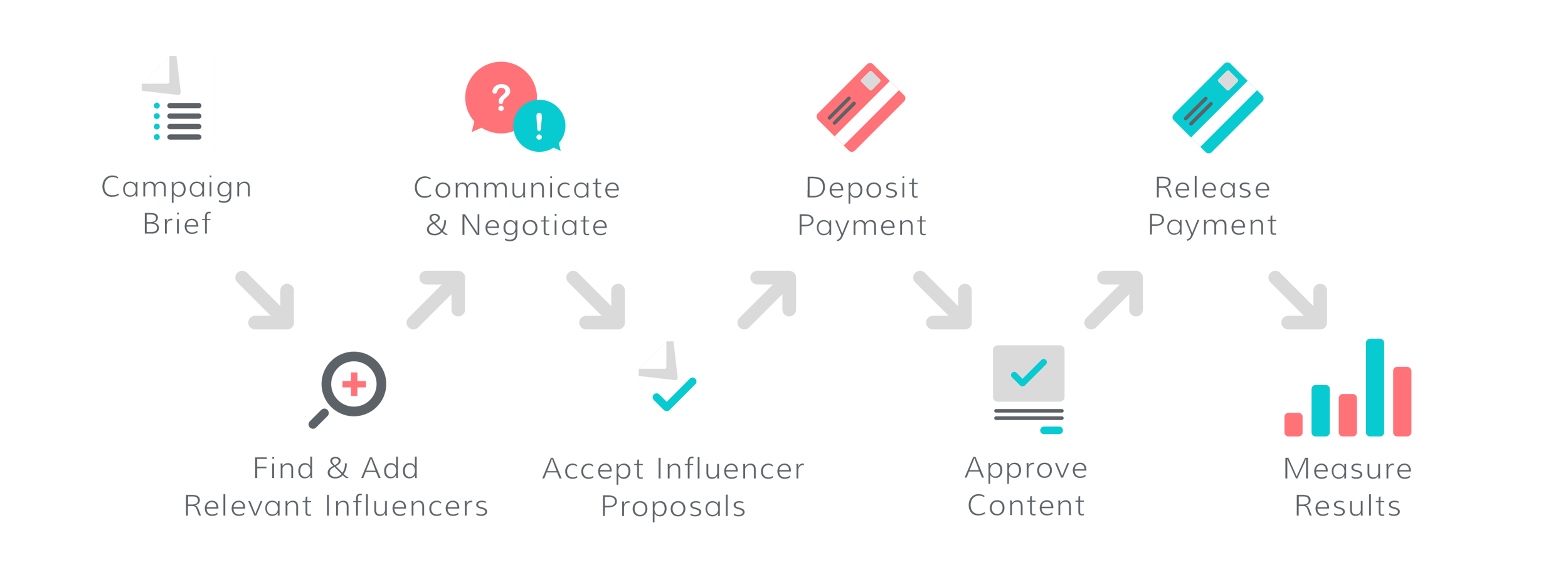
Whalar, by its own design, was created with the idea of collaborating with digital influencers. In this case the digital platform is Instagram. So what does that mean? According to Whalar, Instagram influencer marketing is “when a brand utilizes the audience of an online influencer that best matches the brand and the message it wants to spread.” The brand can then engage with their target audience through a personal recommendation from the trusted influencer. What’s an “influencer?” It’s someone with enough clout that the public accepts their advice/recommendation/idea without hesitation. That’s what Instagram influencer marketing is: Targeting an audience of likeminded people that follow an influencer because they trust their opinion, share similar interests and often, are inspired by their posts.

whalar

By choosing to work with an influencer a brand can have unprecedented success with the right person and their respective audience. Working with influencers not only spreads the word about a brand but it will also grow the brand’s social channels through the implementation of tags and hashtags. Influencer marketing is consequently fast becoming the most effective medium for online brand expansion, advertisement and marketing.

Not just about followers

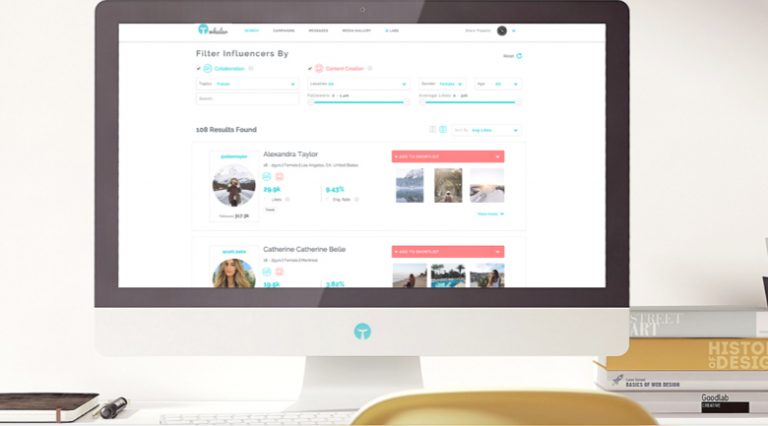
Whalar points out that it’s not just be the number of followers that makes for a successful campaign. Think about it: While a large number of followers mean a large audience, the audience may not be engaged with the content. A focus of the Whalar platform is to calculate the engagement level of every Instagram influencer’s audience that is registered to the site. That way they can showcase to brands which influencers would be the best to work with on a successful campaign.

Takes money to make money

The potential for Whalar to take your product to the next level is vast but it comes with a price. Potential clients need to have a budget of at least $25,000 for an influencer marketing campaign.

Whalar explains that “bychoosing to work with an influencer a brand can have unprecedented success with the right person and their respective audience. Working with influencers not only spreads the word about a brand but it will also grow the brand’s social channels through the implementation of tags and hashtags. Influencer marketing is consequently fast becoming the most effective medium for online brand expansion, advertisement and marketing.”

I’m sold on the fact that Digital Influencers are the key to marketing success. That said, I think it’s less about the ‘celebrity’ status of an influencer and the amount of followers they have, but all about creating amazing quality content and storytelling. Whalar just happens to feel the same way which is why this is a startup in particular and a phenomenon I general that is worth keeping an eye on.

#Whalar