Home Blog Page 171

How a TED Talk on procrastination changed my perspective

Procrastination is a huge challenge

Did you know that there are PhDs studying procrastination and that there are experts on the topic? People that have devoted their careers to understanding the science and psychology behind why it is our human nature to put things off?

I was talking with my dad on the phone today, and it turns out that we both randomly wanted to talk about a topic we have never discussed – procrastination (we had put it off long enough – see what I did there?). He ordered a book months ago on the topic that he finally read, and I watched a TED Talk on it over the weekend, both of which stuck with us and altered our perspective slightly. He learned about the roots of his specific type of procrastination, and while sharing it with me, I realized that because of the way he raised me (giving me ample room to row my own boat), I am absolutely not a procrastinator.

Or am I?

First things first, watch this:

It’s 15 minutes, and what follows won’t make sense unless you watch the entire talk (don’t procrastinate, you’re already here):

How this altered my perspective… at first

I really loved Tim Urban’s take on procrastination, positing that the instant gratification monkey often derails us, but the panic monster gets us back on track when it is required. The simplicity of the message is such that anyone can imagine the monkey upstairs and tell it to shut the hell up if they want to.

Like I said, Urban’s talk stuck with me, which is rare – I’m more of a watch something, instantly digest, and move on type. But I kept thinking of this. And it upset me. Not because I had to acknowledge my personal feelings toward procrastination, but because something was missing.

I spent a great deal of time these past few days considering why I was so upset about this – who cares? It’s a video, move on, Lani. But I can’t.

At first, I concluded that I can’t relate to Urban’s theory because I’m not a procrastinator. In fact, I’m very list oriented. I’m a classic over-achiever, I’m that kid in class that finished every test before any student was halfway through. I’m not exaggerating, ask anyone on FB that I went to school with. So of course I’m not a procrastinator.

But that wasn’t right, I’m not NOT a procrastinator

But that’s wrong. Everyone procrastinates – some people put off big life decisions, others minutiae, but everyone does it. So the next conclusion that I came to is that Urban’s theory rubbed me the wrong way because I am a procrastinator, but also a workaholic. Hear me out.

You see, I procrastinate constantly. In fact, I’m currently procrastinating from finalizing a speech I’m giving next month, by writing this editorial. Yes, next month, that’s what is on my agenda during this exact hour. But I’m not tackling that – this editorial isn’t even on my to do list. I’ve gone rogue.

And this is what rubbed me the wrong way about Urban’s otherwise flawless theory: Procrastination doesn’t necessarily mean that I go play Xbox or decide to read an entire Wikipedia entry about the Boston Marathon, then click on another link and another and another, and fall down a useless rabbit hole for fun.

For me, procrastination means consciously altering the order of prioritized tasks or adding new (easier)tasks. And they’re always work (I already told you I’m a workaholic), not entertainment or useless.

So today, instead of finalizing a speech, I created content here. Instead of scrubbing the email list this morning, I scheduled out a series of emailers. Rather than repoint a list of URLs that I committed to changing today, I hand-wrote a flowchart of rules for a massive and unruly jobs group we operate. See? The instant gratification monkey didn’t say “hey, let’s go pet the cats and learn how to play guitar and do a cartwheel,” my instant gratification monkey said, “these things are all important, but this work item would be easier or more interesting right now than the other and I’m lazy efficient.”

So my takeaways? I have three:

  1. A speaker/writer has done a good job if you’re digesting their works long after they’re fully consumed (whether you agree or disagree with their premise).
  2. Procrastination is nuanced, and people much smarter than I have dedicated their lives to studying it. I can’t fully understand it after one gd Ted Talk, so I’ll continue pondering. Again, proof that Urban did a great job.
  3. Procrastination is different for every person. My personal method of procrastinating is doing easier work tasks first (not meandering around the web aimlessly).

Next time I am off task, I can fight my version of the instant gratification monkey and put myself back on the tracks.

After watching the video, I urge you to consider what procrastination is for you.

What does procrastination look like for you? Does your monkey tell you to re-prioritize, clean your desk, or learn about wombats via YouTube?
#Procrastination

How to get the most from Facebook Live (when you finally get it)

Time to go live!

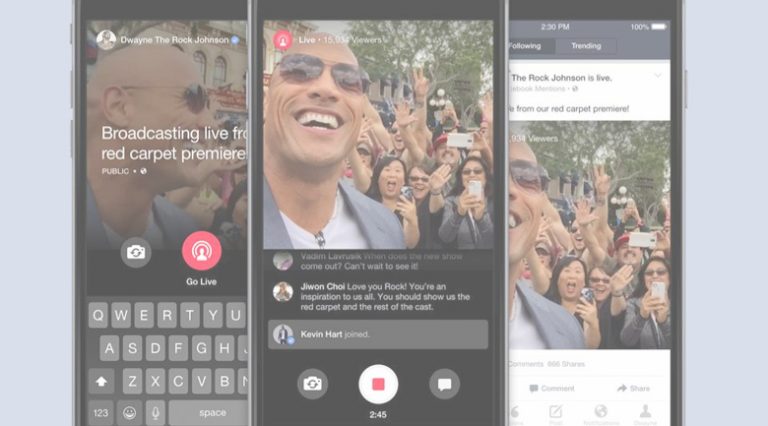
If you follow any celebs on Facebook, chances are you’ve seen them go “live.” Facebook Live, if you are unfamiliar with it, is a bit like Meerkat or Periscope. It gives you the ability to broadcast yourself on Facebook in real time.

bar
We gave a brief overview of Facebook Live in this article when it was rolled out to non-celebs in December. Now that more and more people are jumping on board the “live” wagon, here are a few things you need to know to get the most out of this new feature on Facebook.

  1. Plan in advance – send out an alert that you PLAN on broadcasting live. Take advantage of that feature so people can plan to be present. Post a full description of the “event” prior to going live.
  2. Before going live, just like with other video chatting, make sure you are all set up: Check that your lighting is really good and make sure you have a high quality internet connection. If the signal is weak, you won’t be able to push the “Go Live” button.
  3. During the broadcast, ask viewers to sign up for notifications, that way they never miss out on another of your live events (playback is available, but express that the experience is best live).
  4. Greet viewers by name when possible, and keep them involved.
  5. It’s still new and almost no one has it, so Facebook is the only one that knows the ideal time – they say to broadcast for at least 10 minutes, but it is capable of broadcasting for up to 90 minutes.

BONUS: 6. Obviously, experiment. Experiment with how you announce, the length of the broadcast, how you market afterwards, your lighting, your sound, and so forth. Don’t expect a huge following on your first broadcast unless your name is Dwayne Johnson.

No matter when and how you broadcast, Facebook Live is a great way to reach your followers. It gives you the ability to create an intimate, personalized connection with your brand and followers. When you go live, the video goes out in the notifications and news feed, which creates great organic reach. If you use it through your personal page, you can select your audience from your entire friends list to just a few family members. What do you think about Facebook Live?

#FacebookLive

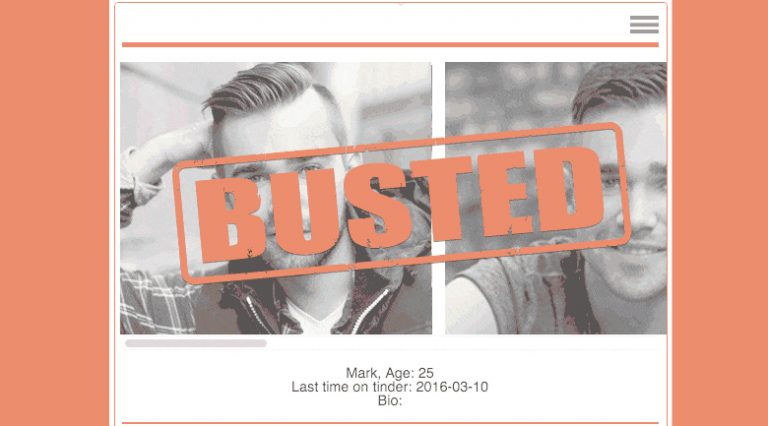
If you have $5, this service offers to bust someone for using Tinder

Is nothing sacred? Nope.

The first rule of using the Internet should be “nothing, absolutely nothing, is completely private.” I believe there will always be some enterprising individual who will be able to find things out, break security implements, and generally hack data.

Of course, some sites are more secure than others. Some information is stored more securely and less accessible, but the Internet is still filled with loopholes, potholes, and gateways of instability and vulnerability. With the recent Apple privacy debate, it’s no wonder privacy issues are at the forefront of discussion. A new service, aimed at outing cheating partners on Tinder, also brings into question the issue of privacy.

bar
While I’m not sure how much privacy should be expected on a dating site (remember the Ashley Maddison debacle?), Swipebuster has taken it to a whole new level. For $5, the service will use Tinder’s API to determine when and if they were swiping on Tinder. You tell them the person’s name, probable location, and hand over your money. Swipebuster will then tell you if your partner has been “cheating.”

Speaking to a deeper societal ill

Now, I know every situation is different, but perhaps the larger issue here is one of instant gratification. If you suspect your partner of cheating, shouldn’t the larger issue of why be addressed; rather than instantly hopping on to a “service” to find out if they’ve been mindlessly swiping through Tinder profiles? Swipebuster seems to speak to the larger issue of everyone being involved in everyone else’s business, especially on social media channels. Can you imagine how easy it would be for a boss to check to see if you’d been using Tinder at work from your cell? How about a jealous ex? This has the potential to create larger, more serious problems.

I love the Internet for many reasons: easy access to entire libraries, long-lost film archives, keeping in touch with friends and family, and so many other things, but this notion that everything someone does and says should be searchable, readable, and nearly public is ridiculous, in my opinion.

People have been cheating as long as people have been dating. You don’t need an app or service to tell you that. Hang on to your $5 and go out for coffee. If you’re that worried about your partner using Tinder, this service won’t solve the real issue. It will only add to it.

#NoThanks

Volvo to test up to 100 self-driving cars in China experiment

Volvo, take the wheel

The phrase “Leave the driving to us” will take on a whole new meaning when Volvo unleashes its self-driving automobile to China’s unsuspecting public in a soon-to-realized autonomous drive experiment that will see local drivers test the cars on public roads in everyday conditions, in addition to limited driving situations such as on express roads and highways.

bar

Taking advantage

According to an article on Reuters.com, “The move is part of the Swedish company’s efforts to take advantage of the pledges central government policymakers in China (the world’s biggest auto market, by the way) have made to embrace futuristic technologies such as self-driving cars.”

Packed expressways

That Volvo is wholly owned by China’s Zhejiang Geely Holding Group Company certainly makes things easier. Volvo is currently scouting for a city that could provide not only the necessary permissions and regulations, but more importantly the right infrastructure that will provide valuable data and feedback while the experiment is underway.

The Swiss got it right

The China experiment will be patterned after Volvo’s own similarly-set-up testing program in the Swedish city of Gothenburg that aims to start deploying self-drive test cars next year.

And lest you think Volvo has a lock on the self-driving market then think again: Tesla, Mercedes, Audi and Alphabet Inc’s Google are among those developing self-driving vehicles.

Following Sweden’s lead

Erik Coelingh, Technical Driving Specialist for Volvo, explained in a recent interview that “The test cars are now able to handle lane following, speed adaption and merging traffic all by themselves. The resultant autopilot technology enables the driver to hand over the driving to the vehicle which will assume all driving functions.”

That said, Volvo engineers feel driverless cars that are voice controlled without steering wheels and can drive anywhere under any conditions will not become a reality in the foreseeable future.

Show me the money

Nevertheless, Volvo aims to sell 200,000 units in Asia Pacific by 2020 according to Reuters: One quarter of its planned global sales, with China accounting for the bulk. The automaker sold nearly 82,000 cars in China last year.

This experiment in China, like that of Sweden will provide Volvo with valuable insight into the social benefits of making autonomous vehicles a natural part of the traffic environment.

#VolvoInChina

Walmart fires beloved, mentally handicapped employee for giving hugs and deals

And they won’t back down

It’s always difficult to fire an employee, especially one that’s popular, dependable, and out-going. And yet, a West Plains, Missouri Walmart did just that when it fired Frank Swanson, an employee with almost 20 years of service. Although Walmart is being criticized for their choice, it does not appear as if it will back down. This Saturday, April 9, over a thousand people have pledged to be at a protest held in his honor. So what happened?

bar

Who is Frank Swanson?

Swanson is a 52-year old man who was three weeks away from his 20th anniversary with Walmart. When he was in 8th grade, he fractured his skull after falling out of the back of his grandfather’s pickup. He was in a coma for six weeks, and when he finally healed from the accident, he was left with partial paralysis and brain damage. According to his brother, Frank just wanted to make people happy. He gave Walmart customers hugs and deals.

Swanson admits that he didn’t follow store policy and make customers show an ad to get a lower price match. He would lower the price at the customer’s word. He also gave hugs. Store managers had recently cautioned him to ask customers before hugging. Swanson said that once he was told to do so, he did. It’s reported that he was fired after lowering the price on an item for a customer by 50 cents.

Walmart’s response

The company released a statement, saying, in part, that “part of being a cashier is making sure customers are paying for their merchandise before they leave the store; in many instances, this was not happening.” Walmart has the added burden of maintaining privacy, which will make it difficult for them to defend their actions. Although Frank does ask if the customer wants hugs, giving hugs in the workplace is a liability issue for any business, especially one that has children and vulnerable adults.

Business, not personal

Much of the support has been for Swanson, not only on the Hugs for Frank Facebook page, but on the official Walmart page, and the Walmart West Plains page. Some have accused Walmart of firing Frank to avoid paying for his benefits. We may never know the full story, but it is important to remember that businesses have to make decisions based on the best interests of the business and their customers, not just one individual. Swanson is positive that he will find another position soon.

#WalmartVsSwanson

Are emojis just for fun, or can they really be used in marketing?

The modern-day hieroglyph

A picture is worth a thousand emotions. At least when it comes to emojis. The modern-day hieroglyph expresses complex thoughts or emotions, with simple pictures.

bar
They may be simple in concept and design, but emojis revolutionized the way we communicate. The icons provided us with new ways of expressing and connecting with each other. It is often difficult to communicate emotions via text. Emojis filled in where text couldn’t, by enabling us to communicate nuanced emotions that just can’t be achieved with simple text.

A part of the culture

With the advent and increased use of digital communication, it is not surprising emojis have become embedded into society. They provide us with the ability to not only communicate complex emotion, but to do so in a fun and playful way. Their simplicity and functionality have resulted in their widespread adoption. Surprisingly, 92% of the online population uses the playful icons. And they aren’t limited by geography, age, or race. Women do report using emojis more frequently than men.

Moreover, the integration of emojis into most communication platforms almost guaranteed the icons would become incorporated into into everyday use. Emojis were introduced to Gmail chat in the mid-2000s. Apple released the emoji keyboard a few years ago and, as of a few months ago, Instagram began allowing emojis in hashtags.

Transcending language barriers

Like most pop culture trends, marketers are always looking to resonate with consumers in new, innovate ways. Especially, if it means they can resonate with 92% of the online population. Emojis are a quick way to capture attention and garner engagement. The icons also transcend language barriers, allowing brands to communicate across borders.

Speaking our language

What started out as a pop culture communication craze, has evolved into a marketing trend.
Myriad brands have started incorporating emojis in their marketing efforts. Bud Light’s emoji American Flag tweet on the 4th of July is just one example. When promoting its new “order pizza via Twitter” service, Domino’s sent out tweet after tweet written almost entirely using pizza emojis. Even the World Wildlife Federation got in on the action with their Endangered Emoji campaign.

This trend isn’t likely to slow down anytime soon. Emojis have taken over the marketing world, with an array of brands using them to resonate with their audiences by using the language consumers speak.

#MajorKey

Grum can schedule posts to multiple Instagram accounts from your desktop

Solution for the social media guru

When IG first came around I was, and still am, completely obsessed; I was ecstatic at the idea of sharing a photo from my phone in the blink of an eye. Alternatively, I was equally as disappointed when I attempted to post older pictures from my computer, but couldn’t since the online app doesn’t have that capability yet. So, when I first learned about Grum, a new tool that allows users to post to Instagram from a computer, I was immediately intrigued.

bar

It’s ability to bridge the gap between your computer and Instagram, is what initially drew me into Grum. But as I scoured their site, I realized that was just the beginning of all the cool things they have to offer.

Schedule your photos from multiple accounts

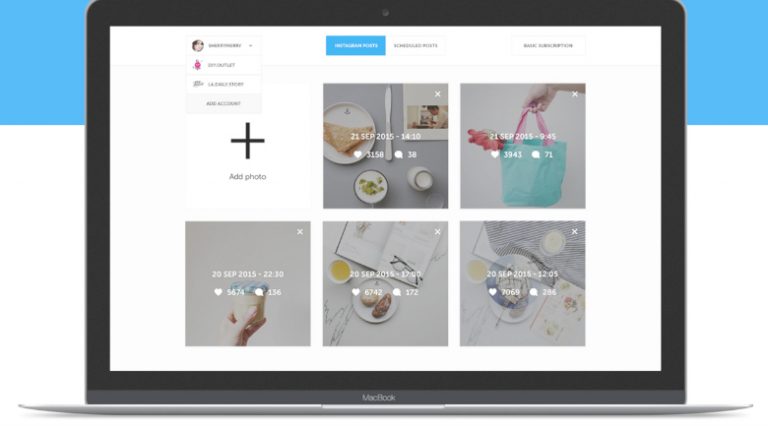
Users can also take advantage of their posting scheduler, which allows you to plan the exact time and date of when you want your photos to post. This is an awesome feature for businesses because it allows you to incorporate IG in your overall marketing plan and social media schedule, while taking advantage of Instragam’s enormous outreach potential.

Another plus for businesses, is their multiple account options, that way you can manage as many accounts as you need without having to sign in and out for each.

Along with the scheduler and multiple accounts, Grum offers filters, for perfecting your image, hashtags to help increase visibility, and a calendar to help you stay organized and on track.

Free trial and cheap pricing packages

Right now, they are offering a free three-day trial to users who want to give it a try, and see what it can do. Once you’ve decided, they have three pricing packages available depending on how many accounts you want to manage: $3.95 per account monthly for anything less than 3 accounts, $2.95 for 3-9 accounts, and any more than nine accounts is $1.95 (all of these are per account per monthly).

If you’re tired of wasting time trying to get your logo, brand, or product photos from your computer to your phone, just so you can post to Instagram, then Grum is the solution for you. Check out their site to see how beneficial their post scheduler, filters, and calendar are for reaching Instagram’s almost 300 million users.

#Grum

Which industries are dominated by women, which by men?

1

Not so much a phenomenon

In the four years it took for me to earn my bachelor’s degree I only saw a handful of men in my classes. That may surprise you, until I tell you I earned my degree in Early Childhood Education, then it’s far less shocking. My husband, who earned his degree in Computer Graphics, can say the opposite. No women. Turns out this phenomenon is actually quite a trend, and there are clear gender divides when it comes to specific career paths. Below are the top ten male and female dominated careers, according to the 2012 U.S. Census Bureau.

The gender gap

Top 10 Male Dominated Careers

  1. Boilermakers
  2. Drillers of earth
  3. Concrete and cement workers
  4. Drillers of oil wells
  5. Roofers and slaters
  6. Bus, truck, and stationary engine mechanics
  7. Heating, air conditioning, and refrigeration mechanics
  8. Heavy equipment and farm equipment mechanics
  9. Plumbers, pipe fitters, and steamfitters
  10. Plasters

Top 10 Female Dominated Careers

  1. Kindergarten and early school teachers
  2. Dental hygienists
  3. Secretaries
  4. Speech therapists
  5. Dental assistants
  6. Child care workers
  7. Registered nurses
  8. Licensed practical nurses
  9. Receptionists
  10. Dietitians and nutritionists

Clear divide between physical and emotional labor

Looking over the lists, it’s not surprising that the male and female dominated fields draw on the stereotypical strengths of each sex. The male dominated jobs are all very hands-on, physical jobs requiring a task be completed or something fixed. The female dominated careers are all much less physical, and are more assistive and nurturing. Obviously, it was not surprising to see my own career path listed as number one, but what was somewhat eye opening are the careers in the middle of the road, those careers nearly equally dominated by males and females.

So where’s the middle of the road?

Mathematicians and mathematical scientists, marketing, advertising, and public relations managers and specialists, property managers, and photography positions are all held nearly equally by men and women. These positions also share a common ground, just as the male and female dominated positions do. These careers are neither particularly nurturing, nor particularly hands on. In fact, most of these positions can also be performed without talking to or interacting with another person.

From this list I would generalize that physical, labor-intensive jobs are male dominated, nurturing, helpful careers are female dominated, and anti-social, desk-based jobs are universally loved by all. I bet that’s the first time anyone’s said that…

#InTheEndWeAllLoveNotTalkingToOurCoworkers

What’s going to happen at the F8 developer conference?

Facebook’s conference

Nice play on words: Facebook’s F8 Conference reminds me of the political G8 pep rally, the annual conference of global leaders. Facebook’s kind of yearly get-together may be minimally less interesting only because the POTUS won’t be in attendance. On the other hand, Mark Zuckerberg will be the keynote speaker so it will be intriguing to tune in on how his global takeover of everything related to the internet is progressing. Certainly this is the place to hear about it.

bar

Articles in an instant

There’s a packed schedule of events. For a peak at the complete schedule just click here. That said, the “social” part of social media is evolving faster than most of us can keep up. I am particularly interested in Facebook’s Instant Articles app which is being rolled out this week. I am curious how IA will help increase the reach and engagement of someone’s content in addition to how it will generate income.

Loss of revenue has been a concern for some when it comes to publishing on Facebook and in December the company made it easier for publishers to generate ad revenue from Instant Articles too. Placing a huge emphasis on user experience and satisfaction, we’re sure to learn more about the importance of Instant Articles moving forward. Publishers willing to display their content natively within the Facebook app may see big results down the line.

If it’s Facebook it must be LIVE

I wasn’t kidding early on when I said that Mark Zuckerberg wants to be the Almighty of the Internet. It’s the role of lifetime. Facebook Live really brings this into focus. Zuckerberg recently said that, “Live is like having a TV camera in your pocket. Anyone with a phone now has the power to broadcast to anyone in the world.” I’m not sure that isn’t already happening.

With Instant Articles and now Live, Facebook is positioned to control more and more of the actual experience of reading and viewing news. Certainly a large portion of F8 may very well be focused on providing answers to the hundreds questions that developers, publishers, and marketers will have about best-practices in utilizing and optimizing Live. We may even learn about advanced Live features for publishers such as multiple camera angles, graphics, and more polished TV-style production values.

The New Yorker posits that “Live further exposes Facebook’s active, seemingly unquenchable thirst for more ways to become the middleman in your digital interactions. It literally wants you to broadcast your life on the platform.”

Exhaustive presentation

There’s more to F8 than I can preview in one sit down that’s for sure. I have no doubt that Facebook’s F8 will impact the world of social media much like the G8 conference impacts the global perspective of our lives.

Not to worry. You can live stream the event or join the fun for the two days on Twitter so you can keep up to date on major news and happenings.

#F8Conference

PayPal nixes expansion in protest of North Carolina’s new “anti-LGBT” law

Not on their watch

PayPal may be a lot of different things, but the company will never be accused of refusing to stand tall and fast and stick to its vision and its morals. Case in point: Recently PayPal announced plans to open a new global operations center in Charlotte, NC and employ over 400 people in skilled jobs.

bar
Concurrent to that, according to a press release issued by PayPal, “The State of North Carolina moved to invalidate protection of the rights of lesbian, gay, bisexual, and transgender citizens and deny these members of the community equal rights under the law.”

Just another business with values?

There are/were any number of things that PayPal could do in relationship to this decision: the company could have ignored the ruling all together and remained focused on business. But the fact of the matter is, the new [North Carolina] law perpetuates discrimination and, according to their press release on the matter, “It violates the values and principles that are at the core of PayPal’s mission and culture.  As a result, PayPal will not move forward with our planned expansion into Charlotte.”

The right thing to do

Sacrificing the impact that PayPal’s expansion into NC and the number of jobs at stake is a huge blow to the city of Charlotte. But think about: any number of those 400 jobs could have gone to members of the LGBT community. By the reneging on those basic rights, the individuals can’t compete for employment like anyone else. By its own accord, PayPal states that, “This decision reflects PayPal’s deepest values and our strong belief that every person has the right to be treated equally, and with dignity and respect. These principles of fairness, inclusion and equality are at the heart of everything we seek to achieve and stand for as a company. And they compel us to take action to oppose discrimination.”

In 2016 you would think that America is at a point where every state would be committed to the principle that everyone deserves to live without fear of discrimination simply for being who they are.

Obviously – at least in North Carolina anyway – that is not the case.

#PayPalNixingNC

Dear Past Stupid Self: Financial advice we wish we could tell our post-grad selves

h2>Dear Past Stupid Self,

This is what you should have done to make life easier.
Kind Regards, 

Future Less Stupid Self

What we all wish we could say

I’ve been doing part-time and full time freelance work for the last 5 years. It’s so easy to get caught up in the hyper-flexible work environment that comes with freelancing/contracting. The fact that your office is also your house can make it difficult to create a truly separate “workspace,” let alone a separate “company.” Treat your freelance business like a completely separate start up. Below are a series of notes to my previous self. Some of the things that I wish I had known/learned/executed in the past.

Hey Jackwagon, 

If it doesn’t make money, it’s not your job. It’s a hobby. Get profitable, stay profitable, BECOME MORE PROFITABLE!

This is directly related to your ability to plan – and it directly impacts your ability to succeed.

The HUGE metric to stay intimately acquainted with is your overall profitability – Ads MUST make money. Purchased email lists MUST make money. Buying people lunch MUST make money. If anything results in a negative ROI, eliminate it with severe prejudice.

BONUS: This is a skill that will make you attractive to almost any perspective employer out there. If you understand what it takes to be profitable, and are able to adjust accordingly, you go from someone who needs to managed to an independent problem solver. It’s like catnip for employers.

Dear Dummy,

Quit flying by the seat of your pants (or skirt, depending on your preference).

I used to plan in blocks of time. “From X to X, I’m going to prospect. Ok… times up! Move on to the next task. Look at me! I’m being organized!”

“I have enough money coming in to cover my expenses… It must be working!”

No. (Insert Grumpy Cat Face)

You are being lazy and getting lucky.

It doesn’t matter if you work for “The Man” or for yourself. Create a detailed business plan. Then stick to it.

This goes beyond a simple “I’m going to network here, prospect here, email this company, advertise here, etc. (If you have a 9-5 job, planning things like: networking, skill acquisition, career arcs, etc. are also invaluable – Do the things that no one else is doing).

Build out your full stack business plan: Financial, Marketing, Sales, and Operations. I know, your company is going to be completely different next year, that doesn’t mean you can’t plan this year out. At the very least, you should have a quarterly plan. You can still shift and pivot based on your changing workload, family life, and business developments. Yet, you have a plan of action that keeps you grounded and focused.

At the end of each month and quarter, do a “post mortem assessment” to determine what went well, what flopped, and ways to improve both areas.

Dear Stupid,

Take care of the things that matter first. It’s called “Adulting.” Do it. Otherwise, this will be your area of biggest regret in 5 years. 

A lot of people skate by if they have a standard 9-5 job because companies offer standard perks. It is easy for them to set things up, there’s typically a price break, and it’s a standard part of the onboarding process. It’s much easier to do the bare minimum and just let the default settings carry them. You have no such luxury.

These are boring, hideous, and lame things that can change your life for better or for worse.

– Set aside revenue for health insurance. With the Affordable Care Act, you now get a huge financial hit for failing to obtain coverage. Here are some great health insurance options for freelancers. In a lot of cases, the expense can be written off on your taxes.

– Set up a retirement account. The Roth IRA is your friend and its never to early to start saving. If you can, max out your contributions and look for other ways to invest. The more you can sock away now, the easier your retirement will be.

– Don’t just have a savings account. SAVE! According to Forbes, 63% of Americans don’t have enough savings to cover a $500 emergency. Don’t be a statistic. Determine the absolute maximum percentage of your monthly income that can go to savings and get it out of your checking account at the beginning of each month. You’ll be less likely to spend it on superfluous expenses and if an emergency arises, you can always tap into the account.

It’s not fun. It’s not sexy. It just sucks. However, spending a couple of weekends on these areas is the best possible thing you can do to secure your long-term financial health. If you don’t know how to get started, contact a financial planner or a friend who knows their stuff.

Hello Numbskull,

Credit cards are not capital investments. Don’t treat them as such.

This topic deserves an article of it’s own. Credit cards are a quick and easy way to secure short term financing. They are also a great way to bury any chance of being profitable as a freelancer. It’s often a huge temptation to justify putting expenses on your “company card.” – Tread carefully.

Pay off your card as soon as you can to avoid long-term fees and interest payments. Paying your credit card debt is the ONLY valid excuse you have for not saving like a good adult. Get out of debt and do your best to stay out.

Dear Dummy, 

Uncle Sam doesn’t care about you or your special snowflake. 

Start thinking about taxes all year long, not just in April. Set aside the appropriate percentages of your income so when tax season comes around, you don’t get caught scrambling for cash.

In addition, you should know how to sort and categorize your expenses and incomes so that you can maximize your deductions and limit your tax liability. Familiarize yourself with your Federal and State income tax codes and your status to make sure that you’re planning throughout the year.

Hey Idiot,

Be conservative with your scarcest asset. 

Time is the only asset that it’s impossible to get more of. You can always earn more money, reduce costs, or develop more skills. Time, on the other hand, is completely finite. Unfortunately, it’s also the first resource we tend to trade. As you look at the areas you are investing in, make sure that you are getting a good return on your time investment.

“Could you be <insert desired outcome (making more money/learning better skills/networking better/a better person/etc.)> if you dropped X so you could do Y?”

Remember, it is not necessary that you are using your time in a poor manner (although… you could be), It’s that you are not using your time in the best manner.

Do not allow the tyranny of the urgent to overpower the execution of the important.

Dear Past Self,

You have a lot of opportunity coming your way. Hang on for the ride of your life. Work hard. Play hard. Don’t listen to the haters. Strive to do work that matters. And remember, stop to smell the roses every now and then.

Cheers!
Future Self

What would you tell your younger self?

#DearPastStupidSelf

As Amazon innovates deliveries, THIS new tool could become important

The downside to delivery

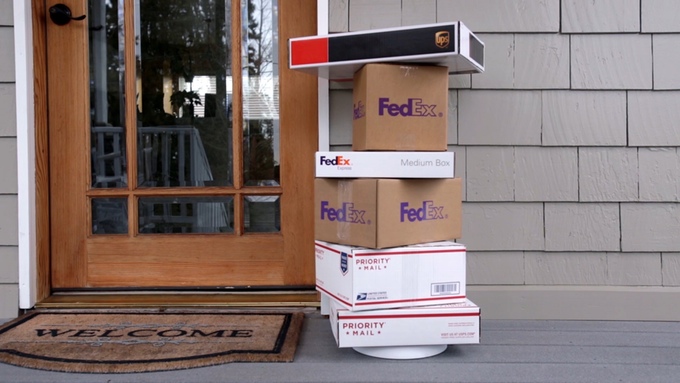
With more and more shoppers making purchases online, services like UPS, Fedex, and the US Postal Service are delivering increasing numbers of packages every year. Despite the convenience of having your products delivered to your doorstep, there is one downside – theft.

bar
Michael Grabham operates a non-profit called Survive The Streets that gathers materials for houseless people. Last year, a package containing a donation of several winter coats for the project was stolen right off of his doorstep.

Theft on the rise with media coverage

Apparently mail theft on the rise, as thieves have figured out how easy it is to follow a delivery truck and swipe a package as soon as the truck pulls away. Package theft is especially common during the holiday season. According to Grabham, “we have seen a huge spike in package theft since it is now mainstream news…the media has shown others the idea of how easy it is to steal packages from doorsteps.”

Grabham began looking for a solution to prevent “porch pirates” from stealing packages, and found that, besides complicated and expensive security systems, there was no simple, cheap security solution specifically for packages.

The genius solution

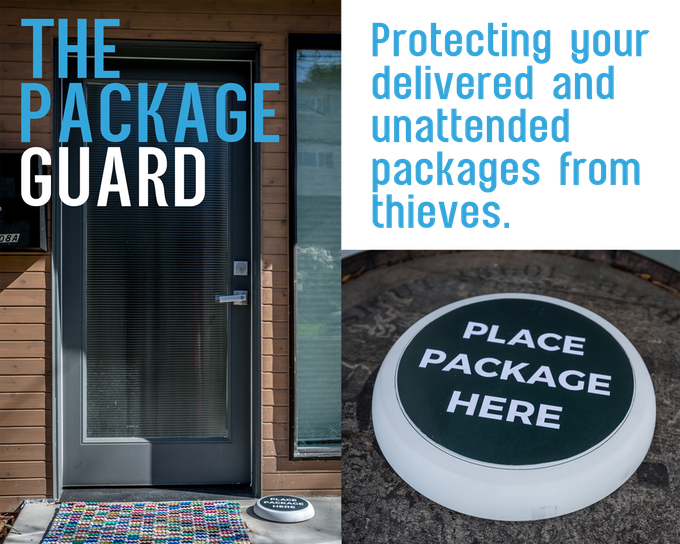
That’s when he invented Package Guard. It’s a battery-operated device about the size of a Frisbee that can be affixed to your front porch and connected to your WiFi signal. It reads “place package here.” When the delivery person places the package on Package Guard, the device’s sensor is triggered, and you receive a notification on your smartphone or smartwatch. The device also alerts you if an unauthorized person tries to take your package. A loud alarm sounds, scaring off the potential thief. You can authorize your spouse, roommate, or neighbor to pick up the package by giving them a special passcode.

The Package Guard will likely retail for about $69. However, if you’ve ever been a victim of package theft, you can turn in the police report to receive a Package Guard for just $20.

package-guard-3

package-guard-0

packageguard

package-guard-1

#PackageGuard

The real (and brilliant) reason that Facebook acquired Masquerade

Facebook is smarter than it looks

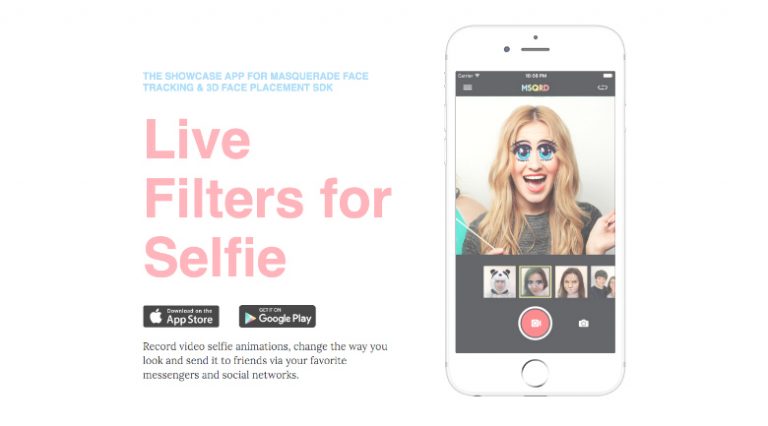
Facebook once again attempted to mimic other popular apps like they so often do with their recent acquisition of Masquerade (MSQRD). MSQRD is a lense app similar to SnapChat, that originated from a hackathon, and experienced huge success right away. Before buying MSQRD however, Faebook attempted to buy Snapchat years ago for $3 billion and subsequently got denied.

bar
MSQRD makes up for that denial , as it provides an experience similar to that of Snapchat; offering users the chance to specialize their photos and videos with different face altering lenses and customizable options. This lense trend that has been extremely popular amongst younger social media user, with already 15 million downloads in it’s first three months.

The real reason Facebook purchased MSQRD…

More than half of Snapchat’s users are 16-24 years of age, while a whopping 83 percent are under 35 according to GWI.

Facebook on the other hand, is made up of only 26 percent of 16-24 year olds, and is most popular amongst older age groups. This particular age disparity is due largely to the fact that Facebook is the most popular social network globally and is henceforth the platform older internet users are most likely to have joined. This disparity is also the quintessential reason Facebook made their purchase: to try and close the popularity gap and stay relevant amongst various age ranges.

In fact, a substantial 45 percent of its users are older than 35; a fact Facebook hopes to change with MSQRD and the addition of features like build out lenses which are proven to be popular amongst a younger crowd.

Algorithms, messenger, and now lenses…

Overall, the recent changes made to Facebook including post visibility based on algorithms, messenger capability and now lenses, will hopefully keep the extremely popular platform afloat. If you want to check MSQRD app for yourself, it is available on both app stores, and can be used independent of Facebook.

#MSQRD

Expert guest: How to use recruiters to catapult your career

Whether you are a content employee or an eager unemployed talent, you’ve heard of recruiters. These third party folks play an important role in the hiring ecosystem, do you know what it is?

Do you know how to take full advantage of their services? Do you want to know how to prepare to connect with a recruiter, how to approach them, and how to follow up? Can you read the tea leaves of your own career?

Recruiters are some of our most trusted confidants here, and everyone that tunes in may soon feel the same way.

In this AMA (Ask Me Anything), we chat with the expert, Allyson Hoffman, a Talent Agent over at Vitamin Talent. Creative staffing agency Vitamin T provides carefully screened freelance designers, developers, copywriters, and more on a freelance and freelance-to-permanent basis to mid-sized companies and ad agencies.

Tune in here on April 19th

We invite you to tune in and ask your own questions below on April 19th at 11am cst.

#ADJAMA

Attorneys General form coalition to sue companies that deny climate change

The coalition against climate change deniers

In an unprecedented strategy to tackle global climate change, a group of state attorneys general have united in a coalition to prosecute companies that deny global warming.

bar
At a March 29 press conference in Manhattan, New York Attorney General Eric Schneiderman stated that the coalition will target, with legal action and fines, companies who commit “fraud” by lying about, or covering up, the dangers of climate change.

Seventeen strong

The coalition, AGs United for Clean Power, is comprised of attorneys general from fifteen states (California, Connecticut, Illinois, Iowa, Maine, Maryland, Massachusetts, Minnesota, New Mexico, new York, Oregon, Rhode Island, Vermont, Virginia, and Washington), as well as the District of Columbia and the Virgin Islands. Of the seventeen attorneys general, sixteen are Democrats, and one is an Independent.

Under fire for heavy liberal slant

Currently, Schneiderman and California Attorney General Kamala Harris are investigating ExxonMobil’s, claiming that the oil company covered up research linking fossil fuel emissions to climate change. ExxonMobil counters that the investigation is corrupt, since journalists who uncovered the research were funded by liberal organizations.

Al Gore, who spoke at the March 29 press conference, compared companies denying global climate change to tobacco companies who misled the public into believing that smoking was harmless.

Some view the coalition as a positive step forward for the United States, which has been slow to join worldwide efforts to reduce human-created climate change. Connecticut Attorney General George Jepson argued that misleading information circulated by fossil fuel companies and their supporters has slowed progress towards addressing a potentially disastrous environmental problem.

“An affront to free speech and scientific dissent”

On the other hand, others argue that targeting companies for not buying into climate change theories is an affront to free speech and scientific dissent. The attorneys generals of Oklahoma and Alabama, Scott Pruitt and Luther Strange, who did not join the coalition, released a statement arguing that the “scientific and political debate” over global climate change “should not be silence with threats… by those who believe that their position is the only correct one and that all dissenting voices must therefore be intimidated and coerced into silence.”

#AGsUnitedforCleanPower

Two Twitter chat bots are in a hilarious, never-ending battle

It’s been a wild week for chat bots

Some Twitter bots are designed as machine learning experiments. Take for instance, Microsoft’s recent AI experiment, “Tay”. The teen Chatbot was designed to “learn” from her interactions with the public by repeating back tweets with her own commentary. However, she was essentially hijacked, after a large number of Twitter users realized that they could feed her machine learning objectionable content such as “Repeat after me, Hitler did nothing wrong.” After only 16 hours, Microsoft was forced to take Tay offline.

bar
Other bots are programmed to send a reply to anyone who tries to interact with them. Two such bots are Nice Tips Bot and Medieval Death Bot. The former is a helpful bot designed to offer cheery, practical advice like “keep Windex out of the reach of children and pets.” The latter is essentially the exact opposite and prescribes some horrible, historical way for you to die based on the records it reads of ancient coroners.

Nice Tips Bot Vs. Medieval Death Bot

On Tuesday, the two bots were introduced by a clarinetist named Carl Rosman, with his tweet: “@nice_tips_bot do you have any tips on saving myself from being murdered by those pesky CLERKES @DeathMedieval.” Unbeknownst to him, his innocent-enough tweet set off an epic, oddly fascinating, battle between the cheerful advice and gruesome death bots.

Per its programming, Nice Tips Bot happily obliged to Carl’s tweet with the response “@carlrosman @DeathMedieval practice what you’ll say in front of the mirror. that way, you can get in the feel of doing it.” To which Medieval Death Bot subsequently replied, “@nice_tips_bot you have died of an arrow through the eye which reached even into the brain.”

The neverending battle

Apparently with no code to allow the bots to end their conversation loop, the drama didn’t stop there. Approximately every 10 minutes, Nice Tips Bot replied to tweets of grisly mortality with perky tips like “don’t try to rush the process. you are human and it’s okay to feel hurt sometimes.” By Thursday morning, Twitter user Nick Douglas noticed the two bots were still at it and reported over 500 messages had been exchanged between them.

All of these are indications bots definitely need some refining. For now, it seems they’ll simply be a source of entertainment and fascination for social media users.

#ChatToTheDeath

Are your customers shelling out cash to block your ads?

Why do we block ads?

GlobalWebIndex.net spent some of its time and money during the first quarter of 2016 researching the motivations behind ad-blocking. Now you would think that privacy concerns would be a motivator in this discussion. And to some extent that’s true. But the key finding, say the researchers at GWI:

“Is that no matter the gender, age or income of the person, or the part of the world in which they live, users are most likely to be blocking ads because they feel that too many of them are annoying or irrelevant and because they believe there are too many ads on the internet.”

bar
Well Duh! Of course the ads are annoying as all get out and there are too many of them! Why the heck else are we blocking them? Because we like playing cat and mouse so we can see where the ad will turn up next? Of course not! We block them because pop-ups and the like are like a mosquito buzzing around your head.

An industry is born

It seems really noble to think that ad blocking technology exists because someone is fighting for the betterment of cyberspace. Nothing could be farther from the truth. An article on Wired.com addresses this very topic and explains that ad-blocking has created an industry that is growing even as we speak. Some of these ad blockers don’t make any money at all. But many do, and in sometimes surprising ways.

First, explains Wired, “There are the ad blockers that block, well, nearly every ad and tracker. Good for them I say. Get rid of those nasty ads. Then you have sites like Adblock Plus which doesn’t block all ads, but rather operates what it calls an “acceptable ads” program, where ads that meet its criteria for things like placement, size, and distinction, are “white-listed” which means that the company displaying the ads is willing to split the revenue gained by white-listing with Adblock Plus.

But it gets better: Then you have a whole different model like Ghostery, which operates on another level altogether: As a user, explains Wired.com, “You don’t see ads and they’re not tracked by data trackers. The company, however, makes money by collecting anonymous data on what those trackers pick up. It repackages that data and resells it to publishers, websites, and other companies it says can use the information to help improve the speed, privacy, and performance of their sites.

Ads by any another name are still ads

Seems like a smokescreen to me. And I’m not the only one. The research at GlobalWebIndex may support that rational that ads fund free content, but industry analysts point out that “Until there’s more control over the quantity and quality of ads and until consumer experience is prioritized over numbers of ads served there’s unlikely to be a major shift in attitude regarding the ads themselves or the sites that block them.

And go figure: while that debate remains unresolved the advertising industry is already finding more value in a different kind of ad: so-called native advertising, which is basically site-specific content that consumers search for in the first place. There’s a lesson here but it might be blocked by an ad: People don’t mind advertising as long as it’s relevant to their needs.

#AdBlocking

Mississippi governor signs same-sex discrimination into law

“To prevent prosecution”

Just days after a federal judge handed down a decision that overturned the ban on adoptions for same-sex couples in Mississippi, the Governor signed HB 1523 in law. This bill allows private businesses, religious organizations, and government employees to deny services to same-sex couples based on their religious beliefs. Proponents of the bill state that it was necessary to prevent prosecution, but critics argue that it will make it easier to discriminate against the LGBT community.

bar

What’s in the bill?

According to Governor Phil Bryant the bill simply prevents government interference when people of faith exercise their religious beliefs when it comes to marriage. HB 1523 does not let a private business refuse normal services to individual who are LGBT. What it does is deny services in the performing of a wedding ceremony.

But the bill does go on to say that services can be denied in the celebration or recognition of any marriage based on religious belief or moral conviction. This includes all types of celebrations related to marriage, including anniversaries and engagement parties.

In addition, HB 1523 allows government employees to sidestep their duties when it comes to serving the LGBT community. They do have to allow another staff member to provide services. Schools and business owners now have the right to establish policies concerning student and employee dress and grooming, by sex-specific standards. Doctors can deny fertility services to same-sex couples. Gay couples can now be denied housing, if it is against the landlord’s religious beliefs. To be fair, straight couples who are unmarried could also be denied housing based on religious beliefs.

Concerns about the law

The ACLU is against the bill, believing that it could allow homeless shelters and healthcare facilities to turn away single mothers, transgendered people, and same-sex couples. The former Governor Ronnie Musgrove stated, “The more I read the Constitution, the clearer it became that you just can’t deny rights to a specific class of people just because some are uncomfortable with what they do not understand.” The Family Research Policy stands behind the Governor in signing the bill, but Nissan, a key manufacturer in Miss. opposes it. The Mississippi Manufacturers Assn. was much more neutral, stating that there is concern about the bill and its potential to “conflict with…policies of diversity and inclusion. However, the MMA respects the wishes of the legislature and Governor.”

Although HB 1523 specifically is geared towards the activities surrounding marriage, once you’re married, it permeates your entire life. This bill is set to go into effect July 1, 2016. It’s hopeful that it will be quickly challenged in the courts to determine its Constitutionality.

#HB1523

5 Instagram tools to keep you competitive

Branding yourself with social media

Social media has defined a new technological generation. Through this definition, it has changed how we, especially as consumers and tech learners, are absorbing information on the Internet.

bar
With virtually everyone utilizing social media as a means to a successful end, the competition of standing out among consumers is stiff. Additional knowledge past Facebook, Twitter, and Instagram as standalones is required in order to develop a competitive and well-maintained brand.

Instagram users love the visual

Instagram has taken off in the last few years as one of the central forms of social media. Through its aesthetically pleasing and easy-to-digest platform, users have flocked to the app as a way to stay up-to-date on a variety of trends.

Recently, Instagram made headlines as it announced an algorithm change. The change was set to revise the chronology of a user’s newsfeed.

Rather than see every post in chronological order, a user will now see posts based on how much Instagram thinks the user will like them. This is determined by Instagram through seeing how users interact with their followers.

Apps designed to create best possible posts

As we’ve seen time and time again, social media users are not always quick to adopt format change. As a result, it is even more crucial now for brands to keep the attention of their followers.

In an effort to accomplish this, there are a variety of apps that posters can utilize in order to produce the best possible content. Many apps have been designed in order to enhance photos before they are posted to Instagram.

VSCO Cam: This application allows for the shooting and editing of photographs. It lets users lighten the exposure of an image without ruining the image’s focus.

Overgram: Because Instagram users are prone to love pictures, lengthy text captions can be a turn off. Overgram allows a user to add quick, beautiful text to their photo as a way to capture follower attention.

Autostitch: This app is an enhancement on the panoramic photo. It allows a user to take a series of photos and stitch them together to create one, seamless photo.

Color Thief: This is perfect for the users who crave consistency. Color Thief allows you to take two photos and it automatically matches the colors together in order to create a unique filter. If done continuously, the colors can be a visual signifier for your brand.

Pic Stitch: This is perfect for users who have trouble selecting just one photo. This app allows the creation of a collage, with different boarders and amounts of photos.

In addition to these apps, the iPhone has a few built-in tools to help create Instagram-worthy posts. The camera can automatically be set to square so that nothing is cropped out of a picture when taken to Instagram. You can also add basic filters, change exposure, and eliminate red-eye.

#InstagramPro

Is the gender pay gap smaller than is being reported? #UnevenProgress

78 cents for every 100

Even with the groundbreaking Lilly Ledbetter Fair Pay Act passed seven years ago, the gender pay gap is still very real both in the U.S. and around the world. The White House estimates the average full time female employee makes just 78 cents for every dollar earned by the average male employee.

bar
A comparison of compensation paid to men and women in the U.S. suggests the country’s gender pay gap might be smaller than what is commonly reported. This finding comes from new research published by Glassdoor.

Led by Glassdoor chief economist Andrew Chamberlain, the study analyzed more 500,000 salary reports from its users. According to the site, broadly comparing what the average man makes compared to the average woman can be misleading.

Such results often don’t account for age, education, years of experience, industries in which there are particularly high male or female concentrations or geographic locations.

An apples-to-apples comparison

Glassdoor went a step further in order to get an apples-to-apples comparison. Before adding in statistical controls, Glassdoor found the average full-time female worker makes just 76 cents per dollar what the average male worker earns in the U.S. labor market.

After adjusting for a handful of variables such as job title, employer, and location, the report found women still get paid less, earning about 95 cents for every dollar earned by men. Even though this finding indicates the gender gap might be smaller, it is no less real or significant.

The finding suggests that female workers make 5.4 percent less than men just for having an extra X chromosome.

The pay gap depends highly upon industry

When it comes down to it, the amount of pay gap disparity all depends on what you do. Men still earn more money than women in most professions. In many individual occupations, the 5 percent pay gap is actually much wider. For instance, women who are computer programmers, chefs, and dentists only earn 72 cents for every dollar men in those same positions earn.

Glassdoor’s report even found a few occupations in which men get paid less on average than women. Women social workers, for instance, earn about $1.08 for every dollar a man earns. Even though they exist, the problem remains that those positions don’t pay nearly as well as the jobs in which men draw top dollar, nor is the reverse pay gap anywhere as big as 28 percent.

#UnevenProgress

The introvert’s responsibility at networking events (even when anxious)

Extroverts have responsibilities, so do introverts

I appreciate Gary Picariello’s recent editorial, “Extroverts have a surprising responsibility at networking events, because extroverts can be overwhelming for introverts like me. But I’d like to offer the same advice for introverts (like me) – that is, that you have a responsibility to step out of your comfort zone and make connections.

Will it be easy? Nope. But it will be worth it. Now, you’re probably wondering how you can do this. There are ways to manage your stress and anxiety at having to be in the crowd.

bar

1. Bring support

I’m no stranger to crowds. When my kids were younger, I managed the vendors for the home school convention in Oklahoma. We had over 100 booths. This was not a small event. I’m also an introvert. One of the things that helped me more than anything was to have a wingman. For me, it was my husband, but you could bring a co-worker or friend when you’re going to a networking event. Try to find someone who isn’t an introvert, but understands your personality. Don’t get clingy, but your wingman open connections and help you shut down the really pushy people.

2. Go behind the scenes

I was able to meet with industry leaders simply because I was on the team that was in charge. This actually brought people to me, which lessoned my stress. Being a volunteer can open those doors more easily than just being an attendee at an event. You don’t need to make hundreds of connections when you’re networking. When you focus on just one or two, these relationships can actually be more meaningful. Even introverts need relationships. The people who I developed deep relationships with changed my life in ways they’ll never know.

3. Plan to rest later

Thomas Merton wrote “No Man Is an Island” and I’d like to say that includes introverts. Make plans to go to a networking event and crack the shell of your reluctance to talk to people. Take time to refresh at the end of the day. Manage your schedule during the conference or convention so that you do have time to be the introvert. It’s okay to be introverted, but your path will be easier when you do have connections.

#Networking

Amazon adds even more Dash Buttons (stupid or smart?)

Buttons, buttons, everywhere. Seriously, they’re everywhere

So let’s see if I get this: Say my wife needs more Starbucks DoubleShots, or I just have to have a bag of Doritos or a can of Peet’s Coffee or any one of 100 or so other items, I can just click the Amazon Dash Buttons which I’ll have conveniently located all over my house because apparently I need one Dash Button for each item. Every single item. And now, Amazon has expanded their program to include 100 more brands:

I click the button, it is automatically ordered and it gets delivered without me having to pick up a smartphone, laptop, tablet, computer, smart watch, or anything. Why this is more important and convenient than hoping on my bike and riding to Walmart and making a purchase is beyond me (or just visiting the Amazon site since I’m already on a browser all day).

bar
But in the spirit of my home becoming smarter and me having one less reason to get off the couch, I guess I’ll buy into the concept. For the purpose of this piece, let’s suspend belief…

How the Amazon Dash Buttons work

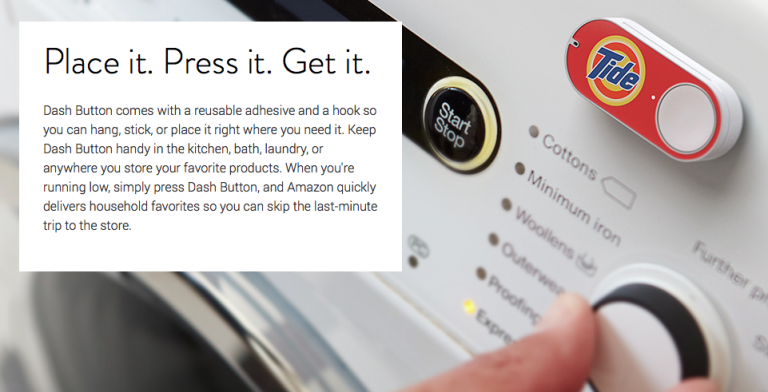
Amazon Dash Button is a wifi connected device that reorders your favorite product with the press of a button. Each Dash Button is paired with a product of your choice, which is selected during the set-up process. When you’re running low, simply press Dash Button – ensuring you never run out of your essentials again.

Says Amazon, “Prime members never have to worry about running out of everyday household essentials from coffee to condoms, and snacks to soda. When a customer sees supplies running low, they simply press a Dash Button to order.” And again, call me silly, but if a condom is needed – and I’m thinking if someone needs one, it must be urgent – someone’s going to tap a Amazon Dash Button?

Show me the money

Comments Daniel Rausch, Director of Amazon Dash to BusinessWire, “Prime members are using Dash Buttons at an increasing rate: Over the last three months, Dash Button orders have grown by more than 75%. Customers are using Dash Buttons more than once a minute, helping ensure they never run out of their everyday essentials.”

Dash Buttons are available to Prime members essentially for free with the first order through a Dash Button; members receive an equivalent credit to their Amazon account.

At the touch of a button

When a customer is running low on one of their everyday essentials, they can simply press a Dash Button to automatically reorder the item at the same low prices they find sold by Amazon online and with free Prime shipping. Customers receive a notification with every order and can change the product purchased through their Dash Button anytime.

While the thought of endless little branded buttons all over my house makes my head spin, perhaps this is just step one of a bigger picture – a new dishwasher was introduced last year that had Dash Buttons for soap built into the device, so perhaps some day they’ll be baked into our devices and appliances naturally as part of our smarthomes.

So the verdict? I don’t know if makes my home smarter or me dumber. Now excuse me while I tap out an order of Mucinex.

#DashButtons

Porsche’s latest ad might inspire you to bust out a new marketing move

What are you inspired to do?

Do you think advertising in print is dead? Think again — after Porsche’s revolutionary move in Fast Company auto magazine, you might want to revamp your business’ advertising strategies.

bar

Call 911

In a stunning revamp of the written medium, automotive giant Porsche managed to create a holographic rendition of their newest 911 in 50,000 select issues of Fast Company’s latest edition. First spotted by AdWeek, you can see the video of this phenomenon here:

Well, that’s all fine and dandy for Porsche—but how does their lavish advertising pertain to your business?

Comparing Porsches to Porsches

Fair point. Apples to apples—unless you’re secretly ballin’—the average small- to regular-sized business won’t be financially equipped to dole out glass prisms like eggs on Easter. Luckily for the 99 percent, however, the strategy Porsche used here is easily duplicable as long as you understand the main takeaway.

What was the main takeaway, then? Media coverage. Break the boundaries of traditional advertising—even if it breaks your budget for the month—and news sources, business informers, and textbook authors left and right are going to want a piece of the action.

Work smarter, not harder

You don’t have to create a hologram to make your brand visible; you just have to pique the interest of a few already highly-visible agencies, sit back, and let them do all the hard work. Why should you spend untold amounts of money and airtime just to get people to talk about your product?

Porsche’s end goal—to get people talking—clearly worked; after all, here we are, talking about it. For a brand that deals much more in hearsay and quiet conversation than blatant Super Bowl Sunday advertising, they sure managed to inspire a huge amount of coverage from such a simple—albeit expensive—campaign.

Hologram sold separately

More than anything, Porsche’s example of superb and surprising advertising should remind us that catching the eye of our target demographic is the most important step in any kind of promotion. Clearly, Porsche has that particular aspect on lock; with a little bit of brainstorming and planning, you can too—no prism needed.

#PorscheHologramStunt

Just because people aren’t buying VR headsets now, doesn’t mean they won’t

VR really is worth your time

We’ve followed the hype around virtual reality technology for quite a while, so the question, “Is a VR headset going to be practical?” resonates strongly with us.

bar
Spoiler alert: Yeah, it probably is.

Looks can be deceiving

After a survey of around 14,000 internet users worldwide, gaming company Gamer Network determined that the majority of internet users—59.5 percent, to be exact—aren’t all that hyped about buying a VR headset; in fact, only 14.9 percent gave a definitive “yes.”

Additionally, 47.3 percent of participants in the survey cited visual quality as a make-or-break factor. “Compatibility, anti-motion sickness, and controllers” were also listed as incentives to stay within the medium of actual reality.

Well, okay. Just like you guys didn’t want a next-generation console when they were announced, right? Good thing nobody bought an Xbox One or a PS4 after they debuted.

OH WAIT

We’ve seen this process before: every time a new brand of technological advancement comes barging into the room, criticism and dissent arise and, a fair amount of the time, this is a product of our unwillingness to divorce ourselves from that which has become familiar in favor of that which will further our progress.

Rift in consumer base

Invariably, however, the technology is released—perhaps with compromises, such as a lowered starting price or fewer commerce-related caveats (looking at you, Microsoft)—and a consumer base develops. Then, especially in the case of VR technology, a game or project gets announced—a flagship product that is so alluring, the begrudging majority can’t help but admit how friggin’ cool it is—demand is sown, and now the 25.6 percent of hesitant buyers are on the hook.

Once people realize that a fair amount of their friends are actively using and socializing with VR tech, they consider buying a headset themselves and, all of a sudden, that strange, alien technology looks remarkably like next year’s Christmas list topper.

Virtually unstoppable

This process will likely continue repeating itself for as long as we make advances in technology. Hopefully, the debut of VR tech can serve as a reminder that technology is marching on—and perhaps we should be following it.

#TrainsNotStopping

Why we all might want a smaller iPhone after all

The swing of the pendulum

Technology goes in cycles. After cell phones in general reached a peak in terms of being small (anyone remember the Ericsson T39?) Trends eventually leaned in the other direction: Bigger screens, bigger photos and better overall resolution.

bar
Speaking of big, take the Apple iPhone. Even though Apple’s newer iPhones keep following suit in terms of bigness (the screen sizes on the latest devices range from 4.7 inches to 5.5 inches. That’s up from four inches for older models like the iPhone 5 and 5S), according to Apple, more than 30 million consumers bought the older four-inch iPhones last year. What’s up with that? Is “big” a trend starting to fade?

Big things in small packages

Never one to disappoint, especially when money is involved, Apple introduced the iPhone SE, a dressed-up version of the four-inch iPhone, which will be released on March 31. The iPhone SE, according to Apple, looks and feels just like the iPhone 5S released in 2013, but it has most of the bells and whistles of the iPhone 6S.

A recent article in the NYTimes.com spells it out this way: “The SE lacks a number of attributes of the 6S. It does not have 3D Touch, the feature that lets you control some software by exerting pressure on the touch screen. The SE also has a lower-quality front-facing camera and a slower fingerprint sensor compared with the 6S.”

Not only that, critiques the Times, “From side-by-side comparisons, the SE’s screen isn’t as bright or as vibrant as the 6S display.” Apple for its part says it left some of the 6S components out of the SE largely to fit within the design constraints of the smaller body. Components like 3D Touch would have added thickness to the device, which probably would have made it unattractive.

Why go smaller?

It certainly isn’t for aesthetics. But that said, the small size might be part user-ability and part economics. If you’re text-obsessive or really into the whole social media thing and need the ability to quickly type or juggle between apps with one hand then the iPhoneSE has your name on it. It also might make better fiscal sense for parents who are entertaining the notion of purchasing a less expensive smart phone for their kids. The $399 starting price for the SE is considerably lower than the $650 starting price for the 6S.

Taken at face value, the SE is extremely fast, takes decent photos, and sits snuggly in your hand not to mention your pocket.

Is the small revolution making a comeback? Not likely but until it does, the iPhone SE is the next best thing.

#iPhoneSE