Home Blog Page 176

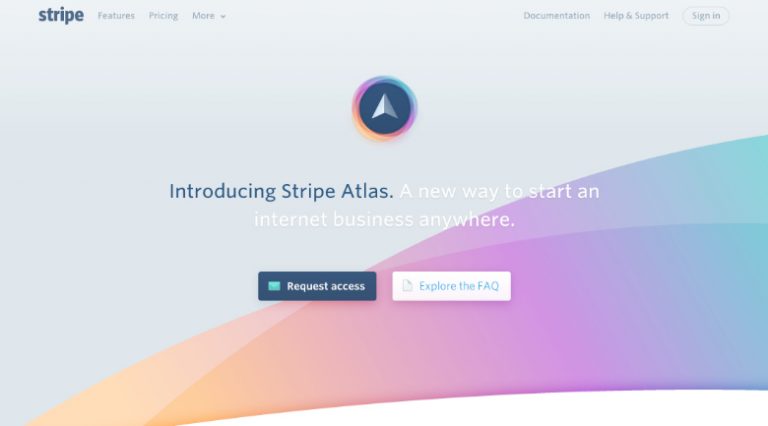
Stripe Atlas makes it easy for international entrepreneurs to startup in U.S.

Crossing entrepreneurial borders

Here’s a helpful for service for entrepreneurs outside of the U.S. who are thinking about starting a U.S.-based company. Stripe, an Irish company that helps individuals and businesses accept payments online, has created a new project called Atlas that is designed to help global entrepreneurs set up a U.S.-based company. Stripe Atlas facilitates and streamlines the process of incorporating as a U.S. company (in the state of Delaware), setting up a U.S. bank account, and accepting payments through Stripe.

bar

Delware-based international companies

Atlas generates and handles all of the paperwork, saving you the headache of incorporating and opening a bank account. You’ll get a business account with Silicon Valley Bank, the leading U.S. bank for tech companies. You’ll also be able to use Stripe to make or accept payments in over 100 currencies.

Besides handling your paperwork, Stripe Atlas also provides much-needed guidance and advice. By partnering with Orric, an international tech law firm, and PwC, a global accounting firm, Stripe Atlas provides professional expertise as you navigate U.S. tax law. In fact, you can have free chats with the experts from PwC every time you have a question.

By joining Stripe Atlas, you’ll also join their network, connecting you with tons of other international startups.

By invitation only

Right now, Stripe Atlas is only available by invitation (but you can request access on the site). They plan to scale up quickly by working with 60 accelerators, investors, and partners to reach as many startups as possible.

With more and more business being conducted online, commerce is spreading beyond the physical boundaries of different geographic locations. At the same time, it can still be challenging to figure out how to start a global business. Stripe Atlas offers services designed to give “developers around the world…equal access to tools and services that are available to those in Berlin and Boston.”

#StripeAtlas

Facebook releases “reactions,” research shows that users are almost ambivalent

Facebook users can now react to posts

Like anything else, Facebook has to update itself from time-to-time in an effort to stay fresh and current. Its latest endeavor has been to release “reactions”.

bar
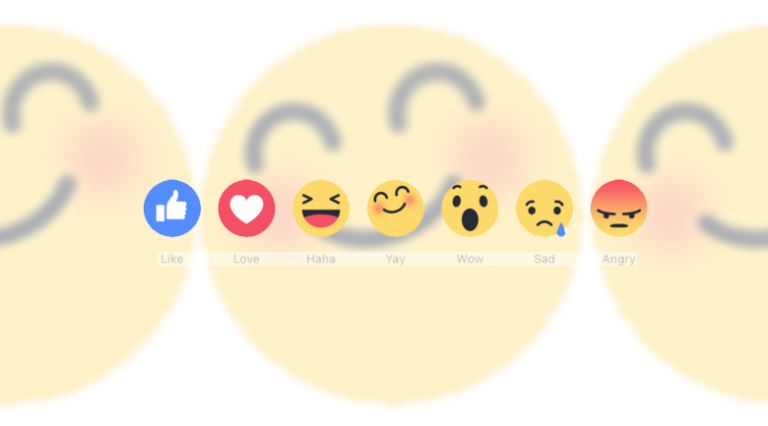
Similar to smartphone emojis, reactions are ways of responding to someone’s message with symbols including: smiley face, sad face, hearts, etc. This was the alternative to Facebook’s never-ending promise of a “dislike” button.

Research examines “reactions” approval

Research done by YouGov examined American’s approval, disapproval, and uncertainty in response to the reactions. Sixty-six percent of people are in favor of the reactions while 14 percent disapprove, leaving 20 percent unsure.

The approval percentages were looked at a bit more closely, with 42 percent citing “somewhat” approval, and 24 percent giving “strong” approval. In terms of demographics, there was not too much of a difference. The findings show that highest disapproval rate is for those over 65 at 22 percent.

Better than a “dislike” button?

Research continued with the aforementioned “dislike” button, as the study ran numbers on reactions versus dislike. It was found that 43 percent would prefer to just have a “like” and “dislike” button, 29 percent favor the new reactions, 15 percent would like to keep it original with just the “like” button, with 14 percent left over in the unsure category.

Lastly, like any good research study, YouGov looked at the impact of reactions on Facebook users. Fifty-five percent believe it will have no impact, nine percent believe Facebook will be “much better” with reactions, and three percent believe it will be “much worse”.

Think before you react

The five reactions available currently are: a heart to signify “love”, a laughing face to signify “haha”, a surprised face to signify “wow”, a crying face to signify “sad”, and a red face to signify “angry”.

While I have yet to use them myself, the option to use reactions does make sense. For example, it always seemed a little dark to me when someone would post a status about the passing of a loved one, only to be greeted with the notification of Joe Schmo “liking” it. Now, Joe can react with a sad face as a way of expressing sympathy.

However, like with any other form of computer-mediated communication, it can be easy for these reactions to be misinterpreted.

#FacebookReactions

Instagram continues double-digit growth

Instagram flexes their muscles

Instagram is continuing to show its prowess as a viable, engaging, and popular social media platform. Particularly within the mobile realm. According to a recent eMarketer report (https://www.emarketer.com/Article.aspx?R=1013612), more than a third of mobile phone users, roughly 89.4 million Americans, will be on Instagram at least once a month in 2016.

bar
That number is expected to surpass the 50% mark for the first time in 2017, with an estimated 51.8% of social network users using Instagram.

This rate of growth isn’t typical

The social platform’s user base growth is certainly a bit atypical for social networks. Compared to the social network sector’s overall growth this year of 3.1%, Instagram’s 15.1% growth is far faster than social network usage in general.

Their user base will exponentially increase over the next four years. In that time, the social network is expected to add 26.9 million users. This will almost double the user growth expected for Twitter and far outpace the growth rates of any other social platform.

Instagram + Facebook = much love

Such a robust growth in users is good news for parent company, Facebook. Instagram usage is helping to drive an increasing share of Facebook’s mobile ad revenues. It is said that in the coming year alone, 9.5% of Facebook”s worldwide mobile ad revenues (20.1% in the US) will be generated by Instagram. This share of ad revenue will grow to 14.0% globally (28.0% in the US) by next year.

With a rapidly increasing revenue potential, the social platform is generating the most momentum with advertisers. Advertisers are turning more and more to Instagram, particularly marketers that want to target mobile millennials. Instagram usage is by far strongest among the generational set.

This year, there will be 48.2 million millennial Instagram users in the US. And that usage isn’t set to slow down. It is expected that, by 2019, nearly two-thirds of all millennial smartphone users will use Instagram.

According to eMarketer principal analyst Debra Aho Williamson, “Instagram and its parent company, Facebook, know that mobile has changed the way people—especially millennials and Gen X-ers—communicate, share and get information. That’s why they are leading the way in helping marketers reach this audience.”

#InstaBOOM

Google’s Tilt Brush allows you to paint in 3D VR, or step inside a painting

VR experiences can be more than just film

When people get excited about Virtual Reality, they are often thinking about watching movies in 3D, or about immersing themselves in the world of a video game.

bar
But Google is proving that VR won’t be just for passively consuming the media creations of others, but can also be utilized as a tool for actively creating your own art.

Microsoft Paint x 1,000,000

The Google Tilt Brush will let users paint in 3D virtual reality. Fast Company reports that Tilt Brush “is like Microsoft Paint for the year 2020.” With Tilt Brush, the “room is your canvas.” A VR wand is used to create 3D paintings that you can then virtually walk around inside. Imagine the Rembrandts and Van Goghs of the world could walk around inside their creations!

Paint with the elements

Tilt Brush offers many of the artist tools you would expect from any digital drawing app – you can make paint brush strokes, pencil lines, or use “ink” or “spray paint.” But Tilt Brush does even more.

You can draw with elements like smoke, snow, and fire, giving your paintings a bit of animation.

You can also choose different backgrounds for your paintings, such as a starry night sky, or a stone pedestal to display your drawing as though it were sculpture in a museum.

Named “Best VR experience”

Tilt Brush was named “Best VR experience” at the 2015 Unity Awards, and received the Proto “Best GUI” award in 2014. Tilt Brush will be available when HTC Vive VR headsets are released, and Google is working on creating a Tilt Brush Gallery so that artists can share their creations.

Who knows, maybe someday art galleries will be filled with VR headsets. Or better yet, rather than go to the gallery or museum, maybe one day you’ll be able to download great works of art directly into your headset. It’s hard to say exactly where all of this is going, but it’s exciting to think of all of the ways that VR could be for interactive, creative experiences. When it comes to VR, the sky is the limit.

#TiltBrush

Drivers aren’t scared of autonomous cars, after all

A sad and strange sight

You may have already seen one. You’re driving around and suddenly you see a car moving down the street – but the front seat is empty. It’s distinctly eerie. Car manufacturers and tech companies are collaborating to get self-driving cars on the roads, and many have already been tested in normal traffic. But let’s face it – many consumers are scared of the idea of letting a car drive itself.

bar

Not ready to give up the wheel just yet

Proponents of driverless vehicles believe that the technology will make the roads safer, because a driverless vehicle cannot succumb to human error. If there is no driver, he or she can’t fall asleep at the wheel, get distracted by a text message, or drive while drunk.

But research suggests that consumers may not be ready to hand over the wheel just yet. AAA recently conducted a survey of 1800 drivers to gauge how comfortable consumers are with the idea of kicking back and relaxing while their car drives itself. The results were somewhat dismal: a full 75 percent of drivers said they didn’t feel safe in a driverless vehicle.

Interested in the features, but don’t want to give up control

However, the results shouldn’t be taken as a total rejection of the idea of automated driving.

While consumers don’t seem too keen on the idea of giving up total control of their vehicles to the robots, 60 percent of survey respondents reported that, next time they buy a new car, they will look for certain self-driving features, such as automatic parking, warnings when you’re swerving out of your lane, and automated cruise control that knows the speed limit, measures the distance of the car in front of you, and adjusts your speed accordingly.

Increasing the comfort level

According to AAA’s managing director of automotive engineering and repair, “people who have these features tend to like them and trust them. That will go a long way for them to start to accept the self-driving technology.” He believes that, if drivers are willing to try selective self-driving features, they will eventually be comfortable letting the car do all of the work. He expects drivers’ “comfort level” with self-driving cars to increase over the next five years.

#DriverlessSafety

Creating video content for Facebook? FB can help

“Your Business Story” by Facebook

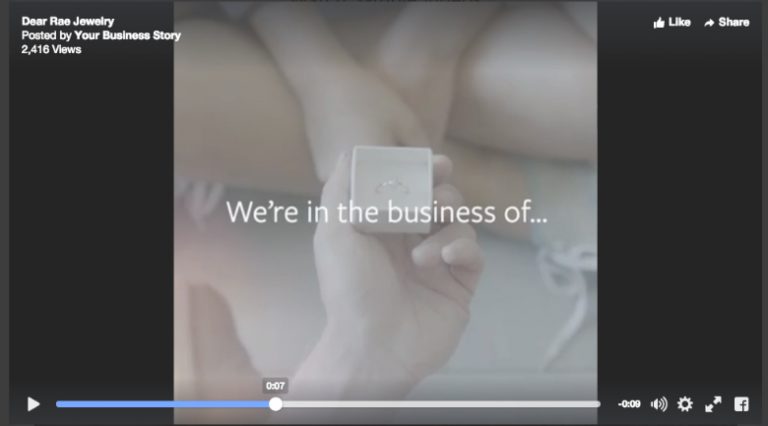
Well, that was easy. And if you have eight business pictures on Facebook and can form a coherent business statement in 90 characters, you too can create a Facebook video for your business like the one below.

While it’s not so much a video as it is a photo gallery set to music, the “Your Business Story” tool from Facebook is actually fun to put together.

Step 1. After visiting the link above and choosing to Create Video, you’ll be prompted to authorize the app. You’ve seen this a thousand times.

Step 2. Choose the page you manage and want to build your video for.

Step 3. Go through your Facebook photo albums and choose eight of your fave photos. After you choose your eight, you will have a chance to rearrange the order.

Step 4. Finish this sentence: “We’re in the business of…” But you only have 90 characters to work with, so make it count.

Step 5. Choose one of four musical options.

Pro tip: As easy as creating my video has been up to this point, this piece stumped me for a quick minute and made me feel like I don’t know how to work the Internet! But after a deep breath and holding down my click in frustration instead of just quickly clicking – you know, how you push an elevator button longer than you need to because you think it will bring the elevator to you quicker? – the music started playing. So, click and hold to listen to your options. Then click once to choose.

You have a video, now what?

Once you’ve created your video – which comes complete with Facebook branding and the thumbs-up icon at the end – you have two options. Post to Facebook or edit. There is no saving it to your computer, no option to Tweet.

Pros: ?This tool was super easy to use. A business could make a new video each week – providing fresh content to customers and their online audience – in a matter of minutes.

Cons:?If your business has strict branding guidelines, this might not be a tool for you. You can’t change the font or the color. And the Facebook branding will always be attached to your video. I’d also love to something other than “We’re in the business of…” as options for the text overlay. Maybe “We strive to…” or “We envision a world where…” or “Our mission is…” I think that might make this tool more appealing to associations and nonprofits as well.

Have fun with it! If you make a video, share the link in the comments so we can check it out!

#FBvideo

Sony’s short throw projector to be released this summer in America

Turns any surface into a television

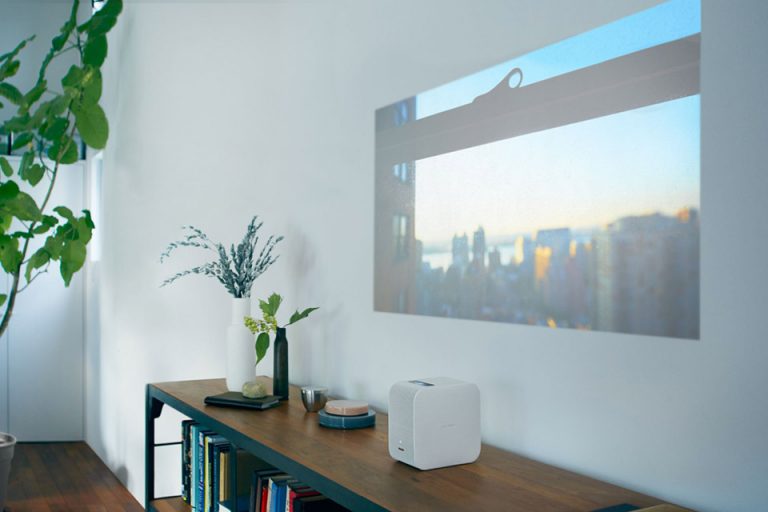
Information on Sony’s new line of futuristic Life Space UX electronics is slowly being released to the public, and is beginning to grace the homes of Japan. One of the electronics includes a short throw projector that turns any surface in your home into a television. A lot more affordable and smaller than their previously released $50000,4K projector, this device is currently out in the Japanese market and in America in the summer.

bar

HDMI and Bluetooth capable, up to 80 inches

The small but powerful 3.19″ x 5.16″ x 5.16″ device is capable of projecting an autofocused 1366 x 768 image of 100 lumens and project between 22 and 80 inches. It comes complete with standard HDMI ports, Bluetooth capability that allows cell device pairing and wireless access via a hub connected to your PC or laptop. All of which is supported by its strong, two hour life battery.

Along with all of these neat functions, The short throw projector comes with a stand that makes the device look like a chic addition to your living room instead of the typical bulky projector.

Expensive now, becoming more affordable

This new device is definitely cooler than the standard television, the only hang up I foresee for consumers is the cost. Coming in at $800, the short throw projector is over $40k less than Sony’s other projector.  But, Is a lot more than a $89 smart 20″ led tv (the lowest projector threshold) and 55″ smart television. This shouldn’t be a problem for those that love the newest technology, or want a discreet, high def projector. But for those who want to get the most bang for their buck, it might be more feasible to get a “50 tv.

A new wave of television technology?

Regardless, Sony has definitely upped the ante in visual technology once more: allowing consumers to watch up to 80″ crystal clear television anywhere in their house. I’m pretty confident with their historical success, that this device won’t have any problems selling. I do wonder though, are affordable, high quality projectors the new wave of television? Will customers be throwing blows for projectors, instead of tv’s at the next Black Friday? We’ll definitely see as more companies find a way to tweak and perfect projector experiences.

Until then, research Sony’s first 4K short throw projector just because it’s breathtaking. Then watch this video and see how their developers squeezed such large technology into the new, and portable, short throw projector.

#SonyProjector

One in four job postings remain unfilled after 60 days [stats]

One in four jobs still open after two months

According Indeed’s hiring lab, a look into the global hiring market has revealed that a quarter of all job listings in America remain open and unmanned for more than two months. Compared to other countries like Russia, where it takes only two days to fill a position, that’s the longest wait for the highest proportion of positions in any country of the world.

And while this statistic may seem like a bad thing, it could turn out to be advantageous for job seekers.

bar
One reason this is occurring: Employers and job seekers both are being more picky in their selections; with another Indeed study showing 49 percent of employers express frustration when finding the right candidate in the appropriate timeline.

Taking the economy into account

Another reason for this is that we are in a generally improving economy right now. When unemployment rates decline and people don’t feel financially obligated to accept the first job they are offered, that means the economy is at least performing, not failing.

Alternatively, in countries like Russia, where it only takes two days to fill a position, the economy is failing, resulting in people being desperate for jobs and rushing to take the first opportunity presented to them. So as the economy improves, job seekers can actually take their time and choose wisely, which is what we are seeing happen in the job market now.

Both of these reasons, are to the benefit of the job seeker. Employers taking more time to hire means they’ll be able to recognize the right candidate and hire you, before they hire someone who isn’t half as experienced in a rush. An improved economy means more opportunities for job seekers to pull from, and select.

It’s more than cash monies

With so many opportunities, employers’ only hope to decrease waiting times is to add value for the job seekers, and to meet their needs. That means simple cash incentives aren’t going to cut it anymore, and should be offered alongside flexibility, culture, and benefits. The sooner employers cater to those needs, the sooner they separate themselves from the competition and attract top talent.

So if you’re a job seeker, the current job market is made around you, waiting for you to make a move. But for businesses who don’t want to wait, the job market insists that you add value in order to decrease waiting times, and avoid job seekers looking elsewhere.

Either way, an improving economy is always good news, and will be an overall positive for job seekers and employers alike.

#Jorbs

Microsoft is innovating by designing for the disabled first

Microsoft expands their focus

As a discipline, design has so often tended to focus on an ideological notion of the ‘average consumer.’ However, this weltanschauung can sometimes limit design because it narrows the focus to only produce designs believed to be useful, which may not necessarily lead to innovation.

Microsoft’s August de los Reyes, who runs design for Xbox, and Kat Holmes, principal design director, are flipping the script and ushering in a new design paradigm. They believe in designing with the disabled in mind.

bar
For them, making designs with the intention of providing the disabled with universal access will ultimately lead to the creation of products that are inherently better for everyone else.

In this case, why not use disability as an engine of innovation?

Disability has long been part of design. There is a long list of inventions which have been informed or spurred on by disability. Take for instance, the telephone, invented in 1872 by an Alexander Graham Bell who was trying to support his work helping the deaf.

Even email, as we know it today, was first brought into creation by Vint Cerf, who, in 1972 programmed the first email protocols in order to communicate with is deaf wife while he was at work.

With the help of design experts, De los Reyes and Holmes, eventually dubbed their paradigm ‘inclusive design.’

This way of thinking begins with studying communities that are often overlooked by others or considered to be outliers in the average consumer world, such as those with dyslexia or who are deaf. De los Reyes and Holmes are finding that, when people are forced to live life differently than most, there is a certain level of expertise and ingenuity which naturally arises. As such, they’re seeking out the disabled and the different, confident that they’ve already invented exactly the solutions that the rest of us need.

Microsoft is already putting the inclusive design paradigm to use

So far, dozens of projects have been completed, with more on the way. One forthcoming project centers on making reading easier for dyslexics through a font and system of text wrapping, which also means faster reading for those without dyslexia. Another project is rethinking of how directions are given on Bing.

The promise of the inclusive design process is that it can translate to everyone. For De los Reyes, this also means designs that push past even Microsoft. De los Reyes said, “If we’re successful, we’re going to change the way products are designed across the industry. Period. That’s my vision.”

#MicrosoftInnovation

Facebook flirts with telecom to boost wireless access in rural areas

Wireless isn’t as widespread as you might think

As apps become ever more data-intensive, and content publishing sites are increasingly focused on transferring large amounts of data, like videos, Facebook has decided that it is high time to collaborate with the telecom industry.

bar
The social media site recently revealed that it will work with an alliance of telecom companies to build out wireless networks, especially in currently underserved areas, such as remote rural locations, and in developing nations.

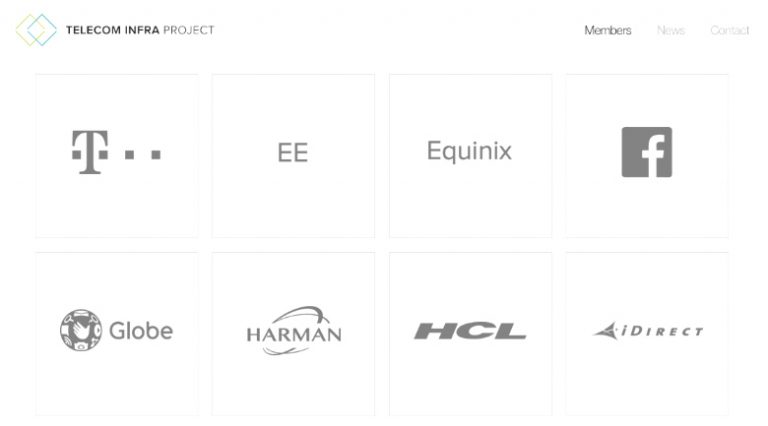
The group is called the Telecom Infra Project (TIP), and includes companies like Intel, Nokia, Deutsche Telekom, and SK Telecom. Currently, no U.S.-based companies have joined TIP, but the Wall Street Journal reported that AT&T is considering it.

Hoping to meet the global data needs

Facebook announced that “scaling traditional telecom infrastructure to meet this global data challenge,” referring to the increasing use of data-intensive apps worldwide, “is not moving as fast as people need it to.” Telecom companies have so far not been highly motivated to invest in building out infrastructure in remote areas with small populations.

But companies like Facebook, who earn more profit the more users they gain, have obvious reasons for getting more people online. That’s why the social media company has decided that, rather than relying on existing infrastructure, they should collaborate with telecom companies to expand.

Partnerships with telecom companies will expand cell phone service into small villages in the Philippines, and will bring 4G to rural areas in the Scottish Highlands. These are just a few examples of how Facebook’s TIP initiative will bring modern internet technologies even to the most remote areas.

“Both sides realize they need each other”

Relations have been tense between content providers and telecom companies in the past, as sites like YouTube and Netflix have long benefitted from the telecom industry’s infrastructure, without investing to maintain or expand it.

According to the CEO of TIP member, Nokia, Rajeev Suri, “the tension has been that these guys [content providers] are taking a slice of carriers’ pie and they aren’t investing in networks.” Facebook’s TIP initiative shows a change in industry attitudes as “both sides realize they need each other.”

#FBwifi

Chick-fil-A will give you free ice cream to just shut up and eat

Chick-fil-A is trying something new

While most brands, including fast food restaurants, are doing everything they can to incorporate mobile into the dining experience, chicken chain Chick-fil-A is doing the opposite – they’re trying to get customers to power down their cell phones while eating in the restaurant, and they’re willing to reward people for it.

bar
While brands like Hardee’s and Sonic are going high tech by offering smartphone apps for ordering and paying, Chick-fil-A would like to see people put down their devices and simply enjoy each other’s company for a change.

Most readers have probably sat through a meal where it seems that everyone is looking at their screen more than they are engaging with one another.

How did this come to be?

The concept was created by a Chick-fil-A store operator, Brad Williams, who says that he wants “our restaurant to provide a sense of community for our customers, where family and friends can come together and share quality time with one another.”

To encourage “conversation and chatter,” Williams provided a “Cell Phone Coop” for each table at his restaurant.

The Cell Phone Coop is a closeable paper box decorated with chicken wire to look like a farmyard coop. Diners are instructed to “turn all family cell phones to silent” and put them inside the coop. If the whole table can make it through the meal without reaching for their phones, everyone gets a free ice cream cone.

The challenge has been a hit

Customers took to Twitter in praise of the concept, giving Chick-fil-A a much-needed social media boost. According to Williams, the challenge is fun and rewarding, so it’s “hard to sit with your family and not do the challenge.”

What’s more, “families who aren’t successful the first time…come back to try again.” The campaign was so successful that other stores began asking to participate, and the execs at Chick-fil-A headquarters decided to extend the Cell Phone to Coop to 150 of its restaurants.

#Chickfila

Meet the must-have tool for the selfie lover

No stopping the selfie train

Ahh the selfie. Instagram and FB feeds are full of friends and family members’ posts, many of them aiming for the perfect selfie. We have written about how to take the perfect selfie, how to enhance your selfie, and why selfies seem to be so popular.

One thing is certain: Selfies are here to stay, and as long as you’re partaking in the selfie game, you might as well aim to be MVP.

bar

Your road to selfie perfection

If you’ve been trying to perfect your selfie portfolio for a while, you know all about the selfie stick. Selfie sticks are great for taking group photos and capturing family vacations so that no one is left out of the shot, but carrying one of those sticks around all day can be inconvenient. Another useful tool for selfies is a wireless remote. This allows you to set your phone in another location and wirelessly activate the shutter on your phone. Totally awesome, but again, carrying it around isn’t as convenient as it could be.

What’s the answer for the selfie lover?

Put it all together, of course

A new premium selfie case, Flip It, wants to make taking selfies easier. Flip It is a compact, protective hard shell case for iPhoe 6/6s. It has a fully built-in selfie stick with Bluetooth remote, plus a kickstand.

The selfie stick flips out from the back of the case. The steel arm telescopes out to 22 inches when fully extended. The Bluetooth remote can be activated from up to 25 feet away. The Bluetooth remote/handle separates from the case by simply sliding it off; easy to put in your hand or pocket and the slide back into the case when you’re finished. The kickstand is built-in to the remote, and is super helpful for those group shots at dinner.

Plus extras – great for social media personalities

Flip It also plans to offer a range of accessories compatible with the case. Some proposed accessories include a tripod, bicycle mount, guitar mount, and more. It’s a pretty good alternative to carrying around a selfie stick and wireless remote on vacations and other outings.

It also saves you the hassle of re-positioning your phone into the traditional selfie stick mounting brackets over and over as the Flip It case is built-in and no re-adjustments are needed. Even if you don’t take a ton of selfies, this would be pretty neat to have on vacation.

What do you think? Would you use the Flip It case?

#FlipIt

The meaningful history of Women’s History Month

How it all began

It was 1911 when the United States held its first International Women’s Day. The Socialist Party organized the observance in remembrance of what the International Ladies’ Garment Workers Union did to improve the working conditions for women and immigrants in the garment industry.

bar
Although the annual day continued to be celebrated both in the U.S. and internationally over the next few decades, it didn’t really gain ground until the late 1970s. Sarah Lawrence College, the Women’s Action Alliance, and the Smithsonian Institute co-sponsored a 15-day conference celebrating women’s history.

President Carter asked for a week

President Jimmy Carter proclaimed the week of March 8, 1980 as National Women’s History Week. The Equal Rights Amendment had just failed to be ratified, and he saw the need to observe the accomplishments of women like, Sojourner Truth, Harriet Tubman, and Susan B. Anthony.

Over the next decade, states began to proclaim the entire month of March as Women’s History Month. Schools offered educational programs that gave them a chance to see how they could make a difference by studying those who came before. The initiative has been supported by the Republican and Democratic National Parties, Congress, governors, and schools.

Celebrating women in history

Since 1988, every U.S. President has issued a proclamation designating March as Women’s History Month.

This year’s theme is “Working to Form a More Perfect Union: Honoring Women in Public Service and Government.” Over the next few weeks, I’m going to take a look at women who have been inspirational in my life, and who were instrumental in their own industries to give women today the chance to step out and be successful. Take time this month to think of those women who came before you and opened the doors in your own industry. Do something to honor their memory or write them a thank you note.

#WomensHistoryMonth

Did Google just invent the first unprintable e-book?

Interactive e-books that can NEVER be printed

Imagine an e-book so ingrained in the digital world, and simultaneously intangible and unusual, they’re calling it “un-printable.” Google’s Creative Lab has been working in tandem with Visual Editions, a London publishing house, to creative just such feats of experimental fiction.

bar
The series of books Creative Lab and Visual Edition is creating together is called Editions At Play, and are all meant to be un-printable. In order for a book to become an un-printable, it must first prove itself worthy. It must involve technology and concepts that paperbound books cannot handle.

So what are the stories about?

A perfect example is the book “Entrances and Exits” by Reif Larson. “Entrances and Exits” uses Google Maps to take the reader through an interactive love story. Doors and portals carry the reader through the book and inside houses you watch relationships and storylines develop. Google Creative Lab’s Tom Uglow explained that Google’s main job in the case of “Entrances and Exits” was to make sure that the technology did not overwhelm the storyline, but served as more of a framework instead. “It should be gently lifting the ideas or themes of the book like a score might lift the themes of a film,” he said. “It should emphasize what the author is talking about.”

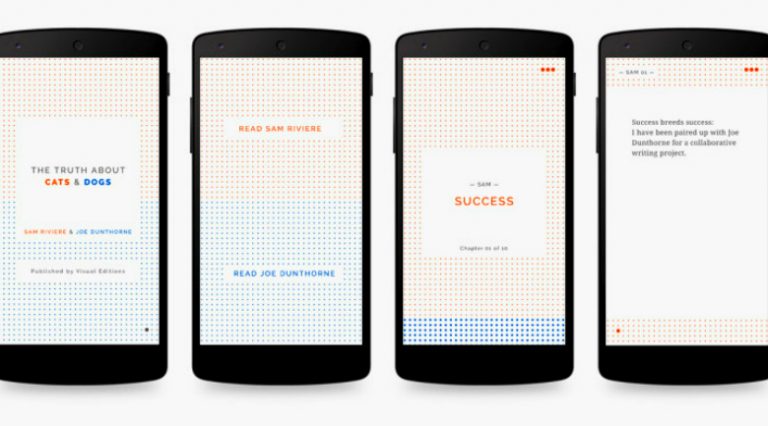
Another title released in the Editions At Play series is “The Truth About Cats and Dogs,” by Sam Riviere and Joe Dunthorne. This strange little bit of new-age electronic literature is a combination of the authors’ poems, diaries and public correspondences, and reads as a conversation. Both books are live on browsers and can be read on a computer, but it’s recommended the reader use a mobile device for the best interactive experience.

The future of books

However, times aren’t going too far into the future. While Google Creative Lab is helping to create a series of un-printable digital books, Amazon is helping us step back in time. In Nov. of 2015 Amazon announced they would be opening a brick-and-mortar bookstore in Seattle. In Feb. 2016 it was accidentally leaked that they may be opening as many as 400 additional bookstores across the country for those craving paper and ink books.

For anyone interested in experiential reading, go browse the future un-printables ready for… un-print.

#GoogleEBook

LumiereVR startup is setting the stage for VR content

VR for the common folk

Virtual reality is no longer limited to just the world of technophiles. The past year has placed VR in the spotlight. People will soon be getting more than just a first-taste of virtual reality. With the Oculus Rift now on pre-order, VR headsets are fast becoming a reality for many people. Today, nearly every major player in the video streaming industry has made its first steps into the VR arena. It’s highly likely that VR will soon find its way in our daily life, along with devices like Samsung Gear VR and Oculus Rift.

bar

LumiereVR changes the game for filmmakers

Although gaming is what comes to most people’s minds when thinking of VR, use cases extend far into entertainment as well. In addition to hardware advances, we’ve also seen lots of headway regarding immersive content. Last March, YouTube teased VR enthusiasts with the addition of 360 video support for both mobile devices and Chrome, as well as support for 60 FPS video. And many companies are following by starting to produce 360 VR video content.

One such player looking to revolutionize the motion picture industry with virtual reality is startup LumiereVR. LumiereVR is comprised of both engineers and filmmakers, looking to completely change the way of motion pictures by using 360 VR technology. According to LumiereVR, their 3D VR camera with image recognition software allows users to cede control to the camera and fully immerse themselves in the moment.

Collaborations and content

With their cutting-edge software, the startup is aiming to give artists an edge. The company’s film team is currently collaborating with dance studios, startups, and even physicians. Through these partnerships, LumiereVR is creating experimental VR/360 film techniques which they hope will result in producing the coolest content.

LumiereVR is working on producing 360 virtual reality content and tools. Their website even has a countdown to launch, which currently reads a little over 6 days. Until then, the company also has “Lumi Stories,” which hosts VR/360 content. The videos are voted and ranked by user generated metrics. It is also home to their VR/360 artist community and boasts plenty of spontaneous collaborations, some of which are even funded.

#LumiereVR

Sprint ends two-year contracts, recants after only one month

A change in plans

Cell phone dynamics are extremely complicated these days, which is perhaps why Sprint is bringing back subsidized phones after customers rioted during the option’s month-long absence from the market.

bar
Sprint has historically allowed both an installment plan and a (recently reinstated) subsidized plan; these plans each require a two year contract, during which the customer pays off the phone in conjunction with service fees. The subsidized plan differs in that the customer pays less per month but more up front, whereas the installment plan is almost exclusively month-to-month.

Costing customers more

After the conclusion of the aforementioned two years, the customer owns the phone and is free to pursue other carriers or options, assuming the phone is receptive to alternatives. Despite criticism that Sprint is the last service provider still incorporating a subsidized option, it seems that Sprint is retaining the plan only at their customers’ behest.

Unfortunately, the customer is not always right—especially in this case. Lifehacker author Eric Ravenscraft did the math, noting that the subsidized option—wherein one might pay as much as 200 dollars up front for a brand-new iPhone 6S—ends up costing customers significantly more than the installment plan, which is negligibly more per month.

Shrewd, Sprint. Very shrewd.

Placating your customers

This is just another case in a long line of consumers resenting change, though—like Subway’s five-dollar footlong or Costco hotdogs, Sprint created an associative deal, and their customers ran with it. The danger of having something associated with your brand is evident here; regardless of why Sprint wanted to nix the subsidized plan, the fact remains that they wanted it gone.

Now, instead, they are fairly obligated to keep the plan intact to placate their consumer base. At best, this is an unwanted reaction from the masses—and at worst, it’s an inefficient system that will invariably cost Sprint an unprecedented amount of wasted revenue.

You never know what your customers will latch onto, so consider each and every aspect you implement as you go. It could become your signature characteristic.

#Sprint

App rounds up your purchases, puts the change toward charity

Every drop counts

We all like to think that we are generous, helpful people. Sometimes we plan to make a big donation to a deserving charity, but then life gets in the way, and we never get around to it.

bar
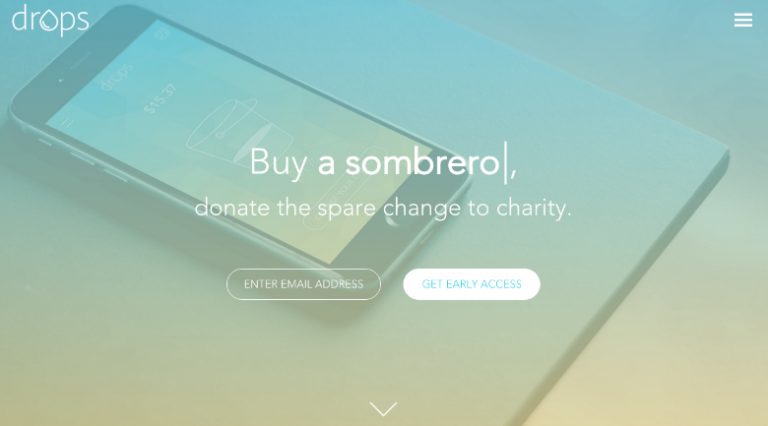
A new app called Drops is making it easy to be a good Samaritan. We’ve written before about apps that round up your purchases and invest the spare change in the stock market, but Drops seems to be designed for folks who simply want to share their abundance with a worthy cause.

You choose the charity

Drops is an entirely mobile app, so you won’t need to open your computer’s web browser to sign up. You simply download the app to your smartphone. Drops uses bank grade security and encryption to link directly to your bank account. Each time you make a purchase on a debit or credit card linked to Drops, the app rounds up your purchase, taking the remainder of the dollar from your bank account and donating it directly to a charity you choose.

Drops doesn’t take a cut

Drops is so named because, according to their founder, Shea Rouda, while “each roundup might seem like a drop in the bucket” eventually “your change adds up, and over time a small roundup leads to a big impact.”

Unlike other “roundup” apps that sometimes charge a fee as high as 10 percent, Drops doesn’t take a cut from your donation – every last penny goes to the charity of your choice. However, you can choose to optionally “tip” one, two, or three dollars per month, to support Drops itself. The startup is in the process of becoming a non-profit, so even your tip will be recycled back into a charitable cause.

Keep or donate

You can set a monetary goal for the month, with a minimum of five dollars to charity, or you can try it out month-to-month. Once you’ve reached your monthly donation goal, you can either keep donating, or keep your spare change. In fact, Drops always gives you the option to keep your roundup instead of donating, so when you are strapped for cash, you won’t be stuck with an automatic payment you can’t afford.

And of course, Drops also provides a tax receipt so you can take a deduction for your donation.

Drops seems like an easy way to share your abundance with others in need. Why not give it a try? After all, every drop counts.

#EveryDropCounts

No one surfs the web anymore; internet use is evolving #MustKnow

The effect of mobile

Mobile has fundamentally changed the way we think of and make use of the Internet. No longer do we surf the web. The introduction and adoption of mobile resulted in a shift away from using the Internet via desktop to devices we carry with us all time.

bar

Mobile growing exponentially

Mobile now represents almost 2 out of 3 digital media minutes, and mobile apps alone now constitute a majority. Although desktop is not declining in total engagement, it is losing share to mobile – which now accounts for 62% of digital media time spent. And mobile apps on their own now drive the majority of digital media time spent at 54%. Indeed, over the past two years, mobile apps have grown 90% and have contributed to 77% of the overall 49% growth in digital media usage.

The new Internet gatekeepers

Additionally, the overarching usage of most of what we used to surf online pivoted to app-only (or app-centric) products. Facebook is perhaps the most notable example, but there’s also Messenger, Instagram, etc. It is this app-only shift combined with the global move to mobile that likely resulted away from surfing the web. Certain markets, such as China, skipped the web surfing stage entirely.

We now live our lives via push notifications and content delivered to us by our favorite apps and the mobile trend will only grow. Going forward, it is messaging and notifications that will shape the app landscape. Particularly, messaging apps, which offer high rates of engagement and long term retention.  Messaging also lends a certain amount of credibility and context to web links and content. In other words, you’re generally likely to be sure a link is valuable if the message from a friend or colleague. In this way, some argue mobile messaging platforms have become the new Internet gatekeepers.

Surfing days are done

Messaging is also cross-platform. We are able to go from chatting with friends in a mobile app to a laptop or tablet. In and of itself, messaging isn’t the reason why messaging is the new trend. Messaging is so important because it offers the ability to hook into other applications. It is ideal to tap into payment systems, location/mapping services, and AI-powered messaging bots.

While the internet will remain, the days of ‘surfing the web’ are numbered. As technology evolves and apps dominate, we will most likely travel to browsers from a push notification or a message link from a friend.

#WebSurfing

Herbalife called out for being a pyramid scheme, seeks settlement with feds

Sweet smell of success: Herbalife in deep water

While researching this article on the on-going melodrama that is Herbalife I decided to just go to the source and get my own take on things. It didn’t take very long: A few phone calls to the local Herbalife contact and the next thing I knew I was invited to an information meeting with other distributors, team leaders and potential Herbalife members. A couple of things jumped out at me, namely everybody gets a piece of the pie: if I sell a bottle of shampoo my team leader gets a cut and the leader above him/her gets a cut and someone living in Belize gets a cut.

bar

Invest in Herbalife

The other thing is that I need to purchase all my products. I need to purchase the initial presentation kit and any other products I may need along the way. This is neither good nor bad. I assume everyone from Avon to Sweet Scent Candles or Mary Kay Cosmetics operates the same way. Ultimately the big money isn’t selling, it is in building a team and having that team create a team and so on and so on with the team leader getting a percentage of whatever it is those teams/individuals are selling.

The buck stops…somewhere

OK enough of that. I’ll probably kick myself in the morning but I opted out of becoming an Herbalife member. Not everyone can remain so cavalier: Billionaire investor William (Bill) Akman (who by his very nature has invested heavily in Herbalife and lost) has spent more than a year locked in a legal battle with Herbalife accusing the company of operating a pyramid scheme. Naturally the company contests Ackman’s claims.

Akman’s Herbalife odyssey has run a winding road in the last few years: initial accusations led to the case being dismissed back in March 2015 but then going back to trial and now Herbalife is looking to find some type of resolution (read about it here)

Enter the FTC

So now the FTC is involved and Herbalife is trying to resolve this is such a way as to not put a dent in its multi-million/billion/gazillion dollar empire. The ramifications go deeper than just William Akman trying to recoup his losses. Plenty of other independent sales organizations (see above) are paying attention to see how this plays out because they risk falling victim to the same accusations.

Herbalife. It’s not just a job. It’s a lot of other people benefitting from each and every sale you make.

#Herbalife

Closing the tech gender gap: Men and women who code are more similar than you may think

The coding gender gap

It is no secret that tech jobs are heavily saturated with men. With a ratio of about 70:30, men continue to outnumber women at all of the major tech companies.

bar
Staggering ratio’s similar to that one imply that women aren’t interested in learning tech skills, such as programming and coding; and is just one reason we perceive men and women to be so different.

Similarities between genders

However, in a recent 500 person survey by Learn to Code With Me, conducted by Laurence Bradford, we learn that for every difference there is a striking similarity between genders. Here are the most notable similarities.

  1. Men and Women Learn at the Same Age: Even though men outnumbered women in almost every age group. Most men and women both, learn coding between the ages of 25-34. This could be because 25 is around the age both are getting out of school, and have the time and ambition to learn to code.
  2. Men and Women Spend the Same Amount of Time on Coding: Men are definitely more likely to spend over 20 hours a week learning code, 11.4% men compared to 6.7% women to be exact. However, most women and men both, spend less than five hours a week.
  3. Men and Women Experience the Same Struggles: Unlike the other categories, there were no major differences between genders in this one. “Finding time” and “maintaining motivation” were the top answers for both men and women when asked what their struggles were with learning to code.
  4. Men and Women Dream About the Same Career: Both men and women say that their dream career for for coding, is Web Development which can pay up to $90,000 annually.
  5. Men and Women Dedicate the Same Amount of Time Learning: Both men and women have been learning to code for 6 months or less. This could mean that both only need six months to learn, or give up after learning for 6 months.
  6. Men and Women prefer Full Time Work: Both genders chose “full-time employment” as their ideal career scenario. For women that was followed by freelancing, and business/startup for men. Which isn’t surprising considering that people regard full-time work as more stable than branching out on their own.

A step towards diversity

Again, there are notable differences between men and women in the tech world, in coding specifically (like how men prefer coding with PCs while Women prefer Macs). However, men and women are more alike than we realize which can be seen by the results of coding survey. Hopefully over the years gender gaps will continue to close, more women will be hired and we’ll start to see uniformity in the tech world.

#GenderSimilarities

5 reasons your team should use this time tracker app, right now

Productivity is the name of the game

Are you a business owner in need of a system to effectively manage your employees’ attendance? Do you dream of eliminating the frustrations of having to manually process an antiquated time clock system? Would you like to have a modern automated system that really works?

bar
Well, then, you should utilize stress-eliminated time clock software – you’re probably automating everything else, so handwritten time sheets should be nixed as well. Time clock and attendance software provides your employees with a convenient, easy-to-use time clock for punching in and out, and streamlines your own efforts.

Maybe your team consists of remote workers or your scheduling is irregular? It matters not; time tracking is relevant for all brands in all industries. Here are 5 reasons why using a time clock and attendance software will give your business an advantage:

1. Increased accuracy

Outdated manual timekeeping systems lead to a host of issues, including the inability to read your employees’ handwriting or the possibility of fraud. Utilizing modern time clock software will reduce the number of inaccuracies with automation.

Give your employees the freedom to track their time digitally or via mobile device and have peace of mind knowing that the data collected is transferred to the software in real time.

2. Productivity improvements

Are you currently having to manually process payroll? Then you know how tedious time card collection and data entry can be. The time alone that it takes to complete this task, depending on how many people are wasted with this responsibility, is enough to switch up how you process payroll.

By utilizing modern time tracking tools, you will drastically reduce the amount of time it takes to process your payroll.

A manual process involves human error which can impact your bottom line. Automating time collection with time clock software will do exactly this. The result is accurate processing that can take much less than time a manually processed system. The increase in productivity you will see comes from reducing the time it takes to manage your current system and from eliminating the inaccuracy of a manual system.

3. Happier employees, yay!

Eliminating the stress of inaccurate time reporting will allow your employees to focus on what truly matters. Additionally, modern time clock software will secure access to your employees’ personal data through an employee self-service portal.

This more practical solution will empower your employees, leading to increased satisfaction for all involved.

4. Reduce stress for all

Are some of your employees working at the office, while others are at home or at another remote location? Having a difficult time searching through emails trying to figure out who started working and at what time? Using an employee clock timing system ends that – you can easily tack time using a variety of clocking options for short and long-term tasks.

5. Improved success rates

Because you’ll be able to easily develop and manage entire schedules for your team of employees, you’ll have more time to focus on improving other aspects of your business. Remember all those ideas you had, but never had the time to start on? Well, assigning hours to a specific task, adding clients to tasks, or keeping track of shift swaps will all be a breeze with tool like Clockspot.

You can even then allocate workloads, resources, and budgets by department more easily and efficiently, making it easier than ever to accomplish goals and further grow your business.

The takeaway

You’re wasting your time and money by using outdated pen and paper. Sure, that’s still the preferred method for to do lists, but not time tracking. Make your team happy and productive, and use the tools at your disposal to modernize. There’s no reason not to.

#TimeTracking

Saying “let’s do coffee” is insulting (but I’ve softened my stance)

“Let’s do coffee!” you say

A few years ago, I penned an editorial on the topic of inviting people to do coffee. The premise is that despite gurus telling you to politely invite people to coffee (and offer to pay if they’re super important), it thrusts the invitee in an awkward position of having to measure their time against your one-sided request (“do coffee with me, for me!”). I suggested that you use the internets to find out where they already gather and ask if they’re willing to connect there (preferably a networking event or conference).

Some people praised me for saying what they’ve always thought but felt rude for saying, noting that if they accepted every offer, “doing coffee” would be their full time job. Others acted as if I was a heartless monster instructing people to drown newborn kittens by hand for no reason.

The reactions gave me inspiration to reevaluate my position

It gave me an opportunity to consider my position, having gone public with such a controversial statement.

One friend shared the story and said that they never decline any invitations and encouraged others to always accept coffee invites. I picked up the phone. It wasn’t confrontational (that’s not my nature), it was inquisitive. I asked how many invitations he gets each week to do coffee. “I get them all the time, at least two or three a week, Lani. Every week!”

My eyes couldn’t roll back in my head further. Okay, I see the disconnect – my original editorial failed to assert the volume of requests in my inbox that I always feel like an asshole declining. I’m not even internet famous, and I average 10 a day, which triples during conference season. I can’t possibly even fit in every request. That’s not self-important, that’s just real. And there are people with much bigger networks than me that are forced to decline the invitations.

So here is how my position has softened

Now, my position has shifted, but only slightly. I have a new filtering system. Here’s how I handle coffee requests today (instead of getting overwhelmed):

First, I try to determine their motive. Types of requests that are immediately disqualified: Anyone trying to sell me something, anyone trying to go over someone’s head in our company, or people hoping to be my best friend forever and braid my hair (I’ve become kind of shy and somewhat anti-social and work 18 hour days, I just don’t have time, mean or not).

Second, I determine whether or not I’m even of value to them. If their time is going to be best spent with someone else in my network, I make the intro and take them off of my to do list. If someone wants to connect to learn more about javascript, that’s not my bag even if I’m entrenched in the tech industry, so I’ll at least help direct traffic.

Third, I do my best to mentor. One type of “let’s do coffee” request I never turn down is someone who is in college looking for guidance, or someone of any age who is hoping to break into the industry. If there is a need that is bigger that myself, I do my best to be of service. It’s a karma thing.

Lastly, I determine whether or not someone’s a brain picker. My time is worth more than a coffee, and if you just want to know how to internet, let me introduce you to Google (or a good consultant). That said, I regularly take brain picking phone calls, but I don’t have to devote half a day of lost productivity to it. I’m considering doing office hours regularly because even this can be overwhelming sometimes.

I also open my phones

If someone is in Austin, I try to funnel people to BASHH (Big Ass Social Happy Hour), a monthly networking event put on by The American Genius. But that doesn’t always work, because I get super busy doing the work of actually putting on the event.

So, during the filtering process, I also try to see if someone’s willing to meet on the phone or Skype so we don’t lose time in the office. If someone makes it through the filter and absolutely cannot do phone or a networking event, I’ll do coffee in person. It’s extremely rare because I really do work 12-18 hours a day, no joke.

The takeaway

If you’re inviting people to coffee willy-nilly, I hope this gives you some context. If you’re hoping to get something out of a meeting with an “influencer,” but aren’t offering anything aside from a free coffee, that’s one-sided and I doubt you’re intending to devalue someone’s time like that.

My hope in writing this is to offer my shifted view. Thank you to everyone who helped by offering up their own stories, you’ve allowed me to refine my process. And I hope this provides you with insight into how you can add your own filters now, or in the future when you’re averaging 100 coffee requests a day!

#LetsDoCoffee

Turns out LinkedIn is a great platform for video content

LinkedIn is often overlooked

Two years ago, we gave small businesses a flow chart to help them get more out of their LinkedIn account. Even so, many people have still passed over LinkedIn because of the popularity of Facebook, Twitter, or Instagram.

Even large corporations have a difficult time managing their presence on multiple social media accounts. It’s no big surprise that LinkedIn gets overlooked, but it might be time to rethink the possibilities.

bar

Survey proves LinkedIn is a great consumer portal

Wibbitz, a platform using text-to-video tool to create video of your stories, recently released the results of a survey about news consumption habits. About three-quarters of those surveyed reported that they get their news through Facebook, but the news junkies are on LinkedIn. Interestingly enough, LinkedIn users watch more video than users of other platforms.

According to the study, digital news sources (28 percent) have overtaken the TV news (24 percent) as the preferred source of news. Although reading news on the desktop computer is the preferred platform, that all changes when it comes to Millennials, who by far prefer to get their news on their smartphone.

Wibbitz also found that women tend to get their news from Facebook as opposed to men (82 percent to 69 percent.) Men get their news from Twitter and LinkedIn more commonly than women do. Facebook users preferred to read political news, while Snapchat users followed the arts and culture news scene more than other social media platforms.

Reach a broader network with video

The takeaway is that LinkedIn should not be ignored if you’re trying to use video to reach users and followers. About 60 percent of the adults in the United States watch videos online. Your brand has to be using video to remain relevant in today’s marketing environment.

LinkedIn is a great platform to initiate your video campaign, because the users want video. Easy peasy, right!?

#LinkedIn

Great idea for landing more freelance clients

Time to sell your services

When you’re a freelancer, getting clients is much different than finding an employer. When job-searching, it’s important to show your potential boss what you can do, which software programs you’re familiar with, and your ability to learn.

Clients, on the other hand, don’t care about the background noise. They just want you to solve their problem. It doesn’t matter to a client which software you use to create beautiful photos or documents. When developing your online presence, as a freelancer, you have to create your portfolio from the client’s perspective.

bar

Your site has to reflect what you do

Reaching your potential customer sounds easy, but it’s a daunting task. A lot of freelancers just want paying clients. Being a good entrepreneur means that you have to dig deeper and know how you can benefit your client. Here are two suggestions to help you hone your message:

Define your client

Make up names and identities for five different clients you could help. Then, interpret their story as to why they need you. Ask yourself some questions about who you can help. You can still be open to other possibilities, but when you’re starting out, find your niche.

If you’re a wedding photographer, which brides want your services? What makes you unique in your community? You meet Abigail, a 30-year old bride who’s getting married for the first time. She’s an environmentalist who loves her dog. Why does Abigail sign a contract with you instead of your competitor? Then there’s Barb, a 65-year old woman getting married for the second time to her high school sweetheart. Barb wants family photos at the wedding and headshots taken in a studio. How do you help her and meet her expectations as a bride?

Brand yourself

When creating your portfolio, share more than your work samples. Did Abigail need you take pictures in special locations or use eco-friendly photography methods? Share how you solved your client’s problems. Create blog posts that explain how you successively achieved the perfect photograph for Abigail. Ask her for a reference that you can post on your portfolio.

Develop a case study to show the challenges of trying to make a dog stand still at the right moment for the photo. Branding yourself and your services will help you find clients.

It’s not easy to market yourself. As a freelancer, if you don’t shout out what you can do, who will? Your inbox is going to be empty. It’s even harder when you’re first starting out, because you may not have clients. You may need to get creative to find your first few customers and get started, but the field is open for freelancers!

#GetMoWork

How athletic apparel brands are tapping into social media influencers

Social media influencers

There has been a steady rise in influencer marketing. Social media and influencer marketing have been helping many companies. From beauty brands to clothing retailers, the strategy enables companies not only drive engagement with new and existing customers, but also boost sales. And now the marketing tactic is helping women’s athletic apparel.

bar
According to a new emarketer report, athletic apparel companies are using social platforms like Facebook and Instagram to interact with consumers. Social media also offers an effective way for these brands to build a following to which they can ultimately promote their products.

Capitalizing on fit culture

Athletic companies are starting to build a solid social media base. Nike arguably has the largest Facebook following. As of January 31, 2016, the company’s Facebook page had around 129.8 million “likes.” Likewise, as of January 2016, their Twitter had 20.2 million followers, as well as 71.9 million Instagram followers. Although, their popularity is unsurprising for such a large brand. The Nike brand encompassing a variety of subprofiles such as Nike Running, Nike Tennis, Nike ID and Nike Baseball. The brand is huge, to say the least.

Following the Athleisure movement

Other athletic apparel companies aren’t far behind in social media presence. For instance, in January, Under Armour had 4.1 million Facebook “likes,” 1.9 million Instagram followers and 573.9 thousand Twitters followers.

Surprisingly, social media platform, Pinterest, had low social presence for Nike, Under Armour, and Atheleta. Under Armour, for example, only had 29,000 followers. However, unlike those brands, lululemon athletica’s social presence was the highest on Pinterest, with 2.09 million followers. The two brands, lululemon athletica and Gap’s Athleta brand, also had a substantial amount of “likes” and followers on their Facebook, Instagram and Twitter profiles.

Driving traffic

By establishing a substantial social media following, these athletic apparel companies may help influence consumer purchases of their brand’s products. Social media can help inspire and inform consumers. Many retailers are turning to influencer marketing to generate that type of awareness which will ultimately drive traffic to stores and sites. In fact, an estimated 84% of global marketing and communications professionals will launch at least one campaign involving an influencer in the next 12 months. Those brands who have already done so have seen positive results.

#Athleisure